Dementia & Primary CareDementia & Primary Care25th January 2011Dr HenkParmentier
Why dementia and Primary Care?A 66 year old lady plucks up courage to go to her General Practitioner because she is concerned about a lump in her breast.   “Well” says her doctor “this kind of thing is not uncommon at your age, but I don’t really have time to do a proper examination even though I would be quite capable of giving you a diagnosis. Anyway the examination is quite embarrassing and waiting for further tests is only going to make you anxious.
Why dementia and Primary Care?Treatment can be very painful and disfiguring and really you’ve had a pretty good innings anyway.    I would suggest that you come back in a couple of years time and if there are metastases we could give you some sedation to take your mind off the pain. By that time, however, you should be thinking of selling your house and moving into a hospice.”
Dementia- IntroductionAmberley Lodge Care Homesituated in PurleyContinuing Care Ward		Old Age Psychiatrists Croydon PCTNursing Home UnitResidential UnitRespite beds for Alzheimer Society
Buckingham Palace
Buckingham Palace
Buckingham Palace
Dementia- IntroductionWhy dementia and Primary Care?The theme of Alzheimer's Awareness Week® 2002 was: “Feeling the Pulse: primary care and dementia”
Dementia- IntroductionWhy dementia and Primary Care?The first place people go if they are worried about dementia is usually their GP.Early detection is essential: Anti dementia drugs should be initiated in early stages of dementiaFuture health care, social and legal choices can still be discussed with patient
DementiaDementia: irreversible condition involving progressive deterioration of cognitive function and behaviour sufficiently severe to affect activities of daily living
DementiaProgressiveIrreversibleLoss of cognitive functions (memory, language, learnt movement, etc)With associated decline in overall functioning and a change in personalityWithout clouding of consciousness (delirium)
DementiaThere are over 55 illnesses which can cause dementiaAlzheimer’s disease and vascular dementia together 80% of all dementias
Dementia spectrum
Dementia SpectrumAlzheimer’s diseaseParietal-temporal distributionVascular dementiaMulti infarct, Binswanger (subcortical)Drugs and toxinsAlcoholIntracranial massesTumor, subdural masses, brain abscessAnoxiaTrauma / head injury
Dementia SpectrumNormal pressure hydrocephalusNeuro degenerative disordersParkinson’s, Huntington’s, Pick’s (frontotemporal), Amyotrophic Lateral Sclerosis, Lewy body dementia (visual hallucinations), Wilson’s……..InfectionsCJD, AIDS, neurosyphilisNutritional disordersWernicke-Korsakoff (thiamine def.), vit B12 def., folate def.
Dementia SpectrumMetabolic disordersHypo / hyperthyroidism, renal insufficiency, hepatic insufficiencyChronic inflammatory disordersLupus, Multiple Sclerosis
Prevalence of dementia1 in 20 over 65 years1 in 10 over 75 years1 in 5 over age of 85From 2000 patients, 1 or 2 news cases will present yearly (incidence) and at any point there will be 14 people with various stages of dementia
Dementia – some factsBehavioural and psychiatric disturbances are present in up to 90% of dementia patients at some point over the course of their illnessLack of detection occurs in 48% of patients with AD and diagnosis is often delayed until the patient is experiencing severe symptomsPatients live up to 10 years after the onset of symptomsEstimated: 26% women and 21% men over 85yo have some form of dementia
Dementia – some factsIt will become increasingly commonPeople will be interested in getting  help as awareness of the condition spreads and treatments become widely availableDoctors now can do a lot to helpAn early diagnosis allows the family, the doctor and the patient to prepare for the future.
What happens in Alzheimer’s DiseaseSelf destruction of brain cells Distinctive pathology (plaques and tangles)Shrinkage of the brain Selective and early destruction of certain nerves using Acetylcholine- involved with memory, mood, alertness, etcEventually all the brain involved
PresentationPatient may complain of forgetfulness, or feeling depressed or anxious  or may be unaware of memory lossFamilies may also cover up or minimise memory loss or loss of functionFamilies may ask for help at any stage: failing memory, decline in functioning  or behavioural problems
Alzheimer’s DiseaseSubtle startSteady (i.e. continuing) declineA decline (shrinkage) from previous functioning starting first from most complex tasks / demanding situationsChanges in behaviour can also be first presentation
Alzheimer’s Disease: Cognitive changesAmnesia- memory loss: forgetting, short term memory loss first and most severeAphasia – language difficulties (naming,  misuses words and decreased vocabulary)Apraxia – difficulty in manipulating objects (e.g. clothes, household appliances, etc)Agnosia – difficulty in recognising things and people  (e.g.names and identity of people, places, physical illness, self neglect, fires, etc) and social nuances
Alzheimer’s Disease: Behavioural changesMood – usually depression, rarely maniaDelusions – usually theft, suspiciousness, impostors, infidelityHallucinations – auditory and visual, can be secondary to cognitive problemsBehaviour: aggression, wandering, disinhibition, over eating, sleep disturbance
Alzheimer’s Disease: Functional changes(Activities of Daily living)Complex  ADLs: paying bills, taxes, complex repair jobs, unfamiliar recipes, travelling in new areasBasic ADLs: familiar household tasks, familiar cooking, basic self care, grooming, Basic Functions: eating, drinking, bodily functions
Other types of dementiaVascular dementiaSlow starvation or sudden strokes (multi-infarct) – a mixed bagHave cardiovascular risk factorsSudden onset and step-wise deteriorationslower thinking, Depression and sundowning commonerGait disturbance, incontinence
Other types of dementiaLewy Body DementiaRare, potentially disastrous effect of major tranquillisersFluctuating consciousnessVivid visual hallucinationsParkinsonian featuresAutonomic dysfunction: falls, fluctuating heart rate or blood pressure, etc
Dementia: how to test ?Screening questions: ask age and date of birth, news in recent 2 weeks, time to nearest hour and date, ask to draw two interlocking pentagonsCognitive tests suitable for GPs:AMTS (Abbreviated Mental test Score)MMSE (Mini Mental State Examination)6-CIT (6 item cognitive impairment test)Clock Drawing
Abbreviated Mental test ScoreEACH QUESTION SCORES ONE POINTAge Time to nearest hour An address - for example 42 West Street - to be repeated by the patient at the end of the test  Year Name of hospital, residential institution or home address, depending on where the patient is situated Recognition of two persons - for example, doctor, nurse, home help etc Date of birth Year first world war started Name of present monarch Count backwards from 20 to 1 A SCORE OF LESS THAN SIX SUGGESTS DEMENTIA
Mini Mental State Examination (MMSE)OrientationWhat is the (year) (season) (date) (day) (month)?		5  Where are we: (country) (city) (part of city) (number of flat/house) (name of street)?				5  RegistrationName three objects: one second to say each.Then ask the patient to name all three after you have said them.Give one point for each correct answer.Then repeat them until he learns all three.Count trials and record.					3
Mini Mental State Examination (MMSE)Attention and calculationSerial 7s: one point for each correct.Stop after five answers.Alternatively spell 'world' backwards.		5  RecallAsk for the three objects repeated above.Give one point for each correct.			3
Mini Mental State Examination (MMSE)LanguageName a pencil, and watch				2Repeat the following: 'No ifs, ands or buts‘	1Follow a three-stage command: 'Take a paper in your right hand, fold it in half and put it on the floor' 							3Read and obey the following: Close your eyes	1Write a sentence					1Copy a design 					1
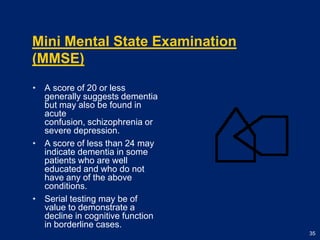
Mini Mental State Examination (MMSE)A score of 20 or less generally suggests dementia but may also be found in acute confusion, schizophrenia or severe depression.A score of less than 24 may indicate dementia in some patients who are well educated and who do not have any of the above conditions.Serial testing may be of value to demonstrate a decline in cognitive function in borderline cases.
Treatment in primary care
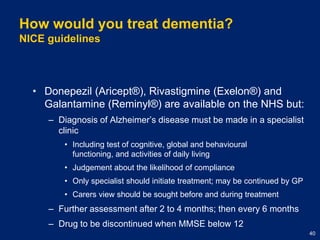
How would you treat dementia?NICE guidelinesDonepezil (Aricept®), Rivastigmine (Exelon®) and Galantamine (Reminyl®) are available on the NHS but:Diagnosis of Alzheimer’s disease must be made in a specialist clinicIncluding test of cognitive, global and behavioural functioning, and activities of daily livingJudgement about the likelihood of complianceOnly specialist should initiate treatment; may be continued by GPCarers view should be sought before and during treatmentFurther assessment after 2 to 4 months; then every 6 monthsDrug to be discontinued when MMSE below 12
How would you treat dementia?Anti-oxidants: Vitamin E (400 to 2000 I.U. daily) fairly safe second line treatment, can be supplemented with Vitamin E (500 mg daily)Gingko Biloba (120 mg to 240 mg of standardised extract daily) has anti-oxidant and circulation enhancing properties, at best effects compare to ACHEIs
How would you treat dementia?Glutamate modulatormemantineFairly safe to useMain side effects are vertigo, restlessness, excitation, fatigue, diarrhoeaRisk of fitsOnly drug evaluated for severe dementiaInsight might come back !!!!!!
How would you cope with aggression?
How would you cope with aggression?FoodInfectionsConstipationEnvironmentSide effects medicationPainSedation
How would you cope with aggression?FoodHUNGER MAKES AGGRESSIVE !
HUNGER MAKES AGGRESSIVE
Sedation(Atypical) antipsychoticsAcetylcholinesterase inhibitorsBenzodiazepinesAntidepressants: trazodoneantihistamines
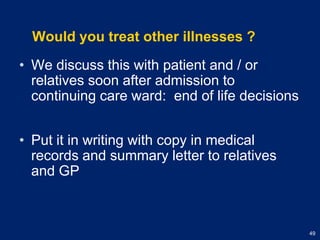
Would you treat other illnesses ?Based on do not resuscitate policyWhat would the patient have liked to be done?Full care: intensive care inclusive experimental treatmentNormal care: hospital careMinimal care: use of limited antibiotics, surgery for treatable illnessesPalliative care: keep warm, dry and pain free
Would you treat other illnesses ?We discuss this with patient and / or relatives soon after admission to continuing care ward:  end of life decisionsPut it in writing with copy in medical records and summary letter to relatives and GP
Dementiaend of life decisionsDementia is a terminal diseaseTherefore patient and relatives need to be prepared for end of lifeWill to be made upFinancial situation sortedHow much medical input at end of life?Living willNo resuscitation policy to be discussed
DementiaPalliative CareEthical issues surround investigation and treatment when the patient develops serious physical illness. Present structures address these problems tangentially at best.
DementiaethicsPrimary Care EthicsEDITED BY DEBORAH BOWMAN AND JOHN SPICERISBN-10 1 85775 730 0 ISBN-13 9781857757309Radcliffe
Chapter 5 Ethical considerations in the primary care of the elderly demented patient Henk Parmentier, John Spicer and Ann King  How am I today?Well, generally speaking,Standing upIn a sitting down situation.
Thank youHenk.parmentier@gmail.com

Parmentier 03

  • 1.
    Dementia & PrimaryCareDementia & Primary Care25th January 2011Dr HenkParmentier
  • 2.
    Why dementia andPrimary Care?A 66 year old lady plucks up courage to go to her General Practitioner because she is concerned about a lump in her breast. “Well” says her doctor “this kind of thing is not uncommon at your age, but I don’t really have time to do a proper examination even though I would be quite capable of giving you a diagnosis. Anyway the examination is quite embarrassing and waiting for further tests is only going to make you anxious.
  • 3.
    Why dementia andPrimary Care?Treatment can be very painful and disfiguring and really you’ve had a pretty good innings anyway. I would suggest that you come back in a couple of years time and if there are metastases we could give you some sedation to take your mind off the pain. By that time, however, you should be thinking of selling your house and moving into a hospice.”
  • 4.
    Dementia- IntroductionAmberley LodgeCare Homesituated in PurleyContinuing Care Ward Old Age Psychiatrists Croydon PCTNursing Home UnitResidential UnitRespite beds for Alzheimer Society
  • 5.
  • 6.
  • 7.
  • 8.
    Dementia- IntroductionWhy dementiaand Primary Care?The theme of Alzheimer's Awareness Week® 2002 was: “Feeling the Pulse: primary care and dementia”
  • 9.
    Dementia- IntroductionWhy dementiaand Primary Care?The first place people go if they are worried about dementia is usually their GP.Early detection is essential: Anti dementia drugs should be initiated in early stages of dementiaFuture health care, social and legal choices can still be discussed with patient
  • 10.
    DementiaDementia: irreversible conditioninvolving progressive deterioration of cognitive function and behaviour sufficiently severe to affect activities of daily living
  • 11.
    DementiaProgressiveIrreversibleLoss of cognitivefunctions (memory, language, learnt movement, etc)With associated decline in overall functioning and a change in personalityWithout clouding of consciousness (delirium)
  • 12.
    DementiaThere are over55 illnesses which can cause dementiaAlzheimer’s disease and vascular dementia together 80% of all dementias
  • 13.
  • 14.
    Dementia SpectrumAlzheimer’s diseaseParietal-temporaldistributionVascular dementiaMulti infarct, Binswanger (subcortical)Drugs and toxinsAlcoholIntracranial massesTumor, subdural masses, brain abscessAnoxiaTrauma / head injury
  • 15.
    Dementia SpectrumNormal pressurehydrocephalusNeuro degenerative disordersParkinson’s, Huntington’s, Pick’s (frontotemporal), Amyotrophic Lateral Sclerosis, Lewy body dementia (visual hallucinations), Wilson’s……..InfectionsCJD, AIDS, neurosyphilisNutritional disordersWernicke-Korsakoff (thiamine def.), vit B12 def., folate def.
  • 16.
    Dementia SpectrumMetabolic disordersHypo/ hyperthyroidism, renal insufficiency, hepatic insufficiencyChronic inflammatory disordersLupus, Multiple Sclerosis
  • 17.
    Prevalence of dementia1in 20 over 65 years1 in 10 over 75 years1 in 5 over age of 85From 2000 patients, 1 or 2 news cases will present yearly (incidence) and at any point there will be 14 people with various stages of dementia
  • 18.
    Dementia – somefactsBehavioural and psychiatric disturbances are present in up to 90% of dementia patients at some point over the course of their illnessLack of detection occurs in 48% of patients with AD and diagnosis is often delayed until the patient is experiencing severe symptomsPatients live up to 10 years after the onset of symptomsEstimated: 26% women and 21% men over 85yo have some form of dementia
  • 19.
    Dementia – somefactsIt will become increasingly commonPeople will be interested in getting help as awareness of the condition spreads and treatments become widely availableDoctors now can do a lot to helpAn early diagnosis allows the family, the doctor and the patient to prepare for the future.
  • 20.
    What happens inAlzheimer’s DiseaseSelf destruction of brain cells Distinctive pathology (plaques and tangles)Shrinkage of the brain Selective and early destruction of certain nerves using Acetylcholine- involved with memory, mood, alertness, etcEventually all the brain involved
  • 21.
    PresentationPatient may complainof forgetfulness, or feeling depressed or anxious or may be unaware of memory lossFamilies may also cover up or minimise memory loss or loss of functionFamilies may ask for help at any stage: failing memory, decline in functioning or behavioural problems
  • 22.
    Alzheimer’s DiseaseSubtle startSteady(i.e. continuing) declineA decline (shrinkage) from previous functioning starting first from most complex tasks / demanding situationsChanges in behaviour can also be first presentation
  • 23.
    Alzheimer’s Disease: CognitivechangesAmnesia- memory loss: forgetting, short term memory loss first and most severeAphasia – language difficulties (naming, misuses words and decreased vocabulary)Apraxia – difficulty in manipulating objects (e.g. clothes, household appliances, etc)Agnosia – difficulty in recognising things and people (e.g.names and identity of people, places, physical illness, self neglect, fires, etc) and social nuances
  • 24.
    Alzheimer’s Disease: BehaviouralchangesMood – usually depression, rarely maniaDelusions – usually theft, suspiciousness, impostors, infidelityHallucinations – auditory and visual, can be secondary to cognitive problemsBehaviour: aggression, wandering, disinhibition, over eating, sleep disturbance
  • 26.
    Alzheimer’s Disease: Functionalchanges(Activities of Daily living)Complex ADLs: paying bills, taxes, complex repair jobs, unfamiliar recipes, travelling in new areasBasic ADLs: familiar household tasks, familiar cooking, basic self care, grooming, Basic Functions: eating, drinking, bodily functions
  • 28.
    Other types ofdementiaVascular dementiaSlow starvation or sudden strokes (multi-infarct) – a mixed bagHave cardiovascular risk factorsSudden onset and step-wise deteriorationslower thinking, Depression and sundowning commonerGait disturbance, incontinence
  • 29.
    Other types ofdementiaLewy Body DementiaRare, potentially disastrous effect of major tranquillisersFluctuating consciousnessVivid visual hallucinationsParkinsonian featuresAutonomic dysfunction: falls, fluctuating heart rate or blood pressure, etc
  • 30.
    Dementia: how totest ?Screening questions: ask age and date of birth, news in recent 2 weeks, time to nearest hour and date, ask to draw two interlocking pentagonsCognitive tests suitable for GPs:AMTS (Abbreviated Mental test Score)MMSE (Mini Mental State Examination)6-CIT (6 item cognitive impairment test)Clock Drawing
  • 31.
    Abbreviated Mental testScoreEACH QUESTION SCORES ONE POINTAge Time to nearest hour An address - for example 42 West Street - to be repeated by the patient at the end of the test Year Name of hospital, residential institution or home address, depending on where the patient is situated Recognition of two persons - for example, doctor, nurse, home help etc Date of birth Year first world war started Name of present monarch Count backwards from 20 to 1 A SCORE OF LESS THAN SIX SUGGESTS DEMENTIA
  • 32.
    Mini Mental StateExamination (MMSE)OrientationWhat is the (year) (season) (date) (day) (month)? 5 Where are we: (country) (city) (part of city) (number of flat/house) (name of street)? 5 RegistrationName three objects: one second to say each.Then ask the patient to name all three after you have said them.Give one point for each correct answer.Then repeat them until he learns all three.Count trials and record. 3
  • 33.
    Mini Mental StateExamination (MMSE)Attention and calculationSerial 7s: one point for each correct.Stop after five answers.Alternatively spell 'world' backwards. 5 RecallAsk for the three objects repeated above.Give one point for each correct. 3
  • 34.
    Mini Mental StateExamination (MMSE)LanguageName a pencil, and watch 2Repeat the following: 'No ifs, ands or buts‘ 1Follow a three-stage command: 'Take a paper in your right hand, fold it in half and put it on the floor' 3Read and obey the following: Close your eyes 1Write a sentence 1Copy a design 1
  • 35.
    Mini Mental StateExamination (MMSE)A score of 20 or less generally suggests dementia but may also be found in acute confusion, schizophrenia or severe depression.A score of less than 24 may indicate dementia in some patients who are well educated and who do not have any of the above conditions.Serial testing may be of value to demonstrate a decline in cognitive function in borderline cases.
  • 37.
  • 40.
    How would youtreat dementia?NICE guidelinesDonepezil (Aricept®), Rivastigmine (Exelon®) and Galantamine (Reminyl®) are available on the NHS but:Diagnosis of Alzheimer’s disease must be made in a specialist clinicIncluding test of cognitive, global and behavioural functioning, and activities of daily livingJudgement about the likelihood of complianceOnly specialist should initiate treatment; may be continued by GPCarers view should be sought before and during treatmentFurther assessment after 2 to 4 months; then every 6 monthsDrug to be discontinued when MMSE below 12
  • 41.
    How would youtreat dementia?Anti-oxidants: Vitamin E (400 to 2000 I.U. daily) fairly safe second line treatment, can be supplemented with Vitamin E (500 mg daily)Gingko Biloba (120 mg to 240 mg of standardised extract daily) has anti-oxidant and circulation enhancing properties, at best effects compare to ACHEIs
  • 42.
    How would youtreat dementia?Glutamate modulatormemantineFairly safe to useMain side effects are vertigo, restlessness, excitation, fatigue, diarrhoeaRisk of fitsOnly drug evaluated for severe dementiaInsight might come back !!!!!!
  • 43.
    How would youcope with aggression?
  • 44.
    How would youcope with aggression?FoodInfectionsConstipationEnvironmentSide effects medicationPainSedation
  • 45.
    How would youcope with aggression?FoodHUNGER MAKES AGGRESSIVE !
  • 46.
  • 47.
  • 48.
    Would you treatother illnesses ?Based on do not resuscitate policyWhat would the patient have liked to be done?Full care: intensive care inclusive experimental treatmentNormal care: hospital careMinimal care: use of limited antibiotics, surgery for treatable illnessesPalliative care: keep warm, dry and pain free
  • 49.
    Would you treatother illnesses ?We discuss this with patient and / or relatives soon after admission to continuing care ward: end of life decisionsPut it in writing with copy in medical records and summary letter to relatives and GP
  • 50.
    Dementiaend of lifedecisionsDementia is a terminal diseaseTherefore patient and relatives need to be prepared for end of lifeWill to be made upFinancial situation sortedHow much medical input at end of life?Living willNo resuscitation policy to be discussed
  • 51.
    DementiaPalliative CareEthical issuessurround investigation and treatment when the patient develops serious physical illness. Present structures address these problems tangentially at best.
  • 52.
    DementiaethicsPrimary Care EthicsEDITEDBY DEBORAH BOWMAN AND JOHN SPICERISBN-10 1 85775 730 0 ISBN-13 9781857757309Radcliffe
  • 53.
    Chapter 5 Ethical considerationsin the primary care of the elderly demented patient Henk Parmentier, John Spicer and Ann King  How am I today?Well, generally speaking,Standing upIn a sitting down situation.
  • 54.

Editor's Notes

  • #3 © Henk Parmentier, WoncaWPoMH2007