CONVERSION DISORDER
Jason Riggs
Somatoform Disorders
Conversion disorder
Hypochondriasis
Somatization disorder
Body dysmorphic disorder
Pain disorder
Somatoform Disorders
Definition
…taking the form of soma (w/ implication of nonsomatic)
…”unexplained disorders”
• A broad group of illnesses with bodily signs and symptoms
as the predominant focus, influenced by the psyche
• Concept of mind/body interactions, with signals from the
brain indicating a problem
• Not based on theoretical construct or laboratory findings-
no significant substantiating data, yet vigorous and
sincere complaints “not imaginary”
Conversion Disorder
Definition
• Starts as a mental or emotional crisis and converts to a physical
problem. Symptoms are not faked
• An illness of symptoms or deficits affecting voluntary motor or
sensory functions, suggesting another medical condition, but judged
due to psychological factors because of preceding conflicts or other
stressors.
• Symptoms or deficits are not intentionally produced, not due to
substance, and not limited to pain or sexual symptomatology.
Conversion Disorder
Definition
• A disturbance of bodily function not conforming
to current concepts of neurological anatomy and
physiology:
– Characterized by the presence of one or more neurological
symptoms, unexplained by a known neurological or medical
disorder;
– Typically occurring in a setting of stress, and producing
considerable dysfunction;
– Requiring for diagnosis the association of psychological factors,
present at the initiation or exacerbation of symptoms.
Conversion Disorder
History
• A disorder stemming from early concepts of hysteria:
– Sigmund Freud introduced the term conversion (based on his
work with Anna O); and
– Hypothesized that the symptoms of conversion reflect
unconscious conflict.
– Commonly known as mass hysteria before 1980
Conversion Disorder
Epidemiology
• Some people have symptoms, but not severe enough to
warrant a diagnosis. Estimated this occurs in 1/3 of
general population at some time or another
• 25-30% of conversion disorder cases are admitted to VA
hospitals
• Range in general population of 11-300/100,000
Conversion Disorder
Epidemiology
• Estimate of 20-25% of people admitted to a general medical service have
had conversion symptoms at some time during life
• 5-16% of psychiatric consultations have resulted in referring patients for
assistance in diagnosis and management of conversion symptoms
• 24% of psychiatric outpatients have at least one conversion symptom
Conversion Disorder
Epidemiology
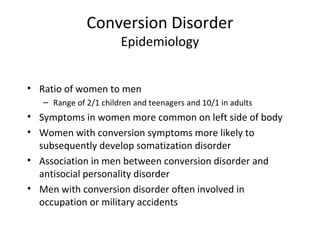
• Ratio of women to men
– Range of 2/1 children and teenagers and 10/1 in adults
• Symptoms in women more common on left side of body
• Women with conversion symptoms more likely to
subsequently develop somatization disorder
• Association in men between conversion disorder and
antisocial personality disorder
• Men with conversion disorder often involved in
occupation or military accidents
Conversion Disorder
Epidemiology
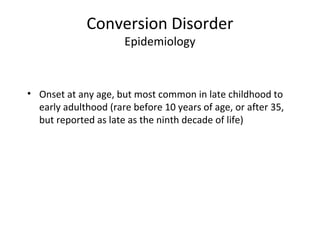
• Onset at any age, but most common in late childhood to
early adulthood (rare before 10 years of age, or after 35,
but reported as late as the ninth decade of life)
Conversion Disorder
Epidemiology
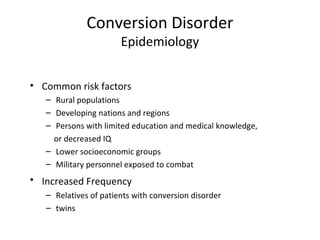
• Common risk factors
– Rural populations
– Developing nations and regions
– Persons with limited education and medical knowledge,
or decreased IQ
– Lower socioeconomic groups
– Military personnel exposed to combat
• Increased Frequency
– Relatives of patients with conversion disorder
– twins
Conversion Disorder
Epidemiology
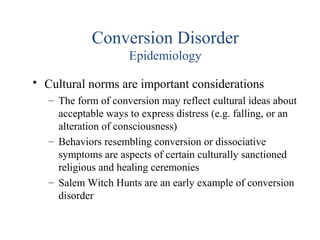
• Cultural norms are important considerations
– The form of conversion may reflect cultural ideas about
acceptable ways to express distress (e.g. falling, or an
alteration of consciousness)
– Behaviors resembling conversion or dissociative
symptoms are aspects of certain culturally sanctioned
religious and healing ceremonies
– Salem Witch Hunts are an early example of conversion
disorder
Conversion Disorder
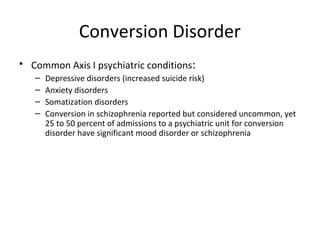
• Common Axis I psychiatric conditions:
– Depressive disorders (increased suicide risk)
– Anxiety disorders
– Somatization disorders
– Conversion in schizophrenia reported but considered uncommon, yet
25 to 50 percent of admissions to a psychiatric unit for conversion
disorder have significant mood disorder or schizophrenia
Conversion Disorder
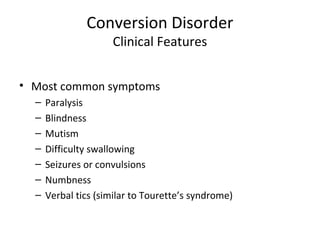
Clinical Features
• Most common symptoms
– Paralysis
– Blindness
– Mutism
– Difficulty swallowing
– Seizures or convulsions
– Numbness
– Verbal tics (similar to Tourette’s syndrome)
Conversion Disorder
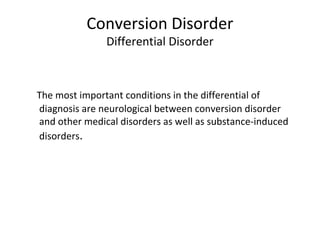
Differential Disorder
The most important conditions in the differential of
diagnosis are neurological between conversion disorder
and other medical disorders as well as substance-induced
disorders.
Conversion Disorder
Course and Prognosis
• Initial symptoms resolve within a few days to < a month
in 90 to 100%
• 75% have no further episodes, with 20-25% recurring
within a year during periods of stress
• 25 to 50% present symtpoms later of neurological
disorders or nonpsychiatric medical conditions affecting
the nervous system
Conversion Disorder
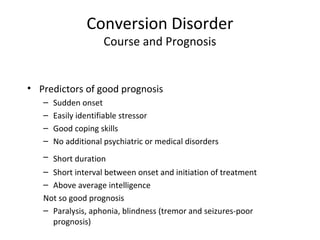
Course and Prognosis
• Predictors of good prognosis
– Sudden onset
– Easily identifiable stressor
– Good coping skills
– No additional psychiatric or medical disorders
– Short duration
– Short interval between onset and initiation of treatment
– Above average intelligence
Not so good prognosis
– Paralysis, aphonia, blindness (tremor and seizures-poor
prognosis)
Conversion Disorder
• http://www.youtube.com/watch?
v=LRzytAhu0hg
Conversion Disorder
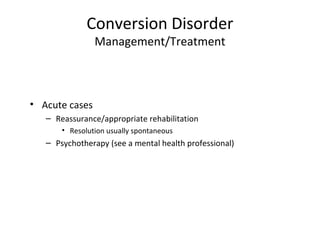
Management/Treatment
• Acute cases
– Reassurance/appropriate rehabilitation
• Resolution usually spontaneous
– Psychotherapy (see a mental health professional)
Conversion Disorder
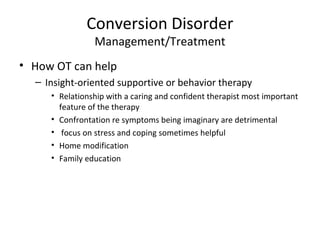
Management/Treatment
• How OT can help
– Insight-oriented supportive or behavior therapy
• Relationship with a caring and confident therapist most important
feature of the therapy
• Confrontation re symptoms being imaginary are detrimental
• focus on stress and coping sometimes helpful
• Home modification
• Family education
Conversion Disorder
Summation/Questions

Conversion disorder power point

  • 1.
  • 2.
    Somatoform Disorders Conversion disorder Hypochondriasis Somatizationdisorder Body dysmorphic disorder Pain disorder
  • 3.
    Somatoform Disorders Definition …taking theform of soma (w/ implication of nonsomatic) …”unexplained disorders” • A broad group of illnesses with bodily signs and symptoms as the predominant focus, influenced by the psyche • Concept of mind/body interactions, with signals from the brain indicating a problem • Not based on theoretical construct or laboratory findings- no significant substantiating data, yet vigorous and sincere complaints “not imaginary”
  • 4.
    Conversion Disorder Definition • Startsas a mental or emotional crisis and converts to a physical problem. Symptoms are not faked • An illness of symptoms or deficits affecting voluntary motor or sensory functions, suggesting another medical condition, but judged due to psychological factors because of preceding conflicts or other stressors. • Symptoms or deficits are not intentionally produced, not due to substance, and not limited to pain or sexual symptomatology.
  • 5.
    Conversion Disorder Definition • Adisturbance of bodily function not conforming to current concepts of neurological anatomy and physiology: – Characterized by the presence of one or more neurological symptoms, unexplained by a known neurological or medical disorder; – Typically occurring in a setting of stress, and producing considerable dysfunction; – Requiring for diagnosis the association of psychological factors, present at the initiation or exacerbation of symptoms.
  • 6.
    Conversion Disorder History • Adisorder stemming from early concepts of hysteria: – Sigmund Freud introduced the term conversion (based on his work with Anna O); and – Hypothesized that the symptoms of conversion reflect unconscious conflict. – Commonly known as mass hysteria before 1980
  • 7.
    Conversion Disorder Epidemiology • Somepeople have symptoms, but not severe enough to warrant a diagnosis. Estimated this occurs in 1/3 of general population at some time or another • 25-30% of conversion disorder cases are admitted to VA hospitals • Range in general population of 11-300/100,000
  • 8.
    Conversion Disorder Epidemiology • Estimateof 20-25% of people admitted to a general medical service have had conversion symptoms at some time during life • 5-16% of psychiatric consultations have resulted in referring patients for assistance in diagnosis and management of conversion symptoms • 24% of psychiatric outpatients have at least one conversion symptom
  • 9.
    Conversion Disorder Epidemiology • Ratioof women to men – Range of 2/1 children and teenagers and 10/1 in adults • Symptoms in women more common on left side of body • Women with conversion symptoms more likely to subsequently develop somatization disorder • Association in men between conversion disorder and antisocial personality disorder • Men with conversion disorder often involved in occupation or military accidents
  • 10.
    Conversion Disorder Epidemiology • Onsetat any age, but most common in late childhood to early adulthood (rare before 10 years of age, or after 35, but reported as late as the ninth decade of life)
  • 11.
    Conversion Disorder Epidemiology • Commonrisk factors – Rural populations – Developing nations and regions – Persons with limited education and medical knowledge, or decreased IQ – Lower socioeconomic groups – Military personnel exposed to combat • Increased Frequency – Relatives of patients with conversion disorder – twins
  • 12.
    Conversion Disorder Epidemiology • Culturalnorms are important considerations – The form of conversion may reflect cultural ideas about acceptable ways to express distress (e.g. falling, or an alteration of consciousness) – Behaviors resembling conversion or dissociative symptoms are aspects of certain culturally sanctioned religious and healing ceremonies – Salem Witch Hunts are an early example of conversion disorder
  • 13.
    Conversion Disorder • CommonAxis I psychiatric conditions: – Depressive disorders (increased suicide risk) – Anxiety disorders – Somatization disorders – Conversion in schizophrenia reported but considered uncommon, yet 25 to 50 percent of admissions to a psychiatric unit for conversion disorder have significant mood disorder or schizophrenia
  • 14.
    Conversion Disorder Clinical Features •Most common symptoms – Paralysis – Blindness – Mutism – Difficulty swallowing – Seizures or convulsions – Numbness – Verbal tics (similar to Tourette’s syndrome)
  • 15.
    Conversion Disorder Differential Disorder Themost important conditions in the differential of diagnosis are neurological between conversion disorder and other medical disorders as well as substance-induced disorders.
  • 16.
    Conversion Disorder Course andPrognosis • Initial symptoms resolve within a few days to < a month in 90 to 100% • 75% have no further episodes, with 20-25% recurring within a year during periods of stress • 25 to 50% present symtpoms later of neurological disorders or nonpsychiatric medical conditions affecting the nervous system
  • 17.
    Conversion Disorder Course andPrognosis • Predictors of good prognosis – Sudden onset – Easily identifiable stressor – Good coping skills – No additional psychiatric or medical disorders – Short duration – Short interval between onset and initiation of treatment – Above average intelligence Not so good prognosis – Paralysis, aphonia, blindness (tremor and seizures-poor prognosis)
  • 18.
  • 19.
    Conversion Disorder Management/Treatment • Acutecases – Reassurance/appropriate rehabilitation • Resolution usually spontaneous – Psychotherapy (see a mental health professional)
  • 20.
    Conversion Disorder Management/Treatment • HowOT can help – Insight-oriented supportive or behavior therapy • Relationship with a caring and confident therapist most important feature of the therapy • Confrontation re symptoms being imaginary are detrimental • focus on stress and coping sometimes helpful • Home modification • Family education
  • 21.