DEMAND FORECASTING
• BY
Dr.S. Subba lakshmi,Ma,Mphil,Phd
Chair ,Business & Economics
Fbs business school
Vijayawada & Bangalore
DEMAND FORECASTING
• What is Demand Forecasting?
• “Demand forecasting is an estimate of sales
revenue or physical units for a specified
future period under a proposed marketing
plan.”
• Demand forecasting is the tool to
scientifically predict the likely demand of a
product in the future.
CONTINUED…….
• Demand forecasting is the scientific and
analytical estimation of demand for a
product { good or service} for a particular
period of time.
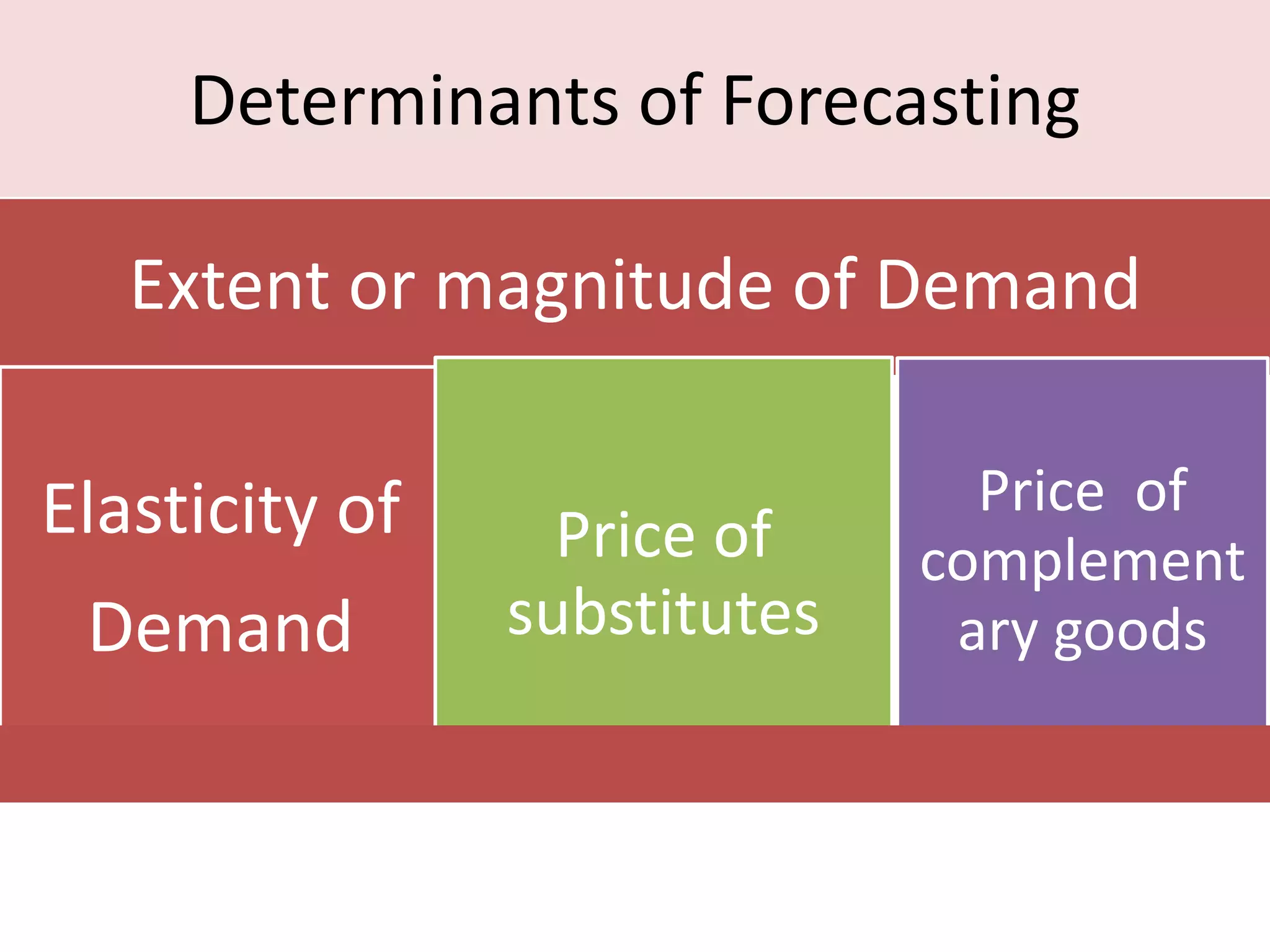
Determinants of Forecasting
Extent or magnitude of Demand
Elasticity of
Demand
Price of
substitutes
Price of
complement
ary goods
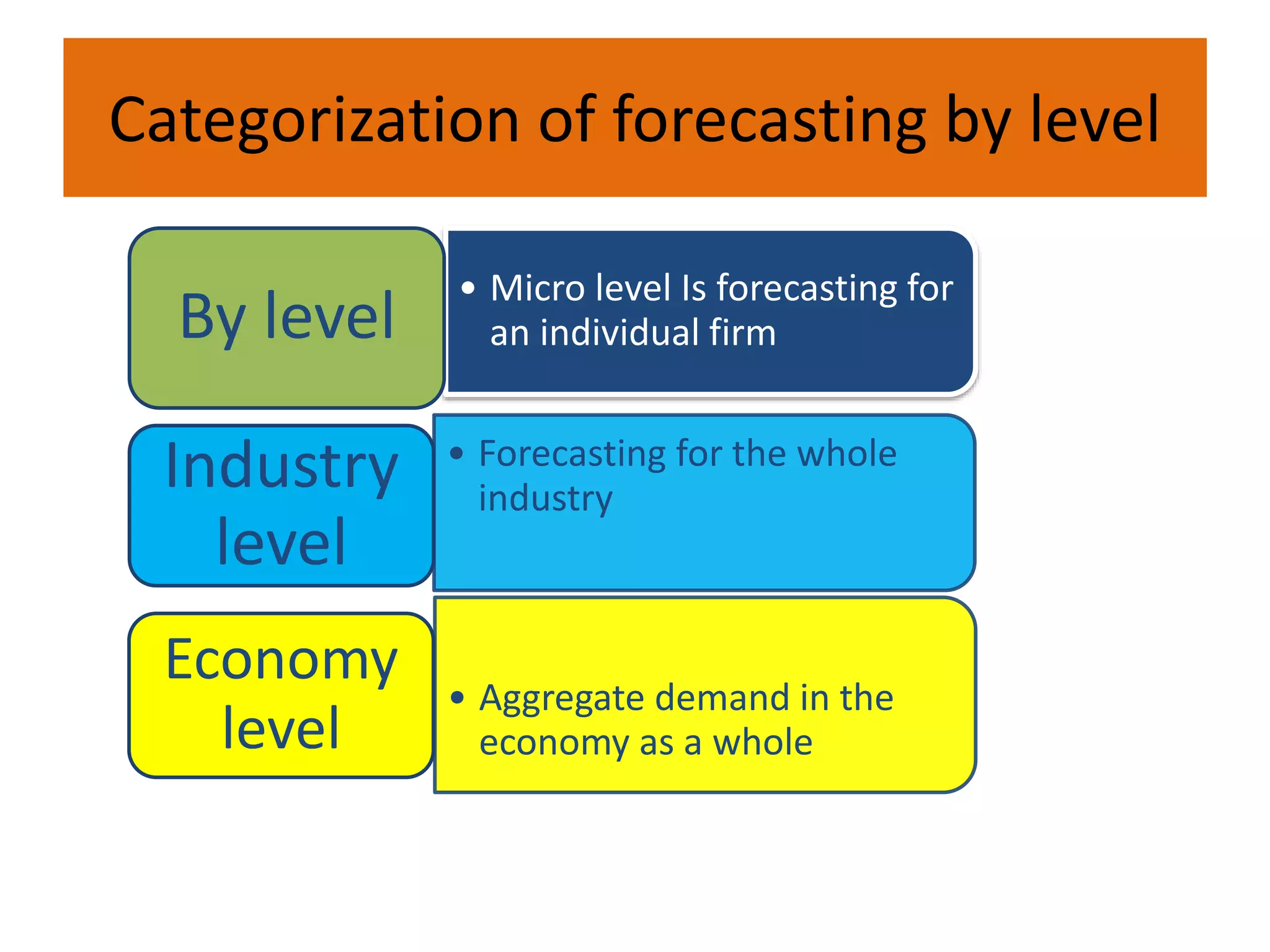
Categorization of forecasting by level
• Micro level Is forecasting for
an individual firmBy level
• Forecasting for the whole
industry
Industry
level
• Aggregate demand in the
economy as a whole
Economy
level
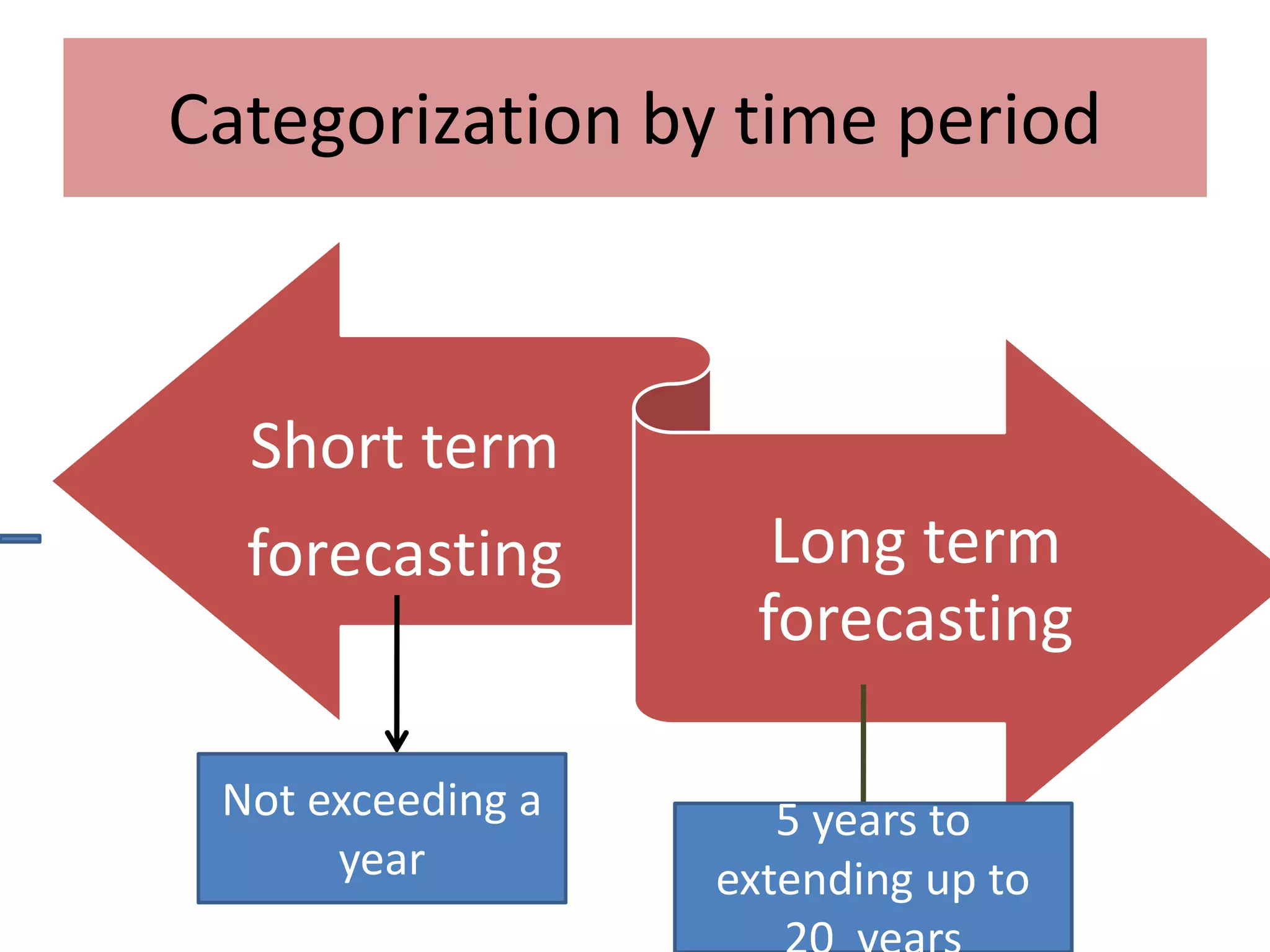
Categorization by time period
Short term
forecasting Long term
forecasting
Not exceeding a
year
5 years to
extending up to
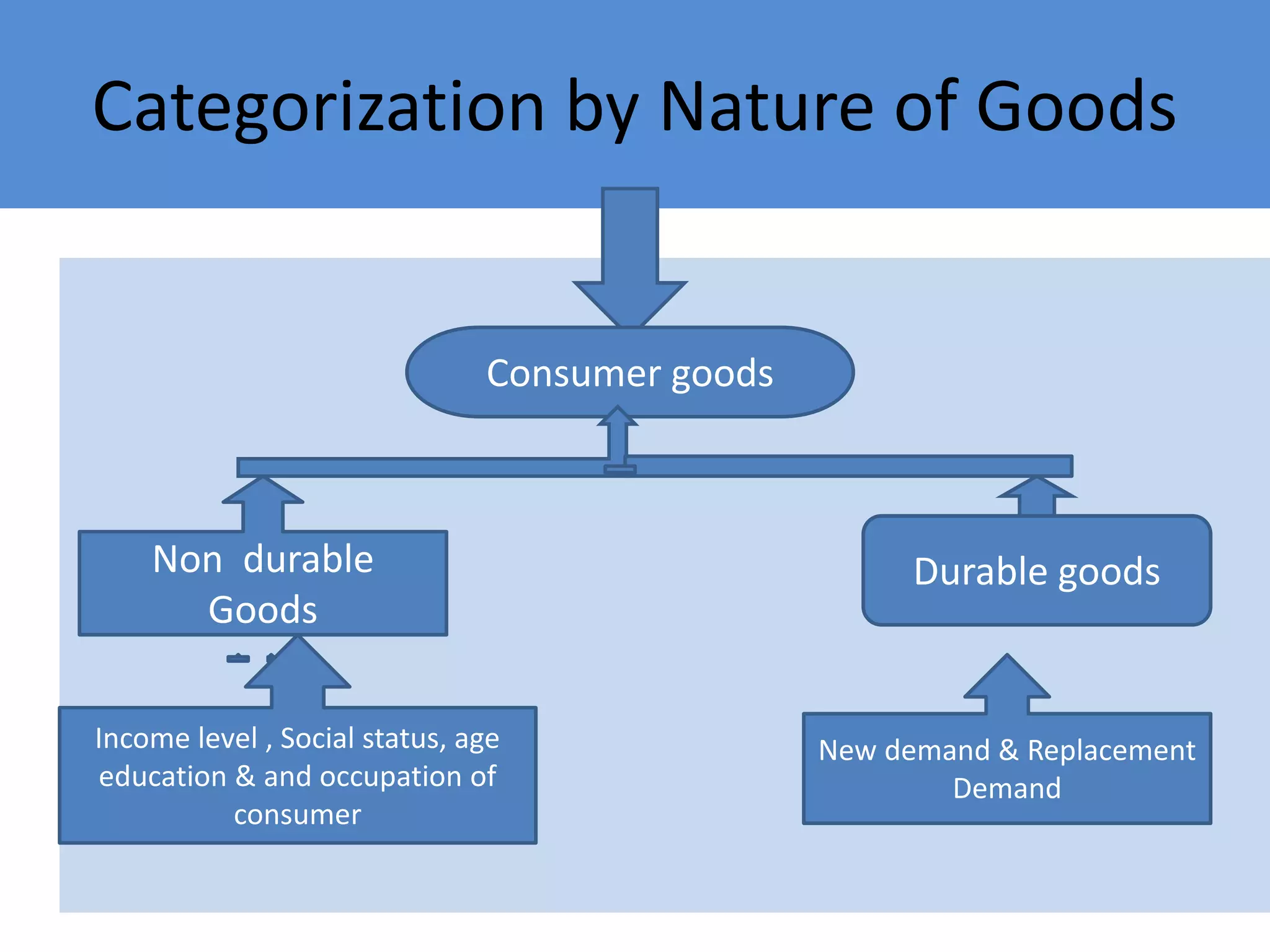
Categorization by Nature of Goods
Consumer goods
Non durable
Goods
Durable goods
New demand & Replacement
Demand
Income level , Social status, age
education & and occupation of
consumer
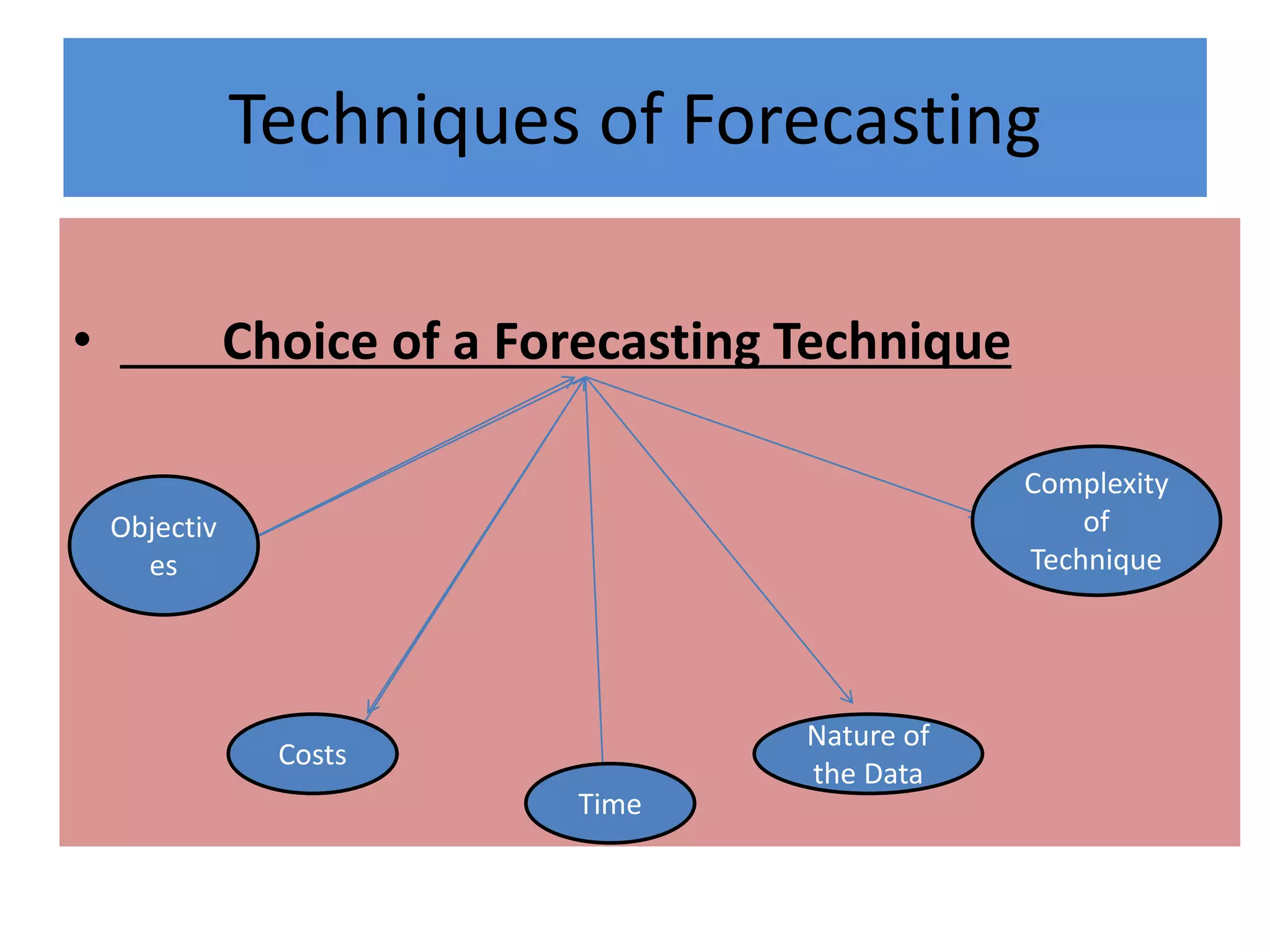
Techniques of Forecasting
• Choice of a Forecasting Technique
Objectiv
es
Costs
Time
Nature of
the Data
Complexity
of
Technique
Objectives of Forecasting
• To forecast for a new product
• To gauge the impact of new advertisement
• The cost of forecasting should not be more than
it’s benefits
• Calculating the opportunity costs of resources
• Time perspective- for short run or for long run?
• Complexity of techniques in relation to
availability of expertise , that is whether the firm
would look for experts in house or outsource it.
Continued…..
• To know the nature and quality of the data
usually taken at regular intervals over a period
of time.
• i.e does the time series show a clear trend or
is it highly unstable?
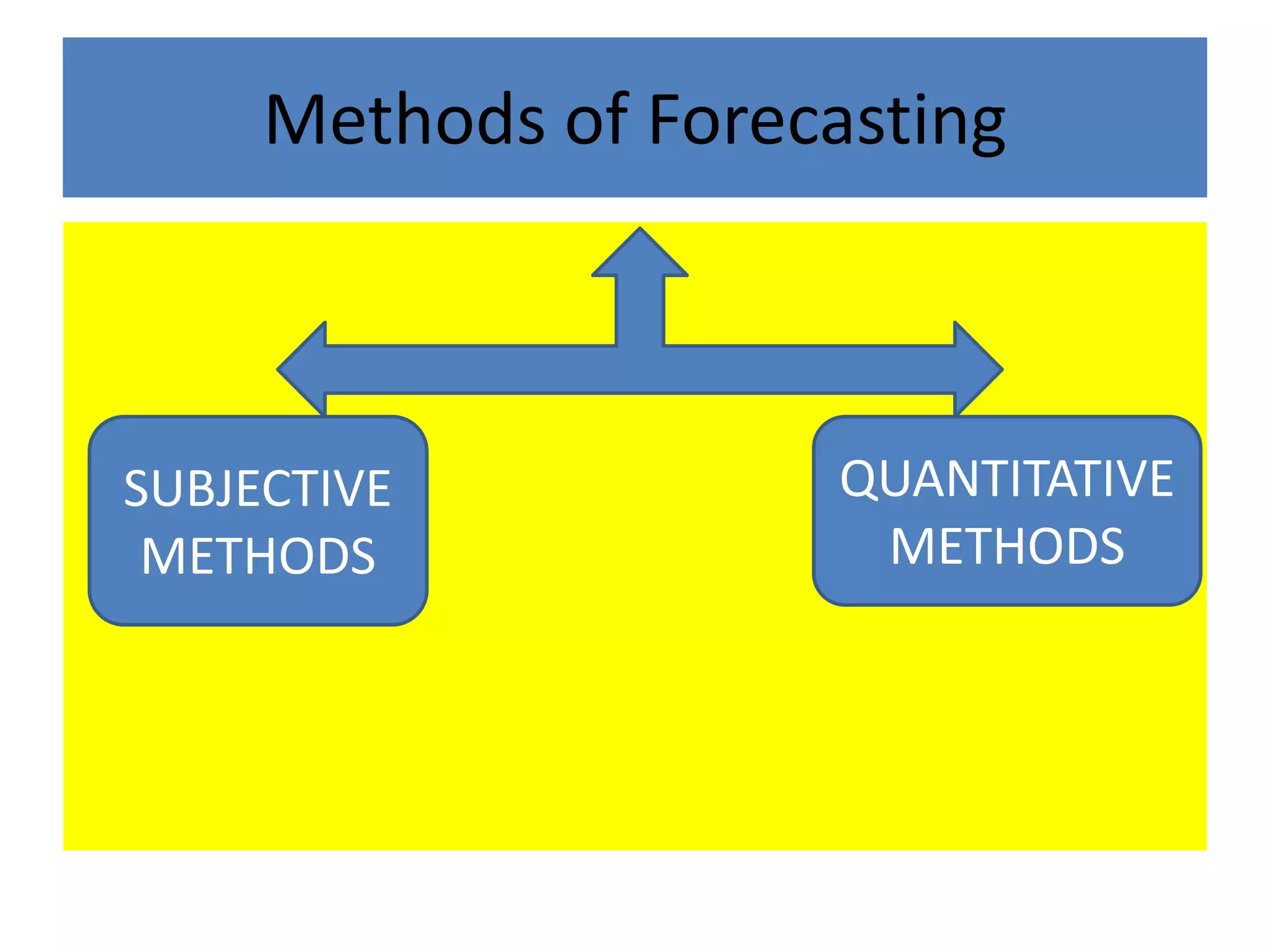
Methods of Forecasting
SUBJECTIVE
METHODS
QUANTITATIVE
METHODS
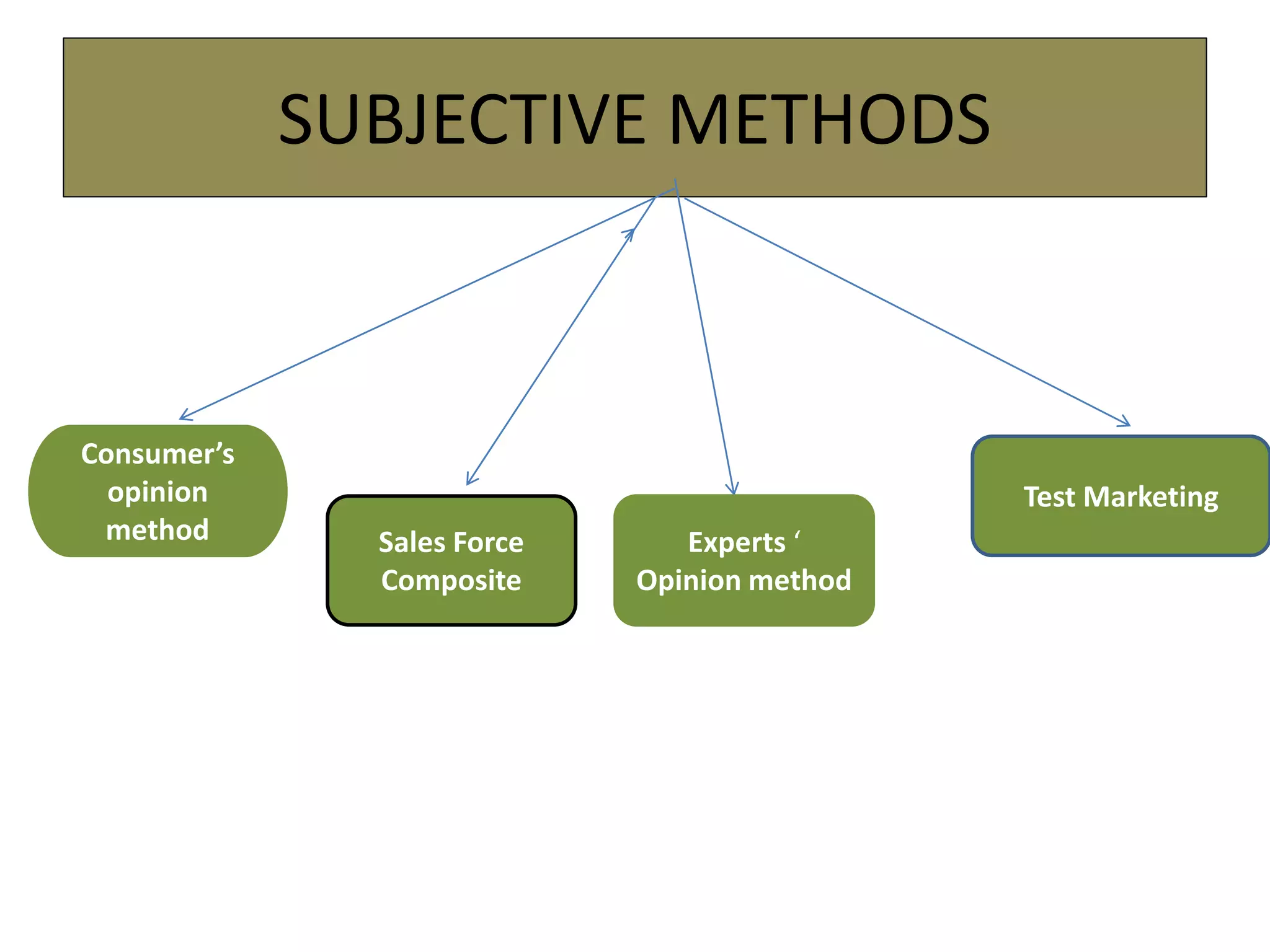
SUBJECTIVE METHODS
Consumer’s
opinion
method Sales Force
Composite
Experts ‘
Opinion method
Test Marketing
Consumers’ Opinion Method
• This is the most effective way to gauge the
demand by taking the opinion of the users
of the product.
• Buyers are asked about their future buying
intentions of the products.
• Are asked about their brand preferences &
quantities of purchase
• Are asked about their possible response to an
increase in price.
Continued……
• Are enquired for probable changes in the
product’s features
• This may bring out the implied comparison
with competetors’ products
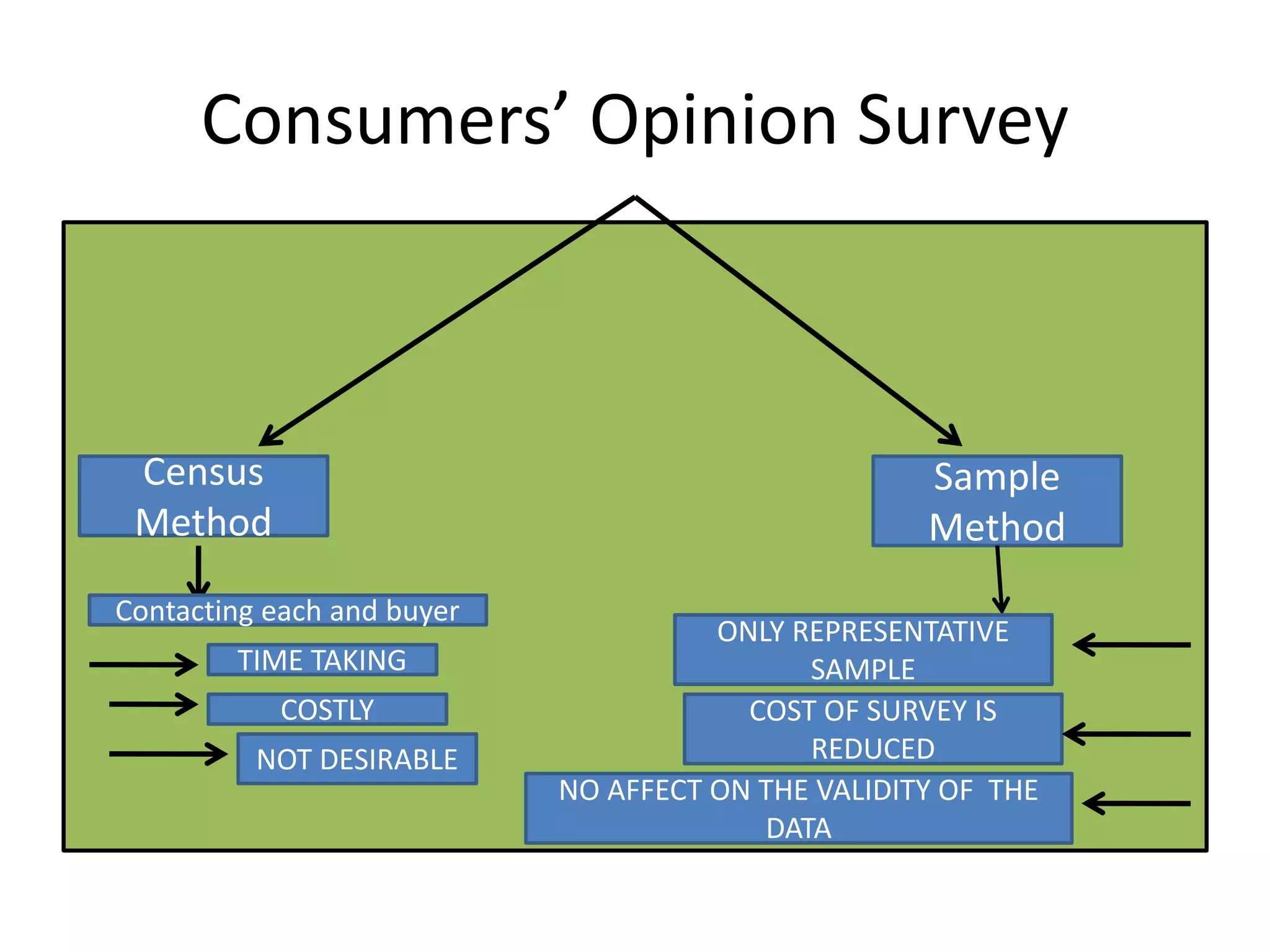
Consumers’ Opinion Survey
Census
Method
Sample
Method
Contacting each and buyer
TIME TAKING
COSTLY
NOT DESIRABLE
ONLY REPRESENTATIVE
SAMPLE
COST OF SURVEY IS
REDUCED
NO AFFECT ON THE VALIDITY OF THE
DATA
•SAMPLE SURVEY METHOD
• Care should be taken that the samples are
representative of the universe.
• STRATIFIED SAMPLING can be used for more
detailed information
• Information from sample can be collected
either by questionnaire method or by
personal interview method.
• The method will be chosen based on size of
the sample and objective of the survey.
•Merits of sample survey method
• Simple to administer and draw the
conclusions
• The results are realistic as they are obtained
on direct opinion of buyers.
• Suitable for short term decisions regarding
product supply & promotion.
Demerits of Sample Survey
• Surveying may prove expensive in terms of resources
and time.
• Un suitable for long term forecasting since consumers’
tastes and preferences may undergo a change.
• Buyers may not give their real buying intensions,
sometimes they may even give wrong responses.
• There is a chance that subjective bias of investigator
misrepresenting the answers of respondents
• Accuracy of investigation depends upon the quality of
the questionnaire &expertise of the interviewer.
Sales force Composite
• What is sales force?
• Sales force consists of sellers, sales
representatives , sales managers, dealers &
distributors.
• METHOD :Since sales force is in direct contact
with the customers they are asked to give their
estimated sales targets in their respective sales
territories in given period of time.
• It is expected that they have a better
understanding of the market
Continued…..
Merits:
1. This method is simple to administer.
2. It is very cost effective as no additional cost
is incurred for the collection of data.
3. Data is more reliable as it is based on the
estimates of sales persons who are in direct
contact with the customers.
Continued…..
• Demerits:
• Since the enumerator is bound have
subjective bias, it may be more optimistic or
pessimistic.
• If the sales persons are unaware of the
economic environment and business they
may make wrong estimates.
• This method is ideal for short term and not
for long term forecasting.
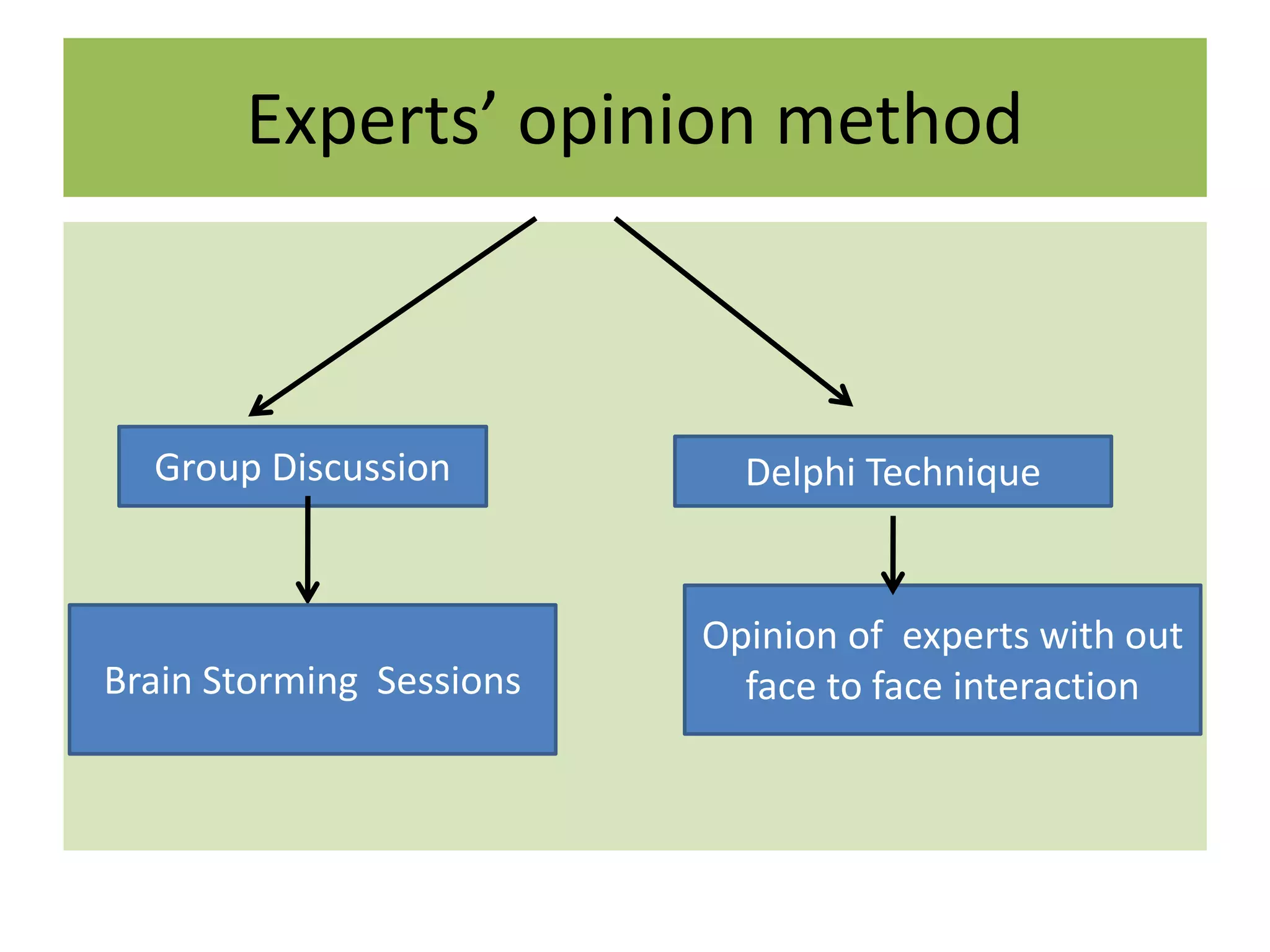
Experts’ opinion method
Group Discussion Delphi Technique
Brain Storming Sessions
Opinion of experts with out
face to face interaction
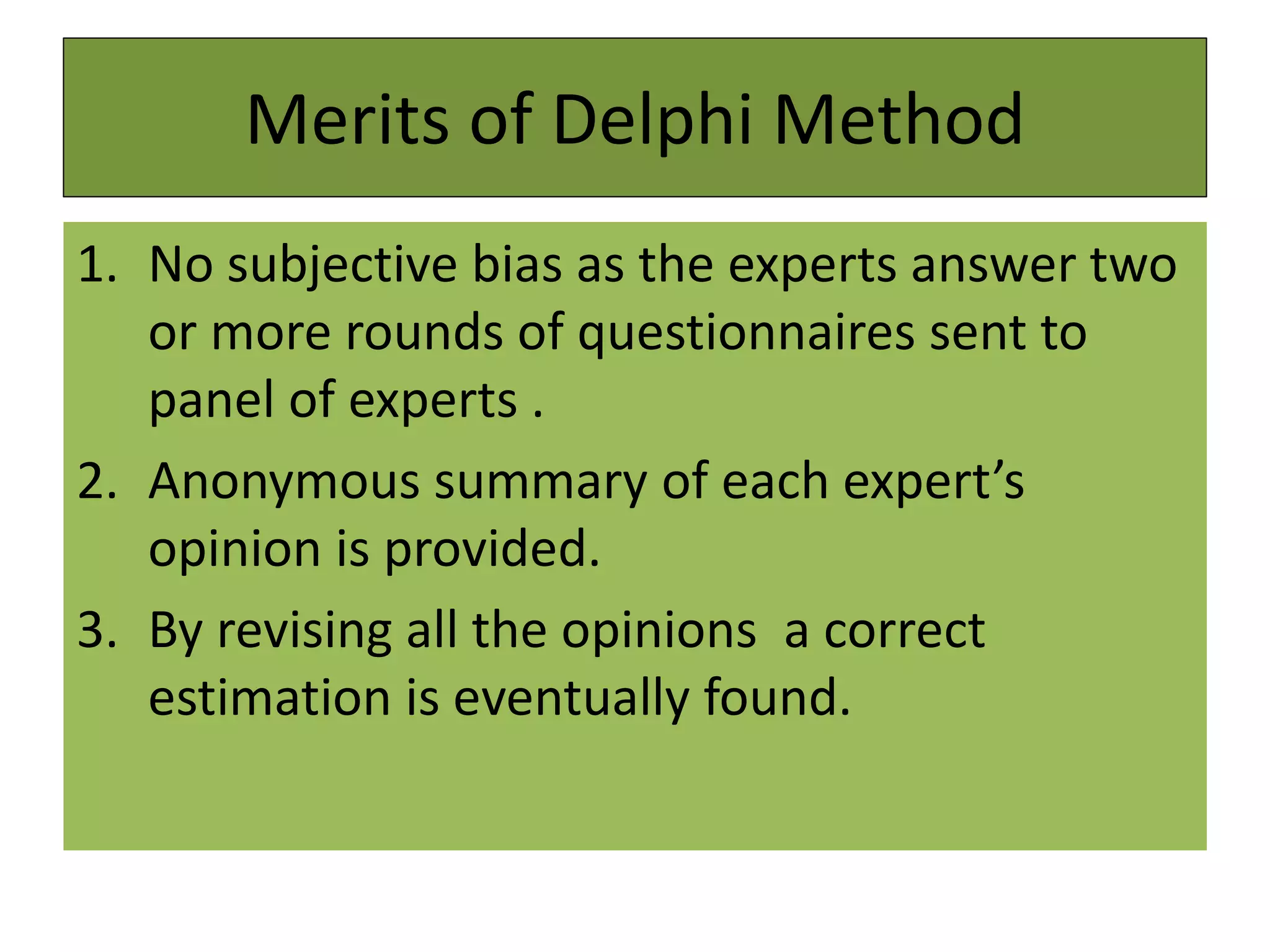
Merits of Delphi Method
1. No subjective bias as the experts answer two
or more rounds of questionnaires sent to
panel of experts .
2. Anonymous summary of each expert’s
opinion is provided.
3. By revising all the opinions a correct
estimation is eventually found.
Market Simulation
1. This is a kind of laboratory experiment by
creating an artificial market.
2. Useful to ascertain consumers’ reactions to
changes in price ,packing and even location
of the product in the shop
3. This method is invented by economists
Grabor-Granger in 1960s.
4. This method is highly useful in the case of
new product.
Test Marketing
• This is a step ahead of market experimentation.
• The product is actually sold in certain segments
of the market with out the consciousness of
being observed by the consumers.
• Demand is forecasted on the basis of actual sales
in the test market and the product is launched in
the entire market on the basis of the results of
sales in the test area.
• It is most reliable and suitable for new products.
Quantitative methods/Statistical tools
• These methods are useful when past data is
available.
• These are more scientific and cost effective.
• There is no scope for subjective bias in these
methods
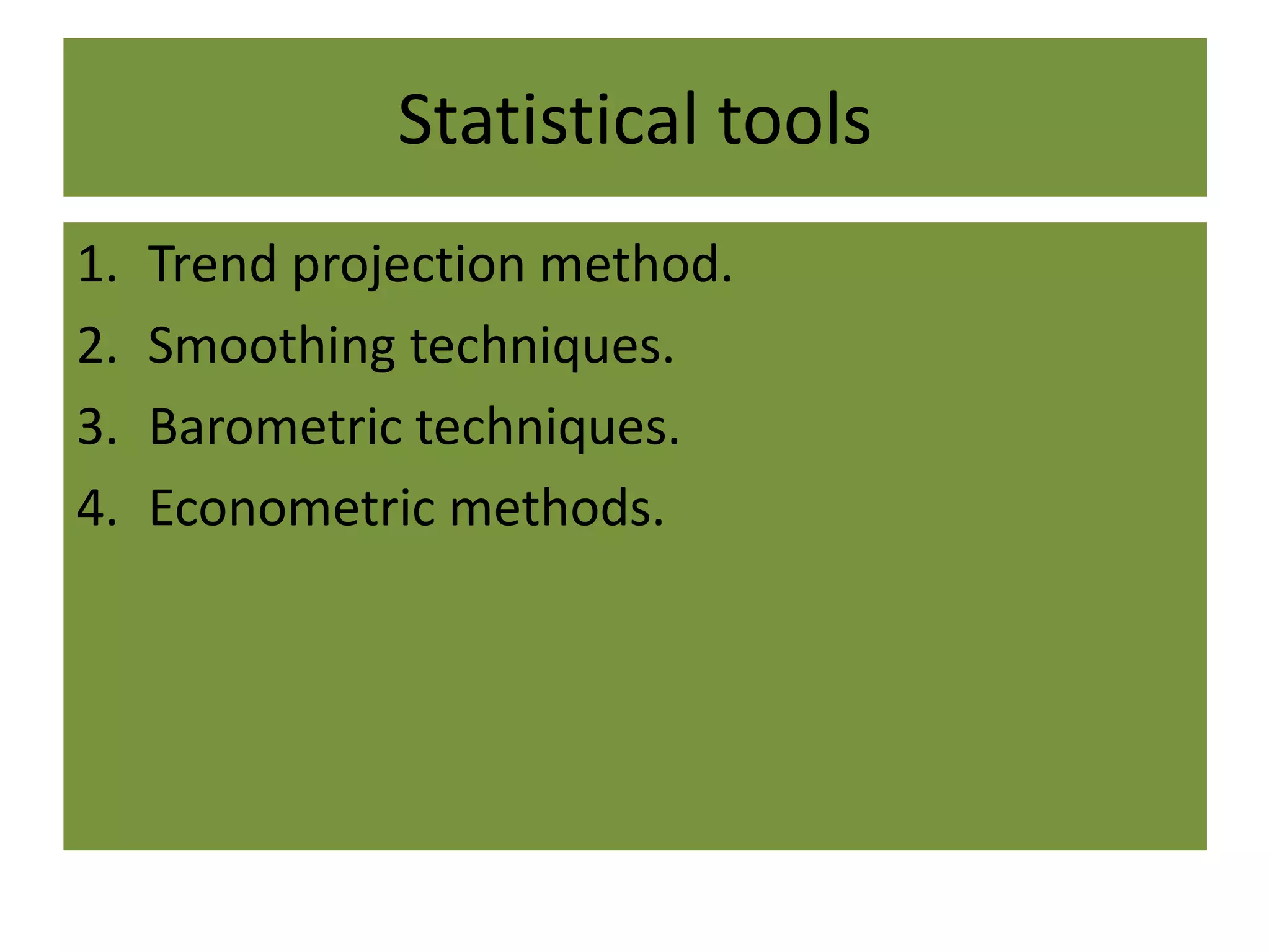
Statistical tools
1. Trend projection method.
2. Smoothing techniques.
3. Barometric techniques.
4. Econometric methods.
Limitations of Demand forecasting
• Change in fashion.
• Consumers psychology.
• Lack of availability of experts.
• Uneconomical
• Lack of past data
THANK-YOU

Demand forecasting ppt

  • 1.
    DEMAND FORECASTING • BY Dr.S.Subba lakshmi,Ma,Mphil,Phd Chair ,Business & Economics Fbs business school Vijayawada & Bangalore
  • 2.
    DEMAND FORECASTING • Whatis Demand Forecasting? • “Demand forecasting is an estimate of sales revenue or physical units for a specified future period under a proposed marketing plan.” • Demand forecasting is the tool to scientifically predict the likely demand of a product in the future.
  • 3.
    CONTINUED……. • Demand forecastingis the scientific and analytical estimation of demand for a product { good or service} for a particular period of time.
  • 4.
    Determinants of Forecasting Extentor magnitude of Demand Elasticity of Demand Price of substitutes Price of complement ary goods
  • 5.
    Categorization of forecastingby level • Micro level Is forecasting for an individual firmBy level • Forecasting for the whole industry Industry level • Aggregate demand in the economy as a whole Economy level
  • 6.
    Categorization by timeperiod Short term forecasting Long term forecasting Not exceeding a year 5 years to extending up to
  • 7.
    Categorization by Natureof Goods Consumer goods Non durable Goods Durable goods New demand & Replacement Demand Income level , Social status, age education & and occupation of consumer
  • 8.
    Techniques of Forecasting •Choice of a Forecasting Technique Objectiv es Costs Time Nature of the Data Complexity of Technique
  • 9.
    Objectives of Forecasting •To forecast for a new product • To gauge the impact of new advertisement • The cost of forecasting should not be more than it’s benefits • Calculating the opportunity costs of resources • Time perspective- for short run or for long run? • Complexity of techniques in relation to availability of expertise , that is whether the firm would look for experts in house or outsource it.
  • 10.
    Continued….. • To knowthe nature and quality of the data usually taken at regular intervals over a period of time. • i.e does the time series show a clear trend or is it highly unstable?
  • 11.
  • 12.
    SUBJECTIVE METHODS Consumer’s opinion method SalesForce Composite Experts ‘ Opinion method Test Marketing
  • 13.
    Consumers’ Opinion Method •This is the most effective way to gauge the demand by taking the opinion of the users of the product. • Buyers are asked about their future buying intentions of the products. • Are asked about their brand preferences & quantities of purchase • Are asked about their possible response to an increase in price.
  • 14.
    Continued…… • Are enquiredfor probable changes in the product’s features • This may bring out the implied comparison with competetors’ products
  • 15.
    Consumers’ Opinion Survey Census Method Sample Method Contactingeach and buyer TIME TAKING COSTLY NOT DESIRABLE ONLY REPRESENTATIVE SAMPLE COST OF SURVEY IS REDUCED NO AFFECT ON THE VALIDITY OF THE DATA
  • 16.
    •SAMPLE SURVEY METHOD •Care should be taken that the samples are representative of the universe. • STRATIFIED SAMPLING can be used for more detailed information • Information from sample can be collected either by questionnaire method or by personal interview method. • The method will be chosen based on size of the sample and objective of the survey.
  • 17.
    •Merits of samplesurvey method • Simple to administer and draw the conclusions • The results are realistic as they are obtained on direct opinion of buyers. • Suitable for short term decisions regarding product supply & promotion.
  • 18.
    Demerits of SampleSurvey • Surveying may prove expensive in terms of resources and time. • Un suitable for long term forecasting since consumers’ tastes and preferences may undergo a change. • Buyers may not give their real buying intensions, sometimes they may even give wrong responses. • There is a chance that subjective bias of investigator misrepresenting the answers of respondents • Accuracy of investigation depends upon the quality of the questionnaire &expertise of the interviewer.
  • 19.
    Sales force Composite •What is sales force? • Sales force consists of sellers, sales representatives , sales managers, dealers & distributors. • METHOD :Since sales force is in direct contact with the customers they are asked to give their estimated sales targets in their respective sales territories in given period of time. • It is expected that they have a better understanding of the market
  • 20.
    Continued….. Merits: 1. This methodis simple to administer. 2. It is very cost effective as no additional cost is incurred for the collection of data. 3. Data is more reliable as it is based on the estimates of sales persons who are in direct contact with the customers.
  • 21.
    Continued….. • Demerits: • Sincethe enumerator is bound have subjective bias, it may be more optimistic or pessimistic. • If the sales persons are unaware of the economic environment and business they may make wrong estimates. • This method is ideal for short term and not for long term forecasting.
  • 22.
    Experts’ opinion method GroupDiscussion Delphi Technique Brain Storming Sessions Opinion of experts with out face to face interaction
  • 23.
    Merits of DelphiMethod 1. No subjective bias as the experts answer two or more rounds of questionnaires sent to panel of experts . 2. Anonymous summary of each expert’s opinion is provided. 3. By revising all the opinions a correct estimation is eventually found.
  • 24.
    Market Simulation 1. Thisis a kind of laboratory experiment by creating an artificial market. 2. Useful to ascertain consumers’ reactions to changes in price ,packing and even location of the product in the shop 3. This method is invented by economists Grabor-Granger in 1960s. 4. This method is highly useful in the case of new product.
  • 25.
    Test Marketing • Thisis a step ahead of market experimentation. • The product is actually sold in certain segments of the market with out the consciousness of being observed by the consumers. • Demand is forecasted on the basis of actual sales in the test market and the product is launched in the entire market on the basis of the results of sales in the test area. • It is most reliable and suitable for new products.
  • 26.
    Quantitative methods/Statistical tools •These methods are useful when past data is available. • These are more scientific and cost effective. • There is no scope for subjective bias in these methods
  • 27.
    Statistical tools 1. Trendprojection method. 2. Smoothing techniques. 3. Barometric techniques. 4. Econometric methods.
  • 28.
    Limitations of Demandforecasting • Change in fashion. • Consumers psychology. • Lack of availability of experts. • Uneconomical • Lack of past data
  • 29.