Techniques Of
Demand Forecasting
Submitted to: Ms Paramjeet
Submitted by: Saloni Dhawan
Roll no: 5714
Meaning & Definition
It is process in which probable demand for
product or service is estimated for the future
period of time.
In the words of Philip Kotler “ The company
(sales) forecast is the expected level of
company sales based on a chosen marketing
plan and assumed marketing environment.”
Meaning & Definition
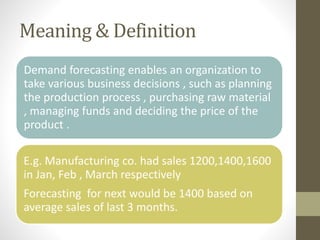
Demand forecasting enables an organization to
take various business decisions , such as planning
the production process , purchasing raw material
, managing funds and deciding the price of the
product .
E.g. Manufacturing co. had sales 1200,1400,1600
in Jan, Feb , March respectively
Forecasting for next would be 1400 based on
average sales of last 3 months.
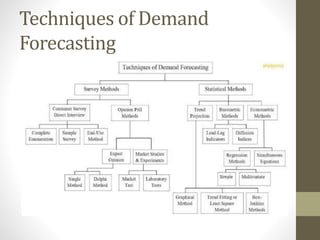
Techniques of Demand
Forecasting
A . Survey Method
It is most common and direct method of
forecasting in short term.
Organizations conduct surveys with consumers to
determine demand of existing products &
anticipate future.
Surveys Method :
1. Complete Enumeration survey/ Census
2. Sample survey’
3. End use method
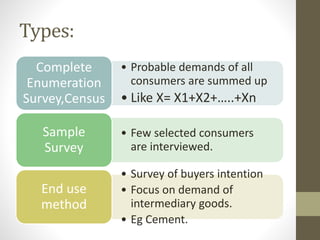
Types:
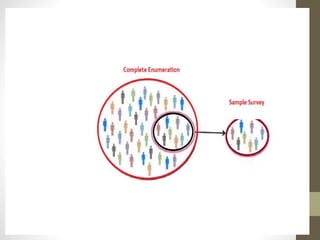
• Probable demands of all
consumers are summed up
• Like X= X1+X2+…..+Xn
Complete
Enumeration
Survey,Census
• Few selected consumers
are interviewed.
Sample
Survey
• Survey of buyers intention
• Focus on demand of
intermediary goods.
• Eg Cement.
End use
method
B . Opinion Poll Method :
Opinion poll method aims at collecting opinion
from those who possess knowledge of market.
E.g. Sales representatives , executives .etc.
Opinion poll method :
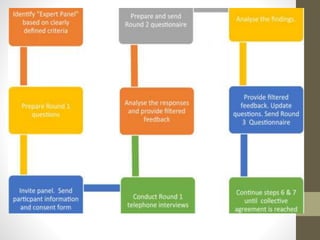
1.Expert opinion method 2. Delphi method
3. Market studies & experiment.
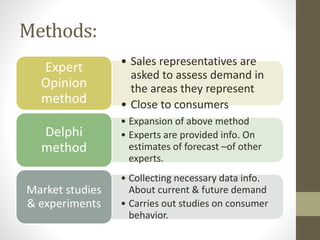
Methods:
• Sales representatives are
asked to assess demand in
the areas they represent
• Close to consumers
Expert
Opinion
method
• Expansion of above method
• Experts are provided info. On
estimates of forecast –of other
experts.
Delphi
method
• Collecting necessary data info.
About current & future demand
• Carries out studies on consumer
behavior.
Market studies
& experiments
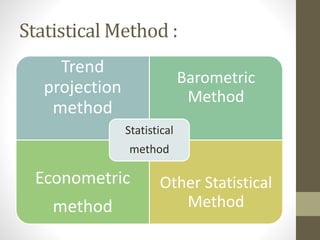
Statistical Method:
These are forecasting techniques
that make use of historical data
for estimating long term demand.
The statistical methods , which
are frequently used for demand
projection are:
Statistical Method :
Trend
projection
method
Barometric
Method
Econometric
method
Other Statistical
Method
Statistical
method
Trend Projection Method
An old firm can use its own data of past years
regarding sales
These data are known as time series of sales.
Assume that past trend will continue in future.
The trend can be estimatedby following:
•Graphical method
•Least Square method
•Box Jenkis method
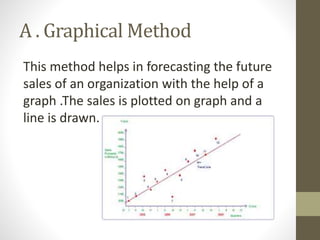
A . Graphical Method
This method helps in forecasting the future
sales of an organization with the help of a
graph .The sales is plotted on graph and a
line is drawn.
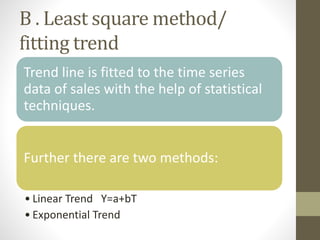
B . Least square method/
fitting trend
Trend line is fitted to the time series
data of sales with the help of statistical
techniques.
Further there are two methods:
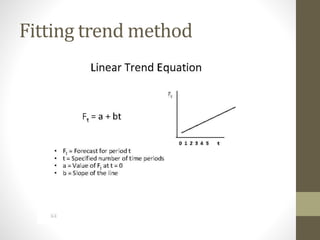
• Linear Trend Y=a+bT
• Exponential Trend
Fitting trend method
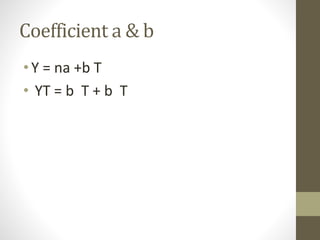
Coefficient a & b
•Y = na +b T
• YT = b T + b T
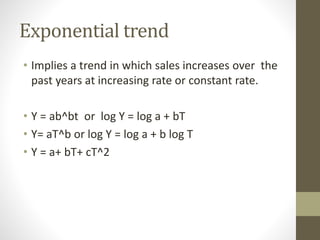
Exponential trend
• Implies a trend in which sales increases over the
past years at increasing rate or constant rate.
• Y = ab^bt or log Y = log a + bT
• Y= aT^b or log Y = log a + b log T
• Y = a+ bT+ cT^2
Box Jenkins method
• It is used only for short term predictions . This
method forecasts demand only with stationary
time series data that does not reveal long term
trend.
• It is used in those situation where time series
data depicts monthly or seasonal variations.
• E.g. this can be used for estimating the sales
forecast of woolen clothes during winter season.
Barometric Method
Demand is predicted on the basis of key variables
occurring in the present.
• Follow the method meteorologists use in
weather forecasting.
Example : suppose government allots land to the XYZ
society for constructing buildings. This indicates that there
would be high demand for cement , bricks and steel.
• Applicable even in the absence of past data
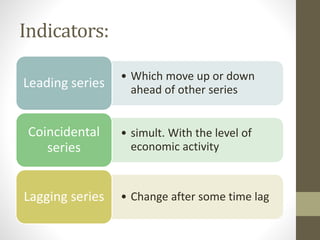
Indicators:
• Which move up or down
ahead of other series
Leading series
• simult. With the level of
economic activity
Coincidental
series
• Change after some time lag
Lagging series
Econometric Method
• It is assumed that demand is determined by one or
more variables
• Eg: income, population.
• It combines statistical tools with economic
theories for casting.
• Very reliable method
• Types:
1. Regression method
X = a + by y = a + bx
1. Simultaneous equation method
Endogenous exogenous
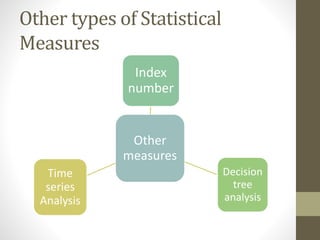
Other types of Statistical
Measures
Other
measures
Index
number
Decision
tree
analysis
Time
series
Analysis
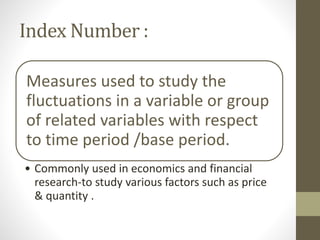
Index Number :
Measures used to study the
fluctuations in a variable or group
of related variables with respect
to time period /base period.
• Commonly used in economics and financial
research-to study various factors such as price
& quantity .
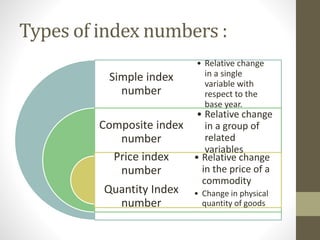
Types of index numbers :
Simple index
number
Composite index
number
Price index
number
Quantity Index
number
• Relative change
in a single
variable with
respect to the
base year.
• Relative change
in a group of
related
variables
• Relative change
in the price of a
commodity
• Change in physical
quantity of goods
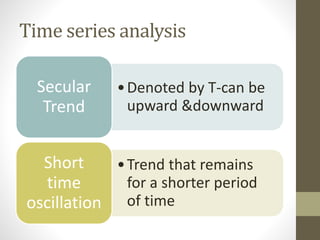
Time series analysis
•Denoted by T-can be
upward &downward
Secular
Trend
•Trend that remains
for a shorter period
of time
Short
time
oscillation
Decision tree analysis
• A tree type structure is drawn to decide
the best solution for a problem.
• In this we find out different options that
we can apply to solve a particular
problem.
Case Study ~ Small retailers
demand forecasting.
• A 2002 study showed that Mall space is expected to
touch 40 million square feet says Jones Lang Lasalle’s
third annual retailer sentiment survey- Asia.
• Due to increase in multi-outlet retail concept marketing
competition raised significantly.
• There is shift from traditional form of retailing to modern
organized sector.
• Top players in Indian retail sector :
• Shoppers stop
• Lifestyle
• Globus
Case study (conti.)
• Challenges faced by small retailers:
• To stand the competition one should understand the
competition .
• They could not afford full fledged demand forecasting analysis.
• But the methods they could use were :
• 1. Delphi Method
• 2. Expert opinion poll ( sales rep. close to consumer)
• Conclusion:
• As the competition increases retailers have to use demand
use demand forecasting tools because prediction of sales
directly affects manufacturing.
Bibliography
•Thank you

Techniques Of Demand Forecasting.pptx

  • 1.
    Techniques Of Demand Forecasting Submittedto: Ms Paramjeet Submitted by: Saloni Dhawan Roll no: 5714
  • 2.
    Meaning & Definition Itis process in which probable demand for product or service is estimated for the future period of time. In the words of Philip Kotler “ The company (sales) forecast is the expected level of company sales based on a chosen marketing plan and assumed marketing environment.”
  • 3.
    Meaning & Definition Demandforecasting enables an organization to take various business decisions , such as planning the production process , purchasing raw material , managing funds and deciding the price of the product . E.g. Manufacturing co. had sales 1200,1400,1600 in Jan, Feb , March respectively Forecasting for next would be 1400 based on average sales of last 3 months.
  • 4.
  • 5.
    A . SurveyMethod It is most common and direct method of forecasting in short term. Organizations conduct surveys with consumers to determine demand of existing products & anticipate future. Surveys Method : 1. Complete Enumeration survey/ Census 2. Sample survey’ 3. End use method
  • 6.
    Types: • Probable demandsof all consumers are summed up • Like X= X1+X2+…..+Xn Complete Enumeration Survey,Census • Few selected consumers are interviewed. Sample Survey • Survey of buyers intention • Focus on demand of intermediary goods. • Eg Cement. End use method
  • 8.
    B . OpinionPoll Method : Opinion poll method aims at collecting opinion from those who possess knowledge of market. E.g. Sales representatives , executives .etc. Opinion poll method : 1.Expert opinion method 2. Delphi method 3. Market studies & experiment.
  • 9.
    Methods: • Sales representativesare asked to assess demand in the areas they represent • Close to consumers Expert Opinion method • Expansion of above method • Experts are provided info. On estimates of forecast –of other experts. Delphi method • Collecting necessary data info. About current & future demand • Carries out studies on consumer behavior. Market studies & experiments
  • 11.
    Statistical Method: These areforecasting techniques that make use of historical data for estimating long term demand. The statistical methods , which are frequently used for demand projection are:
  • 12.
  • 13.
    Trend Projection Method Anold firm can use its own data of past years regarding sales These data are known as time series of sales. Assume that past trend will continue in future.
  • 14.
    The trend canbe estimatedby following: •Graphical method •Least Square method •Box Jenkis method
  • 15.
    A . GraphicalMethod This method helps in forecasting the future sales of an organization with the help of a graph .The sales is plotted on graph and a line is drawn.
  • 16.
    B . Leastsquare method/ fitting trend Trend line is fitted to the time series data of sales with the help of statistical techniques. Further there are two methods: • Linear Trend Y=a+bT • Exponential Trend
  • 17.
  • 18.
    Coefficient a &b •Y = na +b T • YT = b T + b T
  • 19.
    Exponential trend • Impliesa trend in which sales increases over the past years at increasing rate or constant rate. • Y = ab^bt or log Y = log a + bT • Y= aT^b or log Y = log a + b log T • Y = a+ bT+ cT^2
  • 20.
    Box Jenkins method •It is used only for short term predictions . This method forecasts demand only with stationary time series data that does not reveal long term trend. • It is used in those situation where time series data depicts monthly or seasonal variations. • E.g. this can be used for estimating the sales forecast of woolen clothes during winter season.
  • 21.
    Barometric Method Demand ispredicted on the basis of key variables occurring in the present. • Follow the method meteorologists use in weather forecasting. Example : suppose government allots land to the XYZ society for constructing buildings. This indicates that there would be high demand for cement , bricks and steel. • Applicable even in the absence of past data
  • 22.
    Indicators: • Which moveup or down ahead of other series Leading series • simult. With the level of economic activity Coincidental series • Change after some time lag Lagging series
  • 23.
    Econometric Method • Itis assumed that demand is determined by one or more variables • Eg: income, population. • It combines statistical tools with economic theories for casting. • Very reliable method • Types: 1. Regression method X = a + by y = a + bx 1. Simultaneous equation method Endogenous exogenous
  • 24.
    Other types ofStatistical Measures Other measures Index number Decision tree analysis Time series Analysis
  • 25.
    Index Number : Measuresused to study the fluctuations in a variable or group of related variables with respect to time period /base period. • Commonly used in economics and financial research-to study various factors such as price & quantity .
  • 26.
    Types of indexnumbers : Simple index number Composite index number Price index number Quantity Index number • Relative change in a single variable with respect to the base year. • Relative change in a group of related variables • Relative change in the price of a commodity • Change in physical quantity of goods
  • 27.
    Time series analysis •Denotedby T-can be upward &downward Secular Trend •Trend that remains for a shorter period of time Short time oscillation
  • 28.
    Decision tree analysis •A tree type structure is drawn to decide the best solution for a problem. • In this we find out different options that we can apply to solve a particular problem.
  • 29.
    Case Study ~Small retailers demand forecasting. • A 2002 study showed that Mall space is expected to touch 40 million square feet says Jones Lang Lasalle’s third annual retailer sentiment survey- Asia. • Due to increase in multi-outlet retail concept marketing competition raised significantly. • There is shift from traditional form of retailing to modern organized sector. • Top players in Indian retail sector : • Shoppers stop • Lifestyle • Globus
  • 30.
    Case study (conti.) •Challenges faced by small retailers: • To stand the competition one should understand the competition . • They could not afford full fledged demand forecasting analysis. • But the methods they could use were : • 1. Delphi Method • 2. Expert opinion poll ( sales rep. close to consumer) • Conclusion: • As the competition increases retailers have to use demand use demand forecasting tools because prediction of sales directly affects manufacturing.
  • 31.
  • 32.