OPTOM FASLU MUHAMMED
 Degenerations may be unilateral or bilateral
and are secondary phenomena after previous
disease
Degenerative Conditions of
Conjunctiva
 Concretions
 Pinguecula
 Pterygium
29th October 2006 dr sanjay shrivastava 3
Concretions (Lithiasis)
 They are minute hard, yellow, projectile lesions seen in
palpabral conjunctiva.
 Concretions are due to collection of epithelial cells and
inspissated mucous in depressions called Henle’s
gland.
29th October 2006 dr sanjay shrivastava 4
 They produce foreign body sensation. Commonly
found in elderly patients who have suffered from
Trachoma.
 Treatment: Removal under topical Anaesthesia with a
sharp hypodermic needle.
Pinguecula
 It’s a triangular patch on the bulbar conjunctiva in
palpabral aperture in elderly patients especially those
exposed to strong sunlight, dust ,wind , drying etc
 The pinguecula is due to hyaline infiltration and
elastotic degeneration in sub-mucous tissue.
 Yellow triangular raised lesion with apex away from
cornea are seen in palpabral aperture.
 Nasal side is affected first then the temporal.
 The patch looks like fat (pinguis = fat). The lesion is
stationary at a moderate size. The pinguecula becomes
more prominent in congested / inflammed eye.
 No treatment is usually required. If removal is desired
for cosmetic purposes
Pterygium
 Pterygium (A wing) is a triangular encroachment of
bulbar conjunctiva on to the cornea.
 The conjunctiva invade the cornea destroying the
superficial layers of the stroma and bowman
membrane , the corneal tissue is covered by
conjunctival epithelium.
Etiology
 Commonly seen in dry ,sunny, hot climate with sandy
soil, ultra-violet light also act as etiological factor
Signs
 A triangular encroachment of conjunctiva upon the
cornea with numerous small deep opacities in front of
the apex.
 It usually follows pinguecula first develop on nasal
side, in case of double pterygium temporal side is
affected later.
 Progressive pterygium is thick vascular growth with
punctate opacities in front of the apex.
 Atrophic pterygium is thin and pale growth with few
obliterated vessels. It is characterized by formation of
dense fibrous tissue and is associated with
considerable corneal astigmatism.
Prophylaxis
 UV rays filters, protective glasses
 Artificial tears
 If small and does not cause cosmetic problem, it be
left.
 Subconjunctival resection of pterygium leaving a bare
sclera adjacent to limbus
 Sub-conjunctival transplantation of pterygium.
Degenerative Conditions of Cornea
 Epithelial
 I. Keratitis sicca
 II. Recurrent erosion
 III. Keratomalacia
 IV. Neuroparalytic keratopathy
Stromal
 Arcus senilis
 Terrien’s ulcer
 Calcific band keratopathy
 Salzmann’s nodular degeneration
 Lipid keratopathy
 Limbus girdle of Vogt
 Delle
 Anterior crocodile shagreen
Keratitis sicca
 Because the watery part of the tear secretion is lacking,
corneal epithelial punctate erosions develop in
exposed areas
Recurrent erosion
 The epithelium forms small blebs and then desquamates
In recurring cycles.
 The condition usually follows incomplete healing of a
traumatic corneal abrasion, most commonly a fingernail,
paper, or plant injury.
 The cause is uncertain but seems to be a defect
in the epithelium that produces an abnormal
basement membrane.
Keratomalacia
 Keratomalacia, caused by a deficiency of vitamin A, is
characterized by diffuse, excessive keratinization of all
mucous membrane epithelia, including the cornea and
conjunctiva
 The condition occurs most often in children , who
characteristically complain of night blindness
Neuroparalytic keratopathy
 Early neuroparalytic keratopathy, which may resemble
recurrent erosion, often progresses to almost total
corneal epithelial desquamation.
 Frequently, it is complicated by secondary infection
that leads to perforation.
 The condition is caused by a lesion any where along
the course of the ophthalmic division of the fifth
cranial nerve and results in partial or complete loss of
corneal sensitivity
Stromal
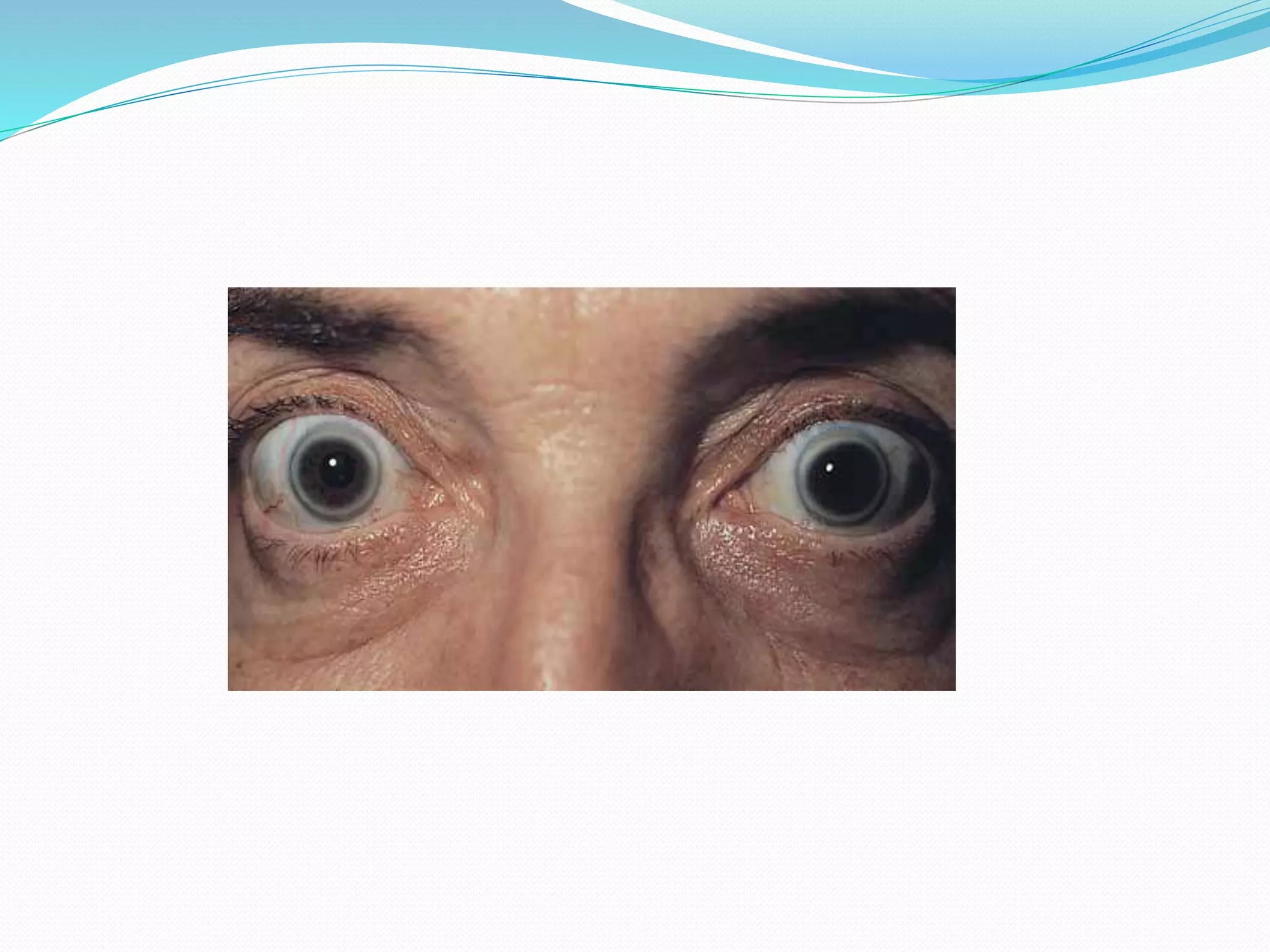
Arcus senilis
 Lipid deposit is limited to the peripheral cornea and
central sclera.
 It starts earliest at the inferior pole of the cornea, then
involves the superior, becoming annular in the late
stage.
 lipid first concentrates in the area of Descemet’s
membrane, then in the area of Bowman’s membrane
Terrien’s ulcer
 The lesion, a limbal depression or gutter, starts as fine,
yellow-white, punctate opacities supranasally,usually
bilaterally, and spreads circumferentially,rarely
reaching inferiorly.
Calcific band keratopathy
Calcific band keratopathy starts in the nasal and temporal
periphery with a translucent area at the level of Bowman’s
membrane; the semiopaque
The extreme peripheral cornea remains clear, but the central
cornea ultimately may become involved.
A deposition of calcium salts on and in Bowman’s
membrane apparently is related to abnormal epithelial
activity.
Calcific band keratopathy may be secondary to primary
hyperparathyroidism; increased vitamin D absorption;
chronic renal failure; ocular disease,especially uveitis ;
long-standingglaucoma; local pilocarpine therapy
Salzmann’s nodular degeneration
 The condition, an elevated white or yellow corneal area,
usually is unilateral (but may be bilateral)
 occurs mainly in women
 It is superimposed on an area of old corneal injury
 the epithelium shows areas of both hypertrophy and
atrophy, with a marked increase of subepithelial
basement membrane material and scar tissue.
Lipid keratopathy (secondary lipidic degeneration)
 Lipid keratopathy may be unilateral or bilateral and
follows old injury, especially surgical.
 Clinically, it appears as a nodular, yellow, often
elevated corneal infiltrate.
 Histologically, the lipid deposition is located mainly
in between Bowman’s membrane and epithelium.
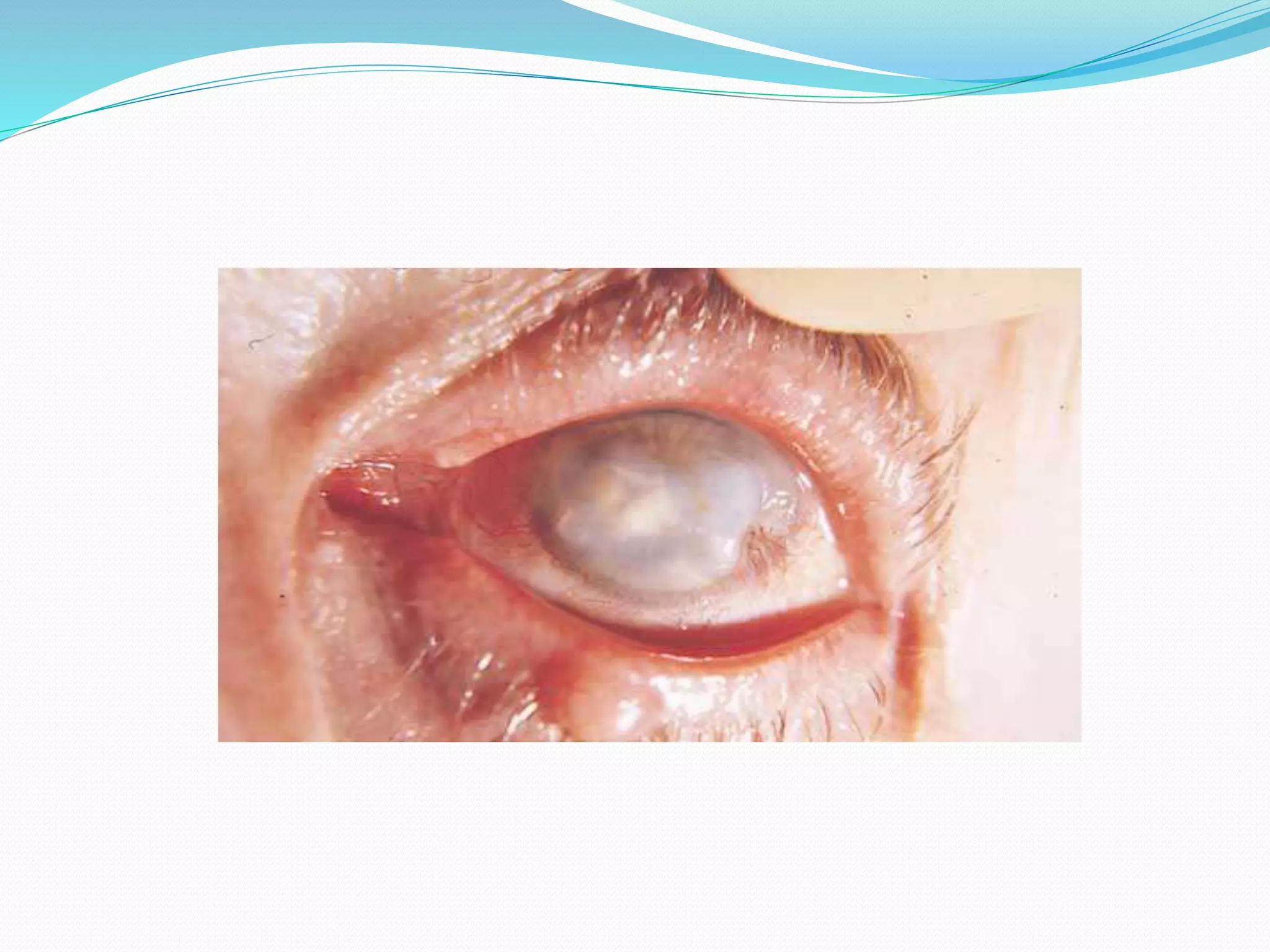
Limbus girdle of Vogt
The limbus girdle of Vogt appears as a symmetric,
yellowish-white corneal opacity forming a half-moon–
like arc running concentrically within the limbus
superficially in the interpalpebral fissure zone, most
commonly nasally
Delle (singular form of dellen)
A delle is a reversible, localized area of corneal
stromal dehydration and corneal thinning owing to a
break in the continuity of the tear film layer secondary
to elevation of surrounding structures
Anterior crocodile shagreen
The condition consists of a central corneal opacification at the level
of Bowman’s membrane that presents as a mosaic of polygonal
gray opacities
1. The condition may occur as a dystrophy
with bilaterality and a dominant inheritance pattern.
2. It also may occur as a degeneration after trauma or associated
with such conditions as megalocornea, iris malformations, and
band keratopathy.
3. A peripheral variety may be seen as an aging
Degenerative Conditions of retina
Microcystoid Degeneration
 Outer plexiform layer is the commen site of the
lesion
 All persons 8 years of age or older show the lesion.
 The tendency is toward relatively equal bilateral
involvement. The temporal neural retina is involved
more than the nasal, and the superior sectors are
affected more than the inferior
 The degeneration always seems to begin at the ora
serrata.
 Early, the cysts are limited to the middle layers of the
neural retina. Later, they may extend to the external
and internal limiting membranes of the neural retina.
 The septa separating the cysts are composed of glial–
axonal tissue rich in the cytochrome oxidase enzyme
system.
 microcysts coalesce, an intraneural retinal macrocyst
or retinoschisis cavity is formed when the macrocyst is
at least 1.5 mm in
 length
 Reticular peripheral cystoid degeneration
 Reticular peripheral cystoid degeneration appears
clinically posterior to typical peripheral microcystoid
degeneration.
 The subsurface retinal vasculature arborizes into fine
branches throughout the reticular lesion.
 The inferior and superior temporal regions, each
involved to approximately the same extent
 Reticular peripheral cystoid degeneration are located
in the nerve fiber layer of the neural retina.
 Early, the cysts are located completely within the nerve
fiber layer;
 later, they may extend from the internal limiting
membrane to the inner plexiform layer.
 The cysts contain hyaluronic acid
Degenerative Retinoschisis
 reticular degenerative (adult) type ,typical
degenerative senile (adult)type
 defined as an intraneural retinal tissue loss or splitting
at least 1.5 mm in length
 It is most common after the age of 40, and rare before
the age of 20 years.
 it is found in the peripheral inferior temporal quadrant
 Neural retinal holes are seen in this condition
 area of the retinoschisis enlarges, the involved neural
retina is destroyed
 Paving Stone (Cobblestone)Degeneration
 The lesions are located primarily between the ora
serrata and equator and are separated from the ora
serrata by normal neural retina.
 The lesions are nonelevated, sharply demarcated,
yellow–white, single or multiple, and separate or
confluent.
 most common in the inferior temporal quadrant
 the lesions are characterized by:
Neural retinal thinning in an area devoid of pigment
epithelium
 An absent choriocapillaris or a partially obliterated
choriocapillaris or sometimes only minimal
abnormalities such as thickening of the walls of the
choriocapillaris are seen
 The disorder involve outer retina
& result in RPE atrophy
Peripheral Retinal Albinotic Spots
I. Areas of hypopigmentation in the neural retinal
periphery are caused by depigmentation of the RPE.
II. Although the lesions probably are degenerative, a
congenital cause cannot be ruled out.
 Myopic Retinopathy
 “high” myopia (greater than 6 diopters of myopia)
affects the neural retina most severely in the posterior
pole and in the periphery
 The globe is enlarged mainly in its posterior third,
with thinning of the sclera.
 optic disc and usually extending temporally
 Thinned sclera bulges posteriorly to form a staphyloma
that is lined by a thin and atrophic choroid.
 Bruch’s membrane may develop small breaks
 peripheral neural retina also becomes thin and
atrophic
Macular Degeneration
 It is characterized by a sharply demarcated, dome-
shaped elevation of the RPE.
 Most RPE detachments are between one-fifth to one-
half disc diameter, rarely reaching two disc diameters.
 The symptoms are those of metamorphopsia, positive
scotoma, and micropsia. Decreased contrast
Decreased color
 The condition recurs in approximately one-fourth to one-
third of patients and occasionally may become bilateral.
 the involved area, most often in the macula, shows fluid
under the neural retina
 Most cases heal spontaneously with restoration of normal
vision.
Age-Related Dry Macular Degeneration
 Dry ARMD is characterized by a gradual reduction of
central vision.
 The cause is unknown.
 High intake of saturated fat and cholesterol is
associated with an increased risk for early ARMD.
Exposure to sunlight and soft and hard drusen also
have been implicated as a risk factors.
 the retinal damage is limited to the foveomacular area
and causes a gradual and subtle visual loss
 increased and decreased pigmentation are seen in the
macula.
 The atrophy of the RPE tends to spread and form well
demarcated borders, called geographic atrophy of
macular degeneration.
 Hyperopia also may be a risk factor.
 The changes usually are bilateral and found in people
older than 50 years of age
 The choriocapillaris may be partially or completely
obliterated.
Age-Related Exudative Macular Degeneration
 exudative ARMD rarely occurs in people younger than
60 years of age.
 The cause is unknown.
 risk increases with age, especially 75 years and older,
and in women.
 main risk factor is age-related macular choroidal
degeneration
 High intake of saturated fat and cholesterol also is
associated with an increased risk for early ARMD.
 .
 Exudative ARMD may be associated with moderate to
severe hypertension, particularly among patients
receiving antihypertensive therapy.
 Hyperopia also may be a risk factor
 Large, soft drusen seem to predispose the eye to
exudative ARMD.
 The age-related macular choroidal degeneration
becomes complicated by neovascular invasion.
 The new vessels grow from the choroid (from the
choriocapillaris) through Bruch’s membrane, usually
under the RPE
 Finally, a hemorrhage between Bruch’s membrane and
RPE occurs
 the haemorrhage may remain localized, it usually
breaks through the RPE under the neural retina; rarely
it may extend into the choroid, the neural retina, or
even the vitreous.

Degenerative condition of eye

  • 1.
  • 2.
     Degenerations maybe unilateral or bilateral and are secondary phenomena after previous disease
  • 3.
    Degenerative Conditions of Conjunctiva Concretions  Pinguecula  Pterygium 29th October 2006 dr sanjay shrivastava 3
  • 4.
    Concretions (Lithiasis)  Theyare minute hard, yellow, projectile lesions seen in palpabral conjunctiva.  Concretions are due to collection of epithelial cells and inspissated mucous in depressions called Henle’s gland. 29th October 2006 dr sanjay shrivastava 4
  • 6.
     They produceforeign body sensation. Commonly found in elderly patients who have suffered from Trachoma.  Treatment: Removal under topical Anaesthesia with a sharp hypodermic needle.
  • 7.
    Pinguecula  It’s atriangular patch on the bulbar conjunctiva in palpabral aperture in elderly patients especially those exposed to strong sunlight, dust ,wind , drying etc  The pinguecula is due to hyaline infiltration and elastotic degeneration in sub-mucous tissue.
  • 9.
     Yellow triangularraised lesion with apex away from cornea are seen in palpabral aperture.  Nasal side is affected first then the temporal.  The patch looks like fat (pinguis = fat). The lesion is stationary at a moderate size. The pinguecula becomes more prominent in congested / inflammed eye.
  • 10.
     No treatmentis usually required. If removal is desired for cosmetic purposes
  • 11.
    Pterygium  Pterygium (Awing) is a triangular encroachment of bulbar conjunctiva on to the cornea.  The conjunctiva invade the cornea destroying the superficial layers of the stroma and bowman membrane , the corneal tissue is covered by conjunctival epithelium.
  • 13.
    Etiology  Commonly seenin dry ,sunny, hot climate with sandy soil, ultra-violet light also act as etiological factor
  • 14.
    Signs  A triangularencroachment of conjunctiva upon the cornea with numerous small deep opacities in front of the apex.  It usually follows pinguecula first develop on nasal side, in case of double pterygium temporal side is affected later.
  • 15.
     Progressive pterygiumis thick vascular growth with punctate opacities in front of the apex.  Atrophic pterygium is thin and pale growth with few obliterated vessels. It is characterized by formation of dense fibrous tissue and is associated with considerable corneal astigmatism.
  • 16.
    Prophylaxis  UV raysfilters, protective glasses  Artificial tears
  • 17.
     If smalland does not cause cosmetic problem, it be left.  Subconjunctival resection of pterygium leaving a bare sclera adjacent to limbus  Sub-conjunctival transplantation of pterygium.
  • 18.
    Degenerative Conditions ofCornea  Epithelial  I. Keratitis sicca  II. Recurrent erosion  III. Keratomalacia  IV. Neuroparalytic keratopathy
  • 19.
    Stromal  Arcus senilis Terrien’s ulcer  Calcific band keratopathy  Salzmann’s nodular degeneration  Lipid keratopathy  Limbus girdle of Vogt  Delle  Anterior crocodile shagreen
  • 20.
    Keratitis sicca  Becausethe watery part of the tear secretion is lacking, corneal epithelial punctate erosions develop in exposed areas
  • 21.
    Recurrent erosion  Theepithelium forms small blebs and then desquamates In recurring cycles.  The condition usually follows incomplete healing of a traumatic corneal abrasion, most commonly a fingernail, paper, or plant injury.  The cause is uncertain but seems to be a defect in the epithelium that produces an abnormal basement membrane.
  • 22.
    Keratomalacia  Keratomalacia, causedby a deficiency of vitamin A, is characterized by diffuse, excessive keratinization of all mucous membrane epithelia, including the cornea and conjunctiva  The condition occurs most often in children , who characteristically complain of night blindness
  • 23.
    Neuroparalytic keratopathy  Earlyneuroparalytic keratopathy, which may resemble recurrent erosion, often progresses to almost total corneal epithelial desquamation.  Frequently, it is complicated by secondary infection that leads to perforation.
  • 24.
     The conditionis caused by a lesion any where along the course of the ophthalmic division of the fifth cranial nerve and results in partial or complete loss of corneal sensitivity
  • 25.
    Stromal Arcus senilis  Lipiddeposit is limited to the peripheral cornea and central sclera.  It starts earliest at the inferior pole of the cornea, then involves the superior, becoming annular in the late stage.  lipid first concentrates in the area of Descemet’s membrane, then in the area of Bowman’s membrane
  • 27.
    Terrien’s ulcer  Thelesion, a limbal depression or gutter, starts as fine, yellow-white, punctate opacities supranasally,usually bilaterally, and spreads circumferentially,rarely reaching inferiorly.
  • 29.
    Calcific band keratopathy Calcificband keratopathy starts in the nasal and temporal periphery with a translucent area at the level of Bowman’s membrane; the semiopaque The extreme peripheral cornea remains clear, but the central cornea ultimately may become involved.
  • 31.
    A deposition ofcalcium salts on and in Bowman’s membrane apparently is related to abnormal epithelial activity. Calcific band keratopathy may be secondary to primary hyperparathyroidism; increased vitamin D absorption; chronic renal failure; ocular disease,especially uveitis ; long-standingglaucoma; local pilocarpine therapy
  • 32.
    Salzmann’s nodular degeneration The condition, an elevated white or yellow corneal area, usually is unilateral (but may be bilateral)  occurs mainly in women  It is superimposed on an area of old corneal injury
  • 33.
     the epitheliumshows areas of both hypertrophy and atrophy, with a marked increase of subepithelial basement membrane material and scar tissue.
  • 35.
    Lipid keratopathy (secondarylipidic degeneration)  Lipid keratopathy may be unilateral or bilateral and follows old injury, especially surgical.  Clinically, it appears as a nodular, yellow, often elevated corneal infiltrate.  Histologically, the lipid deposition is located mainly in between Bowman’s membrane and epithelium.
  • 37.
    Limbus girdle ofVogt The limbus girdle of Vogt appears as a symmetric, yellowish-white corneal opacity forming a half-moon– like arc running concentrically within the limbus superficially in the interpalpebral fissure zone, most commonly nasally
  • 38.
    Delle (singular formof dellen) A delle is a reversible, localized area of corneal stromal dehydration and corneal thinning owing to a break in the continuity of the tear film layer secondary to elevation of surrounding structures
  • 39.
    Anterior crocodile shagreen Thecondition consists of a central corneal opacification at the level of Bowman’s membrane that presents as a mosaic of polygonal gray opacities 1. The condition may occur as a dystrophy with bilaterality and a dominant inheritance pattern. 2. It also may occur as a degeneration after trauma or associated with such conditions as megalocornea, iris malformations, and band keratopathy. 3. A peripheral variety may be seen as an aging
  • 40.
    Degenerative Conditions ofretina Microcystoid Degeneration  Outer plexiform layer is the commen site of the lesion  All persons 8 years of age or older show the lesion.  The tendency is toward relatively equal bilateral involvement. The temporal neural retina is involved more than the nasal, and the superior sectors are affected more than the inferior
  • 41.
     The degenerationalways seems to begin at the ora serrata.  Early, the cysts are limited to the middle layers of the neural retina. Later, they may extend to the external and internal limiting membranes of the neural retina.
  • 42.
     The septaseparating the cysts are composed of glial– axonal tissue rich in the cytochrome oxidase enzyme system.  microcysts coalesce, an intraneural retinal macrocyst or retinoschisis cavity is formed when the macrocyst is at least 1.5 mm in  length
  • 43.
     Reticular peripheralcystoid degeneration  Reticular peripheral cystoid degeneration appears clinically posterior to typical peripheral microcystoid degeneration.  The subsurface retinal vasculature arborizes into fine branches throughout the reticular lesion.
  • 44.
     The inferiorand superior temporal regions, each involved to approximately the same extent  Reticular peripheral cystoid degeneration are located in the nerve fiber layer of the neural retina.
  • 45.
     Early, thecysts are located completely within the nerve fiber layer;  later, they may extend from the internal limiting membrane to the inner plexiform layer.  The cysts contain hyaluronic acid
  • 46.
    Degenerative Retinoschisis  reticulardegenerative (adult) type ,typical degenerative senile (adult)type  defined as an intraneural retinal tissue loss or splitting at least 1.5 mm in length  It is most common after the age of 40, and rare before the age of 20 years.
  • 47.
     it isfound in the peripheral inferior temporal quadrant  Neural retinal holes are seen in this condition  area of the retinoschisis enlarges, the involved neural retina is destroyed
  • 48.
     Paving Stone(Cobblestone)Degeneration  The lesions are located primarily between the ora serrata and equator and are separated from the ora serrata by normal neural retina.  The lesions are nonelevated, sharply demarcated, yellow–white, single or multiple, and separate or confluent.  most common in the inferior temporal quadrant
  • 49.
     the lesionsare characterized by: Neural retinal thinning in an area devoid of pigment epithelium  An absent choriocapillaris or a partially obliterated choriocapillaris or sometimes only minimal abnormalities such as thickening of the walls of the choriocapillaris are seen  The disorder involve outer retina & result in RPE atrophy
  • 50.
    Peripheral Retinal AlbinoticSpots I. Areas of hypopigmentation in the neural retinal periphery are caused by depigmentation of the RPE. II. Although the lesions probably are degenerative, a congenital cause cannot be ruled out.
  • 51.
     Myopic Retinopathy “high” myopia (greater than 6 diopters of myopia) affects the neural retina most severely in the posterior pole and in the periphery  The globe is enlarged mainly in its posterior third, with thinning of the sclera.
  • 52.
     optic discand usually extending temporally  Thinned sclera bulges posteriorly to form a staphyloma that is lined by a thin and atrophic choroid.  Bruch’s membrane may develop small breaks  peripheral neural retina also becomes thin and atrophic
  • 53.
    Macular Degeneration  Itis characterized by a sharply demarcated, dome- shaped elevation of the RPE.  Most RPE detachments are between one-fifth to one- half disc diameter, rarely reaching two disc diameters.
  • 54.
     The symptomsare those of metamorphopsia, positive scotoma, and micropsia. Decreased contrast Decreased color  The condition recurs in approximately one-fourth to one- third of patients and occasionally may become bilateral.  the involved area, most often in the macula, shows fluid under the neural retina  Most cases heal spontaneously with restoration of normal vision.
  • 55.
    Age-Related Dry MacularDegeneration  Dry ARMD is characterized by a gradual reduction of central vision.  The cause is unknown.
  • 56.
     High intakeof saturated fat and cholesterol is associated with an increased risk for early ARMD. Exposure to sunlight and soft and hard drusen also have been implicated as a risk factors.  the retinal damage is limited to the foveomacular area and causes a gradual and subtle visual loss
  • 57.
     increased anddecreased pigmentation are seen in the macula.  The atrophy of the RPE tends to spread and form well demarcated borders, called geographic atrophy of macular degeneration.  Hyperopia also may be a risk factor.
  • 58.
     The changesusually are bilateral and found in people older than 50 years of age  The choriocapillaris may be partially or completely obliterated.
  • 59.
    Age-Related Exudative MacularDegeneration  exudative ARMD rarely occurs in people younger than 60 years of age.  The cause is unknown.
  • 60.
     risk increaseswith age, especially 75 years and older, and in women.  main risk factor is age-related macular choroidal degeneration  High intake of saturated fat and cholesterol also is associated with an increased risk for early ARMD.  .
  • 61.
     Exudative ARMDmay be associated with moderate to severe hypertension, particularly among patients receiving antihypertensive therapy.  Hyperopia also may be a risk factor  Large, soft drusen seem to predispose the eye to exudative ARMD.
  • 62.
     The age-relatedmacular choroidal degeneration becomes complicated by neovascular invasion.  The new vessels grow from the choroid (from the choriocapillaris) through Bruch’s membrane, usually under the RPE  Finally, a hemorrhage between Bruch’s membrane and RPE occurs
  • 63.
     the haemorrhagemay remain localized, it usually breaks through the RPE under the neural retina; rarely it may extend into the choroid, the neural retina, or even the vitreous.