DABUR CASE STUDY
MARKETING MANAGEMENT


         Presented by:
         Gaurav Gupta     (29)
         Kiran Jain       (35)
         Shilpa Kher       (43)
         Ranjana Mandal    (50)
AGENDA

   Dabur – The Brand
   Product Offerings
   Brand Equity-Analysis
   Brand Equity
   Why Restructuring?
   Branding strategy
   SWOT Analysis
   Marketing Mix
PRESENT SCENARIO

   Dabur India is the 4th Largest FMCG Company in India
   Legacy of over 100 years
   Strategic Business Units in Health care, Personal care
    and Food products
   Dabur has a turnover of Rs.1899.57 crore with powerful
    brands like Dabur Amla, Dabur Chyawanprash, Real,
    Vatika and Hajmola
   Bottom Line Driven Company
   Product marketed in over 50 countries
   Leader in Herbal Digestives with 90% market share
DABUR -THE BRAND

   Established : 1884
   Founder       : Dr. S K Burman
   Basic Motive : Manufacture of Ayurvedic Drugs
   Achieved      : By setting up manufacturing units and
                    setting up Research and Development Labs
   Expanded its product line in the mid 1900’s by launching
    Dabur Hair Oil and Chyawanprash
   Added Oral Care Products in the 1970’s
   Shifted base from Kolkata to New Delhi in 1972
   Launched Hajmola tablet in 1978
DABUR -THE BRAND (contd)

   In 2004, restructured its portfolio and structured itself
    into three main SBU’s
   Has 5 power brands under its portfolio
   Entered new markets like the Juice segment, branded
    packaged soups segment
   Developed its Oral Care Market
   Increasing its geographical spread
   Aims at doubling its revenue and profit by the end of
    2009-2010
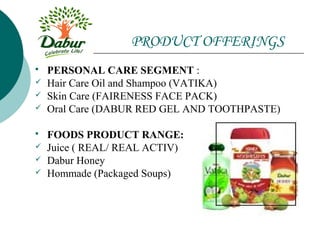
PRODUCT OFFERINGS
   PERSONAL CARE SEGMENT :
   Hair Care Oil and Shampoo (VATIKA)
   Skin Care (FAIRENESS FACE PACK)
   Oral Care (DABUR RED GEL AND TOOTHPASTE)

   FOODS PRODUCT RANGE:
   Juice ( REAL/ REAL ACTIV)
   Dabur Honey
   Hommade (Packaged Soups)
PRODUCT OFFERINGS (contd)
   AYURVEDIC HEALTH PRODUCTS:
   Digestive Segment (HAJMOLA)
   Dabur Chyawanprash
   Pudin Hara
   AYURVEDIC DRUGS
   PHARMACEUTICALS
BRAND EQUITY
   The Brand Equity of Dabur can be judged by the model
    BRAND ASSET VALUATOR
   Four Key components :
   Differentiation
   Relevance
   Esteem
   Knowledge
   As Dabur is a well- established brand all the four
    components are high
   HERBAL has been Dabur’s Brand equity since centuries
HOW DABUR BUILD ITS
                   BRAND EQUITY?

   Identities making up the brand-
    Choice of its logo, symbol, slogan, packaging

   Marketing Activities

   Associations of the brand
WHY
                      RESTRUCTURING?

   Image       : Ayurvedic Company
   Association: 35 - plus age group
   Problems :
   Diversified into too many product ranges
   Image
   Association with a particular age group and hence
    losing on the other potential customers
   Lower Sales and Profits
THE RESTRUCTURING

                                  PROCESS
   Cut down on all its low Contribution Brand
   Positioned itself as an Herbal specialist in the FMCG
    sector
   Set Higher Targets
   Identified Growth Drivers
   Filling up the gaps in Oral Care as well as Hair Care
    market
   Set itself a new Brand Strategy
   Entered new potential areas and targeted the youth as
    well school children
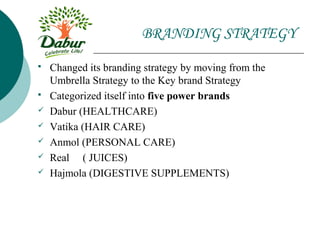
BRANDING STRATEGY
   Changed its branding strategy by moving from the
    Umbrella Strategy to the Key brand Strategy
   Categorized itself into five power brands
   Dabur (HEALTHCARE)
   Vatika (HAIR CARE)
   Anmol (PERSONAL CARE)
   Real ( JUICES)
   Hajmola (DIGESTIVE SUPPLEMENTS)
BRANDING STRATEGY

                           (contd)
   PRODUCT LINE EXTENSION
   In the JUICES range Dabur introduced :
   Coolers (Low fruit Content)
   Real    ( High fruit pulp Content)
   Real ACTIV (Health Conscious Youth)
   Real Juniors (for the children below 6 years of age)
   Real Schoolpack
WHY THESE STRATEGIES?

   Line Extension Strategy was adopted by Dabur
    because:
    It could attract different target audience
   Could renew Interest and liking for the brand by
    introducing new variants
   It could increase its market share
   Diversify without much risk
   Moved from its Core strategy and hence could give
    customers something better and different
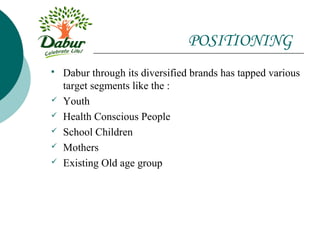
POSITIONING
   Dabur through its diversified brands has tapped various
    target segments like the :
   Youth
   Health Conscious People
   School Children
   Mothers
   Existing Old age group
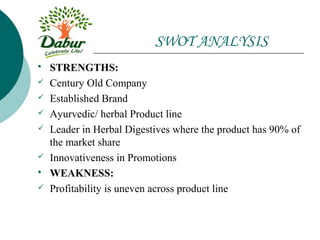
SWOT ANALYSIS
   STRENGTHS:
   Century Old Company
   Established Brand
   Ayurvedic/ herbal Product line
   Leader in Herbal Digestives where the product has 90% of
    the market share
   Innovativeness in Promotions
   WEAKNESS:
   Profitability is uneven across product line
SWOT ANALYSIS (contd)
   OPPORTUNITIES:
   Extend Vatika brand to new categories like Skin Care
    and body wash segments
   Launch several OTC brands
   Southern India Market
   Exploring new geographical areas- local as well global
   Oral Care Segment
   Launching new Products like Hair oils, Herbal and Gel
    Toothpastes etc.
SWOT ANALYSIS (Contd)

   THREATS:
   Competition in the FMCG sector from well established
    names
   Other fields of medicine- Allopathic and Homeopathic
   Markets where Herbal products are not recognised
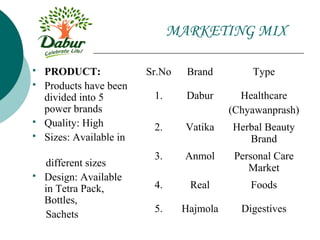
MARKETING MIX

   PRODUCT:              Sr.No    Brand         Type
   Products have been
    divided into 5         1.     Dabur       Healthcare
    power brands                            (Chyawanprash)
   Quality: High          2.     Vatika    Herbal Beauty
   Sizes: Available in                        Brand
                           3.     Anmol      Personal Care
    different sizes                             Market
   Design: Available
    in Tetra Pack,         4.      Real         Foods
    Bottles,
                           5.     Hajmola     Digestives
    Sachets
MARKETING MIX (contd)

   PRICE:
   As, Dabur had different sub-categories it came out with
    variable pricing to reach each and every target segment
   E.g. : One- litre bottle of Cooler (juice) was priced at
    Rs.50
   Selective Price Reduction to increase Demand
   Introduction of Smaller packs at Rs.5
   Came out with Rs.1 sachet of Vatika Shampoo to
    increase market share
   Cutting Price to stand out against competition
MARKETING MIX (contd)
   PLACE :
   Dabur constantly kept on increasing its geographic
    spread to increase its sales revenues
   Entered the South Indian Market
   Expanding in the International Market
   Presence in over 50 countries
   Subsidiaries established in Nepal, Nigeria, Bangladesh
    and Pakistan
   Focus areas : Asia Pacific, Afghanistan, Russia and other
    CIS countries
MARKETING MIX (contd)
   PROMOTIONS :
   Different brands have its own marketing and advertising
    team
   Different brands had different promotions
   Utilized the popularity of Indian films in the domestic and
    global markets to promote its brands
   Undertook the most advertising campaign with Mr.
    Bachchan endorsing Dabur brands
   Signed cricketer Virendar Sehwag and his wife for selected
    Oral, Hair and Healthcare products
MARKETING MIX (contd)
   Adopted the INTEGRATED MARKETING
    COMMUNICATION programme in 2003 to increase
    its market share
   Targeted the Institutional market which included hotels
    and airlines
   Partnered with Institutional clients to provide value
    added services
   Held various contests
   Training sessions and workshops for food and beverage
    professionals
   Tie-up with Discovery Channel
THANK YOU!!!!

Dabur case study

  • 1.
    DABUR CASE STUDY MARKETINGMANAGEMENT Presented by: Gaurav Gupta (29) Kiran Jain (35) Shilpa Kher (43) Ranjana Mandal (50)
  • 2.
    AGENDA  Dabur – The Brand  Product Offerings  Brand Equity-Analysis  Brand Equity  Why Restructuring?  Branding strategy  SWOT Analysis  Marketing Mix
  • 3.
    PRESENT SCENARIO  Dabur India is the 4th Largest FMCG Company in India  Legacy of over 100 years  Strategic Business Units in Health care, Personal care and Food products  Dabur has a turnover of Rs.1899.57 crore with powerful brands like Dabur Amla, Dabur Chyawanprash, Real, Vatika and Hajmola  Bottom Line Driven Company  Product marketed in over 50 countries  Leader in Herbal Digestives with 90% market share
  • 4.
    DABUR -THE BRAND  Established : 1884  Founder : Dr. S K Burman  Basic Motive : Manufacture of Ayurvedic Drugs  Achieved : By setting up manufacturing units and setting up Research and Development Labs  Expanded its product line in the mid 1900’s by launching Dabur Hair Oil and Chyawanprash  Added Oral Care Products in the 1970’s  Shifted base from Kolkata to New Delhi in 1972  Launched Hajmola tablet in 1978
  • 5.
    DABUR -THE BRAND(contd)  In 2004, restructured its portfolio and structured itself into three main SBU’s  Has 5 power brands under its portfolio  Entered new markets like the Juice segment, branded packaged soups segment  Developed its Oral Care Market  Increasing its geographical spread  Aims at doubling its revenue and profit by the end of 2009-2010
  • 6.
    PRODUCT OFFERINGS  PERSONAL CARE SEGMENT :  Hair Care Oil and Shampoo (VATIKA)  Skin Care (FAIRENESS FACE PACK)  Oral Care (DABUR RED GEL AND TOOTHPASTE)  FOODS PRODUCT RANGE:  Juice ( REAL/ REAL ACTIV)  Dabur Honey  Hommade (Packaged Soups)
  • 7.
    PRODUCT OFFERINGS (contd)  AYURVEDIC HEALTH PRODUCTS:  Digestive Segment (HAJMOLA)  Dabur Chyawanprash  Pudin Hara  AYURVEDIC DRUGS  PHARMACEUTICALS
  • 8.
    BRAND EQUITY  The Brand Equity of Dabur can be judged by the model BRAND ASSET VALUATOR  Four Key components :  Differentiation  Relevance  Esteem  Knowledge  As Dabur is a well- established brand all the four components are high  HERBAL has been Dabur’s Brand equity since centuries
  • 9.
    HOW DABUR BUILDITS BRAND EQUITY?  Identities making up the brand- Choice of its logo, symbol, slogan, packaging  Marketing Activities  Associations of the brand
  • 10.
    WHY RESTRUCTURING?  Image : Ayurvedic Company  Association: 35 - plus age group  Problems :  Diversified into too many product ranges  Image  Association with a particular age group and hence losing on the other potential customers  Lower Sales and Profits
  • 11.
    THE RESTRUCTURING PROCESS  Cut down on all its low Contribution Brand  Positioned itself as an Herbal specialist in the FMCG sector  Set Higher Targets  Identified Growth Drivers  Filling up the gaps in Oral Care as well as Hair Care market  Set itself a new Brand Strategy  Entered new potential areas and targeted the youth as well school children
  • 12.
    BRANDING STRATEGY  Changed its branding strategy by moving from the Umbrella Strategy to the Key brand Strategy  Categorized itself into five power brands  Dabur (HEALTHCARE)  Vatika (HAIR CARE)  Anmol (PERSONAL CARE)  Real ( JUICES)  Hajmola (DIGESTIVE SUPPLEMENTS)
  • 13.
    BRANDING STRATEGY (contd)  PRODUCT LINE EXTENSION  In the JUICES range Dabur introduced :  Coolers (Low fruit Content)  Real ( High fruit pulp Content)  Real ACTIV (Health Conscious Youth)  Real Juniors (for the children below 6 years of age)  Real Schoolpack
  • 14.
    WHY THESE STRATEGIES?  Line Extension Strategy was adopted by Dabur because:  It could attract different target audience  Could renew Interest and liking for the brand by introducing new variants  It could increase its market share  Diversify without much risk  Moved from its Core strategy and hence could give customers something better and different
  • 15.
    POSITIONING  Dabur through its diversified brands has tapped various target segments like the :  Youth  Health Conscious People  School Children  Mothers  Existing Old age group
  • 16.
    SWOT ANALYSIS  STRENGTHS:  Century Old Company  Established Brand  Ayurvedic/ herbal Product line  Leader in Herbal Digestives where the product has 90% of the market share  Innovativeness in Promotions  WEAKNESS:  Profitability is uneven across product line
  • 17.
    SWOT ANALYSIS (contd)  OPPORTUNITIES:  Extend Vatika brand to new categories like Skin Care and body wash segments  Launch several OTC brands  Southern India Market  Exploring new geographical areas- local as well global  Oral Care Segment  Launching new Products like Hair oils, Herbal and Gel Toothpastes etc.
  • 18.
    SWOT ANALYSIS (Contd)  THREATS:  Competition in the FMCG sector from well established names  Other fields of medicine- Allopathic and Homeopathic  Markets where Herbal products are not recognised
  • 19.
    MARKETING MIX  PRODUCT: Sr.No Brand Type  Products have been divided into 5 1. Dabur Healthcare power brands (Chyawanprash)  Quality: High 2. Vatika Herbal Beauty  Sizes: Available in Brand 3. Anmol Personal Care different sizes Market  Design: Available in Tetra Pack, 4. Real Foods Bottles, 5. Hajmola Digestives Sachets
  • 20.
    MARKETING MIX (contd)  PRICE:  As, Dabur had different sub-categories it came out with variable pricing to reach each and every target segment  E.g. : One- litre bottle of Cooler (juice) was priced at Rs.50  Selective Price Reduction to increase Demand  Introduction of Smaller packs at Rs.5  Came out with Rs.1 sachet of Vatika Shampoo to increase market share  Cutting Price to stand out against competition
  • 21.
    MARKETING MIX (contd)  PLACE :  Dabur constantly kept on increasing its geographic spread to increase its sales revenues  Entered the South Indian Market  Expanding in the International Market  Presence in over 50 countries  Subsidiaries established in Nepal, Nigeria, Bangladesh and Pakistan  Focus areas : Asia Pacific, Afghanistan, Russia and other CIS countries
  • 22.
    MARKETING MIX (contd)  PROMOTIONS :  Different brands have its own marketing and advertising team  Different brands had different promotions  Utilized the popularity of Indian films in the domestic and global markets to promote its brands  Undertook the most advertising campaign with Mr. Bachchan endorsing Dabur brands  Signed cricketer Virendar Sehwag and his wife for selected Oral, Hair and Healthcare products
  • 23.
    MARKETING MIX (contd)  Adopted the INTEGRATED MARKETING COMMUNICATION programme in 2003 to increase its market share  Targeted the Institutional market which included hotels and airlines  Partnered with Institutional clients to provide value added services  Held various contests  Training sessions and workshops for food and beverage professionals  Tie-up with Discovery Channel
  • 24.