STPD & 4P’s
of
Nestle Products
Group Members
S.Hari thirumal
Sibi
Priti Thakur
Manish
Aritra Sen
STPD of Nestle Kit-Kat
• Segmentation:
 Geographic Segmentation
 Both Urban and Rural Areas
 Demographic Segmentation.
 Segmented for 5 – 40 age groups
 Psychographic Segmentation.
Consumer’s desire for a good value for Money.
Anyone can afford
 Targeting:
 The young crowd and the ads were in line with the Target Group.
• Positioning:
 It positioned it self as anytime snack “Have a Break Have a Kitkat”
 A good refreshing chocolate snack.
• Differentiation:
 Kit Kat differentiated itself based on its finger shaped wafer bar
 Kit Kat used advertisement to promote a ritual for eating a Kit Kat.
Nestle Kit-kat
Product:
• The Kit – kat have a wide range to suit different targeted segments
• Design – Plain bars, filled, chocolate covered wafers,
• Brand name - Kit Kat is the UK's best-selling chocolate bar . Nestlé was
prepared to pay a record price to acquire Rowntree in 1988 because of
the prestigious brands in Rowntree's product portfolio. Kit Kat was an
important part of the portfolio
• Sizes and Packages – wide range to suit key price points and occasions
Place
• Level 3 Product with intensive Distribution
• Nestle has developed a distribution channel which ensures availability
to buy wherever and whenever the consumer wishes to purchase it .
• Strong coverage in urban areas, developing in rural.
• Stored in cold storage
• New Regional Sales Offices to increase width and penetration and
focus in rural areas.
Price
• Competitive Pricing – They fix the price in competition with Cadbury
• Quantity Discount
• The key advantage of maintaining a strong brand image in
competitive market is the degree of flexibility in pricing strategy
Promotion
• Direct Marketing at Malls
• ADVERTISING
• Nestle joined hands with Google and co-branding its product.
• Decreased dependence on children’s TV channels over recent years
• 33% of total industry spend but near equal spend on each brand with rival
offerings from Cadbury.
• Women account for two thirds of all confectionery sales, but a large
proportion of these purchases are subsequently consumed by children
• Kit-Kat advertisement, A creative technique of promoting product
• http://www.youtube.com/watch?v=prFNeCLf_Ok
• http://www.youtube.com/watch?v=29GrCUTdu3A
Baby Food Products
SEGMENTATION
• Demographic - Infants to 3 year children
• Geographic - Urban and Semi-urban areas
• Behavioral - Usage rate, high for different stages
TARGETING
• Mothers in Urban and Semi-urban areas
Differentiation
• Its unique stay fresh seal and along lasting shelf life gives the brand a
formidable competitive advantage.
Positioning
Has positioned among people as healthy baby product, ‘best start for a
healthier future ‘
PRODUCT
• It is available in three sizes ,300g and 200g and also in 25g
• Shape and color are very attractive for the customers
• It is available in different flavors
• Convince goods
• The quality of the product is high compared to competitors
PRICE
• Mark up pricing
Cost of production of good plus a profit
• Product quality
Based on value perception of the buyers not including price on all
aspect
• Price of the product is very high due to the good quality of the
product
• Quantity discount
PLACE
• Nestle cerelac is available all over the region ,regardless of big and
small cities
Transportation –
• It is mainly through road ways
Selective market-
• Available in pharmacies and baby product shops
• It has its own warehouses for storage of products
• Level 3 product
PROMOTION
• It has adopted TV ,news papers ,doctors
• Sample distribution through doctor.
• “Helps to strengthen babies natural defenses” Complete food for
babies
Ad
• http://www.youtube.com/watch?v=bK-786ah15w
• http://www.youtube.com/watch?v=zgrRONRBJDE
MAGGIE KETCHUP
STDP For Maggie Ketchup
• Segmentation-
 Urban(Geographic)
 Income(Demographic)
 Benefits(Behavioral)
• Targeting
 Urban-Fast food and restaurants
 Income-Middle and upper income household
 Benefits-Health consciousness
•Positioning
Tastier , spicy ketchup from the pure ingredients at a moderate price.
•Differentiation
Fresh tomatoes content is more than others.
International standard production .
Packaging is different .
PRODUCT
• QUALITY-
 Offers a wide selection of health conscious choices and utilizes high
quality ingredients .
• FEATURES-
 Tomatoes are more and spicier.
 Thick in consistency
 Possess no harmful chemical ingredients.
• VARIETY - Maggi tomato ketchup, Rich tomato ketchup(with onion and
garlic), tomato pudina, hot and sweet tomato chilli sauce, tomato sauce
• SIZES-
 1 kg-126, 500 gm-80, 200 gm-40, 90 gm-15
• PACKEGING-
Pichkoo-Tetra pack with a cap seal.
Thick bottle
• CHARACTERISTICS-
Consumer good( Convenience good)
Non durable
PLACE
• CHANNELS-The distribution network is well spread as
it is easily available in all retail stores.
• COVERAGE-Available in urban areas.
• PLACE-Small retail shops ,malls ,departmental stores
and online website.
• DISTRIBUTION-It follows a intensive distribution
MANUFACTURER DISTRIBUTOR WHOLE SELLER RETAILER
FINAL
CONSUMER
PRICE
• Pricing policy-
Quality oriented
Mark up pricing
Quantity discount
High priced
PROMOTION
• They promote their product very effectively through television.
• They have applied the strategy of brand extension.
• They also sponsor various cookery shows to promote alternate usage
of products.
• They also use strategy of free product samples to promote it.
• Celebrity endorsements. Eg. Javed Jafferi
• Online/Website
• Retail Shelves
• KFC & McD free samples
Segmentation
 Demographic : Age (5-60 yrs), all genders
 Geographic : Pan India.
 Psychographic : Middle class, upper middle class.
Targeting
 Adult (18-40yrs)
 Urban area
Differentiation
It is popular in the market for its unique taste,
freshness, and dryness for longer period.
Positioning
 Every Day Dairy Whitener is a milk powder
with high nutritional value made to add a rich
and smooth taste to the consumers’ tea
PRODUCT
 Nestle Everyday Dairy Whitener (1986)
 Perfectly consistent homogeneous milk solution (without clots
and granules every time)
 140 years of expertise; A survey across 4 cities of India showed
that nearly 8 out of 10 people prefer tea made with Nestle
EveryDay
 Nestle is adapting the packaging of some of its products to ensure
consumers of all ages can use them without difficulty , Its called “
Inclusive Design ”
 In the market, Nestle EveryDay is available in five different sizes
(10gm,200gm, 400gm,750gm and 1kg).
PLACE
 Nestle EveryDay is level three product. (Manufacturer – Distributor –
Wholesaler –Retailer - Consumer)
 Pan India (Through various retail shop)
 They transport their products at major regional sales office which are
situated at different cites of India
 Production : Moga (Punjab), Choladi (Tamil Nadu), Nanjangud
(Karnataka), Samalkha (Haryana), Pantnagar (Uttarakhand), Tahliwal
(Himachal Pradesh)
 Point of sales display.
PRICE
 In the market, Nestle EveryDay is available in five different sizes
 It has a price ranging from
10gm - Rs:10
200gm - Rs : 82
400gm - Rs : 155
750gm - Rs : 260
1kg - Rs : 391
 So people have different choices to buy.
 EveryDay discount pack 5 %,10%
 This shows how they want to capture the market.
PROMOTION
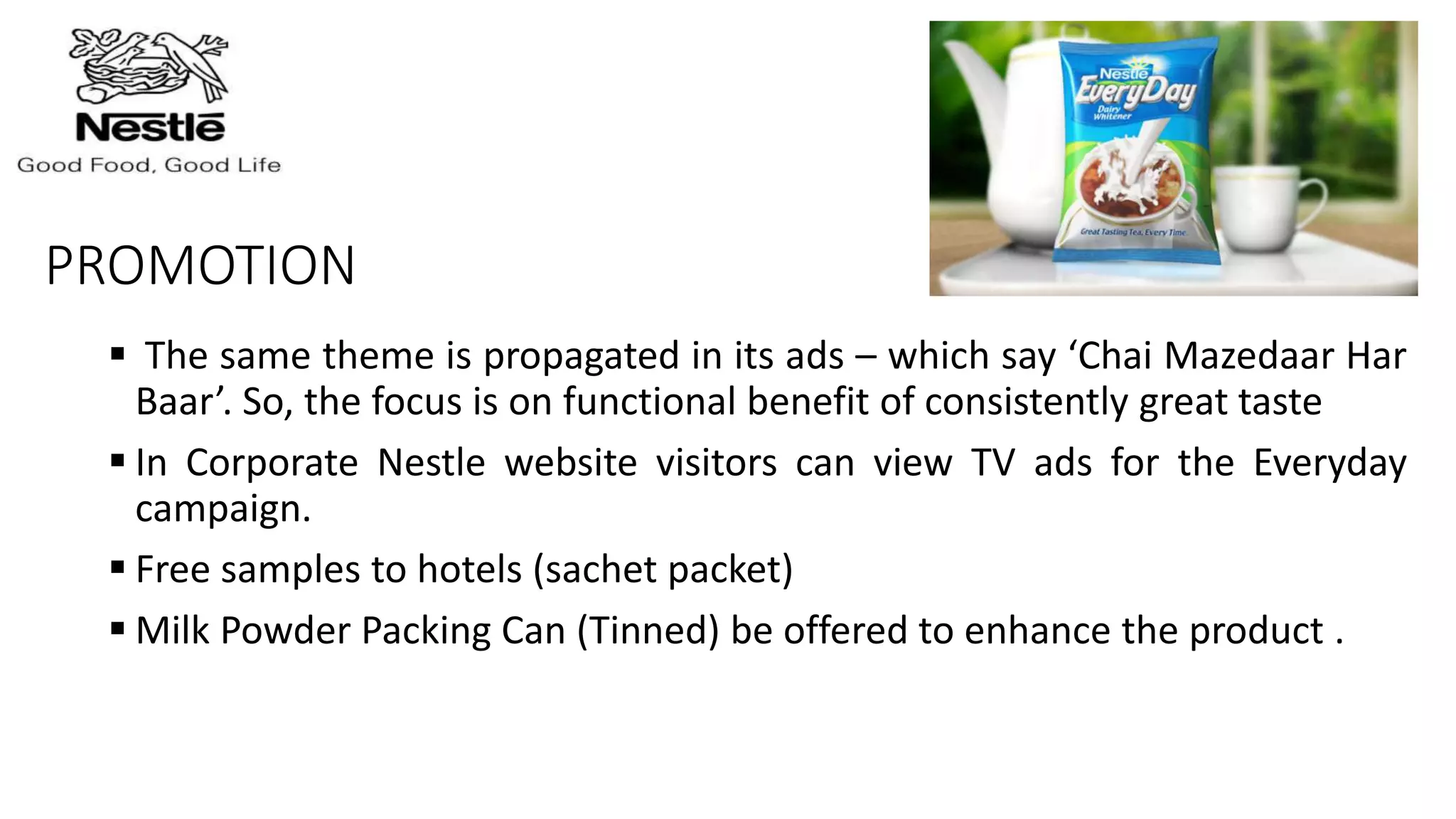
 The same theme is propagated in its ads – which say ‘Chai Mazedaar Har
Baar’. So, the focus is on functional benefit of consistently great taste
 In Corporate Nestle website visitors can view TV ads for the Everyday
campaign.
 Free samples to hotels (sachet packet)
 Milk Powder Packing Can (Tinned) be offered to enhance the product .
Nescafe Classic
Segmentation
• Geographical : Urban Areas
• Demographic : Males and females of age 16yrs – 30yrs (Primary), 30+
(Secondary)
• Psychographic : People of middle class families and upper middle
class families who believe that consumption of coffee indicates high
standard of living
Target
• Main target groups are people ageing between 16yrs – 30yrs who
look for instant quality coffee for their refreshments.
• Differentiation : The only brand having highest level of caffeine
• Positioning : 100% pure instant coffee
Differentiation and Positioning
• “Nes” means miracle and “café” means coffee
• Available in ten product varieties with different tastes
• Made from 100% high quality pure coffee beans of Arabica and
Robusta with rich flavour and aroma
• Pack sizes available are : 50g (Jar and refill packs), 100g (Jar and refill
packs), 200g (Jar and pouches), 500g (pouches)
• Product Characteristics
• Convenience Goods
• Non- Durable
Product
Price
• Skimming strategy
• Product Mix Pricing Strategy
• Price adjustment strategy
• Price leadership strategy
• Price flexibility strategy
Place
Availability
• Retail Shops
• Malls
• Departmental Stores
• Level 3 goods
• Coverage : Covers mostly the urban areas
Promotion
• TV Ads
• Newspapers
• Magazines
• Offers
• Quantity Discounts
• Retail Shelves
• Uses “Pull” strategy
Intro to Maggi Noodles
 Nestlé India Ltd. (NIL), the Indian subsidiary of the
global FMCG major, Nestlé SA.
 Introduced Maggi in India in 1982.
 It launched Maggi 2 Minute Noodles, an instant
noodles product
 With the launch of Maggi noodles, NUL created a new
food category in Indian packaged food market.
STDP
• 5-40 age
• Eating habits
• Usage rate- Medium
• Loyalty- split loyal
Segmentation
• Mothers
• People on the move
Targetting
• Food that is easy to cook and healthy to
eat
Positioning
Differentiation • A complete different product, Taste
maker
Product
• MAGGI 2-MINUTE Noodles is one of the largest & most loved snack
food brands that defines the Instant Noodles category in India.
• The quality of the product is high in its segment
• Its available in variable size
• Maggi is a convenience goods- Staples
• One of the most trusted brand
Place
• Maggi noodles is available in urban areas and covering rural area to
certain extend
• Intensive sales-Available at number of small retail shops and
supermarkets
• It is a Level 3 type product
• It is placed in Snacks category
Price
• Value pricing- Low price for high quality offering
• Maggi has a Quantity discount
• Survival objective – Price is kept constant so it is affordable by all
• It is priced as a snack not as meal
• It follows a pull strategy
Promotion
• TV commercials play an important part
• The ‘two minutes’ promise, which started off as an USP.
• All ads for the brand usually focus on the mother-child relationship.
“The mother and child are the celebrities for Maggi,”
• Distributing free samples.
• Direct marketing in Schools and malls
Thank You

Nestle stpd & 4 p's

  • 1.
    STPD & 4P’s of NestleProducts Group Members S.Hari thirumal Sibi Priti Thakur Manish Aritra Sen
  • 3.
    STPD of NestleKit-Kat • Segmentation:  Geographic Segmentation  Both Urban and Rural Areas  Demographic Segmentation.  Segmented for 5 – 40 age groups  Psychographic Segmentation. Consumer’s desire for a good value for Money. Anyone can afford  Targeting:  The young crowd and the ads were in line with the Target Group.
  • 4.
    • Positioning:  Itpositioned it self as anytime snack “Have a Break Have a Kitkat”  A good refreshing chocolate snack. • Differentiation:  Kit Kat differentiated itself based on its finger shaped wafer bar  Kit Kat used advertisement to promote a ritual for eating a Kit Kat.
  • 5.
    Nestle Kit-kat Product: • TheKit – kat have a wide range to suit different targeted segments • Design – Plain bars, filled, chocolate covered wafers, • Brand name - Kit Kat is the UK's best-selling chocolate bar . Nestlé was prepared to pay a record price to acquire Rowntree in 1988 because of the prestigious brands in Rowntree's product portfolio. Kit Kat was an important part of the portfolio • Sizes and Packages – wide range to suit key price points and occasions
  • 6.
    Place • Level 3Product with intensive Distribution • Nestle has developed a distribution channel which ensures availability to buy wherever and whenever the consumer wishes to purchase it . • Strong coverage in urban areas, developing in rural. • Stored in cold storage • New Regional Sales Offices to increase width and penetration and focus in rural areas.
  • 7.
    Price • Competitive Pricing– They fix the price in competition with Cadbury • Quantity Discount • The key advantage of maintaining a strong brand image in competitive market is the degree of flexibility in pricing strategy
  • 8.
    Promotion • Direct Marketingat Malls • ADVERTISING • Nestle joined hands with Google and co-branding its product. • Decreased dependence on children’s TV channels over recent years • 33% of total industry spend but near equal spend on each brand with rival offerings from Cadbury. • Women account for two thirds of all confectionery sales, but a large proportion of these purchases are subsequently consumed by children • Kit-Kat advertisement, A creative technique of promoting product • http://www.youtube.com/watch?v=prFNeCLf_Ok • http://www.youtube.com/watch?v=29GrCUTdu3A
  • 9.
  • 10.
    SEGMENTATION • Demographic -Infants to 3 year children • Geographic - Urban and Semi-urban areas • Behavioral - Usage rate, high for different stages TARGETING • Mothers in Urban and Semi-urban areas
  • 11.
    Differentiation • Its uniquestay fresh seal and along lasting shelf life gives the brand a formidable competitive advantage. Positioning Has positioned among people as healthy baby product, ‘best start for a healthier future ‘
  • 12.
    PRODUCT • It isavailable in three sizes ,300g and 200g and also in 25g • Shape and color are very attractive for the customers • It is available in different flavors • Convince goods • The quality of the product is high compared to competitors
  • 13.
    PRICE • Mark uppricing Cost of production of good plus a profit • Product quality Based on value perception of the buyers not including price on all aspect • Price of the product is very high due to the good quality of the product • Quantity discount
  • 14.
    PLACE • Nestle cerelacis available all over the region ,regardless of big and small cities Transportation – • It is mainly through road ways Selective market- • Available in pharmacies and baby product shops • It has its own warehouses for storage of products • Level 3 product
  • 15.
    PROMOTION • It hasadopted TV ,news papers ,doctors • Sample distribution through doctor. • “Helps to strengthen babies natural defenses” Complete food for babies Ad • http://www.youtube.com/watch?v=bK-786ah15w • http://www.youtube.com/watch?v=zgrRONRBJDE
  • 16.
  • 17.
    STDP For MaggieKetchup • Segmentation-  Urban(Geographic)  Income(Demographic)  Benefits(Behavioral) • Targeting  Urban-Fast food and restaurants  Income-Middle and upper income household  Benefits-Health consciousness
  • 18.
    •Positioning Tastier , spicyketchup from the pure ingredients at a moderate price. •Differentiation Fresh tomatoes content is more than others. International standard production . Packaging is different .
  • 19.
    PRODUCT • QUALITY-  Offersa wide selection of health conscious choices and utilizes high quality ingredients . • FEATURES-  Tomatoes are more and spicier.  Thick in consistency  Possess no harmful chemical ingredients. • VARIETY - Maggi tomato ketchup, Rich tomato ketchup(with onion and garlic), tomato pudina, hot and sweet tomato chilli sauce, tomato sauce
  • 20.
    • SIZES-  1kg-126, 500 gm-80, 200 gm-40, 90 gm-15 • PACKEGING- Pichkoo-Tetra pack with a cap seal. Thick bottle • CHARACTERISTICS- Consumer good( Convenience good) Non durable
  • 21.
    PLACE • CHANNELS-The distributionnetwork is well spread as it is easily available in all retail stores. • COVERAGE-Available in urban areas. • PLACE-Small retail shops ,malls ,departmental stores and online website. • DISTRIBUTION-It follows a intensive distribution MANUFACTURER DISTRIBUTOR WHOLE SELLER RETAILER FINAL CONSUMER
  • 22.
    PRICE • Pricing policy- Qualityoriented Mark up pricing Quantity discount High priced
  • 23.
    PROMOTION • They promotetheir product very effectively through television. • They have applied the strategy of brand extension. • They also sponsor various cookery shows to promote alternate usage of products. • They also use strategy of free product samples to promote it. • Celebrity endorsements. Eg. Javed Jafferi • Online/Website • Retail Shelves • KFC & McD free samples
  • 25.
    Segmentation  Demographic :Age (5-60 yrs), all genders  Geographic : Pan India.  Psychographic : Middle class, upper middle class. Targeting  Adult (18-40yrs)  Urban area
  • 26.
    Differentiation It is popularin the market for its unique taste, freshness, and dryness for longer period. Positioning  Every Day Dairy Whitener is a milk powder with high nutritional value made to add a rich and smooth taste to the consumers’ tea
  • 27.
    PRODUCT  Nestle EverydayDairy Whitener (1986)  Perfectly consistent homogeneous milk solution (without clots and granules every time)  140 years of expertise; A survey across 4 cities of India showed that nearly 8 out of 10 people prefer tea made with Nestle EveryDay  Nestle is adapting the packaging of some of its products to ensure consumers of all ages can use them without difficulty , Its called “ Inclusive Design ”  In the market, Nestle EveryDay is available in five different sizes (10gm,200gm, 400gm,750gm and 1kg).
  • 28.
    PLACE  Nestle EveryDayis level three product. (Manufacturer – Distributor – Wholesaler –Retailer - Consumer)  Pan India (Through various retail shop)  They transport their products at major regional sales office which are situated at different cites of India  Production : Moga (Punjab), Choladi (Tamil Nadu), Nanjangud (Karnataka), Samalkha (Haryana), Pantnagar (Uttarakhand), Tahliwal (Himachal Pradesh)  Point of sales display.
  • 29.
    PRICE  In themarket, Nestle EveryDay is available in five different sizes  It has a price ranging from 10gm - Rs:10 200gm - Rs : 82 400gm - Rs : 155 750gm - Rs : 260 1kg - Rs : 391  So people have different choices to buy.  EveryDay discount pack 5 %,10%  This shows how they want to capture the market.
  • 30.
    PROMOTION  The sametheme is propagated in its ads – which say ‘Chai Mazedaar Har Baar’. So, the focus is on functional benefit of consistently great taste  In Corporate Nestle website visitors can view TV ads for the Everyday campaign.  Free samples to hotels (sachet packet)  Milk Powder Packing Can (Tinned) be offered to enhance the product .
  • 31.
  • 32.
    Segmentation • Geographical :Urban Areas • Demographic : Males and females of age 16yrs – 30yrs (Primary), 30+ (Secondary) • Psychographic : People of middle class families and upper middle class families who believe that consumption of coffee indicates high standard of living Target • Main target groups are people ageing between 16yrs – 30yrs who look for instant quality coffee for their refreshments.
  • 33.
    • Differentiation :The only brand having highest level of caffeine • Positioning : 100% pure instant coffee Differentiation and Positioning
  • 34.
    • “Nes” meansmiracle and “café” means coffee • Available in ten product varieties with different tastes • Made from 100% high quality pure coffee beans of Arabica and Robusta with rich flavour and aroma • Pack sizes available are : 50g (Jar and refill packs), 100g (Jar and refill packs), 200g (Jar and pouches), 500g (pouches) • Product Characteristics • Convenience Goods • Non- Durable Product
  • 35.
    Price • Skimming strategy •Product Mix Pricing Strategy • Price adjustment strategy • Price leadership strategy • Price flexibility strategy
  • 36.
    Place Availability • Retail Shops •Malls • Departmental Stores • Level 3 goods • Coverage : Covers mostly the urban areas
  • 37.
    Promotion • TV Ads •Newspapers • Magazines • Offers • Quantity Discounts • Retail Shelves • Uses “Pull” strategy
  • 38.
    Intro to MaggiNoodles  Nestlé India Ltd. (NIL), the Indian subsidiary of the global FMCG major, Nestlé SA.  Introduced Maggi in India in 1982.  It launched Maggi 2 Minute Noodles, an instant noodles product  With the launch of Maggi noodles, NUL created a new food category in Indian packaged food market.
  • 39.
    STDP • 5-40 age •Eating habits • Usage rate- Medium • Loyalty- split loyal Segmentation • Mothers • People on the move Targetting • Food that is easy to cook and healthy to eat Positioning Differentiation • A complete different product, Taste maker
  • 40.
    Product • MAGGI 2-MINUTENoodles is one of the largest & most loved snack food brands that defines the Instant Noodles category in India. • The quality of the product is high in its segment • Its available in variable size • Maggi is a convenience goods- Staples • One of the most trusted brand
  • 41.
    Place • Maggi noodlesis available in urban areas and covering rural area to certain extend • Intensive sales-Available at number of small retail shops and supermarkets • It is a Level 3 type product • It is placed in Snacks category
  • 42.
    Price • Value pricing-Low price for high quality offering • Maggi has a Quantity discount • Survival objective – Price is kept constant so it is affordable by all • It is priced as a snack not as meal • It follows a pull strategy
  • 43.
    Promotion • TV commercialsplay an important part • The ‘two minutes’ promise, which started off as an USP. • All ads for the brand usually focus on the mother-child relationship. “The mother and child are the celebrities for Maggi,” • Distributing free samples. • Direct marketing in Schools and malls
  • 44.

Editor's Notes

  • #5 The ritual has the following steps: Remove the wrapper. Separate a finger bar using your finger. Break the bar. Eat it. Surprisingly customers accepted this ritual. Even now, after over 12 years of this campaign, still customers follow this ritual. That shows the power of smart advertising
  • #30 10gm - Rs :10 200gm - Rs : 82 400gm - Rs : 155 750gm - Rs : 260 1kg - Rs : 391
  • #39 Top raman 1990 was a problem Change in formulation in 1990’s
  • #40 Medium-snacks Regular-daily
  • #41 Maggi long life nd no compliants For cho it is impulse
  • #42 Level 3-man,whole,job,retail,customer Transport Inventory
  • #43 Prot quqlity