DABUR INDIA LTD.

    Bhargav Dudagadapa
    Gautam Siddharth
1   Vamsikrishna Pedada
    Ajinkya Patil
    Eshant Gaur
    Mohil Poojara
DABUR- A COMPANY PROFILE
2
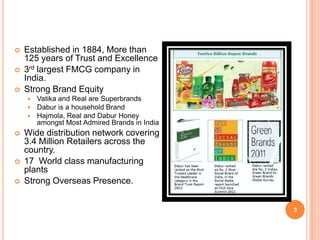
   Established in 1884, More than
    125 years of Trust and Excellence
   3rd largest FMCG company in
    India.
   Strong Brand Equity
       Vatika and Real are Superbrands
       Dabur is a household Brand
       Hajmola, Real and Dabur Honey
        amongst Most Admired Brands in India
   Wide distribution network covering
    3.4 Million Retailers across the
    country.
   17 World class manufacturing
    plants
   Strong Overseas Presence.


                                               3
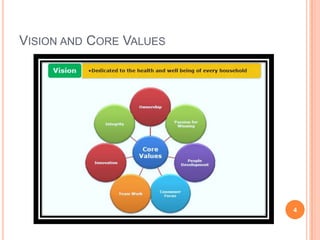
VISION AND CORE VALUES


                         4
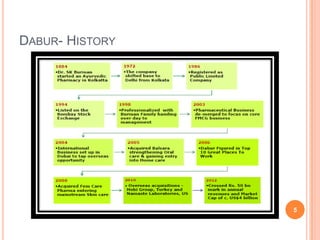
DABUR- HISTORY


                 5
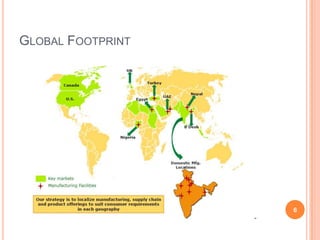
GLOBAL FOOTPRINT


                   6
FMCG SECTOR IN INDIA
7
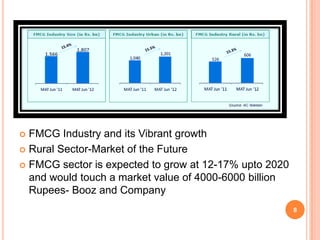
 FMCG Industry and its Vibrant growth
 Rural Sector-Market of the Future

 FMCG sector is expected to grow at 12-17% upto 2020
  and would touch a market value of 4000-6000 billion
  Rupees- Booz and Company
                                                        8
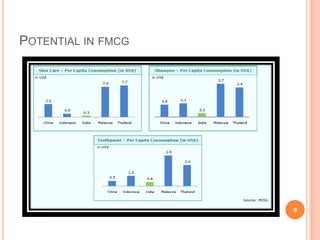
POTENTIAL IN FMCG


                    9
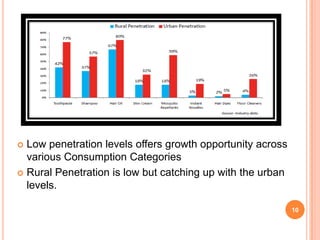
 Low penetration levels offers growth opportunity across
  various Consumption Categories
 Rural Penetration is low but catching up with the urban
  levels.

                                                            10
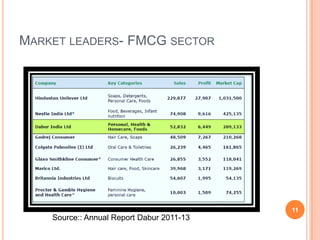
MARKET LEADERS- FMCG SECTOR


                                           11
    Source:: Annual Report Dabur 2011-13
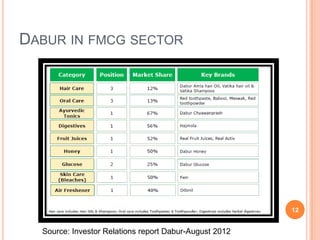
DABUR IN FMCG SECTOR


                                                        12


  Source: Investor Relations report Dabur-August 2012
FINANCIALS OF DABUR
13
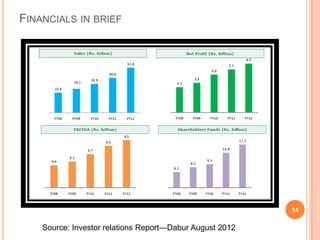
FINANCIALS IN BRIEF


                                                          14

    Source: Investor relations Report—Dabur August 2012
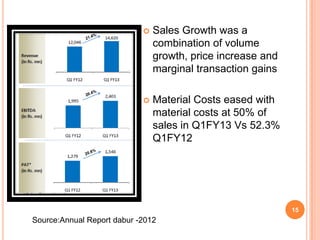
   Sales Growth was a
                                combination of volume
                                growth, price increase and
                                marginal transaction gains

                               Material Costs eased with
                                material costs at 50% of
                                sales in Q1FY13 Vs 52.3%
                                Q1FY12


                                                             15
Source:Annual Report dabur -2012
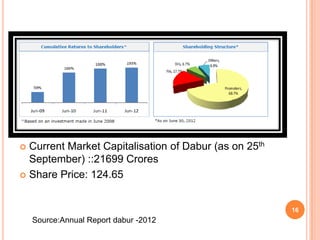
 Current Market Capitalisation of Dabur (as on 25th
  September) ::21699 Crores
 Share Price: 124.65


                                                       16
    Source:Annual Report dabur -2012
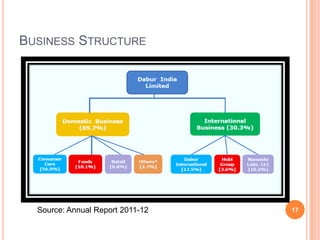
BUSINESS STRUCTURE


  Source: Annual Report 2011-12   17
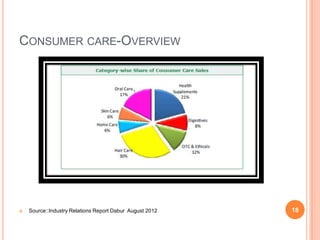
CONSUMER CARE-OVERVIEW


   Source::Industry Relations Report Dabur August 2012   18
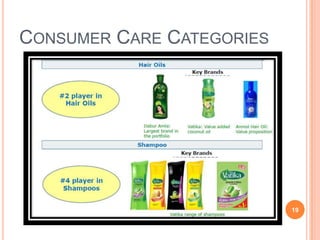
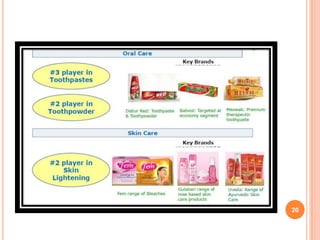
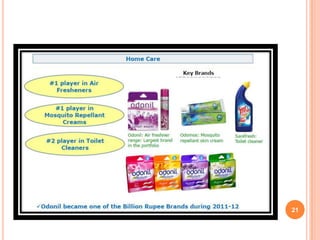
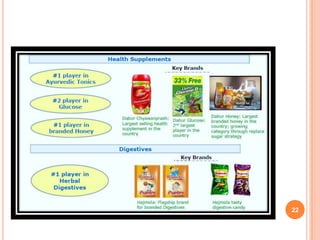
CONSUMER CARE CATEGORIES


                           19
20
21
22
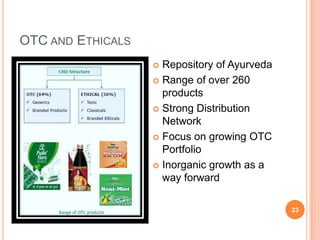
OTC AND ETHICALS
                    Repository of Ayurveda
                    Range of over 260
                     products
                    Strong Distribution
                     Network
                    Focus on growing OTC
                     Portfolio
                    Inorganic growth as a
                     way forward

                                              23
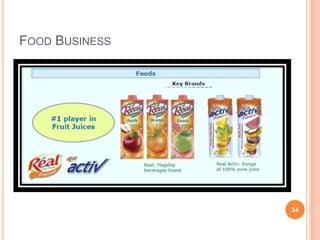
FOOD BUSINESS


                24
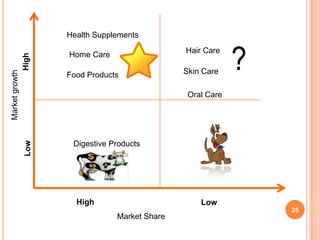
Health Supplements
                                               Hair Care
                    Home Care
             High


                                               Skin Care
Market growth


                    Food Products

                                                Oral Care
           Low


                     Digestive Products


                      High                         Low
                                                            25
                                Market Share
DABUR’S MERGERS AND
     ACQUISITIONS
26
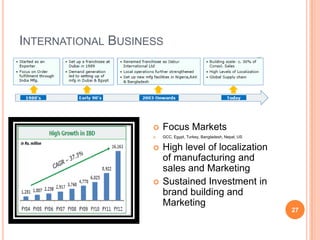
INTERNATIONAL BUSINESS


                       Focus Markets
                       GCC, Egypt, Turkey, Bangladesh, Nepal, US

                       High level of localization
                        of manufacturing and
                        sales and Marketing
                       Sustained Investment in
                        brand building and
                        Marketing
                                                                    27
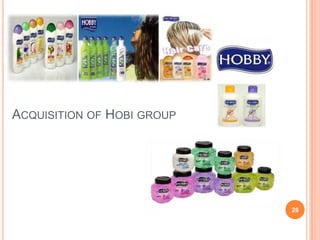
ACQUISITION OF HOBI GROUP


                            28
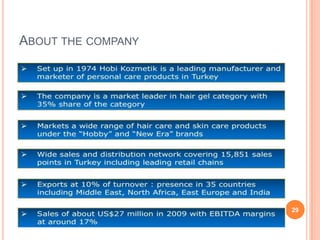
ABOUT THE COMPANY


                    29
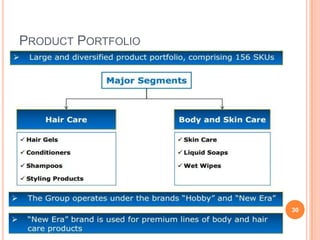
PRODUCT PORTFOLIO


                    30
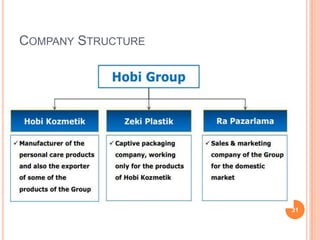
COMPANY STRUCTURE


                    31
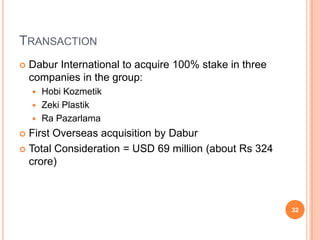
TRANSACTION
   Dabur International to acquire 100% stake in three
    companies in the group:
     Hobi Kozmetik
     Zeki Plastik
     Ra Pazarlama

 First Overseas acquisition by Dabur
 Total Consideration = USD 69 million (about Rs 324
  crore)


                                                         32
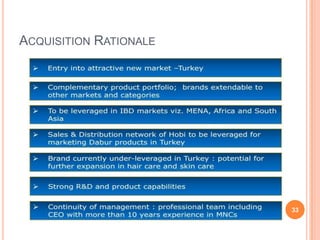
ACQUISITION RATIONALE


                        33
ACQUISITION OF NAMASTE LABS, USA


                                   34
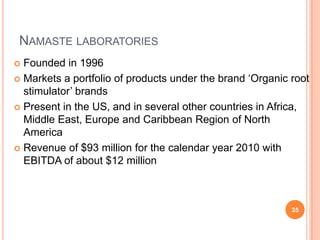
NAMASTE LABORATORIES
 Founded in 1996
 Markets a portfolio of products under the brand ‘Organic root
  stimulator’ brands
 Present in the US, and in several other countries in Africa,
  Middle East, Europe and Caribbean Region of North
  America
 Revenue of $93 million for the calendar year 2010 with
  EBITDA of about $12 million


                                                           35
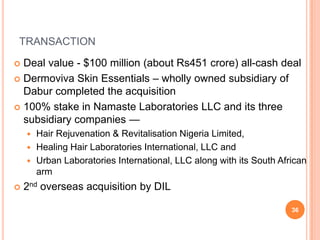
TRANSACTION

 Deal value - $100 million (about Rs451 crore) all-cash deal
 Dermoviva Skin Essentials – wholly owned subsidiary of
  Dabur completed the acquisition
 100% stake in Namaste Laboratories LLC and its three
  subsidiary companies —
     Hair Rejuvenation & Revitalisation Nigeria Limited,
     Healing Hair Laboratories International, LLC and
     Urban Laboratories International, LLC along with its South African
      arm
   2nd overseas acquisition by DIL

                                                                    36
RATIONALE

 Will serve as a gateway to the US market for
  Dabur’s portfolio of consumer products
 Enhances profitability

 Increases stakeholders value

 Adds to Dabur's already strong presence in Africa

 Dabur's entry into the fast-growing USD 1.5-billion
  ethnic hair care products market in the US, Europe
  and Africa


                                                        37
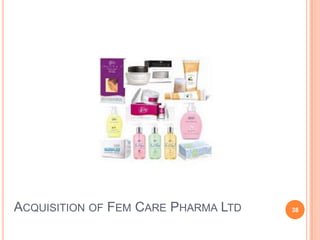
ACQUISITION OF FEM CARE PHARMA LTD   38
FPCL
 Fem Care Pharma Limited was promoted in 1982
 Listed on Bombay Stock Exchange since 1994

 The company markets bleach, liquid soaps and hair
  removing creams under the ‘Fem’ brand
 Distribution reach covering 1,25,000 retail outlets;
  also covers 25,000 parlours directly
 Highly profitable company with gross margins of
  over 60%


                                                         39
DEAL STRUCTURE
 DIL has signed an agreement to acquire 72.15% stake from
  the existing promoters.
 ™The transaction values FCPL at an equity value of Rs
  282.4 crores.
™  Dabur to make an open offer to acquire further 20% of the
  FCPL’s equity share capital.
™  Specialty chemicals division and some other investments
  will be bought over by promoters at book value or market
  value whichever is higher.
™  Acquisition to be funded through internal accruals of Dabur
  India Ltd.
                                                           40
RATIONALE

   Revenue Synergies
       Brand provides access to DIL into fast expanding skin care market
        at mass price points
       Higher reach/penetration for FCPL portfolio through DIL’s
        distribution network
       Potential for extending FEM brand into other related skin care
        categories.
       Potential in International markets: FEM & Jaquline brands have
        presence in GCC/Middle east markets which can be expanded.
       FCPL’s parlour outreach to be leveraged for promoting Dabur’s
        personal care portfolio

                                                                    41
RATIONALE

   Cost Synergies
       Combined business to unlock synergies : Sales &
        Distribution, Marketing, Supply Chain, Sourcing & Manufacturing
       FCPL’s Baddi unit synergistic with DIL’s own skin care plans
       Greater efficiencies possible in trade and distribution
       Combined Adpro spends can be leveraged to reduce media costs
       FCPL’s R&D knowledge in skin care to supplement domain
        knowledge for DIL


                                                                   42
DABUR ACQUIRES AJANTA PHARMA CAPSULE BRAND


                                             43
AJANTA 30 PLUS
 Launched in 1990 as an herbal energizer capsule
 Key brand for Ajanta Pharmaceuticals

 30-Plus is one of the oldest and strongest health care
  energizer brands in the country

   The financial terms and conditions of the deal were not
    disclosed


                                                              44
SWOT ANALYSIS
Strengths
 Competitive pricing
 Ayurvedic Repsitory.
 Strong Brand Image
 Strong Financially
 Strong Research and Innovation base.
 IT base
Weakness
 No direct Outlets.
 Seasonal Demands
 Lack of awareness about Ayurvedic Products   45
Opportunities
 Growing Awareness of Ayurveda

 Improper and Unhealthy Food habits

 Growing Rural Markets

 Growing Middle Class Women and Beauty Sector


Threats
 Allopathic Players; Advertising and Distribution

 Growing Substitutes.

 Growing Health Tourism of Kerala.


                                                     46
FUTURE OF DABUR INDIA
47
RETAIL STORE

   ‘New U’ –A retail store for complete makeover of women
   The brands under NewU includes Dabur’s own private
    label, NewU, range of affordably priced cosmetics such as nail
    paints, facial kits and hair accessory among others
   Rising beauty consciousness.
   The roughly Rs 7,000 crore organized and unorganized hair
    and beauty industry is growing at the CAGR of 35%. At this
    rate, it has the potential to become a Rs-30 ,000 crore
    business by 2015
   Expansion of presence in Retail sector.
   FDI in Muli-Retail
   Online Marketing.
                                                                     48
CRITERIA OF M&A
 Foreign Company/Indian Company
 Plans to expand/Already established retail player in
  Beauty Care


                                                         49
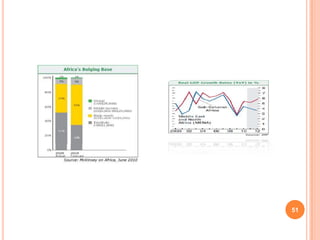
GROWTH IN AFRICAN MARKET
 Africa Epi-Center of our growt
 Africa’s real compound GDP growth, about 5
  percent annually between 2002 and 2009
 Consumer Spending to be boosted by 35% till
  2015.
 New plants in South Africa, Kenya and Nigeria
  coming up.
 Products acquired through Namaste Lab and Hoby
  have to be leveraged in these markets
 Manufacturing Plants to be set up in Egypt and
  Nigeria
 Inorganic growth                                 50
51
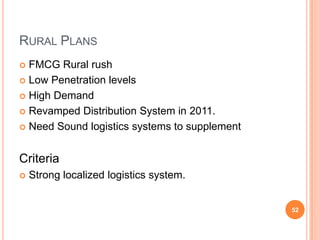
RURAL PLANS
 FMCG Rural rush
 Low Penetration levels

 High Demand

 Revamped Distribution System in 2011.

 Need Sound logistics systems to supplement


Criteria
   Strong localized logistics system.


                                               52
 Expansion of Health Suppliments
 Expansion of OTC & Ethicals

 Expansion of Ayurvedic Products


                                    53
54

Dabur presentation

  • 1.
    DABUR INDIA LTD. Bhargav Dudagadapa Gautam Siddharth 1 Vamsikrishna Pedada Ajinkya Patil Eshant Gaur Mohil Poojara
  • 2.
  • 3.
    Established in 1884, More than 125 years of Trust and Excellence  3rd largest FMCG company in India.  Strong Brand Equity  Vatika and Real are Superbrands  Dabur is a household Brand  Hajmola, Real and Dabur Honey amongst Most Admired Brands in India  Wide distribution network covering 3.4 Million Retailers across the country.  17 World class manufacturing plants  Strong Overseas Presence. 3
  • 4.
  • 5.
  • 6.
  • 7.
  • 8.
     FMCG Industryand its Vibrant growth  Rural Sector-Market of the Future  FMCG sector is expected to grow at 12-17% upto 2020 and would touch a market value of 4000-6000 billion Rupees- Booz and Company 8
  • 9.
  • 10.
     Low penetrationlevels offers growth opportunity across various Consumption Categories  Rural Penetration is low but catching up with the urban levels. 10
  • 11.
    MARKET LEADERS- FMCGSECTOR 11 Source:: Annual Report Dabur 2011-13
  • 12.
    DABUR IN FMCGSECTOR 12 Source: Investor Relations report Dabur-August 2012
  • 13.
  • 14.
    FINANCIALS IN BRIEF 14 Source: Investor relations Report—Dabur August 2012
  • 15.
    Sales Growth was a combination of volume growth, price increase and marginal transaction gains  Material Costs eased with material costs at 50% of sales in Q1FY13 Vs 52.3% Q1FY12 15 Source:Annual Report dabur -2012
  • 16.
     Current MarketCapitalisation of Dabur (as on 25th September) ::21699 Crores  Share Price: 124.65 16 Source:Annual Report dabur -2012
  • 17.
    BUSINESS STRUCTURE Source: Annual Report 2011-12 17
  • 18.
    CONSUMER CARE-OVERVIEW  Source::Industry Relations Report Dabur August 2012 18
  • 19.
  • 20.
  • 21.
  • 22.
  • 23.
    OTC AND ETHICALS  Repository of Ayurveda  Range of over 260 products  Strong Distribution Network  Focus on growing OTC Portfolio  Inorganic growth as a way forward 23
  • 24.
  • 25.
    Health Supplements Hair Care Home Care High Skin Care Market growth Food Products Oral Care Low Digestive Products High Low 25 Market Share
  • 26.
    DABUR’S MERGERS AND ACQUISITIONS 26
  • 27.
    INTERNATIONAL BUSINESS  Focus Markets  GCC, Egypt, Turkey, Bangladesh, Nepal, US  High level of localization of manufacturing and sales and Marketing  Sustained Investment in brand building and Marketing 27
  • 28.
  • 29.
  • 30.
  • 31.
  • 32.
    TRANSACTION  Dabur International to acquire 100% stake in three companies in the group:  Hobi Kozmetik  Zeki Plastik  Ra Pazarlama  First Overseas acquisition by Dabur  Total Consideration = USD 69 million (about Rs 324 crore) 32
  • 33.
  • 34.
  • 35.
    NAMASTE LABORATORIES  Foundedin 1996  Markets a portfolio of products under the brand ‘Organic root stimulator’ brands  Present in the US, and in several other countries in Africa, Middle East, Europe and Caribbean Region of North America  Revenue of $93 million for the calendar year 2010 with EBITDA of about $12 million 35
  • 36.
    TRANSACTION  Deal value- $100 million (about Rs451 crore) all-cash deal  Dermoviva Skin Essentials – wholly owned subsidiary of Dabur completed the acquisition  100% stake in Namaste Laboratories LLC and its three subsidiary companies —  Hair Rejuvenation & Revitalisation Nigeria Limited,  Healing Hair Laboratories International, LLC and  Urban Laboratories International, LLC along with its South African arm  2nd overseas acquisition by DIL 36
  • 37.
    RATIONALE  Will serveas a gateway to the US market for Dabur’s portfolio of consumer products  Enhances profitability  Increases stakeholders value  Adds to Dabur's already strong presence in Africa  Dabur's entry into the fast-growing USD 1.5-billion ethnic hair care products market in the US, Europe and Africa 37
  • 38.
    ACQUISITION OF FEMCARE PHARMA LTD 38
  • 39.
    FPCL  Fem CarePharma Limited was promoted in 1982  Listed on Bombay Stock Exchange since 1994  The company markets bleach, liquid soaps and hair removing creams under the ‘Fem’ brand  Distribution reach covering 1,25,000 retail outlets; also covers 25,000 parlours directly  Highly profitable company with gross margins of over 60% 39
  • 40.
    DEAL STRUCTURE  DILhas signed an agreement to acquire 72.15% stake from the existing promoters.  ™The transaction values FCPL at an equity value of Rs 282.4 crores. ™ Dabur to make an open offer to acquire further 20% of the FCPL’s equity share capital. ™ Specialty chemicals division and some other investments will be bought over by promoters at book value or market value whichever is higher. ™ Acquisition to be funded through internal accruals of Dabur India Ltd. 40
  • 41.
    RATIONALE  Revenue Synergies  Brand provides access to DIL into fast expanding skin care market at mass price points  Higher reach/penetration for FCPL portfolio through DIL’s distribution network  Potential for extending FEM brand into other related skin care categories.  Potential in International markets: FEM & Jaquline brands have presence in GCC/Middle east markets which can be expanded.  FCPL’s parlour outreach to be leveraged for promoting Dabur’s personal care portfolio 41
  • 42.
    RATIONALE  Cost Synergies  Combined business to unlock synergies : Sales & Distribution, Marketing, Supply Chain, Sourcing & Manufacturing  FCPL’s Baddi unit synergistic with DIL’s own skin care plans  Greater efficiencies possible in trade and distribution  Combined Adpro spends can be leveraged to reduce media costs  FCPL’s R&D knowledge in skin care to supplement domain knowledge for DIL 42
  • 43.
    DABUR ACQUIRES AJANTAPHARMA CAPSULE BRAND 43
  • 44.
    AJANTA 30 PLUS Launched in 1990 as an herbal energizer capsule  Key brand for Ajanta Pharmaceuticals  30-Plus is one of the oldest and strongest health care energizer brands in the country  The financial terms and conditions of the deal were not disclosed 44
  • 45.
    SWOT ANALYSIS Strengths  Competitivepricing  Ayurvedic Repsitory.  Strong Brand Image  Strong Financially  Strong Research and Innovation base.  IT base Weakness  No direct Outlets.  Seasonal Demands  Lack of awareness about Ayurvedic Products 45
  • 46.
    Opportunities  Growing Awarenessof Ayurveda  Improper and Unhealthy Food habits  Growing Rural Markets  Growing Middle Class Women and Beauty Sector Threats  Allopathic Players; Advertising and Distribution  Growing Substitutes.  Growing Health Tourism of Kerala. 46
  • 47.
  • 48.
    RETAIL STORE  ‘New U’ –A retail store for complete makeover of women  The brands under NewU includes Dabur’s own private label, NewU, range of affordably priced cosmetics such as nail paints, facial kits and hair accessory among others  Rising beauty consciousness.  The roughly Rs 7,000 crore organized and unorganized hair and beauty industry is growing at the CAGR of 35%. At this rate, it has the potential to become a Rs-30 ,000 crore business by 2015  Expansion of presence in Retail sector.  FDI in Muli-Retail  Online Marketing. 48
  • 49.
    CRITERIA OF M&A Foreign Company/Indian Company  Plans to expand/Already established retail player in Beauty Care 49
  • 50.
    GROWTH IN AFRICANMARKET  Africa Epi-Center of our growt  Africa’s real compound GDP growth, about 5 percent annually between 2002 and 2009  Consumer Spending to be boosted by 35% till 2015.  New plants in South Africa, Kenya and Nigeria coming up.  Products acquired through Namaste Lab and Hoby have to be leveraged in these markets  Manufacturing Plants to be set up in Egypt and Nigeria  Inorganic growth 50
  • 51.
  • 52.
    RURAL PLANS  FMCGRural rush  Low Penetration levels  High Demand  Revamped Distribution System in 2011.  Need Sound logistics systems to supplement Criteria  Strong localized logistics system. 52
  • 53.
     Expansion ofHealth Suppliments  Expansion of OTC & Ethicals  Expansion of Ayurvedic Products 53
  • 54.