Managing Change
Organizational Change
                        Unplanned Change –
Planned Change –        change that is imposed
change resulting        on the organization
from a deliberate       and is often
decision to alter the   unforeseen
organization


        Managers must be
      prepared to handle both
Globalization

   Organizations must rethink
    the most efficient ways to
                                                 Majority of
       Use resources
                                                 new workers
       Disseminate/gather information
                                                 will be female
       Develop people
                                    Workforce will
                                    grow in diversity -
Structural
 Change
   and
                             Workforce is aging -
Mental                       less young workers, more
Change                       middle-aged
                                               Workforce
                                               Diversity
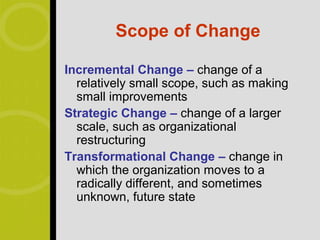
Scope of Change

Incremental Change – change of a
  relatively small scope, such as making
  small improvements
Strategic Change – change of a larger
  scale, such as organizational
  restructuring
Transformational Change – change in
  which the organization moves to a
  radically different, and sometimes
  unknown, future state
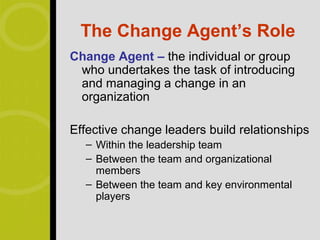
The Change Agent’s Role
Change Agent – the individual or group
 who undertakes the task of introducing
 and managing a change in an
 organization

Effective change leaders build relationships
  – Within the leadership team
  – Between the team and organizational
    members
  – Between the team and key environmental
    players
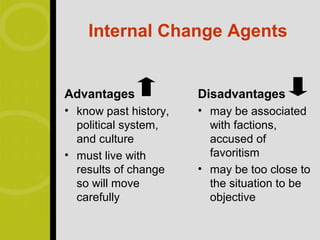
Internal Change Agents


Advantages             Disadvantages
• know past history,   • may be associated
  political system,      with factions,
  and culture            accused of
• must live with         favoritism
  results of change    • may be too close to
  so will move           the situation to be
  carefully              objective
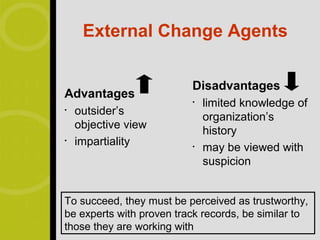
External Change Agents

                          Disadvantages
Advantages
                          •   limited knowledge of
•   outsider’s
                              organization’s
    objective view
                              history
•   impartiality          •   may be viewed with
                              suspicion


To succeed, they must be perceived as trustworthy,
be experts with proven track records, be similar to
those they are working with
Resistance to Change
• Fear of the unknown
• Fear of loss
• Fear of failure
• Disruption of
  interpersonal
  relationships
• Personality conflicts
• Politics
• Cultural assumptions
  and values
Dealing with
  Resistance to Change
• Communication
   – details
   – rationale
• Participation in
  the process
   – ownership
   – commitment
• Empathy and
  support
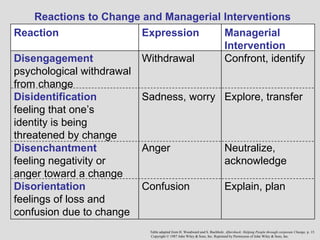
Reactions to Change and Managerial Interventions
Reaction                 Expression     Managerial
                                        Intervention
Disengagement            Withdrawal     Confront, identify
psychological withdrawal
from change
Disidentification        Sadness, worry Explore, transfer
feeling that one’s
identity is being
threatened by change
Disenchantment           Anger          Neutralize,
feeling negativity or                   acknowledge
anger toward a change
Disorientation           Confusion      Explain, plan
feelings of loss and
confusion due to change
                           Table adapted from H. Woodward and S. Buchholz. Aftershock: Helping People through corporate Change, p. 15.
                           Copyright © 1987 John Wiley & Sons, Inc. Reprinted by Permission of John Wiley & Sons, Inc.
Lewin’s Three-Step Change
          Model

1. Unfreezing – involves encouraging
  individuals to discard old behaviors by
  shaking up the equilibrium state that
  maintains the status quo
2. Moving – new attitudes, values, and
  behaviors are substituted for old ones
3. Refreezing – involves the
  establishment of new attitudes, values,
  and behaviors as the new status quo
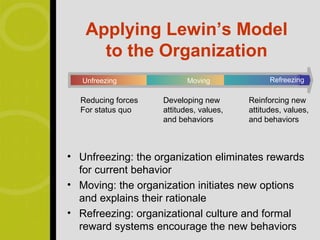
Applying Lewin’s Model
     to the Organization
   Unfreezing              Moving              Refreezing

  Reducing forces   Developing new       Reinforcing new
  For status quo    attitudes, values,   attitudes, values,
                    and behaviors        and behaviors


• Unfreezing: the organization eliminates rewards
  for current behavior
• Moving: the organization initiates new options
  and explains their rationale
• Refreezing: organizational culture and formal
  reward systems encourage the new behaviors
Organizational Development (OD)

 Organizational Development (OD) – a
  systematic approach to organizational
  improvement that applies behavioral
  science theory and research in order to
  increase individual and organizational
  well-being and effectiveness
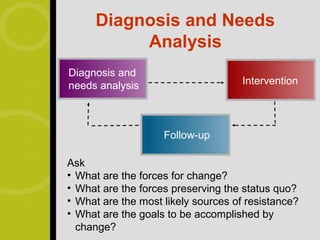
Diagnosis and Needs
           Analysis
Diagnosis and
needs analysis                       Intervention


                    Follow-up

Ask
• What are the forces for change?
• What are the forces preserving the status quo?
• What are the most likely sources of resistance?
• What are the goals to be accomplished by
  change?
OD Intervention Methods:
Organizational/Group Techniques

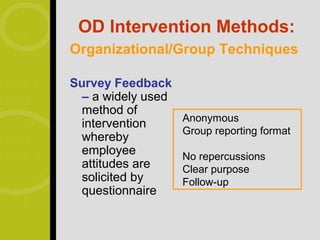
Survey Feedback
 – a widely used
 method of
                   Anonymous
 intervention
                   Group reporting format
 whereby
 employee          No repercussions
 attitudes are     Clear purpose
 solicited by      Follow-up
 questionnaire
OD Intervention Methods:
 Organizational/Group Techniques
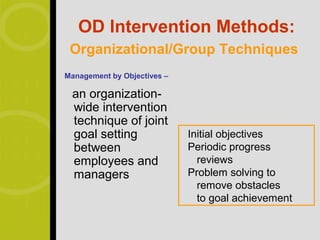
Management by Objectives –

 an organization-
 wide intervention
 technique of joint
 goal setting                Initial objectives
 between                     Periodic progress
 employees and                 reviews
 managers                    Problem solving to
                               remove obstacles
                               to goal achievement
OD Intervention Methods:
 Organizational/Group Techniques

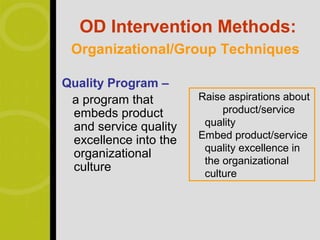
Quality Program –
 a program that        Raise aspirations about
 embeds product             product/service
 and service quality    quality
                       Embed product/service
 excellence into the
                        quality excellence in
 organizational
                        the organizational
 culture                culture
OD Intervention Methods:
  Organizational/Group Techniques
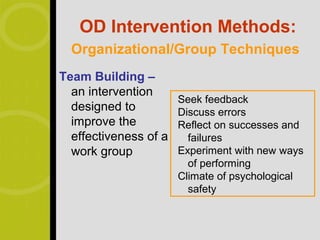
Team Building –
  an intervention
                       Seek feedback
  designed to          Discuss errors
  improve the          Reflect on successes and
  effectiveness of a     failures
  work group           Experiment with new ways
                         of performing
                       Climate of psychological
                         safety
OD Intervention Methods:
 Organizational/Group Techniques

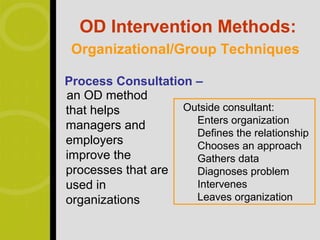
Process Consultation –
an OD method
that helps         Outside consultant:
                     Enters organization
managers and
                     Defines the relationship
employers            Chooses an approach
improve the          Gathers data
processes that are   Diagnoses problem
used in              Intervenes
organizations        Leaves organization
OD Intervention Methods:
  Individual-Focused Techniques

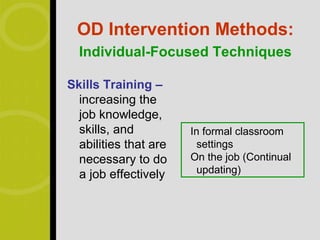
Skills Training –
  increasing the
  job knowledge,
  skills, and          In formal classroom
  abilities that are     settings
  necessary to do      On the job (Continual
  a job effectively      updating)
OD Intervention Methods:
  Individual-Focused Techniques

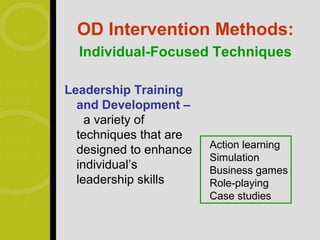
Leadership Training
  and Development –
    a variety of
  techniques that are
                        Action learning
  designed to enhance
                        Simulation
  individual’s          Business games
  leadership skills     Role-playing
                        Case studies
OD Intervention Methods:
   Individual-Focused Techniques

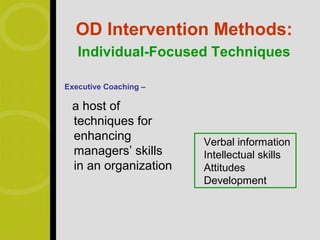
Executive Coaching –

 a host of
 techniques for
 enhancing             Verbal information
 managers’ skills      Intellectual skills
 in an organization    Attitudes
                       Development
OD Intervention Methods:
  Individual-Focused Techniques

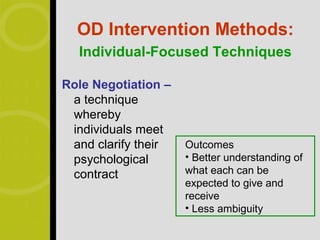
Role Negotiation –
 a technique
 whereby
 individuals meet
 and clarify their   Outcomes
 psychological       • Better understanding of
 contract            what each can be
                     expected to give and
                     receive
                     • Less ambiguity
OD Intervention Methods:
  Individual-Focused Techniques
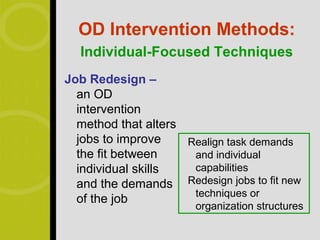
Job Redesign –
  an OD
  intervention
  method that alters
  jobs to improve    Realign task demands
  the fit between     and individual
  individual skills   capabilities
  and the demands Redesign jobs to fit new
                      techniques or
  of the job
                       organization structures
OD Intervention Methods:
  Individual-Focused Techniques

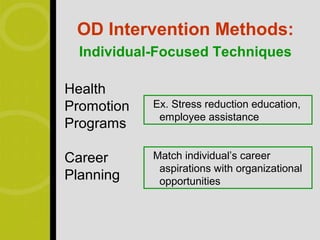
Health
Promotion   Ex. Stress reduction education,
             employee assistance
Programs

Career      Match individual’s career
             aspirations with organizational
Planning     opportunities
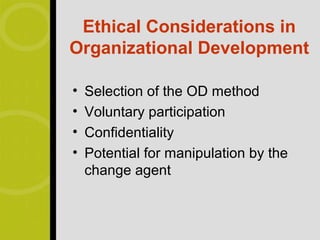
Ethical Considerations in
Organizational Development

•   Selection of the OD method
•   Voluntary participation
•   Confidentiality
•   Potential for manipulation by the
    change agent

Org change new

  • 1.
  • 2.
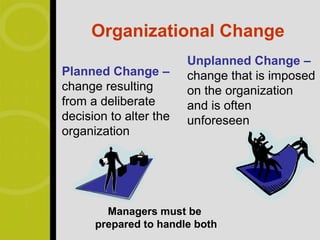
    Organizational Change Unplanned Change – Planned Change – change that is imposed change resulting on the organization from a deliberate and is often decision to alter the unforeseen organization Managers must be prepared to handle both
  • 3.
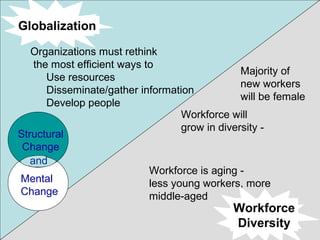
    Globalization Organizations must rethink the most efficient ways to Majority of Use resources new workers Disseminate/gather information will be female Develop people Workforce will grow in diversity - Structural Change and Workforce is aging - Mental less young workers, more Change middle-aged Workforce Diversity
  • 4.
    Scope of Change IncrementalChange – change of a relatively small scope, such as making small improvements Strategic Change – change of a larger scale, such as organizational restructuring Transformational Change – change in which the organization moves to a radically different, and sometimes unknown, future state
  • 5.
    The Change Agent’sRole Change Agent – the individual or group who undertakes the task of introducing and managing a change in an organization Effective change leaders build relationships – Within the leadership team – Between the team and organizational members – Between the team and key environmental players
  • 6.
    Internal Change Agents Advantages Disadvantages • know past history, • may be associated political system, with factions, and culture accused of • must live with favoritism results of change • may be too close to so will move the situation to be carefully objective
  • 7.
    External Change Agents Disadvantages Advantages • limited knowledge of • outsider’s organization’s objective view history • impartiality • may be viewed with suspicion To succeed, they must be perceived as trustworthy, be experts with proven track records, be similar to those they are working with
  • 8.
    Resistance to Change •Fear of the unknown • Fear of loss • Fear of failure • Disruption of interpersonal relationships • Personality conflicts • Politics • Cultural assumptions and values
  • 9.
    Dealing with Resistance to Change • Communication – details – rationale • Participation in the process – ownership – commitment • Empathy and support
  • 10.
    Reactions to Changeand Managerial Interventions Reaction Expression Managerial Intervention Disengagement Withdrawal Confront, identify psychological withdrawal from change Disidentification Sadness, worry Explore, transfer feeling that one’s identity is being threatened by change Disenchantment Anger Neutralize, feeling negativity or acknowledge anger toward a change Disorientation Confusion Explain, plan feelings of loss and confusion due to change Table adapted from H. Woodward and S. Buchholz. Aftershock: Helping People through corporate Change, p. 15. Copyright © 1987 John Wiley & Sons, Inc. Reprinted by Permission of John Wiley & Sons, Inc.
  • 11.
    Lewin’s Three-Step Change Model 1. Unfreezing – involves encouraging individuals to discard old behaviors by shaking up the equilibrium state that maintains the status quo 2. Moving – new attitudes, values, and behaviors are substituted for old ones 3. Refreezing – involves the establishment of new attitudes, values, and behaviors as the new status quo
  • 12.
    Applying Lewin’s Model to the Organization Unfreezing Moving Refreezing Reducing forces Developing new Reinforcing new For status quo attitudes, values, attitudes, values, and behaviors and behaviors • Unfreezing: the organization eliminates rewards for current behavior • Moving: the organization initiates new options and explains their rationale • Refreezing: organizational culture and formal reward systems encourage the new behaviors
  • 13.
    Organizational Development (OD) Organizational Development (OD) – a systematic approach to organizational improvement that applies behavioral science theory and research in order to increase individual and organizational well-being and effectiveness
  • 14.
    Diagnosis and Needs Analysis Diagnosis and needs analysis Intervention Follow-up Ask • What are the forces for change? • What are the forces preserving the status quo? • What are the most likely sources of resistance? • What are the goals to be accomplished by change?
  • 15.
    OD Intervention Methods: Organizational/GroupTechniques Survey Feedback – a widely used method of Anonymous intervention Group reporting format whereby employee No repercussions attitudes are Clear purpose solicited by Follow-up questionnaire
  • 16.
    OD Intervention Methods: Organizational/Group Techniques Management by Objectives – an organization- wide intervention technique of joint goal setting Initial objectives between Periodic progress employees and reviews managers Problem solving to remove obstacles to goal achievement
  • 17.
    OD Intervention Methods: Organizational/Group Techniques Quality Program – a program that Raise aspirations about embeds product product/service and service quality quality Embed product/service excellence into the quality excellence in organizational the organizational culture culture
  • 18.
    OD Intervention Methods: Organizational/Group Techniques Team Building – an intervention Seek feedback designed to Discuss errors improve the Reflect on successes and effectiveness of a failures work group Experiment with new ways of performing Climate of psychological safety
  • 19.
    OD Intervention Methods: Organizational/Group Techniques Process Consultation – an OD method that helps Outside consultant: Enters organization managers and Defines the relationship employers Chooses an approach improve the Gathers data processes that are Diagnoses problem used in Intervenes organizations Leaves organization
  • 20.
    OD Intervention Methods: Individual-Focused Techniques Skills Training – increasing the job knowledge, skills, and In formal classroom abilities that are settings necessary to do On the job (Continual a job effectively updating)
  • 21.
    OD Intervention Methods: Individual-Focused Techniques Leadership Training and Development – a variety of techniques that are Action learning designed to enhance Simulation individual’s Business games leadership skills Role-playing Case studies
  • 22.
    OD Intervention Methods: Individual-Focused Techniques Executive Coaching – a host of techniques for enhancing Verbal information managers’ skills Intellectual skills in an organization Attitudes Development
  • 23.
    OD Intervention Methods: Individual-Focused Techniques Role Negotiation – a technique whereby individuals meet and clarify their Outcomes psychological • Better understanding of contract what each can be expected to give and receive • Less ambiguity
  • 24.
    OD Intervention Methods: Individual-Focused Techniques Job Redesign – an OD intervention method that alters jobs to improve Realign task demands the fit between and individual individual skills capabilities and the demands Redesign jobs to fit new techniques or of the job organization structures
  • 25.
    OD Intervention Methods: Individual-Focused Techniques Health Promotion Ex. Stress reduction education, employee assistance Programs Career Match individual’s career aspirations with organizational Planning opportunities
  • 26.
    Ethical Considerations in OrganizationalDevelopment • Selection of the OD method • Voluntary participation • Confidentiality • Potential for manipulation by the change agent

Editor's Notes