

CHAPTER 2 CUSTOMER-BASED BRAND EQUITY
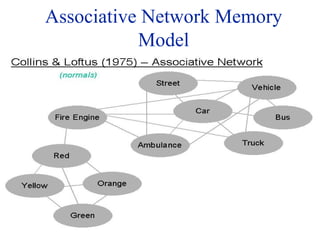
Customer-Based Brand Equity Brand knowledge is the key to building CBBE:  Brand awareness Brand image   Associative Network Memory Model
Associative Network Memory Model Beyindeki bağların oluşumunu etkilemek
Can You Identify the Brands? Convenient, value, golden arches Refreshment, taste, optimism Safety Fun, magic, family entertainment Styling and driving performance Rugged, western cowboy
Customer-Based Brand Equity Brand knowledge is the key to building CBBE: Brand awareness (recognition vs. recall) Brand image   Strength (Quantity and quality of processing) Favorability ( Desirable  and  successfully delivered ) Uniqueness (reason why vs. no reason why not)
Building  Customer-Based Brand Equity Building a strong brand involves a series of steps as part of a “branding ladder” How consumers think, feel, and and act with respect to that brand… A strong brand is also characterized by a logically constructed set of brand “building blocks.” Identifies areas of strength and weakness Provides guidance to marketing activities
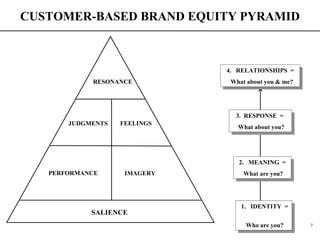
CUSTOMER-BASED BRAND EQUITY PYRAMID RESONANCE SALIENCE JUDGMENTS FEELINGS PERFORMANCE IMAGERY 4.  RELATIONSHIPS  =  What about you & me? 3.  RESPONSE  =  What about you? 2.  MEANING  =  What are you? 1.  IDENTITY  =  Who are you?
Salience Dimensions Depth  of brand awareness Ease of recognition & recall Strength & clarity of category membership Breadth  of brand awareness Purchase consideration Consumption consideration
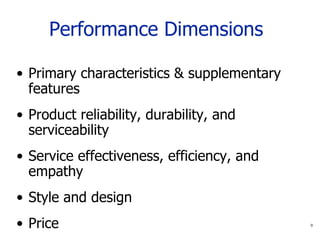
Performance Dimensions   Primary characteristics & supplementary features Product reliability, durability, and serviceability Service effectiveness, efficiency, and empathy Style and design Price
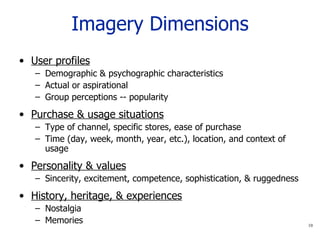
Imagery Dimensions User profiles Demographic & psychographic characteristics Actual or aspirational Group perceptions -- popularity Purchase & usage situations Type of channel, specific stores, ease of purchase Time (day, week, month, year, etc.), location, and context of usage Personality & values Sincerity, excitement, competence, sophistication, & ruggedness History, heritage, & experiences Nostalgia Memories
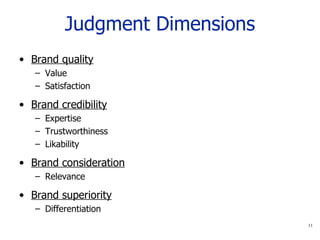
Judgment Dimensions Brand quality Value Satisfaction Brand credibility Expertise Trustworthiness Likability Brand consideration Relevance Brand superiority Differentiation
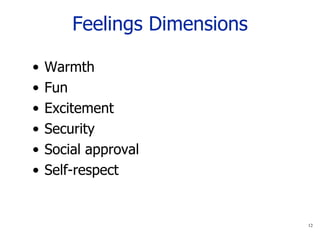
Feelings Dimensions Warmth Fun Excitement Security Social approval Self-respect
Resonance Dimensions  Behavioral loyalty Frequency and amount of repeat purchases Attitudinal attachment Love brand (favorite possessions; “a little pleasure”) Proud of brand Sense of community Kinship Affiliation Active engagement Seek information Join club Visit web site, chat rooms
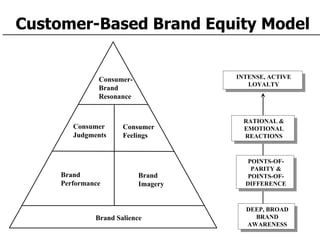
Customer-Based Brand Equity Model Consumer- Brand Resonance Brand Salience Consumer Judgments Consumer Feelings Brand Performance Brand Imagery INTENSE, ACTIVE LOYALTY RATIONAL & EMOTIONAL REACTIONS POINTS-OF-PARITY & POINTS-OF-DIFFERENCE DEEP, BROAD BRAND AWARENESS
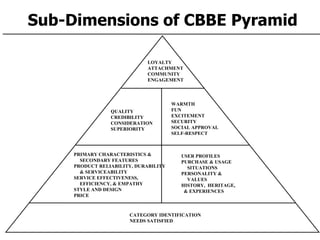
Sub-Dimensions of CBBE Pyramid LOYALTY ATTACHMENT COMMUNITY ENGAGEMENT QUALITY CREDIBILITY CONSIDERATION SUPERIORITY WARMTH FUN EXCITEMENT SECURITY SOCIAL APPROVAL SELF-RESPECT CATEGORY IDENTIFICATION NEEDS SATISFIED PRIMARY CHARACTERISTICS & SECONDARY FEATURES PRODUCT RELIABILITY, DURABILITY & SERVICEABILITY SERVICE EFFECTIVENESS, EFFICIENCY, & EMPATHY  STYLE AND DESIGN  PRICE USER PROFILES PURCHASE & USAGE SITUATIONS PERSONALITY & VALUES HISTORY,  HERITAGE, & EXPERIENCES
Brand-Building Implications: The Five Branding Tenets Customers own brands Don’t take shortcuts with brands Brands should have a duality Brands should have richness Brand resonance provides important focus
Benefits of  Customer-Based Brand Equity Enjoy greater brand loyalty, usage, and affinity Command larger price premiums Receive greater trade cooperation & support Increase marketing communication efficiency & effectiveness Yield licensing opportunities Support brand extensions.
Creating Customer Value   Customer-brand relationships are the foundation of brand resonance and building a strong brand. The customer-based brand equity model certainly puts that notion front and center.
Customer Relationship Management (CRM) Uses a company’s data systems and applications to track consumer activity and manage customer interactions with the company
Customer   Equity The sum of lifetime values of all customers Customer lifetime value  (CLV) is affected by revenue and by the cost of customer acquisition, retention, and cross-selling Consists of three components: Value equity Brand equity Relationship equity  Rust, Zeithamal & Lemon, 2004
Customer Equity Blattberg and Deighton (1996) offer eight guidelines as a means of maximizing customer equity: Invest in highest-value customers first Transform product management into customer management Consider how add-on sales and cross-selling can increase customer equity Look for ways to reduce acquisition costs Track customer equity gains and losses against marketing programs Relate branding to customer equity Monitor the intrinsic retainability of your customer Consider writing separate marketing plans—or even building two marketing organizations—for acquisition and retention efforts
Relationship of Customer Equity to Brand Equity   Customer-based brand equity maintains that brands create value by eliciting differential customer response to marketing activities.  Customers drive the success of brands but brands are the necessary touchpoint that firms have to connect with their customers.

Customer Based Brand Equity

  • 1.
  • 2.
    Customer-Based Brand EquityBrand knowledge is the key to building CBBE: Brand awareness Brand image Associative Network Memory Model
  • 3.
    Associative Network MemoryModel Beyindeki bağların oluşumunu etkilemek
  • 4.
    Can You Identifythe Brands? Convenient, value, golden arches Refreshment, taste, optimism Safety Fun, magic, family entertainment Styling and driving performance Rugged, western cowboy
  • 5.
    Customer-Based Brand EquityBrand knowledge is the key to building CBBE: Brand awareness (recognition vs. recall) Brand image Strength (Quantity and quality of processing) Favorability ( Desirable and successfully delivered ) Uniqueness (reason why vs. no reason why not)
  • 6.
    Building Customer-BasedBrand Equity Building a strong brand involves a series of steps as part of a “branding ladder” How consumers think, feel, and and act with respect to that brand… A strong brand is also characterized by a logically constructed set of brand “building blocks.” Identifies areas of strength and weakness Provides guidance to marketing activities
  • 7.
    CUSTOMER-BASED BRAND EQUITYPYRAMID RESONANCE SALIENCE JUDGMENTS FEELINGS PERFORMANCE IMAGERY 4. RELATIONSHIPS = What about you & me? 3. RESPONSE = What about you? 2. MEANING = What are you? 1. IDENTITY = Who are you?
  • 8.
    Salience Dimensions Depth of brand awareness Ease of recognition & recall Strength & clarity of category membership Breadth of brand awareness Purchase consideration Consumption consideration
  • 9.
    Performance Dimensions Primary characteristics & supplementary features Product reliability, durability, and serviceability Service effectiveness, efficiency, and empathy Style and design Price
  • 10.
    Imagery Dimensions Userprofiles Demographic & psychographic characteristics Actual or aspirational Group perceptions -- popularity Purchase & usage situations Type of channel, specific stores, ease of purchase Time (day, week, month, year, etc.), location, and context of usage Personality & values Sincerity, excitement, competence, sophistication, & ruggedness History, heritage, & experiences Nostalgia Memories
  • 11.
    Judgment Dimensions Brandquality Value Satisfaction Brand credibility Expertise Trustworthiness Likability Brand consideration Relevance Brand superiority Differentiation
  • 12.
    Feelings Dimensions WarmthFun Excitement Security Social approval Self-respect
  • 13.
    Resonance Dimensions Behavioral loyalty Frequency and amount of repeat purchases Attitudinal attachment Love brand (favorite possessions; “a little pleasure”) Proud of brand Sense of community Kinship Affiliation Active engagement Seek information Join club Visit web site, chat rooms
  • 14.
    Customer-Based Brand EquityModel Consumer- Brand Resonance Brand Salience Consumer Judgments Consumer Feelings Brand Performance Brand Imagery INTENSE, ACTIVE LOYALTY RATIONAL & EMOTIONAL REACTIONS POINTS-OF-PARITY & POINTS-OF-DIFFERENCE DEEP, BROAD BRAND AWARENESS
  • 15.
    Sub-Dimensions of CBBEPyramid LOYALTY ATTACHMENT COMMUNITY ENGAGEMENT QUALITY CREDIBILITY CONSIDERATION SUPERIORITY WARMTH FUN EXCITEMENT SECURITY SOCIAL APPROVAL SELF-RESPECT CATEGORY IDENTIFICATION NEEDS SATISFIED PRIMARY CHARACTERISTICS & SECONDARY FEATURES PRODUCT RELIABILITY, DURABILITY & SERVICEABILITY SERVICE EFFECTIVENESS, EFFICIENCY, & EMPATHY STYLE AND DESIGN PRICE USER PROFILES PURCHASE & USAGE SITUATIONS PERSONALITY & VALUES HISTORY, HERITAGE, & EXPERIENCES
  • 16.
    Brand-Building Implications: TheFive Branding Tenets Customers own brands Don’t take shortcuts with brands Brands should have a duality Brands should have richness Brand resonance provides important focus
  • 17.
    Benefits of Customer-Based Brand Equity Enjoy greater brand loyalty, usage, and affinity Command larger price premiums Receive greater trade cooperation & support Increase marketing communication efficiency & effectiveness Yield licensing opportunities Support brand extensions.
  • 18.
    Creating Customer Value Customer-brand relationships are the foundation of brand resonance and building a strong brand. The customer-based brand equity model certainly puts that notion front and center.
  • 19.
    Customer Relationship Management(CRM) Uses a company’s data systems and applications to track consumer activity and manage customer interactions with the company
  • 20.
    Customer Equity The sum of lifetime values of all customers Customer lifetime value (CLV) is affected by revenue and by the cost of customer acquisition, retention, and cross-selling Consists of three components: Value equity Brand equity Relationship equity Rust, Zeithamal & Lemon, 2004
  • 21.
    Customer Equity Blattbergand Deighton (1996) offer eight guidelines as a means of maximizing customer equity: Invest in highest-value customers first Transform product management into customer management Consider how add-on sales and cross-selling can increase customer equity Look for ways to reduce acquisition costs Track customer equity gains and losses against marketing programs Relate branding to customer equity Monitor the intrinsic retainability of your customer Consider writing separate marketing plans—or even building two marketing organizations—for acquisition and retention efforts
  • 22.
    Relationship of CustomerEquity to Brand Equity Customer-based brand equity maintains that brands create value by eliciting differential customer response to marketing activities. Customers drive the success of brands but brands are the necessary touchpoint that firms have to connect with their customers.

Editor's Notes