Dabur India Ltd- A Case Study Presented by: Snehal Soni   N-47 Pankaj Nagpal   N 37 Ajay Dhamija   N 1 Vandana Gupta  N 58 Dhruv Suri   N17
Dabur India Ltd- A Case Study
“The test of a successful company is to further harness energies, align priorities and re-dedicate themselves for achieving even higher goals.”  - V.C. Burman
DABUR – An Introduction
Genesis
120 years of celebrations
Organization Structure DIL operates through holding company structure and operates through three 100 % subsidiaries. These are  Dabur Foods Limited Dabur International Ltd H & B Stores Pvt. Ltd.
Organization Structure
Business Segments
Business Units
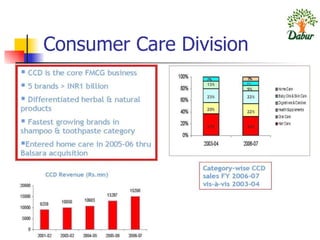
Consumer Care Division
 
CCD Portfolio
CCD Portfolio
CCD Portfolio
CCD Portfolio
International Business
International Business  contd…
Consumer Healthcare Division
Foods Division
Part II  Where is the organization going?  How would you describe the current position of the company?
Environmental Scanning
Modern Retail Sector
Strong Consumer Confidence
Macro Factors Favoring Indian Consumer
Consumer Sector Overview
FMCG Sector Snapshot
Strategic Group Identification
 
Category Penetration
FMCG Sector Snapshot
Proportional Spends
Swot Analysis
SWOT Analysis:Key Findings Strong brand equity  Favourable demographics  Good R & D facilities Favourable Industry Trends Opportunities in Rural Sements Consumer preferance toward Herbal based products
Porter Five Forces Analysis
BCG Matrix BCG Matrix to understand the current position of SBU
BCG Matrix BCG Matrix to understand the current position of business Segment
Environmental Impact Matrix
Ansoff’s Matrix
Segmentation Effective use of segemntation Demographics like in real fruit juice Benefit like in hail oil and shampoo Behaviour like institutional sales through Home made brands
Part  III How would the organization get there?  What strategic suggestions would you make regarding the various components of marketing mix?
Product Focus on high quality Sensitive to geographical diversity Labels in Regional Language Brand name should have Culture Fit
Place Intensive Distribution for Hair care, Home Care, Health Supplement and Food Division Exclusive Distribution for Skin and baby care products
Pricing Policy Integrated pricing Policy Penetrative pricing in the cash cows like Health supplement, Digestives and Home Care Premium pricing in Dog category like Skin and Baby care
Promotion Celebrity Endorsements 5 power brands strategy Change of logo Brand Rationalization Use of small sachets
How can it compete effectively against its competitors?
Winning Competitive Strategies Differentiated approach in all Business Segments 1. Health Care, Home Care and Food Division:  Two Approaches Expand The total Market Expand the Market Share 2. Hair Care segments and Oral Care: Nicher Strategy Challenger strategy : Flanking Strategy 3. Skin care and Baby Care:
Thank You
A brief About Dabur Dabur India Limited (DIL) is the Fourth largest FMCG Company operating in India with a turnover of more than Rs. 2,233 crores.  With a legacy of more than 120 years built on attributes of quality and trust, Dabur has proven its expertise in the fields of health care, personal care, Homecare and Foods.  It is a classic case of a family owned business being handed over to professionals, a company making timely strategic interventions to adapt to the business environment and maintaining its brand equity over the years.
Background The company headquartered in Ghaziabad, UP, is listed on Indian stock exchanges and commands a valuation of over US$ 1.5 billion.  It has been ranked amongst the “Best under a Billion” companies in Asia Pacific ( Forbes Asia 2005 & 2006 ).  As per BW, March 2007, DIL is one of the top 3 most respected FMCG companies.
A historical Perspective Dabur was started in 1884 by Dr S K Burman in Kolkata. His vision "What is life that cannot bring  comfort to others" ,   was instrumental in giving direction to the company in its initial and current stages of development.  It made a humble beginning as a small pharmacy selling healthcare products.
Chronology 1896 - Setting up of plants for mass  manufacturing of its formulations and  entering in the specialized area of Ayurvedic  medicines and branding of products.  1972 - Shifted operations to Delhi. 1975 - Setting up of full fledged research  operations in health care. Mid 90s - Dabur going public 1996 - Setting up of Dabur Foods, a wholly  owned subsidiary

Dabur India Ltd - A Case Study