Bill Discounting
  Factoring &
    Forfaiting
BILL DISCOUNTING
 While   discounting a bill, the Bank buys the
 bill (i.e. Bill of Exchange or Promissory Note)
 before it is due and credits the value of the
 bill after a discount charge to the customer's
 account. The transaction is practically an
 advance against the security of the bill and
 the discount represents the interest on the
 advance from the date of purchase of the bill
 until it is due for payment.
CONDITIONS

A   bill must be a usance bill.
 It must have been accepted and bears at
  least two good signatures (e.g. of reputable
  individuals, companies or banks etc.)
 The Bank will normally only discount trade
  bills.
 Where a usance bill is drawn at a fixed
  period after sight the bill must be accepted to
  establish the maturity.
CONDITIONS

 The   discount should be based on real trade
  background.
 The discount tenor starts from the date of
  discount and expires at the maturity of the
  bill.
DIFFERENT TYPES OF BILLS
DISCOUNTING

 Sales  bill discounting (Drawer bill
  discounting)
 Supplier bill discounting (Drawee bill
  discounting)
 LC Bill discounting
What is factoring?
   Factoring is an ongoing arrangement between the
    client and the factor, where the sales of goods and
    services are made on open account terms and the
    invoices for the same are assigned to the factor
    regularly for the purpose of funding, collection and
    sales ledger administration.
   Factoring involves a long-term relationship between
    the buyer and the seller with the whole turnover
    being assigned to the factoring company.
Origin


    Came into existance in the year 1920
    It was not an organised sector that time
    Association of British Factors(ABF) came in 1976
    Nearly 90% of global factoring turnover comes from
     USA & Europian countries
    RBI appointed the C.S.Kalyanasundaram Committee
     (1988)
    It suggested to start factoring by a bank through its
     subsidiary
As of today,

 Worldwide,  factoring volume is more than
  USD 700 billion a year
 Spread over nearly 60 countries and
  covering more than 1,00,000 businesses.
 Particularly in developed countries, factoring
  is an accepted way of conducting business.
Why use Factoring?

   Through the use of Factoring receivables are
    instantly converted into cash leading to improved
    cash flows that can help funding of future growth.
   It facilitate an efficient follow up of payments from
    buyers, which is made possible through
    relationships developed by factors with client’s
    buyers.
   Factoring provides credit protection for export
    sales which enables to do business with buyers
    who are unwilling to open Letters of Credit.
    Factoring also provides other peripheral services
    such as advisory services, credit assessment, etc.
What are the types of factoring
arrangement?

 There are basically two types of Factoring
 arrangements:
 1) Domestic Factoring- If you are selling in
 India.
 2) International Export Factoring- If you are
 exporting form India.
Domestic Factoring

 The factoring arrangement where all the
 three- the factor, the seller and the buyer are
 in the same country, subject to the same
 laws.
International Factoring

 The factoring arrangement, where the seller
 and the buyer are in two different countries
 involving co-operation between two factoring
 companies, one in the seller’s country
 (Export Factor) and the other in the buyer’s
 country (Import Factor)
Major Types of Factoring

Non-Recourse Factoring - It is the most
  comprehensive type of factoring arrangement
  offering all types of services namely:
 Finance
 Sales Ledger Administration
 Collection
 Debt Protection
 Advisory Services
 It gives protection against bad debts to the client.
  In other words, in case the customer fails to pay,
  the factor will have ‘no recourse’ to the client and
  will have to absorb the bad debts himself.
Recourse Factoring

 In this type of factoring arrangement, the
  factor provides all types of facilities except
  debt protection. In other words, the client is
  responsible for any bad debts incurred.
Invoice Discounting

 In this type of factoring arrangement, only
  finance is provided and no other service is
  offered.
Undisclosed Factoring Or Open
Account Receivables

 The factor does not follow up or collect
 payment from the customer. The customer
 may not be aware of the factoring
 arrangement and pays the client directly. The
 factor receives payment of invoices through
 the client.
Factoring Charges

 Finance  Charge - It represents the interest
  on funds made available to the client by way
  of prepayment against purchase of approved
  invoices.
 Service Charge - The charge levied for
  rendering non-funding services such as
  collection, sales ledger maintenance and
  other advisory services.
How much advance can Client get?

 Advances   are made as a percentage of
 invoice value based on criteria, such as,
 quality of receivables, number and quality of
 the buyers and client’s requirements.
 Typically 80 % of invoice value is advanced.
Advantages (to the client)
 Immediate   conversion of cash sale
 Competitive credit terms
 Accelerate the production cycle
 Free from tensions
 Efficient W.Cap. Management
 Assessing quality of debtors
 Expansion of business
Advantages


 To   the Buyers
  –    Adequate credit facilities
  –    Getting periodical statement from the factor
  –    No affect on quality of goods, contractual
       obligations etc.
Benefits of International Factoring

 To   the Exporter
   –   Deals with only one factor
   –   He gets specialised knoweledge
   –   Risk of B/D are reduced
 To   the Importer
   –   Pays the invoice in the same country
   –   Gets better credit terms
Factoring is not suitable under following
cases -


 a) where large volume of cash sales take place.
 b) engaged in speculative business.
 c) selling highly specialized capital equipments or
 made-to-order goods.
 d) where credit period offered to the buyers is
 more than 180 days.
 e) where there is Consignment Sale or 'Sale or
 Return Arrangements'.
 f) where sales are to the sister / associated
 companies .
 g) where sales are to the public at large, etc.
FCI (Factors Chain International)

    FCI is a global network of leading factoring countries
    It helps its members achieving competitive advantage
     through:
       – A global network
       – Modern & effective communication system
       – Reliable legal framework
       – Standard procedures
       – Universal quality
       – World wide promotion
       – Training programmes
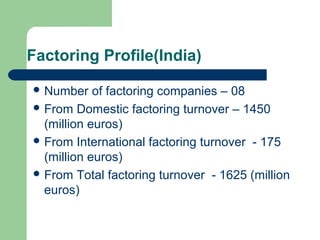
Factoring Profile(India)

 Number    of factoring companies – 08
 From Domestic factoring turnover – 1450
  (million euros)
 From International factoring turnover - 175
  (million euros)
 From Total factoring turnover - 1625 (million
  euros)
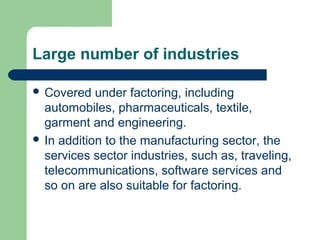
Large number of industries

 Covered   under factoring, including
  automobiles, pharmaceuticals, textile,
  garment and engineering.
 In addition to the manufacturing sector, the
  services sector industries, such as, traveling,
  telecommunications, software services and
  so on are also suitable for factoring.
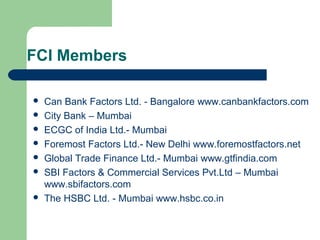
FCI Members

   Can Bank Factors Ltd. - Bangalore www.canbankfactors.com
   City Bank – Mumbai
   ECGC of India Ltd.- Mumbai
   Foremost Factors Ltd.- New Delhi www.foremostfactors.net
   Global Trade Finance Ltd.- Mumbai www.gtfindia.com
   SBI Factors & Commercial Services Pvt.Ltd – Mumbai
    www.sbifactors.com
   The HSBC Ltd. - Mumbai www.hsbc.co.in
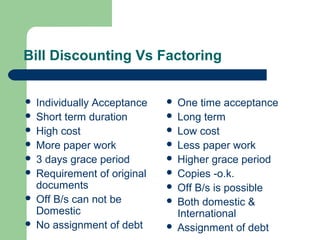
Bill Discounting Vs Factoring


   Individually Acceptance    One time acceptance
   Short term duration        Long term
   High cost                  Low cost
   More paper work            Less paper work
   3 days grace period        Higher grace period
   Requirement of original    Copies -o.k.
    documents                  Off B/s is possible
   Off B/s can not be         Both domestic &
    Domestic                    International
   No assignment of debt      Assignment of debt
Forfaiting

Forfaiting, or Medium-Term Capital Goods
  Financing, means selling a bill of exchange, at a
  discount, to a third party, the Forfaiter, who collects
  the payment from an, essentially, overseas
  customer, through a collateral bank(s), and, thus,
  assuming the underlying responsibility of exporters
  and simultaneously providing trade finance for
  importers by converting a short-term loan to a
  medium term one.
Forfaiting…

 Done on a non - recourse basis
 Used for international trade transactions, usually for
  transactions not less than $100,000
 Tenor of instrument ranges from 180 days to 10 years
 payments are made quarterly, semi-annually, annually, or
  on a bullet basis
Not so Popular as People
 are suspicious of its simplicity
 coupled with a lack of complex documentation
Information the Forfaiter needs
   who the buyer is and his nationality;
   what goods are being sold;
   details regarding the value and currency of the contract;
   the date and duration of the contract,including the credit
    period and number and timing of payments (including any
    interest rate already agreed with the buyer)
   evidence of debt that will be used (either promissory notes,
    bills of exchange, letters of credit)
   the identity of the guarantor of payment (or avalor).
Documents required
by Forfaiter from exporter


   Copy of supply contract, or of its payment terms
   Copy of signed commercial invoice
   Copy of shipping documents including certificates of
    receipt, railway bill, airway will, bill of lading or
    equivalent documents
   Letter of assignment and notification to the guarantor
   Letter of guarantee, or aval (standby letters of credit
    may also be used)
Forfaiting Charges

 Forfaiters try to ensure that the buyer, not the seller,
  incurs charges involved in a Forfait transaction.
Charges depend on
 the level of interest rates relevant to the currency of
  the underlying contract at the time of the Forfaiter's
  commitment
 the Forfaiter's assessment of the credit risks related
  to the importing country and to the avalizing (or
  guaranteeing) bank
Forfaiting vs Export Factoring
Similarities

 Doneon Non – recourse basis
 Common features for advance payment
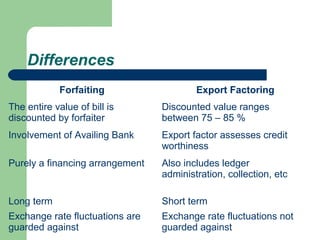
Differences
             Forfaiting                  Export Factoring
The entire value of bill is      Discounted value ranges
discounted by forfaiter          between 75 – 85 %
Involvement of Availing Bank     Export factor assesses credit
                                 worthiness
Purely a financing arrangement   Also includes ledger
                                 administration, collection, etc

Long term                        Short term
Exchange rate fluctuations are   Exchange rate fluctuations not
guarded against                  guarded against

Factoring ppt

  • 1.
    Bill Discounting Factoring & Forfaiting
  • 2.
    BILL DISCOUNTING  While discounting a bill, the Bank buys the bill (i.e. Bill of Exchange or Promissory Note) before it is due and credits the value of the bill after a discount charge to the customer's account. The transaction is practically an advance against the security of the bill and the discount represents the interest on the advance from the date of purchase of the bill until it is due for payment.
  • 3.
    CONDITIONS A bill must be a usance bill.  It must have been accepted and bears at least two good signatures (e.g. of reputable individuals, companies or banks etc.)  The Bank will normally only discount trade bills.  Where a usance bill is drawn at a fixed period after sight the bill must be accepted to establish the maturity.
  • 4.
    CONDITIONS  The discount should be based on real trade background.  The discount tenor starts from the date of discount and expires at the maturity of the bill.
  • 5.
    DIFFERENT TYPES OFBILLS DISCOUNTING  Sales bill discounting (Drawer bill discounting)  Supplier bill discounting (Drawee bill discounting)  LC Bill discounting
  • 6.
    What is factoring?  Factoring is an ongoing arrangement between the client and the factor, where the sales of goods and services are made on open account terms and the invoices for the same are assigned to the factor regularly for the purpose of funding, collection and sales ledger administration.  Factoring involves a long-term relationship between the buyer and the seller with the whole turnover being assigned to the factoring company.
  • 7.
    Origin  Came into existance in the year 1920  It was not an organised sector that time  Association of British Factors(ABF) came in 1976  Nearly 90% of global factoring turnover comes from USA & Europian countries  RBI appointed the C.S.Kalyanasundaram Committee (1988)  It suggested to start factoring by a bank through its subsidiary
  • 8.
    As of today, Worldwide, factoring volume is more than USD 700 billion a year  Spread over nearly 60 countries and covering more than 1,00,000 businesses.  Particularly in developed countries, factoring is an accepted way of conducting business.
  • 9.
    Why use Factoring?  Through the use of Factoring receivables are instantly converted into cash leading to improved cash flows that can help funding of future growth.  It facilitate an efficient follow up of payments from buyers, which is made possible through relationships developed by factors with client’s buyers.  Factoring provides credit protection for export sales which enables to do business with buyers who are unwilling to open Letters of Credit.  Factoring also provides other peripheral services such as advisory services, credit assessment, etc.
  • 10.
    What are thetypes of factoring arrangement?  There are basically two types of Factoring arrangements: 1) Domestic Factoring- If you are selling in India. 2) International Export Factoring- If you are exporting form India.
  • 11.
    Domestic Factoring  Thefactoring arrangement where all the three- the factor, the seller and the buyer are in the same country, subject to the same laws.
  • 12.
    International Factoring  Thefactoring arrangement, where the seller and the buyer are in two different countries involving co-operation between two factoring companies, one in the seller’s country (Export Factor) and the other in the buyer’s country (Import Factor)
  • 13.
    Major Types ofFactoring Non-Recourse Factoring - It is the most comprehensive type of factoring arrangement offering all types of services namely:  Finance  Sales Ledger Administration  Collection  Debt Protection  Advisory Services  It gives protection against bad debts to the client. In other words, in case the customer fails to pay, the factor will have ‘no recourse’ to the client and will have to absorb the bad debts himself.
  • 14.
    Recourse Factoring  Inthis type of factoring arrangement, the factor provides all types of facilities except debt protection. In other words, the client is responsible for any bad debts incurred.
  • 15.
    Invoice Discounting  Inthis type of factoring arrangement, only finance is provided and no other service is offered.
  • 16.
    Undisclosed Factoring OrOpen Account Receivables  The factor does not follow up or collect payment from the customer. The customer may not be aware of the factoring arrangement and pays the client directly. The factor receives payment of invoices through the client.
  • 17.
    Factoring Charges  Finance Charge - It represents the interest on funds made available to the client by way of prepayment against purchase of approved invoices.  Service Charge - The charge levied for rendering non-funding services such as collection, sales ledger maintenance and other advisory services.
  • 18.
    How much advancecan Client get?  Advances are made as a percentage of invoice value based on criteria, such as, quality of receivables, number and quality of the buyers and client’s requirements. Typically 80 % of invoice value is advanced.
  • 19.
    Advantages (to theclient)  Immediate conversion of cash sale  Competitive credit terms  Accelerate the production cycle  Free from tensions  Efficient W.Cap. Management  Assessing quality of debtors  Expansion of business
  • 20.
    Advantages  To the Buyers – Adequate credit facilities – Getting periodical statement from the factor – No affect on quality of goods, contractual obligations etc.
  • 21.
    Benefits of InternationalFactoring  To the Exporter – Deals with only one factor – He gets specialised knoweledge – Risk of B/D are reduced  To the Importer – Pays the invoice in the same country – Gets better credit terms
  • 22.
    Factoring is notsuitable under following cases - a) where large volume of cash sales take place. b) engaged in speculative business. c) selling highly specialized capital equipments or made-to-order goods. d) where credit period offered to the buyers is more than 180 days. e) where there is Consignment Sale or 'Sale or Return Arrangements'. f) where sales are to the sister / associated companies . g) where sales are to the public at large, etc.
  • 23.
    FCI (Factors ChainInternational)  FCI is a global network of leading factoring countries  It helps its members achieving competitive advantage through: – A global network – Modern & effective communication system – Reliable legal framework – Standard procedures – Universal quality – World wide promotion – Training programmes
  • 24.
    Factoring Profile(India)  Number of factoring companies – 08  From Domestic factoring turnover – 1450 (million euros)  From International factoring turnover - 175 (million euros)  From Total factoring turnover - 1625 (million euros)
  • 25.
    Large number ofindustries  Covered under factoring, including automobiles, pharmaceuticals, textile, garment and engineering.  In addition to the manufacturing sector, the services sector industries, such as, traveling, telecommunications, software services and so on are also suitable for factoring.
  • 26.
    FCI Members  Can Bank Factors Ltd. - Bangalore www.canbankfactors.com  City Bank – Mumbai  ECGC of India Ltd.- Mumbai  Foremost Factors Ltd.- New Delhi www.foremostfactors.net  Global Trade Finance Ltd.- Mumbai www.gtfindia.com  SBI Factors & Commercial Services Pvt.Ltd – Mumbai www.sbifactors.com  The HSBC Ltd. - Mumbai www.hsbc.co.in
  • 27.
    Bill Discounting VsFactoring  Individually Acceptance  One time acceptance  Short term duration  Long term  High cost  Low cost  More paper work  Less paper work  3 days grace period  Higher grace period  Requirement of original  Copies -o.k. documents  Off B/s is possible  Off B/s can not be  Both domestic & Domestic International  No assignment of debt  Assignment of debt
  • 28.
    Forfaiting Forfaiting, or Medium-TermCapital Goods Financing, means selling a bill of exchange, at a discount, to a third party, the Forfaiter, who collects the payment from an, essentially, overseas customer, through a collateral bank(s), and, thus, assuming the underlying responsibility of exporters and simultaneously providing trade finance for importers by converting a short-term loan to a medium term one.
  • 29.
    Forfaiting…  Done ona non - recourse basis  Used for international trade transactions, usually for transactions not less than $100,000  Tenor of instrument ranges from 180 days to 10 years  payments are made quarterly, semi-annually, annually, or on a bullet basis Not so Popular as People  are suspicious of its simplicity  coupled with a lack of complex documentation
  • 30.
    Information the Forfaiterneeds  who the buyer is and his nationality;  what goods are being sold;  details regarding the value and currency of the contract;  the date and duration of the contract,including the credit period and number and timing of payments (including any interest rate already agreed with the buyer)  evidence of debt that will be used (either promissory notes, bills of exchange, letters of credit)  the identity of the guarantor of payment (or avalor).
  • 31.
    Documents required by Forfaiterfrom exporter  Copy of supply contract, or of its payment terms  Copy of signed commercial invoice  Copy of shipping documents including certificates of receipt, railway bill, airway will, bill of lading or equivalent documents  Letter of assignment and notification to the guarantor  Letter of guarantee, or aval (standby letters of credit may also be used)
  • 32.
    Forfaiting Charges  Forfaiterstry to ensure that the buyer, not the seller, incurs charges involved in a Forfait transaction. Charges depend on  the level of interest rates relevant to the currency of the underlying contract at the time of the Forfaiter's commitment  the Forfaiter's assessment of the credit risks related to the importing country and to the avalizing (or guaranteeing) bank
  • 33.
    Forfaiting vs ExportFactoring Similarities  Doneon Non – recourse basis  Common features for advance payment
  • 34.
    Differences Forfaiting Export Factoring The entire value of bill is Discounted value ranges discounted by forfaiter between 75 – 85 % Involvement of Availing Bank Export factor assesses credit worthiness Purely a financing arrangement Also includes ledger administration, collection, etc Long term Short term Exchange rate fluctuations are Exchange rate fluctuations not guarded against guarded against