

FINAL PRESENTATION
ON
DABUR
BY:
SIDDHARTH SUNDRIYAL
CM-II
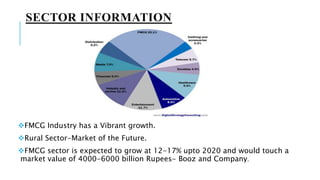
SECTOR INFORMATION
FMCG Industry has a Vibrant growth.
Rural Sector-Market of the Future.
FMCG sector is expected to grow at 12-17% upto 2020 and would touch a
market value of 4000-6000 billion Rupees- Booz and Company.
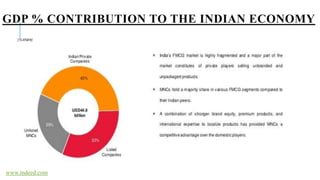
GDP % CONTRIBUTION TO THE INDIAN ECONOMY
www.indeed.com
COMPANY PROFILE
Established in 1884, More than 125 years of Trust and Excellence.
3rd largest FMCG company in India.
Strong Brand Equity
Vatika and Real are Superbrands
Dabur is a household Brand
Hajmola, Real and Dabur Honey amongst Most Admired Brands in India
Wide distribution network covering 3.4 Million Retailers across the country.
17 World class manufacturing plants
Strong Overseas Presence
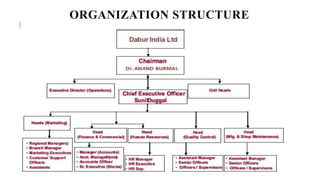
ORGANIZATION STRUCTURE
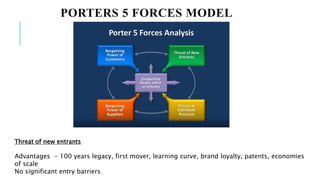
PORTERS 5 FORCES MODEL
Threat of new entrants
Advantages - 100 years legacy, first mover, learning curve, brand loyalty, patents, economies
of scale
No significant entry barriers
CONTD..
Threat of substitute products
Dabur – a leader in Herbal Digestives where the product has 90% of the market share
FMCG or Healthcare products specially Ayurvedic, hardly have substitutes so this threat is not very significant
However, some product substitutes and similar products by competitor’s do exist
Dabur therefore has to constantly re invent its existing product lines in order to cope up with the innovations of its
competitors.
Bargaining power of suppliers
100 years presence – Dabur has a very strong bond with the suppliers
Has a policy of accountability to stakeholders – be it customers, shareholders, employees or supplier (who have a vested
interest in making it all happen)
Bargaining power of customer
Has increased dramatically due to – a wide range of available choice from competitors, both local and global
Dabur has to formulate strategy in such a manner to keep abreast with the increasing competition by improving the
quality and reducing the prices over the period
Rivalry among existing competitors
Key player and competitors of Dabur India currently are:
Hindustan Unilever Ltd, Tata Tea, Nestle India Ltd, Britannia Industries Ltd, Colgate Palmolive
Ltd, Marico Ltd, Galaxo Smitkline consumer, Cadbury India Ltd, Reckitt Benckiser Ltd, Procter
& Gamble
Dabur has to constantly relook its strategy and keep reinventing and branding, in order to maintain
and increase its market presence.
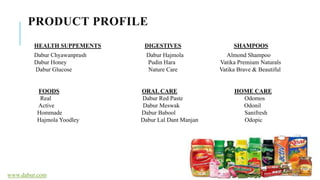
PRODUCT PROFILE
HEALTH SUPPEMENTS DIGESTIVES SHAMPOOS
Dabur Chyawanprash Dabur Hajmola Almond Shampoo
Dabur Honey Pudin Hara Vatika Premium Naturals
Dabur Glucose Nature Care Vatika Brave & Beautiful
FOODS ORAL CARE HOME CARE
Real Dabur Red Paste Odomos
Active Dabur Meswak Odonil
Hommade Dabur Babool Sanifresh
Hajmola Yoodley Dabur Lal Dant Manjan Odopic
www.dabur.com
CONCLUSION
FMCG Sector is a high volume and low margin industry, according to Michael Porter’s 5 forces model in FMCG
industry, the number of the buyers and the number of Suppliers both are high, competition is also very high that’s by
substitutes are easily available in there. If customers are not so very brand loyal that means because of Substitute are
easily available, the switching cost of buyers is also very low. So overall we can say that the FMCG sector is highly
admirable in India because the contribution Of this sector is almost 2.5% of the total GDP
Final presentation on dabur

Final presentation on dabur

  • 1.
  • 2.
    SECTOR INFORMATION FMCG Industryhas a Vibrant growth. Rural Sector-Market of the Future. FMCG sector is expected to grow at 12-17% upto 2020 and would touch a market value of 4000-6000 billion Rupees- Booz and Company.
  • 3.
    GDP % CONTRIBUTIONTO THE INDIAN ECONOMY www.indeed.com
  • 4.
    COMPANY PROFILE Established in1884, More than 125 years of Trust and Excellence. 3rd largest FMCG company in India. Strong Brand Equity Vatika and Real are Superbrands Dabur is a household Brand Hajmola, Real and Dabur Honey amongst Most Admired Brands in India Wide distribution network covering 3.4 Million Retailers across the country. 17 World class manufacturing plants Strong Overseas Presence
  • 5.
  • 7.
    PORTERS 5 FORCESMODEL Threat of new entrants Advantages - 100 years legacy, first mover, learning curve, brand loyalty, patents, economies of scale No significant entry barriers
  • 8.
    CONTD.. Threat of substituteproducts Dabur – a leader in Herbal Digestives where the product has 90% of the market share FMCG or Healthcare products specially Ayurvedic, hardly have substitutes so this threat is not very significant However, some product substitutes and similar products by competitor’s do exist Dabur therefore has to constantly re invent its existing product lines in order to cope up with the innovations of its competitors. Bargaining power of suppliers 100 years presence – Dabur has a very strong bond with the suppliers Has a policy of accountability to stakeholders – be it customers, shareholders, employees or supplier (who have a vested interest in making it all happen) Bargaining power of customer Has increased dramatically due to – a wide range of available choice from competitors, both local and global Dabur has to formulate strategy in such a manner to keep abreast with the increasing competition by improving the quality and reducing the prices over the period
  • 9.
    Rivalry among existingcompetitors Key player and competitors of Dabur India currently are: Hindustan Unilever Ltd, Tata Tea, Nestle India Ltd, Britannia Industries Ltd, Colgate Palmolive Ltd, Marico Ltd, Galaxo Smitkline consumer, Cadbury India Ltd, Reckitt Benckiser Ltd, Procter & Gamble Dabur has to constantly relook its strategy and keep reinventing and branding, in order to maintain and increase its market presence.
  • 10.
    PRODUCT PROFILE HEALTH SUPPEMENTSDIGESTIVES SHAMPOOS Dabur Chyawanprash Dabur Hajmola Almond Shampoo Dabur Honey Pudin Hara Vatika Premium Naturals Dabur Glucose Nature Care Vatika Brave & Beautiful FOODS ORAL CARE HOME CARE Real Dabur Red Paste Odomos Active Dabur Meswak Odonil Hommade Dabur Babool Sanifresh Hajmola Yoodley Dabur Lal Dant Manjan Odopic www.dabur.com
  • 11.
    CONCLUSION FMCG Sector isa high volume and low margin industry, according to Michael Porter’s 5 forces model in FMCG industry, the number of the buyers and the number of Suppliers both are high, competition is also very high that’s by substitutes are easily available in there. If customers are not so very brand loyal that means because of Substitute are easily available, the switching cost of buyers is also very low. So overall we can say that the FMCG sector is highly admirable in India because the contribution Of this sector is almost 2.5% of the total GDP