Nature of Derivatives

A derivative is an instrument whose value
 depends on the values of underlying
 instrument.
Derivatives

 Forward   Contracts:
      Custom   made contracts to buy/sell the underlying asset
      in the future at a fixed price. Maturity and size of the
      contract can be determined individually to almost exactly
      hedge the desired position.
 Futures   Contracts:
      Ready-made     contracts to buy/sell foreign exchange in
       the future at a specific price.
      Contract’s liquidity is guaranteed by the exchange on
       which it is traded.
      Too structured, margin requirements cause cash flow
       uncertainty.
 Options   Contracts:
      Offerthe right, but not the obligation, to buy/sell foreign
       exchange in the future at a specified price.
      Allow hedging contingent risks.
 Swap   Contracts:
     Contractswhich involve two counter parties exchange
     over an agreed period, two streams of payments.
Forward Contract

 Early   Delivery
      Customer  receives/requires the foreign currency earlier
      than the original contract date.
 Extension
      When  he informs that he expects to receive/pay at a
      later date than the contract date.
 Cancellation
      Customer  receives/requires the foreign currency earlier
      than the original contract date
 Cancellation
      Customer requests the banker to cancel the contract
      because he may not receive/pay foreign currency that
      was originally supposed to have been received/paid.
Early Delivery
   Forward Purchase Contract for the customer/Forward sale for
    the banker

            Original: Bank buys forward from market.

            Now: Buys spot and sells forward to square up the buy position
             entered earlier.


   Swap charges: If loss is incurred, the same would be received
    from the customer. In case of gain the same would be paid.
Extension

 Customer    requests for extension


 Existing   contract is cancelled


 Rebook     the forward date
Extension
   Forward Purchase Contract

           Original: Bank buys forward

           Now: Banker would sell spot to square the buy position.

           Purchases forward for new due date.

   Cancellation charges: If loss is incurred, the same
    would be recovered. If gain, the same would be paid
    to the customer.
Cancellation

 Thebank shall recover or pay as the case
 may be, the difference between the
 contracted rate and the rate at which the
 cancellation is effected.
Early Delivery -Charges

 If loss is incurred, the same would be
  recovered from the customer.
 If gain, the same would be paid to the
  customer.
Options-Types

 Call   Option


 Put    Option
Options -Exercise

 ITM


 ATM


 OTM
Options- Styles

 American


 European
Option Premium

 Intrinsic   Value


 Time   Value
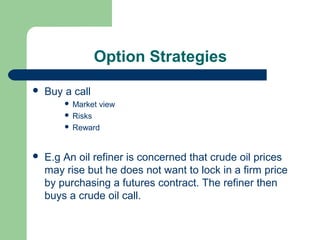
Option Strategies
   Buy a call
         Market view
         Risks
         Reward


   E.g An oil refiner is concerned that crude oil prices
    may rise but he does not want to lock in a firm price
    by purchasing a futures contract. The refiner then
    buys a crude oil call.
 Sell   a call

      Market     View
      Risks
      Reward
   E.g A Fund manager investing in T-bonds wishes to
    enhance the yield on her portfolio. She has the view
    that market will remain stable or fall slightly over the
    next few months. The current T-bond price is $100
    and so the manager sells a call a 100 call with a
    premium of $4.
   If the option is exercised she has to deliver the T-
    bonds from her portfolio.
   If the option is not exercised the premium received
    enhances the profits.
 Buy   a Put
     Market    view
     Risks
     Reward
 Sell   a put
      Market    view
      Risks
      Reward
 Straddle – Simultaneous buying/selling
  options of different types with the same strike
  price.
 Long   Straddle:
     Buy  a call and Buy a put with the same strike price.
     Market view: Significant price changes
     Risks: Limited to the premium
     Reward: Call option exercise with unlimited profit
      potential, if price rises. Put option exercise with large but
      limited profit, if price falls.
 E.g.
 Buy 1 March 5.00 Call 0.10
 Buy 1 March 5.00 Put 0.10
 Break-even point: 4.80 or 5.20
 Short   Straddle:
      Sella call and sell a put with the same strike price.
      Market view: Little or no movement
      Risks: Call option gets exercised, with potential
       unlimited loss for the writer.
      Reward: Limited to the premium paid.
 Strangle: Simultaneous buying or selling of
  options of different types with different strike
  prices.
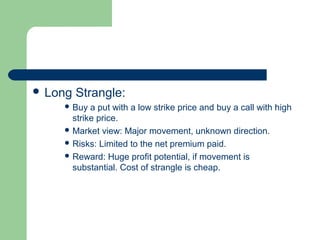
 Long   Strangle:
     Buy  a put with a low strike price and buy a call with high
      strike price.
     Market view: Major movement, unknown direction.
     Risks: Limited to the net premium paid.
     Reward: Huge profit potential, if movement is
      substantial. Cost of strangle is cheap.
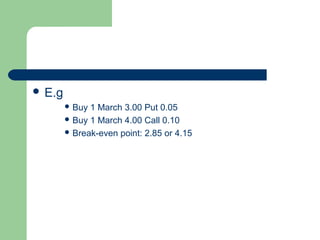
 E.g
         Buy 1 March 3.00 Put 0.05
         Buy 1 March 4.00 Call 0.10
         Break-even point: 2.85 or 4.15
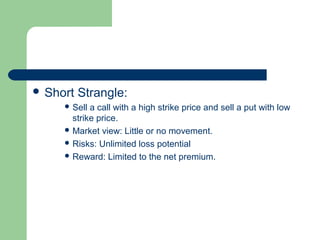
 Short   Strangle:
      Sell a call with a high strike price and sell a put with low
       strike price.
      Market view: Little or no movement.
      Risks: Unlimited loss potential
      Reward: Limited to the net premium.
 Spread:Simultaneous buying and selling of
 options of the same type with different strike
 prices.
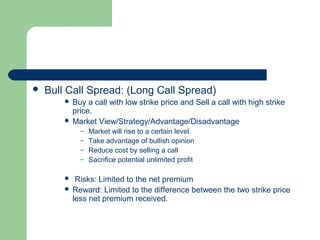
   Bull Call Spread: (Long Call Spread)
         Buy a call with low strike price and Sell a call with high strike
          price.
         Market View/Strategy/Advantage/Disadvantage
            – Market will rise to a certain level.
            – Take advantage of bullish opinion
            – Reduce cost by selling a call
            – Sacrifice potential unlimited profit


          Risks: Limited to the net premium
         Reward: Limited to the difference between the two strike price
          less net premium received.
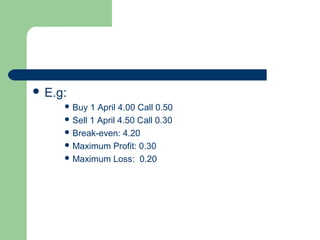
 E.g:
      Buy  1 April 4.00 Call 0.50
      Sell 1 April 4.50 Call 0.30
      Break-even: 4.20
      Maximum Profit: 0.30
      Maximum Loss: 0.20
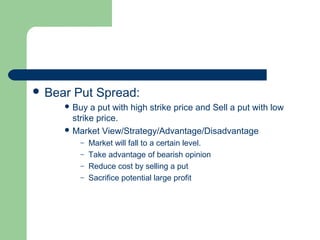
 Bear   Put Spread:
      Buy  a put with high strike price and Sell a put with low
       strike price.
      Market View/Strategy/Advantage/Disadvantage
          – Market will fall to a certain level.
          – Take advantage of bearish opinion
          – Reduce cost by selling a put
          – Sacrifice potential large profit
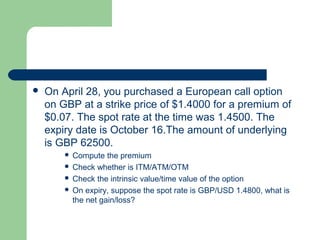
   On April 28, you purchased a European call option
    on GBP at a strike price of $1.4000 for a premium of
    $0.07. The spot rate at the time was 1.4500. The
    expiry date is October 16.The amount of underlying
    is GBP 62500.
         Compute the premium
         Check whether is ITM/ATM/OTM
         Check the intrinsic value/time value of the option
         On expiry, suppose the spot rate is GBP/USD 1.4800, what is
          the net gain/loss?
   Premium = $(62500x0.07) = $4375
   Strike price < Current spot = ITM
   Intrinsic value = USD 0.05 per GBP.
   Time value = USD 0.02 per GBP.
   Should exercise the option
         Gross profit = 1.4800-1.4000 = 0.08
         Net Profit        = 0.08 – 0.07 = 0.01
         Total profit = 0.01 x 62500 = 625 per option contract.
   The current CHF/USD spot is 0.6675. The following 90-day call
    options on CHF are available:
   Your view is that CHF is going to make a strong up-move
    during the next 90 days. Your risk appetite is moderate. What
    strategy is suitable for you?
              –   STRIKE                  PREMIUM
           USD per CHF         USD per CHF
           0.6000              0.075
           0.6500              0.030
           0.7000              0.010
           0.7500              0.002
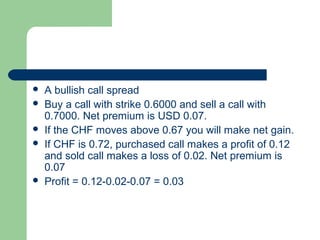
   A bullish call spread
   Buy a call with strike 0.6000 and sell a call with
    0.7000. Net premium is USD 0.07.
   If the CHF moves above 0.67 you will make net gain.
   If CHF is 0.72, purchased call makes a profit of 0.12
    and sold call makes a loss of 0.02. Net premium is
    0.07
   Profit = 0.12-0.02-0.07 = 0.03
   A German firm buys a call option on $100,000 with a
    strike price of DEM 1.60/$ and a premium of DEM
    0.03/$.The interest opportunity cost is 6% p.a and
    maturity is 180 days.
         What is the B.E maturity spot rate beyond which the firm
          makes a net gain?
         Suppose the 6-month forward rate at the time the option was
          bought was DEM 1.62/$. What is the range of maturity spot
          rate for which the option would prove to be better than the
          forward cover?
 The  premium would be DEM 30000 and
  interest on it for 180 days would be
  DEM 900. Thus per dollar cost of premium
  and interest would be DEM 0.0309.
 Since the strike price is DEM 1.60, the
  breakeven rate will be DEM 1.6309 per
 dollar.
 Formaturity spot rate up to DEM (1.6200-
 0.0309) = DEM 1.5891, option would
 be better than forward. Beyond that forward
 would be better.
   A French exporter to U.K has 90 day Pound
    receivable. He purchases a put option on GBP
    250,000 at a strike price of FRF 8.0550/GBP at a
    premium of FRF 0.20 per Pound. The current spot
    rate is FRF 8.1000/GBP and the 90-day forward is
    8.0750. The interest opportunity cost for the firm is
    9%p.a.
         Calculate the maximum FRF/GBP rate at the end of 90 days
          below which the firm will make a net gain from the Put.
         Calculate the range of maturity spot over which the option
          would be better than the forward and vice-versa.
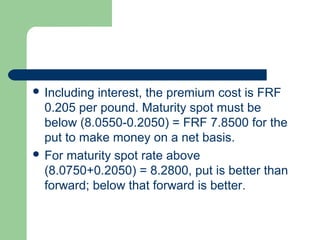
 Including interest, the premium cost is FRF
  0.205 per pound. Maturity spot must be
  below (8.0550-0.2050) = FRF 7.8500 for the
  put to make money on a net basis.
 For maturity spot rate above
  (8.0750+0.2050) = 8.2800, put is better than
  forward; below that forward is better.
Futures

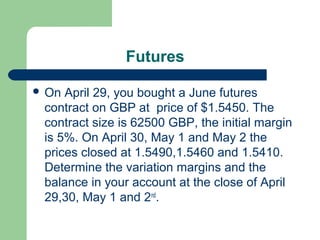
 On April 29, you bought a June futures
 contract on GBP at price of $1.5450. The
 contract size is 62500 GBP, the initial margin
 is 5%. On April 30, May 1 and May 2 the
 prices closed at 1.5490,1.5460 and 1.5410.
 Determine the variation margins and the
 balance in your account at the close of April
 29,30, May 1 and 2nd.
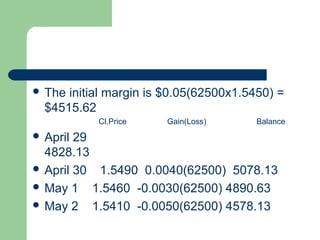
 The initial margin is $0.05(62500x1.5450) =
  $4515.62
           Cl.Price     Gain(Loss)      Balance
 April 29
  4828.13
 April 30 1.5490 0.0040(62500) 5078.13
 May 1 1.5460 -0.0030(62500) 4890.63
 May 2 1.5410 -0.0050(62500) 4578.13
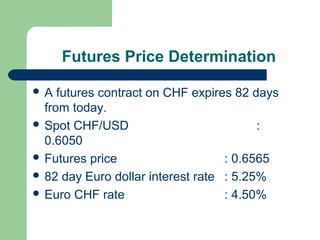
Futures Price Determination

A   futures contract on CHF expires 82 days
  from today.
 Spot CHF/USD                           :
  0.6050
 Futures price                    : 0.6565
 82 day Euro dollar interest rate : 5.25%
 Euro CHF rate                    : 4.50%
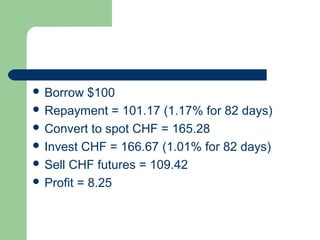
 Borrow   $100
 Repayment = 101.17 (1.17% for 82 days)
 Convert to spot CHF = 165.28
 Invest CHF = 166.67 (1.01% for 82 days)
 Sell CHF futures = 109.42
 Profit = 8.25
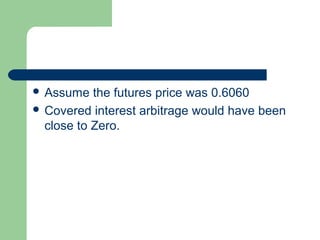
 Assume   the futures price was 0.6060
 Covered interest arbitrage would have been
  close to Zero.
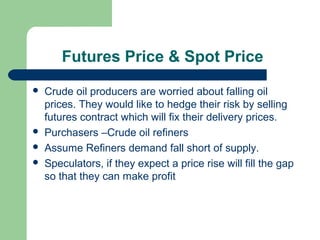
Futures Price & Spot Price
   Crude oil producers are worried about falling oil
    prices. They would like to hedge their risk by selling
    futures contract which will fix their delivery prices.
   Purchasers –Crude oil refiners
   Assume Refiners demand fall short of supply.
   Speculators, if they expect a price rise will fill the gap
    so that they can make profit
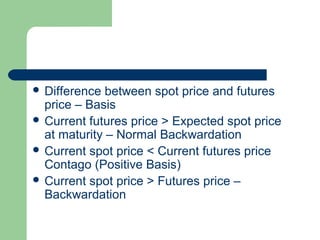
 Difference  between spot price and futures
  price – Basis
 Current futures price > Expected spot price
  at maturity – Normal Backwardation
 Current spot price < Current futures price
  Contago (Positive Basis)
 Current spot price > Futures price –
  Backwardation
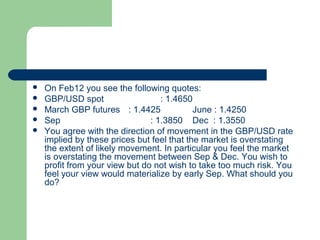
   On Feb12 you see the following quotes:
   GBP/USD spot                   : 1.4650
   March GBP futures : 1.4425              June : 1.4250
   Sep                         : 1.3850 Dec : 1.3550
   You agree with the direction of movement in the GBP/USD rate
    implied by these prices but feel that the market is overstating
    the extent of likely movement. In particular you feel the market
    is overstating the movement between Sep & Dec. You wish to
    profit from your view but do not wish to take too much risk. You
    feel your view would materialize by early Sep. What should you
    do?
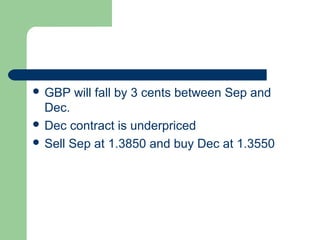
 GBP   will fall by 3 cents between Sep and
  Dec.
 Dec contract is underpriced
 Sell Sep at 1.3850 and buy Dec at 1.3550
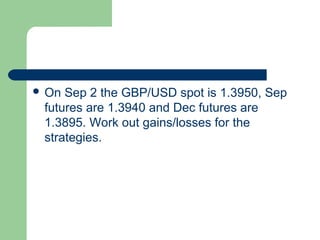
 On Sep 2 the GBP/USD spot is 1.3950, Sep
 futures are 1.3940 and Dec futures are
 1.3895. Work out gains/losses for the
 strategies.
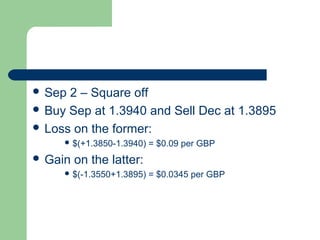
 Sep 2 – Square off
 Buy Sep at 1.3940 and Sell Dec at 1.3895
 Loss on the former:
      $(+1.3850-1.3940)   = $0.09 per GBP
 Gain   on the latter:
      $(-1.3550+1.3895)   = $0.0345 per GBP
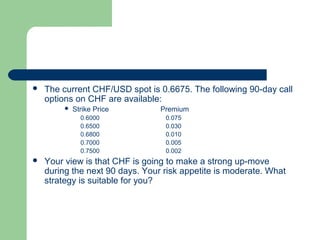
   The current CHF/USD spot is 0.6675. The following 90-day call
    options on CHF are available:
            Strike Price        Premium
               0.6000             0.075
               0.6500             0.030
               0.6800             0.010
               0.7000             0.005
               0.7500             0.002
   Your view is that CHF is going to make a strong up-move
    during the next 90 days. Your risk appetite is moderate. What
    strategy is suitable for you?
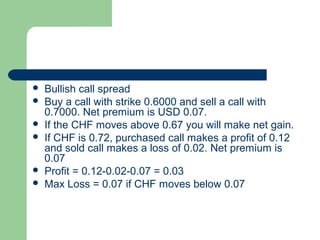
   Bullish call spread
   Buy a call with strike 0.6000 and sell a call with
    0.7000. Net premium is USD 0.07.
   If the CHF moves above 0.67 you will make net gain.
   If CHF is 0.72, purchased call makes a profit of 0.12
    and sold call makes a loss of 0.02. Net premium is
    0.07
   Profit = 0.12-0.02-0.07 = 0.03
   Max Loss = 0.07 if CHF moves below 0.07
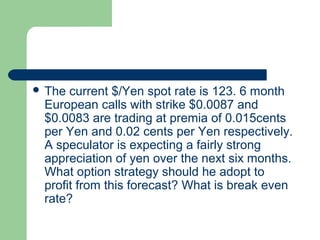
 The current $/Yen spot rate is 123. 6 month
 European calls with strike $0.0087 and
 $0.0083 are trading at premia of 0.015cents
 per Yen and 0.02 cents per Yen respectively.
 A speculator is expecting a fairly strong
 appreciation of yen over the next six months.
 What option strategy should he adopt to
 profit from this forecast? What is break even
 rate?
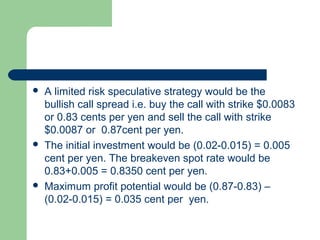
   A limited risk speculative strategy would be the
    bullish call spread i.e. buy the call with strike $0.0083
    or 0.83 cents per yen and sell the call with strike
    $0.0087 or 0.87cent per yen.
   The initial investment would be (0.02-0.015) = 0.005
    cent per yen. The breakeven spot rate would be
    0.83+0.005 = 0.8350 cent per yen.
   Maximum profit potential would be (0.87-0.83) –
    (0.02-0.015) = 0.035 cent per yen.
   The current USD/NLG spot rate is 0.5410.The
    following 2 month calls and puts are available:
   A speculator expects the USD/NLG rates to hold
    fairly steady over the coming quarter with only small
    movements around the current spot rate. What
    strategy should he adopt to profit from this view if at
    the same time he wishes to limit his max loss?
   Sell a butterfly spread
   Sell two calls with strike 0.55 and buy one call each
    with strike 0.50 and 0.60.
   Profit over the range (0.5000+0.0080) and (0.6000-
    0.0080) i.e. 0.5080 and 0.5920.
   Maximum profit will be (0.05-0.008) or 0.0420 and
    the maximum loss would be 0.008.

Ifm derivatives 01[1].03.07

  • 1.
    Nature of Derivatives Aderivative is an instrument whose value depends on the values of underlying instrument.
  • 2.
    Derivatives  Forward Contracts:  Custom made contracts to buy/sell the underlying asset in the future at a fixed price. Maturity and size of the contract can be determined individually to almost exactly hedge the desired position.
  • 3.
     Futures Contracts:  Ready-made contracts to buy/sell foreign exchange in the future at a specific price.  Contract’s liquidity is guaranteed by the exchange on which it is traded.  Too structured, margin requirements cause cash flow uncertainty.
  • 4.
     Options Contracts:  Offerthe right, but not the obligation, to buy/sell foreign exchange in the future at a specified price.  Allow hedging contingent risks.
  • 5.
     Swap Contracts:  Contractswhich involve two counter parties exchange over an agreed period, two streams of payments.
  • 6.
    Forward Contract  Early Delivery  Customer receives/requires the foreign currency earlier than the original contract date.
  • 7.
     Extension  When he informs that he expects to receive/pay at a later date than the contract date.  Cancellation  Customer receives/requires the foreign currency earlier than the original contract date
  • 8.
     Cancellation  Customer requests the banker to cancel the contract because he may not receive/pay foreign currency that was originally supposed to have been received/paid.
  • 9.
    Early Delivery  Forward Purchase Contract for the customer/Forward sale for the banker  Original: Bank buys forward from market.  Now: Buys spot and sells forward to square up the buy position entered earlier.  Swap charges: If loss is incurred, the same would be received from the customer. In case of gain the same would be paid.
  • 10.
    Extension  Customer requests for extension  Existing contract is cancelled  Rebook the forward date
  • 11.
    Extension  Forward Purchase Contract  Original: Bank buys forward  Now: Banker would sell spot to square the buy position.  Purchases forward for new due date.  Cancellation charges: If loss is incurred, the same would be recovered. If gain, the same would be paid to the customer.
  • 12.
    Cancellation  Thebank shallrecover or pay as the case may be, the difference between the contracted rate and the rate at which the cancellation is effected.
  • 13.
    Early Delivery -Charges If loss is incurred, the same would be recovered from the customer.  If gain, the same would be paid to the customer.
  • 14.
    Options-Types  Call Option  Put Option
  • 15.
  • 16.
  • 17.
    Option Premium  Intrinsic Value  Time Value
  • 18.
    Option Strategies  Buy a call  Market view  Risks  Reward  E.g An oil refiner is concerned that crude oil prices may rise but he does not want to lock in a firm price by purchasing a futures contract. The refiner then buys a crude oil call.
  • 19.
     Sell a call  Market View  Risks  Reward
  • 20.
    E.g A Fund manager investing in T-bonds wishes to enhance the yield on her portfolio. She has the view that market will remain stable or fall slightly over the next few months. The current T-bond price is $100 and so the manager sells a call a 100 call with a premium of $4.  If the option is exercised she has to deliver the T- bonds from her portfolio.  If the option is not exercised the premium received enhances the profits.
  • 21.
     Buy a Put  Market view  Risks  Reward
  • 22.
     Sell a put  Market view  Risks  Reward
  • 23.
     Straddle –Simultaneous buying/selling options of different types with the same strike price.
  • 24.
     Long Straddle:  Buy a call and Buy a put with the same strike price.  Market view: Significant price changes  Risks: Limited to the premium  Reward: Call option exercise with unlimited profit potential, if price rises. Put option exercise with large but limited profit, if price falls.
  • 25.
     E.g.  Buy1 March 5.00 Call 0.10  Buy 1 March 5.00 Put 0.10  Break-even point: 4.80 or 5.20
  • 26.
     Short Straddle:  Sella call and sell a put with the same strike price.  Market view: Little or no movement  Risks: Call option gets exercised, with potential unlimited loss for the writer.  Reward: Limited to the premium paid.
  • 27.
     Strangle: Simultaneousbuying or selling of options of different types with different strike prices.
  • 28.
     Long Strangle:  Buy a put with a low strike price and buy a call with high strike price.  Market view: Major movement, unknown direction.  Risks: Limited to the net premium paid.  Reward: Huge profit potential, if movement is substantial. Cost of strangle is cheap.
  • 29.
     E.g  Buy 1 March 3.00 Put 0.05  Buy 1 March 4.00 Call 0.10  Break-even point: 2.85 or 4.15
  • 30.
     Short Strangle:  Sell a call with a high strike price and sell a put with low strike price.  Market view: Little or no movement.  Risks: Unlimited loss potential  Reward: Limited to the net premium.
  • 31.
     Spread:Simultaneous buyingand selling of options of the same type with different strike prices.
  • 32.
    Bull Call Spread: (Long Call Spread)  Buy a call with low strike price and Sell a call with high strike price.  Market View/Strategy/Advantage/Disadvantage – Market will rise to a certain level. – Take advantage of bullish opinion – Reduce cost by selling a call – Sacrifice potential unlimited profit  Risks: Limited to the net premium  Reward: Limited to the difference between the two strike price less net premium received.
  • 33.
     E.g:  Buy 1 April 4.00 Call 0.50  Sell 1 April 4.50 Call 0.30  Break-even: 4.20  Maximum Profit: 0.30  Maximum Loss: 0.20
  • 34.
     Bear Put Spread:  Buy a put with high strike price and Sell a put with low strike price.  Market View/Strategy/Advantage/Disadvantage – Market will fall to a certain level. – Take advantage of bearish opinion – Reduce cost by selling a put – Sacrifice potential large profit
  • 35.
    On April 28, you purchased a European call option on GBP at a strike price of $1.4000 for a premium of $0.07. The spot rate at the time was 1.4500. The expiry date is October 16.The amount of underlying is GBP 62500.  Compute the premium  Check whether is ITM/ATM/OTM  Check the intrinsic value/time value of the option  On expiry, suppose the spot rate is GBP/USD 1.4800, what is the net gain/loss?
  • 36.
    Premium = $(62500x0.07) = $4375  Strike price < Current spot = ITM  Intrinsic value = USD 0.05 per GBP.  Time value = USD 0.02 per GBP.  Should exercise the option  Gross profit = 1.4800-1.4000 = 0.08  Net Profit = 0.08 – 0.07 = 0.01  Total profit = 0.01 x 62500 = 625 per option contract.
  • 37.
    The current CHF/USD spot is 0.6675. The following 90-day call options on CHF are available:  Your view is that CHF is going to make a strong up-move during the next 90 days. Your risk appetite is moderate. What strategy is suitable for you? – STRIKE PREMIUM  USD per CHF USD per CHF  0.6000 0.075  0.6500 0.030  0.7000 0.010  0.7500 0.002
  • 38.
    A bullish call spread  Buy a call with strike 0.6000 and sell a call with 0.7000. Net premium is USD 0.07.  If the CHF moves above 0.67 you will make net gain.  If CHF is 0.72, purchased call makes a profit of 0.12 and sold call makes a loss of 0.02. Net premium is 0.07  Profit = 0.12-0.02-0.07 = 0.03
  • 39.
    A German firm buys a call option on $100,000 with a strike price of DEM 1.60/$ and a premium of DEM 0.03/$.The interest opportunity cost is 6% p.a and maturity is 180 days.  What is the B.E maturity spot rate beyond which the firm makes a net gain?  Suppose the 6-month forward rate at the time the option was bought was DEM 1.62/$. What is the range of maturity spot rate for which the option would prove to be better than the forward cover?
  • 40.
     The premium would be DEM 30000 and interest on it for 180 days would be DEM 900. Thus per dollar cost of premium and interest would be DEM 0.0309.  Since the strike price is DEM 1.60, the breakeven rate will be DEM 1.6309 per dollar.
  • 41.
     Formaturity spotrate up to DEM (1.6200- 0.0309) = DEM 1.5891, option would be better than forward. Beyond that forward would be better.
  • 42.
    A French exporter to U.K has 90 day Pound receivable. He purchases a put option on GBP 250,000 at a strike price of FRF 8.0550/GBP at a premium of FRF 0.20 per Pound. The current spot rate is FRF 8.1000/GBP and the 90-day forward is 8.0750. The interest opportunity cost for the firm is 9%p.a.  Calculate the maximum FRF/GBP rate at the end of 90 days below which the firm will make a net gain from the Put.  Calculate the range of maturity spot over which the option would be better than the forward and vice-versa.
  • 43.
     Including interest,the premium cost is FRF 0.205 per pound. Maturity spot must be below (8.0550-0.2050) = FRF 7.8500 for the put to make money on a net basis.  For maturity spot rate above (8.0750+0.2050) = 8.2800, put is better than forward; below that forward is better.
  • 44.
    Futures  On April29, you bought a June futures contract on GBP at price of $1.5450. The contract size is 62500 GBP, the initial margin is 5%. On April 30, May 1 and May 2 the prices closed at 1.5490,1.5460 and 1.5410. Determine the variation margins and the balance in your account at the close of April 29,30, May 1 and 2nd.
  • 45.
     The initialmargin is $0.05(62500x1.5450) = $4515.62 Cl.Price Gain(Loss) Balance  April 29 4828.13  April 30 1.5490 0.0040(62500) 5078.13  May 1 1.5460 -0.0030(62500) 4890.63  May 2 1.5410 -0.0050(62500) 4578.13
  • 46.
    Futures Price Determination A futures contract on CHF expires 82 days from today.  Spot CHF/USD : 0.6050  Futures price : 0.6565  82 day Euro dollar interest rate : 5.25%  Euro CHF rate : 4.50%
  • 47.
     Borrow $100  Repayment = 101.17 (1.17% for 82 days)  Convert to spot CHF = 165.28  Invest CHF = 166.67 (1.01% for 82 days)  Sell CHF futures = 109.42  Profit = 8.25
  • 48.
     Assume the futures price was 0.6060  Covered interest arbitrage would have been close to Zero.
  • 49.
    Futures Price &Spot Price  Crude oil producers are worried about falling oil prices. They would like to hedge their risk by selling futures contract which will fix their delivery prices.  Purchasers –Crude oil refiners  Assume Refiners demand fall short of supply.  Speculators, if they expect a price rise will fill the gap so that they can make profit
  • 50.
     Difference between spot price and futures price – Basis  Current futures price > Expected spot price at maturity – Normal Backwardation  Current spot price < Current futures price Contago (Positive Basis)  Current spot price > Futures price – Backwardation
  • 51.
    On Feb12 you see the following quotes:  GBP/USD spot : 1.4650  March GBP futures : 1.4425 June : 1.4250  Sep : 1.3850 Dec : 1.3550  You agree with the direction of movement in the GBP/USD rate implied by these prices but feel that the market is overstating the extent of likely movement. In particular you feel the market is overstating the movement between Sep & Dec. You wish to profit from your view but do not wish to take too much risk. You feel your view would materialize by early Sep. What should you do?
  • 52.
     GBP will fall by 3 cents between Sep and Dec.  Dec contract is underpriced  Sell Sep at 1.3850 and buy Dec at 1.3550
  • 53.
     On Sep2 the GBP/USD spot is 1.3950, Sep futures are 1.3940 and Dec futures are 1.3895. Work out gains/losses for the strategies.
  • 54.
     Sep 2– Square off  Buy Sep at 1.3940 and Sell Dec at 1.3895  Loss on the former:  $(+1.3850-1.3940) = $0.09 per GBP  Gain on the latter:  $(-1.3550+1.3895) = $0.0345 per GBP
  • 55.
    The current CHF/USD spot is 0.6675. The following 90-day call options on CHF are available:  Strike Price Premium 0.6000 0.075 0.6500 0.030 0.6800 0.010 0.7000 0.005 0.7500 0.002  Your view is that CHF is going to make a strong up-move during the next 90 days. Your risk appetite is moderate. What strategy is suitable for you?
  • 56.
    Bullish call spread  Buy a call with strike 0.6000 and sell a call with 0.7000. Net premium is USD 0.07.  If the CHF moves above 0.67 you will make net gain.  If CHF is 0.72, purchased call makes a profit of 0.12 and sold call makes a loss of 0.02. Net premium is 0.07  Profit = 0.12-0.02-0.07 = 0.03  Max Loss = 0.07 if CHF moves below 0.07
  • 57.
     The current$/Yen spot rate is 123. 6 month European calls with strike $0.0087 and $0.0083 are trading at premia of 0.015cents per Yen and 0.02 cents per Yen respectively. A speculator is expecting a fairly strong appreciation of yen over the next six months. What option strategy should he adopt to profit from this forecast? What is break even rate?
  • 58.
    A limited risk speculative strategy would be the bullish call spread i.e. buy the call with strike $0.0083 or 0.83 cents per yen and sell the call with strike $0.0087 or 0.87cent per yen.  The initial investment would be (0.02-0.015) = 0.005 cent per yen. The breakeven spot rate would be 0.83+0.005 = 0.8350 cent per yen.  Maximum profit potential would be (0.87-0.83) – (0.02-0.015) = 0.035 cent per yen.
  • 59.
    The current USD/NLG spot rate is 0.5410.The following 2 month calls and puts are available:  A speculator expects the USD/NLG rates to hold fairly steady over the coming quarter with only small movements around the current spot rate. What strategy should he adopt to profit from this view if at the same time he wishes to limit his max loss?
  • 60.
    Sell a butterfly spread  Sell two calls with strike 0.55 and buy one call each with strike 0.50 and 0.60.  Profit over the range (0.5000+0.0080) and (0.6000- 0.0080) i.e. 0.5080 and 0.5920.  Maximum profit will be (0.05-0.008) or 0.0420 and the maximum loss would be 0.008.