Pharmaceutical analysis
Complexometric Titration
BY- VIRENDRA VAISHNAV
APOLLO COLLEGE OF
PHARMACY , DURG
Introduction
 TITRATION – A technique in which solution of known concentration
used to determine the concentaration of unknown solution.
 CONDITION FOR TITRATION :-
 Rapid reaction
 Well designed stoichiometry
 Large equilibrium constant
COMPLEXOMETRy
COMPLEXOMETRIC TITRATION – (chelatometry) is a form of volumetric
analysis in which the formation of a colored complex is used to
indicate the end point of a titration.
 Used for the determination of a mixture of different metal ions in
solution
 It also involves formation of complex
 Ligands are used for complexation
COMPLEX - Metal ion+ Ligand [ M + L = ML ]
LIGAND
 The neutral molecules or ion which are directly attached to central metal ion
or atom through co-ordinate bond in the complex ion is called Ligands.
 Ligand should have atleast one pair of electron
 Ligand should be capable to donate their lon pair of electron to central
metal ion
 Ligand act as lewis base & Metal ion act as lewis acid
TYPES OF LIGAND – On the basis of number of donating lone pair
 Monodentate ( NH3 , H2O , Cl )
 Bidentate ( ethylenediamine & oxalate ion )
 Polydentate or Multidentate ( SCN , EDTA )
Chelating agents
 Multidentate ligands are called Chelates .
 Chelating agents are chemical compounds that react with metal ions to
form a stable, water-soluble complex.
 They are also known as chelants, chelators, or sequestering agents.
 Chelating agents have a ring-like center which forms at least two bonds
with the metal ion allowing it to be excreted
 Chelating agents may also be used in the treatment of heavy metal
poisoning.
 Example - EDTA ( Ethylene diamine tetra acetate or acetic acid )
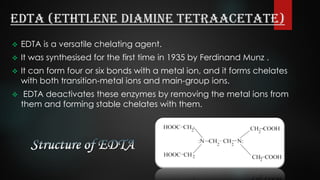
EDTA (Ethtlene Diamine TetraAcetate)
 EDTA is a versatile chelating agent.
 It was synthesised for the first time in 1935 by Ferdinand Munz .
 It can form four or six bonds with a metal ion, and it forms chelates
with both transition-metal ions and main-group ions.
 EDTA deactivates these enzymes by removing the metal ions from
them and forming stable chelates with them.
Types of complexometric reaction
DIRECT TITRATION - It is simplest and the most convenient method in which the
standard solution of EDTA is slowly added to the metal ion solution till the end
point is achieved
 The solution containing the metal ion is buffered to an appropriate pH at
which the stability constant of the metal-EDTA complex is large.
BACK TITRATION - This involves addition of a known excess of EDTA to the
metal ion (buffered to an appropriate pH). Then, the excess EDT A is titrated
with a standard solution of a different metal ion
 The choice of a second metal ion is important as it must not displace the
analyte metal ion from its EDTA complex.
INDICATORS - Common indicators are organic dyes such as Fast Sulphon
Black, Eriochrome Black T, Eriochrome Red B, Patton Reeder, or Murexide.
Hardness of Water
 The hardness is due to both Ca and Mg salts but the two are
determined together in the titration.
 The total Ca and Mg is titrated with standard EDTA solution using
eriochrome black –T as indicator.
Masking & demasking agent
MASKING AGENT - a reagent that protects some component of the
analyte from reaction with EDTA.
 Masking used to prevent one element from interfering in the analysis of
another element .
DEMASKING AGENT -Demasking is the process inwhich the masked
substance regains its ability to enter into a particular reaction.
 It is used to counteract the effect of a masking agent .
THANK YOU

Complexometric titration

  • 1.
    Pharmaceutical analysis Complexometric Titration BY-VIRENDRA VAISHNAV APOLLO COLLEGE OF PHARMACY , DURG
  • 2.
    Introduction  TITRATION –A technique in which solution of known concentration used to determine the concentaration of unknown solution.  CONDITION FOR TITRATION :-  Rapid reaction  Well designed stoichiometry  Large equilibrium constant
  • 3.
    COMPLEXOMETRy COMPLEXOMETRIC TITRATION –(chelatometry) is a form of volumetric analysis in which the formation of a colored complex is used to indicate the end point of a titration.  Used for the determination of a mixture of different metal ions in solution  It also involves formation of complex  Ligands are used for complexation COMPLEX - Metal ion+ Ligand [ M + L = ML ]
  • 4.
    LIGAND  The neutralmolecules or ion which are directly attached to central metal ion or atom through co-ordinate bond in the complex ion is called Ligands.  Ligand should have atleast one pair of electron  Ligand should be capable to donate their lon pair of electron to central metal ion  Ligand act as lewis base & Metal ion act as lewis acid TYPES OF LIGAND – On the basis of number of donating lone pair  Monodentate ( NH3 , H2O , Cl )  Bidentate ( ethylenediamine & oxalate ion )  Polydentate or Multidentate ( SCN , EDTA )
  • 5.
    Chelating agents  Multidentateligands are called Chelates .  Chelating agents are chemical compounds that react with metal ions to form a stable, water-soluble complex.  They are also known as chelants, chelators, or sequestering agents.  Chelating agents have a ring-like center which forms at least two bonds with the metal ion allowing it to be excreted  Chelating agents may also be used in the treatment of heavy metal poisoning.  Example - EDTA ( Ethylene diamine tetra acetate or acetic acid )
  • 6.
    EDTA (Ethtlene DiamineTetraAcetate)  EDTA is a versatile chelating agent.  It was synthesised for the first time in 1935 by Ferdinand Munz .  It can form four or six bonds with a metal ion, and it forms chelates with both transition-metal ions and main-group ions.  EDTA deactivates these enzymes by removing the metal ions from them and forming stable chelates with them.
  • 7.
    Types of complexometricreaction DIRECT TITRATION - It is simplest and the most convenient method in which the standard solution of EDTA is slowly added to the metal ion solution till the end point is achieved  The solution containing the metal ion is buffered to an appropriate pH at which the stability constant of the metal-EDTA complex is large. BACK TITRATION - This involves addition of a known excess of EDTA to the metal ion (buffered to an appropriate pH). Then, the excess EDT A is titrated with a standard solution of a different metal ion  The choice of a second metal ion is important as it must not displace the analyte metal ion from its EDTA complex. INDICATORS - Common indicators are organic dyes such as Fast Sulphon Black, Eriochrome Black T, Eriochrome Red B, Patton Reeder, or Murexide.
  • 8.
    Hardness of Water The hardness is due to both Ca and Mg salts but the two are determined together in the titration.  The total Ca and Mg is titrated with standard EDTA solution using eriochrome black –T as indicator.
  • 9.
    Masking & demaskingagent MASKING AGENT - a reagent that protects some component of the analyte from reaction with EDTA.  Masking used to prevent one element from interfering in the analysis of another element . DEMASKING AGENT -Demasking is the process inwhich the masked substance regains its ability to enter into a particular reaction.  It is used to counteract the effect of a masking agent .
  • 10.