This document provides an overview of integration and techniques for evaluating integrals. It discusses integration as the inverse operation of differentiation and indefinite integrals. Several methods for evaluating integrals are described, including substitution, integration by parts, partial fractions, and special integrals involving trigonometric, exponential, logarithmic and hyperbolic functions. Examples of standard forms that can be converted into special integrals are given. The document also compares properties of differentiation and integration and provides contact information for the author.
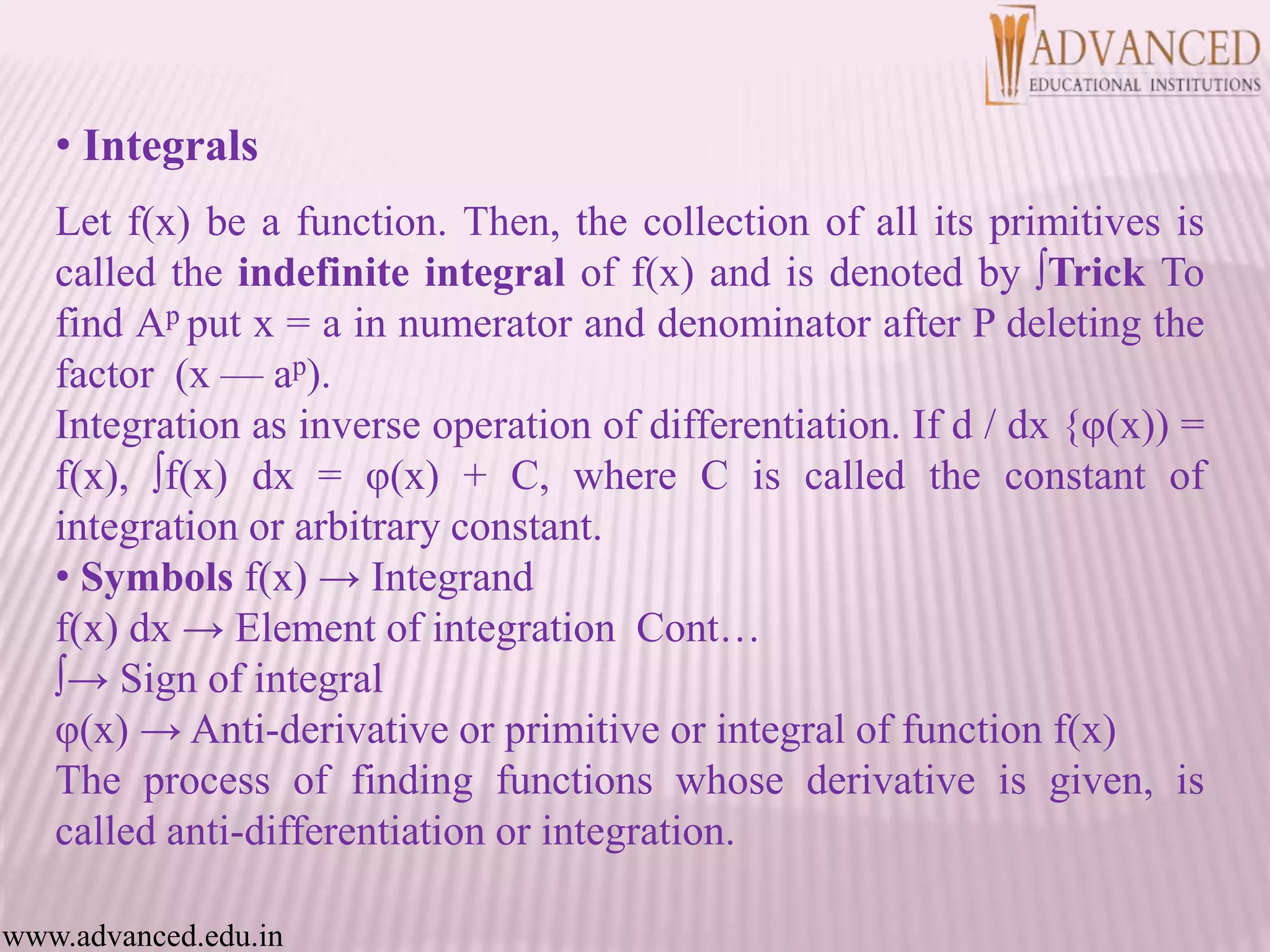
• Integrals
Let f(x)be a function. Then, the collection of all its primitives is
called the indefinite integral of f(x) and is denoted by ∫Trick To
find Ap put x = a in numerator and denominator after P deleting the
factor (x — ap).
Integration as inverse operation of differentiation. If d / dx {φ(x)) =
f(x), ∫f(x) dx = φ(x) + C, where C is called the constant of
integration or arbitrary constant.
• Symbols f(x) → Integrand
f(x) dx → Element of integration Cont…
∫→ Sign of integral
φ(x) → Anti-derivative or primitive or integral of function f(x)
The process of finding functions whose derivative is given, is
called anti-differentiation or integration.
www.advanced.edu.in
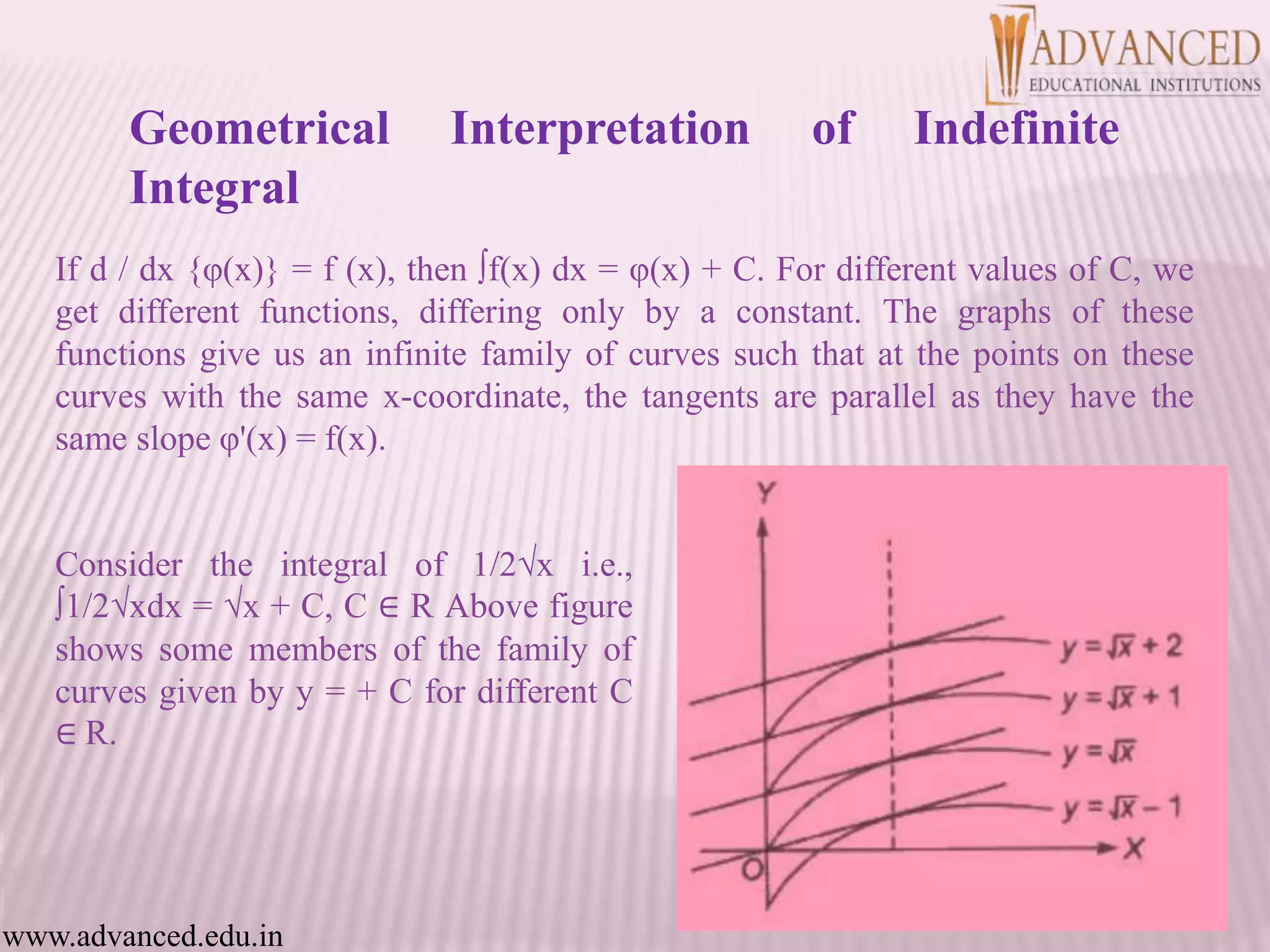
If d /dx {φ(x)} = f (x), then ∫f(x) dx = φ(x) + C. For different values of C, we
get different functions, differing only by a constant. The graphs of these
functions give us an infinite family of curves such that at the points on these
curves with the same x-coordinate, the tangents are parallel as they have the
same slope φ'(x) = f(x).
Consider the integral of 1/2√x i.e.,
∫1/2√xdx = √x + C, C ∈ R Above figure
shows some members of the family of
curves given by y = + C for different C
∈ R.
www.advanced.edu.in
Geometrical Interpretation of Indefinite
Integral
8.
1. Both differentiationand integration are linear operator on functions as
d/dx {a f(x) ± bg(x)} = a d/dx{f(x) ± d/ dx{g(x)}and ∫[a. f (x) ± b . g
(x)dx = a ∫f(x)dx ± b ∫g(x)dx.
2. All functions are not differentiable, similarly there are some function
which are not integrable.
3. Integral of a function is always discussed in an interval but derivative of
a function can be discussed in a interval as well as on a point.
4. Geometrically derivative of a function represents slope of the tangent to
the graph of function at the point. On the other hand, integral of a
function represents an infinite family of curves placed parallel to each
other having parallel tangents at points of intersection of the curves with
a line parallel to Y-axis.
www.advanced.edu.in
Comparison between Differentiation and Integration
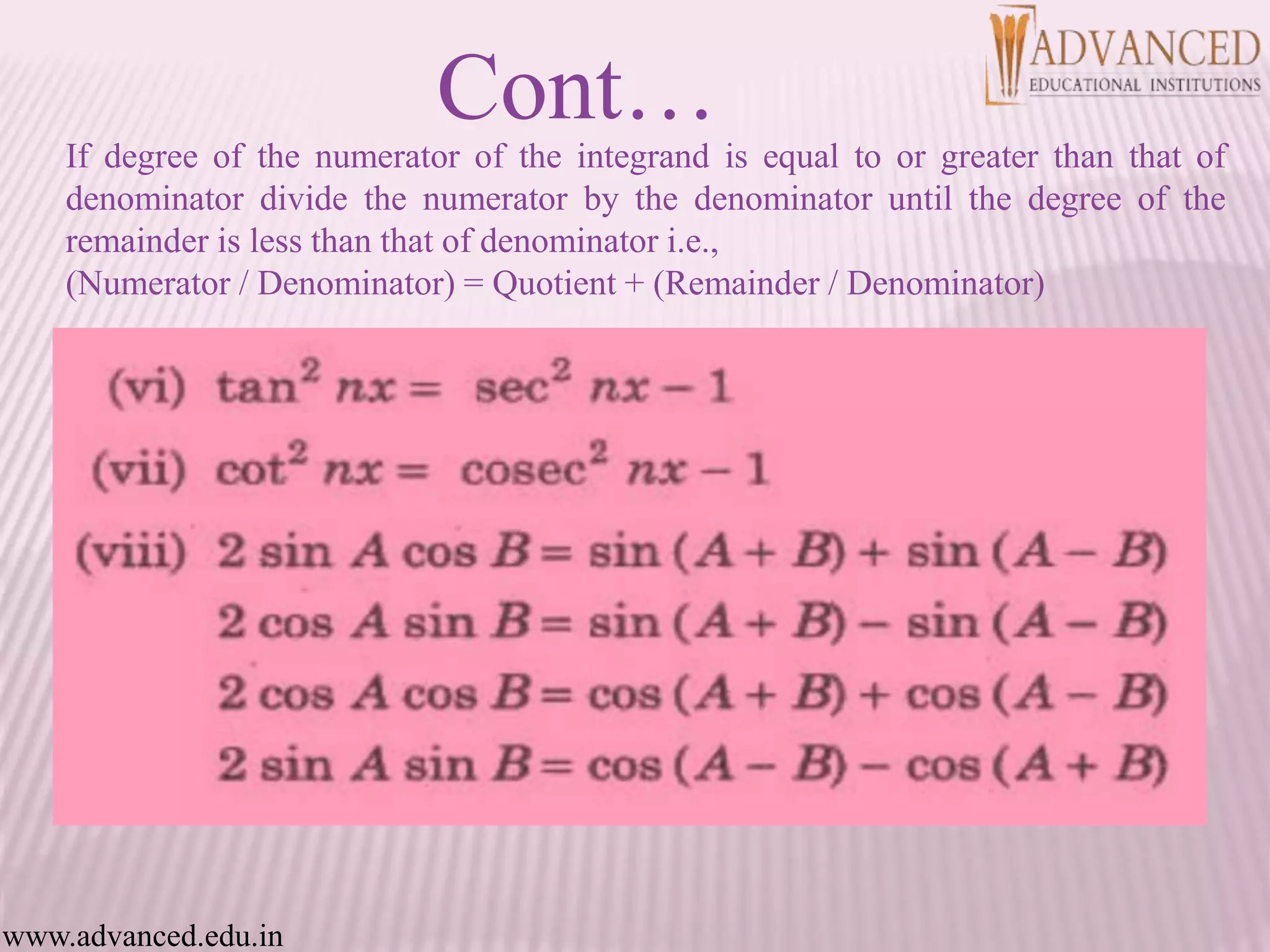
If degree ofthe numerator of the integrand is equal to or greater than that of
denominator divide the numerator by the denominator until the degree of the
remainder is less than that of denominator i.e.,
(Numerator / Denominator) = Quotient + (Remainder / Denominator)
Cont…
www.advanced.edu.in
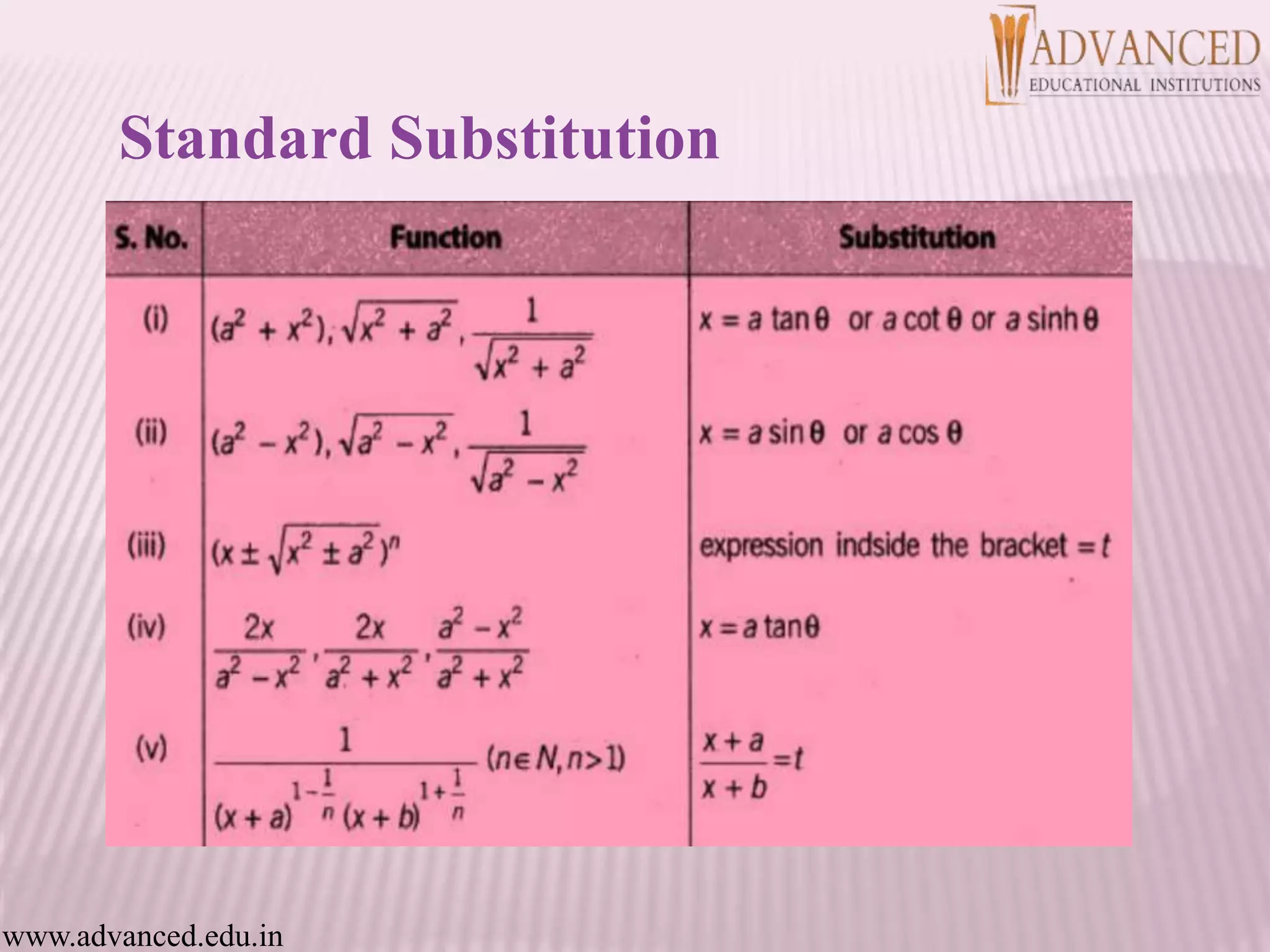
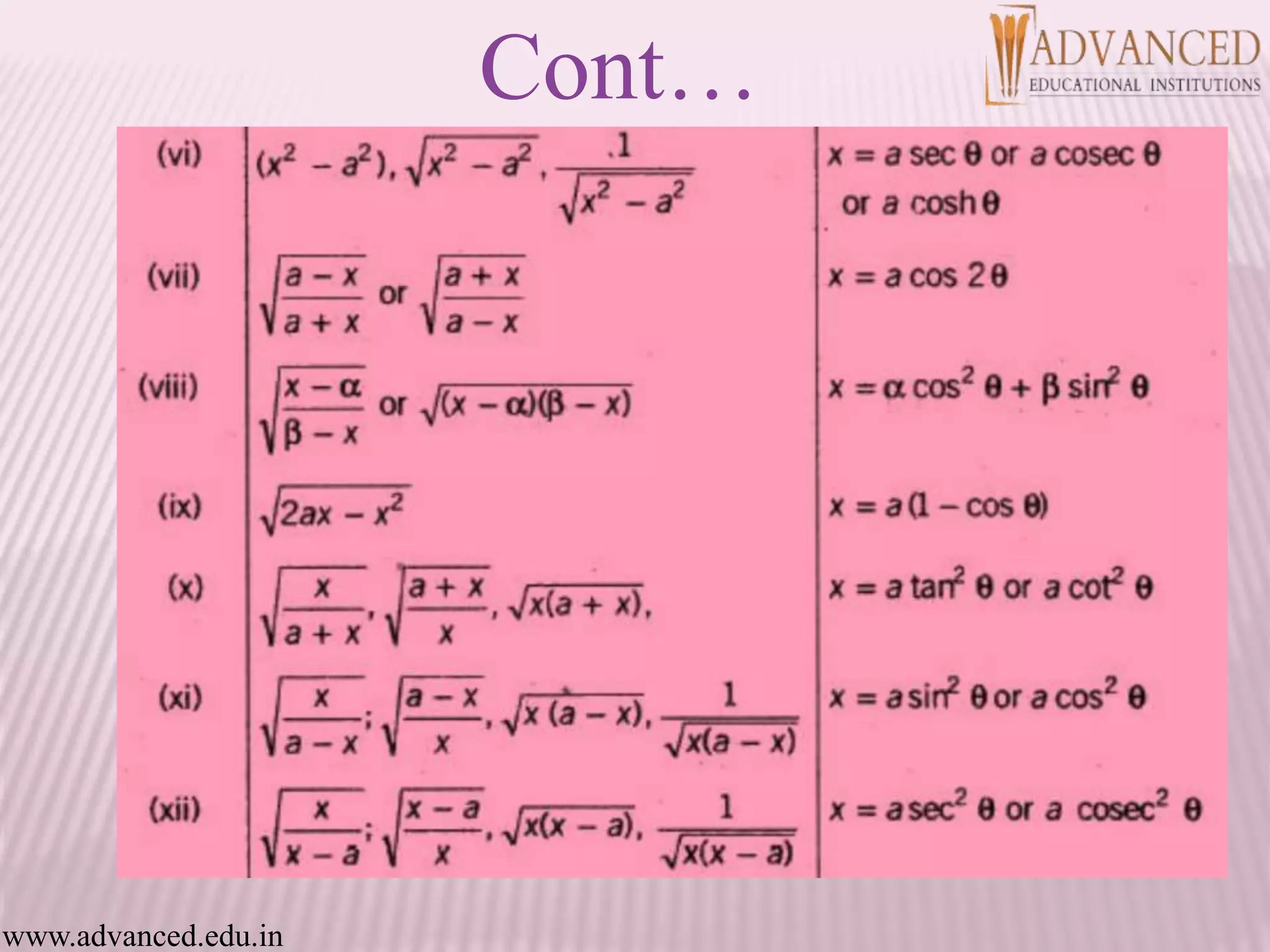
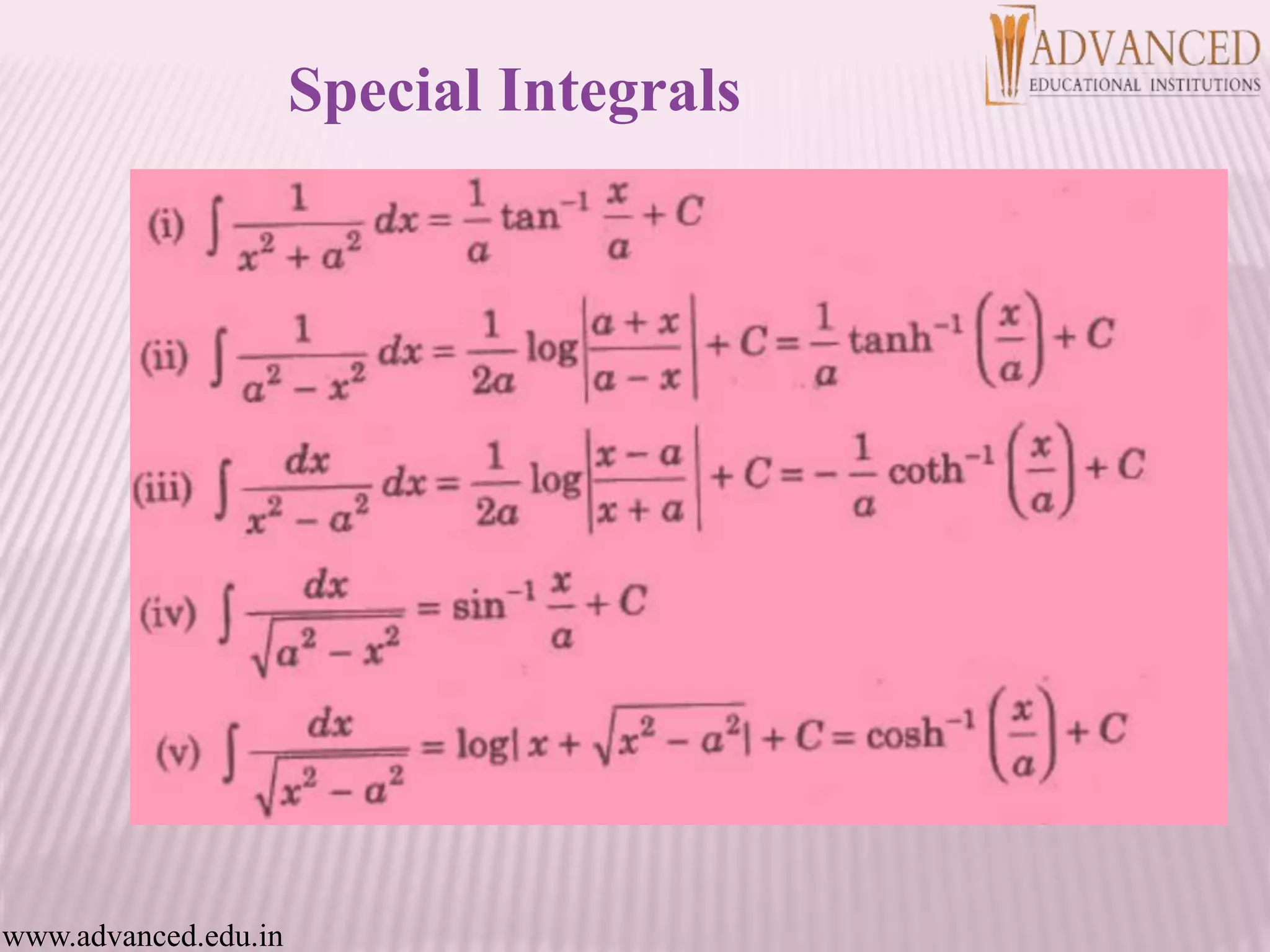
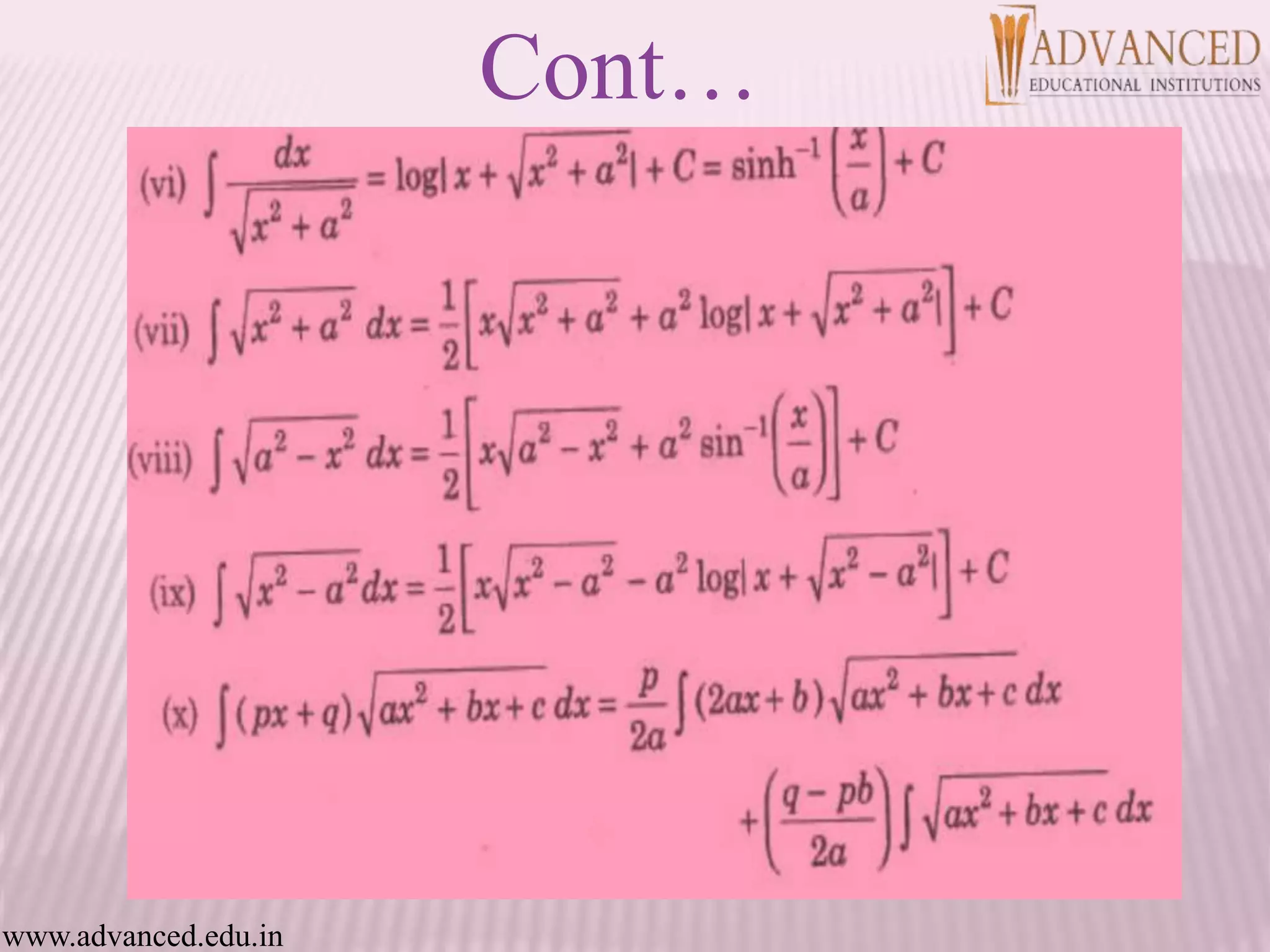
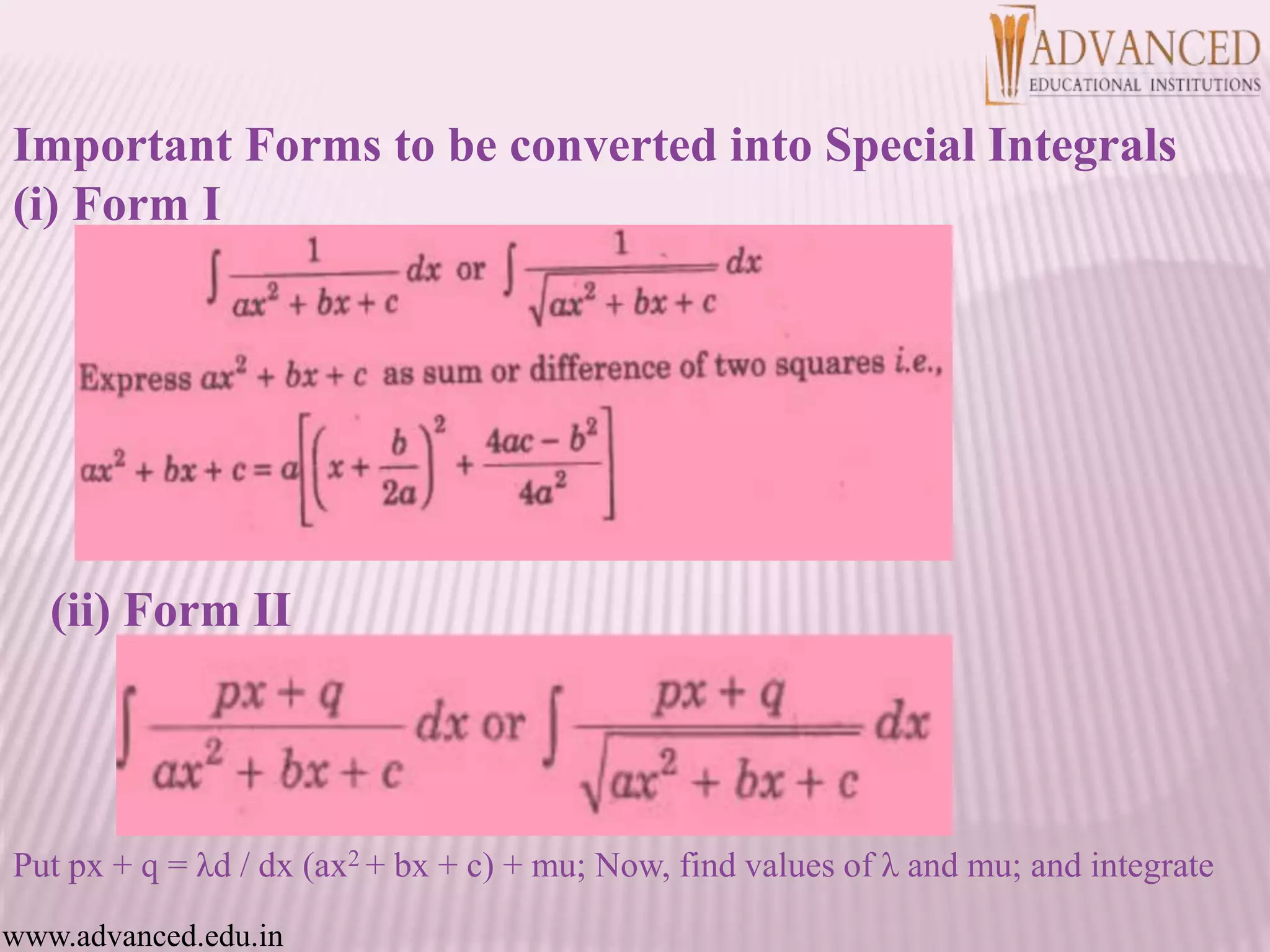
Important Forms tobe converted into Special Integrals
(i) Form I
(ii) Form II
Put px + q = λd / dx (ax2 + bx + c) + mu; Now, find values of λ and mu; and integrate
www.advanced.edu.in
19.
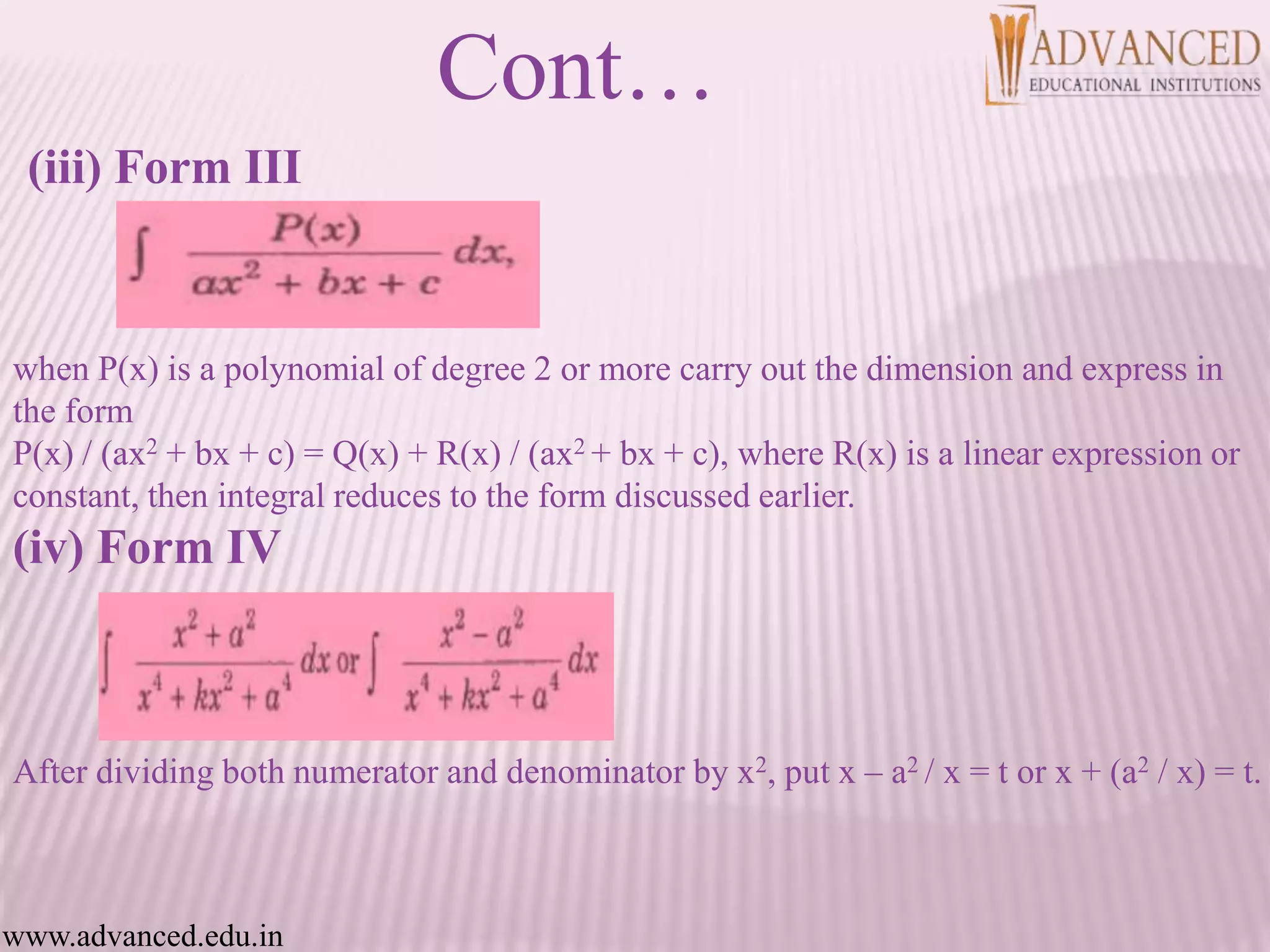
(iii) Form III
whenP(x) is a polynomial of degree 2 or more carry out the dimension and express in
the form
P(x) / (ax2 + bx + c) = Q(x) + R(x) / (ax2 + bx + c), where R(x) is a linear expression or
constant, then integral reduces to the form discussed earlier.
(iv) Form IV
After dividing both numerator and denominator by x2, put x – a2 / x = t or x + (a2 / x) = t.
Cont…
www.advanced.edu.in
20.
(v) Form V
Toevaluate the above type of integrals, we proceed as follow:
(a) Divide numerator and denominator by cos2x.
(b) Replace sec2x, if any in denominator by 1 + tan2 x.
(c) Put tan x = t, then sec2xdx = dt
Cont…
www.advanced.edu.in
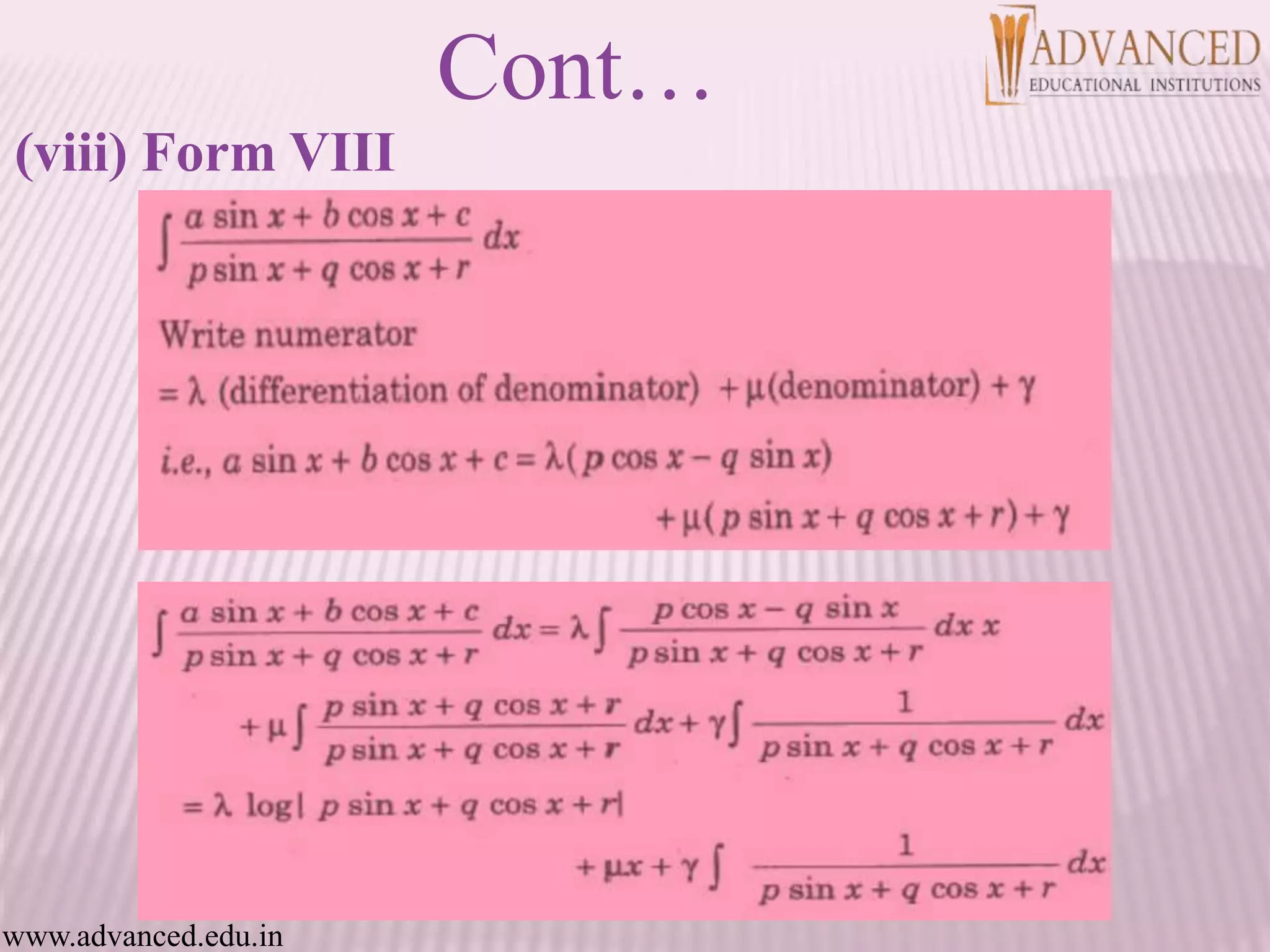
(ix) Form IX
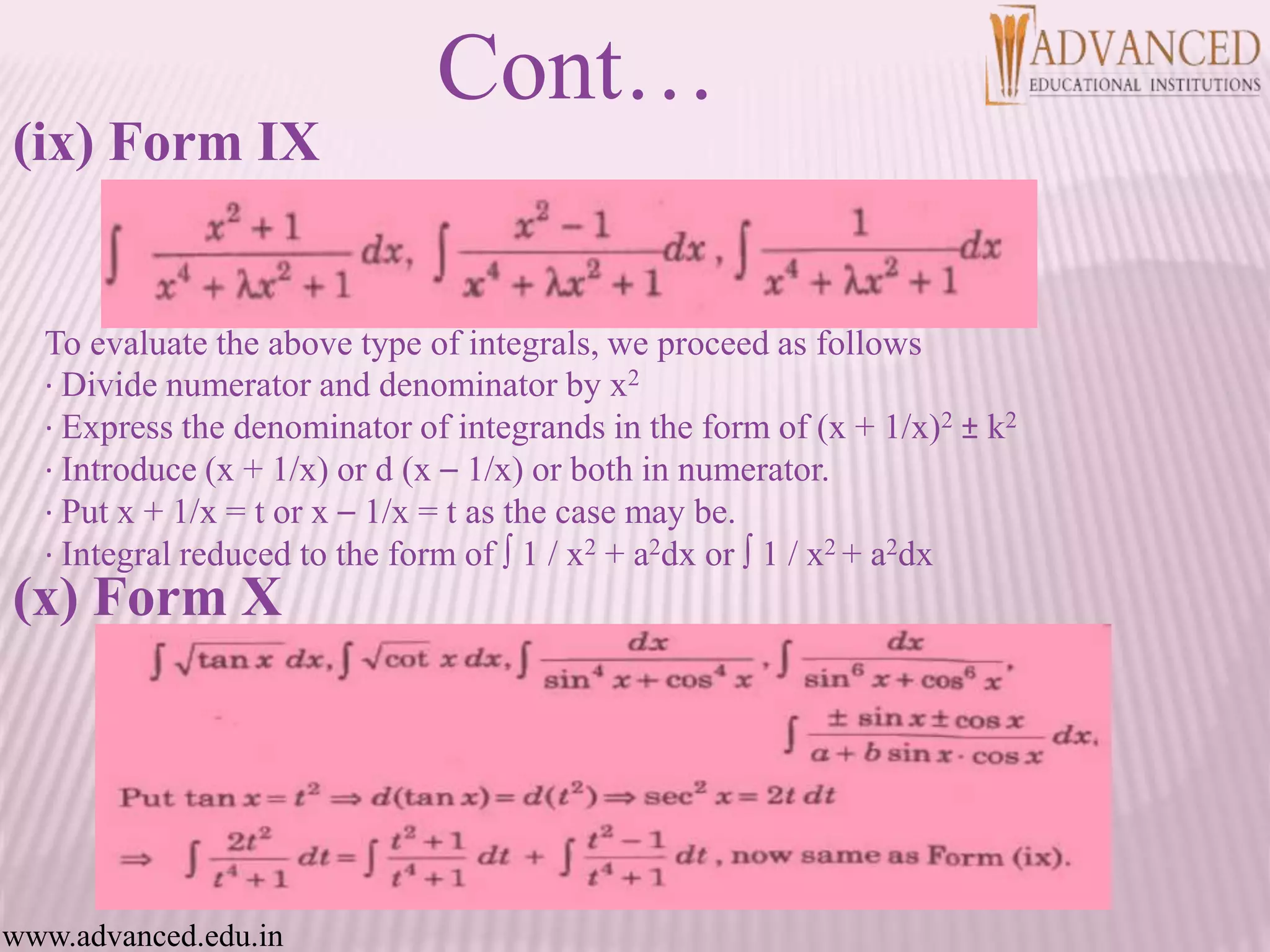
Toevaluate the above type of integrals, we proceed as follows
· Divide numerator and denominator by x2
· Express the denominator of integrands in the form of (x + 1/x)2 ± k2
· Introduce (x + 1/x) or d (x – 1/x) or both in numerator.
· Put x + 1/x = t or x – 1/x = t as the case may be.
· Integral reduced to the form of ∫ 1 / x2 + a2dx or ∫ 1 / x2 + a2dx
(x) Form X
Cont…
www.advanced.edu.in
25.
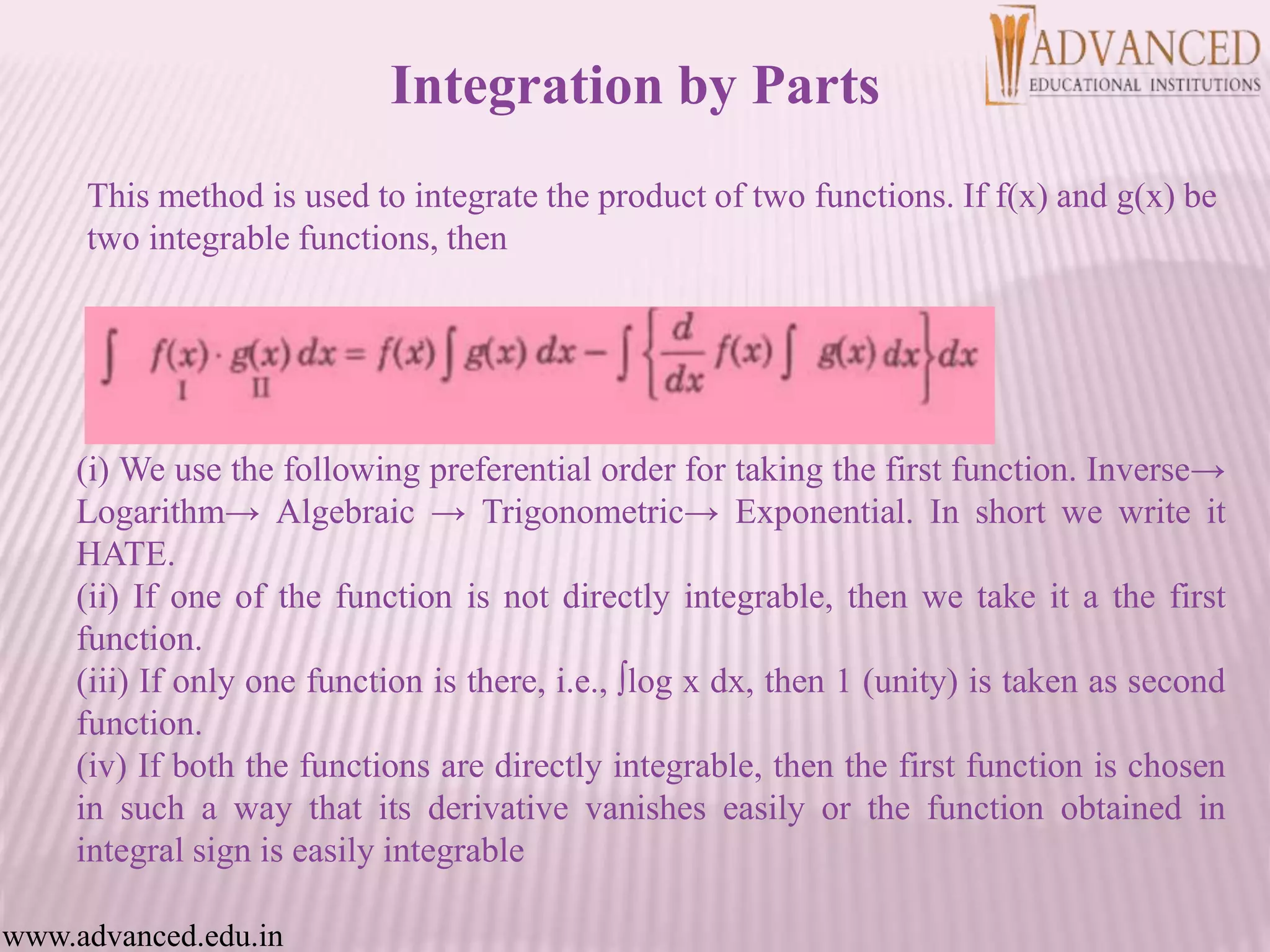
This method isused to integrate the product of two functions. If f(x) and g(x) be
two integrable functions, then
(i) We use the following preferential order for taking the first function. Inverse→
Logarithm→ Algebraic → Trigonometric→ Exponential. In short we write it
HATE.
(ii) If one of the function is not directly integrable, then we take it a the first
function.
(iii) If only one function is there, i.e., ∫log x dx, then 1 (unity) is taken as second
function.
(iv) If both the functions are directly integrable, then the first function is chosen
in such a way that its derivative vanishes easily or the function obtained in
integral sign is easily integrable
www.advanced.edu.in
Integration by Parts
(i) If f(x)and g(x) are two polynomials, then f(x) / g(x) defines a rational algebraic
function of x. If degree of f(x) < degree of g(x), then f(x) / g(x) is called a proper
rational function.
(ii) If degree of f(x) ≥ degree of g(x), then f(x) /g(x) is called an improper g(x)
rational function.
(iii) If f(x) / g(x) isan improper rational function, then we divide f(x) by g(x) g(x) and
convert it into a proper rational function as f(x) / g(x) = φ(x) + h(x) / g(x).
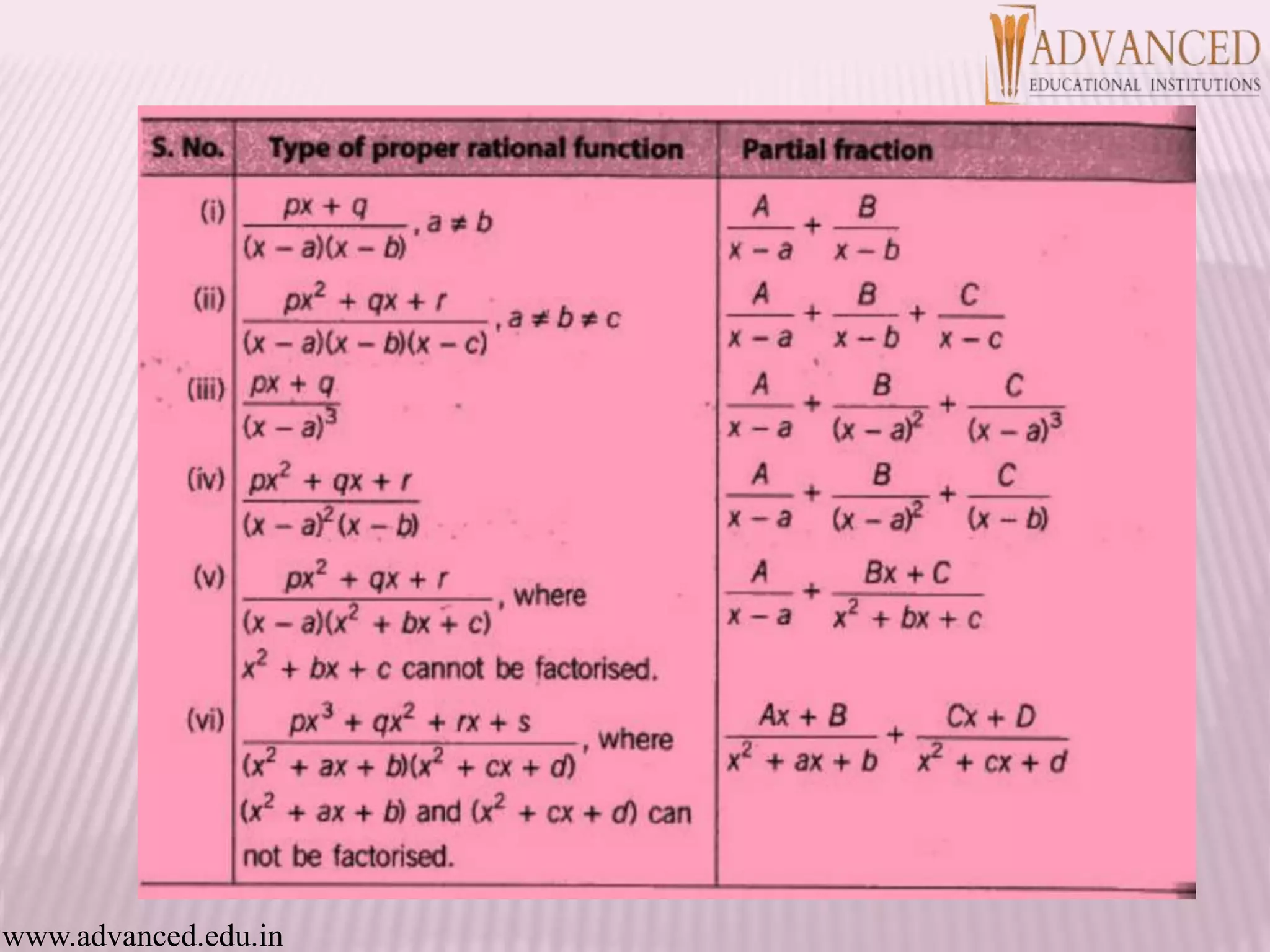
(iv) Any proper rational function f(x) / g(x) can be expressed as the sum of rational
functions each having a simple factor of g(x). Each such fraction is called a partial
fraction and the process of obtaining them, is called the resolution or decomposition
of f(x) /g(x) partial fraction.
www.advanced.edu.in
Integration Using Partial Fractions
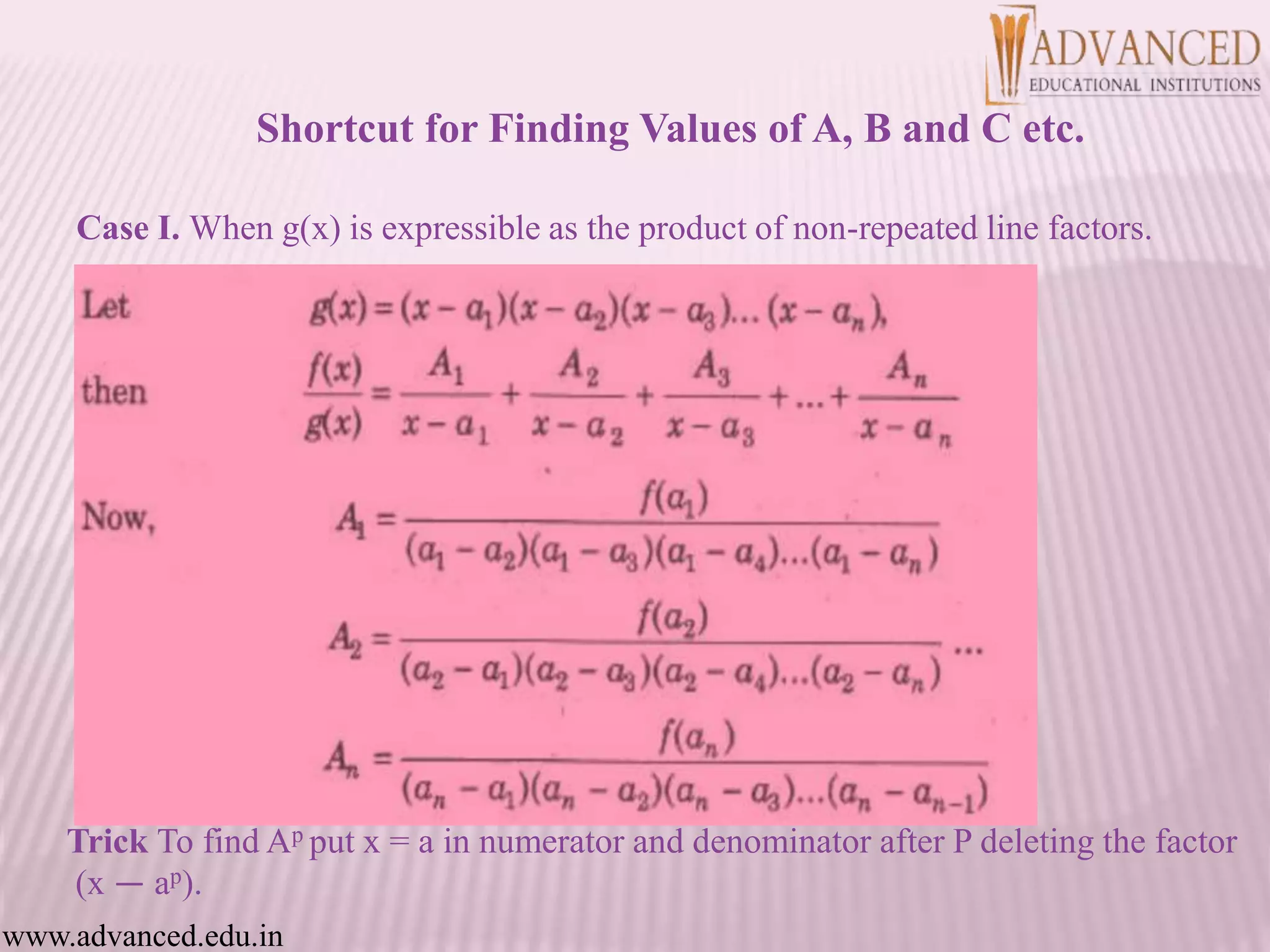
Case I. Wheng(x) is expressible as the product of non-repeated line factors.
Trick To find Ap put x = a in numerator and denominator after P deleting the factor
(x — ap).
www.advanced.edu.in
Shortcut for Finding Values of A, B and C etc.
30.
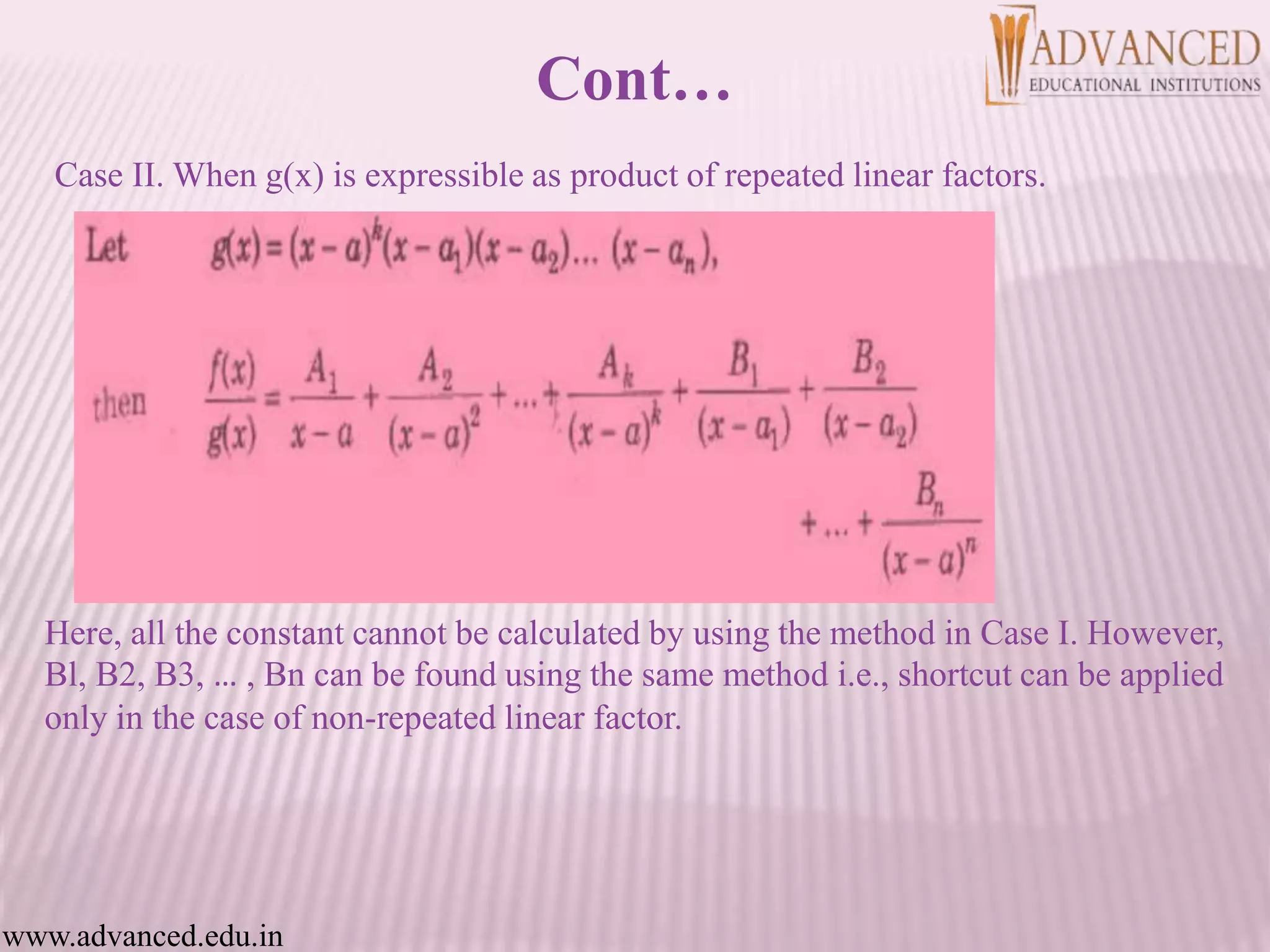
Case II. Wheng(x) is expressible as product of repeated linear factors.
Here, all the constant cannot be calculated by using the method in Case I. However,
Bl, B2, B3, … , Bn can be found using the same method i.e., shortcut can be applied
only in the case of non-repeated linear factor.
www.advanced.edu.in
Cont…
31.
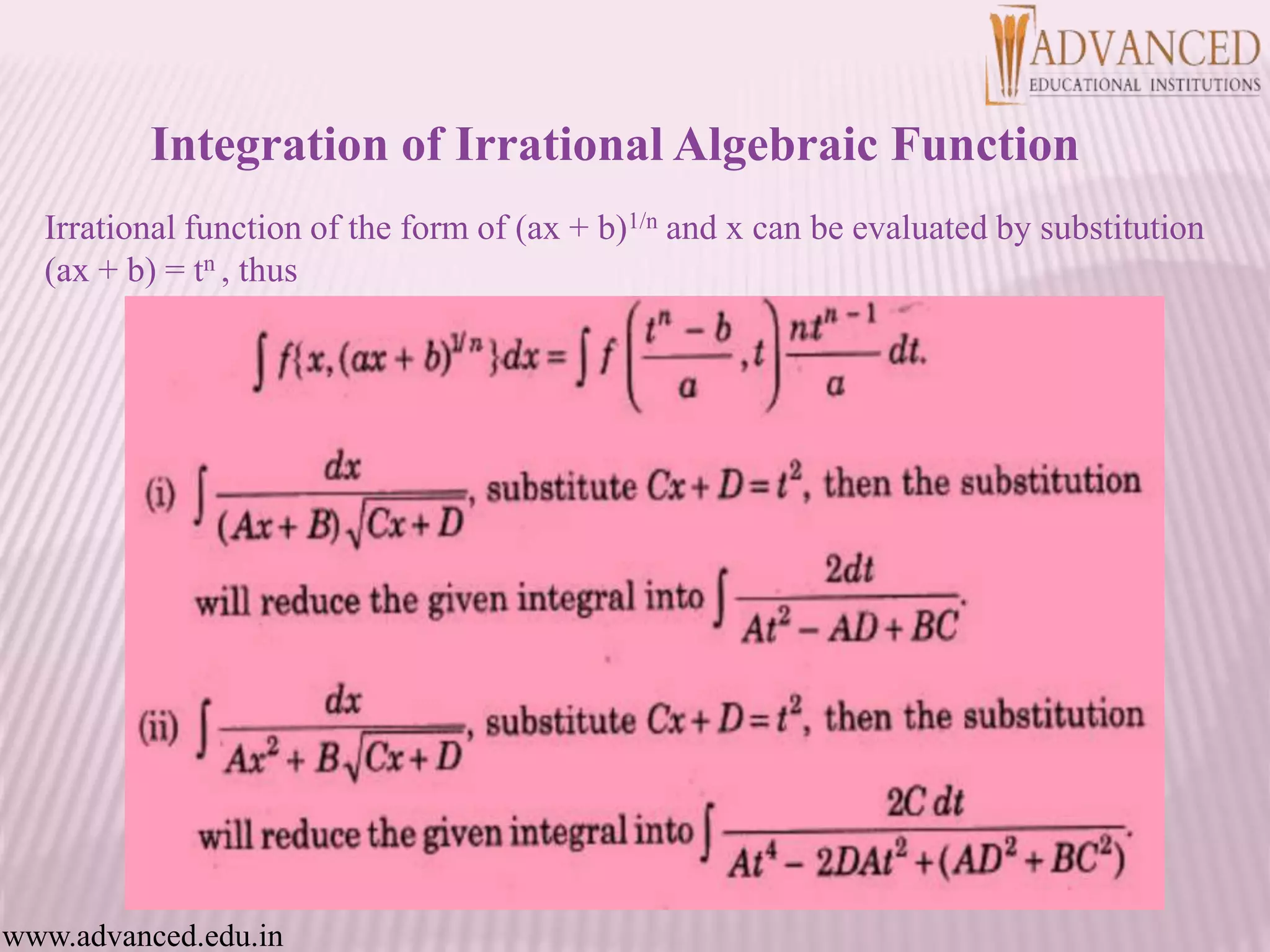
Irrational function ofthe form of (ax + b)1/n and x can be evaluated by substitution
(ax + b) = tn , thus
www.advanced.edu.in
Integration of Irrational Algebraic Function
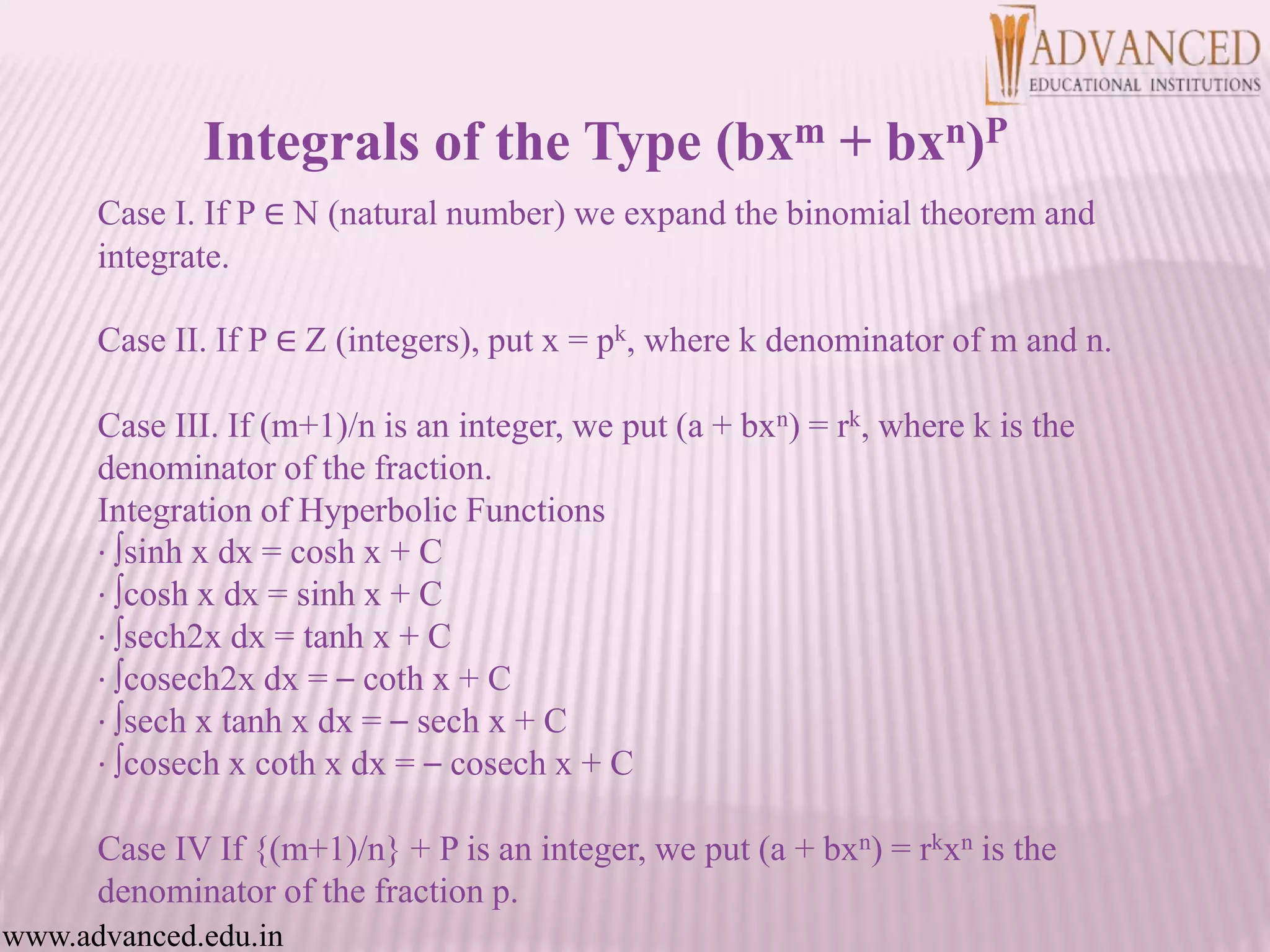
Case I. IfP ∈ N (natural number) we expand the binomial theorem and
integrate.
Case II. If P ∈ Z (integers), put x = pk, where k denominator of m and n.
Case III. If (m+1)/n is an integer, we put (a + bxn) = rk, where k is the
denominator of the fraction.
Integration of Hyperbolic Functions
· ∫sinh x dx = cosh x + C
· ∫cosh x dx = sinh x + C
· ∫sech2x dx = tanh x + C
· ∫cosech2x dx = – coth x + C
· ∫sech x tanh x dx = – sech x + C
· ∫cosech x coth x dx = – cosech x + C
Case IV If {(m+1)/n} + P is an integer, we put (a + bxn) = rkxn is the
denominator of the fraction p.
www.advanced.edu.in
Integrals of the Type (bxm + bxn)P