Cylindrical andCylindrical and
Spherical CoordinatesSpherical Coordinates
Representation and Conversions
By: Shalini Singh
Assistant Professor
www.advanced.edu.in
CONTENTSCONTENTS
Cylindrical Co-ordinates
Co-ordinates formation in 3-D
Cylindrical Formation
Spherical Co-ordinates
Spherical Representation in 3-D
Conversion of Cylindrical Into Spherical
Rectangular Co-ordinates
Integral
Conclusion
www.advanced.edu.in
IntroductionIntroduction
The laws of electromagnetic are invariant with coordinate system.
When we solve problems in electromagnetic. For Eg. Finding Electric
Field at a point, we desire the fields. The position is expressed in terms
of Co-ordinates. The co-ordinates are specified by the co-ordinate
System.
Most Common Co-ordinate systems are:
•Cartesian Or Rectangular Coordinate system
• Cylindrical Coordinate system
•Spherical Coordinate system
www.advanced.edu.in
Representing 3D points inRepresenting 3D points in
Cylindrical Coordinates.Cylindrical Coordinates.
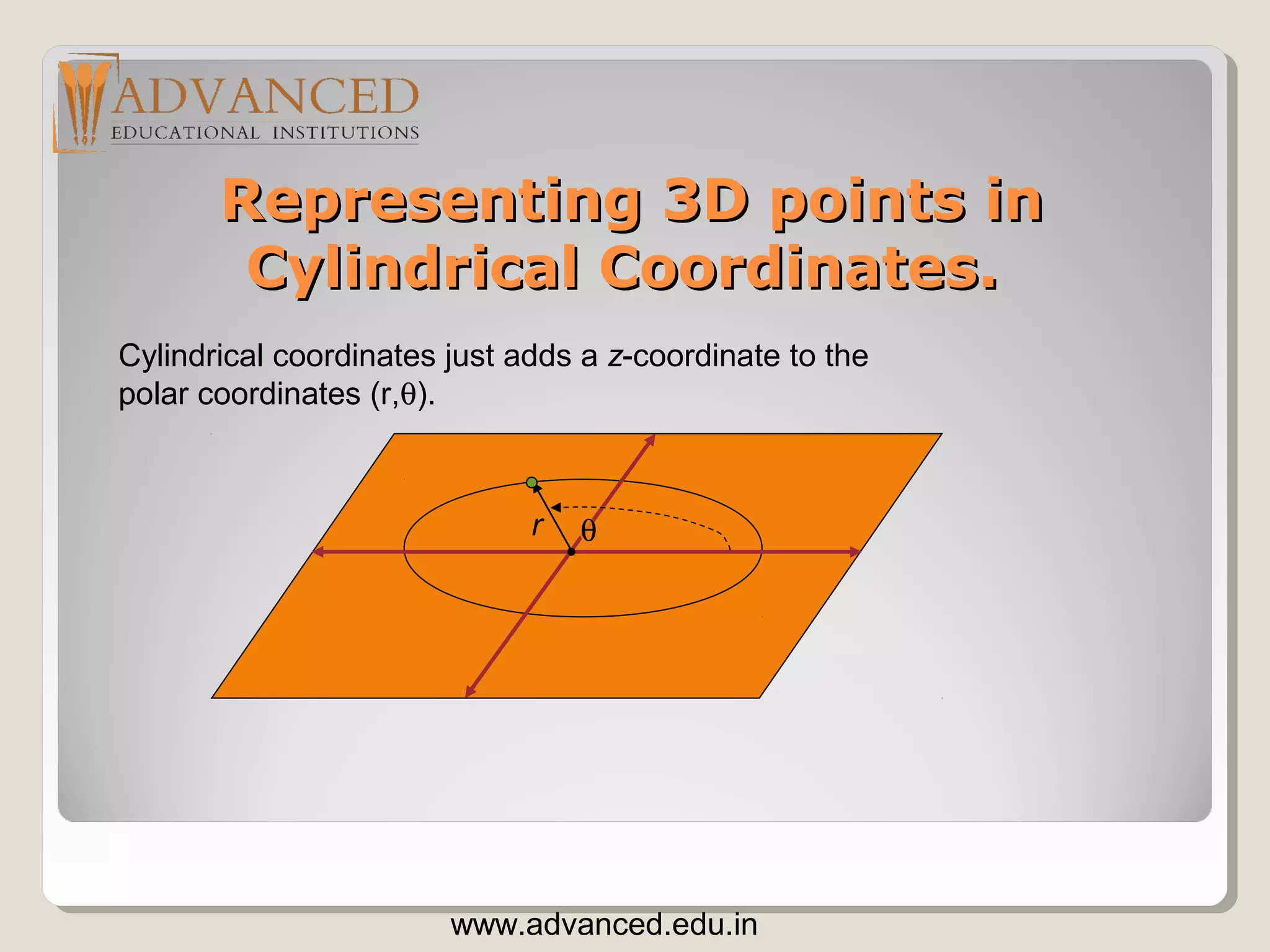
θr
Recall polar representations in the plane
www.advanced.edu.in
Representing 3D points inRepresenting 3D points in
Cylindrical Coordinates.Cylindrical Coordinates.
θr
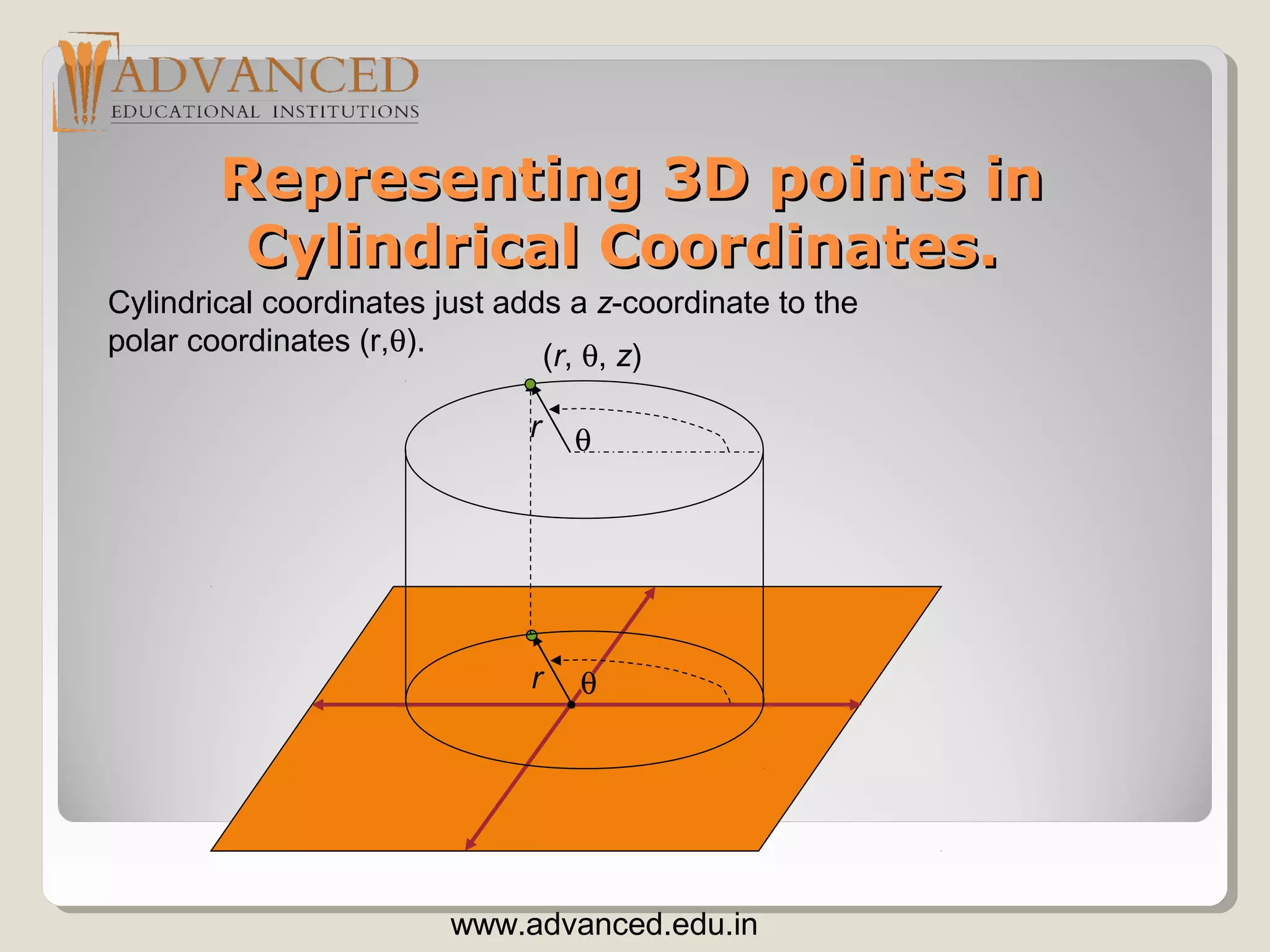
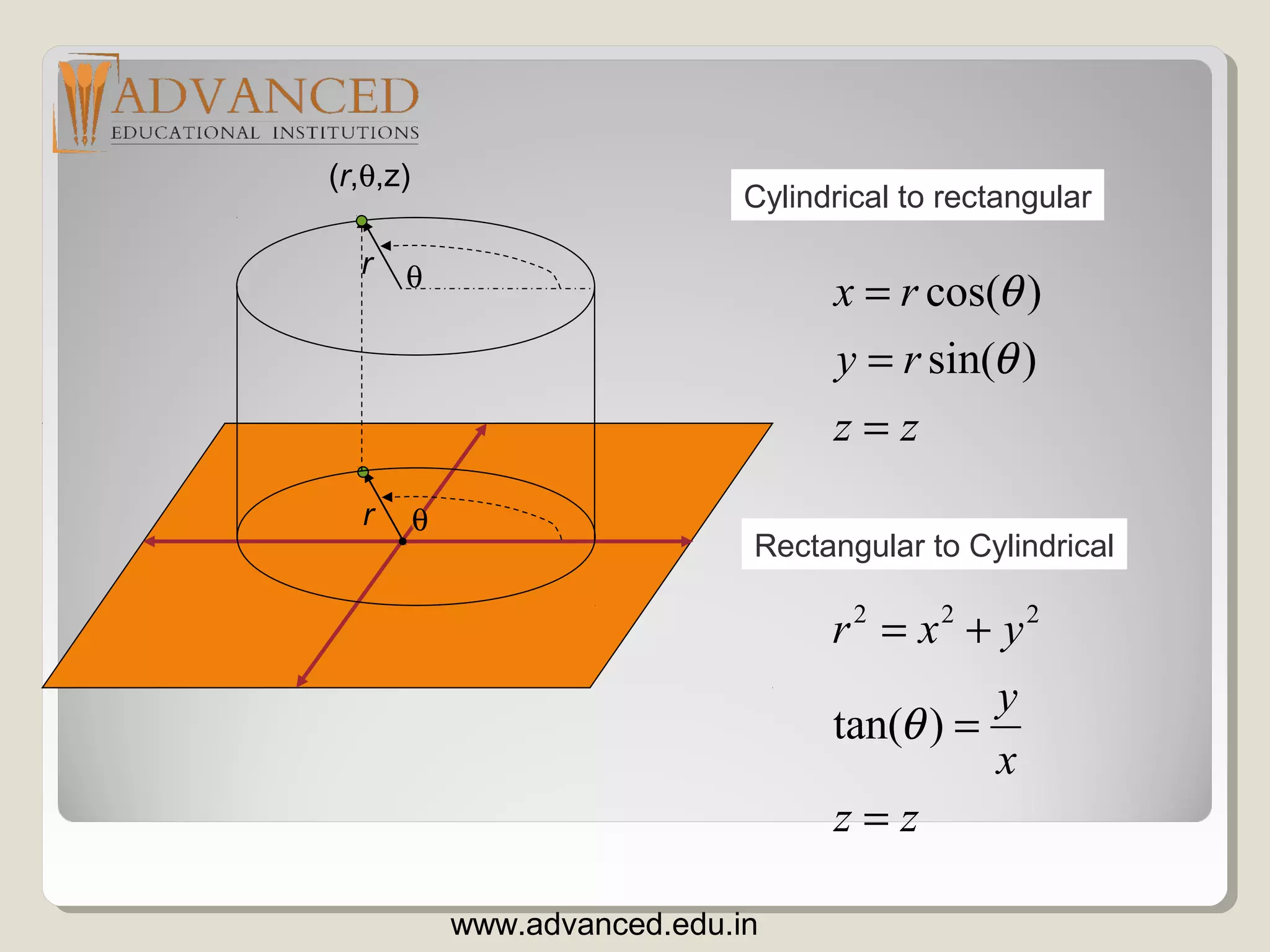
Cylindrical coordinates just adds a z-coordinate to the
polar coordinates (r,θ).
www.advanced.edu.in
θr
Representing 3D points inRepresenting 3D points in
Cylindrical Coordinates.Cylindrical Coordinates.
θr
(r, θ, z)
www.advanced.edu.in
Cylindrical coordinates just adds a z-coordinate to the
polar coordinates (r,θ).
cos( )
sin( )
x r
y r
z z
θ
θ
=
=
=
θr
θr
(r,θ,z)
Rectangular to Cylindrical
2 2 2
tan( )
r x y
y
x
z z
= +
=
=
θ
Cylindrical to rectangular
www.advanced.edu.in
Spherical Coordinates are the 3D analog of
polar representations in the plane.
We divide 3-dimensional space into
1. a set of concentric spheres centered at the
origin.
2. rays emitting outwards from the origin
www.advanced.edu.in
Representing 3D points inRepresenting 3D points in
Spherical CoordinatesSpherical Coordinates(x,y,z)
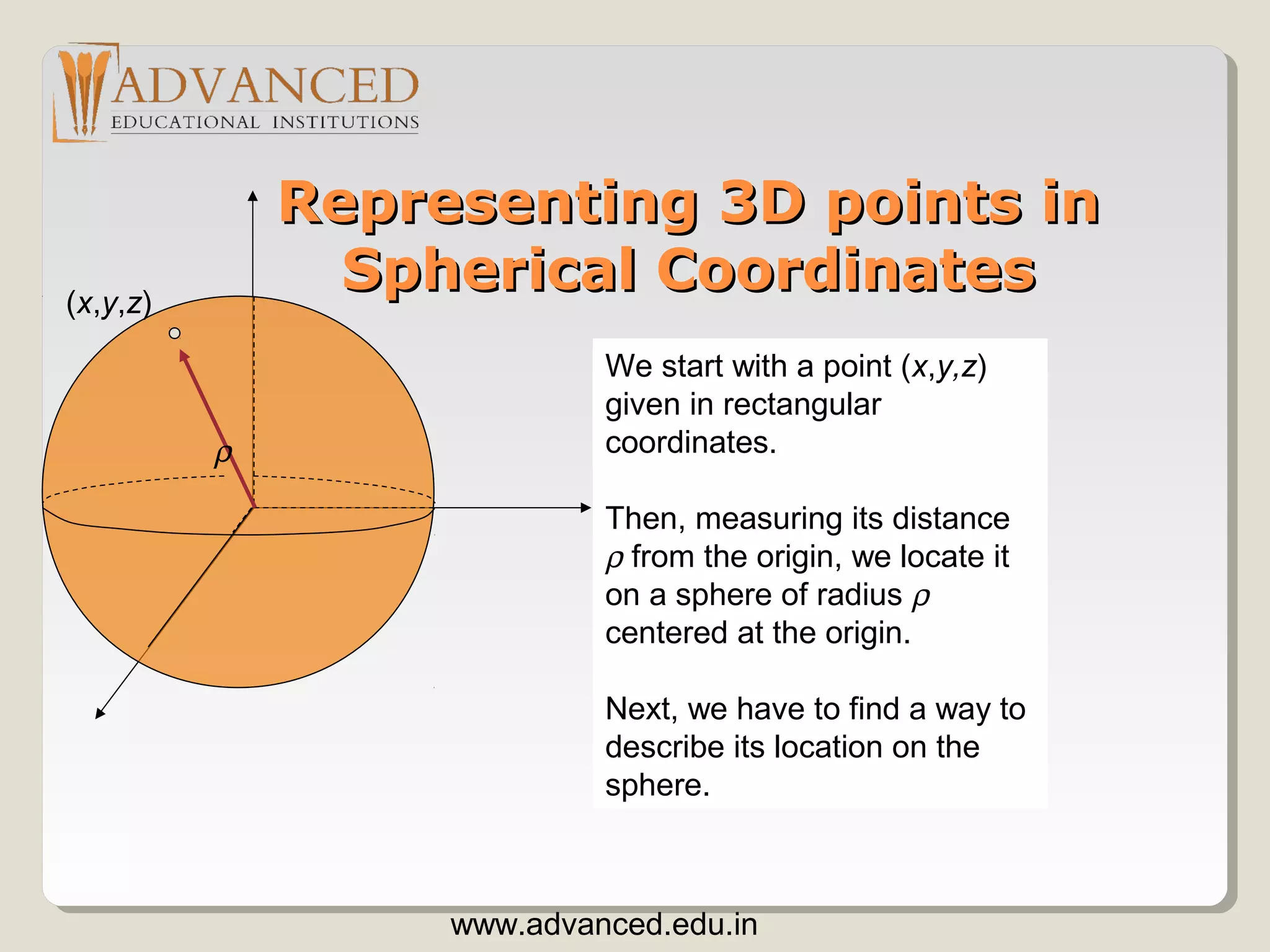
We start with a point (x,y,z)
given in rectangular
coordinates.
Then, measuring its distance
ρ from the origin, we locate it
on a sphere of radius ρ
centered at the origin.
Next, we have to find a way to
describe its location on the
sphere.
ρ
www.advanced.edu.in
Representing 3D points inRepresenting 3D points in
Spherical CoordinatesSpherical Coordinates
We use a method similar to the
method used to measure latitude
and longitude on the surface of the
Earth.
We find the great circle that goes
through the “north pole,” the “south
pole,” and the point.
www.advanced.edu.in
Representing 3D points inRepresenting 3D points in
Spherical CoordinatesSpherical Coordinates
φ
We measure the latitude or polar
angle starting at the “north pole” in
the plane given by the great circle.
This angle is called φ. The range
of this angle is
Note:
all angles are measured in
radians, as always.
0 .φ π≤ ≤
www.advanced.edu.in
Representing 3D points inRepresenting 3D points in
Spherical CoordinatesSpherical Coordinates
We use a method similar to the
method used to measure latitude
and longitude on the surface of the
Earth.
Next, we draw a horizontal circle
on the sphere that passes through
the point.
www.advanced.edu.in
Representing 3D points inRepresenting 3D points in
Spherical CoordinatesSpherical Coordinates
And “drop it down” onto the xy-
plane.
www.advanced.edu.in
Representing 3D points inRepresenting 3D points in
Spherical CoordinatesSpherical Coordinates
We measure the latitude or azimuthal
angle on the latitude circle, starting at
the positive x-axis and rotating toward
the positive y-axis.
The range of the angle is
Angle is called θ.
0 2 .θ π≤ <
Note that this is the same angle as the θ in cylindrical coordinates!
www.advanced.edu.in
Finally, a Point in SphericalFinally, a Point in Spherical
Coordinates!Coordinates!
(ρ ,θ ,φ)
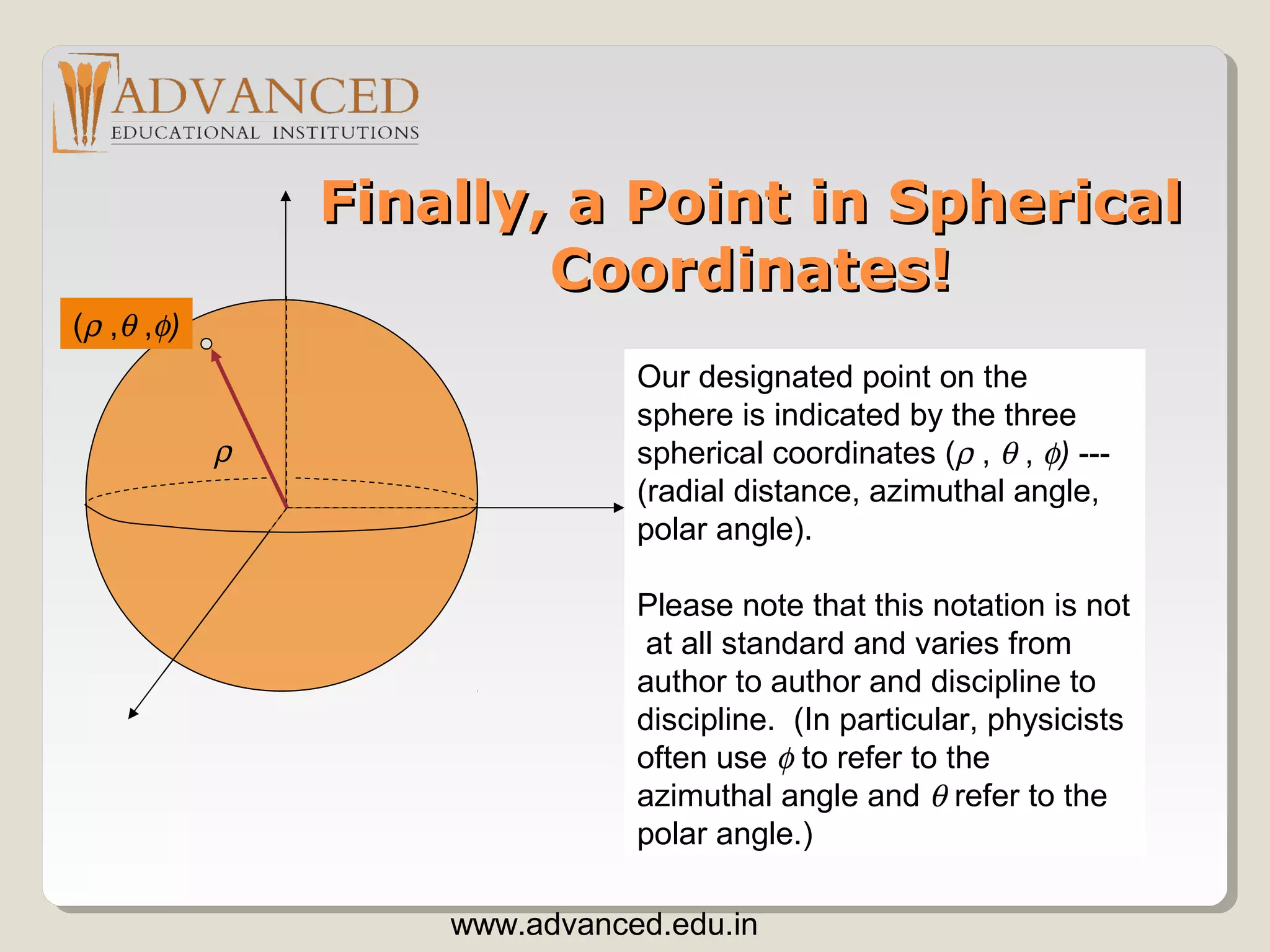
Our designated point on the
sphere is indicated by the three
spherical coordinates (ρ , θ , φ) ---
(radial distance, azimuthal angle,
polar angle).
Please note that this notation is not
at all standard and varies from
author to author and discipline to
discipline. (In particular, physicists
often use φ to refer to the
azimuthal angle and θ refer to the
polar angle.)
ρ
www.advanced.edu.in
φ
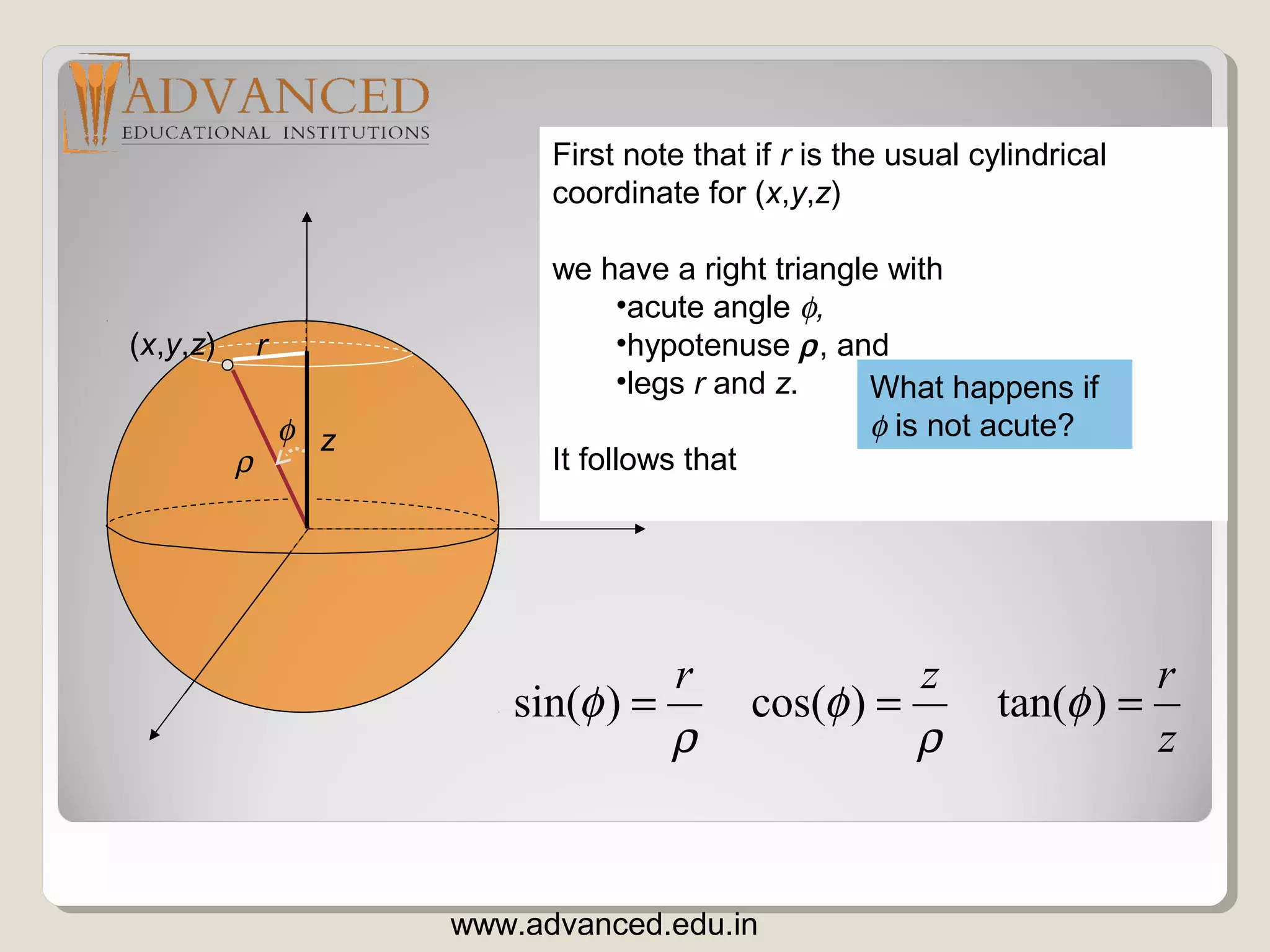
(x,y,z)
z
ρ
r
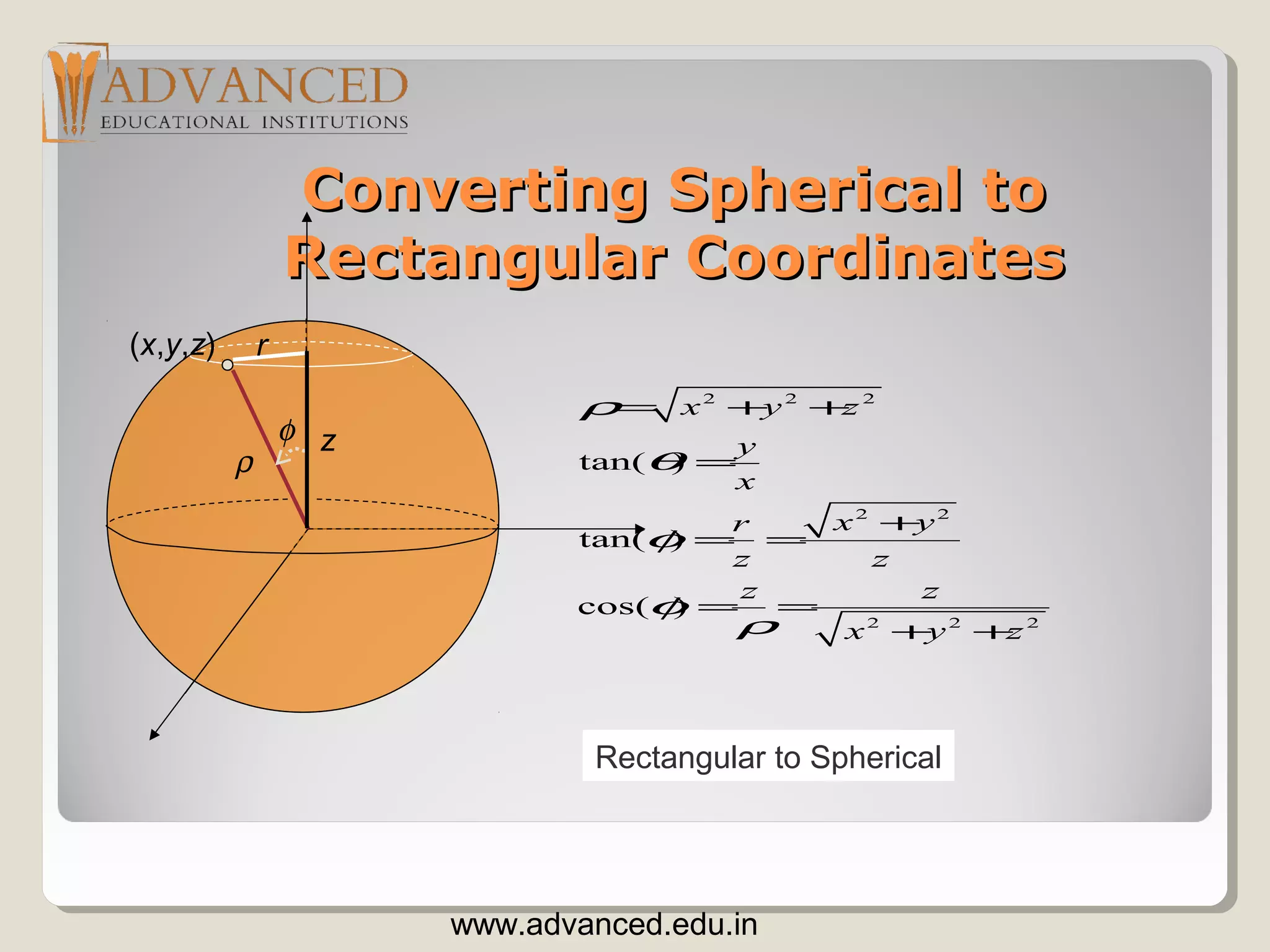
First note that if r is the usual cylindrical
coordinate for (x,y,z)
we have a right triangle with
•acute angle φ,
•hypotenuse ρ, and
•legs r and z.
It follows that
sin( ) cos( ) tan( )
r z r
z
φ φ φ
ρ ρ
= = =
What happens if
φ is not acute?
www.advanced.edu.in
Converting Spherical toConverting Spherical to
Rectangular CoordinatesRectangular Coordinates
2 2 2
2 2
2 2 2
tan( )
tan( )
cos( )
x y z
y
x
x yr
z z
z z
x y z
ρ
θ
φ
φ
ρ
= + +
=
+
= =
= =
+ +
φ
(x,y,z)
z
ρ
r
Rectangular to Spherical
www.advanced.edu.in
Cylindrical andCylindrical and
Spherical CoordinatesSpherical Coordinates
Integration
www.advanced.edu.in
Rectangular CoordinatesRectangular Coordinates
We know that in a Riemann Sum approximation for a triple integral, a
summand
This computes the function value at some point in the little “sub-cube” and
multiplies it by the volume of the little cube of length , width , and
height .
* * *
( , , ) .i i i i i if x y z x y z∆ ∆ ∆
* * *
function value volume of the small
at a sampling point cube
( , , ) .i i i i i if x y z x y z∆ ∆ ∆
14243 14243
ix∆ iy∆ iz∆
www.advanced.edu.in
Integration Elements:Integration Elements:
Cylindrical CoordinatesCylindrical Coordinates
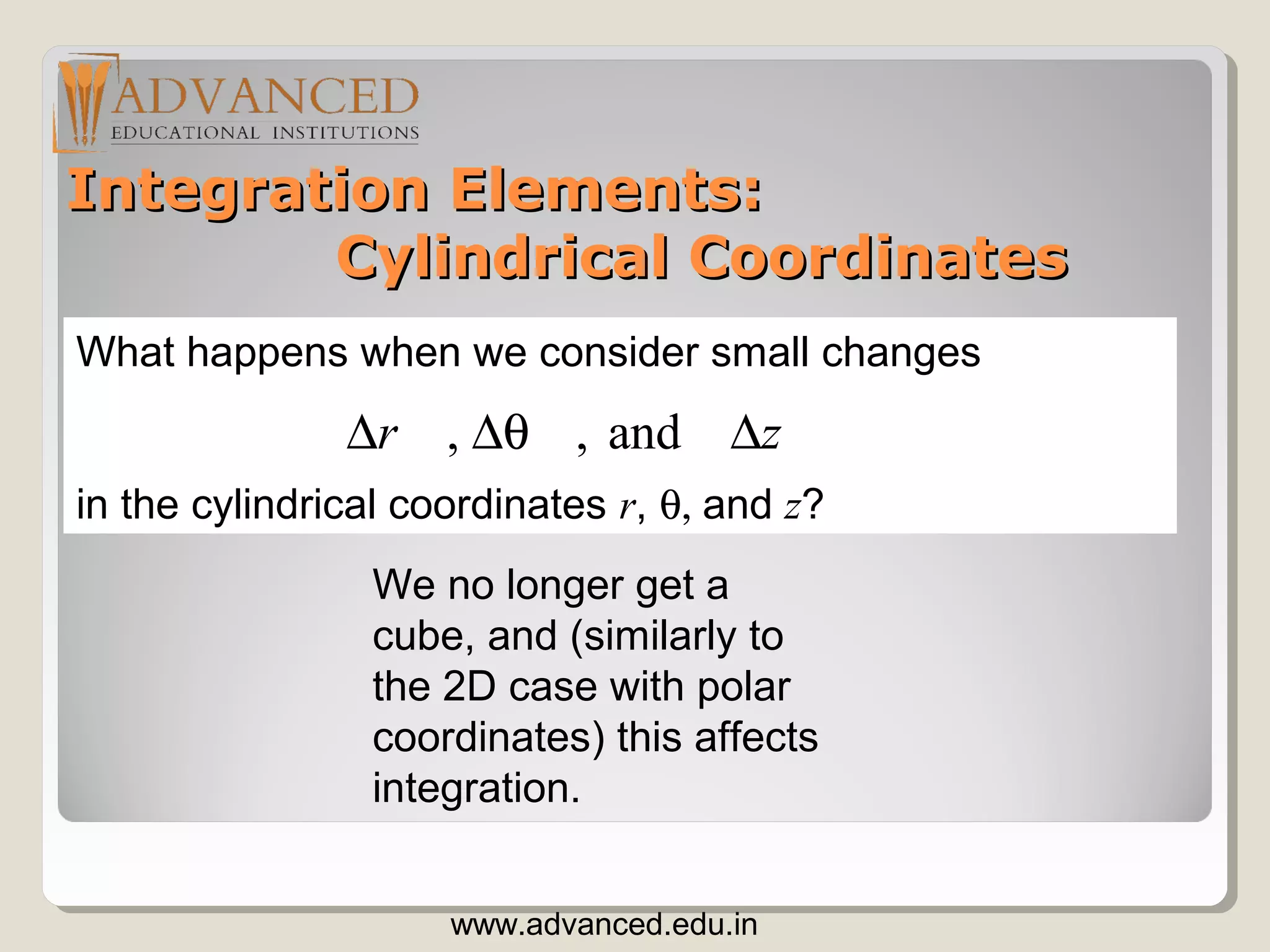
What happens when we consider small changes
in the cylindrical coordinates r, θ, and z?
, , andr z∆ ∆θ ∆
We no longer get a
cube, and (similarly to
the 2D case with polar
coordinates) this affects
integration.
www.advanced.edu.in
Integration Elements:Integration Elements:
Cylindrical CoordinatesCylindrical Coordinates
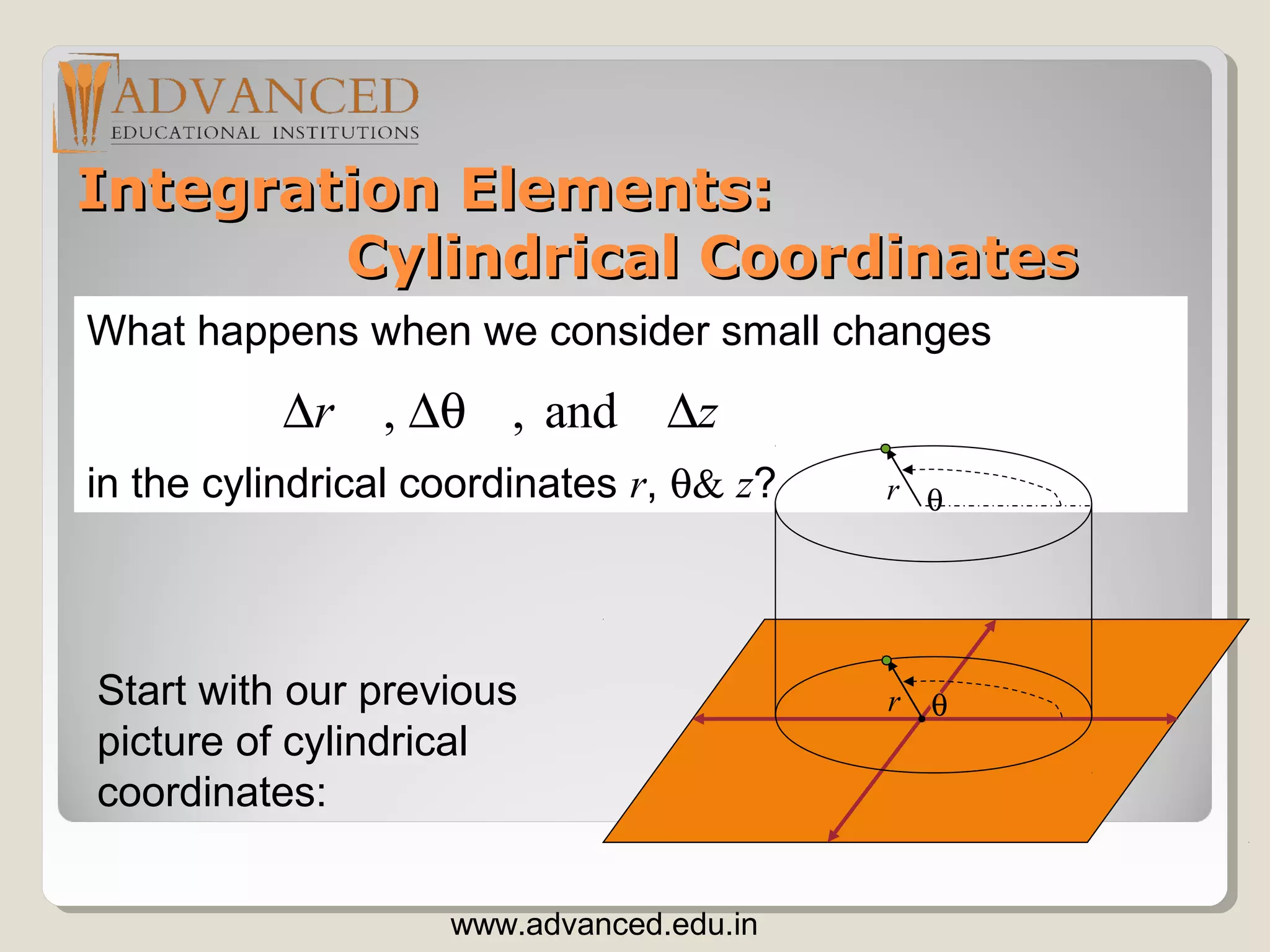
What happens when we consider small changes
in the cylindrical coordinates r, θ& z?
, , andr z∆ ∆θ ∆
Start with our previous
picture of cylindrical
coordinates:
θr
θr
www.advanced.edu.in
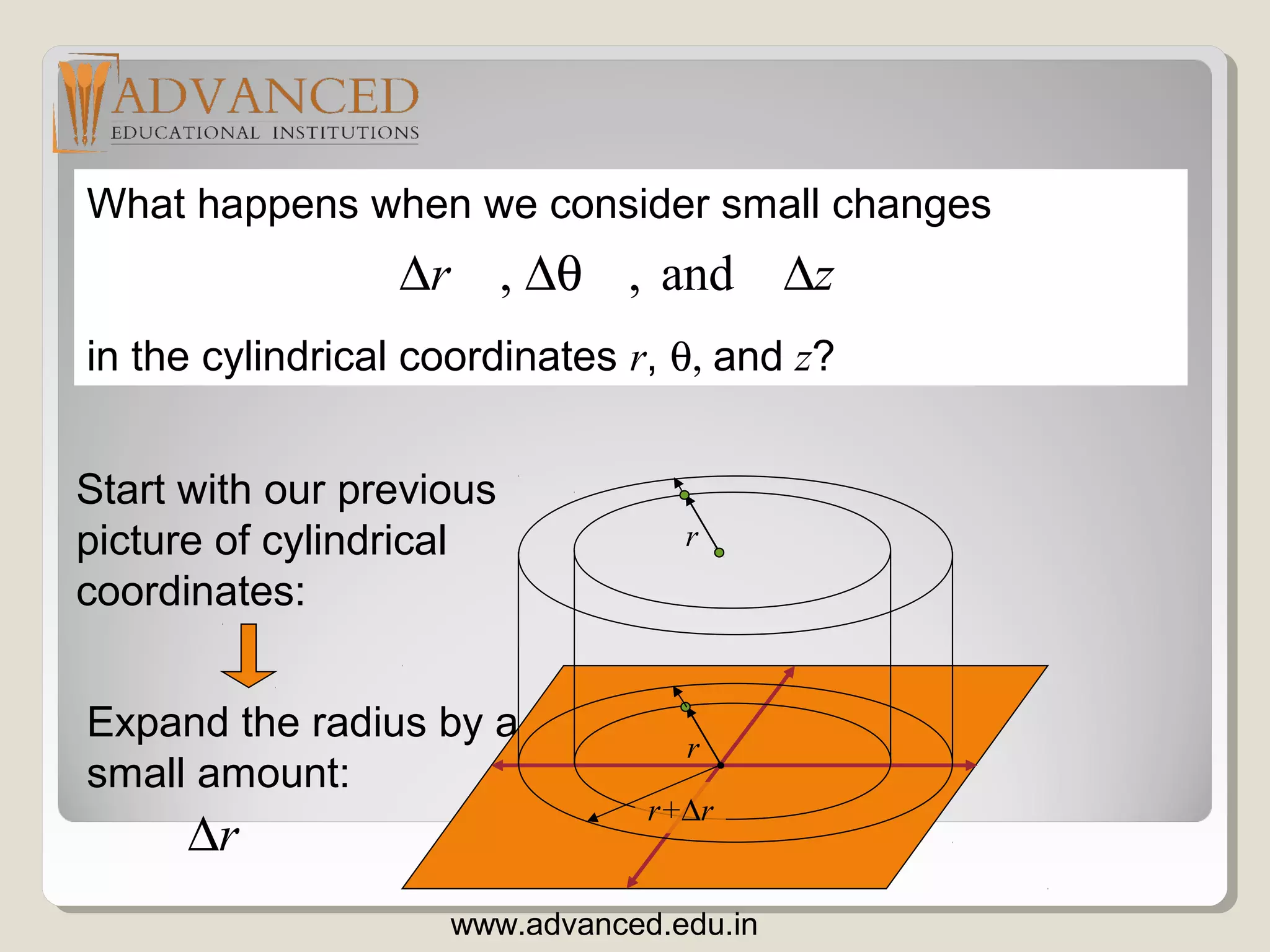
What happens when we consider small changes
in the cylindrical coordinates r, θ, and z?
, , andr z∆ ∆θ ∆
Start with our previous
picture of cylindrical
coordinates:
Expand the radius by a
small amount:
r∆
r
r+∆r
r
www.advanced.edu.in
θ
This give us a “wedge.”
Combining this with the cylindrical shell created by the
change in r, we get
www.advanced.edu.in
This give us a “wedge.”
Intersecting this wedge with the cylindrical shell created by
the change in r, we get
www.advanced.edu.in
Finally , we look at a small vertical change ∆ z .
www.advanced.edu.in
Integration in CylindricalIntegration in Cylindrical
Coordinates.Coordinates.
dA r dr d≈ θ
We need to find the volume of this little solid.
As in polar coordinates, we have the area of a horizontal
cross section is. . .
www.advanced.edu.in
Integration in CylindricalIntegration in Cylindrical
Coordinates.Coordinates.
dV r dr d dz≈ θ
We need to find the volume of this little solid.
Since the volume is just the base times the height. . .
So . . .
( , , )
S
f r z r dr d dzθ θ∫∫∫
www.advanced.edu.in
CONCLUSION
www.advanced.edu.in

Cylindrical and spherical coordinates shalini

  • 1.
    Cylindrical andCylindrical and SphericalCoordinatesSpherical Coordinates Representation and Conversions By: Shalini Singh Assistant Professor www.advanced.edu.in
  • 2.
    CONTENTSCONTENTS Cylindrical Co-ordinates Co-ordinates formationin 3-D Cylindrical Formation Spherical Co-ordinates Spherical Representation in 3-D Conversion of Cylindrical Into Spherical Rectangular Co-ordinates Integral Conclusion www.advanced.edu.in
  • 3.
    IntroductionIntroduction The laws ofelectromagnetic are invariant with coordinate system. When we solve problems in electromagnetic. For Eg. Finding Electric Field at a point, we desire the fields. The position is expressed in terms of Co-ordinates. The co-ordinates are specified by the co-ordinate System. Most Common Co-ordinate systems are: •Cartesian Or Rectangular Coordinate system • Cylindrical Coordinate system •Spherical Coordinate system www.advanced.edu.in
  • 4.
    Representing 3D pointsinRepresenting 3D points in Cylindrical Coordinates.Cylindrical Coordinates. θr Recall polar representations in the plane www.advanced.edu.in
  • 5.
    Representing 3D pointsinRepresenting 3D points in Cylindrical Coordinates.Cylindrical Coordinates. θr Cylindrical coordinates just adds a z-coordinate to the polar coordinates (r,θ). www.advanced.edu.in
  • 6.
    θr Representing 3D pointsinRepresenting 3D points in Cylindrical Coordinates.Cylindrical Coordinates. θr (r, θ, z) www.advanced.edu.in Cylindrical coordinates just adds a z-coordinate to the polar coordinates (r,θ).
  • 7.
    cos( ) sin( ) xr y r z z θ θ = = = θr θr (r,θ,z) Rectangular to Cylindrical 2 2 2 tan( ) r x y y x z z = + = = θ Cylindrical to rectangular www.advanced.edu.in
  • 8.
    Spherical Coordinates arethe 3D analog of polar representations in the plane. We divide 3-dimensional space into 1. a set of concentric spheres centered at the origin. 2. rays emitting outwards from the origin www.advanced.edu.in
  • 9.
    Representing 3D pointsinRepresenting 3D points in Spherical CoordinatesSpherical Coordinates(x,y,z) We start with a point (x,y,z) given in rectangular coordinates. Then, measuring its distance ρ from the origin, we locate it on a sphere of radius ρ centered at the origin. Next, we have to find a way to describe its location on the sphere. ρ www.advanced.edu.in
  • 10.
    Representing 3D pointsinRepresenting 3D points in Spherical CoordinatesSpherical Coordinates We use a method similar to the method used to measure latitude and longitude on the surface of the Earth. We find the great circle that goes through the “north pole,” the “south pole,” and the point. www.advanced.edu.in
  • 11.
    Representing 3D pointsinRepresenting 3D points in Spherical CoordinatesSpherical Coordinates φ We measure the latitude or polar angle starting at the “north pole” in the plane given by the great circle. This angle is called φ. The range of this angle is Note: all angles are measured in radians, as always. 0 .φ π≤ ≤ www.advanced.edu.in
  • 12.
    Representing 3D pointsinRepresenting 3D points in Spherical CoordinatesSpherical Coordinates We use a method similar to the method used to measure latitude and longitude on the surface of the Earth. Next, we draw a horizontal circle on the sphere that passes through the point. www.advanced.edu.in
  • 13.
    Representing 3D pointsinRepresenting 3D points in Spherical CoordinatesSpherical Coordinates And “drop it down” onto the xy- plane. www.advanced.edu.in
  • 14.
    Representing 3D pointsinRepresenting 3D points in Spherical CoordinatesSpherical Coordinates We measure the latitude or azimuthal angle on the latitude circle, starting at the positive x-axis and rotating toward the positive y-axis. The range of the angle is Angle is called θ. 0 2 .θ π≤ < Note that this is the same angle as the θ in cylindrical coordinates! www.advanced.edu.in
  • 15.
    Finally, a Pointin SphericalFinally, a Point in Spherical Coordinates!Coordinates! (ρ ,θ ,φ) Our designated point on the sphere is indicated by the three spherical coordinates (ρ , θ , φ) --- (radial distance, azimuthal angle, polar angle). Please note that this notation is not at all standard and varies from author to author and discipline to discipline. (In particular, physicists often use φ to refer to the azimuthal angle and θ refer to the polar angle.) ρ www.advanced.edu.in
  • 16.
    φ (x,y,z) z ρ r First note thatif r is the usual cylindrical coordinate for (x,y,z) we have a right triangle with •acute angle φ, •hypotenuse ρ, and •legs r and z. It follows that sin( ) cos( ) tan( ) r z r z φ φ φ ρ ρ = = = What happens if φ is not acute? www.advanced.edu.in
  • 17.
    Converting Spherical toConvertingSpherical to Rectangular CoordinatesRectangular Coordinates 2 2 2 2 2 2 2 2 tan( ) tan( ) cos( ) x y z y x x yr z z z z x y z ρ θ φ φ ρ = + + = + = = = = + + φ (x,y,z) z ρ r Rectangular to Spherical www.advanced.edu.in
  • 18.
    Cylindrical andCylindrical and SphericalCoordinatesSpherical Coordinates Integration www.advanced.edu.in
  • 19.
    Rectangular CoordinatesRectangular Coordinates Weknow that in a Riemann Sum approximation for a triple integral, a summand This computes the function value at some point in the little “sub-cube” and multiplies it by the volume of the little cube of length , width , and height . * * * ( , , ) .i i i i i if x y z x y z∆ ∆ ∆ * * * function value volume of the small at a sampling point cube ( , , ) .i i i i i if x y z x y z∆ ∆ ∆ 14243 14243 ix∆ iy∆ iz∆ www.advanced.edu.in
  • 20.
    Integration Elements:Integration Elements: CylindricalCoordinatesCylindrical Coordinates What happens when we consider small changes in the cylindrical coordinates r, θ, and z? , , andr z∆ ∆θ ∆ We no longer get a cube, and (similarly to the 2D case with polar coordinates) this affects integration. www.advanced.edu.in
  • 21.
    Integration Elements:Integration Elements: CylindricalCoordinatesCylindrical Coordinates What happens when we consider small changes in the cylindrical coordinates r, θ& z? , , andr z∆ ∆θ ∆ Start with our previous picture of cylindrical coordinates: θr θr www.advanced.edu.in
  • 22.
    What happens whenwe consider small changes in the cylindrical coordinates r, θ, and z? , , andr z∆ ∆θ ∆ Start with our previous picture of cylindrical coordinates: Expand the radius by a small amount: r∆ r r+∆r r www.advanced.edu.in
  • 23.
    θ This give usa “wedge.” Combining this with the cylindrical shell created by the change in r, we get www.advanced.edu.in
  • 24.
    This give usa “wedge.” Intersecting this wedge with the cylindrical shell created by the change in r, we get www.advanced.edu.in
  • 25.
    Finally , welook at a small vertical change ∆ z . www.advanced.edu.in
  • 26.
    Integration in CylindricalIntegrationin Cylindrical Coordinates.Coordinates. dA r dr d≈ θ We need to find the volume of this little solid. As in polar coordinates, we have the area of a horizontal cross section is. . . www.advanced.edu.in
  • 27.
    Integration in CylindricalIntegrationin Cylindrical Coordinates.Coordinates. dV r dr d dz≈ θ We need to find the volume of this little solid. Since the volume is just the base times the height. . . So . . . ( , , ) S f r z r dr d dzθ θ∫∫∫ www.advanced.edu.in CONCLUSION
  • 28.