Nicole Slosser
     EDU 643
 26 April 2011
Table of Contents
 Rectangular Coordinates
 What are Polar Coordinates?
 Graphing Polar Coordinates
 Converting Polar to Rectangular
 Converting Rectangular to Polar
 Assessment
 Project
Rectangular Coordinates
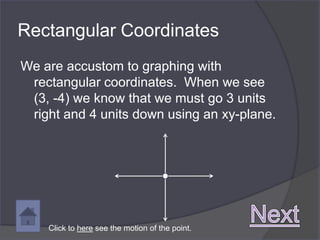
We are accustom to graphing with
 rectangular coordinates. When we see
 (3, -4) we know that we must go 3 units
 right and 4 units down using an xy-plane.


    Click to here see the motion of the point.
Rectangular Coordinates
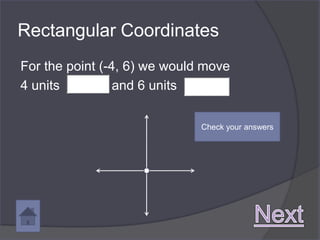
For the point (-4, 6) we would move
4 units          and 6 units

                              Check your answers
Polar Coordinates
Some things, such as navigation,
  engineering, and modeling real-world
  situations can’t easily be measured
  linearly.
We have polar coordinates to describe
  curves and rotations.
Polar Coordinates
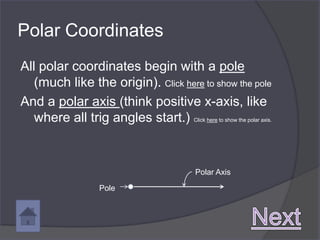
All polar coordinates begin with a pole
   (much like the origin). Click here to show the pole
And a polar axis (think positive x-axis, like
   where all trig angles start.)     Click here to show the polar axis.


                                     Polar Axis

                Pole
Polar Coordinates
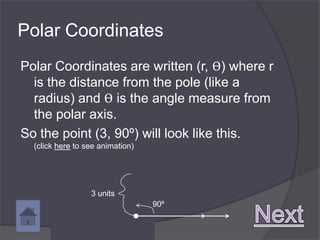
Polar Coordinates are written (r, ϴ) where r
  is the distance from the pole (like a
  radius) and ϴ is the angle measure from
  the polar axis.
So the point (3, 90º) will look like this.
  (click here to see animation)


                  3 units
                                  90º
Polar Coordinates
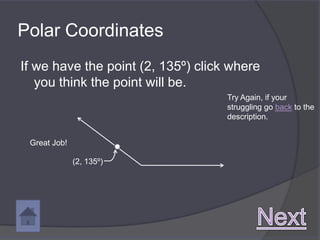
If we have the point (2, 135º) click where
   you think the point will be.
                                    Try Again, if your
                                    struggling go back to the
                                    description.


 Great Job!

              (2, 135º)
Polar Coordinates
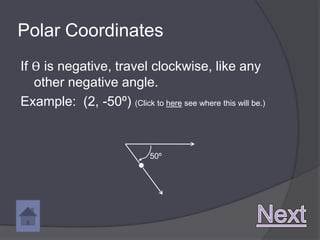
If ϴ is negative, travel clockwise, like any
   other negative angle.
Example: (2, -50º) (Click to here see where this will be.)


                              50º
Polar Coordinates
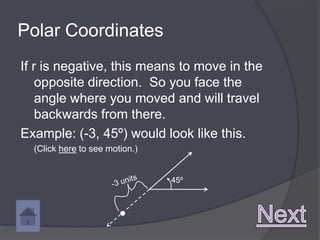
If r is negative, this means to move in the
    opposite direction. So you face the
    angle where you moved and will travel
    backwards from there.
Example: (-3, 45º) would look like this.
  (Click here to see motion.)


                                45º
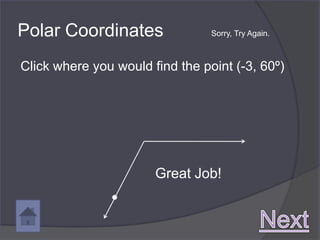
Polar Coordinates                Sorry, Try Again.


Click where you would find the point (-3, 60º)


                       Great Job!
Converting Polar to
Rectangular
Often it is useful to be able to go between
  the two graphing systems. We will use
  trig to help us convert from polar to
  rectangular.
Converting Polar to
Rectangular
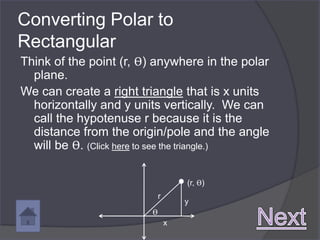
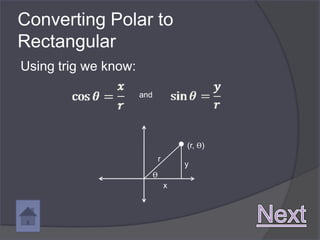
Think of the point (r, ϴ) anywhere in the polar
  plane.
We can create a right triangle that is x units
  horizontally and y units vertically. We can
  call the hypotenuse r because it is the
  distance from the origin/pole and the angle
  will be ϴ. (Click here to see the triangle.)

                                    (r, ϴ)
                            r
                                    y
                        ϴ
                                x
Converting Polar to
Rectangular
Using trig we know:

                      and


                                        (r, ϴ)
                                r
                                        y
                            ϴ
                                    x
Converting Polar to
Rectangular
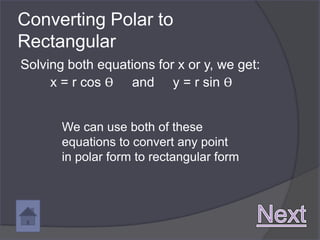
Solving both equations for x or y, we get:
     x = r cos ϴ and y = r sin ϴ


       We can use both of these
       equations to convert any point
       in polar form to rectangular form
Converting Polar to
Rectangular
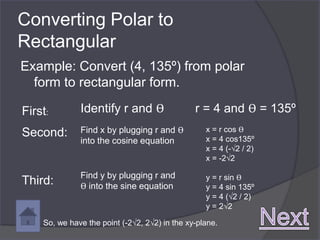
Example: Convert (4, 135º) from polar
  form to rectangular form.

First:        Identify r and ϴ                 r = 4 and ϴ = 135º
Second:       Find x by plugging r and ϴ          x = r cos ϴ
              into the cosine equation            x = 4 cos135º
                                                  x = 4 (-√2 / 2)
                                                  x = -2√2

              Find y by plugging r and            y = r sin ϴ
Third:        ϴ into the sine equation            y = 4 sin 135º
                                                  y = 4 (√2 / 2)
                                                  y = 2√2

    So, we have the point (-2√2, 2√2) in the xy-plane.
Converting Polar to
Rectangular
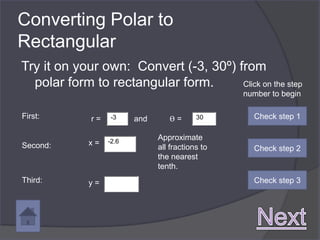
Try it on your own: Convert (-3, 30º) from
  polar form to rectangular form.      Click on the step
                                                  number to begin

First:       r=   -3     and      ϴ=       30       Check step 1


                  -2.6
                               Approximate
Second:      x=
                               all fractions to     Check step 2
                               the nearest
                               tenth.
Third:       y=                                     Check step 3
Converting Rectangular to
Polar
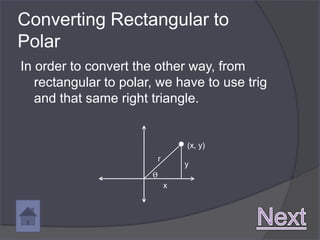
In order to convert the other way, from
   rectangular to polar, we have to use trig
   and that same right triangle.


                                   (x, y)
                           r
                                   y
                       ϴ
                               x
Converting Rectangular to
Polar
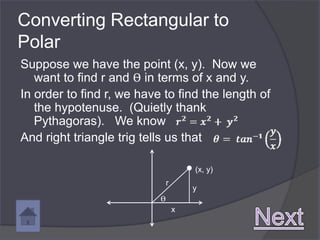
Suppose we have the point (x, y). Now we
   want to find r and ϴ in terms of x and y.
In order to find r, we have to find the length of
   the hypotenuse. (Quietly thank
   Pythagoras). We know
And right triangle trig tells us that

                                       (x, y)
                               r
                                       y
                           ϴ
                                   x
Converting Rectangular to Polar

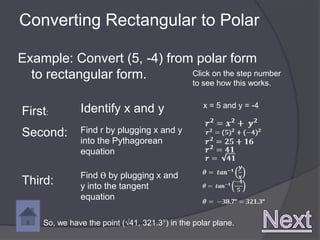
Example: Convert (5, -4) from polar form
  to rectangular form.       Click on the step number
                                                to see how this works.

                                                   x = 5 and y = -4
First:         Identify x and y
Second:        Find r by plugging x and y
               into the Pythagorean
               equation

               Find ϴ by plugging x and
Third:         y into the tangent
               equation

     So, we have the point (√41, 321.3°) in the polar plane.
Converting Rectangular to Polar

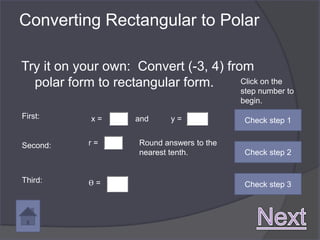
Try it on your own: Convert (-3, 4) from
  polar form to rectangular form.      Click on the
                                              step number to
                                              begin.
First:       x=       and      y=              Check step 1


Second:      r=        Round answers to the
                       nearest tenth.          Check step 2


Third:       ϴ=                                Check step 3
Converting Rectangular to
Polar
Whenever your point lies in Quadrant 2 or
  3, you must add 180º to your new ϴ.
This makes the adjustment that your
  calculator doesn’t. Your calculator looks
  for the first ϴ, not necessarily the correct
  ϴ.
Converting Equations
When converting equations from polar
  form into rectangular form (where we
  know how to graph it better) we look
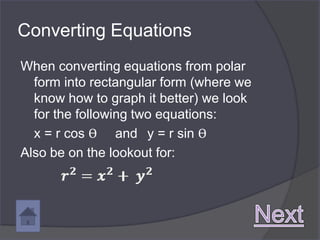
  for the following two equations:
  x = r cos ϴ and y = r sin ϴ
Also be on the lookout for:
Converting Equations
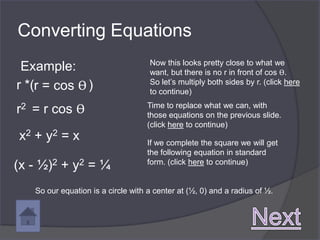
                                    Now this looks pretty close to what we
 Example:                           want, but there is no r in front of cos ϴ.
r *(r = cos ϴ )                     So let’s multiply both sides by r. (click here
                                    to continue)

r2 = r cos ϴ                       Time to replace what we can, with
                                   those equations on the previous slide.
                                   (click here to continue)
x2 + y2 = x                        If we complete the square we will get
                                   the following equation in standard
(x - ½)2 + y2 = ¼                  form. (click here to continue)


   So our equation is a circle with a center at (½, 0) and a radius of ½.
Converting Equations
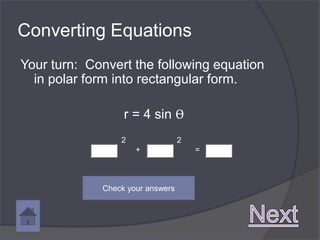
Your turn: Convert the following equation
  in polar form into rectangular form.

                  r = 4 sin ϴ
                 2                2
                     +                =


             Check your answers
Converting Equations
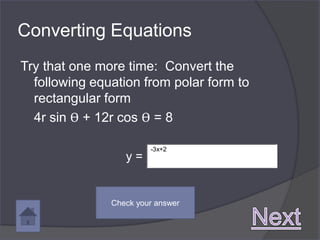
Try that one more time: Convert the
  following equation from polar form to
  rectangular form
  4r sin ϴ + 12r cos ϴ = 8

                        -3x+2
                  y=


               Check your answer
Assessment
The following is a short ten-question quiz.

Please click on the letter that best matches
  the correct answer.
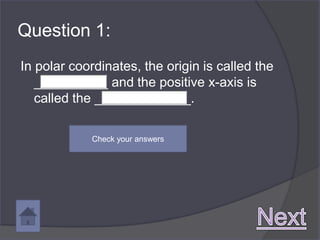
Question 1:
In polar coordinates, the origin is called the
   __________ and the positive x-axis is
   called the _____________.

            Check your answers
Sorry, that is incorrect. See
Question 2:                    Polar Graphing for some help.


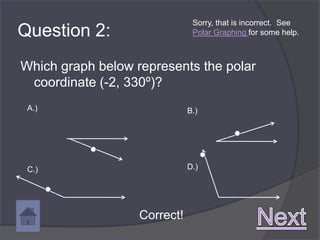
Which graph below represents the polar
 coordinate (-2, 330º)?
 A.)                          B.)


 C.)                          D.)


                   Correct!
Question 3:
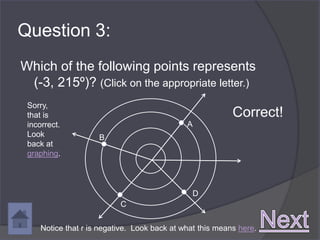
Which of the following points represents
 (-3, 215º)? (Click on the appropriate letter.)
 Sorry,
 that is                                                   Correct!
 incorrect.                                   A
 Look                B
 back at
 graphing.


                                               D
                           C


     Notice that r is negative. Look back at what this means here.
Sorry, that is incorrect.

Question 4:                     Look back at converting.


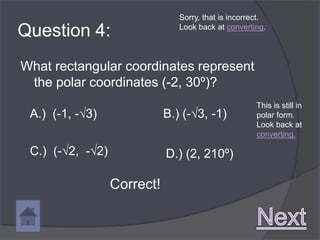
What rectangular coordinates represent
 the polar coordinates (-2, 30º)?
                                                      This is still in
 A.) (-1, -√3)               B.) (-√3, -1)            polar form.
                                                      Look back at
                                                      converting.

 C.) (-√2, -√2)              D.) (2, 210º)

                  Correct!
Sorry, that is incorrect.

Question 5:                        Look back at converting.


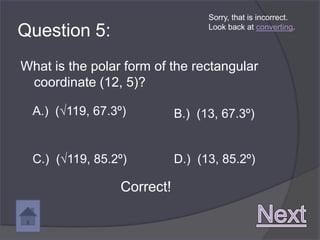
What is the polar form of the rectangular
 coordinate (12, 5)?

  A.) (√119, 67.3º)          B.) (13, 67.3º)


  C.) (√119, 85.2º)          D.) (13, 85.2º)

                  Correct!
Sorry, that is incorrect.
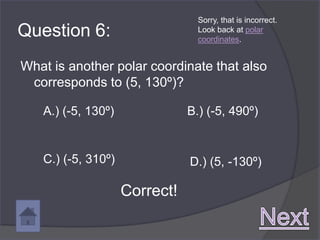
Question 6:                      Look back at polar
                                 coordinates.


What is another polar coordinate that also
 corresponds to (5, 130º)?

   A.) (-5, 130º)              B.) (-5, 490º)


   C.) (-5, 310º)              D.) (5, -130º)

                    Correct!
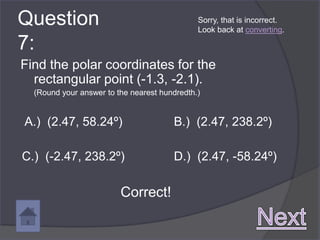
Question                                      Sorry, that is incorrect.
                                              Look back at converting.

7:
Find the polar coordinates for the
  rectangular point (-1.3, -2.1).
  (Round your answer to the nearest hundredth.)


A.) (2.47, 58.24º)                     B.) (2.47, 238.2º)

C.) (-2.47, 238.2º)                    D.) (2.47, -58.24º)

                         Correct!
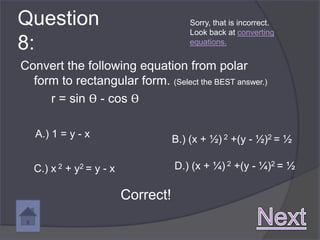
Question                                Sorry, that is incorrect.
                                        Look back at converting
8:                                      equations.


Convert the following equation from polar
  form to rectangular form. (Select the BEST answer.)
     r = sin ϴ - cos ϴ

   A.) 1 = y - x                    B.) (x + ½) 2 +(y - ½)2 = ½

  C.) x 2 + y2 = y - x              D.) (x + ¼) 2 +(y - ¼)2 = ½

                         Correct!
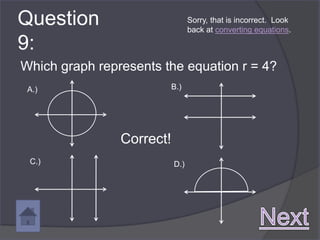
Question                         Sorry, that is incorrect. Look
                                 back at converting equations.

9:
Which graph represents the equation r = 4?
 A.)                       B.)


                Correct!
 C.)                       D.)
Question                           Sorry, that is incorrect. Look
                                   back at converting equations.
10:
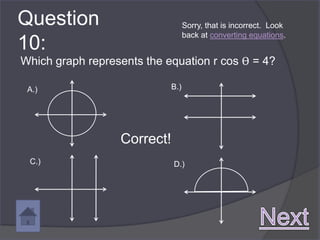
Which graph represents the equation r cos ϴ = 4?

 A.)                         B.)


                  Correct!
 C.)                         D.)
Project
Rummaging through a friend’s attic, a treasure map was discovered. Lucky day! But
     at a closer inspection you realize that the map is for Anchorage, Alaska and it is
     more of a list of directions than a map. It appears that all of the directions are in
     polar coordinates. But, Anchorage isn’t laid out that way.
In 1964, Anchorage was struck by a large earthquake which damaged at great deal of
     the town. The local government decided it would be best to rebuild from scratch.
     Roads were designed so that they always crossed at right angles to improve
     traffic. Anchorage is built like a huge rectangular grid.
It appears that the directions begin from your friend’s old family home, which used to
     be located on the corner of present-day 7th Street and G Street, one block south of
     the current the Alaska Center of Performing Arts. Your mission is to find the
     location of the treasure. (Locate the cross-streets on the modern map.) (Search
     for the corner of 7th and G, Anchorage, AK.)

Here are the map directions: Travel (3, 45°) from there, travel (5.83, 210.96°) from
   there, travel (-3.16, 108.43°) from there (4.47, 386.57°) and finally travel (6.40, -
   231.34°).

And your follow-up assignment: Paris was designed long before cars and updated
   traffic constraints. The city is laid out much like a polar grid. With a partner,
   design a treasure map with a difficult-to-locate solution to challenge another pair.
   (Include at least four steps and a correct solution on a separate sheet of paper.)
Sources:
“Corner of 7th and G Anchorage, AK.” Google Maps. 6 April 2011
   <http://maps.google.com/>.
Gurewich, Nathan and Ori Gurewich. Teach Yourself Visual Basic 4
   in 21 days: Third Edition. Sams Publishing. Indianapolis, IN.
   1995.
“History of Anchorage, Alaska.” Wikipedia, the free encyclopedia. 5
   April 2011 <http://en.wikipedia.org/wiki/History_of_Anchorage,
   _Alaska>.
Sullivan, Michael. Precalculus: Eighth Edition. Pearson: Prentice
   Hall. Upper Saddle River, NJ. 2008.


           All graphics drawn and animated by Nicole Slosser using PowerPoint tools.

Polar interactive p pt

  • 1.
    Nicole Slosser EDU 643 26 April 2011
  • 2.
    Table of Contents Rectangular Coordinates  What are Polar Coordinates?  Graphing Polar Coordinates  Converting Polar to Rectangular  Converting Rectangular to Polar  Assessment  Project
  • 3.
    Rectangular Coordinates We areaccustom to graphing with rectangular coordinates. When we see (3, -4) we know that we must go 3 units right and 4 units down using an xy-plane. Click to here see the motion of the point.
  • 4.
    Rectangular Coordinates For thepoint (-4, 6) we would move 4 units and 6 units Check your answers
  • 5.
    Polar Coordinates Some things,such as navigation, engineering, and modeling real-world situations can’t easily be measured linearly. We have polar coordinates to describe curves and rotations.
  • 6.
    Polar Coordinates All polarcoordinates begin with a pole (much like the origin). Click here to show the pole And a polar axis (think positive x-axis, like where all trig angles start.) Click here to show the polar axis. Polar Axis Pole
  • 7.
    Polar Coordinates Polar Coordinatesare written (r, ϴ) where r is the distance from the pole (like a radius) and ϴ is the angle measure from the polar axis. So the point (3, 90º) will look like this. (click here to see animation) 3 units 90º
  • 8.
    Polar Coordinates If wehave the point (2, 135º) click where you think the point will be. Try Again, if your struggling go back to the description. Great Job! (2, 135º)
  • 9.
    Polar Coordinates If ϴis negative, travel clockwise, like any other negative angle. Example: (2, -50º) (Click to here see where this will be.) 50º
  • 10.
    Polar Coordinates If ris negative, this means to move in the opposite direction. So you face the angle where you moved and will travel backwards from there. Example: (-3, 45º) would look like this. (Click here to see motion.) 45º
  • 11.
    Polar Coordinates Sorry, Try Again. Click where you would find the point (-3, 60º) Great Job!
  • 12.
    Converting Polar to Rectangular Oftenit is useful to be able to go between the two graphing systems. We will use trig to help us convert from polar to rectangular.
  • 13.
    Converting Polar to Rectangular Thinkof the point (r, ϴ) anywhere in the polar plane. We can create a right triangle that is x units horizontally and y units vertically. We can call the hypotenuse r because it is the distance from the origin/pole and the angle will be ϴ. (Click here to see the triangle.) (r, ϴ) r y ϴ x
  • 14.
    Converting Polar to Rectangular Usingtrig we know: and (r, ϴ) r y ϴ x
  • 15.
    Converting Polar to Rectangular Solvingboth equations for x or y, we get: x = r cos ϴ and y = r sin ϴ We can use both of these equations to convert any point in polar form to rectangular form
  • 16.
    Converting Polar to Rectangular Example:Convert (4, 135º) from polar form to rectangular form. First: Identify r and ϴ r = 4 and ϴ = 135º Second: Find x by plugging r and ϴ x = r cos ϴ into the cosine equation x = 4 cos135º x = 4 (-√2 / 2) x = -2√2 Find y by plugging r and y = r sin ϴ Third: ϴ into the sine equation y = 4 sin 135º y = 4 (√2 / 2) y = 2√2 So, we have the point (-2√2, 2√2) in the xy-plane.
  • 17.
    Converting Polar to Rectangular Tryit on your own: Convert (-3, 30º) from polar form to rectangular form. Click on the step number to begin First: r= -3 and ϴ= 30 Check step 1 -2.6 Approximate Second: x= all fractions to Check step 2 the nearest tenth. Third: y= Check step 3
  • 18.
    Converting Rectangular to Polar Inorder to convert the other way, from rectangular to polar, we have to use trig and that same right triangle. (x, y) r y ϴ x
  • 19.
    Converting Rectangular to Polar Supposewe have the point (x, y). Now we want to find r and ϴ in terms of x and y. In order to find r, we have to find the length of the hypotenuse. (Quietly thank Pythagoras). We know And right triangle trig tells us that (x, y) r y ϴ x
  • 20.
    Converting Rectangular toPolar Example: Convert (5, -4) from polar form to rectangular form. Click on the step number to see how this works. x = 5 and y = -4 First: Identify x and y Second: Find r by plugging x and y into the Pythagorean equation Find ϴ by plugging x and Third: y into the tangent equation So, we have the point (√41, 321.3°) in the polar plane.
  • 21.
    Converting Rectangular toPolar Try it on your own: Convert (-3, 4) from polar form to rectangular form. Click on the step number to begin. First: x= and y= Check step 1 Second: r= Round answers to the nearest tenth. Check step 2 Third: ϴ= Check step 3
  • 22.
    Converting Rectangular to Polar Wheneveryour point lies in Quadrant 2 or 3, you must add 180º to your new ϴ. This makes the adjustment that your calculator doesn’t. Your calculator looks for the first ϴ, not necessarily the correct ϴ.
  • 23.
    Converting Equations When convertingequations from polar form into rectangular form (where we know how to graph it better) we look for the following two equations: x = r cos ϴ and y = r sin ϴ Also be on the lookout for:
  • 24.
    Converting Equations Now this looks pretty close to what we Example: want, but there is no r in front of cos ϴ. r *(r = cos ϴ ) So let’s multiply both sides by r. (click here to continue) r2 = r cos ϴ Time to replace what we can, with those equations on the previous slide. (click here to continue) x2 + y2 = x If we complete the square we will get the following equation in standard (x - ½)2 + y2 = ¼ form. (click here to continue) So our equation is a circle with a center at (½, 0) and a radius of ½.
  • 25.
    Converting Equations Your turn:Convert the following equation in polar form into rectangular form. r = 4 sin ϴ 2 2 + = Check your answers
  • 26.
    Converting Equations Try thatone more time: Convert the following equation from polar form to rectangular form 4r sin ϴ + 12r cos ϴ = 8 -3x+2 y= Check your answer
  • 27.
    Assessment The following isa short ten-question quiz. Please click on the letter that best matches the correct answer.
  • 28.
    Question 1: In polarcoordinates, the origin is called the __________ and the positive x-axis is called the _____________. Check your answers
  • 29.
    Sorry, that isincorrect. See Question 2: Polar Graphing for some help. Which graph below represents the polar coordinate (-2, 330º)? A.) B.) C.) D.) Correct!
  • 30.
    Question 3: Which ofthe following points represents (-3, 215º)? (Click on the appropriate letter.) Sorry, that is Correct! incorrect. A Look B back at graphing. D C Notice that r is negative. Look back at what this means here.
  • 31.
    Sorry, that isincorrect. Question 4: Look back at converting. What rectangular coordinates represent the polar coordinates (-2, 30º)? This is still in A.) (-1, -√3) B.) (-√3, -1) polar form. Look back at converting. C.) (-√2, -√2) D.) (2, 210º) Correct!
  • 32.
    Sorry, that isincorrect. Question 5: Look back at converting. What is the polar form of the rectangular coordinate (12, 5)? A.) (√119, 67.3º) B.) (13, 67.3º) C.) (√119, 85.2º) D.) (13, 85.2º) Correct!
  • 33.
    Sorry, that isincorrect. Question 6: Look back at polar coordinates. What is another polar coordinate that also corresponds to (5, 130º)? A.) (-5, 130º) B.) (-5, 490º) C.) (-5, 310º) D.) (5, -130º) Correct!
  • 34.
    Question Sorry, that is incorrect. Look back at converting. 7: Find the polar coordinates for the rectangular point (-1.3, -2.1). (Round your answer to the nearest hundredth.) A.) (2.47, 58.24º) B.) (2.47, 238.2º) C.) (-2.47, 238.2º) D.) (2.47, -58.24º) Correct!
  • 35.
    Question Sorry, that is incorrect. Look back at converting 8: equations. Convert the following equation from polar form to rectangular form. (Select the BEST answer.) r = sin ϴ - cos ϴ A.) 1 = y - x B.) (x + ½) 2 +(y - ½)2 = ½ C.) x 2 + y2 = y - x D.) (x + ¼) 2 +(y - ¼)2 = ½ Correct!
  • 36.
    Question Sorry, that is incorrect. Look back at converting equations. 9: Which graph represents the equation r = 4? A.) B.) Correct! C.) D.)
  • 37.
    Question Sorry, that is incorrect. Look back at converting equations. 10: Which graph represents the equation r cos ϴ = 4? A.) B.) Correct! C.) D.)
  • 38.
    Project Rummaging through afriend’s attic, a treasure map was discovered. Lucky day! But at a closer inspection you realize that the map is for Anchorage, Alaska and it is more of a list of directions than a map. It appears that all of the directions are in polar coordinates. But, Anchorage isn’t laid out that way. In 1964, Anchorage was struck by a large earthquake which damaged at great deal of the town. The local government decided it would be best to rebuild from scratch. Roads were designed so that they always crossed at right angles to improve traffic. Anchorage is built like a huge rectangular grid. It appears that the directions begin from your friend’s old family home, which used to be located on the corner of present-day 7th Street and G Street, one block south of the current the Alaska Center of Performing Arts. Your mission is to find the location of the treasure. (Locate the cross-streets on the modern map.) (Search for the corner of 7th and G, Anchorage, AK.) Here are the map directions: Travel (3, 45°) from there, travel (5.83, 210.96°) from there, travel (-3.16, 108.43°) from there (4.47, 386.57°) and finally travel (6.40, - 231.34°). And your follow-up assignment: Paris was designed long before cars and updated traffic constraints. The city is laid out much like a polar grid. With a partner, design a treasure map with a difficult-to-locate solution to challenge another pair. (Include at least four steps and a correct solution on a separate sheet of paper.)
  • 39.
    Sources: “Corner of 7thand G Anchorage, AK.” Google Maps. 6 April 2011 <http://maps.google.com/>. Gurewich, Nathan and Ori Gurewich. Teach Yourself Visual Basic 4 in 21 days: Third Edition. Sams Publishing. Indianapolis, IN. 1995. “History of Anchorage, Alaska.” Wikipedia, the free encyclopedia. 5 April 2011 <http://en.wikipedia.org/wiki/History_of_Anchorage, _Alaska>. Sullivan, Michael. Precalculus: Eighth Edition. Pearson: Prentice Hall. Upper Saddle River, NJ. 2008. All graphics drawn and animated by Nicole Slosser using PowerPoint tools.