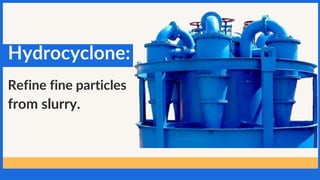
Hydrocyclone:
Refine fine particles
from slurry.
It is mainly equipment that uses fluid pressure to centrifugal
forces to generate centrifugal force. In simple words, it
mainly works on the principle of weight variations like
particles that are smaller in size and have a specific gravity
and which have higher size have a specific gravity.
WHAT IS HYDROCYCLONE?
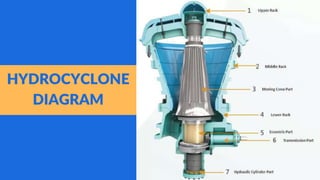
HYDROCYCLONE
DIAGRAM
TYPES OF HYDROCYCLONES
• XCI Hydrocyclone - It has an improved feeding and desilting throat that provides
an extra benefit.
• XCII Hydrocyclone- It has an involute type of throat, which increases the
centrifugal force to feed the granule.
• XCIII Hydrocyclone- It is equipped with a special fishtail device at the desilting
throat. that adjusts the lower level of flow concentration
• XCIV Hydrocyclone- It has a sophisticated structure and a desilting throat-
tightening tube that is adjustable. The length of the desilting site can be altered or
determined by the tightening area.
FACTORS EFFECTING THE PROCESS
• Size: The hydrocyclone's size determines how much centrifugal force it will produce, with a
smaller hydrocyclone producing finer cut-size particles and a larger hydrocyclone generating
low-density particles.
• Flow Rate: A lower flow rate leads in something like a wider separation, whereas an increase
in flow results in a greater number of finer separations.
• Inlet Size: Larger the size of the inlet more will be the capacity and the smaller the size will
decrease the overall capacity.
• Vortex Finder: More the size of the vortex more will be the wider separation of the particles
whereas the smaller the size will provide more finite particles.
• Underflow Diameter: If the hydrocyclone's diameter is not appropriately calculated with
respect to tones per hour, the results may suffer.
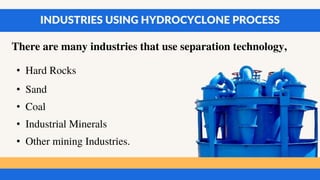
INDUSTRIES USING HYDROCYCLONE PROCESS
There are many industries that use separation technology,
• Hard Rocks
• Sand
• Coal
• Industrial Minerals
• Other mining Industries.
USES
• To separate sand and tiny particles, it is employed in the paper and pulp
industries or mills.
• used in the oil business or in mills to separate oil from water or water from oil
• In the iron industry, it is employed to separate cooling liquid from metal
components.
• It is utilized in the concentration and refinement of starch slurries in the
industries that generate starch.
• It is also used in the food processing industry.
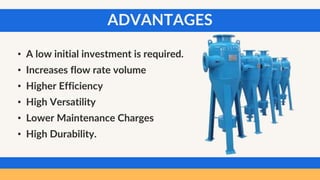
• A low initial investment is required.
• Increases flow rate volume
• Higher Efficiency
• High Versatility
• Lower Maintenance Charges
• High Durability.
ADVANTAGES
• Higher Operating costs due to pressure drop.
• Unable to regulate viscous flow
• A limited number of microalgal strains
• Unable to produce completely dry underflow
• Higher Probability of clogging the dust outlet
DISADVANTAGES
Manufactured with advanced engineering and equipment matching the
industry norms, Hydrocyclones are great industrial equipment that helps to
cater the different mining industries and food industries. With the
involvement of the different types of hydrocyclones it has evolved to meet
the different needs of different situations.
Every equipment or machine goes through a deteriorating phase due to
internal wear and tear but if maintained properly it can have the great added
advantage to your overall business.
CONCLUSION
THANK
YOU

Hydrocyclone: Refine fine particles from slurry

  • 1.
  • 2.
    It is mainlyequipment that uses fluid pressure to centrifugal forces to generate centrifugal force. In simple words, it mainly works on the principle of weight variations like particles that are smaller in size and have a specific gravity and which have higher size have a specific gravity. WHAT IS HYDROCYCLONE?
  • 3.
  • 4.
    TYPES OF HYDROCYCLONES •XCI Hydrocyclone - It has an improved feeding and desilting throat that provides an extra benefit. • XCII Hydrocyclone- It has an involute type of throat, which increases the centrifugal force to feed the granule. • XCIII Hydrocyclone- It is equipped with a special fishtail device at the desilting throat. that adjusts the lower level of flow concentration • XCIV Hydrocyclone- It has a sophisticated structure and a desilting throat- tightening tube that is adjustable. The length of the desilting site can be altered or determined by the tightening area.
  • 5.
    FACTORS EFFECTING THEPROCESS • Size: The hydrocyclone's size determines how much centrifugal force it will produce, with a smaller hydrocyclone producing finer cut-size particles and a larger hydrocyclone generating low-density particles. • Flow Rate: A lower flow rate leads in something like a wider separation, whereas an increase in flow results in a greater number of finer separations. • Inlet Size: Larger the size of the inlet more will be the capacity and the smaller the size will decrease the overall capacity. • Vortex Finder: More the size of the vortex more will be the wider separation of the particles whereas the smaller the size will provide more finite particles. • Underflow Diameter: If the hydrocyclone's diameter is not appropriately calculated with respect to tones per hour, the results may suffer.
  • 6.
    INDUSTRIES USING HYDROCYCLONEPROCESS There are many industries that use separation technology, • Hard Rocks • Sand • Coal • Industrial Minerals • Other mining Industries.
  • 7.
    USES • To separatesand and tiny particles, it is employed in the paper and pulp industries or mills. • used in the oil business or in mills to separate oil from water or water from oil • In the iron industry, it is employed to separate cooling liquid from metal components. • It is utilized in the concentration and refinement of starch slurries in the industries that generate starch. • It is also used in the food processing industry.
  • 8.
    • A lowinitial investment is required. • Increases flow rate volume • Higher Efficiency • High Versatility • Lower Maintenance Charges • High Durability. ADVANTAGES
  • 9.
    • Higher Operatingcosts due to pressure drop. • Unable to regulate viscous flow • A limited number of microalgal strains • Unable to produce completely dry underflow • Higher Probability of clogging the dust outlet DISADVANTAGES
  • 10.
    Manufactured with advancedengineering and equipment matching the industry norms, Hydrocyclones are great industrial equipment that helps to cater the different mining industries and food industries. With the involvement of the different types of hydrocyclones it has evolved to meet the different needs of different situations. Every equipment or machine goes through a deteriorating phase due to internal wear and tear but if maintained properly it can have the great added advantage to your overall business. CONCLUSION
  • 11.