SAJJAD KHUDHUR ABBAS
Ceo , Founder & Head of SHacademy
Chemical Engineering , Al-Muthanna University, Iraq
Oil & Gas Safety and Health Professional – OSHACADEMY
Trainer of Trainers (TOT) - Canadian Center of Human
Development
Episode 42 : Gas Solid
Separation
INTRODUCTION
The process may be interpreted to mean both degassing of solids and
dedusting of the solids.
3 phases may be distinguished in any gas cleaning process, i.e;
• transport of particles onto a surface (separation)
• collection of separated particles from the separation
surface into discharge hoppers (or particle fixation)
• disposal of the collected particles from the gas cleaning
equipment
All phases are equally important as the failure of any of the phases
will result in the failure of the separation process
.
In the 1st
. phase, forces are applied to the particles in order
to bring them to a collecting surfaces.
The principles of particles separation are usually classified
according to the nature of the force involved. These may
be:
1.External forces due to fields of acceleration which are
external to the gaseous suspension, such as gravity,
electrostatic or magnetic forces
2.Internal forces due to fields of effects which take place
within the suspension itself. E.g. intertial or centrifugal
forces, diffusion, coagulation, electrostatic effect
Gas cleaning equipment often combines 2 or more of the
above mentioned principles in one unit.
The most common classification of g-c equipment- is divided
into 4 groups, i.e.
1. aero-mechanical dry separators in which gravity and/or
inertial effects prevail. This group includes yclone, settling
chambers, inertials separators, dual vortex separators and
fan collectors (or mechanical cyclones)
2. aero-mechanical wet separators (scrubbers) which make use
of diffusional and inertial effect
3. electrostatic precipitators which depend on electrostatic and
gravity forces
4. filters which use inertial and diffusional effects
General characteristics of equipment
The factors affecting the choice of gas cleaning equipment. For any particular
application are;
1. flowrate-pressure drop relationship
2. efficiency
3. economic criteria
4. suitability for different conditions (the nature of both solids and ga)
5. solids concentration,
6. method of disposal
7. reliability
Flowrate-pressure drop relationship
Most gas-cleaning devices have fixed relationship between static pres. drop and gas
flowrate, depending on the configuration of the equipt.
Most frequently, the relationship is expressed is expressed as:
∆P =(1/2).Eu.v2
ρg (1)
where:
∆P is static pressure drop
Eu is the Euler number, and is a resistance coeff. (analogous to CD) which
may be function of Re, other operational variables such as the feed
concentration of solids, etc.
v is characteristic velocity = Q/A where A is characteristic area in the
separator ( e.g cross-section of the cylindrical body in cyclone)
ρg is gas density
One exception in the application of eq. 1 is in air filters, where pressure drop is
also a function of the amount of dust deposited on the filter.
Efficiency
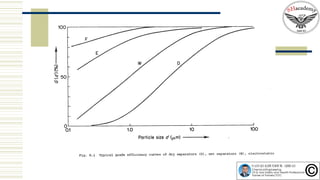
It is an important criteria since it governs the degree of cleaning. It is best expressed
as gred efficiency. G(d) increases from zero for ultrafine particles to 100 for
coarse particles.
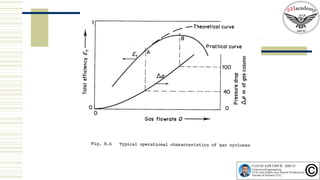
Figure 6.1 shows typical gred efficiency curves for dry sep (D), wet sep. (W),
electrostatic and filter
Economic criteria
It is consist of the capital and running costs.
Capital cost is normally expressed per
1000m3
of cleaned gas per hour. It may be
further split into the cost of the construction
material, cost of labour, erection, design, etc.
The running cost include cost of power,
maintenance, water, etc.
Suitability for different conditions
 Thera are a number of other factors such as gas temperature
and humidity, the cohesiveness and abrasiveness of th dust,
reliaility, limits in dust concentrations, etc, which may exert
an overiding influence on the final choice
Gas Solid Separation: Cyclone
Definition of cyclone separators
A cyclone separator is an equipment for the
removal from air streams of particles above 10
micrometer in diameter.
The equipment is a settling chamber in the form
of a vertical cylinder, so arranged that the particle
laden air spirals round the cylinder to create
centrifugal forces which throw the particles to the
outside walls (Learle, 1966 )
Advantages/disadvantages
The advantages of cyclone and all aero-mechanical dry
separators include:
 Simple design
 Low capital cost
 Suitability for higher temperatures
 Low energy consumption
 Product is dry
 Reliability
Disadvantages:
Their relatively low efficiency for very fine particles which
leads to their frequent role as a pre-cleaner
Cyclone types most commonly used
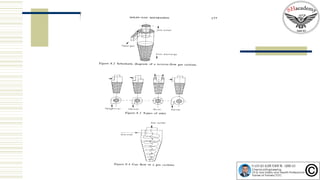
 Cyclone separators can be classified according to either their
geometrical configuration in (tangential inlet axial discharge,
tangential inlet peripheral discharge, axial inlet and discharge, and
axial inlet peripheral discharge, Figures a-d below, respectively)
 or their efficiency in (( high efficient (98-99%), moderate efficient
( 70- 80%),and low efficient ( 50%)) (Othmer,1978) and (Storch et
al.,1979).
 Figures (Othmer,
1978.) [112]
Figure a. Tangential
inlet, axial discharge.
Figure b. Tanential
inlet, peripheral
discharge
Figure c. Axial inlet,
axial discharge
Figure d. Axial inlet,
peripheral discharge
Operating principles of cyclone
separators
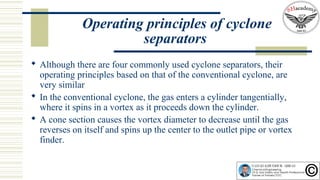
 Although there are four commonly used cyclone separators, their
operating principles based on that of the conventional cyclone, are
very similar
 In the conventional cyclone, the gas enters a cylinder tangentially,
where it spins in a vortex as it proceeds down the cylinder.
 A cone section causes the vortex diameter to decrease until the gas
reverses on itself and spins up the center to the outlet pipe or vortex
finder.
 A cone causes flow reversal to occur sooner and
makes the cyclone more compact.
 Dust particles are centrifuged toward the wall and
collected by inertial impingement.
 The collected dust flows down in the gas boundary
layer to the cone apex where it is discharged
through an air lock or into a dust hopper serving
one or more parallel cyclones (Othmer, 1978 ) .
 Although conventional cyclones can be built to
larger diameter, they are commonly 600 to 915 mm
in diameter.
Operating principles of cyclone
separators
Applications of cyclone separators
 Cyclones can be used for separating particles from
liquids as well as from gases and they can also be
used for separating liquid droplets from gases
(Learle,1966 ).
 The first cyclones used for dust separation probably
were built about 1885 by the Knickerboker
Company ( U.S.Pat.325,521) (Othmer, 1978 ).
 In industries such as food industries, cyclones are
used for removing the dry product from the air.
 In synthetic detergent production, fast reactor cyclones are used in
separating a cracking catalyst from vaporized reaction products
(Coker, 1993 ).
 Cyclones are used for classification as for example, in the degritting of
kaolin clay where sand is removed from the crude clay suspension
before finer classification in a conveyor discharge centrifuge and final
product recovery in a disk centrifuge.
Applications of cyclone separators
Key parameters of cyclone separators
 The most important parameters of a cyclone as for any separating
device are its collecting efficiency and the pressure drop across the
unit. (Storch ,et al.,1979).
 The collecting efficiency of a cyclone is defined as its ability toability to
capture and retain dust particlescapture and retain dust particles
 whereas the pressure drop is the amount of power that the unit needs
to do so.
Pressure Drop
 Factors that contribute to cyclone pressure drop (static pressure
differential across the cyclone):
1. Gas expansion as it enters the cyclone
2. Formation of vortex
3. Wall friction
4. regain of rotational kinetic energy as pressure energy






=∆ 2
2
1
vEuP fρ
Pressure Drop
EU is a resistance coeff., the Euler no.
ρf is the gas density
ν is the characteristic velocity
( )2
/4 DQv π=
Q is the gas flow rate
D is the cyclone inside diameter
Efficiency
 Is defined as the fraction of particles of acertain
size that are collected by the cyclone.
 It increases with:
1. Increasing particle diameter and density
2. ⇑ gas inlet velocity
3. ⇓ cyclone diameter
4. ⇑ cyclone length
5. Drawing some of the gas from the cyclome
through the dust exit
6. Wetting the cyclone walls
Typical cyclone fractional efficiency
curve
The particle size for
which the grade
efficiency is 50%, d50
is often used as a
single number
measurement of the
efficiency of the
ccyclone.
d50 –the cut size of the
cyclone (or other
separation device)
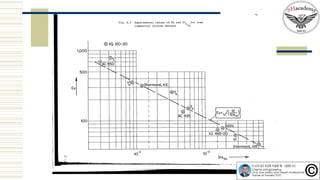
Scale up
 The scale up of cyclones is based on a dimensionless group,
the stokes number, which characterized the separation
performance of a family of geometrically similar cyclones.
D
x
Stk p
µ
νρ
18
2
50
50=
50
12
Stk
Eu =
Geometries , Euler and Stokes
numbers for 2 common cyclones
Cyclon
e type
A B C E J L K N
 
Eu Stk50
 
Stairma
nd, HE
4.
0
2.
5
1.
5
0.3
75
0.50 0.2 0.5 0.5 320 1.4 x 10-
4
Stairma
nd, HR
4.
0
2.
5
1.
5
0.5
75
0.875 0.375 0.7
5
0.7
5
46 6 x 10-3
Correctly designed n operated cyclone 
should operate at pressure drop within a 
recommended range   ( at ambient 
conditions), is between 50-150 mm of water 
gauge (WG) (500-1500Pa)
Data necessary for cyclone design
 Particle size distribution
 Inlet dust loading (g/m3
)
 Particle density (kg/m3
)
 Gas flowrate (m3
/h)
 Gas temperature (o
C)
 Special condition of corrosivity, abrasiveness, fluctuation in 
gas flowrate.etc.
Thanks for Watching 
Please follow me / SAJJAD KHUDHUR ABBAS 

Episode 42 : Gas Solid Separation

  • 1.
    SAJJAD KHUDHUR ABBAS Ceo, Founder & Head of SHacademy Chemical Engineering , Al-Muthanna University, Iraq Oil & Gas Safety and Health Professional – OSHACADEMY Trainer of Trainers (TOT) - Canadian Center of Human Development Episode 42 : Gas Solid Separation
  • 2.
    INTRODUCTION The process maybe interpreted to mean both degassing of solids and dedusting of the solids. 3 phases may be distinguished in any gas cleaning process, i.e; • transport of particles onto a surface (separation) • collection of separated particles from the separation surface into discharge hoppers (or particle fixation) • disposal of the collected particles from the gas cleaning equipment All phases are equally important as the failure of any of the phases will result in the failure of the separation process .
  • 3.
    In the 1st .phase, forces are applied to the particles in order to bring them to a collecting surfaces. The principles of particles separation are usually classified according to the nature of the force involved. These may be: 1.External forces due to fields of acceleration which are external to the gaseous suspension, such as gravity, electrostatic or magnetic forces 2.Internal forces due to fields of effects which take place within the suspension itself. E.g. intertial or centrifugal forces, diffusion, coagulation, electrostatic effect Gas cleaning equipment often combines 2 or more of the above mentioned principles in one unit.
  • 4.
    The most commonclassification of g-c equipment- is divided into 4 groups, i.e. 1. aero-mechanical dry separators in which gravity and/or inertial effects prevail. This group includes yclone, settling chambers, inertials separators, dual vortex separators and fan collectors (or mechanical cyclones) 2. aero-mechanical wet separators (scrubbers) which make use of diffusional and inertial effect 3. electrostatic precipitators which depend on electrostatic and gravity forces 4. filters which use inertial and diffusional effects
  • 5.
    General characteristics ofequipment The factors affecting the choice of gas cleaning equipment. For any particular application are; 1. flowrate-pressure drop relationship 2. efficiency 3. economic criteria 4. suitability for different conditions (the nature of both solids and ga) 5. solids concentration, 6. method of disposal 7. reliability
  • 6.
    Flowrate-pressure drop relationship Mostgas-cleaning devices have fixed relationship between static pres. drop and gas flowrate, depending on the configuration of the equipt. Most frequently, the relationship is expressed is expressed as: ∆P =(1/2).Eu.v2 ρg (1) where: ∆P is static pressure drop Eu is the Euler number, and is a resistance coeff. (analogous to CD) which may be function of Re, other operational variables such as the feed concentration of solids, etc. v is characteristic velocity = Q/A where A is characteristic area in the separator ( e.g cross-section of the cylindrical body in cyclone) ρg is gas density One exception in the application of eq. 1 is in air filters, where pressure drop is also a function of the amount of dust deposited on the filter.
  • 7.
    Efficiency It is animportant criteria since it governs the degree of cleaning. It is best expressed as gred efficiency. G(d) increases from zero for ultrafine particles to 100 for coarse particles. Figure 6.1 shows typical gred efficiency curves for dry sep (D), wet sep. (W), electrostatic and filter
  • 9.
    Economic criteria It isconsist of the capital and running costs. Capital cost is normally expressed per 1000m3 of cleaned gas per hour. It may be further split into the cost of the construction material, cost of labour, erection, design, etc. The running cost include cost of power, maintenance, water, etc.
  • 10.
    Suitability for differentconditions  Thera are a number of other factors such as gas temperature and humidity, the cohesiveness and abrasiveness of th dust, reliaility, limits in dust concentrations, etc, which may exert an overiding influence on the final choice
  • 11.
  • 12.
    Definition of cycloneseparators A cyclone separator is an equipment for the removal from air streams of particles above 10 micrometer in diameter. The equipment is a settling chamber in the form of a vertical cylinder, so arranged that the particle laden air spirals round the cylinder to create centrifugal forces which throw the particles to the outside walls (Learle, 1966 )
  • 13.
    Advantages/disadvantages The advantages ofcyclone and all aero-mechanical dry separators include:  Simple design  Low capital cost  Suitability for higher temperatures  Low energy consumption  Product is dry  Reliability Disadvantages: Their relatively low efficiency for very fine particles which leads to their frequent role as a pre-cleaner
  • 14.
    Cyclone types mostcommonly used  Cyclone separators can be classified according to either their geometrical configuration in (tangential inlet axial discharge, tangential inlet peripheral discharge, axial inlet and discharge, and axial inlet peripheral discharge, Figures a-d below, respectively)  or their efficiency in (( high efficient (98-99%), moderate efficient ( 70- 80%),and low efficient ( 50%)) (Othmer,1978) and (Storch et al.,1979).
  • 15.
     Figures (Othmer, 1978.)[112] Figure a. Tangential inlet, axial discharge. Figure b. Tanential inlet, peripheral discharge Figure c. Axial inlet, axial discharge Figure d. Axial inlet, peripheral discharge
  • 16.
    Operating principles ofcyclone separators  Although there are four commonly used cyclone separators, their operating principles based on that of the conventional cyclone, are very similar  In the conventional cyclone, the gas enters a cylinder tangentially, where it spins in a vortex as it proceeds down the cylinder.  A cone section causes the vortex diameter to decrease until the gas reverses on itself and spins up the center to the outlet pipe or vortex finder.
  • 17.
     A conecauses flow reversal to occur sooner and makes the cyclone more compact.  Dust particles are centrifuged toward the wall and collected by inertial impingement.  The collected dust flows down in the gas boundary layer to the cone apex where it is discharged through an air lock or into a dust hopper serving one or more parallel cyclones (Othmer, 1978 ) .  Although conventional cyclones can be built to larger diameter, they are commonly 600 to 915 mm in diameter. Operating principles of cyclone separators
  • 19.
    Applications of cycloneseparators  Cyclones can be used for separating particles from liquids as well as from gases and they can also be used for separating liquid droplets from gases (Learle,1966 ).  The first cyclones used for dust separation probably were built about 1885 by the Knickerboker Company ( U.S.Pat.325,521) (Othmer, 1978 ).  In industries such as food industries, cyclones are used for removing the dry product from the air.
  • 20.
     In syntheticdetergent production, fast reactor cyclones are used in separating a cracking catalyst from vaporized reaction products (Coker, 1993 ).  Cyclones are used for classification as for example, in the degritting of kaolin clay where sand is removed from the crude clay suspension before finer classification in a conveyor discharge centrifuge and final product recovery in a disk centrifuge. Applications of cyclone separators
  • 21.
    Key parameters ofcyclone separators  The most important parameters of a cyclone as for any separating device are its collecting efficiency and the pressure drop across the unit. (Storch ,et al.,1979).  The collecting efficiency of a cyclone is defined as its ability toability to capture and retain dust particlescapture and retain dust particles  whereas the pressure drop is the amount of power that the unit needs to do so.
  • 22.
    Pressure Drop  Factorsthat contribute to cyclone pressure drop (static pressure differential across the cyclone): 1. Gas expansion as it enters the cyclone 2. Formation of vortex 3. Wall friction 4. regain of rotational kinetic energy as pressure energy
  • 23.
          =∆ 2 2 1 vEuP fρ PressureDrop EU is a resistance coeff., the Euler no. ρf is the gas density ν is the characteristic velocity ( )2 /4 DQv π= Q is the gas flow rate D is the cyclone inside diameter
  • 24.
    Efficiency  Is definedas the fraction of particles of acertain size that are collected by the cyclone.  It increases with: 1. Increasing particle diameter and density 2. ⇑ gas inlet velocity 3. ⇓ cyclone diameter 4. ⇑ cyclone length 5. Drawing some of the gas from the cyclome through the dust exit 6. Wetting the cyclone walls
  • 25.
    Typical cyclone fractionalefficiency curve The particle size for which the grade efficiency is 50%, d50 is often used as a single number measurement of the efficiency of the ccyclone. d50 –the cut size of the cyclone (or other separation device)
  • 27.
    Scale up  Thescale up of cyclones is based on a dimensionless group, the stokes number, which characterized the separation performance of a family of geometrically similar cyclones. D x Stk p µ νρ 18 2 50 50= 50 12 Stk Eu =
  • 29.
    Geometries , Eulerand Stokes numbers for 2 common cyclones Cyclon e type A B C E J L K N   Eu Stk50   Stairma nd, HE 4. 0 2. 5 1. 5 0.3 75 0.50 0.2 0.5 0.5 320 1.4 x 10- 4 Stairma nd, HR 4. 0 2. 5 1. 5 0.5 75 0.875 0.375 0.7 5 0.7 5 46 6 x 10-3 Correctly designed n operated cyclone  should operate at pressure drop within a  recommended range   ( at ambient  conditions), is between 50-150 mm of water  gauge (WG) (500-1500Pa)
  • 30.
    Data necessary forcyclone design  Particle size distribution  Inlet dust loading (g/m3 )  Particle density (kg/m3 )  Gas flowrate (m3 /h)  Gas temperature (o C)  Special condition of corrosivity, abrasiveness, fluctuation in  gas flowrate.etc.
  • 33.