Cyclone Separator
By:
Waqas Ahmed
B.Sc. Mechanical Engg
25 Feb 2014
Definition




Cyclones are mostly used for removing
industrials dust from air or process
gases. They are the principal type of gassolid separator
Most common form of particulate removal
gas is spun rapidly – heavier particulate
matter to collect on outside of separator
by centrifugal force, where it is collected
and removed.
Principles of Operation








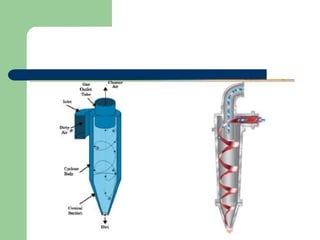
As with centrifugation, the driving force behind cyclone
separation is centrifugal force and the difference in
specific gravity between the particle and the carrier gas.
In a Cyclone, the air or vapor containing particulate
material is forced into along the tangential axis. A helical
flow pattern is set up within the chamber.
The centrifugal force causes the particles to migrate to the
outside of the chamber. Here they fall down to the bottom
of the cyclone by gravity.
The air moves up the center of the cyclone and reaches the
top.
Cont…
Types
Vertical Cyclone Separator




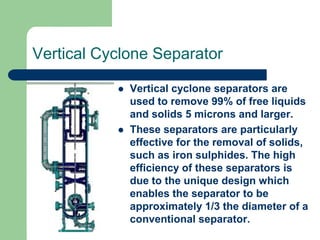
Vertical cyclone separators are
used to remove 99% of free liquids
and solids 5 microns and larger.
These separators are particularly
effective for the removal of solids,
such as iron sulphides. The high
efficiency of these separators is
due to the unique design which
enables the separator to be
approximately 1/3 the diameter of a
conventional separator.
Single-cyclone separators






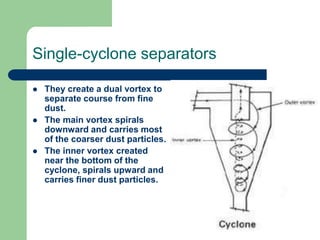
They create a dual vortex to
separate course from fine
dust.
The main vortex spirals
downward and carries most
of the coarser dust particles.
The inner vortex created
near the bottom of the
cyclone, spirals upward and
carries finer dust particles.
Multi Cyclone separator








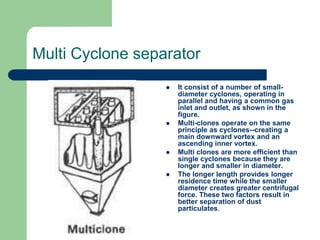
It consist of a number of smalldiameter cyclones, operating in
parallel and having a common gas
inlet and outlet, as shown in the
figure.
Multi-clones operate on the same
principle as cyclones--creating a
main downward vortex and an
ascending inner vortex.
Multi clones are more efficient than
single cyclones because they are
longer and smaller in diameter.
The longer length provides longer
residence time while the smaller
diameter creates greater centrifugal
force. These two factors result in
better separation of dust
particulates.
Design Procedure


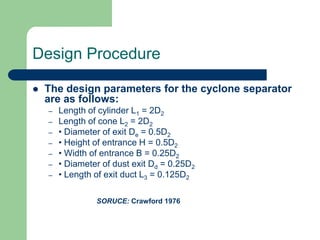
The design parameters for the cyclone separator
are as follows:
–
–
–
–
–
–
–

Length of cylinder L1 = 2D2
Length of cone L2 = 2D2
• Diameter of exit De = 0.5D2
• Height of entrance H = 0.5D2
• Width of entrance B = 0.25D2
• Diameter of dust exit Dd = 0.25D2
• Length of exit duct L3 = 0.125D2
SORUCE: Crawford 1976
Cont…


The efficiency of collection of various
particles (η) can be determine form the
empirical relation and graph developed by
Lapple 1951.
Cont…
Cyclone Collector Design
Considerations:





Particle size (particles with larger mass
being subjected to greater force),
Force exerted on the dust particles
Time that the force is exerted on the
particles

Cyclone separator

  • 1.
    Cyclone Separator By: Waqas Ahmed B.Sc.Mechanical Engg 25 Feb 2014
  • 2.
    Definition   Cyclones are mostlyused for removing industrials dust from air or process gases. They are the principal type of gassolid separator Most common form of particulate removal gas is spun rapidly – heavier particulate matter to collect on outside of separator by centrifugal force, where it is collected and removed.
  • 3.
    Principles of Operation     Aswith centrifugation, the driving force behind cyclone separation is centrifugal force and the difference in specific gravity between the particle and the carrier gas. In a Cyclone, the air or vapor containing particulate material is forced into along the tangential axis. A helical flow pattern is set up within the chamber. The centrifugal force causes the particles to migrate to the outside of the chamber. Here they fall down to the bottom of the cyclone by gravity. The air moves up the center of the cyclone and reaches the top.
  • 4.
  • 7.
  • 8.
    Vertical Cyclone Separator   Verticalcyclone separators are used to remove 99% of free liquids and solids 5 microns and larger. These separators are particularly effective for the removal of solids, such as iron sulphides. The high efficiency of these separators is due to the unique design which enables the separator to be approximately 1/3 the diameter of a conventional separator.
  • 9.
    Single-cyclone separators    They createa dual vortex to separate course from fine dust. The main vortex spirals downward and carries most of the coarser dust particles. The inner vortex created near the bottom of the cyclone, spirals upward and carries finer dust particles.
  • 10.
    Multi Cyclone separator     Itconsist of a number of smalldiameter cyclones, operating in parallel and having a common gas inlet and outlet, as shown in the figure. Multi-clones operate on the same principle as cyclones--creating a main downward vortex and an ascending inner vortex. Multi clones are more efficient than single cyclones because they are longer and smaller in diameter. The longer length provides longer residence time while the smaller diameter creates greater centrifugal force. These two factors result in better separation of dust particulates.
  • 11.
    Design Procedure  The designparameters for the cyclone separator are as follows: – – – – – – – Length of cylinder L1 = 2D2 Length of cone L2 = 2D2 • Diameter of exit De = 0.5D2 • Height of entrance H = 0.5D2 • Width of entrance B = 0.25D2 • Diameter of dust exit Dd = 0.25D2 • Length of exit duct L3 = 0.125D2 SORUCE: Crawford 1976
  • 13.
    Cont…  The efficiency ofcollection of various particles (η) can be determine form the empirical relation and graph developed by Lapple 1951.
  • 14.
  • 15.
    Cyclone Collector Design Considerations:    Particlesize (particles with larger mass being subjected to greater force), Force exerted on the dust particles Time that the force is exerted on the particles