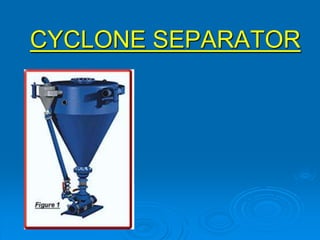
CYCLONE SEPARATOR
Statement of the Problem
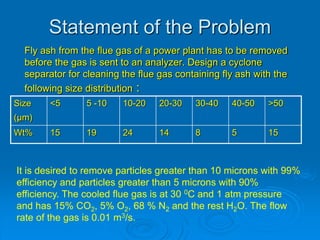
Fly ash from the flue gas of a power plant has to be removed
before the gas is sent to an analyzer. Design a cyclone
separator for cleaning the flue gas containing fly ash with the
following size distribution :
Size
(μm)
<5 5 -10 10-20 20-30 30-40 40-50 >50
Wt% 15 19 24 14 8 5 15
It is desired to remove particles greater than 10 microns with 99%
efficiency and particles greater than 5 microns with 90%
efficiency. The cooled flue gas is at 30 0C and 1 atm pressure
and has 15% CO2, 5% O2, 68 % N2 and the rest H2O. The flow
rate of the gas is 0.01 m3/s.
INTRODUCTION
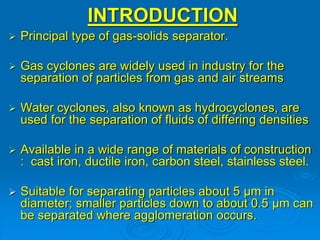
 Principal type of gas-solids separator.
 Gas cyclones are widely used in industry for the
separation of particles from gas and air streams
 Water cyclones, also known as hydrocyclones, are
used for the separation of fluids of differing densities
 Available in a wide range of materials of construction
: cast iron, ductile iron, carbon steel, stainless steel.
 Suitable for separating particles about 5 μm in
diameter; smaller particles down to about 0.5 μm can
be separated where agglomeration occurs.
1. Simple and inexpensive to manufacture, require
little maintenance
2. Contains no moving parts
3. Has the ability to operate at high temperatures
and pressures
3. Unlike the slow setting within a settling tank, the
pump and cyclone separator system yields fast
separation and utilizes less space.
Advantages
Basic Principles
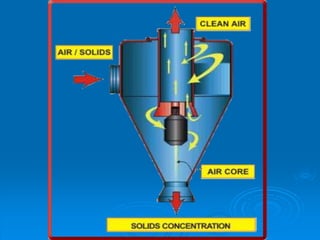
 The flow stream enters the body of the separator tangentially
through the inlet at the top and it begins to swirl due to the
circular design of the chamber until it reaches the bottom.
 Materials that are denser than the carrier medium are separated
from the stream during this downward flow and can be removed
through the outlet at the bottom of the cone.
 As the mixture is circulating down the funnel it creates a
"whirlpool effect" in the middle of the cone. This causes a vortex
in the center of the cone through which the lighter flow stream
rises.
 As the fluid or vapor reaches the top of the vortex, it is passing
by the difference in pressure through a tube that sticks down into
the center of the funnel. This tube is called a vortex finder.
OPERATION
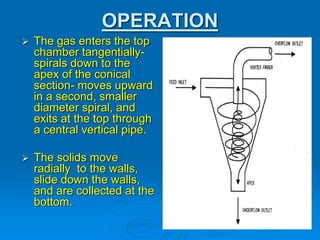
 The gas enters the top
chamber tangentially-
spirals down to the
apex of the conical
section- moves upward
in a second, smaller
diameter spiral, and
exits at the top through
a central vertical pipe.
 The solids move
radially to the walls,
slide down the walls,
and are collected at the
bottom.
Two main types of cyclone separators:
 Axial-the material enters from the top of the cyclone and is
forced to move tangentially by a grate at the top
 Tangential-the material enters from an inlet on the side which
is positioned tangentially to the body.
Cyclone separator is used :
 for removal of dust particles from emissions from cotton gins,
grain elevators, tractors, grain mixers, and other agricultural
machinery.
 in the food industry for the separation of agglomerated particles
and for the separation of starch and protein.
 For cleaning flue gases from Power Plants.
Design Procedure (1/2)
 Select High Efficiency or High Throughput design
depending on performance required.
 Obtain an estimate of the particle size distribution
of the solids in the screen.
 Assume inlet velocity(ex-10 m/s) and calculate
diameter of inlet duct. Calculate other cyclone
dimensions from given relations.
 Estimate the number of cyclones needed in
parallel.
Design Procedure (2/2)
 Calculate the scale-up factor.
 Calculate the efficiency of recovery of solids. If
unsatisfactory, try a different inlet velocity.
 Calculate the cyclone pressure drop and ensure that it
is feasible.
Formulae Used
Scaling Factor (Stairmand):
[(Dc2/Dc1)3 * (Q1/Q2) *(μ1/ μ2)* ( Δρ1/ Δρ2)]0.5
Where,
Dc1: diameter of standard cyclone= 8’’ (203 mm)
Dc2: diameter of proposed cyclone,mm
Q1 : standard flow rate
for high efficiency design= 223 m3/h
for high throughput design= 669 m3/h
Δρ1: solid-fluid density difference in standard conditions= 2000 kg/m3
Δρ2 : density difference, proposed design
μ1 : test viscosity fluid (air at 1 atm, 20º C)= 0.018 mN s/m2
μ2 : viscosity, proposed fluid
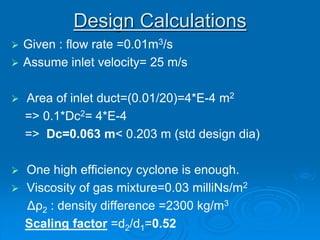
Design Calculations
 Given : flow rate =0.01m3/s
 Assume inlet velocity= 25 m/s
 Area of inlet duct=(0.01/20)=4*E-4 m2
=> 0.1*Dc2= 4*E-4
=> Dc=0.063 m< 0.203 m (std design dia)
 One high efficiency cyclone is enough.
 Viscosity of gas mixture=0.03 milliNs/m2
Δρ2 : density difference =2300 kg/m3
Scaling factor =d2/d1=0.52
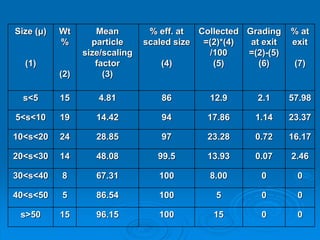
Size (μ)
(1)
Wt
%
(2)
Mean
particle
size/scaling
factor
(3)
% eff. at
scaled size
(4)
Collected
=(2)*(4)
/100
(5)
Grading
at exit
=(2)-(5)
(6)
% at
exit
(7)
s<5 15 4.81 86 12.9 2.1 57.98
5<s<10 19 14.42 94 17.86 1.14 23.37
10<s<20 24 28.85 97 23.28 0.72 16.17
20<s<30 14 48.08 99.5 13.93 0.07 2.46
30<s<40 8 67.31 100 8.00 0 0
40<s<50 5 86.54 100 5 0 0
s>50 15 96.15 100 15 0 0
Performance of Cyclone
For ptl size> 5μm :
Removal efficiency = ∑(5)i=2 to 7 /85
=97.73% (>90%).
For ptl size>10 μm :
Removal efficiency = ∑(5)i=3 to 7 /66
=98.9% (≈99% )
Therefore, the cyclone can remove particles
with the desired efficiency.
 Pressure Drop Formula(Δp) =
(ρf /203)*{u1
2 [1+2φ2(2rt/re -1 )] + 2u2
2}
where,
 Δp: pressure drop
 ρf : gas density =0.8 kg/m3
 u1 : inlet duct velocity
 u2 : exit duct velocity
 rt :radius of circle to which centre line of the inlet
is tangential
 re :radius of exit pipe
 Φ : Pressure drop correction factor
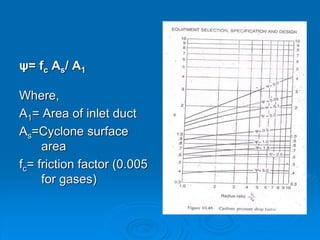
ψ= fc As/ A1
Where,
A1= Area of inlet duct
As=Cyclone surface
area
fc= friction factor (0.005
for gases)
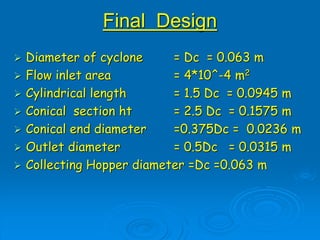
Final Design
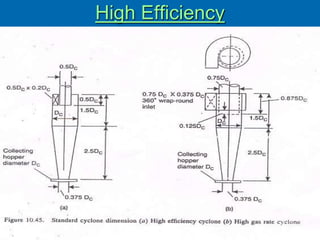
 Diameter of cyclone = Dc = 0.063 m
 Flow inlet area = 4*10^-4 m2
 Cylindrical length = 1.5 Dc = 0.0945 m
 Conical section ht = 2.5 Dc = 0.1575 m
 Conical end diameter =0.375Dc = 0.0236 m
 Outlet diameter = 0.5Dc = 0.0315 m
 Collecting Hopper diameter =Dc =0.063 m
References
 Chemical engineering, volume 6-
Coulson and Richardson
 www.wsu.edu
 www.flyash.info
 www.engr.pitt.edu
High Efficiency

12-ed-i-cyclone-6s-r13.ppt cyclone separtor

  • 1.
  • 2.
    Statement of theProblem Fly ash from the flue gas of a power plant has to be removed before the gas is sent to an analyzer. Design a cyclone separator for cleaning the flue gas containing fly ash with the following size distribution : Size (μm) <5 5 -10 10-20 20-30 30-40 40-50 >50 Wt% 15 19 24 14 8 5 15 It is desired to remove particles greater than 10 microns with 99% efficiency and particles greater than 5 microns with 90% efficiency. The cooled flue gas is at 30 0C and 1 atm pressure and has 15% CO2, 5% O2, 68 % N2 and the rest H2O. The flow rate of the gas is 0.01 m3/s.
  • 3.
    INTRODUCTION  Principal typeof gas-solids separator.  Gas cyclones are widely used in industry for the separation of particles from gas and air streams  Water cyclones, also known as hydrocyclones, are used for the separation of fluids of differing densities  Available in a wide range of materials of construction : cast iron, ductile iron, carbon steel, stainless steel.  Suitable for separating particles about 5 μm in diameter; smaller particles down to about 0.5 μm can be separated where agglomeration occurs.
  • 4.
    1. Simple andinexpensive to manufacture, require little maintenance 2. Contains no moving parts 3. Has the ability to operate at high temperatures and pressures 3. Unlike the slow setting within a settling tank, the pump and cyclone separator system yields fast separation and utilizes less space. Advantages
  • 6.
    Basic Principles  Theflow stream enters the body of the separator tangentially through the inlet at the top and it begins to swirl due to the circular design of the chamber until it reaches the bottom.  Materials that are denser than the carrier medium are separated from the stream during this downward flow and can be removed through the outlet at the bottom of the cone.  As the mixture is circulating down the funnel it creates a "whirlpool effect" in the middle of the cone. This causes a vortex in the center of the cone through which the lighter flow stream rises.  As the fluid or vapor reaches the top of the vortex, it is passing by the difference in pressure through a tube that sticks down into the center of the funnel. This tube is called a vortex finder.
  • 7.
    OPERATION  The gasenters the top chamber tangentially- spirals down to the apex of the conical section- moves upward in a second, smaller diameter spiral, and exits at the top through a central vertical pipe.  The solids move radially to the walls, slide down the walls, and are collected at the bottom.
  • 8.
    Two main typesof cyclone separators:  Axial-the material enters from the top of the cyclone and is forced to move tangentially by a grate at the top  Tangential-the material enters from an inlet on the side which is positioned tangentially to the body. Cyclone separator is used :  for removal of dust particles from emissions from cotton gins, grain elevators, tractors, grain mixers, and other agricultural machinery.  in the food industry for the separation of agglomerated particles and for the separation of starch and protein.  For cleaning flue gases from Power Plants.
  • 9.
    Design Procedure (1/2) Select High Efficiency or High Throughput design depending on performance required.  Obtain an estimate of the particle size distribution of the solids in the screen.  Assume inlet velocity(ex-10 m/s) and calculate diameter of inlet duct. Calculate other cyclone dimensions from given relations.  Estimate the number of cyclones needed in parallel.
  • 10.
    Design Procedure (2/2) Calculate the scale-up factor.  Calculate the efficiency of recovery of solids. If unsatisfactory, try a different inlet velocity.  Calculate the cyclone pressure drop and ensure that it is feasible.
  • 11.
    Formulae Used Scaling Factor(Stairmand): [(Dc2/Dc1)3 * (Q1/Q2) *(μ1/ μ2)* ( Δρ1/ Δρ2)]0.5 Where, Dc1: diameter of standard cyclone= 8’’ (203 mm) Dc2: diameter of proposed cyclone,mm Q1 : standard flow rate for high efficiency design= 223 m3/h for high throughput design= 669 m3/h Δρ1: solid-fluid density difference in standard conditions= 2000 kg/m3 Δρ2 : density difference, proposed design μ1 : test viscosity fluid (air at 1 atm, 20º C)= 0.018 mN s/m2 μ2 : viscosity, proposed fluid
  • 12.
    Design Calculations  Given: flow rate =0.01m3/s  Assume inlet velocity= 25 m/s  Area of inlet duct=(0.01/20)=4*E-4 m2 => 0.1*Dc2= 4*E-4 => Dc=0.063 m< 0.203 m (std design dia)  One high efficiency cyclone is enough.  Viscosity of gas mixture=0.03 milliNs/m2 Δρ2 : density difference =2300 kg/m3 Scaling factor =d2/d1=0.52
  • 13.
    Size (μ) (1) Wt % (2) Mean particle size/scaling factor (3) % eff.at scaled size (4) Collected =(2)*(4) /100 (5) Grading at exit =(2)-(5) (6) % at exit (7) s<5 15 4.81 86 12.9 2.1 57.98 5<s<10 19 14.42 94 17.86 1.14 23.37 10<s<20 24 28.85 97 23.28 0.72 16.17 20<s<30 14 48.08 99.5 13.93 0.07 2.46 30<s<40 8 67.31 100 8.00 0 0 40<s<50 5 86.54 100 5 0 0 s>50 15 96.15 100 15 0 0
  • 14.
    Performance of Cyclone Forptl size> 5μm : Removal efficiency = ∑(5)i=2 to 7 /85 =97.73% (>90%). For ptl size>10 μm : Removal efficiency = ∑(5)i=3 to 7 /66 =98.9% (≈99% ) Therefore, the cyclone can remove particles with the desired efficiency.
  • 15.
     Pressure DropFormula(Δp) = (ρf /203)*{u1 2 [1+2φ2(2rt/re -1 )] + 2u2 2} where,  Δp: pressure drop  ρf : gas density =0.8 kg/m3  u1 : inlet duct velocity  u2 : exit duct velocity  rt :radius of circle to which centre line of the inlet is tangential  re :radius of exit pipe  Φ : Pressure drop correction factor
  • 16.
    ψ= fc As/A1 Where, A1= Area of inlet duct As=Cyclone surface area fc= friction factor (0.005 for gases)
  • 17.
    Final Design  Diameterof cyclone = Dc = 0.063 m  Flow inlet area = 4*10^-4 m2  Cylindrical length = 1.5 Dc = 0.0945 m  Conical section ht = 2.5 Dc = 0.1575 m  Conical end diameter =0.375Dc = 0.0236 m  Outlet diameter = 0.5Dc = 0.0315 m  Collecting Hopper diameter =Dc =0.063 m
  • 18.
    References  Chemical engineering,volume 6- Coulson and Richardson  www.wsu.edu  www.flyash.info  www.engr.pitt.edu
  • 19.