Cyclones and hydrocyclones use centrifugal force and gravity to separate mixtures without filters. Contaminated gas or liquid enters tangentially and spins, forcing heavier particles to the outer wall. Lighter particles spiral up the center and exit at the top while heavier particles exit at the bottom. They are commonly used to remove particulates in industrial processes like mining, drilling, and wastewater treatment. Operating parameters like geometry and flow characteristics determine separation size and efficiency. They have low costs but reduced performance with non-ideal mixtures.
CYCLONIC SEPARATION
• Cyclonicseparation is a method of removing
particulates from an air, gas or liquid stream, without
the use of filters, through vortex separation. Rotational
effects and gravity are used to separate mixtures of
solids and fluids. The method can also be used to
separate fine droplets of liquid from a gaseous stream.
• Most common form of particulate removal gas is spun
rapidly – heavier particulate matter to collect on
outside of separator by centrifugal force, where it is
collected and removed.
3.
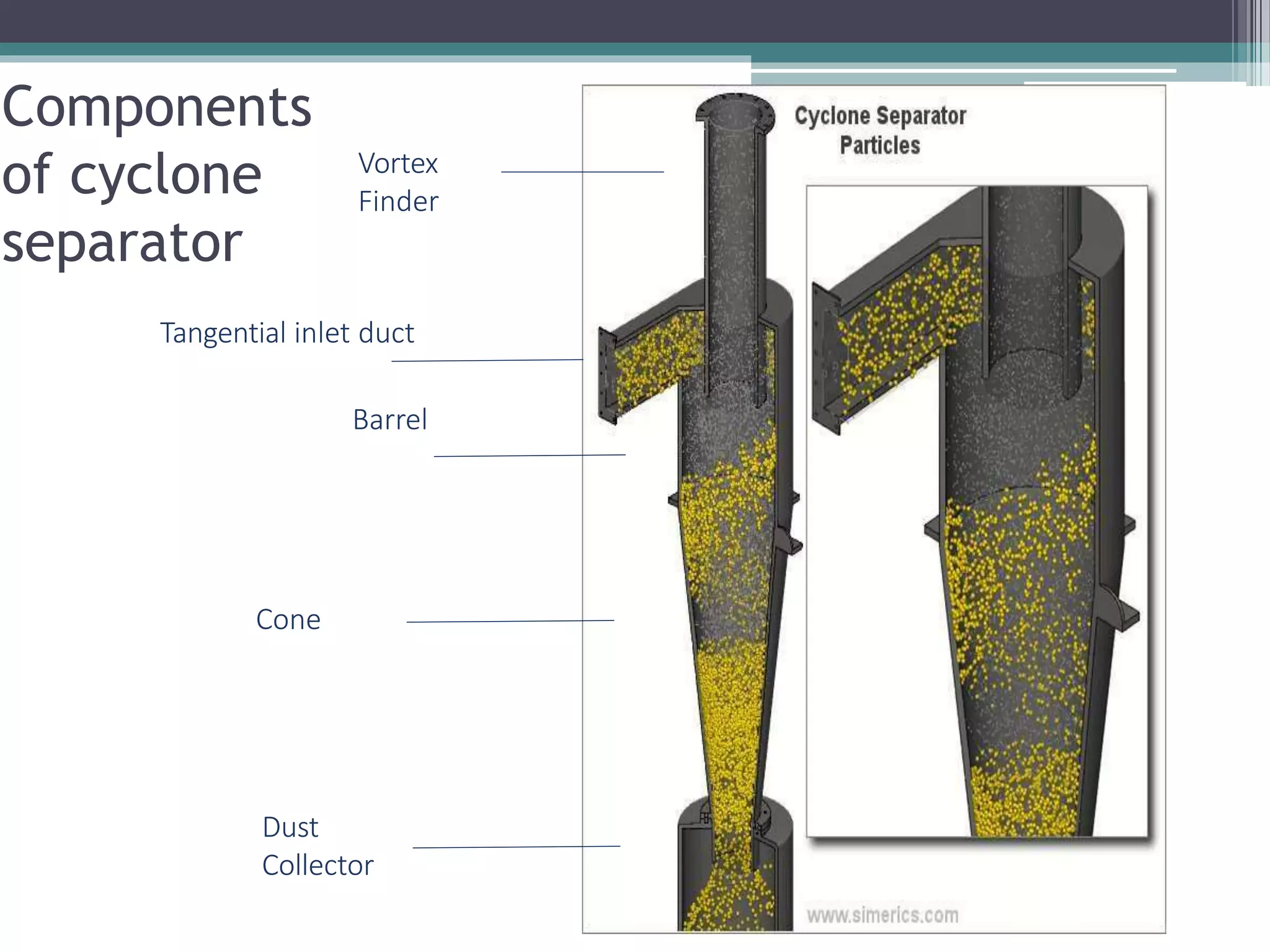
CYCLONE SEPARATORS
Theycreate a dual vortex to
separate course from fine
dust.
The main vortex spirals
downward and carries most
of the coarser dust particles.
The inner vortex created
near the bottom of the
cyclone, spirals upward and
carries finer dust particles.
Principles of Operation
In a Cyclone, the air or vapor containing
particulate material is forced into along
the tangential axis. Ahelical flow pattern
is set up within thechamber.
The centrifugal force causes the particles to
migrate tothe outside of the chamber.
Here they fall down to the bottom of the
cyclone by gravity.
The collected particulates are allowed to exit
out an underflow pipe whilethe gas phase
reverses its axial direction of flow and exits
out through the vortex finder (gas outlet
tube).
The air moves up the center of the cyclone
and reaches the
top.
6.
MECHANISM
• Cyclones mainlyhave a vortex reversal
allowing the clean gas to exit at the top of
the cyclone. They usually stand alone and
solid dust collects in the conical portion of
the cyclone for removal. In cyclone
separators, contaminated liquid or dust-
laden air enters tangentially near the top of
the cyclone. Larger or heavier particles (the
coarse) are thrown to the sides and slide to
the bottom, where they are collected. The
remaining air or liquid (the fines) reverses
direction and spirals up the center of the
cyclone and out the top.
7.
Hydrocyclones
• Analogous devicesfor separating
particles or solids from liquids are
called hydrocyclones or
hydroclones.
• A hydrocyclone is a device to
classify, separate or sort particles
in a liquid suspension based on
the ratio of their centripetal
force to fluid resistance. This ratio
is high for dense (where
separation by density is required)
and coarse (where separation by
size is required) particles, and low
for light and fine particles.
Hydrocyclones also find
application in the separation of
liquids of different densities.
8.
Operating theory
• Themixture is injected into
the hydrocyclone in such a
way as to create the vortex
and, depending upon the
relative densities of the two
phases, the centrifugal
acceleration will cause the
dispersed phase to move
away from or towards the
central core of the vortex.
9.
Operating Parameters
• Ahydrocyclone is a classifier that has two exits on
the axis:
one on the bottom (underflow or reject)
and one at the top (overflow or accept).
• The underflow is generally the denser or coarser
fraction, while the overflow is the lighter or finer
fraction.
• It has no moving parts and its operation depends
two major parameters:
i. the characteristics of the feed stream.
ii. the geometry of the cyclone.
10.
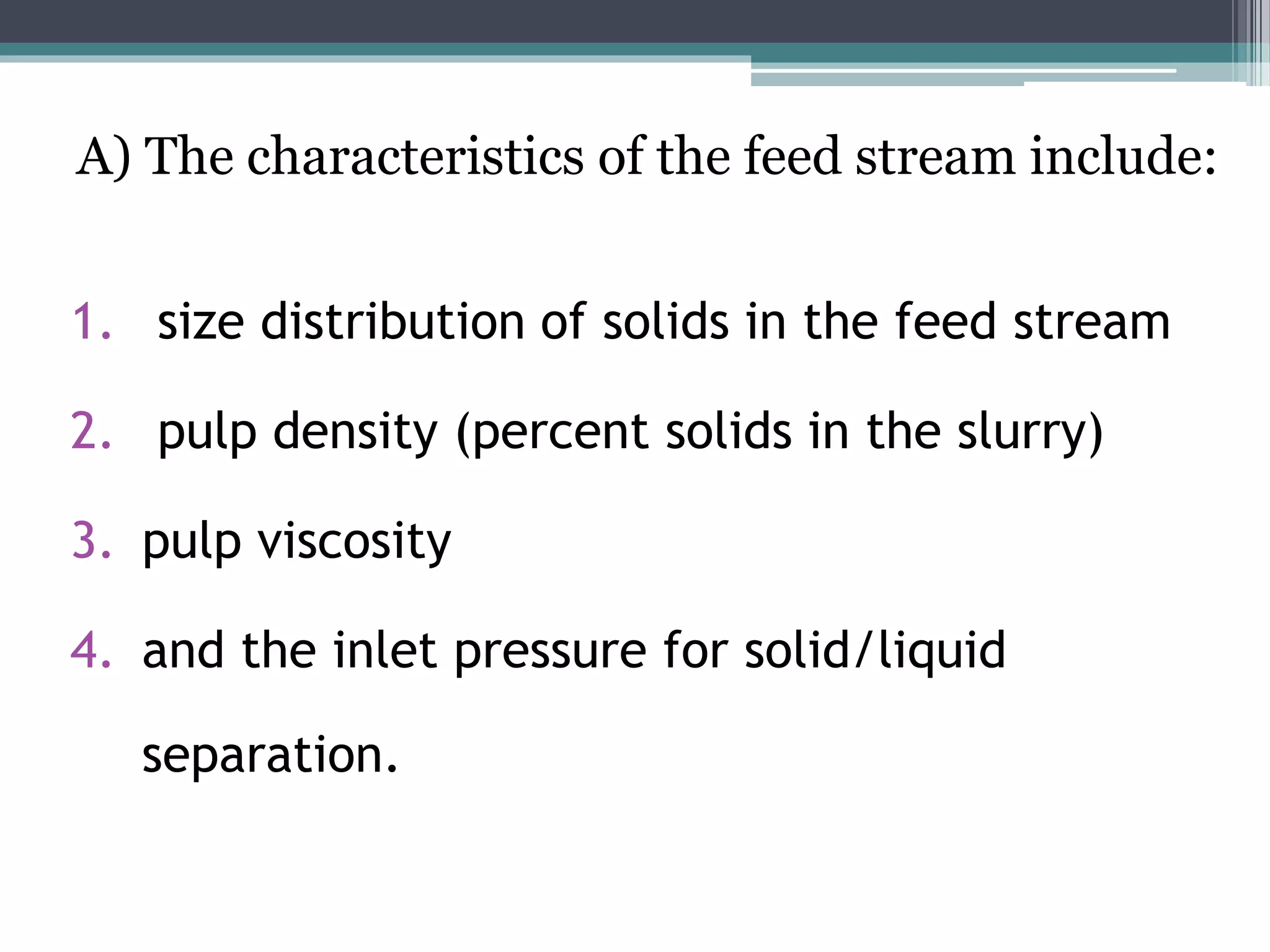
A) The characteristicsof the feed stream include:
1. size distribution of solids in the feed stream
2. pulp density (percent solids in the slurry)
3. pulp viscosity
4. and the inlet pressure for solid/liquid
separation.
11.
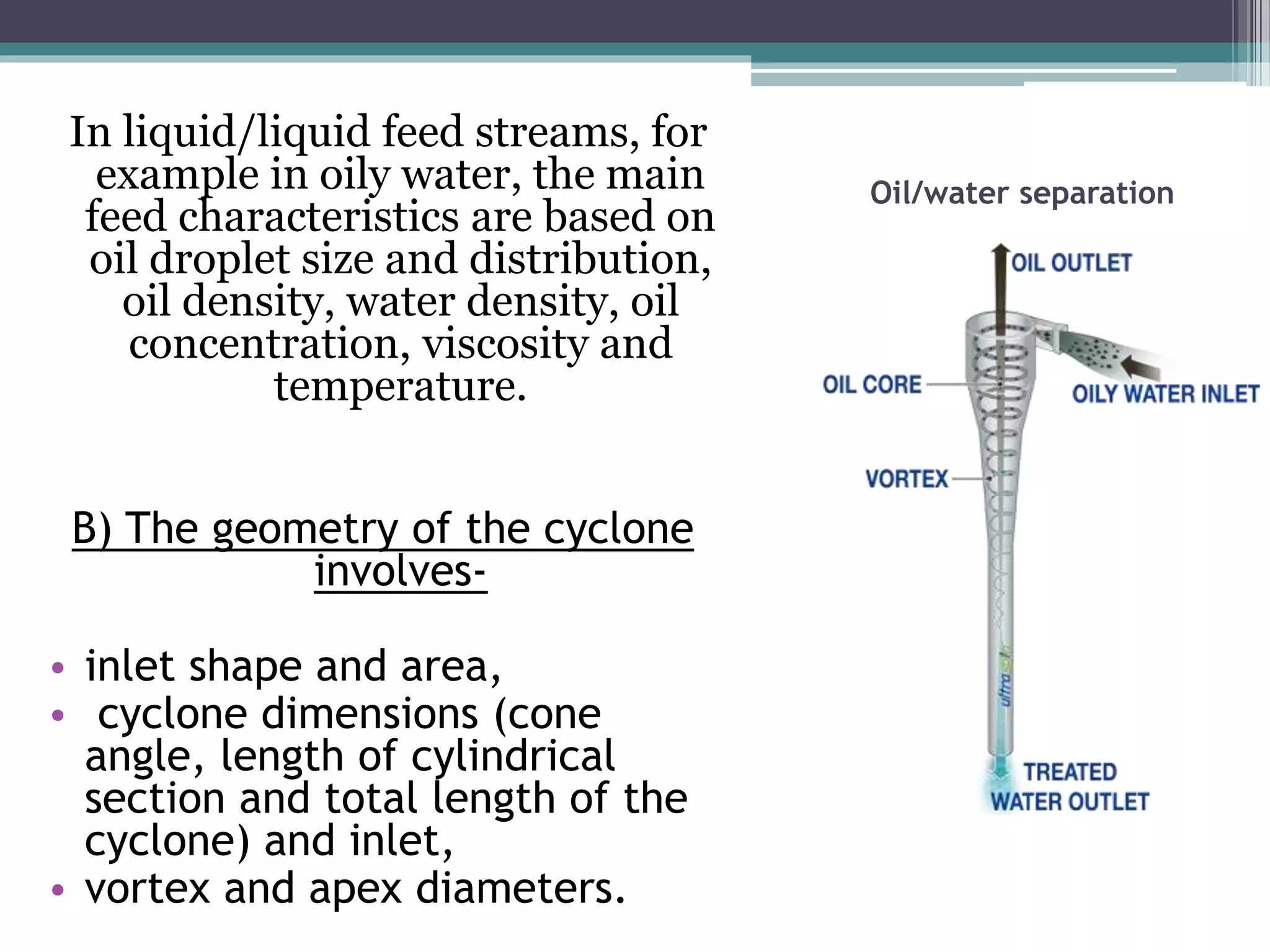
Oil/water separation
In liquid/liquidfeed streams, for
example in oily water, the main
feed characteristics are based on
oil droplet size and distribution,
oil density, water density, oil
concentration, viscosity and
temperature.
B) The geometry of the cyclone
involves-
• inlet shape and area,
• cyclone dimensions (cone
angle, length of cylindrical
section and total length of the
cyclone) and inlet,
• vortex and apex diameters.
12.
DESIGN PARAMETERS ANDEFFICIENCY
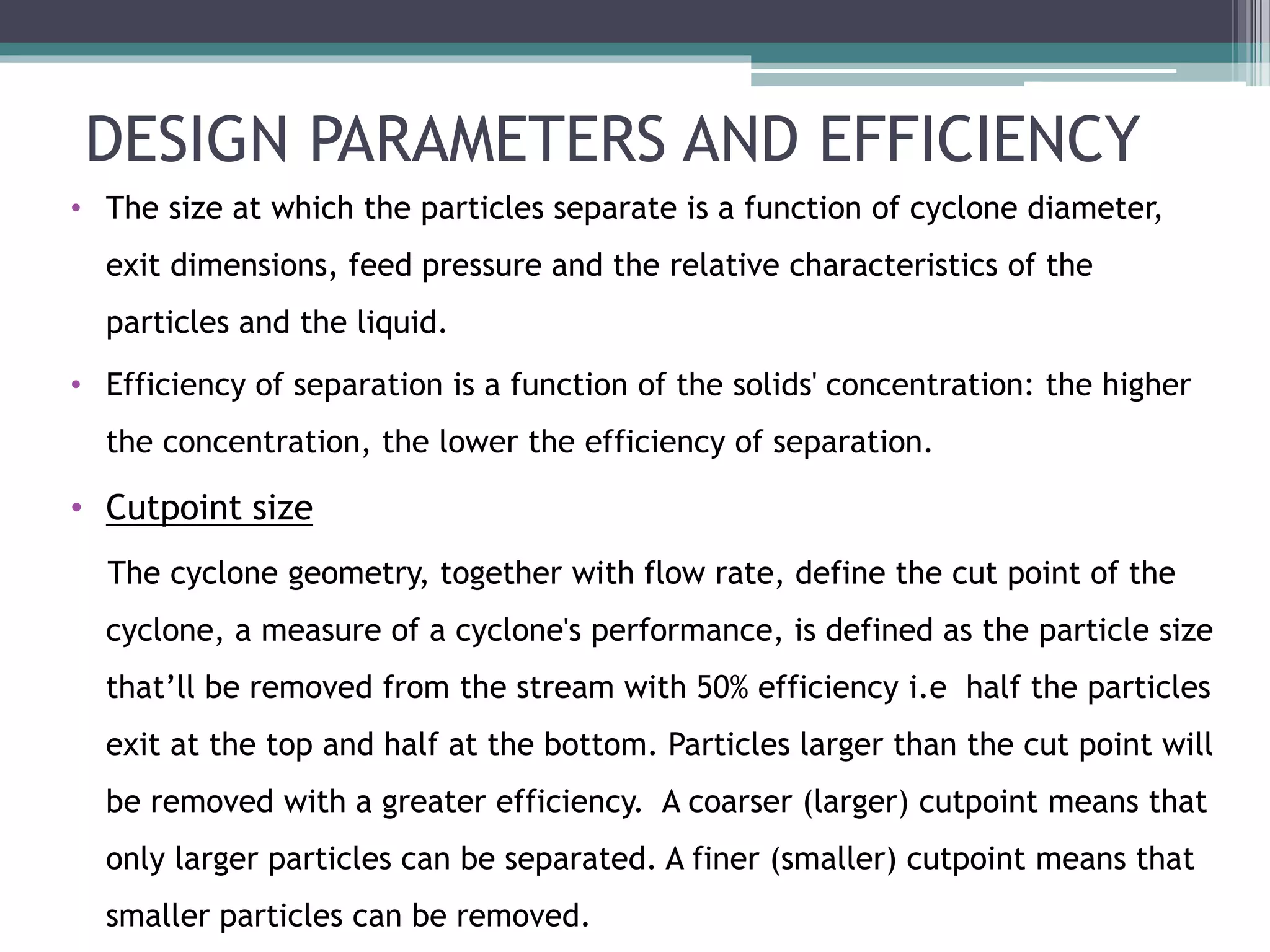
• The size at which the particles separate is a function of cyclone diameter,
exit dimensions, feed pressure and the relative characteristics of the
particles and the liquid.
• Efficiency of separation is a function of the solids' concentration: the higher
the concentration, the lower the efficiency of separation.
• Cutpoint size
The cyclone geometry, together with flow rate, define the cut point of the
cyclone, a measure of a cyclone's performance, is defined as the particle size
that’ll be removed from the stream with 50% efficiency i.e half the particles
exit at the top and half at the bottom. Particles larger than the cut point will
be removed with a greater efficiency. A coarser (larger) cutpoint means that
only larger particles can be separated. A finer (smaller) cutpoint means that
smaller particles can be removed.
13.
CYCLONE/HYDROCYCLONE
ADVANTAGES DISADVANTAGES
• Lowcapital cost.
• High efficiency for 5 - 200 micron
particles.
• High volume flowrate.
• Lack of moving parts reduces wear.
• Continuous or batch removal of
underflow requires virtually no
downtime for maintenance or
recovery.
• Versatile application.
• Small relative to other separation
equipment.
• Can operate at a wide range of
temperatures and pressures
• Reduced efficiency at less-than-
capacity flow.
• Difficult to obtain good
separation of substances of
similar densities.
• Cannot handle viscous flow.
• Extremely high velocities cause
abrasive wear.
• Hydrocyclones cannot produce
completely dry underflow.
• Clogging of the dust outlet is
common in reverse flow cyclones
14.
Industrial usage
• Ahydrocyclone is most often used to separate "heavies" from a liquid mixture
originating at a centrifugal pump or some other continuous source of
pressurized liquid. A hydrocyclone is most likely to be the right choice for
processes where "lights" are the greater part of the mixture and where the
"heavies" settle fairly easily.
These may be used to separate solid waste from water in wastewater
and sewage treatment.
Applications include:
• In pulp and paper mills to remove sand, staples, plastic particles and other
contaminants.
• In the drilling industry to separate sand from the expensive clay that is used
for lubrication during the drilling.
• In oil industry to separate oil from water or vice versa.
• In metal working to separate metal particles from cooling liquid.
• In mineral processing, hydrocyclones are used extensively both to classify
particles for recirculation in grinding circuits and to differentiate between
the economic mineral and gangue.
• To remove sand and silt particles from irrigation water for drip
irrigation purposes.