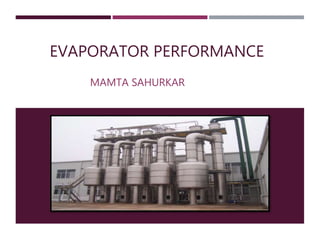
EVAPORATOR PERFORMANCE
MAMTA SAHURKAR
• Since evaporators dealing with boiling solutions, and in
particular with solutions with non-volatile solutes, any
calculations must account for the effect of boiling point
elevation.
• The vapor pressure of an aqueous solution is less than that of
pure water at the same temperature; so the boiling point of the
solution will be higher than that of the water.This is
called Boiling Point Elevation (BPE) or vapor pressure lowering.
• The boiling point of a solution is a colligative property -- it
depends on the concentration of solute in the solution, but not
on what the solute and solvent are.
Boiling Point Elevation
• The equilibrium vapor rising from a solution exhibiting
boiling point elevation will exist at a temperature and
pressure such that it is superheated with respect to pure
vapor.
• The vapor rises at the solution boiling point, elevated
with respect to the pure component boiling point.The
vapor, however, is solute free, so it won't condense until
the extra heat corresponding to the elevation is removed,
thus it is superheated.
• When working problems involving heat transfer to or
from boiling solutions, it is necessary to adjust the
temperature difference driving force for the boiling point
elevation.
• For strong solutions, one can take advantage of Duhring's Rule.
• The boiling point of a given solution is a linear function of the
boiling point of water at the same temperature.
• This lets us plotTBP solution againstTBP water and get a straight line
for each concentration.
• Another way of thinking of these plots -- they plot the
temperature where the vapor pressure of the solution is equal to
some fixed value against the temperature where the vapor
pressure of water equals the same value.
• For Duhring Plots to be valid, the range of boiling points must be
relatively narrow and the solution must obey Raoult's Law.
Duhring's Rule
To use a Duhring plot:
1.For a particular system pressure, determine the boiling temperature of
pure water. This can be done from a vapor pressure equation or steam
table.
2.Enter the plot from the bottom (the water boiling point), trace up to
the diagonal line representing the NaOH fraction, then trace left to read
the solution boiling point from the vertical axis.
3.The boiling point elevation is the difference between the two
temperatures.
There are three main measures of evaporator performance:
1.Capacity (kg vaporized / time)
2.Economy (kg vaporized / kg steam input)
3.Steam Consumption (kg / hr.)
The performance of a steam-heated evaporator is measured in
terms of its capacity and economy.
Performance Measures
Capacity of evaporator
• Capacity is defined as the number of
kilogram of water vaporized per hour.
• Capacity of evaporator is defined as the number of kilograms of
water vaporized/evaporator per hour. The rate of heat transfer Q
the heating surface of evaporator is the product of heat transfer
heat transfer surface area and the overall temperature drop.
• The capacity of an evaporator depends upon the temperature of the
solution. If the feed solution is at the boiling temperature
the pressure in vapor space of an evaporator, all the heat supplied
utilized for evaporation, thus increasing the capacity of evaporator.
Q = U×A× T
Where
Q = Rate of heat transfer
A = area of the heat
transfer surface
T = overall temperature
drop
Economy of evaporator
Economy (or steam economy) is the
number kilogram of water vaporized
from all the effects per kilogram of steam
used.
• Economy is the number of kg of water vaporized per kg of steam
fed to the unit.
•The rate of heat transfer Q through the heating surface of an
evaporator, by the definition of overall heat transfer coefficient, is
product of three factors.
1.The area of heat transfer surfaceA
2.The overall heat transfer coefficient U
3.The overall temperature drop ΔT
Q = U * A * ΔT
•Economy calculations are determined using enthalpy balances.
•The key factor in determining the economy of an evaporator is the number of
effects.
•The economy of a single effect evaporator is always less than 1.0.
•Multiple effect evaporators have higher economy but lower capacity than
single effect.
•The thermal condition of the evaporator feed has an important impact on
economy and performance.
•If the feed is not already at its boiling point, heat effects must be considered.
•If the feed is cold (below boiling) some of the heat going into the evaporator
must be used to raise the feed to boiling before evaporation can begin; this
reduces the capacity.
Steam consumption
•Steam consumption is very important to know,
can be estimated by the ratio of capacity divided
the economy.
•That is the steam consumption (in kg/h) is:
Consumption = Capacity/Economy.
For single effect evaporator, the steam economy is
about 0.8 (<1).The capacity is about n -times that
of a single effect evaporator and the economy is
about 0.8 n for a n -effect evaporators. However,
pumps, interconnecting pipes and valves are
required for transfer of liquid from one effect to
another effect that increases both equipment and
operating costs.
The rate equation for heat transfer takes the form:
Q = U * A * ΔT
where:
1. Q is the heat transferred per unit time
2.U is the overall coefficient of heat transfer
3.A is the heat transfer surface
4.T is the temperature difference between the two
streams.
Heat transfer in evaporators
•In applying this equation to evaporators, there may be
some difficulty in deciding the correct value for the
temperature difference because of what is known as the
boiling point rise (BPR) or boiling point elevation (BPE)
•If water is boiled in an evaporator under a given
pressure, then the temperature of the liquor may be
determined from steam tables and the temperature
difference is readily calculated.
•At the same pressure, a solution has a boiling point
greater than that of water, and the difference between
its boiling point and that of water is the BPR or BPE.
•For example, at atmospheric pressure (101.3
kN/m2 ), a 25 per cent solution of sodium chloride
boils at 381 K and shows a BPR of 8 deg K. If steam
at 389 K were used to concentrate the salt solution,
the overall temperature difference would not be
(389 − 373) = 16 deg K, but (389 − 381) = 8 deg K.
Such solutions usually require more heat to
vaporize unit mass of water, so that the reduction in
capacity of a unit may be considerable.
•The value of the BPR cannot be calculated from physical
data of the liquor, though Duhring’s rule is often used to
find the change in BPR with pressure.
•Duhring’s rule states that the boiling point of given
solution is a linear function of the boiling point of pure
water at the same pressure.
•Thus, if the boiling point of the solution is plotted
against that of water at the same pressure, then a
straight line is obtained.
•Thus, if the pressure is fixed, the boiling point of water
is found from steam tables, and the boiling point of the
solution from Duhring’s plot.
•Different lines are obtained for different
concentrations.
•The boiling point rise is much greater with strong
electrolytes, such as salt and caustic soda.
Proble
ms
Technical problems can arise during evaporation,
especially when the process is applied to the food industry.
Some evaporators are sensitive to differences in viscosity
and consistency of the dilute solution. These evaporators
could work inefficiently because of a loss of circulation.
The pump of an evaporator may need to be changed if the
evaporator needs to be used to concentrate a highly
viscous solution.
Fouling
Occurs when hard deposits form on the surfaces of the
mediums in the evaporators. In foods, proteins and
polysaccharides can create such deposits that reduce the
efficiency of heat transfer. Foaming can also create a
since dealing with the excess foam can be costly in time
efficiency. Antifoam agents are to be used, but only a few
used when food is being processed.
Corrosion
Occur when acidic solutions such as citrus juices are
concentrated. The surface damage caused can shorten the
life of evaporators. Quality and flavor of food can also
during evaporation. Overall, when choosing an evaporator,
THANK YOU

Evaporator performance

  • 1.
  • 2.
    • Since evaporatorsdealing with boiling solutions, and in particular with solutions with non-volatile solutes, any calculations must account for the effect of boiling point elevation. • The vapor pressure of an aqueous solution is less than that of pure water at the same temperature; so the boiling point of the solution will be higher than that of the water.This is called Boiling Point Elevation (BPE) or vapor pressure lowering. • The boiling point of a solution is a colligative property -- it depends on the concentration of solute in the solution, but not on what the solute and solvent are. Boiling Point Elevation
  • 3.
    • The equilibriumvapor rising from a solution exhibiting boiling point elevation will exist at a temperature and pressure such that it is superheated with respect to pure vapor. • The vapor rises at the solution boiling point, elevated with respect to the pure component boiling point.The vapor, however, is solute free, so it won't condense until the extra heat corresponding to the elevation is removed, thus it is superheated. • When working problems involving heat transfer to or from boiling solutions, it is necessary to adjust the temperature difference driving force for the boiling point elevation.
  • 4.
    • For strongsolutions, one can take advantage of Duhring's Rule. • The boiling point of a given solution is a linear function of the boiling point of water at the same temperature. • This lets us plotTBP solution againstTBP water and get a straight line for each concentration. • Another way of thinking of these plots -- they plot the temperature where the vapor pressure of the solution is equal to some fixed value against the temperature where the vapor pressure of water equals the same value. • For Duhring Plots to be valid, the range of boiling points must be relatively narrow and the solution must obey Raoult's Law. Duhring's Rule
  • 6.
    To use aDuhring plot: 1.For a particular system pressure, determine the boiling temperature of pure water. This can be done from a vapor pressure equation or steam table. 2.Enter the plot from the bottom (the water boiling point), trace up to the diagonal line representing the NaOH fraction, then trace left to read the solution boiling point from the vertical axis. 3.The boiling point elevation is the difference between the two temperatures.
  • 7.
    There are threemain measures of evaporator performance: 1.Capacity (kg vaporized / time) 2.Economy (kg vaporized / kg steam input) 3.Steam Consumption (kg / hr.) The performance of a steam-heated evaporator is measured in terms of its capacity and economy. Performance Measures
  • 8.
    Capacity of evaporator •Capacity is defined as the number of kilogram of water vaporized per hour.
  • 9.
    • Capacity ofevaporator is defined as the number of kilograms of water vaporized/evaporator per hour. The rate of heat transfer Q the heating surface of evaporator is the product of heat transfer heat transfer surface area and the overall temperature drop. • The capacity of an evaporator depends upon the temperature of the solution. If the feed solution is at the boiling temperature the pressure in vapor space of an evaporator, all the heat supplied utilized for evaporation, thus increasing the capacity of evaporator. Q = U×A× T Where Q = Rate of heat transfer A = area of the heat transfer surface T = overall temperature drop
  • 10.
    Economy of evaporator Economy(or steam economy) is the number kilogram of water vaporized from all the effects per kilogram of steam used.
  • 11.
    • Economy isthe number of kg of water vaporized per kg of steam fed to the unit. •The rate of heat transfer Q through the heating surface of an evaporator, by the definition of overall heat transfer coefficient, is product of three factors. 1.The area of heat transfer surfaceA 2.The overall heat transfer coefficient U 3.The overall temperature drop ΔT Q = U * A * ΔT
  • 12.
    •Economy calculations aredetermined using enthalpy balances. •The key factor in determining the economy of an evaporator is the number of effects. •The economy of a single effect evaporator is always less than 1.0. •Multiple effect evaporators have higher economy but lower capacity than single effect. •The thermal condition of the evaporator feed has an important impact on economy and performance. •If the feed is not already at its boiling point, heat effects must be considered. •If the feed is cold (below boiling) some of the heat going into the evaporator must be used to raise the feed to boiling before evaporation can begin; this reduces the capacity.
  • 13.
    Steam consumption •Steam consumptionis very important to know, can be estimated by the ratio of capacity divided the economy. •That is the steam consumption (in kg/h) is: Consumption = Capacity/Economy.
  • 14.
    For single effectevaporator, the steam economy is about 0.8 (<1).The capacity is about n -times that of a single effect evaporator and the economy is about 0.8 n for a n -effect evaporators. However, pumps, interconnecting pipes and valves are required for transfer of liquid from one effect to another effect that increases both equipment and operating costs.
  • 15.
    The rate equationfor heat transfer takes the form: Q = U * A * ΔT where: 1. Q is the heat transferred per unit time 2.U is the overall coefficient of heat transfer 3.A is the heat transfer surface 4.T is the temperature difference between the two streams. Heat transfer in evaporators
  • 16.
    •In applying thisequation to evaporators, there may be some difficulty in deciding the correct value for the temperature difference because of what is known as the boiling point rise (BPR) or boiling point elevation (BPE) •If water is boiled in an evaporator under a given pressure, then the temperature of the liquor may be determined from steam tables and the temperature difference is readily calculated. •At the same pressure, a solution has a boiling point greater than that of water, and the difference between its boiling point and that of water is the BPR or BPE.
  • 17.
    •For example, atatmospheric pressure (101.3 kN/m2 ), a 25 per cent solution of sodium chloride boils at 381 K and shows a BPR of 8 deg K. If steam at 389 K were used to concentrate the salt solution, the overall temperature difference would not be (389 − 373) = 16 deg K, but (389 − 381) = 8 deg K. Such solutions usually require more heat to vaporize unit mass of water, so that the reduction in capacity of a unit may be considerable.
  • 18.
    •The value ofthe BPR cannot be calculated from physical data of the liquor, though Duhring’s rule is often used to find the change in BPR with pressure. •Duhring’s rule states that the boiling point of given solution is a linear function of the boiling point of pure water at the same pressure. •Thus, if the boiling point of the solution is plotted against that of water at the same pressure, then a straight line is obtained.
  • 19.
    •Thus, if thepressure is fixed, the boiling point of water is found from steam tables, and the boiling point of the solution from Duhring’s plot. •Different lines are obtained for different concentrations. •The boiling point rise is much greater with strong electrolytes, such as salt and caustic soda.
  • 20.
    Proble ms Technical problems canarise during evaporation, especially when the process is applied to the food industry. Some evaporators are sensitive to differences in viscosity and consistency of the dilute solution. These evaporators could work inefficiently because of a loss of circulation. The pump of an evaporator may need to be changed if the evaporator needs to be used to concentrate a highly viscous solution.
  • 21.
    Fouling Occurs when harddeposits form on the surfaces of the mediums in the evaporators. In foods, proteins and polysaccharides can create such deposits that reduce the efficiency of heat transfer. Foaming can also create a since dealing with the excess foam can be costly in time efficiency. Antifoam agents are to be used, but only a few used when food is being processed. Corrosion Occur when acidic solutions such as citrus juices are concentrated. The surface damage caused can shorten the life of evaporators. Quality and flavor of food can also during evaporation. Overall, when choosing an evaporator,
  • 22.