15-08-2020
1
Cyclone Separator
• Principle: centrifugal force is generated by
using high gas velocity and this force is
used to remove solid particles from gas
Construction and working
• It is the structure without moving parts in
which the Velocity of an inlet gas stream is
transferred in to a confined vortex from
which centrifugal Forces tend to drive the
particles to the wall of the Cyclone Body.
• It consists of a vertically placed Cylinder
which has an inverted cone attached to its
base.
15-08-2020
2
• The particulate laden gas streams enter
tangentially at the inlet point in to the
cylinder.
• The outlet pipe for the particulate free gas is
central Cylinder opening at the top.
• The gas receives a rotating motion. The
vortex so formed develops centrifugal
forces
• The gas path follows a double vortex.
• First the gas spirals down ward at the outer
periphery of the cylindrical portion and
reaches the Bottom.
• The gas then moves up ward in a narrow
spiral concentric with the first and leaves
through the outlet pipe at the top.
• The carrier gas velocity exceeds several
times inlet gas velocity.
• Due to such rapid spiraling movement the
disperses solid (Particulate) are thrown at
the wall of the cyclone by the Centrifugal
Force and than they drop by the gravity to
the bottom where they are collected.
• Centrifugal force employed in Cyclones
varies from 5-2500 times gravity.
• The Cyclone efficiencies < 90% for
particulate diameter of 10 micron.
• The Cyclone efficiencies equal to 95% for
particulate diameter of 20 micron and less
15-08-2020
3
Efficiency increases with increase in:
• Dust Particle Size
• Dust Particle Density
• Gas Inlet Velocity
• Inlet Dust loading
• Cyclone Body Length ( Number of Gas
Revolutions)
• Ratio of Body Diameter to Gas Outlet
Tube Diameter.
Efficiency Decreases with
Increase in
• Gas Outlet Diameter
• Cyclone Diameter
• Gas Viscosity / Density
• Inlet width and Inlet Area.
• Mixing of Dirty gas with clean gas at top
To Increase Efficiency a smaller diameter long taper
Cyclone should be used.
Operating Problems:
There are three problems:
• Erosion: Heavy, hard, sharp, edged particles in high
concentration moving at high velocity scrap against
wall and erode the metallic surface.
• Corrosion: Occurs when Cyclone operates at a
temperature below condensation point. Stainless Alloy
is a better choice.
• Build-Up: Dust cake builds at the wall especially when
it is Hygroscopic. The cheapest way is to use flange
connection between dust collecting hopper and body
cake can be periodically scraped.
15-08-2020
4
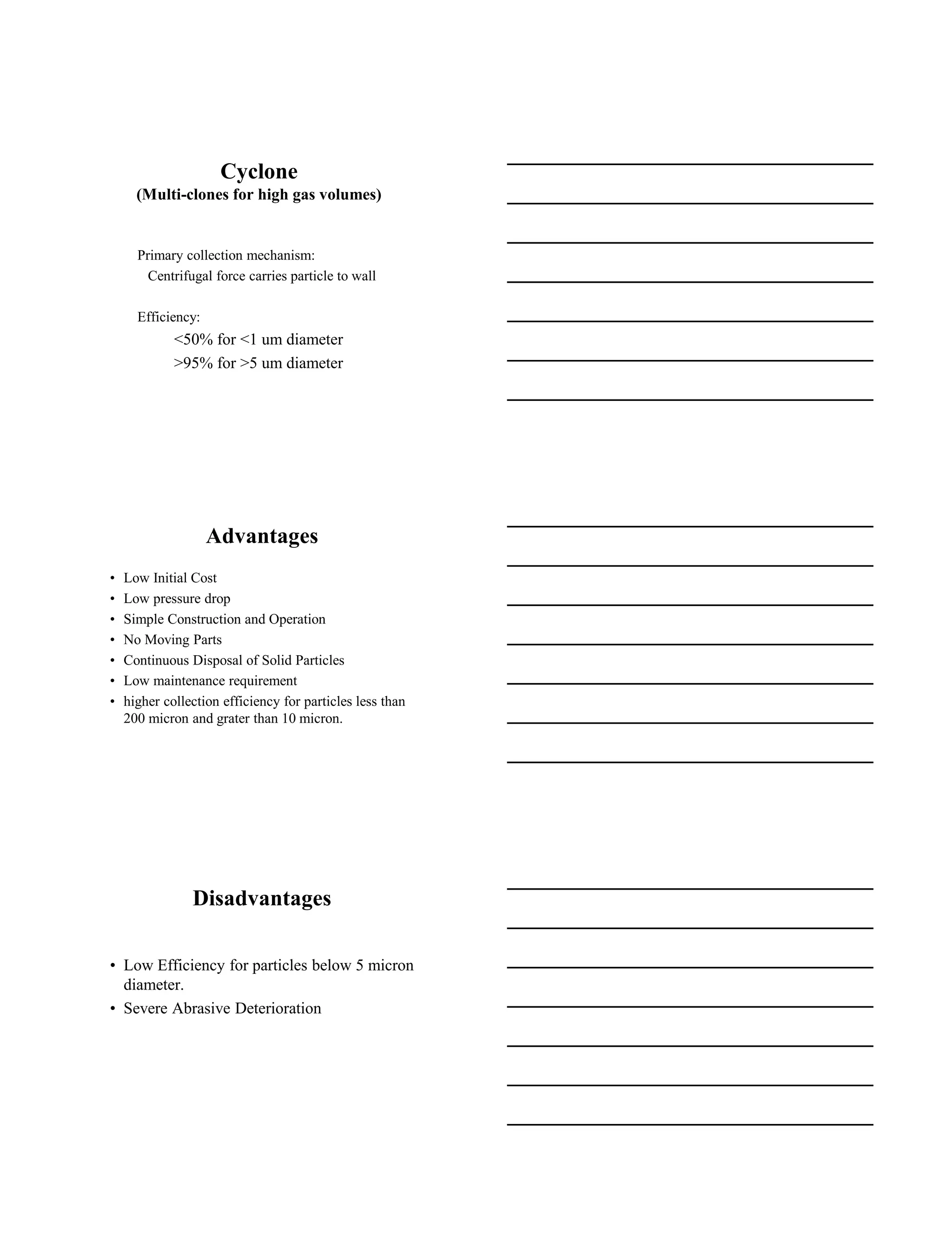
Cyclone
(Multi-clones for high gas volumes)
Primary collection mechanism:
Centrifugal force carries particle to wall
Efficiency:
<50% for <1 um diameter
>95% for >5 um diameter
Advantages
• Low Initial Cost
• Low pressure drop
• Simple Construction and Operation
• No Moving Parts
• Continuous Disposal of Solid Particles
• Low maintenance requirement
• higher collection efficiency for particles less than
200 micron and grater than 10 micron.
Disadvantages
• Low Efficiency for particles below 5 micron
diameter.
• Severe Abrasive Deterioration
15-08-2020
5
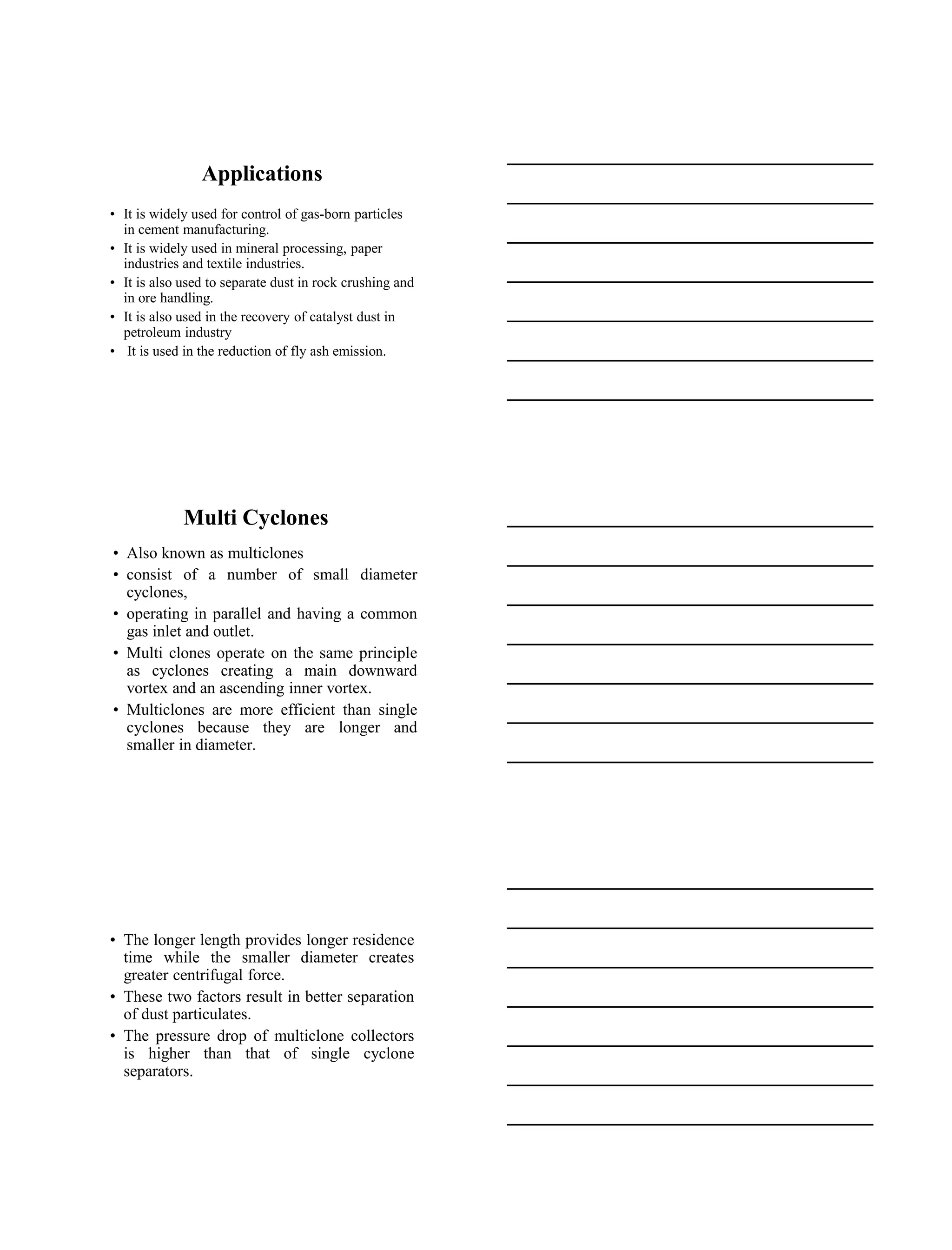
Applications
• It is widely used for control of gas-born particles
in cement manufacturing.
• It is widely used in mineral processing, paper
industries and textile industries.
• It is also used to separate dust in rock crushing and
in ore handling.
• It is also used in the recovery of catalyst dust in
petroleum industry
• It is used in the reduction of fly ash emission.
Multi Cyclones
• Also known as multiclones
• consist of a number of small diameter
cyclones,
• operating in parallel and having a common
gas inlet and outlet.
• Multi clones operate on the same principle
as cyclones creating a main downward
vortex and an ascending inner vortex.
• Multiclones are more efficient than single
cyclones because they are longer and
smaller in diameter.
• The longer length provides longer residence
time while the smaller diameter creates
greater centrifugal force.
• These two factors result in better separation
of dust particulates.
• The pressure drop of multiclone collectors
is higher than that of single cyclone
separators.

7. cyclone seperator

  • 1.
    15-08-2020 1 Cyclone Separator • Principle:centrifugal force is generated by using high gas velocity and this force is used to remove solid particles from gas Construction and working • It is the structure without moving parts in which the Velocity of an inlet gas stream is transferred in to a confined vortex from which centrifugal Forces tend to drive the particles to the wall of the Cyclone Body. • It consists of a vertically placed Cylinder which has an inverted cone attached to its base.
  • 2.
    15-08-2020 2 • The particulateladen gas streams enter tangentially at the inlet point in to the cylinder. • The outlet pipe for the particulate free gas is central Cylinder opening at the top. • The gas receives a rotating motion. The vortex so formed develops centrifugal forces • The gas path follows a double vortex. • First the gas spirals down ward at the outer periphery of the cylindrical portion and reaches the Bottom. • The gas then moves up ward in a narrow spiral concentric with the first and leaves through the outlet pipe at the top. • The carrier gas velocity exceeds several times inlet gas velocity. • Due to such rapid spiraling movement the disperses solid (Particulate) are thrown at the wall of the cyclone by the Centrifugal Force and than they drop by the gravity to the bottom where they are collected. • Centrifugal force employed in Cyclones varies from 5-2500 times gravity. • The Cyclone efficiencies < 90% for particulate diameter of 10 micron. • The Cyclone efficiencies equal to 95% for particulate diameter of 20 micron and less
  • 3.
    15-08-2020 3 Efficiency increases withincrease in: • Dust Particle Size • Dust Particle Density • Gas Inlet Velocity • Inlet Dust loading • Cyclone Body Length ( Number of Gas Revolutions) • Ratio of Body Diameter to Gas Outlet Tube Diameter. Efficiency Decreases with Increase in • Gas Outlet Diameter • Cyclone Diameter • Gas Viscosity / Density • Inlet width and Inlet Area. • Mixing of Dirty gas with clean gas at top To Increase Efficiency a smaller diameter long taper Cyclone should be used. Operating Problems: There are three problems: • Erosion: Heavy, hard, sharp, edged particles in high concentration moving at high velocity scrap against wall and erode the metallic surface. • Corrosion: Occurs when Cyclone operates at a temperature below condensation point. Stainless Alloy is a better choice. • Build-Up: Dust cake builds at the wall especially when it is Hygroscopic. The cheapest way is to use flange connection between dust collecting hopper and body cake can be periodically scraped.
  • 4.
    15-08-2020 4 Cyclone (Multi-clones for highgas volumes) Primary collection mechanism: Centrifugal force carries particle to wall Efficiency: <50% for <1 um diameter >95% for >5 um diameter Advantages • Low Initial Cost • Low pressure drop • Simple Construction and Operation • No Moving Parts • Continuous Disposal of Solid Particles • Low maintenance requirement • higher collection efficiency for particles less than 200 micron and grater than 10 micron. Disadvantages • Low Efficiency for particles below 5 micron diameter. • Severe Abrasive Deterioration
  • 5.
    15-08-2020 5 Applications • It iswidely used for control of gas-born particles in cement manufacturing. • It is widely used in mineral processing, paper industries and textile industries. • It is also used to separate dust in rock crushing and in ore handling. • It is also used in the recovery of catalyst dust in petroleum industry • It is used in the reduction of fly ash emission. Multi Cyclones • Also known as multiclones • consist of a number of small diameter cyclones, • operating in parallel and having a common gas inlet and outlet. • Multi clones operate on the same principle as cyclones creating a main downward vortex and an ascending inner vortex. • Multiclones are more efficient than single cyclones because they are longer and smaller in diameter. • The longer length provides longer residence time while the smaller diameter creates greater centrifugal force. • These two factors result in better separation of dust particulates. • The pressure drop of multiclone collectors is higher than that of single cyclone separators.