EVAPORATION
Prepared by: Ankita Yagnik
Assistant Professor
Akshar-Preet Institute of Pharmacy, Jamnagar.
Definition:
 Evaporation is a type of phase transition;
it is the process by which molecules in a
liquid state (e.g water) spontaneously
become gaseous (e.g water vapor).
 The equipment used for evaporation is
known as Evaporator.
2
Purpose of evaporation:
 To concentrate solution by removing the
vapor from a boiling liquid solution .
 In the majority of cases, evaporation
refers to the removal of water from an
aqueous solution.
 Example: concentration of aqueous
solutions of sugar, sodium chloride,
sodium hydroxide, glycerol, glue, milk,
and orange juice.
 In these cases the concentrated solution
is the desired product and the
evaporated water is normally discarded.
3
Evaporation and Distillation
4
Evaporation Distillation
In evaporation, vaporization takes
place below the boiling point.
In the distillation method,
vaporization takes place at the
boiling point
Evaporation takes place only from
the surface of the liquid
Distillation takes place from the
whole liquid mass.
It takes place below boiling point so
there is no bubble formation in
evaporation.
At the boiling point of the distillation
process, the liquid forms bubbles.
Evaporation is not necessarily
separation or purifying technique.
Distillation is a separation or
purifying technique
Evaporation is a slow process. Distillation happens rapidly.
Evaporation and Drying
 The term drying usually refers the
removal of relatively small amounts of
water from solid or nearly solid material,
whereas Evaporation is usually limited to
the removal of relatively large amounts
of water from solutions.
 In most cases drying involves the
removal of water at temperatures below
its boiling point, whereas , Evaporation
means the removal of water by boiling a
solution. 5
Applications of evaporation
 Manufacturing of bulk drugs.
 Manufacturing of biological products.
 Manufacturing of food products.
 Manufacturing of demineralised water.
 Minimize the chances of chemical
reactions.
 Prepare the product for next operation
like drying.
 Improve product storage life.
 Decrease the impact of microbial growth.6
Factors affecting rate of
evaporation
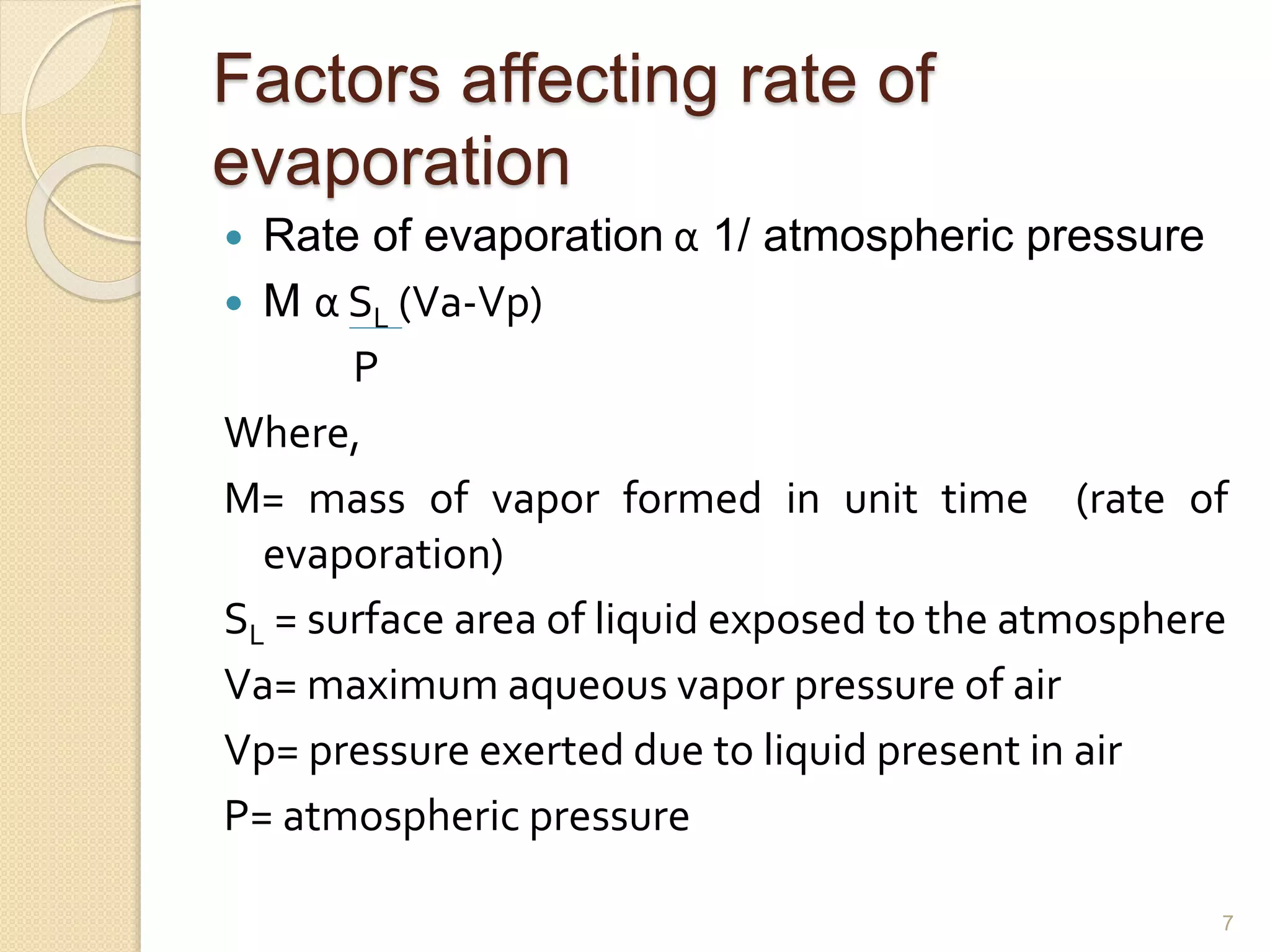
 Rate of evaporation α 1/ atmospheric pressure
 M α SL (Va-Vp)
P
Where,
M= mass of vapor formed in unit time (rate of
evaporation)
SL = surface area of liquid exposed to the atmosphere
Va= maximum aqueous vapor pressure of air
Vp= pressure exerted due to liquid present in air
P= atmospheric pressure
7
 Temperature:
Higher the temperature greater will be the
evaporation.
 Vapor pressure:
Lower the pressure ,greater will be the
evaporation.
 Surface area:
Greater the surface area of the liquid,
greater will be the evaporation.
 Time of evaporation:
Exposure time is longer, more will be the
evaporation.
8
 Density:
The higher the density, slower the liquid
evaporates.
 Concentration:
Low concentration of the substance, faster
the evaporation.
 Film formation:
Some solutions deposit solid materials
called scale on the heating surfaces. results
in the overall heat-transfer coefficient
decreases and evaporator must be
cleaned.
9
Equipments used for
evaporation
 1. Evaporators with heating medium in jacket:
Ex. Steam jacketed kettle
 2. Evaporators with tube placed horizontally:
Ex. Horizontal tube evaporator
 3. Evaporators with tube placed vertically:
A) Evaporators with short tubes:
i) Single effect evaporator Ex. Short tube
vertical evaporator, Short tube vertical
evaporator with propeller, Basket type
evaporator
ii) Multiple effect evaporator Ex. Triple effect
evaporator 10
cont...
B) Evaporators with long tubes:
i) Evaporators with natural circulation
Ex. Climbing film evaporator, Falling film
evaporator
ii) Evaporators with forced circulation
Ex. Forced circulation evaporator
11
Horizontal tube evaporator
 Principle:
Steam is passed through the horizontal
tubes, which are immersed in a pool of
liquid to be evaporated. Heat transfers
through the tubes and the solvent
evaporates. Concentrated liquid is
collected.
12
 Construction:
 Large cylindrical body with doomed shaped
at the top and bottom, made of cast iron or
plate steel.
 The lower part of the body consists of steam
compartment with inlet for steam at one end
and a vent for non-condensed gases on the
other end.
 A condensate outlet is provided at the bottom
of the steam compartment.
 At one point an inlet for feed is provided and
one outlet for vapor is placed at the top of the
dom.
 Another outlet for thick liquid is placed at the
centre of the conical bottom of the body.
13
 Working:
 Feed is introduced into the evaporator until
the steam compartment is immersed.
 The horizontal tubes receives the heat and
conduct it to the liquid.
 The feed absorbs heat and solvent gets
evaporated.
 Concentrated liquid is collected.
 Uses:
 Best suited for non-viscous solution. E.g.
Cascara extract
14
 Advantages:
 Cost per square meter of heating surface is
less.
 Disadvantages:
 Requires large heating area
 Not suitable for heat sensitive material
 Unsuitable for crystalline products
15
16
Vertical tube evaporator
 Principle:
Liquid is passed through the vertical
tubes and steam is supplied from outside
tubes.
Heat transfer takes place through the
tubes and the liquids inside tube gets
heated.
The solvent evaporates, vapor escapes
from the top and concentrated liquid is
collected from bottom.
17
 Construction:
Consist of long cylindrical body made up of
cast iron with dome shaped top and
bottom.
Calandria are fitted at the bottom which
consist of number of vertical tubes with
diameter 0.05- 0.075 meters & length of 1-
2 meters.
About 100 such tubes are fitted in the body
of 2.5 m.
Inlets are provided for steam and feed.
Outlets are provided for vapor,
concentrated products, non-condensed18
 Working:
Feed is introduced into the evaporator
until the steam compartment is
immersed.
The vertical tubes receives the heat and
conduct it to the liquid.
The feed absorbs heat, solvent begins to
boil and solvent gets evaporated.
Concentrated liquid is collected from the
bottom outlet.
19
 Advantages:
 Increases the heating surface 10-15 times
than steam jacketed kettle.
 Vigorous circulation enhances rate of heat
transfer.
 More units can be joined.
 Disadvantages:
 Liquid to be maintained above calandria.
 Complicated- increased installation cost.
 Pressure has to maintain.
 Cleaning and maintenance is difficult.
 Uses:
 Manufacture of cascara extract, sugar, salt,
20
Climbing film evaporator
 Principle:
Tubes are heated externally by steam.
The preheated tubes enters from the
bottom and liquid flows up through the
the heated tubes.
Liquid near walls becomes vapor and
forms small bubbles. Larger bubbles flow
up with slag and strikes deflector.
Deflector throws the concentrate, down
to the bottom.
21
 Construction:
Heating unit consists of steam jacketed
tubes. Long and narrow tubes are held
between the plates.
Deflector is placed at the top of the vapor
head.
Inlets are provided for steam and feed.
Outlets are provided for vapor,
concentrated product, non condensed
gases and condensate.
 Uses:
 Insulin, liver extracts, vitamins, foaming
liquids, corrosive solutions can be
concentrated
22
23
 Working:
 The preheated liquid feed is introduced from
the bottom of the unit.
 Steam enters into the spaces outside the
tubes through the inlet.
 Heat transferred to the liquor through the
walls of the tubes.
 Liquid and vapor moves upward at high
velocity.
 Vapor and liquid is separated from upper part
having cyclone separator.
 The vapor leaves from the top while
concentrate is collected from the bottom.
24
 Advantages:
Large area for heat transfer
Enhanced heat transfer
Suitable for heat sensitive materials
Used for foam forming liquids
Instrument needs less space
 Disadvantages:
Expensive, construction is quite
complicated
Cleaning and maintenance is quite
difficult
Large head space required
Not for viscous, salting and scaling25
Falling film evaporator
 Principle:
Feed enters from the top and flows down
the walls of the tube. The liquid becomes
vapor and forms small bubbles. They
tend to fuse to form layers of bubbles.
Concentration takes place during
downward journey. Vapor and liquid are
separated at the bottom.
26
 Construction
 It resembles climbing film evaporator, but it is
Inverted. Feed inlet is from the top of the steam
Compartment.
 The outlet of the product is at bottom and is
connected to a cyclone separator.
 Working:
 Steam is supplied into the steam compartment.
Feed enters from the top of the tubes.
 The feed flows down the walls of the tubes and
the liquid gets heat rapidly.
 The feed absorbs heat, solvent begins to boil
and solvent gets evaporated.
 Vapor and liquid are separated in the cyclone
separator. 27
28
 ADVANTAGES
 Suitable for high viscous liquids.
 Liquid hold up time is less.
 Liquid is not overheated.
 Highly acidic and corrosive feeds can be concentrated.
 DISADVANTAGES
 Not for suspensions, salting and scaling liquids.
 Poor feed distribution in tubes.
 Feed ratio is high.
 USES
 Separate volatile and non volatile liquids
 Concentration of yeast extracts
 Manufacture of gelatin
 Extracts of tea and coffee
29
Forced circulation evaporator
 Principle:
Liquid is circulated through the tubes
at high pressure by means of pump.
Hence boiling does not takes place as
boiling point is elevated.
Forced circulation creates agitation.
When liquid leaves the tube and
enters the vapor head, pressure falls
suddenly.
This leads to flashing of superheated
liquor. Thus evaporation is effected.
30
31
 Construction:
 Heating unit consists of steam jacketed tubes.
 Inlets are provided for steam and feed.
 Outlets are provided for vapor, concentrated
products, non condensed gases and
condensate.
 Pump is connected near the inlet.
 Working:
 Steam is introduced in calandria. Pump sends
the liquid to the tubes with positive velocity.
 As the liquids moves up it gets heated. The
mixture of vapor and liquid moves upward with
high velocity.
 The mixture strikes deflector which throws
liquid downward.
32
 The vapor enters the cyclone separator and leaves
the equipment, this results in effective separation of
liquid and vapor.
 The concentrated liquid returns to the pump for
further evaporation and finally the concentrated
product is collected.
 USES:
 Insulin and liver extract
 Crystallizing operations
 Suitable for thermolabile substance
 ADVANTAGES:
 Heat transfer coefficient is high
 Salting, scaling are not possible
 Suitable for high viscous preparations
 DISADVANTAGES:
 Equipment is expensive
 More power supply is required
33
Natural circulation evaporator
 Principle:
 Natural circulation evaporators are based on
the natural circulation of the product caused
by the density differences that arises from
heating.
 Construction:
 Heating unit consists of steam jacketed
tubes.
 Inlets are provided for steam and feed.
 Outlets are provided for vapor, concentrated
products, non condensed gases and
condensate. 34
35
 Working:.
 Feed enters the lower liquor chamber.
 Product rise in thin film along the vertical pipe
surface.
 The pipe surface is heated by steam.
 As fluid travels up the tubes and reaches the
boiling point, hence start to boil and vapor is
formed.
 The mixture strikes deflector which throws
liquid downward.
 The vapor enters the cyclone separator and
leaves the equipment, this results in effective
separation of liquid and vapor.
 The concentrated liquid/ concentrated
product is collected.
36
 Uses:
 Concentration of anhydrous caustic, beet
sugar, foamy liquors, low or moderately
viscous liquids and precipitating liquids.
 Advantage:
 It is based on the natural circulation of
product.
 Disadvantage:
 The system will be dried out if tubes are not
well immersed in the solution.
37
38

Evaporation by ankita yagnik

  • 1.
    EVAPORATION Prepared by: AnkitaYagnik Assistant Professor Akshar-Preet Institute of Pharmacy, Jamnagar.
  • 2.
    Definition:  Evaporation isa type of phase transition; it is the process by which molecules in a liquid state (e.g water) spontaneously become gaseous (e.g water vapor).  The equipment used for evaporation is known as Evaporator. 2
  • 3.
    Purpose of evaporation: To concentrate solution by removing the vapor from a boiling liquid solution .  In the majority of cases, evaporation refers to the removal of water from an aqueous solution.  Example: concentration of aqueous solutions of sugar, sodium chloride, sodium hydroxide, glycerol, glue, milk, and orange juice.  In these cases the concentrated solution is the desired product and the evaporated water is normally discarded. 3
  • 4.
    Evaporation and Distillation 4 EvaporationDistillation In evaporation, vaporization takes place below the boiling point. In the distillation method, vaporization takes place at the boiling point Evaporation takes place only from the surface of the liquid Distillation takes place from the whole liquid mass. It takes place below boiling point so there is no bubble formation in evaporation. At the boiling point of the distillation process, the liquid forms bubbles. Evaporation is not necessarily separation or purifying technique. Distillation is a separation or purifying technique Evaporation is a slow process. Distillation happens rapidly.
  • 5.
    Evaporation and Drying The term drying usually refers the removal of relatively small amounts of water from solid or nearly solid material, whereas Evaporation is usually limited to the removal of relatively large amounts of water from solutions.  In most cases drying involves the removal of water at temperatures below its boiling point, whereas , Evaporation means the removal of water by boiling a solution. 5
  • 6.
    Applications of evaporation Manufacturing of bulk drugs.  Manufacturing of biological products.  Manufacturing of food products.  Manufacturing of demineralised water.  Minimize the chances of chemical reactions.  Prepare the product for next operation like drying.  Improve product storage life.  Decrease the impact of microbial growth.6
  • 7.
    Factors affecting rateof evaporation  Rate of evaporation α 1/ atmospheric pressure  M α SL (Va-Vp) P Where, M= mass of vapor formed in unit time (rate of evaporation) SL = surface area of liquid exposed to the atmosphere Va= maximum aqueous vapor pressure of air Vp= pressure exerted due to liquid present in air P= atmospheric pressure 7
  • 8.
     Temperature: Higher thetemperature greater will be the evaporation.  Vapor pressure: Lower the pressure ,greater will be the evaporation.  Surface area: Greater the surface area of the liquid, greater will be the evaporation.  Time of evaporation: Exposure time is longer, more will be the evaporation. 8
  • 9.
     Density: The higherthe density, slower the liquid evaporates.  Concentration: Low concentration of the substance, faster the evaporation.  Film formation: Some solutions deposit solid materials called scale on the heating surfaces. results in the overall heat-transfer coefficient decreases and evaporator must be cleaned. 9
  • 10.
    Equipments used for evaporation 1. Evaporators with heating medium in jacket: Ex. Steam jacketed kettle  2. Evaporators with tube placed horizontally: Ex. Horizontal tube evaporator  3. Evaporators with tube placed vertically: A) Evaporators with short tubes: i) Single effect evaporator Ex. Short tube vertical evaporator, Short tube vertical evaporator with propeller, Basket type evaporator ii) Multiple effect evaporator Ex. Triple effect evaporator 10
  • 11.
    cont... B) Evaporators withlong tubes: i) Evaporators with natural circulation Ex. Climbing film evaporator, Falling film evaporator ii) Evaporators with forced circulation Ex. Forced circulation evaporator 11
  • 12.
    Horizontal tube evaporator Principle: Steam is passed through the horizontal tubes, which are immersed in a pool of liquid to be evaporated. Heat transfers through the tubes and the solvent evaporates. Concentrated liquid is collected. 12
  • 13.
     Construction:  Largecylindrical body with doomed shaped at the top and bottom, made of cast iron or plate steel.  The lower part of the body consists of steam compartment with inlet for steam at one end and a vent for non-condensed gases on the other end.  A condensate outlet is provided at the bottom of the steam compartment.  At one point an inlet for feed is provided and one outlet for vapor is placed at the top of the dom.  Another outlet for thick liquid is placed at the centre of the conical bottom of the body. 13
  • 14.
     Working:  Feedis introduced into the evaporator until the steam compartment is immersed.  The horizontal tubes receives the heat and conduct it to the liquid.  The feed absorbs heat and solvent gets evaporated.  Concentrated liquid is collected.  Uses:  Best suited for non-viscous solution. E.g. Cascara extract 14
  • 15.
     Advantages:  Costper square meter of heating surface is less.  Disadvantages:  Requires large heating area  Not suitable for heat sensitive material  Unsuitable for crystalline products 15
  • 16.
  • 17.
    Vertical tube evaporator Principle: Liquid is passed through the vertical tubes and steam is supplied from outside tubes. Heat transfer takes place through the tubes and the liquids inside tube gets heated. The solvent evaporates, vapor escapes from the top and concentrated liquid is collected from bottom. 17
  • 18.
     Construction: Consist oflong cylindrical body made up of cast iron with dome shaped top and bottom. Calandria are fitted at the bottom which consist of number of vertical tubes with diameter 0.05- 0.075 meters & length of 1- 2 meters. About 100 such tubes are fitted in the body of 2.5 m. Inlets are provided for steam and feed. Outlets are provided for vapor, concentrated products, non-condensed18
  • 19.
     Working: Feed isintroduced into the evaporator until the steam compartment is immersed. The vertical tubes receives the heat and conduct it to the liquid. The feed absorbs heat, solvent begins to boil and solvent gets evaporated. Concentrated liquid is collected from the bottom outlet. 19
  • 20.
     Advantages:  Increasesthe heating surface 10-15 times than steam jacketed kettle.  Vigorous circulation enhances rate of heat transfer.  More units can be joined.  Disadvantages:  Liquid to be maintained above calandria.  Complicated- increased installation cost.  Pressure has to maintain.  Cleaning and maintenance is difficult.  Uses:  Manufacture of cascara extract, sugar, salt, 20
  • 21.
    Climbing film evaporator Principle: Tubes are heated externally by steam. The preheated tubes enters from the bottom and liquid flows up through the the heated tubes. Liquid near walls becomes vapor and forms small bubbles. Larger bubbles flow up with slag and strikes deflector. Deflector throws the concentrate, down to the bottom. 21
  • 22.
     Construction: Heating unitconsists of steam jacketed tubes. Long and narrow tubes are held between the plates. Deflector is placed at the top of the vapor head. Inlets are provided for steam and feed. Outlets are provided for vapor, concentrated product, non condensed gases and condensate.  Uses:  Insulin, liver extracts, vitamins, foaming liquids, corrosive solutions can be concentrated 22
  • 23.
  • 24.
     Working:  Thepreheated liquid feed is introduced from the bottom of the unit.  Steam enters into the spaces outside the tubes through the inlet.  Heat transferred to the liquor through the walls of the tubes.  Liquid and vapor moves upward at high velocity.  Vapor and liquid is separated from upper part having cyclone separator.  The vapor leaves from the top while concentrate is collected from the bottom. 24
  • 25.
     Advantages: Large areafor heat transfer Enhanced heat transfer Suitable for heat sensitive materials Used for foam forming liquids Instrument needs less space  Disadvantages: Expensive, construction is quite complicated Cleaning and maintenance is quite difficult Large head space required Not for viscous, salting and scaling25
  • 26.
    Falling film evaporator Principle: Feed enters from the top and flows down the walls of the tube. The liquid becomes vapor and forms small bubbles. They tend to fuse to form layers of bubbles. Concentration takes place during downward journey. Vapor and liquid are separated at the bottom. 26
  • 27.
     Construction  Itresembles climbing film evaporator, but it is Inverted. Feed inlet is from the top of the steam Compartment.  The outlet of the product is at bottom and is connected to a cyclone separator.  Working:  Steam is supplied into the steam compartment. Feed enters from the top of the tubes.  The feed flows down the walls of the tubes and the liquid gets heat rapidly.  The feed absorbs heat, solvent begins to boil and solvent gets evaporated.  Vapor and liquid are separated in the cyclone separator. 27
  • 28.
  • 29.
     ADVANTAGES  Suitablefor high viscous liquids.  Liquid hold up time is less.  Liquid is not overheated.  Highly acidic and corrosive feeds can be concentrated.  DISADVANTAGES  Not for suspensions, salting and scaling liquids.  Poor feed distribution in tubes.  Feed ratio is high.  USES  Separate volatile and non volatile liquids  Concentration of yeast extracts  Manufacture of gelatin  Extracts of tea and coffee 29
  • 30.
    Forced circulation evaporator Principle: Liquid is circulated through the tubes at high pressure by means of pump. Hence boiling does not takes place as boiling point is elevated. Forced circulation creates agitation. When liquid leaves the tube and enters the vapor head, pressure falls suddenly. This leads to flashing of superheated liquor. Thus evaporation is effected. 30
  • 31.
  • 32.
     Construction:  Heatingunit consists of steam jacketed tubes.  Inlets are provided for steam and feed.  Outlets are provided for vapor, concentrated products, non condensed gases and condensate.  Pump is connected near the inlet.  Working:  Steam is introduced in calandria. Pump sends the liquid to the tubes with positive velocity.  As the liquids moves up it gets heated. The mixture of vapor and liquid moves upward with high velocity.  The mixture strikes deflector which throws liquid downward. 32
  • 33.
     The vaporenters the cyclone separator and leaves the equipment, this results in effective separation of liquid and vapor.  The concentrated liquid returns to the pump for further evaporation and finally the concentrated product is collected.  USES:  Insulin and liver extract  Crystallizing operations  Suitable for thermolabile substance  ADVANTAGES:  Heat transfer coefficient is high  Salting, scaling are not possible  Suitable for high viscous preparations  DISADVANTAGES:  Equipment is expensive  More power supply is required 33
  • 34.
    Natural circulation evaporator Principle:  Natural circulation evaporators are based on the natural circulation of the product caused by the density differences that arises from heating.  Construction:  Heating unit consists of steam jacketed tubes.  Inlets are provided for steam and feed.  Outlets are provided for vapor, concentrated products, non condensed gases and condensate. 34
  • 35.
  • 36.
     Working:.  Feedenters the lower liquor chamber.  Product rise in thin film along the vertical pipe surface.  The pipe surface is heated by steam.  As fluid travels up the tubes and reaches the boiling point, hence start to boil and vapor is formed.  The mixture strikes deflector which throws liquid downward.  The vapor enters the cyclone separator and leaves the equipment, this results in effective separation of liquid and vapor.  The concentrated liquid/ concentrated product is collected. 36
  • 37.
     Uses:  Concentrationof anhydrous caustic, beet sugar, foamy liquors, low or moderately viscous liquids and precipitating liquids.  Advantage:  It is based on the natural circulation of product.  Disadvantage:  The system will be dried out if tubes are not well immersed in the solution. 37
  • 38.