
CONTINOUS VARIABLE TRANSMISSION
C V T
BY : Ziad Zohdy
Basics of Transmission
• The job of the transmission is to change the
speed ratio between the engine and the wheels of
an automobile
• The transmission uses a range of gears -- from
low to high -- to make more effective use of the
engine's torque as driving conditions change. The
gears can be engaged manually or automatically.
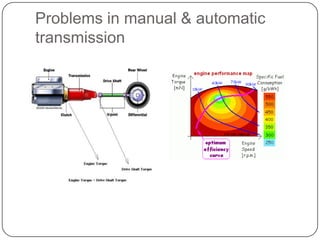
Problems in manual & automatic
transmission
Benefits of CVT
 Provide engine torque in optimum condition (road
loads / drive shaft torque)
 No shift clonk
 Transmission ratio can be adjusted continuously
 Better acceleration
 Improved fuel efficiency
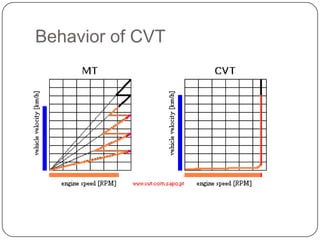
Behavior of CVT
CVT MAIN TYPES
 Pulley based CVT
 Toroidal CVT
 Hydrostatic CVT
Pulley based CVT
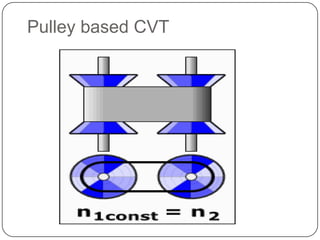
 The gear ratio is changed by moving the two sheaves
of one pulley closer together and the two sheaves of
the other pulley farther apart.
 The distance between the pulleys does not change
 and neither does the length of the belt
 so changing the gear ratio means both pulleys must
be adjusted (one bigger, the other smaller)
simultaneously in order to maintain the proper amount
of tension on the belt.
Pulley based CVT
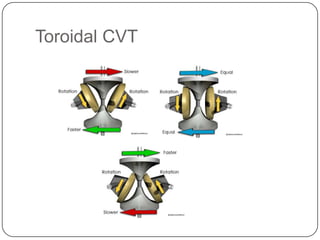
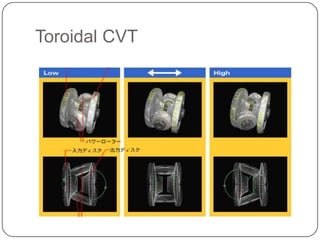
Toroidal CVT
Toroidal CVT
Hydrostatic CVT
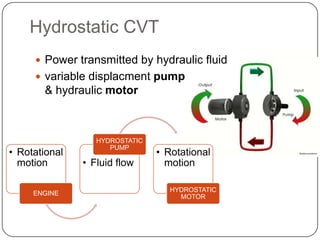
 Power transmitted by hydraulic fluid
 variable displacment pump
& hydraulic motor
• Rotational
motion
ENGINE
• Fluid flow
HYDROSTATIC
PUMP
• Rotational
motion
HYDROSTATIC
MOTOR
Hydrostatic CVT
 often,hydrostatic transmission is combined with a
planetary gearset and clutches to create a hybrid system
known as a hydromechanical transmission.
 Hydromechanical transmissions transfer power from the
engine to the wheels in three different modes
 At a low speed power is transmitted hydraulically
 at a high speed, power is transmitted mechanically
 Between these extremes, the transmission uses both
hydraulic and mechanical means to transfer power.
 Hydromechanical transmissions are ideal for heavy-duty
applications, which is why they are common in agricultural
tractors
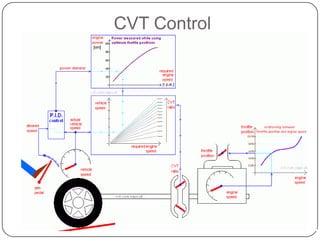
CVT Control
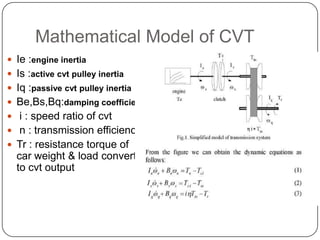
Mathematical Model of CVT
 Ie :engine inertia
 Is :active cvt pulley inertia
 Iq :passive cvt pulley inertia
 Be,Bs,Bq:damping coefficient
 i : speed ratio of cvt
 n : transmission efficiency
 Tr : resistance torque of
car weight & load converted
to cvt output
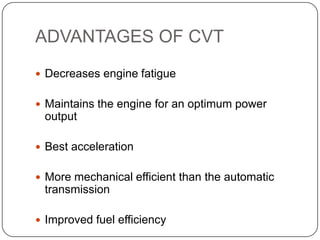
ADVANTAGES OF CVT
 Decreases engine fatigue
 Maintains the engine for an optimum power
output
 Best acceleration
 More mechanical efficient than the automatic
transmission
 Improved fuel efficiency
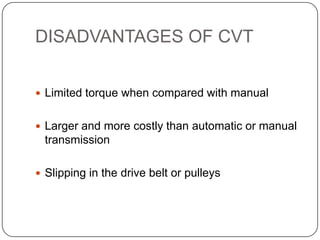
DISADVANTAGES OF CVT
 Limited torque when compared with manual
 Larger and more costly than automatic or manual
transmission
 Slipping in the drive belt or pulleys
REFRENCES
 http://www.synchrotronic.com/
 http://auto.howstuffworks.com/cvt.htm
 http://www.wipo.int/pctdb/en/wo.jsp?IA=WO20070
47352&wo=2007047352&DISPLAY=CLAIMS
 www.wikipedia.com
BY : ZIAD ZOHDY
THANK YOU 

Cvt

  • 1.
  • 2.
    Basics of Transmission •The job of the transmission is to change the speed ratio between the engine and the wheels of an automobile • The transmission uses a range of gears -- from low to high -- to make more effective use of the engine's torque as driving conditions change. The gears can be engaged manually or automatically.
  • 3.
    Problems in manual& automatic transmission
  • 4.
    Benefits of CVT Provide engine torque in optimum condition (road loads / drive shaft torque)  No shift clonk  Transmission ratio can be adjusted continuously  Better acceleration  Improved fuel efficiency
  • 5.
  • 6.
    CVT MAIN TYPES Pulley based CVT  Toroidal CVT  Hydrostatic CVT
  • 7.
    Pulley based CVT The gear ratio is changed by moving the two sheaves of one pulley closer together and the two sheaves of the other pulley farther apart.  The distance between the pulleys does not change  and neither does the length of the belt  so changing the gear ratio means both pulleys must be adjusted (one bigger, the other smaller) simultaneously in order to maintain the proper amount of tension on the belt.
  • 8.
  • 9.
  • 10.
  • 11.
    Hydrostatic CVT  Powertransmitted by hydraulic fluid  variable displacment pump & hydraulic motor • Rotational motion ENGINE • Fluid flow HYDROSTATIC PUMP • Rotational motion HYDROSTATIC MOTOR
  • 12.
    Hydrostatic CVT  often,hydrostatictransmission is combined with a planetary gearset and clutches to create a hybrid system known as a hydromechanical transmission.  Hydromechanical transmissions transfer power from the engine to the wheels in three different modes  At a low speed power is transmitted hydraulically  at a high speed, power is transmitted mechanically  Between these extremes, the transmission uses both hydraulic and mechanical means to transfer power.  Hydromechanical transmissions are ideal for heavy-duty applications, which is why they are common in agricultural tractors
  • 13.
  • 14.
    Mathematical Model ofCVT  Ie :engine inertia  Is :active cvt pulley inertia  Iq :passive cvt pulley inertia  Be,Bs,Bq:damping coefficient  i : speed ratio of cvt  n : transmission efficiency  Tr : resistance torque of car weight & load converted to cvt output
  • 15.
    ADVANTAGES OF CVT Decreases engine fatigue  Maintains the engine for an optimum power output  Best acceleration  More mechanical efficient than the automatic transmission  Improved fuel efficiency
  • 16.
    DISADVANTAGES OF CVT Limited torque when compared with manual  Larger and more costly than automatic or manual transmission  Slipping in the drive belt or pulleys
  • 18.
    REFRENCES  http://www.synchrotronic.com/  http://auto.howstuffworks.com/cvt.htm http://www.wipo.int/pctdb/en/wo.jsp?IA=WO20070 47352&wo=2007047352&DISPLAY=CLAIMS  www.wikipedia.com
  • 19.
    BY : ZIADZOHDY THANK YOU 