AUTOMATIC TRANSMISSION
in automobiles
DEFINITION
An automatic transmission is an
automobile gearbox that can
change gear ratios automatically
as the vehicle moves, freeing the
driver from having to shift gears
manually.
Basic Operation
• Most A/T have 3 or four forward speed
transmission sysytem.
• They also have PARK, NEUTRAL, and
REVERSE.
• Maximum overdrive ratio goes upto 4th or 5th
gear.
• A typical A/T move the vehicle in 1st gear.
Then it shifts to 2nd without assistance from
driver . They happen automatically as vehicle
speed increases & the engine load or throttle
opening decreases.
• To slow and stop the vehicle the
driver only needs to release
accelerator pedal or apply brake.
some examples of AT
systems
Planetary Gearbox
CVT
COMPONENTS
Torque Converter
Gear Sets
Hydraulic System
Torque converter
Torque Converter
 Enhances the torque
 There is a fluid which moves the turbine and
enhances the torque
 Then transmits the motion to gears.
Gears
Gears
 Power and torque combinations are made
according to the need with the help of
hydraulic clutch.
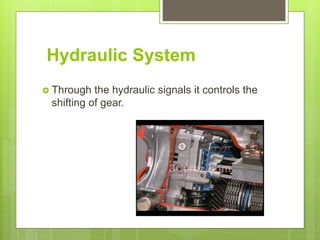
Hydraulic System
 Through the hydraulic signals it controls the
shifting of gear.
 video
Continuously variable transmission
A continuously variable transmission
(CVT) is a transmission which can
change steplessly through an infinite
number of effective gear ratios between
maximum and minimum values.
Continuously variable
transmission
CVTs operate smoothly since there are no gear
changes which cause sudden jerks.
There are 25% fewer moving parts to a CVT
transmission.
They are also cheaper, but still expensive to
repair.
Higher fuel consumption than the manual
transmission version.
CVTs operate smoothly. Which sometimes gives a
perception of low power.
Audi A4 CVT
 video
Comparison of engine
efficiency(Dual-Clutch vs CVT)
CVT diagram
Frequently Asked Ques
WHAT IS THE PURPOSE OF CVTs?
To vary the transmission continuously
HOW DO CVTs IMPROVE EFFICIENCY?
They allow engine to operate always in the
optimum state of R.P.M.
Common Confusion
 Which one is better?
Manual vs. automatic
transmission
 There are many sets of things that
differentiate manual and automatic
transmission.
 Apart from having few basic functionality
differences, these are some differences:
• Repair
• wear-and-tear and
• necessary maintenance
Factors Manual Transmission Automatic Transmission
Initial Cost cost of manual transmission
cars is low
cost of similar automatic
transmission car is higher
Fuel Efficiency higher because of low energy
loss of a clutch plate based
system
lower compared to manual
transmission because of
energy losses in hydraulic
torque convertor are higher
Maintenance Cost lower compared to automatic
transmission because of
lesser complexity of manual
transmission
higher compared to manual
transmission because of
more complexity of automatic
transmission
Sporty Thrill Driver can choose between
fuel efficiency and thrill
No liberty to choose gears
Comfort and
Convenience
less comfortable as the
driver has to change
gears and it is less
convinient in city traffic
very comfortable as the
driver needs not worry
about the clutch
Driving Skill requires more skills. driver
needs to operate clutch. It
takes more time to be
habitual of smoothly
driving a manual
transmission car
It requires lesser skills to
drive an automatic trans.
the driver needs to
operate just the
accelerator, brake and
steering. Thus it takes less
time to be habitual to drive
an automatic transmission
car smoothly compared to
manual transmission car.
Engineers gave an option, now users have
to choose according to the need.
Thank you

Automatic Transmission

  • 1.
  • 2.
    DEFINITION An automatic transmissionis an automobile gearbox that can change gear ratios automatically as the vehicle moves, freeing the driver from having to shift gears manually.
  • 4.
    Basic Operation • MostA/T have 3 or four forward speed transmission sysytem. • They also have PARK, NEUTRAL, and REVERSE. • Maximum overdrive ratio goes upto 4th or 5th gear. • A typical A/T move the vehicle in 1st gear. Then it shifts to 2nd without assistance from driver . They happen automatically as vehicle speed increases & the engine load or throttle opening decreases.
  • 5.
    • To slowand stop the vehicle the driver only needs to release accelerator pedal or apply brake.
  • 6.
    some examples ofAT systems Planetary Gearbox CVT
  • 7.
  • 8.
  • 9.
    Torque Converter  Enhancesthe torque  There is a fluid which moves the turbine and enhances the torque  Then transmits the motion to gears.
  • 10.
  • 11.
    Gears  Power andtorque combinations are made according to the need with the help of hydraulic clutch.
  • 12.
    Hydraulic System  Throughthe hydraulic signals it controls the shifting of gear.
  • 13.
  • 14.
    Continuously variable transmission Acontinuously variable transmission (CVT) is a transmission which can change steplessly through an infinite number of effective gear ratios between maximum and minimum values.
  • 15.
    Continuously variable transmission CVTs operatesmoothly since there are no gear changes which cause sudden jerks. There are 25% fewer moving parts to a CVT transmission. They are also cheaper, but still expensive to repair. Higher fuel consumption than the manual transmission version. CVTs operate smoothly. Which sometimes gives a perception of low power. Audi A4 CVT
  • 16.
  • 18.
  • 19.
  • 20.
    Frequently Asked Ques WHATIS THE PURPOSE OF CVTs? To vary the transmission continuously HOW DO CVTs IMPROVE EFFICIENCY? They allow engine to operate always in the optimum state of R.P.M.
  • 21.
  • 22.
    Manual vs. automatic transmission There are many sets of things that differentiate manual and automatic transmission.  Apart from having few basic functionality differences, these are some differences: • Repair • wear-and-tear and • necessary maintenance
  • 23.
    Factors Manual TransmissionAutomatic Transmission Initial Cost cost of manual transmission cars is low cost of similar automatic transmission car is higher Fuel Efficiency higher because of low energy loss of a clutch plate based system lower compared to manual transmission because of energy losses in hydraulic torque convertor are higher Maintenance Cost lower compared to automatic transmission because of lesser complexity of manual transmission higher compared to manual transmission because of more complexity of automatic transmission Sporty Thrill Driver can choose between fuel efficiency and thrill No liberty to choose gears
  • 24.
    Comfort and Convenience less comfortableas the driver has to change gears and it is less convinient in city traffic very comfortable as the driver needs not worry about the clutch Driving Skill requires more skills. driver needs to operate clutch. It takes more time to be habitual of smoothly driving a manual transmission car It requires lesser skills to drive an automatic trans. the driver needs to operate just the accelerator, brake and steering. Thus it takes less time to be habitual to drive an automatic transmission car smoothly compared to manual transmission car.
  • 25.
    Engineers gave anoption, now users have to choose according to the need. Thank you