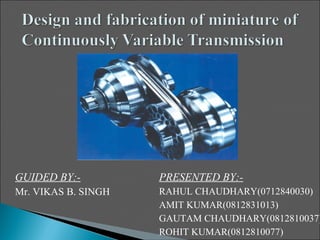
GUIDED BY:-          PRESENTED BY:-
Mr. VIKAS B. SINGH   RAHUL CHAUDHARY(0712840030)
                     AMIT KUMAR(0812831013)
                     GAUTAM CHAUDHARY(0812810037)
                     ROHIT KUMAR(0812810077)
   Produce jerk to vehicle during the change of gears.

   Considerable loss of power in the transmission system.

   Low starting acceleration.

   Considerable driving fatigue.
   This unique transmission does not have several set of gears like
    most transmissions, but rather have an infinite number of gear
    ratios.
   CVT does not strictly require the presence of a clutch, allowing
    the dismissal thereof.
   Seamless acceleration with a “direct” drive feel for enhanced
    driving pleasure.
   With fewer moving parts, CVT is simpler than AT in principle.
   CVT is emerging as a keystone technology that enables other
    innovations.
   Specially design discs (design on CNC machine).
   Motor.
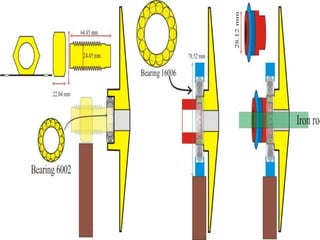
   Bearing (608, 6801 and 6807).
   Sprocket and chain drive.
   Mild Steel rods or shafts.
   Threading nut and bolt.
   Wooden body frame.
   Rubber belt.
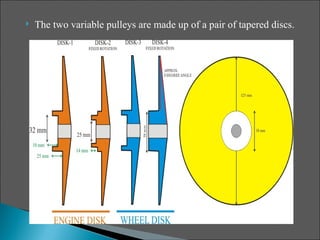
   The two variable pulleys are made up of a pair of tapered discs.
Weight of disc = 8.8 N
Weight of pulley = 8.8*2 = 17.6 N
This weight of pulley acts as a point load on shaft.
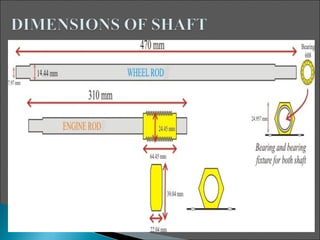
Bending moment due to this point load M = wl/4 = (17.6*0.470)/4
                                         M = 2.07 N m

Power of the motor used = 0.25 HP = 186.5 watt
Speed of the motor = 1400 rpm (approx.)
Torque produced by motor T = (P*60)/(2πN) = (186.5*60)/(2π*1400)
                            T = 1.27 Nm
Equivalent bending moment Me = [M+(M2+T2 )1/2]/2
                             Me = 2.24 Nm
For mild steel,
                Allowable bending stess = 56 Mpa
                Allowable shear stress = 42 Mpa
                      Factor of safety = 6
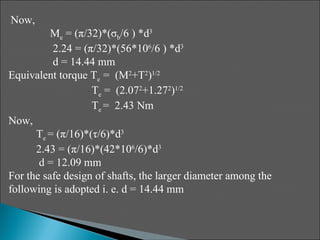
Now,
          Me = (π/32)*(σb/6 ) *d3
          2.24 = (π/32)*(56*106/6 ) *d3
          d = 14.44 mm
Equivalent torque Te = (M2+T2)1/2
                   Te = (2.072+1.272)1/2
                   Te = 2.43 Nm
Now,
      Te = (π/16)*(τ/6)*d3
      2.43 = (π/16)*(42*106/6)*d3
       d = 12.09 mm
For the safe design of shafts, the larger diameter among the
following is adopted i. e. d = 14.44 mm
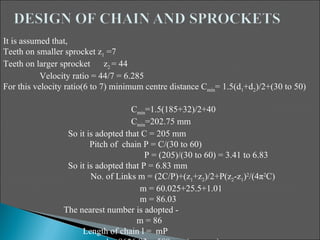
It is assumed that,
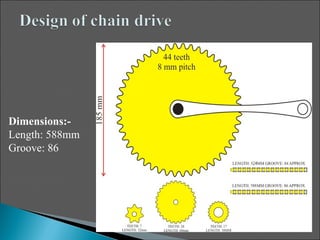
Teeth on smaller sprocket z1 =7
Teeth on larger sprocket      z2 = 44
           Velocity ratio = 44/7 = 6.285
For this velocity ratio(6 to 7) minimum centre distance Cmin= 1.5(d1+d2)/2+(30 to 50)

                                    Cmin=1.5(185+32)/2+40
                                    Cmin=202.75 mm
                 So it is adopted that C = 205 mm
                        Pitch of chain P = C/(30 to 60)
                                        P = (205)/(30 to 60) = 3.41 to 6.83
                 So it is adopted that P = 6.83 mm
                        No. of Links m = (2C/P)+(z1+z2)/2+P(z2-z1)2/(4π2C)
                                      m = 60.025+25.5+1.01
                                      m = 86.03
                The nearest number is adopted -
                                     m = 86
                     Length of chain l = mP
Dimensions:-
Length: 588mm
Groove: 86
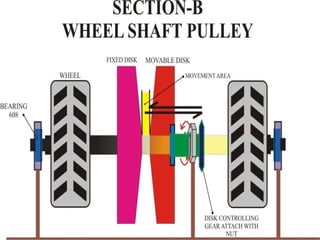
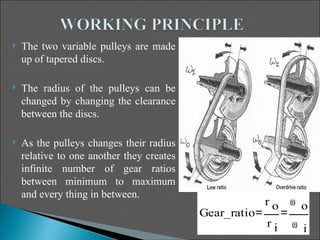
   The two variable pulleys are made
    up of tapered discs.

   The radius of the pulleys can be
    changed by changing the clearance
    between the discs.

   As the pulleys changes their radius
    relative to one another they creates
    infinite number of gear ratios
    between minimum to maximum
    and every thing in between.
                                                        ro   ω o
                                           Gear_ratio
                                                        ri   ω i
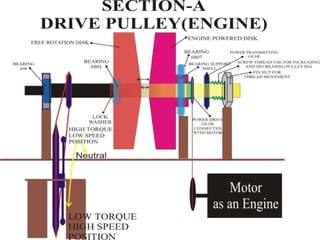
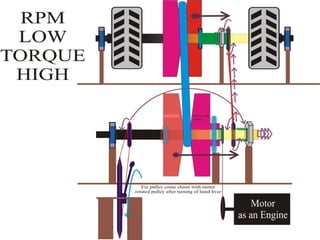
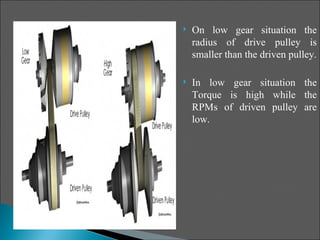
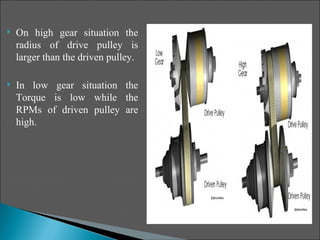
   On low gear situation the
    radius of drive pulley is
    smaller than the driven pulley.

   In low gear situation the
    Torque is high while the
    RPMs of driven pulley are
    low.
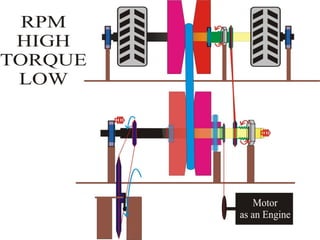
   On high gear situation the
    radius of drive pulley is
    larger than the driven pulley.

   In low gear situation the
    Torque is low while the
    RPMs of driven pulley are
    high.
videoplayback_14.FLV
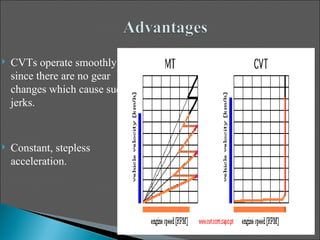
   CVTs operate smoothly
    since there are no gear
    changes which cause sudden
    jerks.


   Constant, stepless
    acceleration.
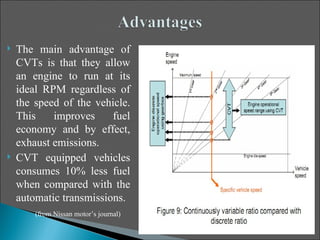
   The main advantage of
    CVTs is that they allow
    an engine to run at its
    ideal RPM regardless of
    the speed of the vehicle.
    This    improves     fuel
    economy and by effect,
    exhaust emissions.
   CVT equipped vehicles
    consumes 10% less fuel
    when compared with the
    automatic transmissions.
        (from Nissan motor’s journal)
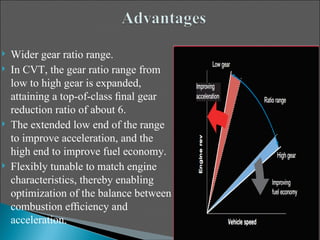
   Wider gear ratio range.
   In CVT, the gear ratio range from
    low to high gear is expanded,
    attaining a top-of-class final gear
    reduction ratio of about 6.
   The extended low end of the range
    to improve acceleration, and the
    high end to improve fuel economy.
   Flexibly tunable to match engine
    characteristics, thereby enabling
    optimization of the balance between
    combustion efficiency and
    acceleration.
   There are 25% fewer moving parts to a CVT
    transmission.

   Less power loss in a CVT than a typical automatic
    transmission.

   Responds better to changing conditions, such as
    changes in throttle and speed.
   Many small tractors for home and garden use simple rubber
    belt CVTs.

   All snowmobiles, old and new, and motor scooters use
    CVTs.

   Some combine harvesters have CVTs.

   CVTs have been used in aircraft electrical power
    generating systems and in Formula race cars.

   Some drill presses and milling machines contain a pulley-
    based CVT.
   Much of the existing literature is quick to admit that the
    automotive industry lacks a broad knowledge base
    regarding CVTs. Whereas conventional transmissions have
    been continuously refined and improved since the very start
    of the 20th century, CVT development is only just
    beginning. As infrastructure is built up along with said
    knowledge base, CVTs will become ever-more prominent in
    the automotive landscape. Even today’s CVTs, which
    represent first-generation designs at best, outperform
    conventional transmissions.        Automakers who fail to
    develop CVTs now, while the field is still in its infancy, risk
    being left behind as CVT development and implementation
    continues its exponential growth. Moreover, CVTs are do
    not fall exclusively in the realm of IC engines.
   CVT is the most superior technology for power
    transmission
   And it would be the widely acceptable technology
    throughout the world.
Continuously variable-transmission-cvt

Continuously variable-transmission-cvt

  • 1.
    GUIDED BY:- PRESENTED BY:- Mr. VIKAS B. SINGH RAHUL CHAUDHARY(0712840030) AMIT KUMAR(0812831013) GAUTAM CHAUDHARY(0812810037) ROHIT KUMAR(0812810077)
  • 2.
    Produce jerk to vehicle during the change of gears.  Considerable loss of power in the transmission system.  Low starting acceleration.  Considerable driving fatigue.
  • 3.
    This unique transmission does not have several set of gears like most transmissions, but rather have an infinite number of gear ratios.  CVT does not strictly require the presence of a clutch, allowing the dismissal thereof.  Seamless acceleration with a “direct” drive feel for enhanced driving pleasure.  With fewer moving parts, CVT is simpler than AT in principle.  CVT is emerging as a keystone technology that enables other innovations.
  • 4.
    Specially design discs (design on CNC machine).  Motor.  Bearing (608, 6801 and 6807).  Sprocket and chain drive.  Mild Steel rods or shafts.  Threading nut and bolt.  Wooden body frame.  Rubber belt.
  • 5.
    The two variable pulleys are made up of a pair of tapered discs.
  • 6.
    Weight of disc= 8.8 N Weight of pulley = 8.8*2 = 17.6 N This weight of pulley acts as a point load on shaft. Bending moment due to this point load M = wl/4 = (17.6*0.470)/4 M = 2.07 N m Power of the motor used = 0.25 HP = 186.5 watt Speed of the motor = 1400 rpm (approx.) Torque produced by motor T = (P*60)/(2πN) = (186.5*60)/(2π*1400) T = 1.27 Nm Equivalent bending moment Me = [M+(M2+T2 )1/2]/2 Me = 2.24 Nm For mild steel, Allowable bending stess = 56 Mpa Allowable shear stress = 42 Mpa Factor of safety = 6
  • 7.
    Now, Me = (π/32)*(σb/6 ) *d3 2.24 = (π/32)*(56*106/6 ) *d3 d = 14.44 mm Equivalent torque Te = (M2+T2)1/2 Te = (2.072+1.272)1/2 Te = 2.43 Nm Now, Te = (π/16)*(τ/6)*d3 2.43 = (π/16)*(42*106/6)*d3 d = 12.09 mm For the safe design of shafts, the larger diameter among the following is adopted i. e. d = 14.44 mm
  • 9.
    It is assumedthat, Teeth on smaller sprocket z1 =7 Teeth on larger sprocket z2 = 44 Velocity ratio = 44/7 = 6.285 For this velocity ratio(6 to 7) minimum centre distance Cmin= 1.5(d1+d2)/2+(30 to 50) Cmin=1.5(185+32)/2+40 Cmin=202.75 mm So it is adopted that C = 205 mm Pitch of chain P = C/(30 to 60) P = (205)/(30 to 60) = 3.41 to 6.83 So it is adopted that P = 6.83 mm No. of Links m = (2C/P)+(z1+z2)/2+P(z2-z1)2/(4π2C) m = 60.025+25.5+1.01 m = 86.03 The nearest number is adopted - m = 86 Length of chain l = mP
  • 10.
  • 14.
    The two variable pulleys are made up of tapered discs.  The radius of the pulleys can be changed by changing the clearance between the discs.  As the pulleys changes their radius relative to one another they creates infinite number of gear ratios between minimum to maximum and every thing in between. ro ω o Gear_ratio ri ω i
  • 16.
    On low gear situation the radius of drive pulley is smaller than the driven pulley.  In low gear situation the Torque is high while the RPMs of driven pulley are low.
  • 18.
    On high gear situation the radius of drive pulley is larger than the driven pulley.  In low gear situation the Torque is low while the RPMs of driven pulley are high.
  • 19.
  • 20.
    CVTs operate smoothly since there are no gear changes which cause sudden jerks.  Constant, stepless acceleration.
  • 21.
    The main advantage of CVTs is that they allow an engine to run at its ideal RPM regardless of the speed of the vehicle. This improves fuel economy and by effect, exhaust emissions.  CVT equipped vehicles consumes 10% less fuel when compared with the automatic transmissions. (from Nissan motor’s journal)
  • 22.
    Wider gear ratio range.  In CVT, the gear ratio range from low to high gear is expanded, attaining a top-of-class final gear reduction ratio of about 6.  The extended low end of the range to improve acceleration, and the high end to improve fuel economy.  Flexibly tunable to match engine characteristics, thereby enabling optimization of the balance between combustion efficiency and acceleration.
  • 23.
    There are 25% fewer moving parts to a CVT transmission.  Less power loss in a CVT than a typical automatic transmission.  Responds better to changing conditions, such as changes in throttle and speed.
  • 24.
    Many small tractors for home and garden use simple rubber belt CVTs.  All snowmobiles, old and new, and motor scooters use CVTs.  Some combine harvesters have CVTs.  CVTs have been used in aircraft electrical power generating systems and in Formula race cars.  Some drill presses and milling machines contain a pulley- based CVT.
  • 25.
    Much of the existing literature is quick to admit that the automotive industry lacks a broad knowledge base regarding CVTs. Whereas conventional transmissions have been continuously refined and improved since the very start of the 20th century, CVT development is only just beginning. As infrastructure is built up along with said knowledge base, CVTs will become ever-more prominent in the automotive landscape. Even today’s CVTs, which represent first-generation designs at best, outperform conventional transmissions. Automakers who fail to develop CVTs now, while the field is still in its infancy, risk being left behind as CVT development and implementation continues its exponential growth. Moreover, CVTs are do not fall exclusively in the realm of IC engines.
  • 26.
    CVT is the most superior technology for power transmission  And it would be the widely acceptable technology throughout the world.