CONTINUOUSLY VARIABLE
TRANSMISSION
(CVT)
CONTENTS
• INTRODUCTION
• HISTORY
• TYPES OF CVT
• ADVANTAGES
• CVT VS AT
• DISADVANTAGES
• APPLICATION
• CONCLUSION
• REFERENCE
INTRODUCTION
 CVT is an advanced technology of automatic transmission.
 Unlike traditional automatic transmissions, continuously variable
transmissions don't have a gearbox with a set number of gears.
 CVT also known as single-speed transmission, gearless
transmission, one-speed automatic, variable pulley transmission.
 Varies the transmission ratio continuously.
 Shifts automatically with an infinite number of ratios.
HISTORY
• Leonardo da Vinci sketches is the basis for the first
continuously variable transmission in 1490.
• First patent for the CVT Transmission was made by Daimler &
Benz in 1886.
• The first workable belt driven CVT was designed and built by
the Dutchman Huub van Doorne in 1958.
• In Early 1990's Nissan introduced CVT in their Nissan March
TYPES OF CVT
1. Pulley based CVT
2. Cone CVT
3. Toroidal CVT
4. Hydraulic CVT
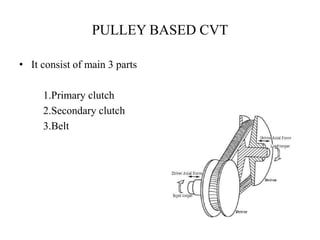
PULLEY BASED CVT
• It consist of main 3 parts
1.Primary clutch
2.Secondary clutch
3.Belt
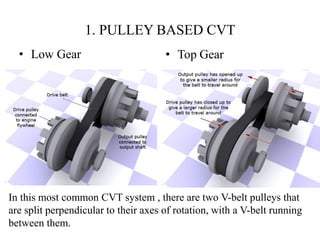
1. PULLEY BASED CVT
• Low Gear • Top Gear
In this most common CVT system , there are two V-belt pulleys that
are split perpendicular to their axes of rotation, with a V-belt running
between them.
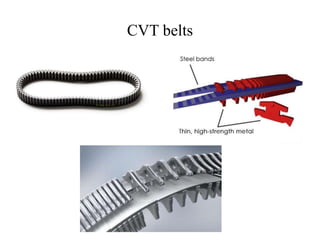
CVT belts
• https://www.youtube.com/watch?v=dp8lHBD
Fhpo
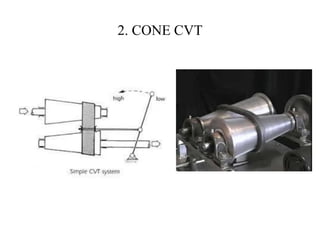
2. CONE CVT
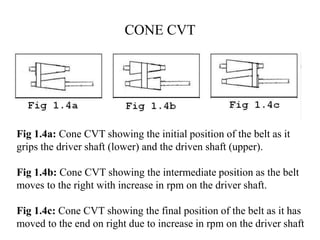
CONE CVT
Fig 1.4a: Cone CVT showing the initial position of the belt as it
grips the driver shaft (lower) and the driven shaft (upper).
Fig 1.4b: Cone CVT showing the intermediate position as the belt
moves to the right with increase in rpm on the driver shaft.
Fig 1.4c: Cone CVT showing the final position of the belt as it has
moved to the end on right due to increase in rpm on the driver shaft
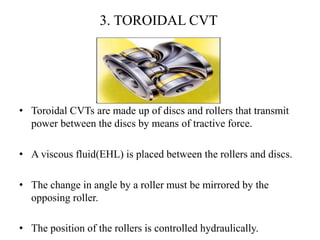
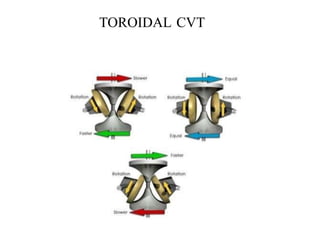
3. TOROIDAL CVT
• Toroidal CVTs are made up of discs and rollers that transmit
power between the discs by means of tractive force.
• A viscous fluid(EHL) is placed between the rollers and discs.
• The change in angle by a roller must be mirrored by the
opposing roller.
• The position of the rollers is controlled hydraulically.
TOROIDAL CVT
4. HYDRAULIC CVT
• It consist of variable-displacement pumps and hydraulic motor.
• In this type of transmission, the rotational motion of the engine
operates a variable-displacement pumps on the driving side.
• The pump converts rotational motion into fluid flow.
• A hydraulic motor located on the driven side, the fluid flow is
converted back into rotational motion.
HYDROSTATIC CVT
ADVANTAGES
• Allow for an infinite number of gear ratios.
• Eliminates "shift shock" -- makes it smoother ride
• Responds better to changing conditions.
• Better fuel economy & power loss than automatic transmission
ADVANTAGES
• The main advantage of CVTs is that they allow an engine to
run at its ideal RPM regardless of the speed of the vehicle.
• There are fewer moving parts to a CVT transmission.
DISADVANTAGES
• Limited torque capacity as compared to the manual
transmission system
• More costlier than manual transmission
• Slipping in the drive belt or pulleys.
• Additional gear train required for reverse condition.
APPLICATIONS
• Commonly used in automobiles
• New continuous variable transmission for medium duty trucks
and buses.
• Starts development on wind turbine cvt
CONCLUSION
• The applications and benefits of continuously variable
transmissions can only increase based on today’s research and
development.
• With an increase in the number of companies opting for CVTs
there will be a consequent decrease in the cost of the vehicle as
well as the transmission.
REFERENCE
• Nilabh Srivastava, Imtiaz Haque, “A review on belt and chain continuously
variable transmissions (CVT): Dynamics and control” ,Mechanism and
Machine Theory, Volume 44, Issue 1, January 2009, Pages 19-41.
• Mr. Jadhav S. S Prof. Hanamapure N. S, “ Toroidal Drive System for
Vehicle Transmission Control”, IJSRD - International Journal for Scientific
Research & Development| Vol. 2, Issue 09, 2014 | ISSN (online): 2321-0613.
• Da Wen Ge, Sugeng Ariyono and Daw Thet Thet Mon, “ A REVIEW ON
CONTINUOUSLY VARIABLE TRANSMISSIONS CONTROL”, National
Conference in Mechanical Engineering Research and Postgraduate Students
(1st NCMER 2010) 26-27 MAY 2010
THANK YOU…

CONTINUOUSLY VARIABLE TRANSMISSION - CVT

  • 1.
  • 2.
    CONTENTS • INTRODUCTION • HISTORY •TYPES OF CVT • ADVANTAGES • CVT VS AT • DISADVANTAGES • APPLICATION • CONCLUSION • REFERENCE
  • 3.
    INTRODUCTION  CVT isan advanced technology of automatic transmission.  Unlike traditional automatic transmissions, continuously variable transmissions don't have a gearbox with a set number of gears.  CVT also known as single-speed transmission, gearless transmission, one-speed automatic, variable pulley transmission.  Varies the transmission ratio continuously.  Shifts automatically with an infinite number of ratios.
  • 4.
    HISTORY • Leonardo daVinci sketches is the basis for the first continuously variable transmission in 1490. • First patent for the CVT Transmission was made by Daimler & Benz in 1886. • The first workable belt driven CVT was designed and built by the Dutchman Huub van Doorne in 1958. • In Early 1990's Nissan introduced CVT in their Nissan March
  • 5.
    TYPES OF CVT 1.Pulley based CVT 2. Cone CVT 3. Toroidal CVT 4. Hydraulic CVT
  • 6.
    PULLEY BASED CVT •It consist of main 3 parts 1.Primary clutch 2.Secondary clutch 3.Belt
  • 7.
    1. PULLEY BASEDCVT • Low Gear • Top Gear In this most common CVT system , there are two V-belt pulleys that are split perpendicular to their axes of rotation, with a V-belt running between them.
  • 8.
  • 9.
  • 10.
  • 11.
    CONE CVT Fig 1.4a:Cone CVT showing the initial position of the belt as it grips the driver shaft (lower) and the driven shaft (upper). Fig 1.4b: Cone CVT showing the intermediate position as the belt moves to the right with increase in rpm on the driver shaft. Fig 1.4c: Cone CVT showing the final position of the belt as it has moved to the end on right due to increase in rpm on the driver shaft
  • 12.
    3. TOROIDAL CVT •Toroidal CVTs are made up of discs and rollers that transmit power between the discs by means of tractive force. • A viscous fluid(EHL) is placed between the rollers and discs. • The change in angle by a roller must be mirrored by the opposing roller. • The position of the rollers is controlled hydraulically.
  • 13.
  • 14.
    4. HYDRAULIC CVT •It consist of variable-displacement pumps and hydraulic motor. • In this type of transmission, the rotational motion of the engine operates a variable-displacement pumps on the driving side. • The pump converts rotational motion into fluid flow. • A hydraulic motor located on the driven side, the fluid flow is converted back into rotational motion.
  • 15.
  • 16.
    ADVANTAGES • Allow foran infinite number of gear ratios. • Eliminates "shift shock" -- makes it smoother ride • Responds better to changing conditions. • Better fuel economy & power loss than automatic transmission
  • 17.
    ADVANTAGES • The mainadvantage of CVTs is that they allow an engine to run at its ideal RPM regardless of the speed of the vehicle. • There are fewer moving parts to a CVT transmission.
  • 18.
    DISADVANTAGES • Limited torquecapacity as compared to the manual transmission system • More costlier than manual transmission • Slipping in the drive belt or pulleys. • Additional gear train required for reverse condition.
  • 19.
    APPLICATIONS • Commonly usedin automobiles • New continuous variable transmission for medium duty trucks and buses. • Starts development on wind turbine cvt
  • 20.
    CONCLUSION • The applicationsand benefits of continuously variable transmissions can only increase based on today’s research and development. • With an increase in the number of companies opting for CVTs there will be a consequent decrease in the cost of the vehicle as well as the transmission.
  • 21.
    REFERENCE • Nilabh Srivastava,Imtiaz Haque, “A review on belt and chain continuously variable transmissions (CVT): Dynamics and control” ,Mechanism and Machine Theory, Volume 44, Issue 1, January 2009, Pages 19-41. • Mr. Jadhav S. S Prof. Hanamapure N. S, “ Toroidal Drive System for Vehicle Transmission Control”, IJSRD - International Journal for Scientific Research & Development| Vol. 2, Issue 09, 2014 | ISSN (online): 2321-0613. • Da Wen Ge, Sugeng Ariyono and Daw Thet Thet Mon, “ A REVIEW ON CONTINUOUSLY VARIABLE TRANSMISSIONS CONTROL”, National Conference in Mechanical Engineering Research and Postgraduate Students (1st NCMER 2010) 26-27 MAY 2010
  • 22.