A Presentation on
Continuously
Variable
Transmission
Submitted By:
Pranav Puneet
Mechanical Engineering
NIT, BBSR
Nalanda Institute of Technology, BBSR
1
2
Contents:
1) Basics of Transmission.
2) Introduction of CVT.
3) History.
4) Types of CVT
a) Variable Diameter Pulley (VDP) CVT.
b) Toroidal CVT.
c) Hydrostatic CVT.
5) Behavior of CVT.
6) Possible Markets & competitions of CVT.
7) Automobiles equipped with CVT.
8) Advantages of CVT.
9) Drawbacks of CVT.
10) Conclusion.
11) References.
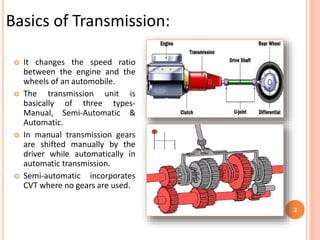
 It changes the speed ratio
between the engine and the
wheels of an automobile.
 The transmission unit is
basically of three types-
Manual, Semi-Automatic &
Automatic.
 In manual transmission gears
are shifted manually by the
driver while automatically in
automatic transmission.
 Semi-automatic incorporates
CVT where no gears are used.
Basics of Transmission:
3
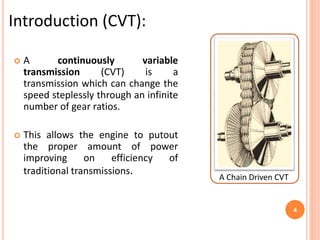
A Chain Driven CVT
 A continuously variable
transmission (CVT) is a
transmission which can change the
speed steplessly through an infinite
number of gear ratios.
 This allows the engine to putout
the proper amount of power
improving on efficiency of
traditional transmissions.
4
Introduction (CVT):
A Timeline of CVT Innovation:
o 1490 - Da Vinci sketches a stepless continuously variable transmission.
o 1886 - First Toroidal CVT patent filed.
o 1958 - Daf (of The Netherlands) produces a CVT in a car.
o 1989 - Subaru Justy GL is the first U.S.-sold production automobile to offer a
CVT.
o 2004 - Ford begins offering a CVT.
History:
5
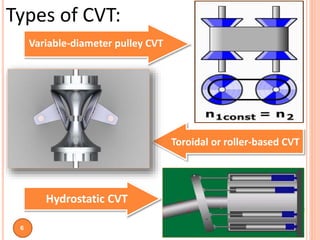
Types of CVT:
Variable-diameter pulley CVT
Toroidal or roller-based CVT
Hydrostatic CVT
6
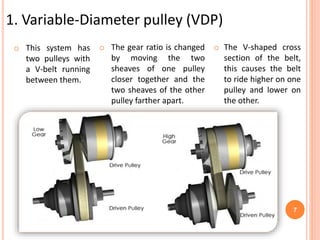
1. Variable-Diameter pulley (VDP)
7
o This system has
two pulleys with
a V-belt running
between them.
o The gear ratio is changed
by moving the two
sheaves of one pulley
closer together and the
two sheaves of the other
pulley farther apart.
o The V-shaped cross
section of the belt,
this causes the belt
to ride higher on one
pulley and lower on
the other.
VDP Metal Belts & Chains:
Metal belts were introduced by Van
Doorne’s Transmission in 1987
Metal chains used in VDP
8
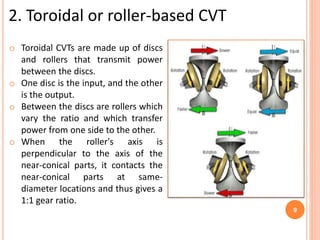
2. Toroidal or roller-based CVT
o Toroidal CVTs are made up of discs
and rollers that transmit power
between the discs.
o One disc is the input, and the other
is the output.
o Between the discs are rollers which
vary the ratio and which transfer
power from one side to the other.
o When the roller's axis is
perpendicular to the axis of the
near-conical parts, it contacts the
near-conical parts at same-
diameter locations and thus gives a
1:1 gear ratio.
9
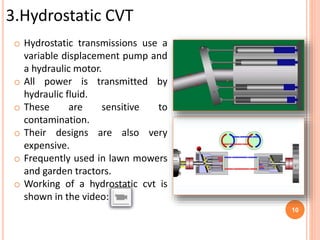
3.Hydrostatic CVT
o Hydrostatic transmissions use a
variable displacement pump and
a hydraulic motor.
o All power is transmitted by
hydraulic fluid.
o These are sensitive to
contamination.
o Their designs are also very
expensive.
o Frequently used in lawn mowers
and garden tractors.
o Working of a hydrostatic cvt is
shown in the video:
10
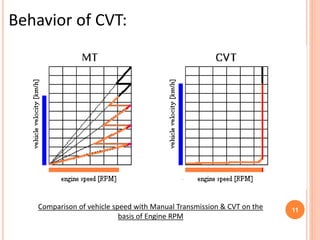
Behavior of CVT:
Comparison of vehicle speed with Manual Transmission & CVT on the
basis of Engine RPM
11
o Automobile
Possible Markets of CVT:
 Can be used in cars, scooters & especially in off-road
vehicles.
 Claims of a 20% gain in fuel economy compared to past
transmission technology.
o Heavy Industry
Applications
 Fully adaptable drive system for industrial Land
Vehicles.
 Adjustments and maintenance made easier through
smaller parts and computer monitoring technology.
o Wind Energy
technology
 Allows for a Possible 3.5 speed increase, allowing
for a increase in efficiency.
 Prevents over speeding of fan blades.
 Using CVT technology can reduce the cost of a
wind turbine.
12
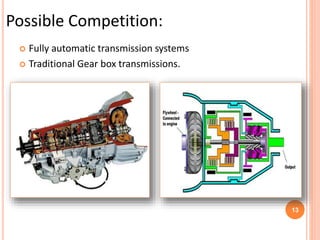
 Fully automatic transmission systems
 Traditional Gear box transmissions.
Possible Competition:
13
14
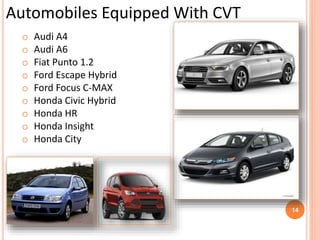
o Audi A4
o Audi A6
o Fiat Punto 1.2
o Ford Escape Hybrid
o Ford Focus C-MAX
o Honda Civic Hybrid
o Honda HR
o Honda Insight
o Honda City
Automobiles Equipped With CVT
 CVTs can compensate for changing vehicle speeds, allowing the engine
speed to remain at its level of peak power and efficiency.
 CVT improves fuel economy and reduce exhaust emissions.
 Provide engine torque in optimum condition (road loads / drive shaft
torque).
 No clutch & gear shift.
 Better acceleration.
Advantages:
15
 Becomes Jerky in automobile applications at slow speeds.
 Intricate parts with high material cost.
 Higher cost.
 Transmitting motion by friction causes greater wear.
CVT Drawbacks:
16
CVT can be the future of transmission system.
This technology is still experimental, although some
companies have proven that CVT are practically beneficial.
With proper funding for research it is possible to create a
CVT to satisfy each of the three categories listed.
Conclusion:
17
References:
18
o http://auto.howstuffworks.com/cvt.htm
o https://www.lib.ucdavis.edu/dept/pse/resources/CVT04/
o https//www.audi.com/multitronic, 2001
o https://en.m.wikipedia.org/wiki/Continuously_variable_transmission
o http://www.torotrak.com/pdfs/tech_papers/2007/CTI_Michigan_2007.pdf
o http://www.youtube.com/watch?v=MhFK5gfAGpM
o http://www.youtube.com/watch?v=pyYNvwKPAKA
19
Thank You!

Cvt

  • 1.
    A Presentation on Continuously Variable Transmission SubmittedBy: Pranav Puneet Mechanical Engineering NIT, BBSR Nalanda Institute of Technology, BBSR 1
  • 2.
    2 Contents: 1) Basics ofTransmission. 2) Introduction of CVT. 3) History. 4) Types of CVT a) Variable Diameter Pulley (VDP) CVT. b) Toroidal CVT. c) Hydrostatic CVT. 5) Behavior of CVT. 6) Possible Markets & competitions of CVT. 7) Automobiles equipped with CVT. 8) Advantages of CVT. 9) Drawbacks of CVT. 10) Conclusion. 11) References.
  • 3.
     It changesthe speed ratio between the engine and the wheels of an automobile.  The transmission unit is basically of three types- Manual, Semi-Automatic & Automatic.  In manual transmission gears are shifted manually by the driver while automatically in automatic transmission.  Semi-automatic incorporates CVT where no gears are used. Basics of Transmission: 3
  • 4.
    A Chain DrivenCVT  A continuously variable transmission (CVT) is a transmission which can change the speed steplessly through an infinite number of gear ratios.  This allows the engine to putout the proper amount of power improving on efficiency of traditional transmissions. 4 Introduction (CVT):
  • 5.
    A Timeline ofCVT Innovation: o 1490 - Da Vinci sketches a stepless continuously variable transmission. o 1886 - First Toroidal CVT patent filed. o 1958 - Daf (of The Netherlands) produces a CVT in a car. o 1989 - Subaru Justy GL is the first U.S.-sold production automobile to offer a CVT. o 2004 - Ford begins offering a CVT. History: 5
  • 6.
    Types of CVT: Variable-diameterpulley CVT Toroidal or roller-based CVT Hydrostatic CVT 6
  • 7.
    1. Variable-Diameter pulley(VDP) 7 o This system has two pulleys with a V-belt running between them. o The gear ratio is changed by moving the two sheaves of one pulley closer together and the two sheaves of the other pulley farther apart. o The V-shaped cross section of the belt, this causes the belt to ride higher on one pulley and lower on the other.
  • 8.
    VDP Metal Belts& Chains: Metal belts were introduced by Van Doorne’s Transmission in 1987 Metal chains used in VDP 8
  • 9.
    2. Toroidal orroller-based CVT o Toroidal CVTs are made up of discs and rollers that transmit power between the discs. o One disc is the input, and the other is the output. o Between the discs are rollers which vary the ratio and which transfer power from one side to the other. o When the roller's axis is perpendicular to the axis of the near-conical parts, it contacts the near-conical parts at same- diameter locations and thus gives a 1:1 gear ratio. 9
  • 10.
    3.Hydrostatic CVT o Hydrostatictransmissions use a variable displacement pump and a hydraulic motor. o All power is transmitted by hydraulic fluid. o These are sensitive to contamination. o Their designs are also very expensive. o Frequently used in lawn mowers and garden tractors. o Working of a hydrostatic cvt is shown in the video: 10
  • 11.
    Behavior of CVT: Comparisonof vehicle speed with Manual Transmission & CVT on the basis of Engine RPM 11
  • 12.
    o Automobile Possible Marketsof CVT:  Can be used in cars, scooters & especially in off-road vehicles.  Claims of a 20% gain in fuel economy compared to past transmission technology. o Heavy Industry Applications  Fully adaptable drive system for industrial Land Vehicles.  Adjustments and maintenance made easier through smaller parts and computer monitoring technology. o Wind Energy technology  Allows for a Possible 3.5 speed increase, allowing for a increase in efficiency.  Prevents over speeding of fan blades.  Using CVT technology can reduce the cost of a wind turbine. 12
  • 13.
     Fully automatictransmission systems  Traditional Gear box transmissions. Possible Competition: 13
  • 14.
    14 o Audi A4 oAudi A6 o Fiat Punto 1.2 o Ford Escape Hybrid o Ford Focus C-MAX o Honda Civic Hybrid o Honda HR o Honda Insight o Honda City Automobiles Equipped With CVT
  • 15.
     CVTs cancompensate for changing vehicle speeds, allowing the engine speed to remain at its level of peak power and efficiency.  CVT improves fuel economy and reduce exhaust emissions.  Provide engine torque in optimum condition (road loads / drive shaft torque).  No clutch & gear shift.  Better acceleration. Advantages: 15
  • 16.
     Becomes Jerkyin automobile applications at slow speeds.  Intricate parts with high material cost.  Higher cost.  Transmitting motion by friction causes greater wear. CVT Drawbacks: 16
  • 17.
    CVT can bethe future of transmission system. This technology is still experimental, although some companies have proven that CVT are practically beneficial. With proper funding for research it is possible to create a CVT to satisfy each of the three categories listed. Conclusion: 17
  • 18.
    References: 18 o http://auto.howstuffworks.com/cvt.htm o https://www.lib.ucdavis.edu/dept/pse/resources/CVT04/ ohttps//www.audi.com/multitronic, 2001 o https://en.m.wikipedia.org/wiki/Continuously_variable_transmission o http://www.torotrak.com/pdfs/tech_papers/2007/CTI_Michigan_2007.pdf o http://www.youtube.com/watch?v=MhFK5gfAGpM o http://www.youtube.com/watch?v=pyYNvwKPAKA
  • 19.