A
Seminar Report
On
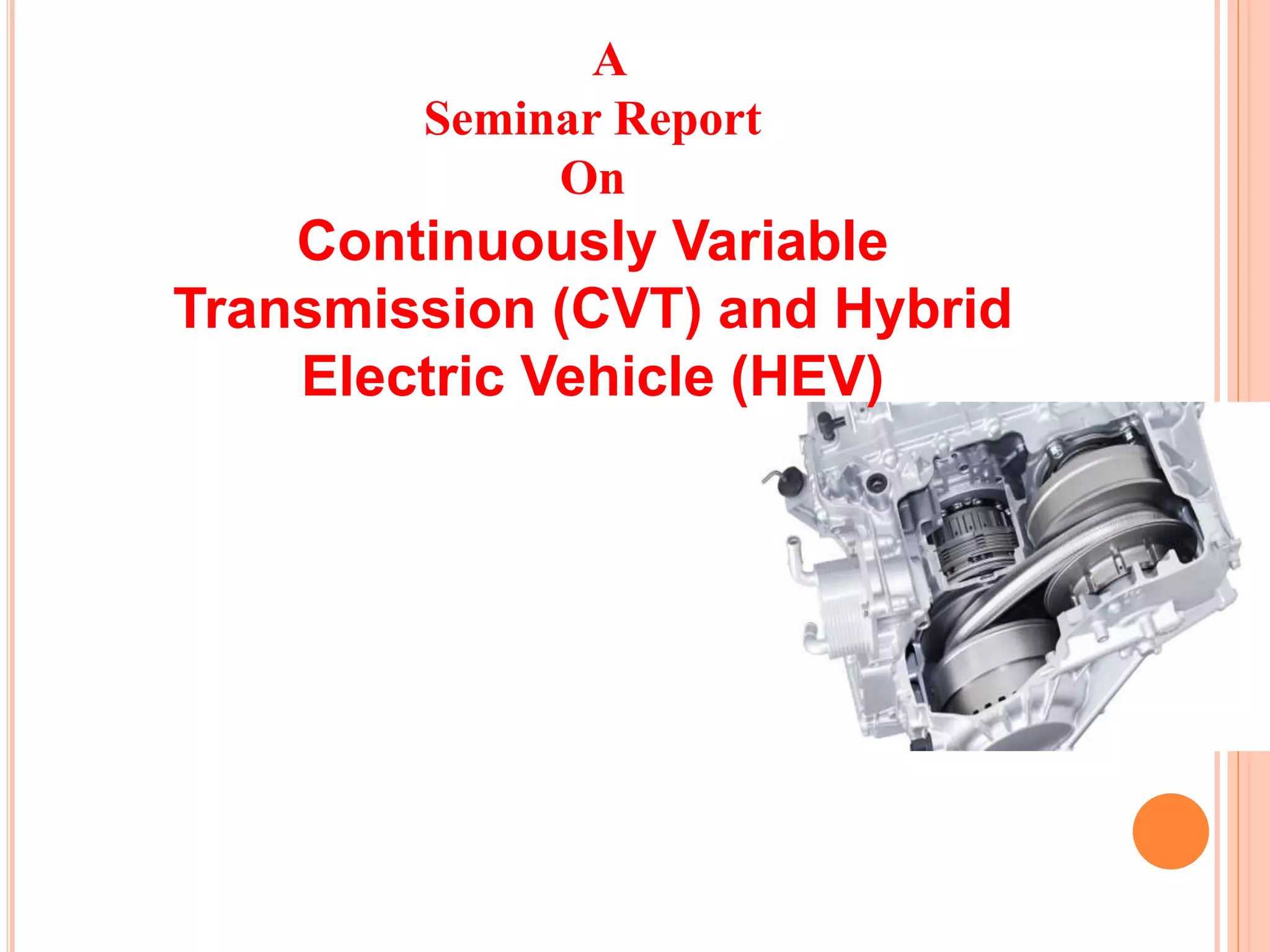
Continuously Variable
Transmission (CVT) and Hybrid
Electric Vehicle (HEV)
CONTENT
1.Introduction
2.Literature review
3.CVT theory and Design
4.Component of CVT
4.1 Primary clutch
4.2 Secondary clutch
4.3 Belt
4.3.1 Push belt
4.3.2 Toroidal traction drives
4.3.3 Variable diameter Elastomer belt
5.Working of CVT
5.1 How do sheaves move?
6.Research and Development
7.Future prospects for CVT
8.Case Study of Hybrid vehicle Transmission
8.1 Components of Hybrid Vehicle
8.1.1 Series Hybrid
8.1.2 Parallel Hybrid
9.Other application
10.Advantages
11.Limitations
12.Conclusion
13.References
INTRODUCTION
 After more than a century of research and
development, engineers continue to explore the
outer limits of IC efficiency and performance.
 Many IC vehicles meet Low Emissions Vehicle
standards.
 With limited room for improvement, automobile
manufacturers have begun full-scale
development of alternative power vehicles.
 One potential solution is the continuously
variable transmission (CVT).
 A CVT, also known as single-speed
transmission, gearless transmission, one-speed
automatic, variable pulley transmission, or in
case of motorcycles, a twist-and-go.
 A transmission that can change seamlessly
through an infinite number of effective gear
ratios between maximum and minimum values.
LITERATURE REVIEW
 Leonardo da Vinci-1490-introduced a steeples continuously variable transmission.
 Milton Reeves-invented-variable speed transmission-saw milling-1879-applied to his
first car-1896.
 In 1910-Zenith Motorcycles-V-twin engine motorcycle-named Gradua-Gear.
 In 1912-British motorcycle manufacturer Rudge-Whitworth -Rudge Multigear. The
Multi was a much improved version of Zenith’s Gradua-Gear.
 In 1926-George Constantinesco-Constantinesco car-smooth & efficient-invented in
1923.
 Toyota-used Power Split Transmission(PST)-in 1997.
 Audi since 2000 has offered a chain-type CVT as an option on some of its larger-
engine models.
 Fiat in 2000 has offered a Cone-type CVT as an option on its hit model Fiat Punto.
 In 2008 Mitsubishi Lancer model was available with CVT.
 Suzuki has used CVT since 2010 on their SX4 and Kizashi models.
 In 2016, FCA US LLC announced-2017 Chrysler Pacifica Hybrid minivan- uses a
CVT.
CVT THEORY
 Today’s automobiles almost exclusively use either a conventional manual or
automatic transmission with “multiple planetary gear sets that use integral
clutches and bands to achieve discrete gear ratios” .
 The continuously variable transmission replaces discrete gear ratios with
infinitely adjustable gear ratio.
COMPONENTS OF CVT
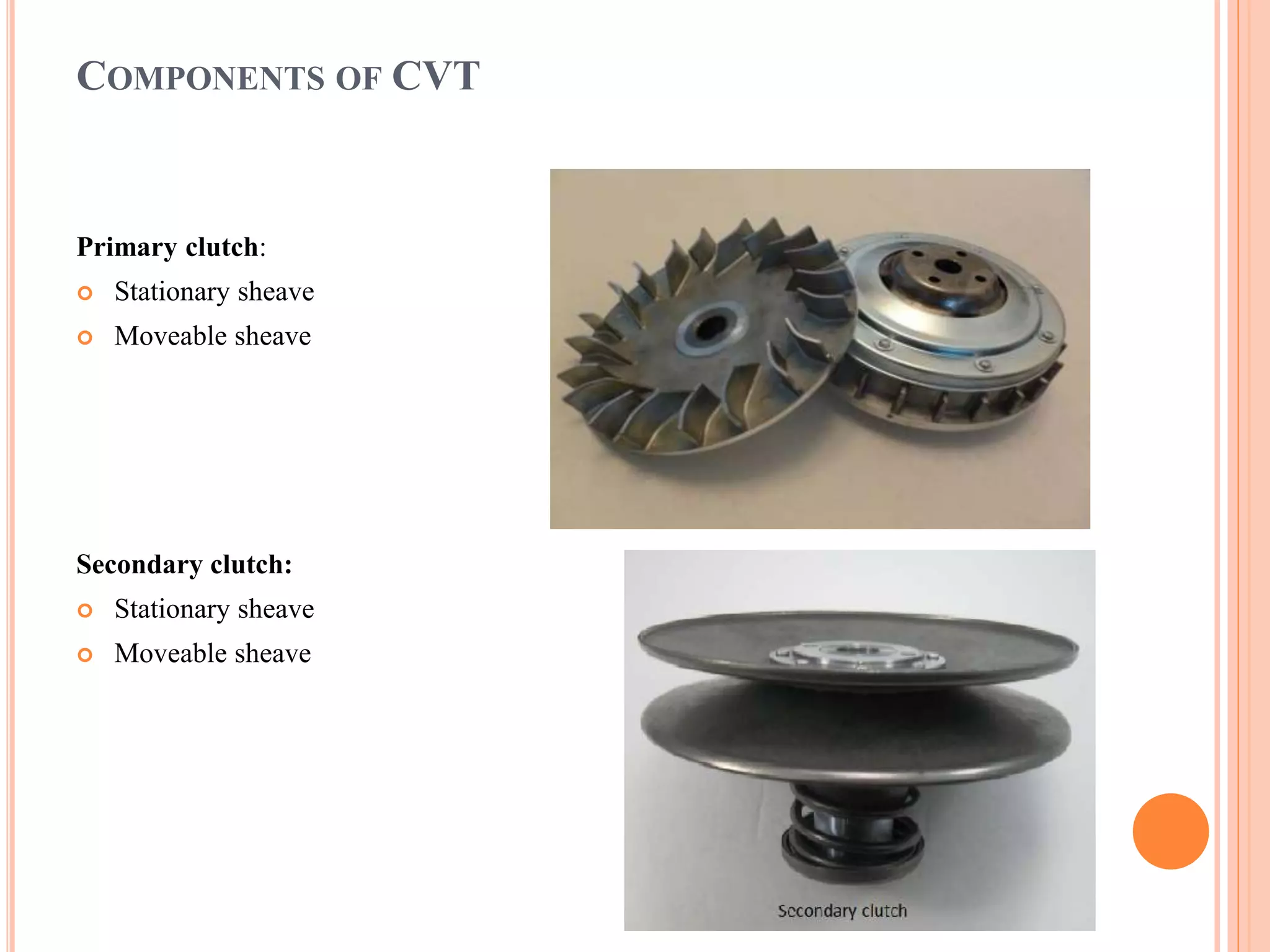
Primary clutch:
 Stationary sheave
 Moveable sheave
Secondary clutch:
 Stationary sheave
 Moveable sheave
Belt:
Push Belt:
o This most common type of CVT uses segmented steel blocks stacked on a steel
ribbon.
o These v-blocks are held together by two endless steel bands.
o It is also called as Metal Belt.
Toroidal Traction-Drive:
 These transmissions use the high shear strength of viscous fluids to transmit torque
between an input torus and an output torus.
 As the movable torus slides linearly, the angle of a roller changes relative to shaft
position.
Variable Diameter Elastomer Belt:
 This type of CVT, uses a flat, flexible belt mounted on movable supports.
 These supports can change radius and thus gear ratio.
 However, the supports separate at high gear ratios to form a discontinuous gear path.
 This can lead to the problems with creep and slip that have plagued CVTs for years.
WORKING OF CVT:
 A CVT is an automatic transmission that varies ratio depending on vehicle speed, engine rpm and
load.
 CVT -three principle
components: Primary clutch, Secondary
clutch and a Belt.
 Primary clutch - two sheave: Movable
sheave-Stationary sheave.
 Secondary clutch also have two sheave like
primary clutch.
 Stationary sheave is connected to engine
crankshaft and movable sheave to move in
and out to engage the belt.
 This belt transmits power from input
shaft to output shaft.
 By axial movement of sheaves the overall gear ratio can be adjusted continuously.
 When the pulley sheaves are far apart it acts like a small gear , when the sheaves are close
together it acts like a large gear.
 Since the length of the belt must be always same, both the sheave of the input and output must be
adjusted simultaneously.
 As the belts are made in conical shape the movement of belt is possible.
HOW DO THE SHEAVES MOVE?
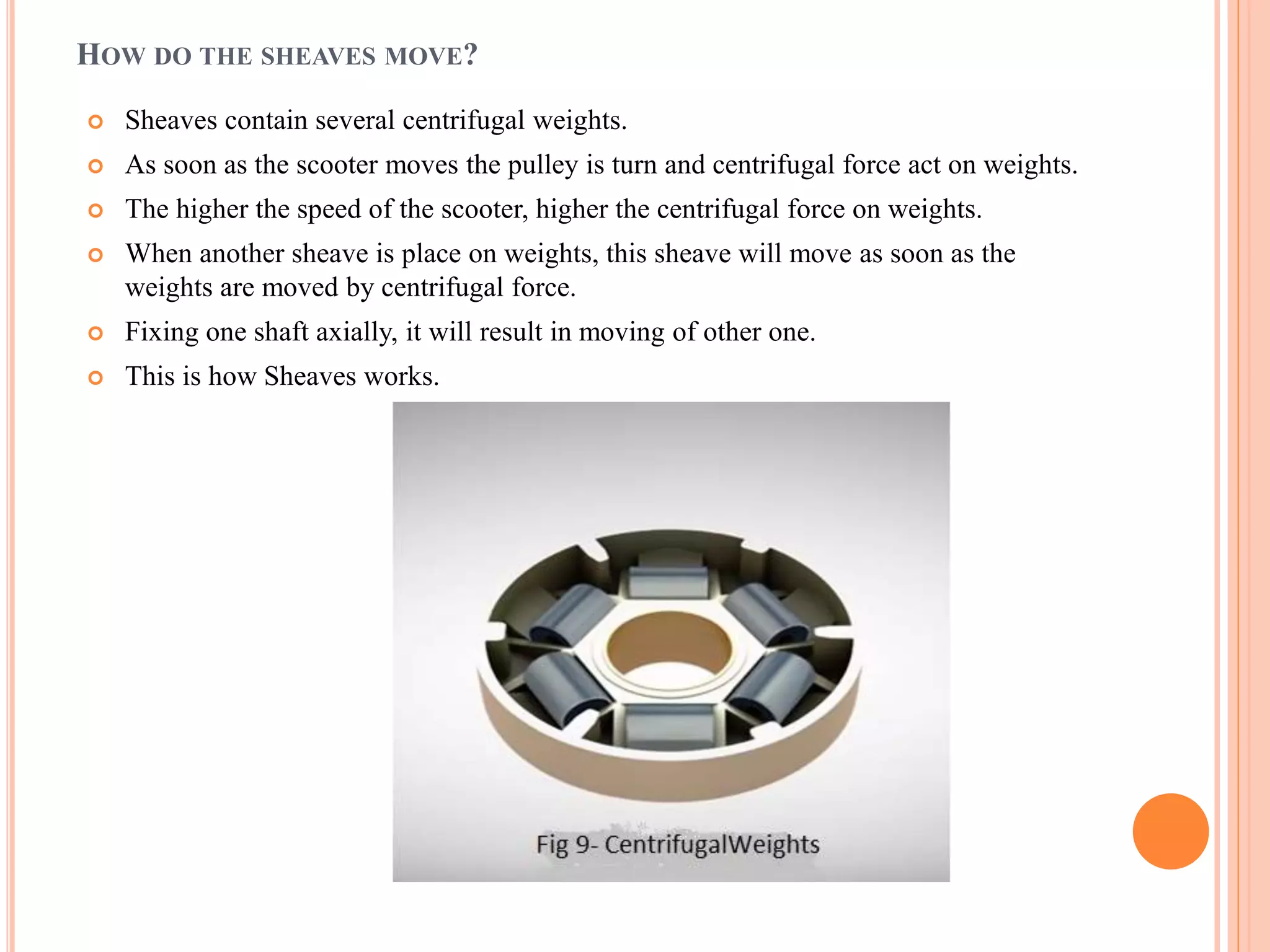
 Sheaves contain several centrifugal weights.
 As soon as the scooter moves the pulley is turn and centrifugal force act on weights.
 The higher the speed of the scooter, higher the centrifugal force on weights.
 When another sheave is place on weights, this sheave will move as soon as the
weights are moved by centrifugal force.
 Fixing one shaft axially, it will result in moving of other one.
 This is how Sheaves works.
RESEARCH & DEVELOPMENT
 While IC development has slowed in recent years as automobile manufacturers
devote more resources to hybrid electric vehicles (HEVs) and fuel cell vehicles
(FEVs), CVT ect. research and development is expanding quickly.
 Even U.S. automakers, who have lagged in CVT research until recently, are unveiling
new designs.
 Audi’s new CVT offers both better fuel mileage than a conventional automatic and
better acceleration than even a manual transmission.
 Many small cars have used CVTs in recent years, and many more will use them in the
near future.
 Nissan, Honda, and Subaru use belt-drive CVTs developed with Dutch company Van
Doorne Transmissie (VDT) in some of their smaller cars.
FUTURE PROSPECTS FOR CVTS
 Much of the existing literature is quick to admit that the automotive industry lacks a
broad knowledge base regarding CVTs.
 Whereas conventional transmissions have been continuously refined and improved
since the very start of the 20th century.
 CVT development is only just beginning.
 As infrastructure is built up along with said knowledge base, CVTs will become ever-
more prominent in the automotive landscape.
CASE STUDY OF HYBRID ELECTRIC VEHICLES
 A hybrid vehicle uses two or more distinct types of power, such as internal combustion engine
+ electric motor.
 In 1975 Augustus Kinzel (US Patent 3'884'317) developed hybrid vehicles.
 Today efforts are been made in particular to low CO2 emission that has increased in past
years.
 More over because of the low intensity of lithium ion batteries; pure electric vehicles are not
alternative to the traditional vehicles with combustion engines.
 Components for Hybrid Vehicle
1. Rechargeable battery: Store & provide energy-Usually lithium ion or secondary cells.
2. An electric motor and generator:Drive wheel with electric & convert mech to electric.
3. Series Hybrid:The combustion engine does not have a direct connection to the drive axial.
The combustion engine drives the generator. It is also known as Range Extender.
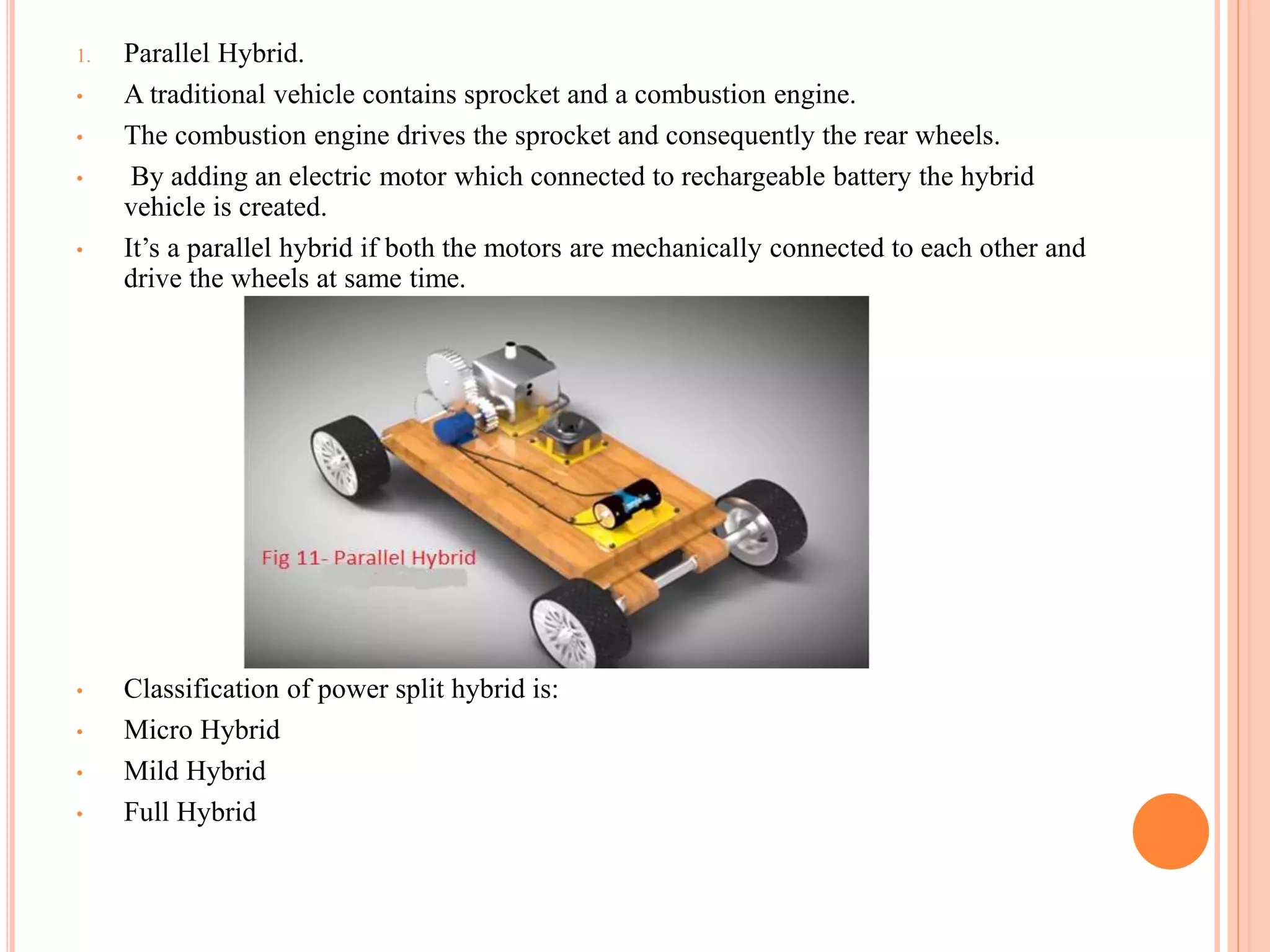
1. Parallel Hybrid.
• A traditional vehicle contains sprocket and a combustion engine.
• The combustion engine drives the sprocket and consequently the rear wheels.
• By adding an electric motor which connected to rechargeable battery the hybrid
vehicle is created.
• It’s a parallel hybrid if both the motors are mechanically connected to each other and
drive the wheels at same time.
• Classification of power split hybrid is:
• Micro Hybrid
• Mild Hybrid
• Full Hybrid
OTHER APPLICATIONS
 Tractors
 Golf Carts
 Lawn Mowers
 Motorized Wheelchairs
 Bicycles
 Power tools and household appliances
 Industrial Equipment and production machinery
 Mini machines
ADVANTAGES
 Better fuel consumption.
 Improved acceleration due to the lower power loss.
 Step less transmission.
 Provides a smoother ride than automatic transmission.
 Adapts to road conditions and power demands to allows for a better ride.
 Better emission control and less greenhouse gas emissions because of
improved control of the engine’s speed range.
Limitations:
 Higher cost.
 Belt-driven CVTs (VDP system) have a limited amount of torque.
 Transmitting motion by friction causes greater wear.
 Requires special oil and other materials.
CONCLUSION
I studied-
 Today, only a handful of cars worldwide make use of CVTs, but the
applications and benefits of continuously variable transmissions can only
increase based on today’s research and development.
 As automakers continue to develop CVTs, more and more vehicle lines will
begin to use them.
 As development continues, fuel efficiency and performance benefits will
increase.
 This will lead to increased sales of CVT-equipped vehicles. Increased sales
will prompt further development and implementation.
 Moreover, increasing development will foster competition among
manufacturers.
 Automakers from Japan, Europe, and U.S. are already either using or
developing CVTs, which will in turn lower manufacturing costs.
 The CVT has just begun to blossom.
REFERENCES
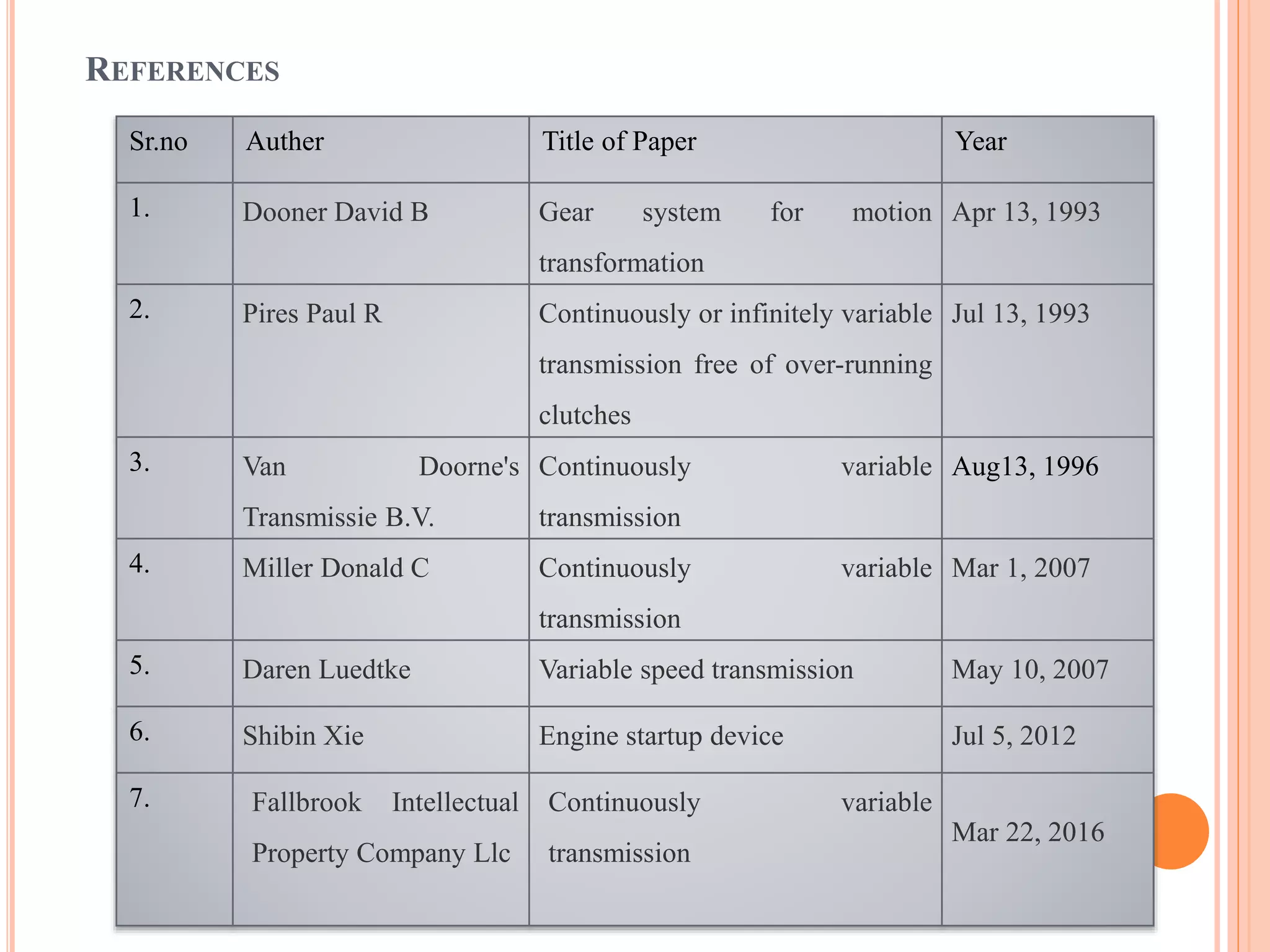
Sr.no Auther Title of Paper Year
1. Dooner David B Gear system for motion
transformation
Apr 13, 1993
2. Pires Paul R Continuously or infinitely variable
transmission free of over-running
clutches
Jul 13, 1993
3. Van Doorne's
Transmissie B.V.
Continuously variable
transmission
Aug13, 1996
4. Miller Donald C Continuously variable
transmission
Mar 1, 2007
5. Daren Luedtke Variable speed transmission May 10, 2007
6. Shibin Xie Engine startup device Jul 5, 2012
7. Fallbrook Intellectual
Property Company Llc
Continuously variable
transmission
Mar 22, 2016
THANK YOU

New cvt ppt

  • 1.
    A Seminar Report On Continuously Variable Transmission(CVT) and Hybrid Electric Vehicle (HEV)
  • 2.
    CONTENT 1.Introduction 2.Literature review 3.CVT theoryand Design 4.Component of CVT 4.1 Primary clutch 4.2 Secondary clutch 4.3 Belt 4.3.1 Push belt 4.3.2 Toroidal traction drives 4.3.3 Variable diameter Elastomer belt 5.Working of CVT 5.1 How do sheaves move? 6.Research and Development 7.Future prospects for CVT 8.Case Study of Hybrid vehicle Transmission 8.1 Components of Hybrid Vehicle 8.1.1 Series Hybrid 8.1.2 Parallel Hybrid 9.Other application 10.Advantages 11.Limitations 12.Conclusion 13.References
  • 3.
    INTRODUCTION  After morethan a century of research and development, engineers continue to explore the outer limits of IC efficiency and performance.  Many IC vehicles meet Low Emissions Vehicle standards.  With limited room for improvement, automobile manufacturers have begun full-scale development of alternative power vehicles.  One potential solution is the continuously variable transmission (CVT).  A CVT, also known as single-speed transmission, gearless transmission, one-speed automatic, variable pulley transmission, or in case of motorcycles, a twist-and-go.  A transmission that can change seamlessly through an infinite number of effective gear ratios between maximum and minimum values.
  • 4.
    LITERATURE REVIEW  Leonardoda Vinci-1490-introduced a steeples continuously variable transmission.  Milton Reeves-invented-variable speed transmission-saw milling-1879-applied to his first car-1896.  In 1910-Zenith Motorcycles-V-twin engine motorcycle-named Gradua-Gear.  In 1912-British motorcycle manufacturer Rudge-Whitworth -Rudge Multigear. The Multi was a much improved version of Zenith’s Gradua-Gear.  In 1926-George Constantinesco-Constantinesco car-smooth & efficient-invented in 1923.  Toyota-used Power Split Transmission(PST)-in 1997.  Audi since 2000 has offered a chain-type CVT as an option on some of its larger- engine models.  Fiat in 2000 has offered a Cone-type CVT as an option on its hit model Fiat Punto.  In 2008 Mitsubishi Lancer model was available with CVT.  Suzuki has used CVT since 2010 on their SX4 and Kizashi models.  In 2016, FCA US LLC announced-2017 Chrysler Pacifica Hybrid minivan- uses a CVT.
  • 5.
    CVT THEORY  Today’sautomobiles almost exclusively use either a conventional manual or automatic transmission with “multiple planetary gear sets that use integral clutches and bands to achieve discrete gear ratios” .  The continuously variable transmission replaces discrete gear ratios with infinitely adjustable gear ratio.
  • 6.
    COMPONENTS OF CVT Primaryclutch:  Stationary sheave  Moveable sheave Secondary clutch:  Stationary sheave  Moveable sheave
  • 7.
    Belt: Push Belt: o Thismost common type of CVT uses segmented steel blocks stacked on a steel ribbon. o These v-blocks are held together by two endless steel bands. o It is also called as Metal Belt. Toroidal Traction-Drive:  These transmissions use the high shear strength of viscous fluids to transmit torque between an input torus and an output torus.  As the movable torus slides linearly, the angle of a roller changes relative to shaft position. Variable Diameter Elastomer Belt:  This type of CVT, uses a flat, flexible belt mounted on movable supports.  These supports can change radius and thus gear ratio.  However, the supports separate at high gear ratios to form a discontinuous gear path.  This can lead to the problems with creep and slip that have plagued CVTs for years.
  • 8.
    WORKING OF CVT: A CVT is an automatic transmission that varies ratio depending on vehicle speed, engine rpm and load.  CVT -three principle components: Primary clutch, Secondary clutch and a Belt.  Primary clutch - two sheave: Movable sheave-Stationary sheave.  Secondary clutch also have two sheave like primary clutch.  Stationary sheave is connected to engine crankshaft and movable sheave to move in and out to engage the belt.  This belt transmits power from input shaft to output shaft.  By axial movement of sheaves the overall gear ratio can be adjusted continuously.  When the pulley sheaves are far apart it acts like a small gear , when the sheaves are close together it acts like a large gear.  Since the length of the belt must be always same, both the sheave of the input and output must be adjusted simultaneously.  As the belts are made in conical shape the movement of belt is possible.
  • 9.
    HOW DO THESHEAVES MOVE?  Sheaves contain several centrifugal weights.  As soon as the scooter moves the pulley is turn and centrifugal force act on weights.  The higher the speed of the scooter, higher the centrifugal force on weights.  When another sheave is place on weights, this sheave will move as soon as the weights are moved by centrifugal force.  Fixing one shaft axially, it will result in moving of other one.  This is how Sheaves works.
  • 10.
    RESEARCH & DEVELOPMENT While IC development has slowed in recent years as automobile manufacturers devote more resources to hybrid electric vehicles (HEVs) and fuel cell vehicles (FEVs), CVT ect. research and development is expanding quickly.  Even U.S. automakers, who have lagged in CVT research until recently, are unveiling new designs.  Audi’s new CVT offers both better fuel mileage than a conventional automatic and better acceleration than even a manual transmission.  Many small cars have used CVTs in recent years, and many more will use them in the near future.  Nissan, Honda, and Subaru use belt-drive CVTs developed with Dutch company Van Doorne Transmissie (VDT) in some of their smaller cars.
  • 11.
    FUTURE PROSPECTS FORCVTS  Much of the existing literature is quick to admit that the automotive industry lacks a broad knowledge base regarding CVTs.  Whereas conventional transmissions have been continuously refined and improved since the very start of the 20th century.  CVT development is only just beginning.  As infrastructure is built up along with said knowledge base, CVTs will become ever- more prominent in the automotive landscape.
  • 12.
    CASE STUDY OFHYBRID ELECTRIC VEHICLES  A hybrid vehicle uses two or more distinct types of power, such as internal combustion engine + electric motor.  In 1975 Augustus Kinzel (US Patent 3'884'317) developed hybrid vehicles.  Today efforts are been made in particular to low CO2 emission that has increased in past years.  More over because of the low intensity of lithium ion batteries; pure electric vehicles are not alternative to the traditional vehicles with combustion engines.  Components for Hybrid Vehicle 1. Rechargeable battery: Store & provide energy-Usually lithium ion or secondary cells. 2. An electric motor and generator:Drive wheel with electric & convert mech to electric. 3. Series Hybrid:The combustion engine does not have a direct connection to the drive axial. The combustion engine drives the generator. It is also known as Range Extender.
  • 13.
    1. Parallel Hybrid. •A traditional vehicle contains sprocket and a combustion engine. • The combustion engine drives the sprocket and consequently the rear wheels. • By adding an electric motor which connected to rechargeable battery the hybrid vehicle is created. • It’s a parallel hybrid if both the motors are mechanically connected to each other and drive the wheels at same time. • Classification of power split hybrid is: • Micro Hybrid • Mild Hybrid • Full Hybrid
  • 14.
    OTHER APPLICATIONS  Tractors Golf Carts  Lawn Mowers  Motorized Wheelchairs  Bicycles  Power tools and household appliances  Industrial Equipment and production machinery  Mini machines
  • 15.
    ADVANTAGES  Better fuelconsumption.  Improved acceleration due to the lower power loss.  Step less transmission.  Provides a smoother ride than automatic transmission.  Adapts to road conditions and power demands to allows for a better ride.  Better emission control and less greenhouse gas emissions because of improved control of the engine’s speed range. Limitations:  Higher cost.  Belt-driven CVTs (VDP system) have a limited amount of torque.  Transmitting motion by friction causes greater wear.  Requires special oil and other materials.
  • 16.
    CONCLUSION I studied-  Today,only a handful of cars worldwide make use of CVTs, but the applications and benefits of continuously variable transmissions can only increase based on today’s research and development.  As automakers continue to develop CVTs, more and more vehicle lines will begin to use them.  As development continues, fuel efficiency and performance benefits will increase.  This will lead to increased sales of CVT-equipped vehicles. Increased sales will prompt further development and implementation.  Moreover, increasing development will foster competition among manufacturers.  Automakers from Japan, Europe, and U.S. are already either using or developing CVTs, which will in turn lower manufacturing costs.  The CVT has just begun to blossom.
  • 17.
    REFERENCES Sr.no Auther Titleof Paper Year 1. Dooner David B Gear system for motion transformation Apr 13, 1993 2. Pires Paul R Continuously or infinitely variable transmission free of over-running clutches Jul 13, 1993 3. Van Doorne's Transmissie B.V. Continuously variable transmission Aug13, 1996 4. Miller Donald C Continuously variable transmission Mar 1, 2007 5. Daren Luedtke Variable speed transmission May 10, 2007 6. Shibin Xie Engine startup device Jul 5, 2012 7. Fallbrook Intellectual Property Company Llc Continuously variable transmission Mar 22, 2016
  • 18.

Editor's Notes