Continuously Variable
Transmission
By- Rishabh Nishad
ME-IIIrd Year
Sec-B
1502931123
Under Guidance Of
Mr. Sumeet Dubey
Asst. Professor
ME Department
Index:-
1. Transmission and it’s type’s.
2. History of CVT.
3. CVT-Construction and Working.
4. Advantages and Disadvantages.
5. Types Of CVT.
6. Applications.
7. Market Share of different Transmission’s
8. Refrences.
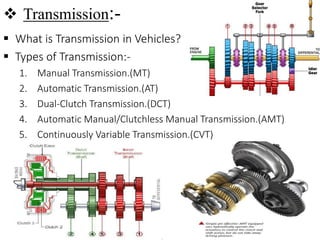
 Transmission:-
 What is Transmission in Vehicles?
 Types of Transmission:-
1. Manual Transmission.(MT)
2. Automatic Transmission.(AT)
3. Dual-Clutch Transmission.(DCT)
4. Automatic Manual/Clutchless Manual Transmission.(AMT)
5. Continuously Variable Transmission.(CVT)
 History Of CVT:-
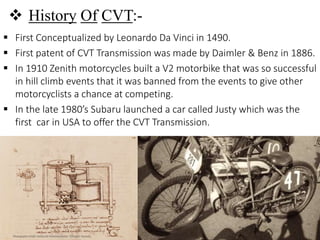
 First Conceptualized by Leonardo Da Vinci in 1490.
 First patent of CVT Transmission was made by Daimler & Benz in 1886.
 In 1910 Zenith motorcycles built a V2 motorbike that was so successful
in hill climb events that it was banned from the events to give other
motorcyclists a chance at competing.
 In the late 1980’s Subaru launched a car called Justy which was the
first car in USA to offer the CVT Transmission.
 CVT:-
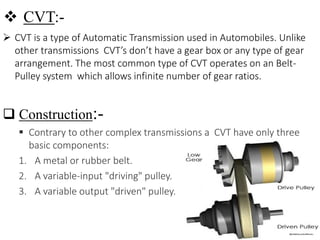
 CVT is a type of Automatic Transmission used in Automobiles. Unlike
other transmissions CVT’s don’t have a gear box or any type of gear
arrangement. The most common type of CVT operates on an Belt-
Pulley system which allows infinite number of gear ratios.
 Construction:-
 Contrary to other complex transmissions a CVT have only three
basic components:
1. A metal or rubber belt.
2. A variable-input "driving" pulley.
3. A variable output "driven" pulley.
 Working:-
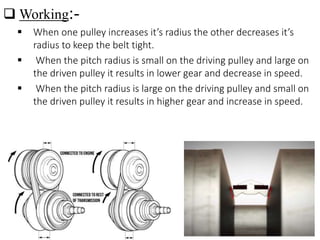
 When one pulley increases it’s radius the other decreases it’s
radius to keep the belt tight.
 When the pitch radius is small on the driving pulley and large on
the driven pulley it results in lower gear and decrease in speed.
 When the pitch radius is large on the driving pulley and small on
the driven pulley it results in higher gear and increase in speed.
 Advantages:-
I. Engine holds one revolution range, typically the one that delivers
the most efficiency, most power, or most torque and only gear
ratio changes.
II. The result is a smoother, more fuel efficient and quicker drive
than an normal automatic.
 Disadvantages:-
I. Energy losses due to friction are greater with a CVT.
II. Experience of car driving Is not so good because of set revolution
range of engine.
III. Traditional, belt-drive CVTs can handle limited amount of torque.
CVTs are often found in small cars and SUVs like Audi A4, Nissan’s
new Pathfinder etc.
 Types Of CVT’s:-
I. Toroidal CVTs:- It replaces the belts and pulleys with discs and
power rollers.
II. Hydrostatic CVTs:-It’s non-frictional. The pump and motors are
used to converts fluid flow into rotational motion and vice-versa.
 Advancements:-
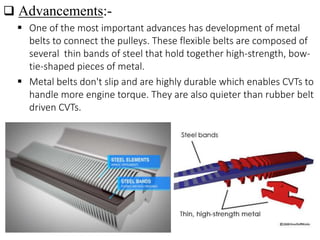
 One of the most important advances has development of metal
belts to connect the pulleys. These flexible belts are composed of
several thin bands of steel that hold together high-strength, bow-
tie-shaped pieces of metal.
 Metal belts don't slip and are highly durable which enables CVTs to
handle more engine torque. They are also quieter than rubber belt
driven CVTs.
 Market Scenario :-
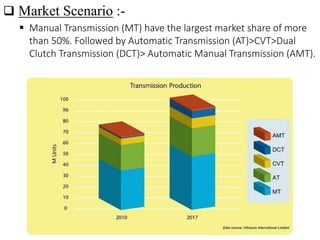
 Manual Transmission (MT) have the largest market share of more
than 50%. Followed by Automatic Transmission (AT)>CVT>Dual
Clutch Transmission (DCT)> Automatic Manual Transmission (AMT).
THANK YOU

Continuously variable transmission

  • 1.
    Continuously Variable Transmission By- RishabhNishad ME-IIIrd Year Sec-B 1502931123 Under Guidance Of Mr. Sumeet Dubey Asst. Professor ME Department
  • 2.
    Index:- 1. Transmission andit’s type’s. 2. History of CVT. 3. CVT-Construction and Working. 4. Advantages and Disadvantages. 5. Types Of CVT. 6. Applications. 7. Market Share of different Transmission’s 8. Refrences.
  • 3.
     Transmission:-  Whatis Transmission in Vehicles?  Types of Transmission:- 1. Manual Transmission.(MT) 2. Automatic Transmission.(AT) 3. Dual-Clutch Transmission.(DCT) 4. Automatic Manual/Clutchless Manual Transmission.(AMT) 5. Continuously Variable Transmission.(CVT)
  • 4.
     History OfCVT:-  First Conceptualized by Leonardo Da Vinci in 1490.  First patent of CVT Transmission was made by Daimler & Benz in 1886.  In 1910 Zenith motorcycles built a V2 motorbike that was so successful in hill climb events that it was banned from the events to give other motorcyclists a chance at competing.  In the late 1980’s Subaru launched a car called Justy which was the first car in USA to offer the CVT Transmission.
  • 5.
     CVT:-  CVTis a type of Automatic Transmission used in Automobiles. Unlike other transmissions CVT’s don’t have a gear box or any type of gear arrangement. The most common type of CVT operates on an Belt- Pulley system which allows infinite number of gear ratios.  Construction:-  Contrary to other complex transmissions a CVT have only three basic components: 1. A metal or rubber belt. 2. A variable-input "driving" pulley. 3. A variable output "driven" pulley.
  • 6.
     Working:-  Whenone pulley increases it’s radius the other decreases it’s radius to keep the belt tight.  When the pitch radius is small on the driving pulley and large on the driven pulley it results in lower gear and decrease in speed.  When the pitch radius is large on the driving pulley and small on the driven pulley it results in higher gear and increase in speed.
  • 7.
     Advantages:- I. Engineholds one revolution range, typically the one that delivers the most efficiency, most power, or most torque and only gear ratio changes. II. The result is a smoother, more fuel efficient and quicker drive than an normal automatic.  Disadvantages:- I. Energy losses due to friction are greater with a CVT. II. Experience of car driving Is not so good because of set revolution range of engine. III. Traditional, belt-drive CVTs can handle limited amount of torque. CVTs are often found in small cars and SUVs like Audi A4, Nissan’s new Pathfinder etc.
  • 8.
     Types OfCVT’s:- I. Toroidal CVTs:- It replaces the belts and pulleys with discs and power rollers. II. Hydrostatic CVTs:-It’s non-frictional. The pump and motors are used to converts fluid flow into rotational motion and vice-versa.
  • 9.
     Advancements:-  Oneof the most important advances has development of metal belts to connect the pulleys. These flexible belts are composed of several thin bands of steel that hold together high-strength, bow- tie-shaped pieces of metal.  Metal belts don't slip and are highly durable which enables CVTs to handle more engine torque. They are also quieter than rubber belt driven CVTs.
  • 10.
     Market Scenario:-  Manual Transmission (MT) have the largest market share of more than 50%. Followed by Automatic Transmission (AT)>CVT>Dual Clutch Transmission (DCT)> Automatic Manual Transmission (AMT).
  • 11.