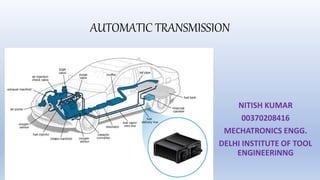
AUTOMATIC TRANSMISSION
NITISH KUMAR
00370208416
MECHATRONICS ENGG.
DELHI INSTITUTE OF TOOL
ENGINEERINNG
INTRODUCTION
What is Transmission ?
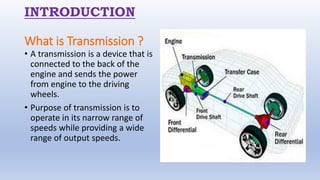
• A transmission is a device that is
connected to the back of the
engine and sends the power
from engine to the driving
wheels.
• Purpose of transmission is to
operate in its narrow range of
speeds while providing a wide
range of output speeds.
What is Automatic Transmission?
• An automatic transmission, also called auto, self-shifting transmission
or AT,is a type ofmotor vehicle transmission that can automatically
change gear ratios as the vehicle moves, freeing the driver from
having to shift gears manually. Both the automatic transmission (plus
its torque converter) and a manual transmission (with its clutch)
accomplish exactly the same thing, but they do it in totally different
ways.
• The modern automatic transmission system is by far, the most
complicated mechanical component in today’s life.
• Automatic transmission system mainly contains Mechanical systems,
Hydraulic systems, Electrical systems and computer controls. All
working together in perfect harmony which goes virtually unnoticed
until there is a problem.
How is automatic transmission different from
manual transmission ?
Manual transmission uses compound gearset whereas automatic
transmission uses epicyclic/planetary gearset.
There is no clutch pedal in an automatic transmission car.
There is no gear shift in an automatic transmission car. Once you put
the transmission into drive, everything else is automatic.
Manual transmission locks and unlocks different sets of gears to
the output shaft to achieve the various gear ratios, while in an
automatic transmission, the same set of gears produces all of the
different gear ratios.
Types of Automatic
Transmission
Rear wheel drive
Front wheel drive
REAR WHEEL DRIVE
 The transmission is usually mounted to the back of the engine.
 Power flow on this system is simple and straight forward going from
the engine, through the torque converter, then through the
transmission and drive shaft until it reaches the final drive where it
split and sent to the rear wheels.
 Example of rear wheels - Alpha Romeo Alfeta in early 70’s.
REAR WHEEL DRIVE
FRONT WHEEL DRIVE
 On a front wheel drive car, the transmission is usually combined with the
final drive to form what is called a transaxle.
 Transaxle is a device set up in the transmission gear box, clutch, final drive,
combined into a single unit.
 Front-wheel-drive layout are those in which the front wheels of the vehicle
are driven. The most popular layout used in cars today is the front-engine,
front wheel drive, with the engine in front of front axle, driving the front
wheels.
 This layout is typically chosen for its compact packaging.
 Front axles are connected directly to the transaxle and provide power to
the final wheels.
FRONT WHEEL DRIVES
TRANSMISSION COMPONENTS
Planetary Gear Sets
Hydraulic Systems
Torque convertor
Governor
Computer controls
PLANETARY GEAR SETS
• A gear set in which all of the gears are
in one plane, grouped around each
other like the planets around the sun.
• The central gear is called the "sun
gear". In mesh with it is a circular
grouping of gears, called "planet
gears", mounted on a rotating carrier.
• The planet gears also engage teeth on
the inner periphery of the "ring gear".
• By holding any one of the three gear
elements motionless, different ratios
can be produced between the other
two. Planetary gear sets are common
in automatic transmissions.
HYDRAULIC SYSTEM
The Hydraulic system is a complex maze of passages and tubes that sends
transmission fluid under pressure to all parts of the transmission and
torque converter.
It works with some components.
Oil Pump.
Valve Body.
Clutches
Bands
OIL PUMP
• Produces all the oil pressure that
is required in the transmission.
• The oil is sent under pressure to
the pressure regulator, the valve
body and the rest of
components as required.
VALVE BODY
• The valve body is the control
center of the automatic
transmission. It contains a maze
of channels and passages that
direct hydraulic fluid to the
numerous valves which then
activate the appropriate clutch
pack or band servo to
smoothly shift to the
appropriate gear for each driving
situation.
CLUTCHES
• A clutch is a mechanical device
which is provided for the
transmission of power (and
therefore usually motion) from
one component ( the driving
member) to another ( the driven
member).
• The simplest application of
clutches are employed in devices
which have two rotating shafts.
BANDS
• A band is a steel strap with friction
material bonded to the inside
surface.
• One end of the band is anchored
against the transmission case while
the other end is connected to a
servo.
• A flexible metal ring fits around the
outside of the clutch housing. It
tightens to engage the gears , and
loosens to release them.
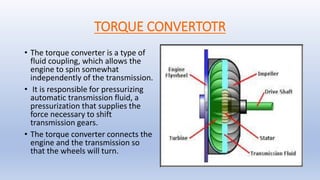
TORQUE CONVERTOTR
• The torque converter is a type of
fluid coupling, which allows the
engine to spin somewhat
independently of the transmission.
• It is responsible for pressurizing
automatic transmission fluid, a
pressurization that supplies the
force necessary to shift
transmission gears.
• The torque converter connects the
engine and the transmission so
that the wheels will turn.
COMPUTER CONTROLS
The computer uses sensors on the engine and transmission to detect
such things as throttle position, vehicle speed, engine speed, engine
load, brake pedal position, etc. to control exact shift points as well as
how soft the shift should be. Once the computer receives this
information, it then sends signals to a solenoid pack inside the
transmission.
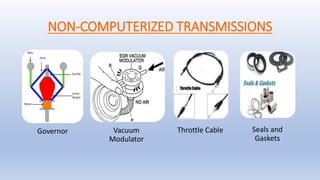
NON-COMPUTERIZED TRANSMISSIONS
Governor Vacuum
Modulator
Throttle Cable Seals and
Gaskets
SPOTTING PROBLEMS BEFORE THEY GET
WORSE
oWatch for leaks or strains under the car.
oCheck fluid for color and odor.
oBe sensitive to new noises, vibrations and shift behavior.
CONCLUSION
An automatic transmission car is far much better to drive than a
manual one. The ease of driving an automatic car makes it suitable
for many motorists especially the older ones. As it has been
discussed, automatic cars offers low risks of collisions from the fact
that they are easier to control. The older drivers will perform better
with automatic cars. It was only in the manual cars that many
collisions were witnessed.

AUTOMATIC TRANSMISSION

  • 1.
    AUTOMATIC TRANSMISSION NITISH KUMAR 00370208416 MECHATRONICSENGG. DELHI INSTITUTE OF TOOL ENGINEERINNG
  • 2.
    INTRODUCTION What is Transmission? • A transmission is a device that is connected to the back of the engine and sends the power from engine to the driving wheels. • Purpose of transmission is to operate in its narrow range of speeds while providing a wide range of output speeds.
  • 3.
    What is AutomaticTransmission? • An automatic transmission, also called auto, self-shifting transmission or AT,is a type ofmotor vehicle transmission that can automatically change gear ratios as the vehicle moves, freeing the driver from having to shift gears manually. Both the automatic transmission (plus its torque converter) and a manual transmission (with its clutch) accomplish exactly the same thing, but they do it in totally different ways.
  • 4.
    • The modernautomatic transmission system is by far, the most complicated mechanical component in today’s life. • Automatic transmission system mainly contains Mechanical systems, Hydraulic systems, Electrical systems and computer controls. All working together in perfect harmony which goes virtually unnoticed until there is a problem.
  • 5.
    How is automatictransmission different from manual transmission ? Manual transmission uses compound gearset whereas automatic transmission uses epicyclic/planetary gearset. There is no clutch pedal in an automatic transmission car. There is no gear shift in an automatic transmission car. Once you put the transmission into drive, everything else is automatic. Manual transmission locks and unlocks different sets of gears to the output shaft to achieve the various gear ratios, while in an automatic transmission, the same set of gears produces all of the different gear ratios.
  • 6.
    Types of Automatic Transmission Rearwheel drive Front wheel drive
  • 7.
    REAR WHEEL DRIVE The transmission is usually mounted to the back of the engine.  Power flow on this system is simple and straight forward going from the engine, through the torque converter, then through the transmission and drive shaft until it reaches the final drive where it split and sent to the rear wheels.  Example of rear wheels - Alpha Romeo Alfeta in early 70’s.
  • 8.
  • 9.
    FRONT WHEEL DRIVE On a front wheel drive car, the transmission is usually combined with the final drive to form what is called a transaxle.  Transaxle is a device set up in the transmission gear box, clutch, final drive, combined into a single unit.  Front-wheel-drive layout are those in which the front wheels of the vehicle are driven. The most popular layout used in cars today is the front-engine, front wheel drive, with the engine in front of front axle, driving the front wheels.  This layout is typically chosen for its compact packaging.  Front axles are connected directly to the transaxle and provide power to the final wheels.
  • 10.
  • 11.
    TRANSMISSION COMPONENTS Planetary GearSets Hydraulic Systems Torque convertor Governor Computer controls
  • 12.
    PLANETARY GEAR SETS •A gear set in which all of the gears are in one plane, grouped around each other like the planets around the sun. • The central gear is called the "sun gear". In mesh with it is a circular grouping of gears, called "planet gears", mounted on a rotating carrier. • The planet gears also engage teeth on the inner periphery of the "ring gear". • By holding any one of the three gear elements motionless, different ratios can be produced between the other two. Planetary gear sets are common in automatic transmissions.
  • 13.
    HYDRAULIC SYSTEM The Hydraulicsystem is a complex maze of passages and tubes that sends transmission fluid under pressure to all parts of the transmission and torque converter. It works with some components. Oil Pump. Valve Body. Clutches Bands
  • 14.
    OIL PUMP • Producesall the oil pressure that is required in the transmission. • The oil is sent under pressure to the pressure regulator, the valve body and the rest of components as required.
  • 15.
    VALVE BODY • Thevalve body is the control center of the automatic transmission. It contains a maze of channels and passages that direct hydraulic fluid to the numerous valves which then activate the appropriate clutch pack or band servo to smoothly shift to the appropriate gear for each driving situation.
  • 16.
    CLUTCHES • A clutchis a mechanical device which is provided for the transmission of power (and therefore usually motion) from one component ( the driving member) to another ( the driven member). • The simplest application of clutches are employed in devices which have two rotating shafts.
  • 17.
    BANDS • A bandis a steel strap with friction material bonded to the inside surface. • One end of the band is anchored against the transmission case while the other end is connected to a servo. • A flexible metal ring fits around the outside of the clutch housing. It tightens to engage the gears , and loosens to release them.
  • 18.
    TORQUE CONVERTOTR • Thetorque converter is a type of fluid coupling, which allows the engine to spin somewhat independently of the transmission. • It is responsible for pressurizing automatic transmission fluid, a pressurization that supplies the force necessary to shift transmission gears. • The torque converter connects the engine and the transmission so that the wheels will turn.
  • 19.
    COMPUTER CONTROLS The computeruses sensors on the engine and transmission to detect such things as throttle position, vehicle speed, engine speed, engine load, brake pedal position, etc. to control exact shift points as well as how soft the shift should be. Once the computer receives this information, it then sends signals to a solenoid pack inside the transmission.
  • 20.
  • 21.
    SPOTTING PROBLEMS BEFORETHEY GET WORSE oWatch for leaks or strains under the car. oCheck fluid for color and odor. oBe sensitive to new noises, vibrations and shift behavior.
  • 22.
    CONCLUSION An automatic transmissioncar is far much better to drive than a manual one. The ease of driving an automatic car makes it suitable for many motorists especially the older ones. As it has been discussed, automatic cars offers low risks of collisions from the fact that they are easier to control. The older drivers will perform better with automatic cars. It was only in the manual cars that many collisions were witnessed.