SEMINAR REPORT
On
Continuous Variable Transmission
By
MANOJ P
SPG 07 1704
POSTGRADUATE DEGREE IN PRODUCT DESIGN & ENGINEERING
2017 – 2019
COURSE LEADER
Dr.T.S.Mruthunjaya,
Head of Department - PGPDE,
School of Post Graduate Studies, NTTF
SCHOOL OF POSTGRADUATE STUDIES
NETTUR TECHNICAL TRAINING FOUNDATION
BANGALORE - 560 058
ACKNOWLEDGEMENT
First of all I thank the almighty for providing me with the strength and courage to present
the seminar.
I avail this opportunity to express my sincere gratitude and outset thank to my
seminar guide and head of Product Design
Dr. T.S MRUTHYUMJAYA, for permitting me to conduct the seminar and for his inspiring
assistance, encouragement and useful guidance. And I also thank our Principal Mr. M
Gibson, for his inspiring assistance, encouragement and useful guidance.
I am also indebted to all the teaching and non- teaching staff of the department of
NTTF, School of Postgraduate Studies, for their cooperation and suggestions, which is the
spirit behind this report.
MANOJ P
SEMINAR TOPIC- CONTINUOUS VARIABLE TRANSMISSION
MANOJ P, PGPDE, SCHOOL OF POSTGRADUATE STUDIES, NTTF Page | 1
Abstract
Continuously Variable Transmissions (CVT) offers a continuum of gear ratios between
desired limits. This allows the engine to operate more time in the optimum range given an
appropriate control of the engine valve throttle opening and transmission ratio. In contrast,
traditional and manual transmissions have several fixed transmission ratios forcing the engine
to operate outside the optimum range. In this report an overview of the general working
principal of CVT is elaborated along with the classifications. A brief discussion on the merits
and demerits of using this system is also mentioned. This report evaluates the current state of
CVT and a comparison of CVT and the manual transmission is being made in order to establish
the higher performance and fuel efficiency of this automatic transmission over the
conventional drive system.
SEMINAR TOPIC- CONTINUOUS VARIABLE TRANSMISSION
MANOJ P, PGPDE, SCHOOL OF POSTGRADUATE STUDIES, NTTF Page | 2
Contents
1. Introduction………………………………………………………………………………………1
2. Literature Survey……………………………………………………………………………….2
3. Types of Continuous Variable transmission……………………………………….4
1. Variable diameter pulley transmission……………………………………….. 4
2. Hydrostatic Continuous variable transmission……………………………. 6
3. Frictional continuous variable transmission…………………………………8
4. Toroidal or roller based continuous variable transmission…………10
5. Magnetic continuous variable transmission……………………………….12
4. Latest update on CVT……………………………………………………………………. 15
5. Advantages & disadvantages of continuous variable transmission….22
6. Conclusion……………………………………………………………………………………...23
7. Reference……………………………………………………………………………………….24
SEMINAR TOPIC- CONTINUOUS VARIABLE TRANSMISSION
MANOJ P, PGPDE, SCHOOL OF POSTGRADUATE STUDIES, NTTF Page | 3
List of figures
Fig: 1. Elements of CVT
Fig: 2. Sheave & rocker pin connected via plate.
Fig: 3. Speed varying mechanism.
Fig: 4. Schematic diagram of flywheel automobile (break specific fuel consumption)
Fig: 5. typical hydrostatic transmission
Fig: 6. Schematic diagram of hydrostatic transmission
Fig: 7. Flat disc and a roller attached to a driving member.
Fig: 8. two cones based friction variator
Fig: 9. typical full toroidal variator
Fig: 10. Input & output discs on toroidal variator
Fig: 11. Rollers placed between input & output shafts
Fig: 12. Roller attached with hydraulic reaction piston
Fig: 12. Mechanism of toroidal variator.
Fig: 13. Schematic representation of magnetic CVT.
Fig: 14. Components of MCVT.
Fig: 15. MCVT with a powerful stator with compact winding.
Fig: 16. Toyota direct shift-CVT arrangement.
Fig: 17. Improvised vane pump system.
Fig: 18. Reduced belt angle
Fig: 19. Reducing belt angle enhances sense of acceleration.
Fig: 20. Toyota motor corporation performance comparison
Fig: 21. Toyota motor corporation fuel efficiency.
Fig: 22. Toyota motor corporation direct shift comparison
Fig: 23. Details of new technology (Toyota Motor Corporation).
Fig: 24. Detail of reduced angle in CVT belt. (Toyota Motor Corporation).
Fig: 25. The XTRONIC CVT boosts fuel efficiency and reduces friction by adding distance between the drive
pulley and the transmission oil preventing unwanted contact.
Fig: 26. The XTRONIC CVT is the first to feature a sub-planetary gear, which reduces overall size and weight and
increases efficiency.
SEMINAR TOPIC- CONTINUOUS VARIABLE TRANSMISSION
MANOJ P, PGPDE, SCHOOL OF POSTGRADUATE STUDIES, NTTF Page | 4
Introduction
The Continuously Variable Transmission (C.V.T.) is a transmission in which the ratio of
the rotational speeds of two shafts, as the input shaft and output shaft of a vehicle or other
machine, can be varied continuously within a given range, providing an infinite number of
possible ratios. The other mechanical transmissions like clutch-gear assembly, allow a few
different gear ratios to be selected, but CVT transmission essentially has an infinite number of
ratios available within a finite range. It provides even better fuel economy if the engine is
constantly made to run at a single speed. This transmission is capable of a better user
experience, without the rise and fall in speed of an engine, and the jerk felt when changing
gears.
The overwhelming majority of transmissions in road going vehicles are either manual
or conventional automatic in design. These transmissions use meshing gears that give discrete
ratio steps between engine and the vehicle speed. However, alternative designs exist that can
transmit power and simultaneously give a step less change of ratio; in other words a
Continuously Variable Transmission. These are a type of automatic transmission that provides
an uninterrupted range of speed ratios, unlike a normal transmission that provides only a few
discrete ratios.
Continuously Variable Transmission (CVT) has a wide range of speed ratio and it can
adjust the ratio continuously and automatically according to the mode of operation to
maintain the engine to work in economy range or maximum power range all the time.
Therefore, not only can it significantly improve the economy and power performance but also
reduce the engine emissions pollution and driving impact to make the car run placidly and
feels comfortably, at the same time driving operation can be simplified to reduce driver labor
intensity, and to enhance security. Among a lot of types of CVT, the development and
application of metal pushing belt type CVT for car has caused extensive concerns. CVTs are
not new to the automotive world; but their limited torque capabilities and apprehensions on
reliability had restricted its use in the past. New developments in gear reduction and
manufacturing have led to ever more robust CVT which in turn allows them to be used in
diverse automotive applications.
SEMINAR TOPIC- CONTINUOUS VARIABLE TRANSMISSION
MANOJ P, PGPDE, SCHOOL OF POSTGRADUATE STUDIES, NTTF Page | 5
Literature survey
Over the past few decades, automotive transmission technology has undergone
several refinements in order to meet the goals of increased vehicle performance and reduced
exhaust emissions. One of the most promising technologies introduced in the automotive
market is the continuously variable transmission (CVT). CVT is a power transmission device
whose speed ratio can be varied continuously between two finite limits. Speed ratio is defined
as the ratio of belt pitch radius on the driven pulley to that on the driver pulley, or the ratio of
driver pulley speed to driven pulley speed. A few authors also use the reciprocal definition for
speed ratio, i.e. ratio of driven to driver pulley speeds. There are many kinds of CVTs, each
having their own characteristics, e.g. Toroidal CVT, Belt CVT, Chain CVT, etc. However, among
all, belt and chain types are the most commonly used CVTs in automotive applications. CVT is
also a promising power-transmission technology for future hybrid vehicles. As mentioned
before, several car companies like Ford, Toyota, Honda, Audi, etc., have already begun to
mass-produce vehicles with such types of CVT integrated into their drivelines.
By the research work on CVTs for the different aspects of CVT, ex: performance,
efficiency, configuration design durability & fatigue analysis. CVT with their built models
develop describe the interaction with the system shows various complexity. In addition CVT
to its advantages, there are many possible parasitic losses associated with CVT which deals
with its inefficiency. Parasitic losses occur under no-load conditions and are independent of
the transmitted power. They are mainly speed & temperature dependent, e.g. in a manual
transmission such losses can be due to oil churning, seal effects, bearing drag, etc.
CVT losses can be attributed to slippage, wedging action, hydraulic pumping of
sheaves, other sheave actuation mechanisms, thermal effects, flexure effects, lubrication
effects, fatigue and wear, etc.
A CVT system changes the driven pulley diameter (Distance between two conical
pulleys) with respect to speed and hence it changes infinite gear ratio. Hence, the driving
pulley is kept constant. Only the driven pulley changes the dimension accordingly speed. The
simulation of the vehicle acceleration performance is carried out and that gives result that
both drivability and fuel economy for the vehicle with CVT are better than the one with manual
SEMINAR TOPIC- CONTINUOUS VARIABLE TRANSMISSION
MANOJ P, PGPDE, SCHOOL OF POSTGRADUATE STUDIES, NTTF Page | 6
transmission or multi ratio automatic transmission. CVTs use infinite gear ratios instead of
gears to attain optimal speed. CVT is the better option for transmission system in modern
automobile vehicles.
Maaike van der Laan and Mark van Drogen and Arjen Brandsma (Van Doorne’s
Transmissie b.v. / Bosch Group) have explained about the Developments in clamping force.
Control for the push belt Continuously Variable Transmission (CVT) aim at increased efficiency
in combination with improved robustness. Current control strategies attempt to prevent
macro slip between elements and pulleys at all times for maximum robustness. In order to
search for the limiting factors in developing a new control strategy, situations where macro
slip occurs have been investigated. An important failure mechanism proves to be the
occurrence of adhesive wear in the contact leading to a loss in torque transfer. As a
combination of normal load and slip speed, respectively clamping force and slip rate in a
variator, a transition can be found from a safe wear region to an excessive/adhesive wear
region.
CVTs are increasingly found on small cars, and especially high-gas-mileage or hybrid
vehicles. On these platforms, the torque is limited because the electric motor can provide
torque without changing the speed of the engine. By leaving the engine running at the rate
that generates the best gas mileage for the given operating conditions, overall mileage can be
improved over a system with a smaller number of fixed gears, where the system may be
operating at peak efficiency only for a small range of speeds. CVTs are also found in agricultural
equipment; due to the high torque nature of these vehicles, mechanical gears are integrated
to provide tractive force at high speeds. The system is similar to that of a hydrostatic gearbox,
and at 'inching speeds' relies entirely on hydrostatic drive.
Some of the current day examples of these hybrid vehicles are Toyota Prius, Highlander
and Camry, the Nissan Altima, and newer-model Ford Escape Hybrid SUVs. CVT technology
uses only one input from a prime mover, and delivers variable output speeds and torque.
SEMINAR TOPIC- CONTINUOUS VARIABLE TRANSMISSION
MANOJ P, PGPDE, SCHOOL OF POSTGRADUATE STUDIES, NTTF Page | 7
Types of CVTs
1. Variable diameter pulley transmission:
Variable diameter pulley transmission uses a belt to transmit power from the input shaft
to the output shaft by axial movement of sheaves. The overall gear ratio can be adjusted
continuously. When the pulley sheaves are far apart, pulley acts like the small gear & when
the sheaves are close together they act as large gear. Since the length of the belt must always
be same, the sheaves of input shaft & output shaft have to adjust simultaneously.
If a cross-section of the belt is created, we can see its “V” shape design, that way the
movement of the belt is possible. Scooters use v belt made of rubber or polymer. More often
n than not, these cogged v-belts, that way, the belt has enough flexibility to adjust itself to
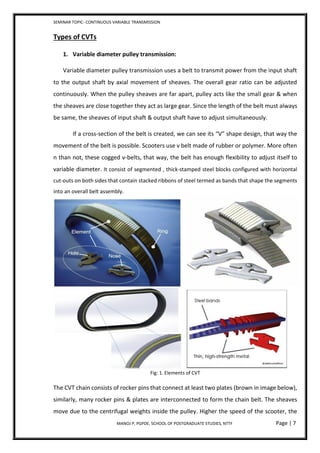
variable diameter. It consist of segmented , thick-stamped steel blocks configured with horizontal
cut-outs on both sides that contain stacked ribbons of steel termed as bands that shape the segments
into an overall belt assembly.
Fig: 1. Elements of CVT
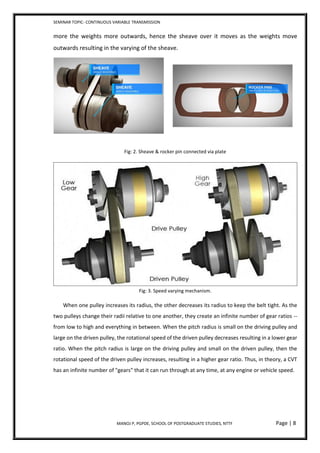
The CVT chain consists of rocker pins that connect at least two plates (brown in image below),
similarly, many rocker pins & plates are interconnected to form the chain belt. The sheaves
move due to the centrifugal weights inside the pulley. Higher the speed of the scooter, the
SEMINAR TOPIC- CONTINUOUS VARIABLE TRANSMISSION
MANOJ P, PGPDE, SCHOOL OF POSTGRADUATE STUDIES, NTTF Page | 8
more the weights more outwards, hence the sheave over it moves as the weights move
outwards resulting in the varying of the sheave.
Fig: 2. Sheave & rocker pin connected via plate
Fig: 3. Speed varying mechanism.
When one pulley increases its radius, the other decreases its radius to keep the belt tight. As the
two pulleys change their radii relative to one another, they create an infinite number of gear ratios --
from low to high and everything in between. When the pitch radius is small on the driving pulley and
large on the driven pulley, the rotational speed of the driven pulley decreases resulting in a lower gear
ratio. When the pitch radius is large on the driving pulley and small on the driven pulley, then the
rotational speed of the driven pulley increases, resulting in a higher gear ratio. Thus, in theory, a CVT
has an infinite number of "gears" that it can run through at any time, at any engine or vehicle speed.
SEMINAR TOPIC- CONTINUOUS VARIABLE TRANSMISSION
MANOJ P, PGPDE, SCHOOL OF POSTGRADUATE STUDIES, NTTF Page | 9
2. Hydrostatic CVTs:
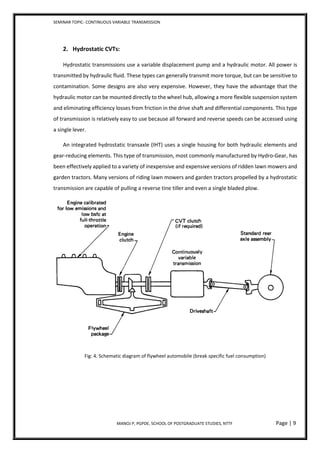
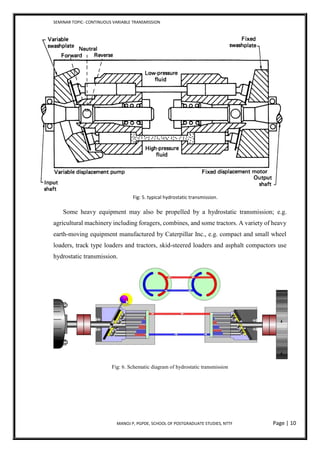
Hydrostatic transmissions use a variable displacement pump and a hydraulic motor. All power is
transmitted by hydraulic fluid. These types can generally transmit more torque, but can be sensitive to
contamination. Some designs are also very expensive. However, they have the advantage that the
hydraulic motor can be mounted directly to the wheel hub, allowing a more flexible suspension system
and eliminating efficiency losses from friction in the drive shaft and differential components. This type
of transmission is relatively easy to use because all forward and reverse speeds can be accessed using
a single lever.
An integrated hydrostatic transaxle (IHT) uses a single housing for both hydraulic elements and
gear-reducing elements. This type of transmission, most commonly manufactured by Hydro-Gear, has
been effectively applied to a variety of inexpensive and expensive versions of ridden lawn mowers and
garden tractors. Many versions of riding lawn mowers and garden tractors propelled by a hydrostatic
transmission are capable of pulling a reverse tine tiller and even a single bladed plow.
Fig: 4. Schematic diagram of flywheel automobile (break specific fuel consumption)
SEMINAR TOPIC- CONTINUOUS VARIABLE TRANSMISSION
MANOJ P, PGPDE, SCHOOL OF POSTGRADUATE STUDIES, NTTF Page | 10
Fig: 5. typical hydrostatic transmission.
Some heavy equipment may also be propelled by a hydrostatic transmission; e.g.
agricultural machinery including foragers, combines, and some tractors. A variety of heavy
earth-moving equipment manufactured by Caterpillar Inc., e.g. compact and small wheel
loaders, track type loaders and tractors, skid-steered loaders and asphalt compactors use
hydrostatic transmission.
Fig: 6. Schematic diagram of hydrostatic transmission
SEMINAR TOPIC- CONTINUOUS VARIABLE TRANSMISSION
MANOJ P, PGPDE, SCHOOL OF POSTGRADUATE STUDIES, NTTF Page | 11
3. Frictional CVT (FVT):
The most common type of CVT is the frictional type, in which two bodies are brought into
contact at points of varying distance from their axes of rotation, and allowing friction to
transfer motion from one body to the other. Sometimes there is a third intermediary body,
usually a wheel or belt.
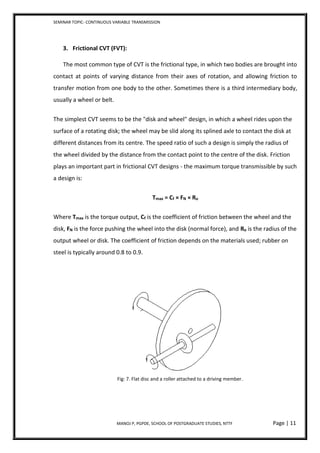
The simplest CVT seems to be the "disk and wheel" design, in which a wheel rides upon the
surface of a rotating disk; the wheel may be slid along its splined axle to contact the disk at
different distances from its centre. The speed ratio of such a design is simply the radius of
the wheel divided by the distance from the contact point to the centre of the disk. Friction
plays an important part in frictional CVT designs - the maximum torque transmissible by such
a design is:
Tmax = Cf × FN × Ro
Where Tmax is the torque output, Cf is the coefficient of friction between the wheel and the
disk, FN is the force pushing the wheel into the disk (normal force), and Ro is the radius of the
output wheel or disk. The coefficient of friction depends on the materials used; rubber on
steel is typically around 0.8 to 0.9.
Fig: 7. Flat disc and a roller attached to a driving member.
SEMINAR TOPIC- CONTINUOUS VARIABLE TRANSMISSION
MANOJ P, PGPDE, SCHOOL OF POSTGRADUATE STUDIES, NTTF Page | 12
A cone CVT varies the effective gear ratio using one or more conical rollers. The simplest
type of cone CVT, the single-cone version, uses a wheel that moves along the slope of the
cone, creating the variation between the narrow and wide diameters of the cone. In a CVT
with oscillating cones, the torque is transmitted via friction from a variable number of cones
(according to the torque to be transmitted) to a central, barrel-shaped hub. The side surface
of the hub is convex with a specific radius of curvature which is smaller than the concavity
radius of the cones. In this way, there will be only one (theoretical) contact point between
each cone and the hub at any time.
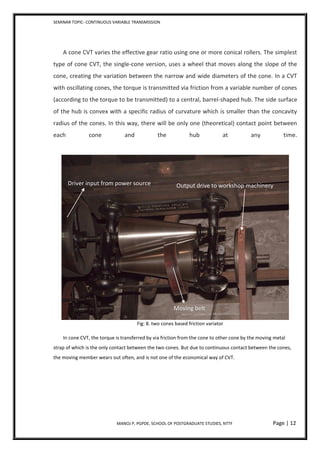
Fig: 8. two cones based friction variator
In cone CVT, the torque is transferred by via friction from the cone to other cone by the moving metal
strap of which is the only contact between the two cones. But due to continuous contact between the cones,
the moving member wears out often, and is not one of the economical way of CVT.
Moving belt
Driver input from power source Output drive to workshop machinery
SEMINAR TOPIC- CONTINUOUS VARIABLE TRANSMISSION
MANOJ P, PGPDE, SCHOOL OF POSTGRADUATE STUDIES, NTTF Page | 13
4. Toroidal or roller-based CVT (Extroid CVT):
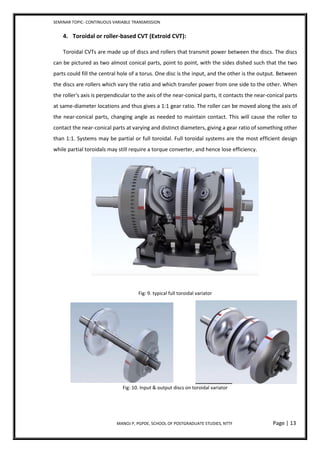
Toroidal CVTs are made up of discs and rollers that transmit power between the discs. The discs
can be pictured as two almost conical parts, point to point, with the sides dished such that the two
parts could fill the central hole of a torus. One disc is the input, and the other is the output. Between
the discs are rollers which vary the ratio and which transfer power from one side to the other. When
the roller's axis is perpendicular to the axis of the near-conical parts, it contacts the near-conical parts
at same-diameter locations and thus gives a 1:1 gear ratio. The roller can be moved along the axis of
the near-conical parts, changing angle as needed to maintain contact. This will cause the roller to
contact the near-conical parts at varying and distinct diameters, giving a gear ratio of something other
than 1:1. Systems may be partial or full toroidal. Full toroidal systems are the most efficient design
while partial toroidals may still require a torque converter, and hence lose efficiency.
Fig: 9. typical full toroidal variator
Fig: 10. Input & output discs on toroidal variator
SEMINAR TOPIC- CONTINUOUS VARIABLE TRANSMISSION
MANOJ P, PGPDE, SCHOOL OF POSTGRADUATE STUDIES, NTTF Page | 14
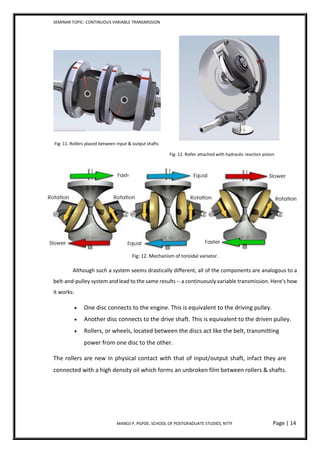
Fig: 11. Rollers placed between input & output shafts
Fig: 12. Roller attached with hydraulic reaction piston
Fig: 12. Mechanism of toroidal variator.
Although such a system seems drastically different, all of the components are analogous to a
belt-and-pulley system and lead to the same results -- a continuously variable transmission. Here's how
it works:
 One disc connects to the engine. This is equivalent to the driving pulley.
 Another disc connects to the drive shaft. This is equivalent to the driven pulley.
 Rollers, or wheels, located between the discs act like the belt, transmitting
power from one disc to the other.
The rollers are new in physical contact with that of input/output shaft, infact they are
connected with a high density oil which forms an unbroken film between rollers & shafts.
SEMINAR TOPIC- CONTINUOUS VARIABLE TRANSMISSION
MANOJ P, PGPDE, SCHOOL OF POSTGRADUATE STUDIES, NTTF Page | 15
5. Magnetic CVT or mCVT:
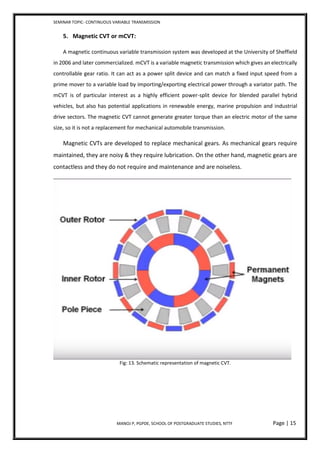
A magnetic continuous variable transmission system was developed at the University of Sheffield
in 2006 and later commercialized. mCVT is a variable magnetic transmission which gives an electrically
controllable gear ratio. It can act as a power split device and can match a fixed input speed from a
prime mover to a variable load by importing/exporting electrical power through a variator path. The
mCVT is of particular interest as a highly efficient power-split device for blended parallel hybrid
vehicles, but also has potential applications in renewable energy, marine propulsion and industrial
drive sectors. The magnetic CVT cannot generate greater torque than an electric motor of the same
size, so it is not a replacement for mechanical automobile transmission.
Magnetic CVTs are developed to replace mechanical gears. As mechanical gears require
maintained, they are noisy & they require lubrication. On the other hand, magnetic gears are
contactless and they do not require and maintenance and are noiseless.
Fig: 13. Schematic representation of magnetic CVT.
SEMINAR TOPIC- CONTINUOUS VARIABLE TRANSMISSION
MANOJ P, PGPDE, SCHOOL OF POSTGRADUATE STUDIES, NTTF Page | 16
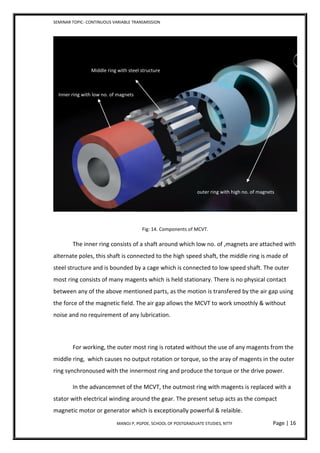
Fig: 14. Components of MCVT.
The inner ring consists of a shaft around which low no. of ,magnets are attached with
alternate poles, this shaft is connected to the high speed shaft, the middle ring is made of
steel structure and is bounded by a cage which is connected to low speed shaft. The outer
most ring consists of many magents which is held stationary. There is no physical contact
between any of the above mentioned parts, as the motion is transfered by the air gap using
the force of the magnetic field. The air gap allows the MCVT to work smoothly & without
noise and no requirement of any lubrication.
For working, the outer most ring is rotated without the use of any magents from the
middle ring, which causes no output rotation or torque, so the aray of magents in the outer
ring synchronoused with the innermost ring and produce the torque or the drive power.
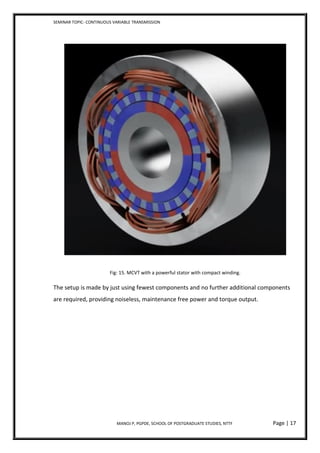
In the advancemnet of the MCVT, the outmost ring with magents is replaced with a
stator with electrical winding around the gear. The present setup acts as the compact
magnetic motor or generator which is exceptionally powerful & relaible.
Inner ring with low no. of magnets
Middle ring with steel structure
outer ring with high no. of magnets
SEMINAR TOPIC- CONTINUOUS VARIABLE TRANSMISSION
MANOJ P, PGPDE, SCHOOL OF POSTGRADUATE STUDIES, NTTF Page | 17
Fig: 15. MCVT with a powerful stator with compact winding.
The setup is made by just using fewest components and no further additional components
are required, providing noiseless, maintenance free power and torque output.
SEMINAR TOPIC- CONTINUOUS VARIABLE TRANSMISSION
MANOJ P, PGPDE, SCHOOL OF POSTGRADUATE STUDIES, NTTF Page | 18
Latest Update on CVT
TOYOTA MOTOR DIRECT SHIFT GEAR TRAIN-
Toyota has striven to reduce mechanical loss, adopt a wider gear range, and improve
shift tracking. These initiatives have resulted in a direct and smooth driving experience with
superior fuel efficiency, which has been improved by six percent over the existing transmission
system.
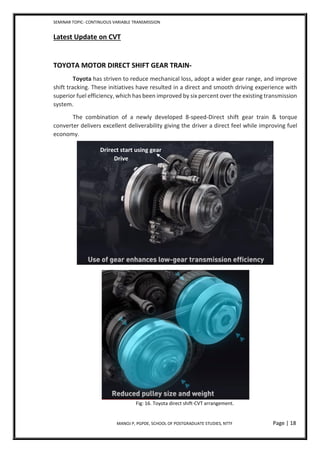
The combination of a newly developed 8-speed-Direct shift gear train & torque
converter delivers excellent deliverability giving the driver a direct feel while improving fuel
economy.
Fig: 16. Toyota direct shift-CVT arrangement.
Drirect start using gear
Drive
SEMINAR TOPIC- CONTINUOUS VARIABLE TRANSMISSION
MANOJ P, PGPDE, SCHOOL OF POSTGRADUATE STUDIES, NTTF Page | 19
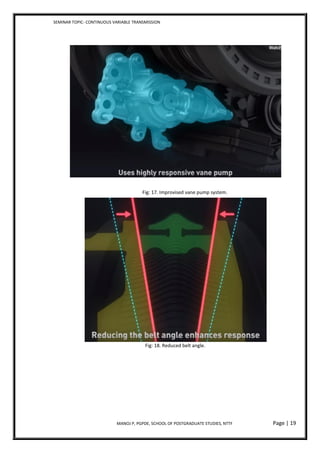
Fig: 17. Improvised vane pump system.
Fig: 18. Reduced belt angle.
SEMINAR TOPIC- CONTINUOUS VARIABLE TRANSMISSION
MANOJ P, PGPDE, SCHOOL OF POSTGRADUATE STUDIES, NTTF Page | 20
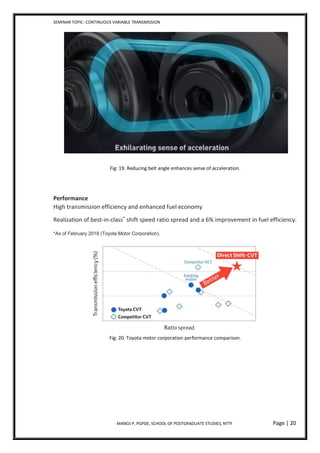
Fig: 19. Reducing belt angle enhances sense of acceleration.
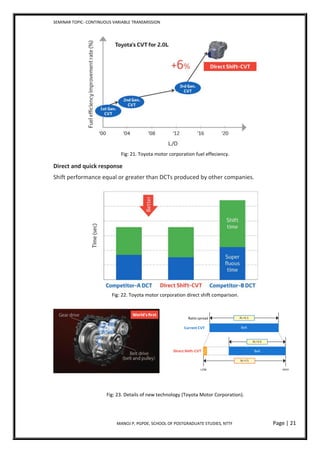
Performance
High transmission efficiency and enhanced fuel economy
Realization of best-in-class* shift speed ratio spread and a 6% improvement in fuel efficiency.
*As of February 2018 (Toyota Motor Corporation).
Fig: 20. Toyota motor corporation performance comparison.
SEMINAR TOPIC- CONTINUOUS VARIABLE TRANSMISSION
MANOJ P, PGPDE, SCHOOL OF POSTGRADUATE STUDIES, NTTF Page | 21
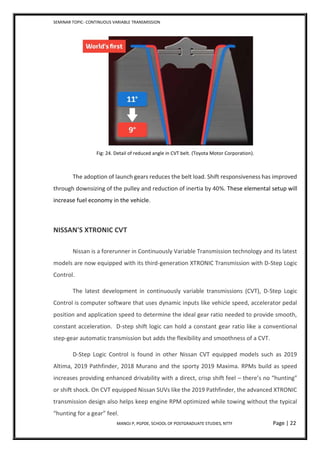
Fig: 21. Toyota motor corporation fuel effeciency.
Direct and quick response
Shift performance equal or greater than DCTs produced by other companies.
Fig: 22. Toyota motor corporation direct shift comparison.
Fig: 23. Details of new technology (Toyota Motor Corporation).
SEMINAR TOPIC- CONTINUOUS VARIABLE TRANSMISSION
MANOJ P, PGPDE, SCHOOL OF POSTGRADUATE STUDIES, NTTF Page | 22
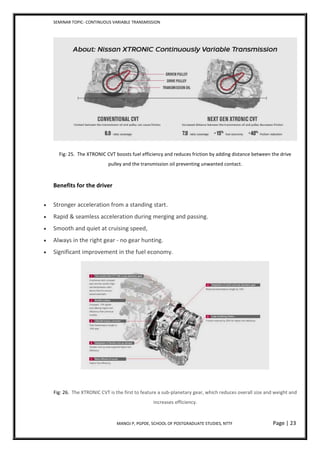
Fig: 24. Detail of reduced angle in CVT belt. (Toyota Motor Corporation).
The adoption of launch gears reduces the belt load. Shift responsiveness has improved
through downsizing of the pulley and reduction of inertia by 40%. These elemental setup will
increase fuel economy in the vehicle.
NISSAN'S XTRONIC CVT
Nissan is a forerunner in Continuously Variable Transmission technology and its latest
models are now equipped with its third-generation XTRONIC Transmission with D-Step Logic
Control.
The latest development in continuously variable transmissions (CVT), D-Step Logic
Control is computer software that uses dynamic inputs like vehicle speed, accelerator pedal
position and application speed to determine the ideal gear ratio needed to provide smooth,
constant acceleration. D-step shift logic can hold a constant gear ratio like a conventional
step-gear automatic transmission but adds the flexibility and smoothness of a CVT.
D-Step Logic Control is found in other Nissan CVT equipped models such as 2019
Altima, 2019 Pathfinder, 2018 Murano and the sporty 2019 Maxima. RPMs build as speed
increases providing enhanced drivability with a direct, crisp shift feel – there’s no “hunting”
or shift shock. On CVT equipped Nissan SUVs like the 2019 Pathfinder, the advanced XTRONIC
transmission design also helps keep engine RPM optimized while towing without the typical
“hunting for a gear” feel.
SEMINAR TOPIC- CONTINUOUS VARIABLE TRANSMISSION
MANOJ P, PGPDE, SCHOOL OF POSTGRADUATE STUDIES, NTTF Page | 23
Fig: 25. The XTRONIC CVT boosts fuel efficiency and reduces friction by adding distance between the drive
pulley and the transmission oil preventing unwanted contact.
Benefits for the driver
 Stronger acceleration from a standing start.
 Rapid & seamless acceleration during merging and passing.
 Smooth and quiet at cruising speed,
 Always in the right gear - no gear hunting.
 Significant improvement in the fuel economy.
Fig: 26. The XTRONIC CVT is the first to feature a sub-planetary gear, which reduces overall size and weight and
increases efficiency.
SEMINAR TOPIC- CONTINUOUS VARIABLE TRANSMISSION
MANOJ P, PGPDE, SCHOOL OF POSTGRADUATE STUDIES, NTTF Page | 24
What kind of transmission fluid does a Nissan XTRONIC CVT use?
The required fluid for all XTRONIC CVT-equipped Nissan models is Nissan CVT Fluid NS-3. Do
not use Automatic transmission fluid (ATF), Manual transmission fluid, or mix this fluid with
other fluids, as it may damage the CVT transmission and void the warranty. When checking or
replacement of XTRONIC CVT fluid is required.
Nissan Xtronic CVT transmission so innovative it doesn't use gears. Learn how Nissan’s newest
CVTs are setting the benchmark for automatic transmissions.
SEMINAR TOPIC- CONTINUOUS VARIABLE TRANSMISSION
MANOJ P, PGPDE, SCHOOL OF POSTGRADUATE STUDIES, NTTF Page | 25
Advantages & Disadvantages
A. Advantages
 CVTs have much smoother operation than hydraulic automatic transmissions in an
automobile gearbox that can change gear ratios automatically as the car or truck moves,
thus freeing the driver from having to shift gears manually.
 CVTs can smoothly compensate for changing vehicle speeds, allowing the engine speed to
remain at its level of peak efficiency. This improves both fuel economy and exhaust.
 CVTs offer a continuum of infinitely variable gear ratios by changing the location of pulleys
heaves. As a result, CVTs have the potential to increase the overall vehicle efficiency and
reduce the jerk usually associated with manual and automatic transmissions.
 CVT's design advantages lie not only in its efficiency but its simplicity .It consists of very
few components. A continuously variable transmission typically includes the following
major component groups:
A high-power/density rubber belt
 A hydraulically operated driving pulley.
 A mechanical torque-sensing driving pulley.
 Microprocessors and sensors.
B. Disadvantages
 CVTs torque-handling capability is limited by the strength of their transmission
medium (usually a belt or chain), and by their ability to withstand friction wear
between torque source and transmission medium (in friction-driven CVTs). CVTs in
production prior to 2005 are predominantly belt- or chain-driven and therefore
typically limited to low-powered cars and other light-duty applications. Units using
advanced lubricants, however, have been proven to support a range of torques in
production vehicles, including that used for buses, heavy trucks, and earth-moving
equipment.
 Difficulty in transmitting high torque at low operating speeds, which so far has limited their
use to small vehicles.
 Size and weight of CVTs has long been a concern, since CVT automatics weigh far more
than manual transmissions.
SEMINAR TOPIC- CONTINUOUS VARIABLE TRANSMISSION
MANOJ P, PGPDE, SCHOOL OF POSTGRADUATE STUDIES, NTTF Page | 26
Conclusion
A continuously variable transmission (CVT) is a transmission which can change
sleeplessly through an infinite number of effective gear ratios between maximum and
minimum values. This contrasts with other mechanical transmissions that only allow a few
different distinct gear ratios to be selected. The flexibility of a CVT allows the driving shaft to
maintain a constant angular velocity over a range of output velocities. This can provide better
fuel economy than other transmissions by enabling the engine to run at its most efficient
revolutions per minute (RPM) for a range of vehicle speeds.
Few variations of CVTs have been excessively used in the field of automobile industry,
and since then there is constant growth and constant development in the field of Continuous
variable transmission. As the CVT is majorly the most advanced technology and science to
drive the load more effectively compared to the conventional driver and driven shaft
implementations. It is estimated that upcoming hybrid vehicles will be incorporated with CVT
as the force behind the driving component.
SEMINAR TOPIC- CONTINUOUS VARIABLE TRANSMISSION
MANOJ P, PGPDE, SCHOOL OF POSTGRADUATE STUDIES, NTTF Page | 27
Reference:
1. https://youtu.be/EAELukfr2oY?list=WL
2. https://youtu.be/nayVR2PAWHo?list=WL
3. https://youtu.be/TunlPGZ3UOg?list=WL
4. https://youtu.be/MTeJWE_Ou0g?list=WL
5. Torotrak, homepage, http//www.torotrak.com, 2001.
6. http//www.audi.com/multitronic, 2001.
7. International Journal of Scientific & Engineering Research, Volume 6, Issue 7, July-2015 1141 ISSN
2229-5518.
8. Design of Continuously Variable Transmission (CVT) with Metal Pushing Belt and Variable Pulleys
E. Maleki Pour, S. Golabi.
9. Modeling and Simulation of Friction-limited Continuously Variable Transmissions Nilabh
Srivastava.
10. https://www.nissanusa.com/experience-nissan/news-and-events/xtronic-cvt-continuously-
variable-transmission.html
11. https://global.toyota/en/mobility/tnga/powertrain2018/cvt/

Continuous Variable Transmissionm, Report.

  • 1.
    SEMINAR REPORT On Continuous VariableTransmission By MANOJ P SPG 07 1704 POSTGRADUATE DEGREE IN PRODUCT DESIGN & ENGINEERING 2017 – 2019 COURSE LEADER Dr.T.S.Mruthunjaya, Head of Department - PGPDE, School of Post Graduate Studies, NTTF SCHOOL OF POSTGRADUATE STUDIES NETTUR TECHNICAL TRAINING FOUNDATION BANGALORE - 560 058
  • 2.
    ACKNOWLEDGEMENT First of allI thank the almighty for providing me with the strength and courage to present the seminar. I avail this opportunity to express my sincere gratitude and outset thank to my seminar guide and head of Product Design Dr. T.S MRUTHYUMJAYA, for permitting me to conduct the seminar and for his inspiring assistance, encouragement and useful guidance. And I also thank our Principal Mr. M Gibson, for his inspiring assistance, encouragement and useful guidance. I am also indebted to all the teaching and non- teaching staff of the department of NTTF, School of Postgraduate Studies, for their cooperation and suggestions, which is the spirit behind this report. MANOJ P
  • 3.
    SEMINAR TOPIC- CONTINUOUSVARIABLE TRANSMISSION MANOJ P, PGPDE, SCHOOL OF POSTGRADUATE STUDIES, NTTF Page | 1 Abstract Continuously Variable Transmissions (CVT) offers a continuum of gear ratios between desired limits. This allows the engine to operate more time in the optimum range given an appropriate control of the engine valve throttle opening and transmission ratio. In contrast, traditional and manual transmissions have several fixed transmission ratios forcing the engine to operate outside the optimum range. In this report an overview of the general working principal of CVT is elaborated along with the classifications. A brief discussion on the merits and demerits of using this system is also mentioned. This report evaluates the current state of CVT and a comparison of CVT and the manual transmission is being made in order to establish the higher performance and fuel efficiency of this automatic transmission over the conventional drive system.
  • 4.
    SEMINAR TOPIC- CONTINUOUSVARIABLE TRANSMISSION MANOJ P, PGPDE, SCHOOL OF POSTGRADUATE STUDIES, NTTF Page | 2 Contents 1. Introduction………………………………………………………………………………………1 2. Literature Survey……………………………………………………………………………….2 3. Types of Continuous Variable transmission……………………………………….4 1. Variable diameter pulley transmission……………………………………….. 4 2. Hydrostatic Continuous variable transmission……………………………. 6 3. Frictional continuous variable transmission…………………………………8 4. Toroidal or roller based continuous variable transmission…………10 5. Magnetic continuous variable transmission……………………………….12 4. Latest update on CVT……………………………………………………………………. 15 5. Advantages & disadvantages of continuous variable transmission….22 6. Conclusion……………………………………………………………………………………...23 7. Reference……………………………………………………………………………………….24
  • 5.
    SEMINAR TOPIC- CONTINUOUSVARIABLE TRANSMISSION MANOJ P, PGPDE, SCHOOL OF POSTGRADUATE STUDIES, NTTF Page | 3 List of figures Fig: 1. Elements of CVT Fig: 2. Sheave & rocker pin connected via plate. Fig: 3. Speed varying mechanism. Fig: 4. Schematic diagram of flywheel automobile (break specific fuel consumption) Fig: 5. typical hydrostatic transmission Fig: 6. Schematic diagram of hydrostatic transmission Fig: 7. Flat disc and a roller attached to a driving member. Fig: 8. two cones based friction variator Fig: 9. typical full toroidal variator Fig: 10. Input & output discs on toroidal variator Fig: 11. Rollers placed between input & output shafts Fig: 12. Roller attached with hydraulic reaction piston Fig: 12. Mechanism of toroidal variator. Fig: 13. Schematic representation of magnetic CVT. Fig: 14. Components of MCVT. Fig: 15. MCVT with a powerful stator with compact winding. Fig: 16. Toyota direct shift-CVT arrangement. Fig: 17. Improvised vane pump system. Fig: 18. Reduced belt angle Fig: 19. Reducing belt angle enhances sense of acceleration. Fig: 20. Toyota motor corporation performance comparison Fig: 21. Toyota motor corporation fuel efficiency. Fig: 22. Toyota motor corporation direct shift comparison Fig: 23. Details of new technology (Toyota Motor Corporation). Fig: 24. Detail of reduced angle in CVT belt. (Toyota Motor Corporation). Fig: 25. The XTRONIC CVT boosts fuel efficiency and reduces friction by adding distance between the drive pulley and the transmission oil preventing unwanted contact. Fig: 26. The XTRONIC CVT is the first to feature a sub-planetary gear, which reduces overall size and weight and increases efficiency.
  • 6.
    SEMINAR TOPIC- CONTINUOUSVARIABLE TRANSMISSION MANOJ P, PGPDE, SCHOOL OF POSTGRADUATE STUDIES, NTTF Page | 4 Introduction The Continuously Variable Transmission (C.V.T.) is a transmission in which the ratio of the rotational speeds of two shafts, as the input shaft and output shaft of a vehicle or other machine, can be varied continuously within a given range, providing an infinite number of possible ratios. The other mechanical transmissions like clutch-gear assembly, allow a few different gear ratios to be selected, but CVT transmission essentially has an infinite number of ratios available within a finite range. It provides even better fuel economy if the engine is constantly made to run at a single speed. This transmission is capable of a better user experience, without the rise and fall in speed of an engine, and the jerk felt when changing gears. The overwhelming majority of transmissions in road going vehicles are either manual or conventional automatic in design. These transmissions use meshing gears that give discrete ratio steps between engine and the vehicle speed. However, alternative designs exist that can transmit power and simultaneously give a step less change of ratio; in other words a Continuously Variable Transmission. These are a type of automatic transmission that provides an uninterrupted range of speed ratios, unlike a normal transmission that provides only a few discrete ratios. Continuously Variable Transmission (CVT) has a wide range of speed ratio and it can adjust the ratio continuously and automatically according to the mode of operation to maintain the engine to work in economy range or maximum power range all the time. Therefore, not only can it significantly improve the economy and power performance but also reduce the engine emissions pollution and driving impact to make the car run placidly and feels comfortably, at the same time driving operation can be simplified to reduce driver labor intensity, and to enhance security. Among a lot of types of CVT, the development and application of metal pushing belt type CVT for car has caused extensive concerns. CVTs are not new to the automotive world; but their limited torque capabilities and apprehensions on reliability had restricted its use in the past. New developments in gear reduction and manufacturing have led to ever more robust CVT which in turn allows them to be used in diverse automotive applications.
  • 7.
    SEMINAR TOPIC- CONTINUOUSVARIABLE TRANSMISSION MANOJ P, PGPDE, SCHOOL OF POSTGRADUATE STUDIES, NTTF Page | 5 Literature survey Over the past few decades, automotive transmission technology has undergone several refinements in order to meet the goals of increased vehicle performance and reduced exhaust emissions. One of the most promising technologies introduced in the automotive market is the continuously variable transmission (CVT). CVT is a power transmission device whose speed ratio can be varied continuously between two finite limits. Speed ratio is defined as the ratio of belt pitch radius on the driven pulley to that on the driver pulley, or the ratio of driver pulley speed to driven pulley speed. A few authors also use the reciprocal definition for speed ratio, i.e. ratio of driven to driver pulley speeds. There are many kinds of CVTs, each having their own characteristics, e.g. Toroidal CVT, Belt CVT, Chain CVT, etc. However, among all, belt and chain types are the most commonly used CVTs in automotive applications. CVT is also a promising power-transmission technology for future hybrid vehicles. As mentioned before, several car companies like Ford, Toyota, Honda, Audi, etc., have already begun to mass-produce vehicles with such types of CVT integrated into their drivelines. By the research work on CVTs for the different aspects of CVT, ex: performance, efficiency, configuration design durability & fatigue analysis. CVT with their built models develop describe the interaction with the system shows various complexity. In addition CVT to its advantages, there are many possible parasitic losses associated with CVT which deals with its inefficiency. Parasitic losses occur under no-load conditions and are independent of the transmitted power. They are mainly speed & temperature dependent, e.g. in a manual transmission such losses can be due to oil churning, seal effects, bearing drag, etc. CVT losses can be attributed to slippage, wedging action, hydraulic pumping of sheaves, other sheave actuation mechanisms, thermal effects, flexure effects, lubrication effects, fatigue and wear, etc. A CVT system changes the driven pulley diameter (Distance between two conical pulleys) with respect to speed and hence it changes infinite gear ratio. Hence, the driving pulley is kept constant. Only the driven pulley changes the dimension accordingly speed. The simulation of the vehicle acceleration performance is carried out and that gives result that both drivability and fuel economy for the vehicle with CVT are better than the one with manual
  • 8.
    SEMINAR TOPIC- CONTINUOUSVARIABLE TRANSMISSION MANOJ P, PGPDE, SCHOOL OF POSTGRADUATE STUDIES, NTTF Page | 6 transmission or multi ratio automatic transmission. CVTs use infinite gear ratios instead of gears to attain optimal speed. CVT is the better option for transmission system in modern automobile vehicles. Maaike van der Laan and Mark van Drogen and Arjen Brandsma (Van Doorne’s Transmissie b.v. / Bosch Group) have explained about the Developments in clamping force. Control for the push belt Continuously Variable Transmission (CVT) aim at increased efficiency in combination with improved robustness. Current control strategies attempt to prevent macro slip between elements and pulleys at all times for maximum robustness. In order to search for the limiting factors in developing a new control strategy, situations where macro slip occurs have been investigated. An important failure mechanism proves to be the occurrence of adhesive wear in the contact leading to a loss in torque transfer. As a combination of normal load and slip speed, respectively clamping force and slip rate in a variator, a transition can be found from a safe wear region to an excessive/adhesive wear region. CVTs are increasingly found on small cars, and especially high-gas-mileage or hybrid vehicles. On these platforms, the torque is limited because the electric motor can provide torque without changing the speed of the engine. By leaving the engine running at the rate that generates the best gas mileage for the given operating conditions, overall mileage can be improved over a system with a smaller number of fixed gears, where the system may be operating at peak efficiency only for a small range of speeds. CVTs are also found in agricultural equipment; due to the high torque nature of these vehicles, mechanical gears are integrated to provide tractive force at high speeds. The system is similar to that of a hydrostatic gearbox, and at 'inching speeds' relies entirely on hydrostatic drive. Some of the current day examples of these hybrid vehicles are Toyota Prius, Highlander and Camry, the Nissan Altima, and newer-model Ford Escape Hybrid SUVs. CVT technology uses only one input from a prime mover, and delivers variable output speeds and torque.
  • 9.
    SEMINAR TOPIC- CONTINUOUSVARIABLE TRANSMISSION MANOJ P, PGPDE, SCHOOL OF POSTGRADUATE STUDIES, NTTF Page | 7 Types of CVTs 1. Variable diameter pulley transmission: Variable diameter pulley transmission uses a belt to transmit power from the input shaft to the output shaft by axial movement of sheaves. The overall gear ratio can be adjusted continuously. When the pulley sheaves are far apart, pulley acts like the small gear & when the sheaves are close together they act as large gear. Since the length of the belt must always be same, the sheaves of input shaft & output shaft have to adjust simultaneously. If a cross-section of the belt is created, we can see its “V” shape design, that way the movement of the belt is possible. Scooters use v belt made of rubber or polymer. More often n than not, these cogged v-belts, that way, the belt has enough flexibility to adjust itself to variable diameter. It consist of segmented , thick-stamped steel blocks configured with horizontal cut-outs on both sides that contain stacked ribbons of steel termed as bands that shape the segments into an overall belt assembly. Fig: 1. Elements of CVT The CVT chain consists of rocker pins that connect at least two plates (brown in image below), similarly, many rocker pins & plates are interconnected to form the chain belt. The sheaves move due to the centrifugal weights inside the pulley. Higher the speed of the scooter, the
  • 10.
    SEMINAR TOPIC- CONTINUOUSVARIABLE TRANSMISSION MANOJ P, PGPDE, SCHOOL OF POSTGRADUATE STUDIES, NTTF Page | 8 more the weights more outwards, hence the sheave over it moves as the weights move outwards resulting in the varying of the sheave. Fig: 2. Sheave & rocker pin connected via plate Fig: 3. Speed varying mechanism. When one pulley increases its radius, the other decreases its radius to keep the belt tight. As the two pulleys change their radii relative to one another, they create an infinite number of gear ratios -- from low to high and everything in between. When the pitch radius is small on the driving pulley and large on the driven pulley, the rotational speed of the driven pulley decreases resulting in a lower gear ratio. When the pitch radius is large on the driving pulley and small on the driven pulley, then the rotational speed of the driven pulley increases, resulting in a higher gear ratio. Thus, in theory, a CVT has an infinite number of "gears" that it can run through at any time, at any engine or vehicle speed.
  • 11.
    SEMINAR TOPIC- CONTINUOUSVARIABLE TRANSMISSION MANOJ P, PGPDE, SCHOOL OF POSTGRADUATE STUDIES, NTTF Page | 9 2. Hydrostatic CVTs: Hydrostatic transmissions use a variable displacement pump and a hydraulic motor. All power is transmitted by hydraulic fluid. These types can generally transmit more torque, but can be sensitive to contamination. Some designs are also very expensive. However, they have the advantage that the hydraulic motor can be mounted directly to the wheel hub, allowing a more flexible suspension system and eliminating efficiency losses from friction in the drive shaft and differential components. This type of transmission is relatively easy to use because all forward and reverse speeds can be accessed using a single lever. An integrated hydrostatic transaxle (IHT) uses a single housing for both hydraulic elements and gear-reducing elements. This type of transmission, most commonly manufactured by Hydro-Gear, has been effectively applied to a variety of inexpensive and expensive versions of ridden lawn mowers and garden tractors. Many versions of riding lawn mowers and garden tractors propelled by a hydrostatic transmission are capable of pulling a reverse tine tiller and even a single bladed plow. Fig: 4. Schematic diagram of flywheel automobile (break specific fuel consumption)
  • 12.
    SEMINAR TOPIC- CONTINUOUSVARIABLE TRANSMISSION MANOJ P, PGPDE, SCHOOL OF POSTGRADUATE STUDIES, NTTF Page | 10 Fig: 5. typical hydrostatic transmission. Some heavy equipment may also be propelled by a hydrostatic transmission; e.g. agricultural machinery including foragers, combines, and some tractors. A variety of heavy earth-moving equipment manufactured by Caterpillar Inc., e.g. compact and small wheel loaders, track type loaders and tractors, skid-steered loaders and asphalt compactors use hydrostatic transmission. Fig: 6. Schematic diagram of hydrostatic transmission
  • 13.
    SEMINAR TOPIC- CONTINUOUSVARIABLE TRANSMISSION MANOJ P, PGPDE, SCHOOL OF POSTGRADUATE STUDIES, NTTF Page | 11 3. Frictional CVT (FVT): The most common type of CVT is the frictional type, in which two bodies are brought into contact at points of varying distance from their axes of rotation, and allowing friction to transfer motion from one body to the other. Sometimes there is a third intermediary body, usually a wheel or belt. The simplest CVT seems to be the "disk and wheel" design, in which a wheel rides upon the surface of a rotating disk; the wheel may be slid along its splined axle to contact the disk at different distances from its centre. The speed ratio of such a design is simply the radius of the wheel divided by the distance from the contact point to the centre of the disk. Friction plays an important part in frictional CVT designs - the maximum torque transmissible by such a design is: Tmax = Cf × FN × Ro Where Tmax is the torque output, Cf is the coefficient of friction between the wheel and the disk, FN is the force pushing the wheel into the disk (normal force), and Ro is the radius of the output wheel or disk. The coefficient of friction depends on the materials used; rubber on steel is typically around 0.8 to 0.9. Fig: 7. Flat disc and a roller attached to a driving member.
  • 14.
    SEMINAR TOPIC- CONTINUOUSVARIABLE TRANSMISSION MANOJ P, PGPDE, SCHOOL OF POSTGRADUATE STUDIES, NTTF Page | 12 A cone CVT varies the effective gear ratio using one or more conical rollers. The simplest type of cone CVT, the single-cone version, uses a wheel that moves along the slope of the cone, creating the variation between the narrow and wide diameters of the cone. In a CVT with oscillating cones, the torque is transmitted via friction from a variable number of cones (according to the torque to be transmitted) to a central, barrel-shaped hub. The side surface of the hub is convex with a specific radius of curvature which is smaller than the concavity radius of the cones. In this way, there will be only one (theoretical) contact point between each cone and the hub at any time. Fig: 8. two cones based friction variator In cone CVT, the torque is transferred by via friction from the cone to other cone by the moving metal strap of which is the only contact between the two cones. But due to continuous contact between the cones, the moving member wears out often, and is not one of the economical way of CVT. Moving belt Driver input from power source Output drive to workshop machinery
  • 15.
    SEMINAR TOPIC- CONTINUOUSVARIABLE TRANSMISSION MANOJ P, PGPDE, SCHOOL OF POSTGRADUATE STUDIES, NTTF Page | 13 4. Toroidal or roller-based CVT (Extroid CVT): Toroidal CVTs are made up of discs and rollers that transmit power between the discs. The discs can be pictured as two almost conical parts, point to point, with the sides dished such that the two parts could fill the central hole of a torus. One disc is the input, and the other is the output. Between the discs are rollers which vary the ratio and which transfer power from one side to the other. When the roller's axis is perpendicular to the axis of the near-conical parts, it contacts the near-conical parts at same-diameter locations and thus gives a 1:1 gear ratio. The roller can be moved along the axis of the near-conical parts, changing angle as needed to maintain contact. This will cause the roller to contact the near-conical parts at varying and distinct diameters, giving a gear ratio of something other than 1:1. Systems may be partial or full toroidal. Full toroidal systems are the most efficient design while partial toroidals may still require a torque converter, and hence lose efficiency. Fig: 9. typical full toroidal variator Fig: 10. Input & output discs on toroidal variator
  • 16.
    SEMINAR TOPIC- CONTINUOUSVARIABLE TRANSMISSION MANOJ P, PGPDE, SCHOOL OF POSTGRADUATE STUDIES, NTTF Page | 14 Fig: 11. Rollers placed between input & output shafts Fig: 12. Roller attached with hydraulic reaction piston Fig: 12. Mechanism of toroidal variator. Although such a system seems drastically different, all of the components are analogous to a belt-and-pulley system and lead to the same results -- a continuously variable transmission. Here's how it works:  One disc connects to the engine. This is equivalent to the driving pulley.  Another disc connects to the drive shaft. This is equivalent to the driven pulley.  Rollers, or wheels, located between the discs act like the belt, transmitting power from one disc to the other. The rollers are new in physical contact with that of input/output shaft, infact they are connected with a high density oil which forms an unbroken film between rollers & shafts.
  • 17.
    SEMINAR TOPIC- CONTINUOUSVARIABLE TRANSMISSION MANOJ P, PGPDE, SCHOOL OF POSTGRADUATE STUDIES, NTTF Page | 15 5. Magnetic CVT or mCVT: A magnetic continuous variable transmission system was developed at the University of Sheffield in 2006 and later commercialized. mCVT is a variable magnetic transmission which gives an electrically controllable gear ratio. It can act as a power split device and can match a fixed input speed from a prime mover to a variable load by importing/exporting electrical power through a variator path. The mCVT is of particular interest as a highly efficient power-split device for blended parallel hybrid vehicles, but also has potential applications in renewable energy, marine propulsion and industrial drive sectors. The magnetic CVT cannot generate greater torque than an electric motor of the same size, so it is not a replacement for mechanical automobile transmission. Magnetic CVTs are developed to replace mechanical gears. As mechanical gears require maintained, they are noisy & they require lubrication. On the other hand, magnetic gears are contactless and they do not require and maintenance and are noiseless. Fig: 13. Schematic representation of magnetic CVT.
  • 18.
    SEMINAR TOPIC- CONTINUOUSVARIABLE TRANSMISSION MANOJ P, PGPDE, SCHOOL OF POSTGRADUATE STUDIES, NTTF Page | 16 Fig: 14. Components of MCVT. The inner ring consists of a shaft around which low no. of ,magnets are attached with alternate poles, this shaft is connected to the high speed shaft, the middle ring is made of steel structure and is bounded by a cage which is connected to low speed shaft. The outer most ring consists of many magents which is held stationary. There is no physical contact between any of the above mentioned parts, as the motion is transfered by the air gap using the force of the magnetic field. The air gap allows the MCVT to work smoothly & without noise and no requirement of any lubrication. For working, the outer most ring is rotated without the use of any magents from the middle ring, which causes no output rotation or torque, so the aray of magents in the outer ring synchronoused with the innermost ring and produce the torque or the drive power. In the advancemnet of the MCVT, the outmost ring with magents is replaced with a stator with electrical winding around the gear. The present setup acts as the compact magnetic motor or generator which is exceptionally powerful & relaible. Inner ring with low no. of magnets Middle ring with steel structure outer ring with high no. of magnets
  • 19.
    SEMINAR TOPIC- CONTINUOUSVARIABLE TRANSMISSION MANOJ P, PGPDE, SCHOOL OF POSTGRADUATE STUDIES, NTTF Page | 17 Fig: 15. MCVT with a powerful stator with compact winding. The setup is made by just using fewest components and no further additional components are required, providing noiseless, maintenance free power and torque output.
  • 20.
    SEMINAR TOPIC- CONTINUOUSVARIABLE TRANSMISSION MANOJ P, PGPDE, SCHOOL OF POSTGRADUATE STUDIES, NTTF Page | 18 Latest Update on CVT TOYOTA MOTOR DIRECT SHIFT GEAR TRAIN- Toyota has striven to reduce mechanical loss, adopt a wider gear range, and improve shift tracking. These initiatives have resulted in a direct and smooth driving experience with superior fuel efficiency, which has been improved by six percent over the existing transmission system. The combination of a newly developed 8-speed-Direct shift gear train & torque converter delivers excellent deliverability giving the driver a direct feel while improving fuel economy. Fig: 16. Toyota direct shift-CVT arrangement. Drirect start using gear Drive
  • 21.
    SEMINAR TOPIC- CONTINUOUSVARIABLE TRANSMISSION MANOJ P, PGPDE, SCHOOL OF POSTGRADUATE STUDIES, NTTF Page | 19 Fig: 17. Improvised vane pump system. Fig: 18. Reduced belt angle.
  • 22.
    SEMINAR TOPIC- CONTINUOUSVARIABLE TRANSMISSION MANOJ P, PGPDE, SCHOOL OF POSTGRADUATE STUDIES, NTTF Page | 20 Fig: 19. Reducing belt angle enhances sense of acceleration. Performance High transmission efficiency and enhanced fuel economy Realization of best-in-class* shift speed ratio spread and a 6% improvement in fuel efficiency. *As of February 2018 (Toyota Motor Corporation). Fig: 20. Toyota motor corporation performance comparison.
  • 23.
    SEMINAR TOPIC- CONTINUOUSVARIABLE TRANSMISSION MANOJ P, PGPDE, SCHOOL OF POSTGRADUATE STUDIES, NTTF Page | 21 Fig: 21. Toyota motor corporation fuel effeciency. Direct and quick response Shift performance equal or greater than DCTs produced by other companies. Fig: 22. Toyota motor corporation direct shift comparison. Fig: 23. Details of new technology (Toyota Motor Corporation).
  • 24.
    SEMINAR TOPIC- CONTINUOUSVARIABLE TRANSMISSION MANOJ P, PGPDE, SCHOOL OF POSTGRADUATE STUDIES, NTTF Page | 22 Fig: 24. Detail of reduced angle in CVT belt. (Toyota Motor Corporation). The adoption of launch gears reduces the belt load. Shift responsiveness has improved through downsizing of the pulley and reduction of inertia by 40%. These elemental setup will increase fuel economy in the vehicle. NISSAN'S XTRONIC CVT Nissan is a forerunner in Continuously Variable Transmission technology and its latest models are now equipped with its third-generation XTRONIC Transmission with D-Step Logic Control. The latest development in continuously variable transmissions (CVT), D-Step Logic Control is computer software that uses dynamic inputs like vehicle speed, accelerator pedal position and application speed to determine the ideal gear ratio needed to provide smooth, constant acceleration. D-step shift logic can hold a constant gear ratio like a conventional step-gear automatic transmission but adds the flexibility and smoothness of a CVT. D-Step Logic Control is found in other Nissan CVT equipped models such as 2019 Altima, 2019 Pathfinder, 2018 Murano and the sporty 2019 Maxima. RPMs build as speed increases providing enhanced drivability with a direct, crisp shift feel – there’s no “hunting” or shift shock. On CVT equipped Nissan SUVs like the 2019 Pathfinder, the advanced XTRONIC transmission design also helps keep engine RPM optimized while towing without the typical “hunting for a gear” feel.
  • 25.
    SEMINAR TOPIC- CONTINUOUSVARIABLE TRANSMISSION MANOJ P, PGPDE, SCHOOL OF POSTGRADUATE STUDIES, NTTF Page | 23 Fig: 25. The XTRONIC CVT boosts fuel efficiency and reduces friction by adding distance between the drive pulley and the transmission oil preventing unwanted contact. Benefits for the driver  Stronger acceleration from a standing start.  Rapid & seamless acceleration during merging and passing.  Smooth and quiet at cruising speed,  Always in the right gear - no gear hunting.  Significant improvement in the fuel economy. Fig: 26. The XTRONIC CVT is the first to feature a sub-planetary gear, which reduces overall size and weight and increases efficiency.
  • 26.
    SEMINAR TOPIC- CONTINUOUSVARIABLE TRANSMISSION MANOJ P, PGPDE, SCHOOL OF POSTGRADUATE STUDIES, NTTF Page | 24 What kind of transmission fluid does a Nissan XTRONIC CVT use? The required fluid for all XTRONIC CVT-equipped Nissan models is Nissan CVT Fluid NS-3. Do not use Automatic transmission fluid (ATF), Manual transmission fluid, or mix this fluid with other fluids, as it may damage the CVT transmission and void the warranty. When checking or replacement of XTRONIC CVT fluid is required. Nissan Xtronic CVT transmission so innovative it doesn't use gears. Learn how Nissan’s newest CVTs are setting the benchmark for automatic transmissions.
  • 27.
    SEMINAR TOPIC- CONTINUOUSVARIABLE TRANSMISSION MANOJ P, PGPDE, SCHOOL OF POSTGRADUATE STUDIES, NTTF Page | 25 Advantages & Disadvantages A. Advantages  CVTs have much smoother operation than hydraulic automatic transmissions in an automobile gearbox that can change gear ratios automatically as the car or truck moves, thus freeing the driver from having to shift gears manually.  CVTs can smoothly compensate for changing vehicle speeds, allowing the engine speed to remain at its level of peak efficiency. This improves both fuel economy and exhaust.  CVTs offer a continuum of infinitely variable gear ratios by changing the location of pulleys heaves. As a result, CVTs have the potential to increase the overall vehicle efficiency and reduce the jerk usually associated with manual and automatic transmissions.  CVT's design advantages lie not only in its efficiency but its simplicity .It consists of very few components. A continuously variable transmission typically includes the following major component groups: A high-power/density rubber belt  A hydraulically operated driving pulley.  A mechanical torque-sensing driving pulley.  Microprocessors and sensors. B. Disadvantages  CVTs torque-handling capability is limited by the strength of their transmission medium (usually a belt or chain), and by their ability to withstand friction wear between torque source and transmission medium (in friction-driven CVTs). CVTs in production prior to 2005 are predominantly belt- or chain-driven and therefore typically limited to low-powered cars and other light-duty applications. Units using advanced lubricants, however, have been proven to support a range of torques in production vehicles, including that used for buses, heavy trucks, and earth-moving equipment.  Difficulty in transmitting high torque at low operating speeds, which so far has limited their use to small vehicles.  Size and weight of CVTs has long been a concern, since CVT automatics weigh far more than manual transmissions.
  • 28.
    SEMINAR TOPIC- CONTINUOUSVARIABLE TRANSMISSION MANOJ P, PGPDE, SCHOOL OF POSTGRADUATE STUDIES, NTTF Page | 26 Conclusion A continuously variable transmission (CVT) is a transmission which can change sleeplessly through an infinite number of effective gear ratios between maximum and minimum values. This contrasts with other mechanical transmissions that only allow a few different distinct gear ratios to be selected. The flexibility of a CVT allows the driving shaft to maintain a constant angular velocity over a range of output velocities. This can provide better fuel economy than other transmissions by enabling the engine to run at its most efficient revolutions per minute (RPM) for a range of vehicle speeds. Few variations of CVTs have been excessively used in the field of automobile industry, and since then there is constant growth and constant development in the field of Continuous variable transmission. As the CVT is majorly the most advanced technology and science to drive the load more effectively compared to the conventional driver and driven shaft implementations. It is estimated that upcoming hybrid vehicles will be incorporated with CVT as the force behind the driving component.
  • 29.
    SEMINAR TOPIC- CONTINUOUSVARIABLE TRANSMISSION MANOJ P, PGPDE, SCHOOL OF POSTGRADUATE STUDIES, NTTF Page | 27 Reference: 1. https://youtu.be/EAELukfr2oY?list=WL 2. https://youtu.be/nayVR2PAWHo?list=WL 3. https://youtu.be/TunlPGZ3UOg?list=WL 4. https://youtu.be/MTeJWE_Ou0g?list=WL 5. Torotrak, homepage, http//www.torotrak.com, 2001. 6. http//www.audi.com/multitronic, 2001. 7. International Journal of Scientific & Engineering Research, Volume 6, Issue 7, July-2015 1141 ISSN 2229-5518. 8. Design of Continuously Variable Transmission (CVT) with Metal Pushing Belt and Variable Pulleys E. Maleki Pour, S. Golabi. 9. Modeling and Simulation of Friction-limited Continuously Variable Transmissions Nilabh Srivastava. 10. https://www.nissanusa.com/experience-nissan/news-and-events/xtronic-cvt-continuously- variable-transmission.html 11. https://global.toyota/en/mobility/tnga/powertrain2018/cvt/