INDIA’S MOST VERSATILE LEARNING CENTRE
1
2
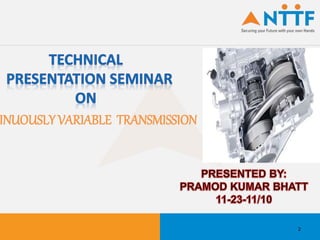
INUOUSLY VARIABLE TRANSMISSION (CVT)
BASICS OF TRANSMISSION
INTRODUCTION
WHAT IS CONTINUOUSLY VARIABLE TRANSMISSION
(CVT)
HISTORY OF CVT
CVT COMPONENTS & DESIGN
WHY USE CVT…..?
APPLICATIONS
ADVANTAGES
DISADVANTAGES
FUTURE SCOPE
CONCLUSION
REFERENCES
CONTENTS
3
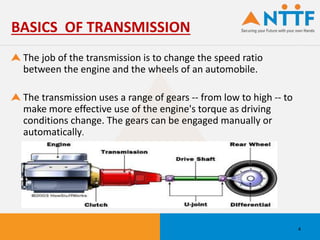
BASICS OF TRANSMISSION
The job of the transmission is to change the speed ratio
between the engine and the wheels of an automobile.
The transmission uses a range of gears -- from low to high -- to
make more effective use of the engine's torque as driving
conditions change. The gears can be engaged manually or
automatically.
4
CVT is an advanced technology of automatic transmission.
Unlike traditional automatic transmissions, continuously
variable transmissions don't have a gearbox with a set
number of gears.
Varies the transmission ratio continuously.
Shifts automatically with an infinite number of ratios.
INTRODUCTION
5
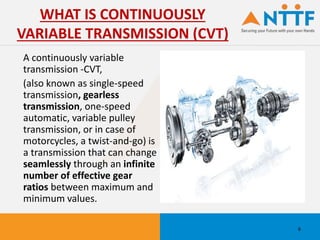
A continuously variable
transmission -CVT,
(also known as single-speed
transmission, gearless
transmission, one-speed
automatic, variable pulley
transmission, or in case of
motorcycles, a twist-and-go) is
a transmission that can change
seamlessly through an infinite
number of effective gear
ratios between maximum and
minimum values.
WHAT IS CONTINUOUSLY
VARIABLE TRANSMISSION (CVT)
6
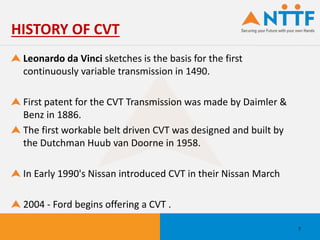
Leonardo da Vinci sketches is the basis for the first
continuously variable transmission in 1490.
First patent for the CVT Transmission was made by Daimler &
Benz in 1886.
The first workable belt driven CVT was designed and built by
the Dutchman Huub van Doorne in 1958.
In Early 1990's Nissan introduced CVT in their Nissan March
2004 - Ford begins offering a CVT .
HISTORY OF CVT
7
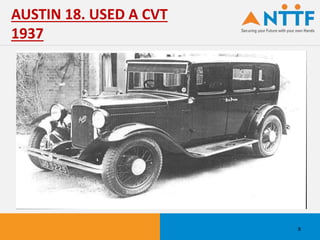
AUSTIN 18. USED A CVT
1937
8
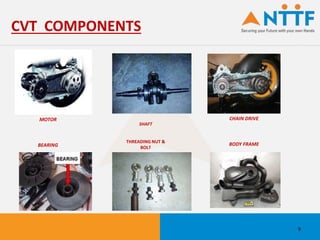
CVT COMPONENTS
9
MOTOR
BEARING
SHAFT
THREADING NUT &
BOLT
CHAIN DRIVE
BODY FRAME
10
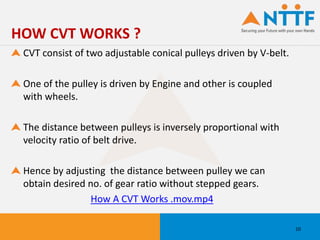
HOW CVT WORKS ?
CVT consist of two adjustable conical pulleys driven by V-belt.
One of the pulley is driven by Engine and other is coupled
with wheels.
The distance between pulleys is inversely proportional with
velocity ratio of belt drive.
Hence by adjusting the distance between pulley we can
obtain desired no. of gear ratio without stepped gears.
How A CVT Works .mov.mp4
CVT has been classified into following types:
1. Pulley Based CVTs or Reeves drive
2. Toroidal or roller-based CVTs (Extroid CVT)
3. Hydrostatic CVTs
4. Infinitely Variable Transmission (IVT)
5. Cone CVTs
DESIGNS
11
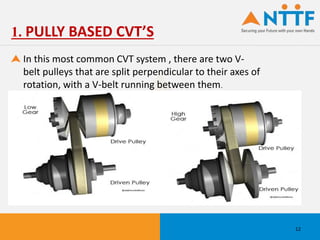
In this most common CVT system , there are two V-
belt pulleys that are split perpendicular to their axes of
rotation, with a V-belt running between them.
1. PULLY BASED CVT’S
12
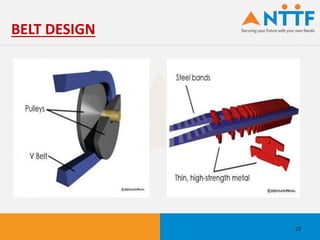
BELT DESIGN
13
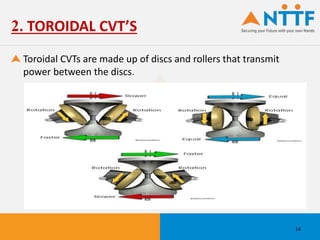
Toroidal CVTs are made up of discs and rollers that transmit
power between the discs.
2. TOROIDAL CVT’S
14
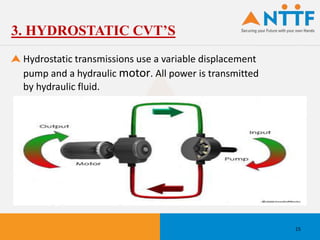
Hydrostatic transmissions use a variable displacement
pump and a hydraulic motor. All power is transmitted
by hydraulic fluid.
3. HYDROSTATIC CVT’S
15
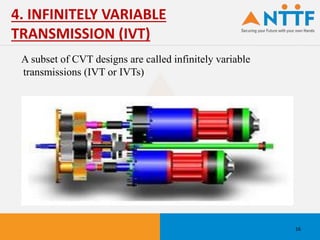
A subset of CVT designs are called infinitely variable
transmissions (IVT or IVTs)
4. INFINITELY VARIABLE
TRANSMISSION (IVT)
16
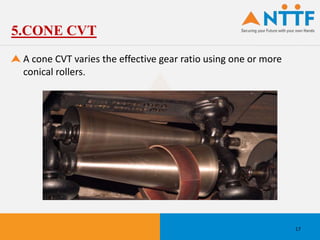
A cone CVT varies the effective gear ratio using one or more
conical rollers.
5.CONE CVT
17
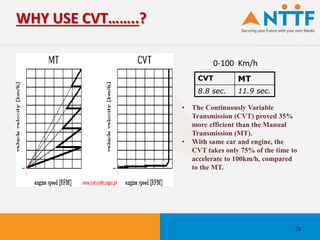
WHY USE CVT……..?
CVT MT
8.8 sec. 11.9 sec.
0-100 Km/h
• The Continuously Variable
Transmission (CVT) proved 35%
more efficient than the Manual
Transmission (MT).
• With same car and engine, the
CVT takes only 75% of the time to
accelerate to 100km/h, compared
to the MT.
18
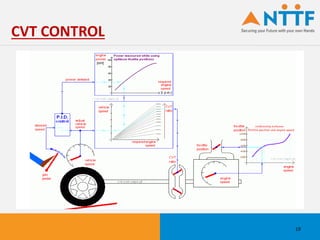
CVT CONTROL
19
Tractors
Golf Carts
Ride on Lawn Mowers
Motorized Wheelchairs
Bicycles
Power tools
Industrial Equipment
Minimachines
APPLICATIONS
20
There is improved acceleration due to the lower power loss
experienced.
Step less transmission.
Delivers maximum torque.
Provides a smoother ride than automatic transmission.
Adapts to varying road conditions and power demands to
allows for a better ride.
This improves fuel economy and reduce exhaust emissions.
There are 25% fewer moving parts to a CVT transmission
ADVANTAGES
21
Higher cost.
Belt-driven CVTs (VDP system) have a limited amount of torque.
Transmitting motion by friction causes greater wear.
Require special oil and other materials.
Becomes Jerky in automobile applications at slow speeds.
New technology so there are limited people that understand the
operations with in a CVT.
DISADVANTAGES
22
CVT can be improved with research on the belt design
permitting use in high performance vehicles.
Hybrid vehicles will also feature with this type of transmission
Electric motors can avoid the low speed/ high torque
problems often associated with CVTs, through an
innovative double-motor system.
Kia recently tested a system where the CVT allows the
engine to run at constant speed and the motor allows the
engine to run at constant torque independent of driving
conditions.
In the future a major amount of cars will feature CVT .
FUTURE SCOPE
23
Today, only a handful of cars worldwide make use of CVTs,
but the applications and benefits of continuously variable
transmissions can only increase based on today’s research and
development.
As automakers continue to develop CVTs, more and more
vehicle lines will begin to use them. As development
continues, fuel efficiency and performance benefits will
inevitably increase; this will lead to increased sales of CVT-
equipped vehicles.
Increased sales will prompt further development and
implementation, and the cycle will repeat ad infinitum.
CONCLUSION
24
www.google.com
www.wikipedia.com
www.studymafia.org
http://www.synchrotronic.com
http://auto.howstuffworks.com/cvt.htm
www.autos.aol.com
https://www.subaru.com/engineering/transmission.html
REFERENCES
25
26

Cvt ppt

  • 1.
    INDIA’S MOST VERSATILELEARNING CENTRE 1
  • 2.
  • 3.
    BASICS OF TRANSMISSION INTRODUCTION WHATIS CONTINUOUSLY VARIABLE TRANSMISSION (CVT) HISTORY OF CVT CVT COMPONENTS & DESIGN WHY USE CVT…..? APPLICATIONS ADVANTAGES DISADVANTAGES FUTURE SCOPE CONCLUSION REFERENCES CONTENTS 3
  • 4.
    BASICS OF TRANSMISSION Thejob of the transmission is to change the speed ratio between the engine and the wheels of an automobile. The transmission uses a range of gears -- from low to high -- to make more effective use of the engine's torque as driving conditions change. The gears can be engaged manually or automatically. 4
  • 5.
    CVT is anadvanced technology of automatic transmission. Unlike traditional automatic transmissions, continuously variable transmissions don't have a gearbox with a set number of gears. Varies the transmission ratio continuously. Shifts automatically with an infinite number of ratios. INTRODUCTION 5
  • 6.
    A continuously variable transmission-CVT, (also known as single-speed transmission, gearless transmission, one-speed automatic, variable pulley transmission, or in case of motorcycles, a twist-and-go) is a transmission that can change seamlessly through an infinite number of effective gear ratios between maximum and minimum values. WHAT IS CONTINUOUSLY VARIABLE TRANSMISSION (CVT) 6
  • 7.
    Leonardo da Vincisketches is the basis for the first continuously variable transmission in 1490. First patent for the CVT Transmission was made by Daimler & Benz in 1886. The first workable belt driven CVT was designed and built by the Dutchman Huub van Doorne in 1958. In Early 1990's Nissan introduced CVT in their Nissan March 2004 - Ford begins offering a CVT . HISTORY OF CVT 7
  • 8.
    AUSTIN 18. USEDA CVT 1937 8
  • 9.
  • 10.
    10 HOW CVT WORKS? CVT consist of two adjustable conical pulleys driven by V-belt. One of the pulley is driven by Engine and other is coupled with wheels. The distance between pulleys is inversely proportional with velocity ratio of belt drive. Hence by adjusting the distance between pulley we can obtain desired no. of gear ratio without stepped gears. How A CVT Works .mov.mp4
  • 11.
    CVT has beenclassified into following types: 1. Pulley Based CVTs or Reeves drive 2. Toroidal or roller-based CVTs (Extroid CVT) 3. Hydrostatic CVTs 4. Infinitely Variable Transmission (IVT) 5. Cone CVTs DESIGNS 11
  • 12.
    In this mostcommon CVT system , there are two V- belt pulleys that are split perpendicular to their axes of rotation, with a V-belt running between them. 1. PULLY BASED CVT’S 12
  • 13.
  • 14.
    Toroidal CVTs aremade up of discs and rollers that transmit power between the discs. 2. TOROIDAL CVT’S 14
  • 15.
    Hydrostatic transmissions usea variable displacement pump and a hydraulic motor. All power is transmitted by hydraulic fluid. 3. HYDROSTATIC CVT’S 15
  • 16.
    A subset ofCVT designs are called infinitely variable transmissions (IVT or IVTs) 4. INFINITELY VARIABLE TRANSMISSION (IVT) 16
  • 17.
    A cone CVTvaries the effective gear ratio using one or more conical rollers. 5.CONE CVT 17
  • 18.
    WHY USE CVT……..? CVTMT 8.8 sec. 11.9 sec. 0-100 Km/h • The Continuously Variable Transmission (CVT) proved 35% more efficient than the Manual Transmission (MT). • With same car and engine, the CVT takes only 75% of the time to accelerate to 100km/h, compared to the MT. 18
  • 19.
  • 20.
    Tractors Golf Carts Ride onLawn Mowers Motorized Wheelchairs Bicycles Power tools Industrial Equipment Minimachines APPLICATIONS 20
  • 21.
    There is improvedacceleration due to the lower power loss experienced. Step less transmission. Delivers maximum torque. Provides a smoother ride than automatic transmission. Adapts to varying road conditions and power demands to allows for a better ride. This improves fuel economy and reduce exhaust emissions. There are 25% fewer moving parts to a CVT transmission ADVANTAGES 21
  • 22.
    Higher cost. Belt-driven CVTs(VDP system) have a limited amount of torque. Transmitting motion by friction causes greater wear. Require special oil and other materials. Becomes Jerky in automobile applications at slow speeds. New technology so there are limited people that understand the operations with in a CVT. DISADVANTAGES 22
  • 23.
    CVT can beimproved with research on the belt design permitting use in high performance vehicles. Hybrid vehicles will also feature with this type of transmission Electric motors can avoid the low speed/ high torque problems often associated with CVTs, through an innovative double-motor system. Kia recently tested a system where the CVT allows the engine to run at constant speed and the motor allows the engine to run at constant torque independent of driving conditions. In the future a major amount of cars will feature CVT . FUTURE SCOPE 23
  • 24.
    Today, only ahandful of cars worldwide make use of CVTs, but the applications and benefits of continuously variable transmissions can only increase based on today’s research and development. As automakers continue to develop CVTs, more and more vehicle lines will begin to use them. As development continues, fuel efficiency and performance benefits will inevitably increase; this will lead to increased sales of CVT- equipped vehicles. Increased sales will prompt further development and implementation, and the cycle will repeat ad infinitum. CONCLUSION 24
  • 25.
  • 26.

Editor's Notes