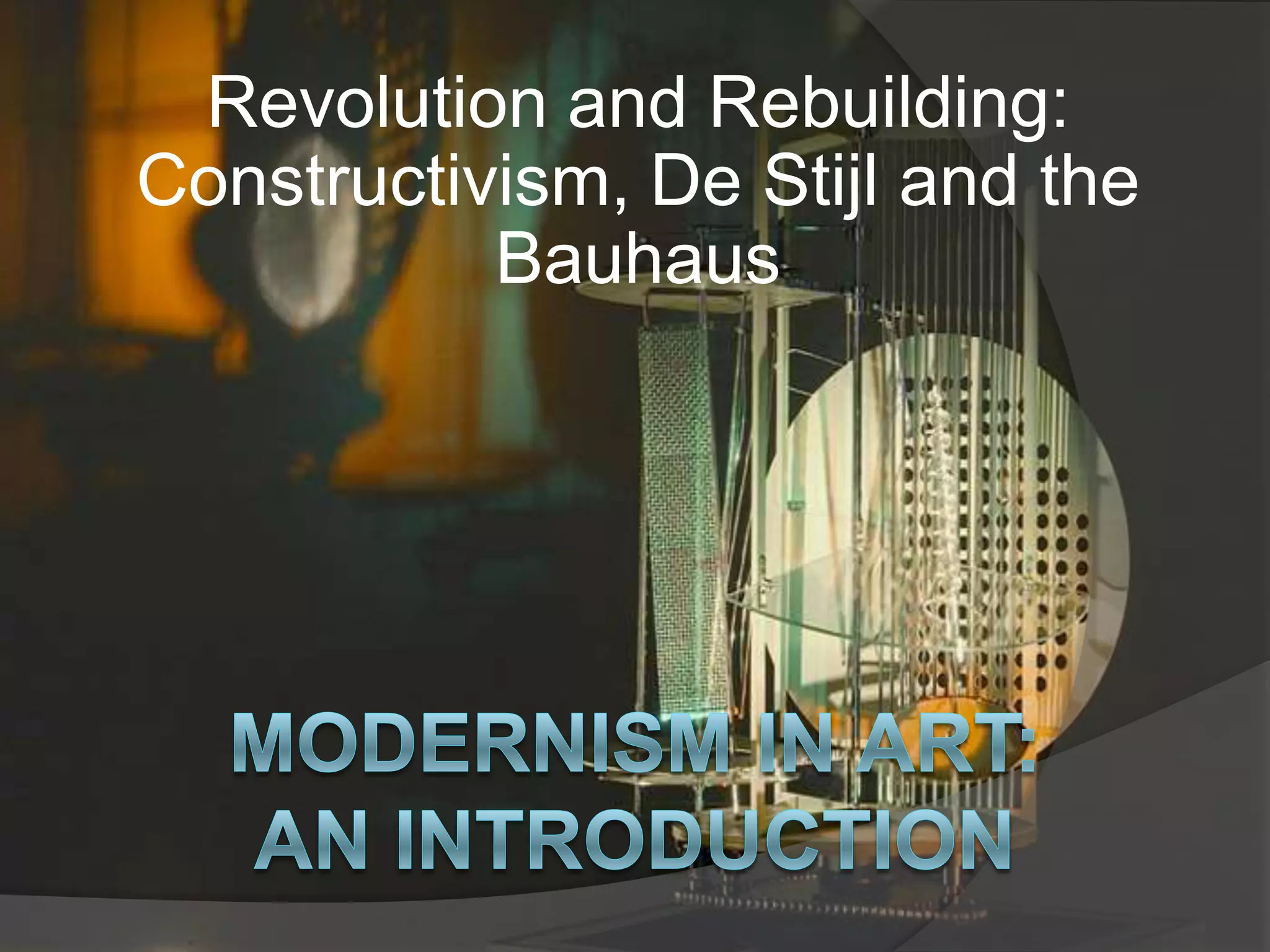
Revolution and Rebuilding:  Constructivism, De Stijl and the BauhausModernism in Art: An Introduction
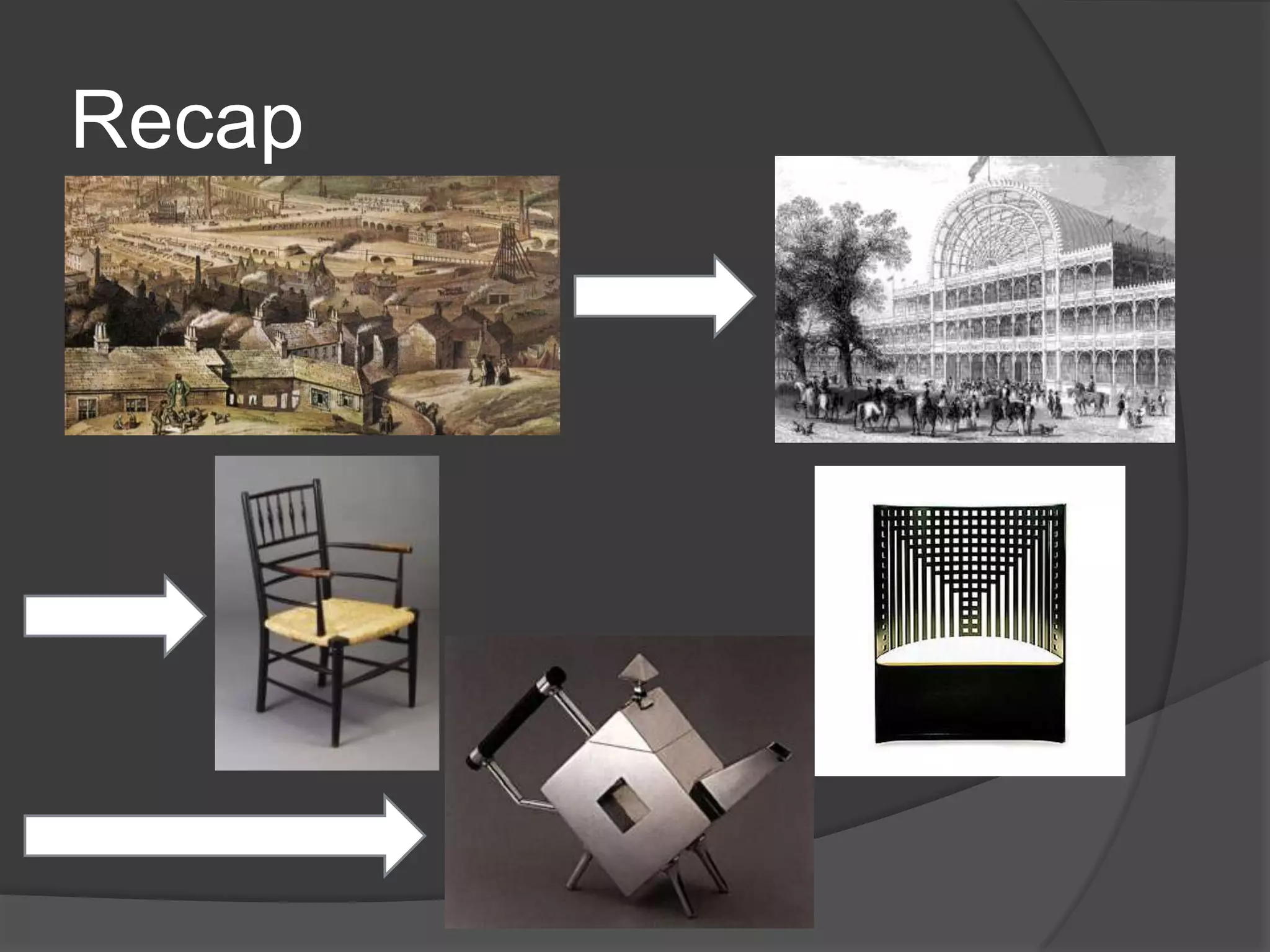
RecapForm follows Function
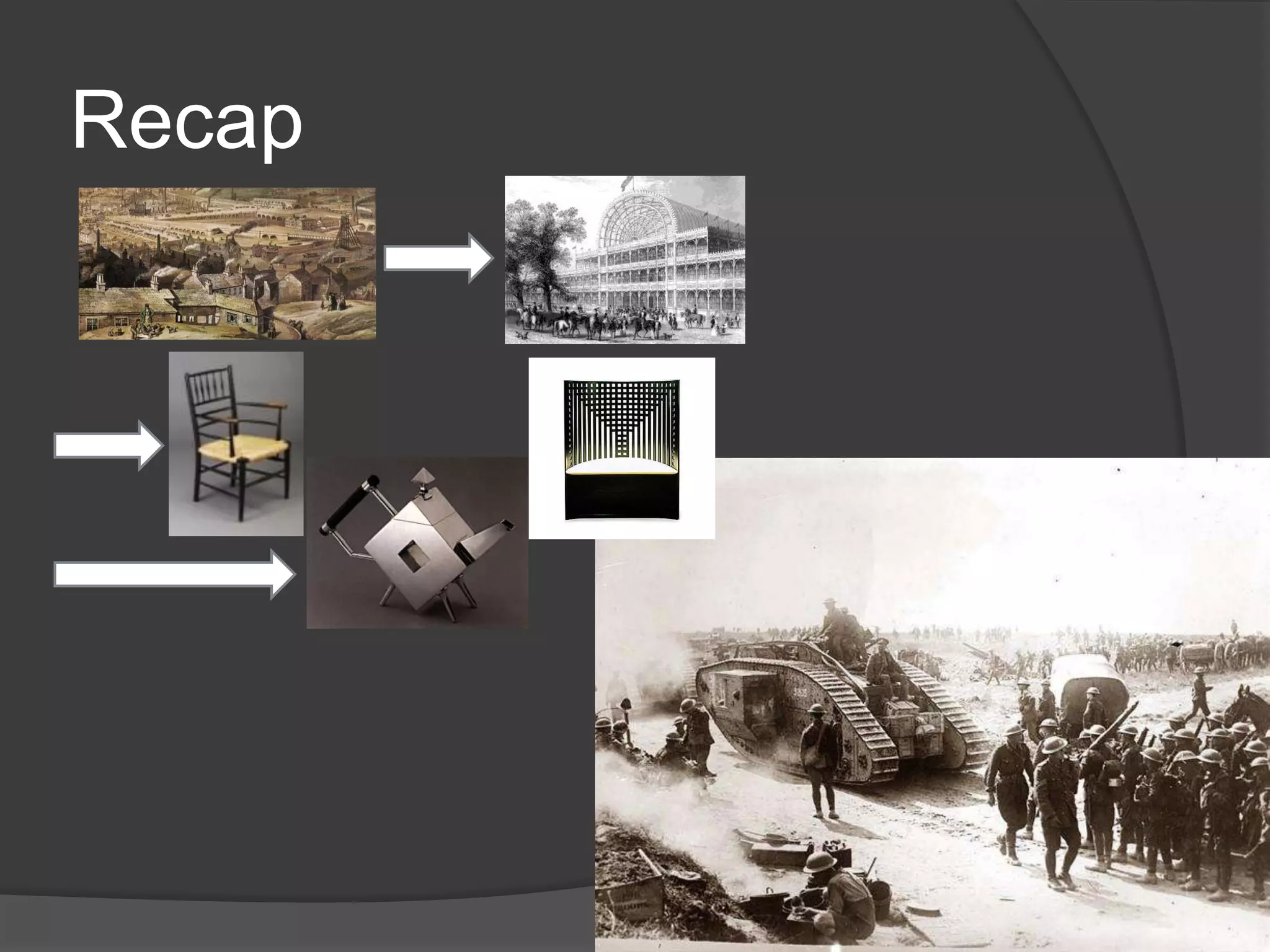
Recap
Recap
Ornament and Crime – Adolf Loos“The child is amoral. To us the Papuan is also amoral [...] The Papuan tattoos his skin, his boat, his oar, in short, everything that is within his reach. He is no criminal. The modern man who tattoos himself is a criminal or a degenerate. There are prisons where eighty percent of the inmates bear tattoos.”“...the man of our time who daubs the walls with erotic symbols to satisfy an inner urge is a criminal or a degenerate. It is obvious that this urge overcomes man; such symptoms of degeneration most forcefully express themselves in public conveniences. One can measure the culture of a country by the degree to which its lavatory walls are daubed [...] what is natural to the Papuan and the child is a symptom of degeneration in the modern man.”“The evolution of culture is synonymous with the removal of ornament from objects of daily use.”(Loos 1908)
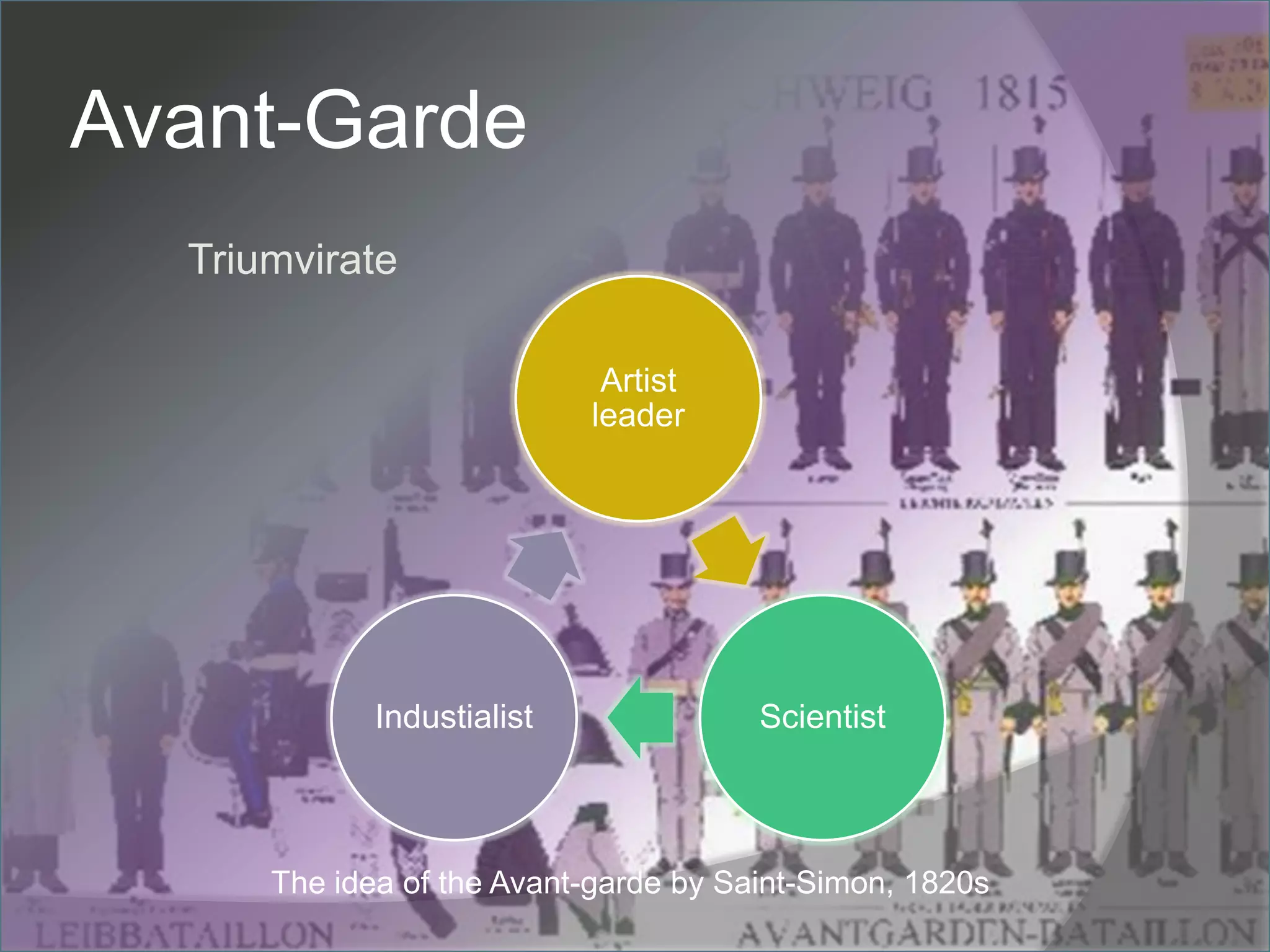
Avant-GardeTriumvirateThe idea of the Avant-garde by Saint-Simon, 1820s
“The ambition [of the artistic-social avant-garde] was to create a new social  role for art, one that made the artist a significant participant in the organization and building of social life” (Margolin 1997, p.2)Giacomo Balla (1914)Design for Futurist Suit
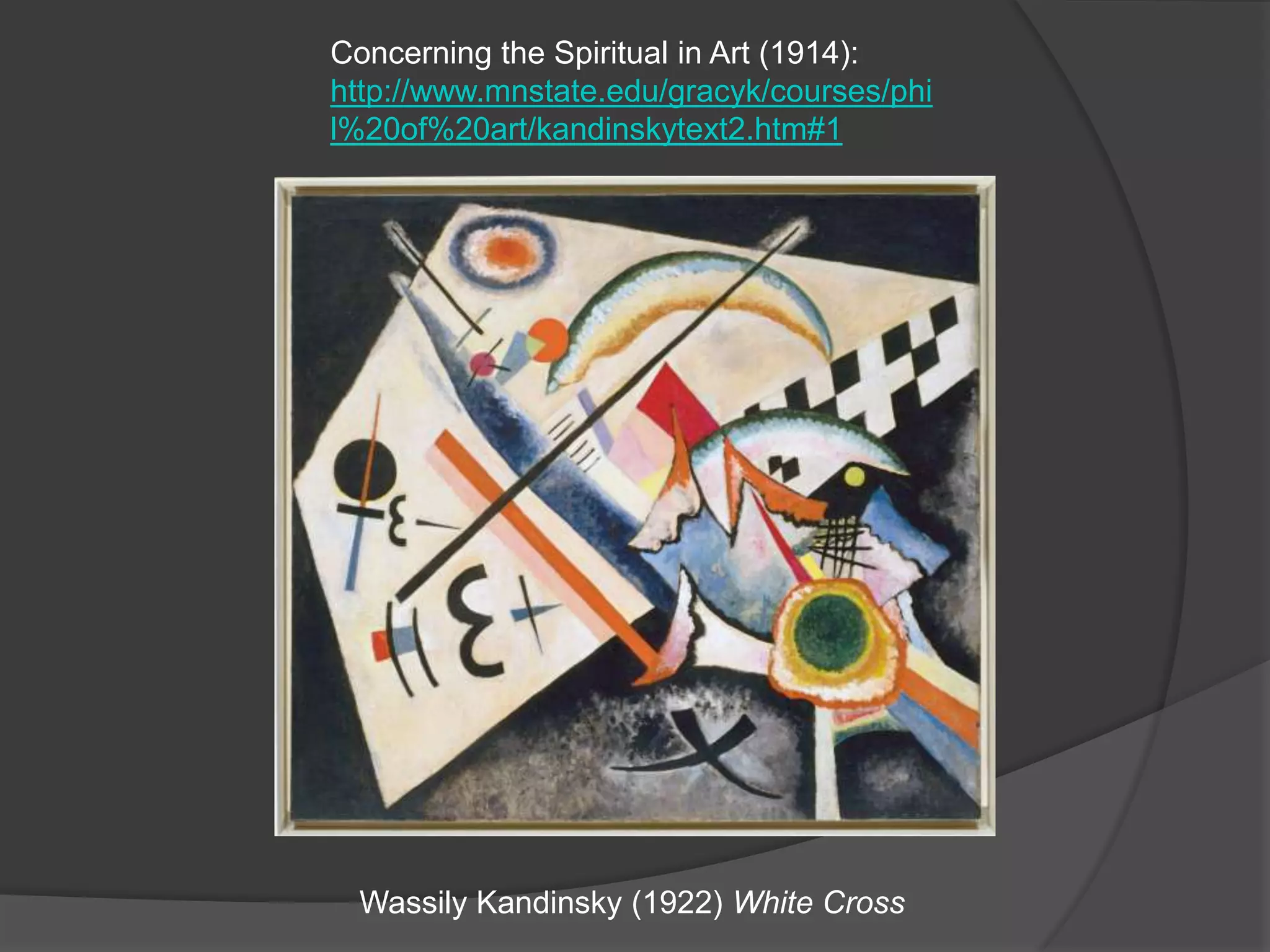
Concerning the Spiritual in Art (1914):  http://www.mnstate.edu/gracyk/courses/phil%20of%20art/kandinskytext2.htm#1Wassily Kandinsky (1922) White Cross
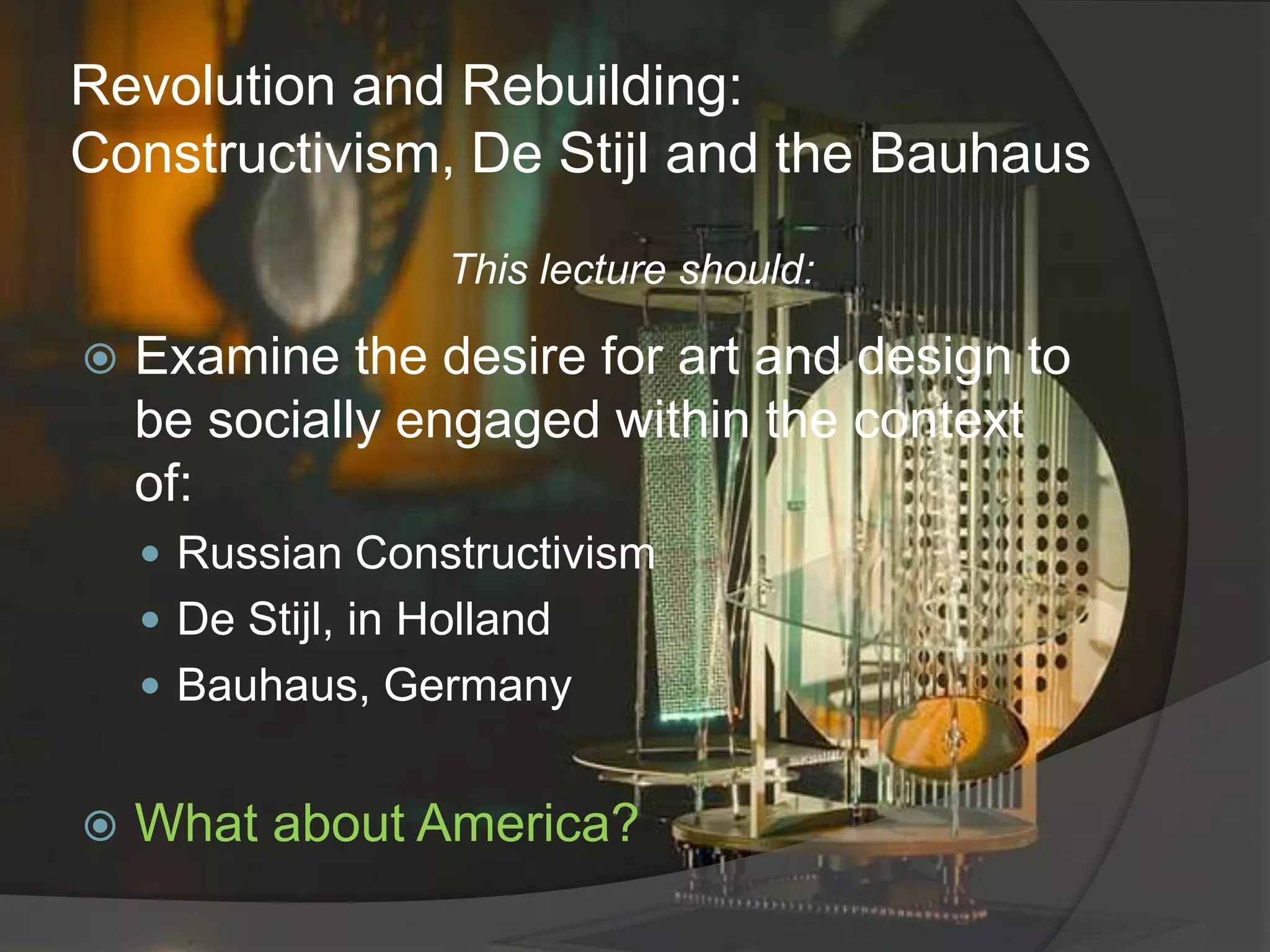
Revolution and Rebuilding:  Constructivism, De Stijl and the BauhausThis lecture should:Examine the desire for art and design to be socially engaged within the context of:Russian ConstructivismDe Stijl, in Holland Bauhaus, GermanyWhat about America?
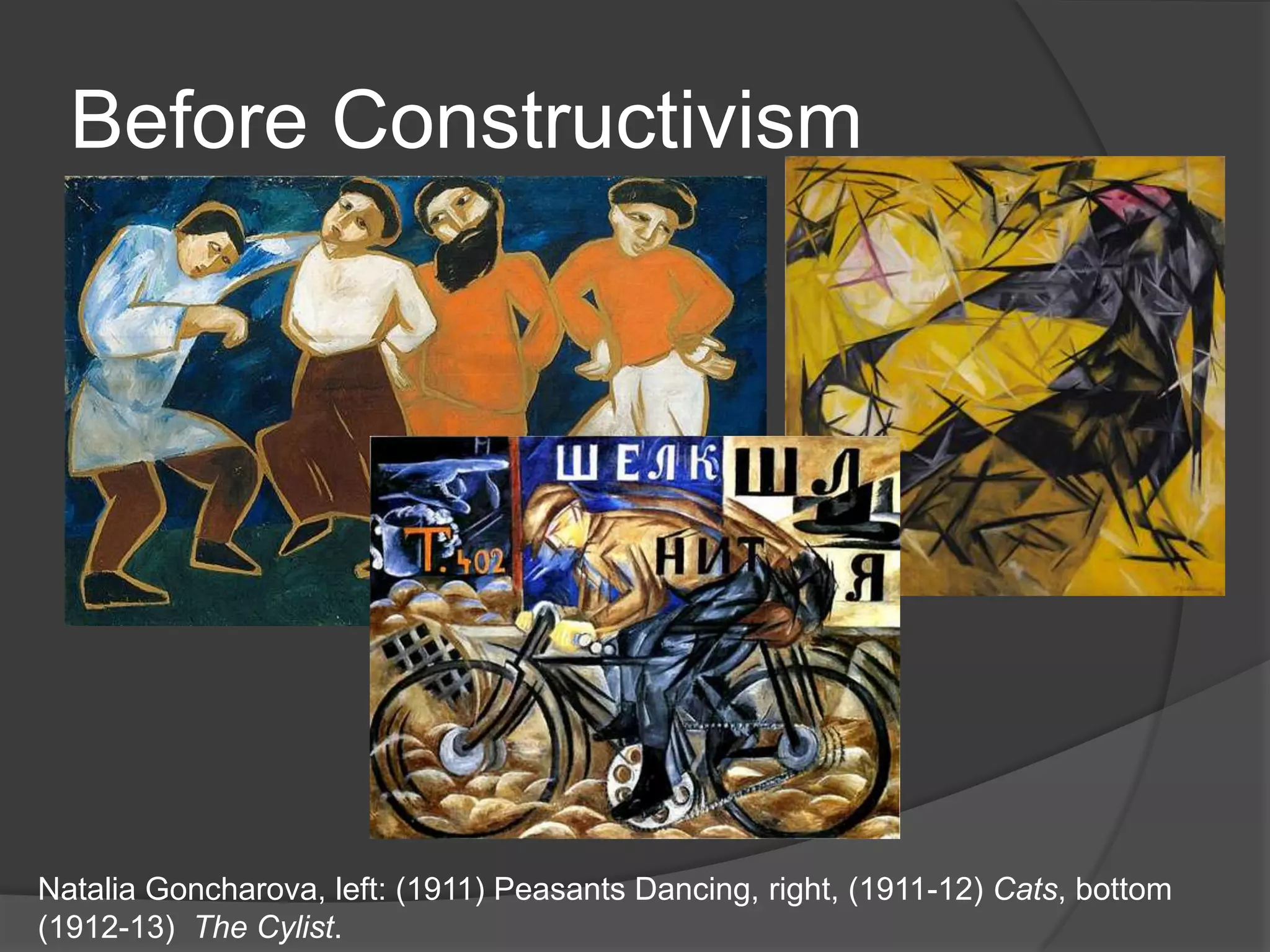
Before ConstructivismNatalia Goncharova, left: (1911) Peasants Dancing, right, (1911-12) Cats, bottom (1912-13)  The Cylist.
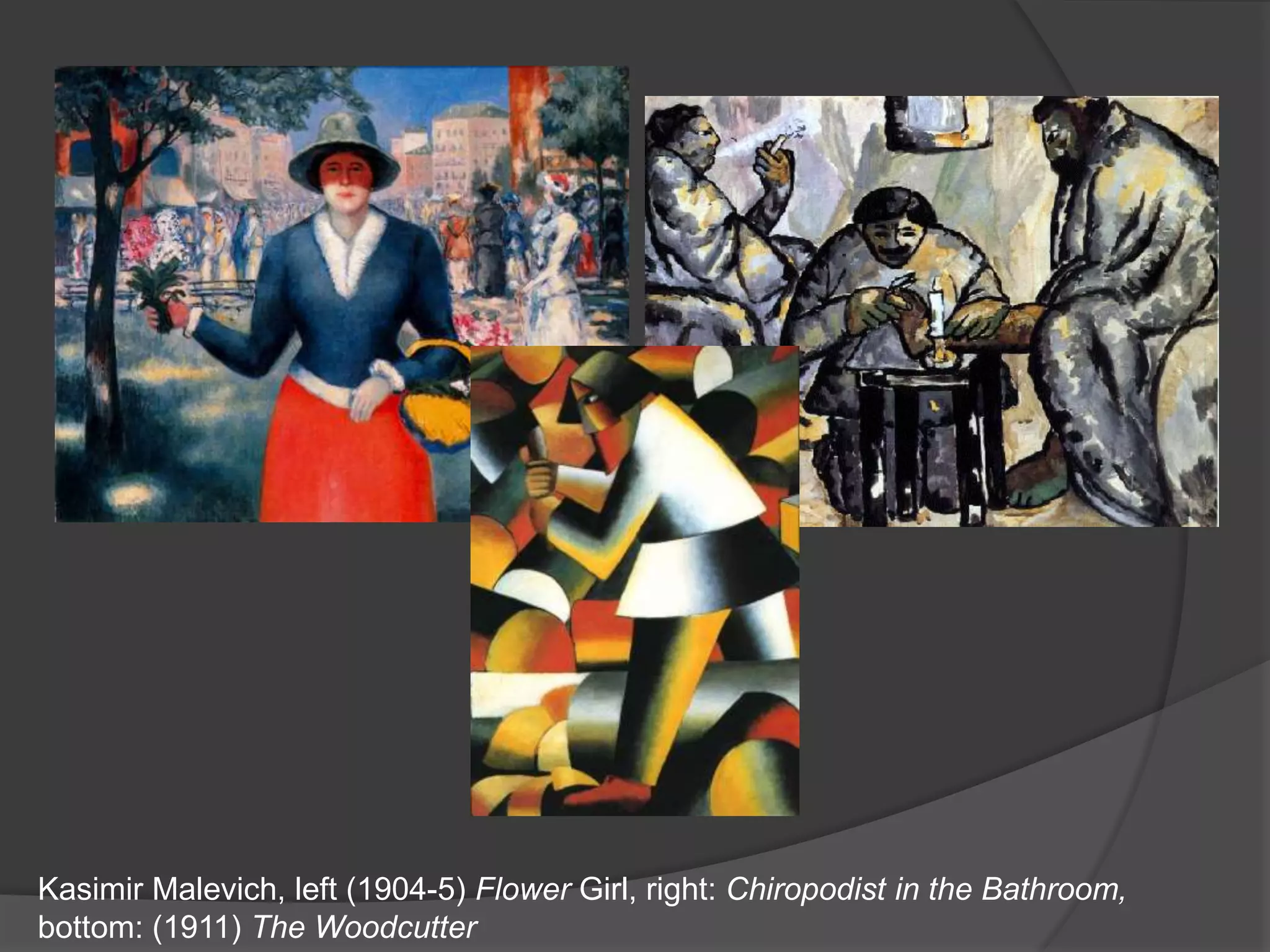
Kasimir Malevich, left (1904-5) Flower Girl, right: Chiropodist in the Bathroom, bottom: (1911) The Woodcutter
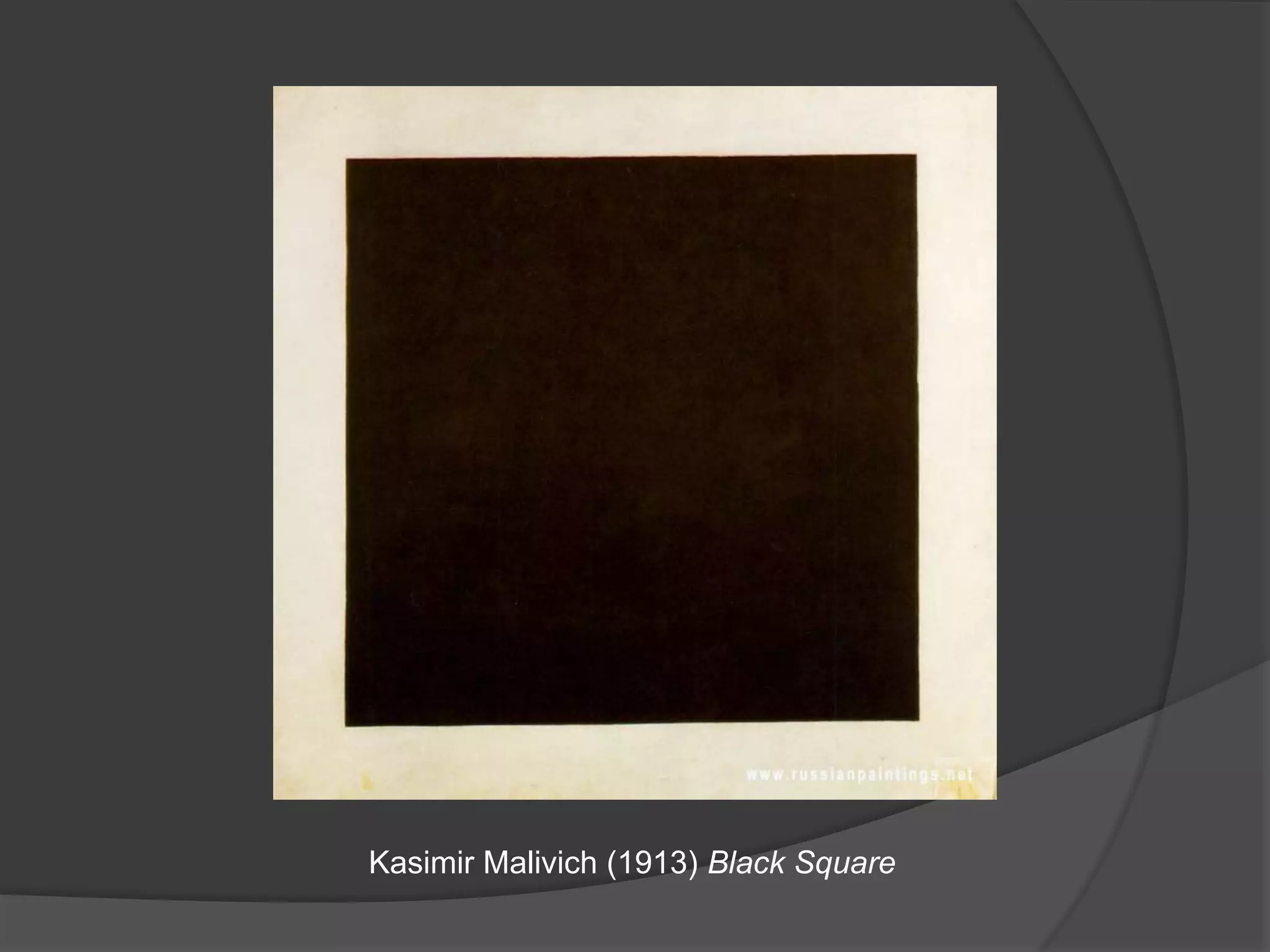
Kasimir Malivich (1913) Black Square
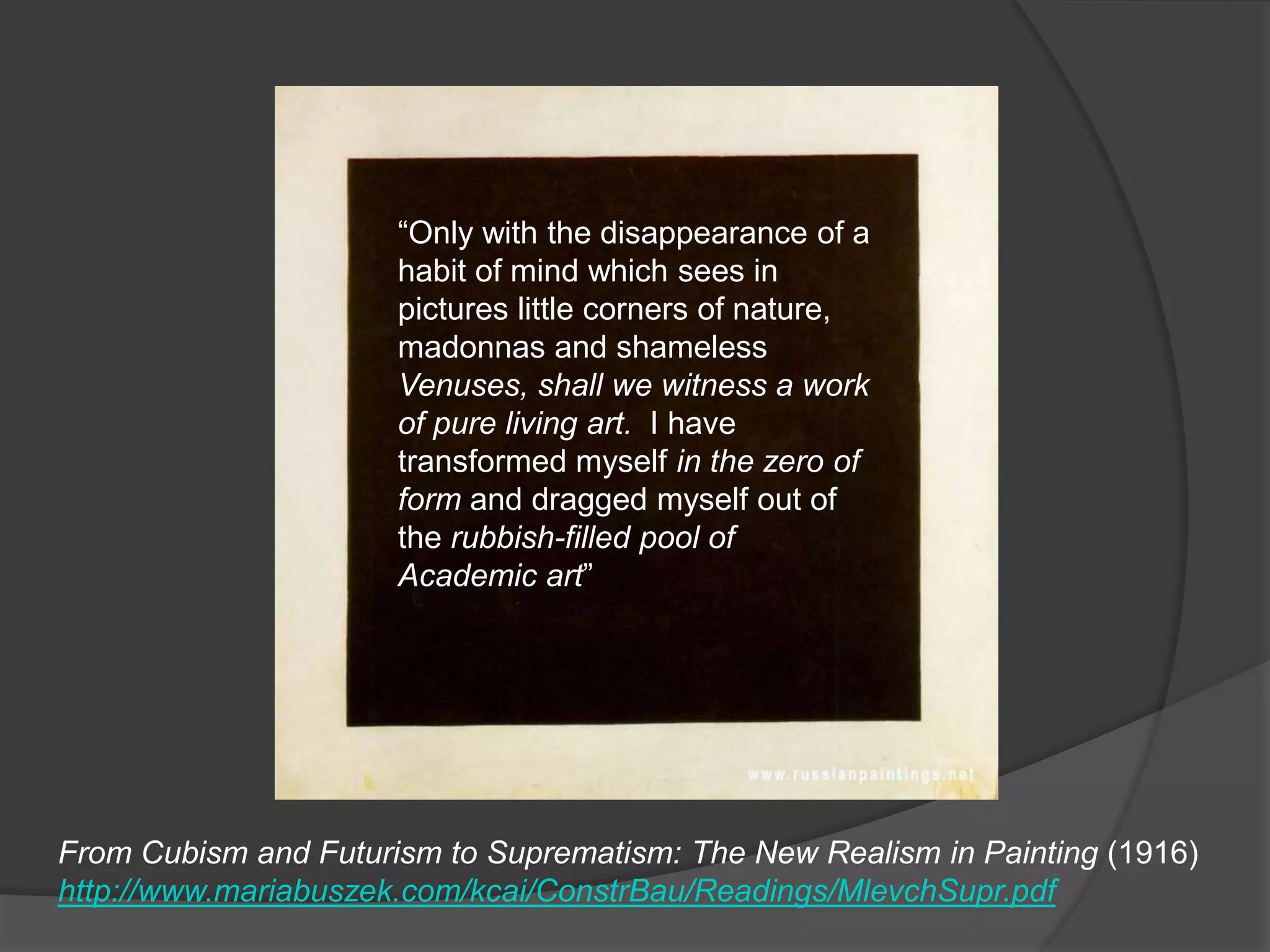
“Only with the disappearance of a habit of mind which sees in pictures little corners of nature, madonnas and shameless Venuses, shall we witness a work of pure living art.  I have transformed myself in the zero of form and dragged myself out of the rubbish-filled pool of Academic art”From Cubism and Futurism to Suprematism: The New Realism in Painting (1916)http://www.mariabuszek.com/kcai/ConstrBau/Readings/MlevchSupr.pdf
“The artist can be a creator only when the forms in his picture have nothing in common with nature [...] art is the ability to construct [...] on the basis of weight, speed and the directions of movement.”Kasimir Malevich (1916) Suprematist Construction
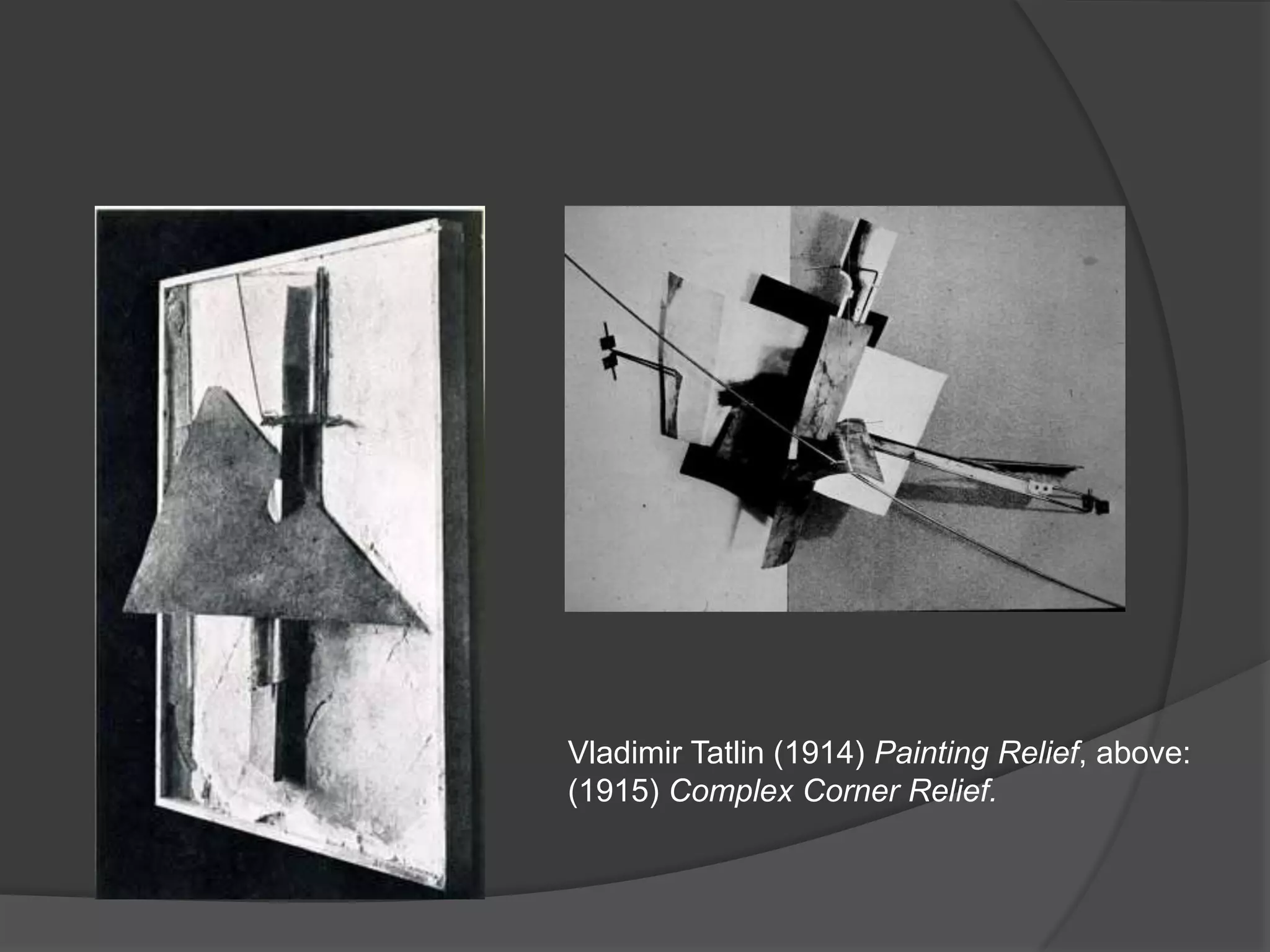
Vladimir Tatlin (1914) Painting Relief, above: (1915) Complex Corner Relief.
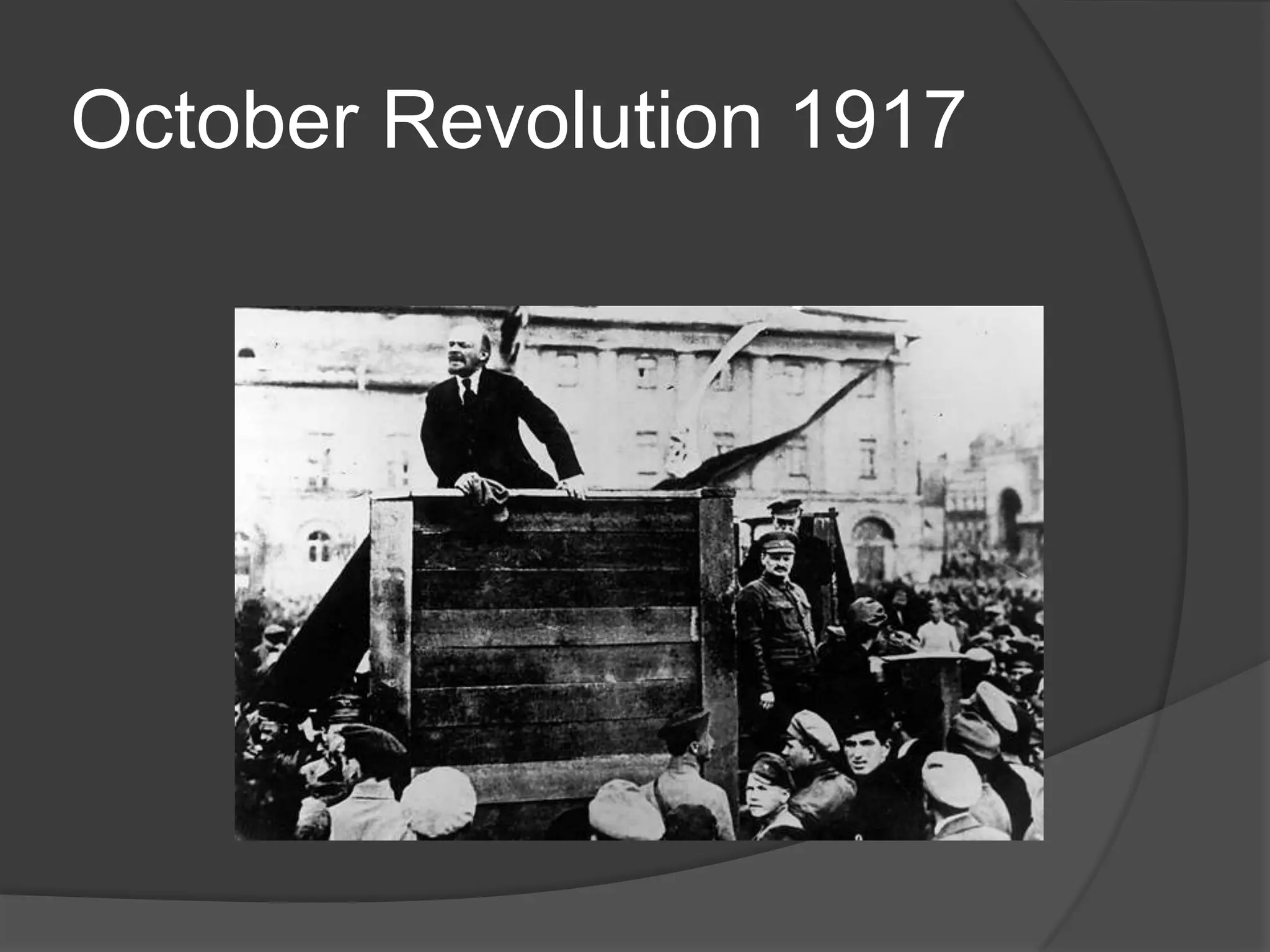
October Revolution 1917
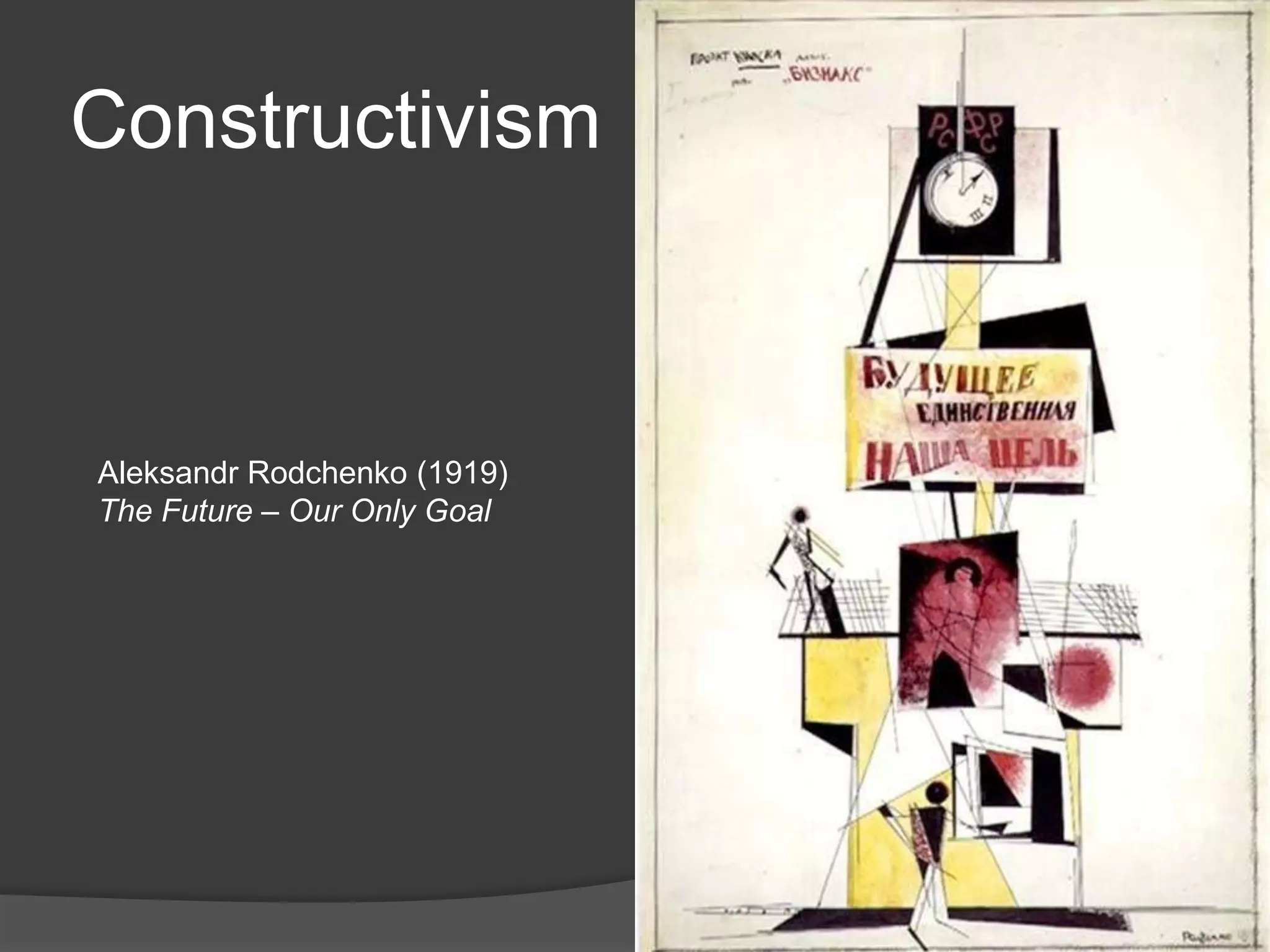
ConstructivismAleksandr Rodchenko (1919)The Future – Our Only Goal
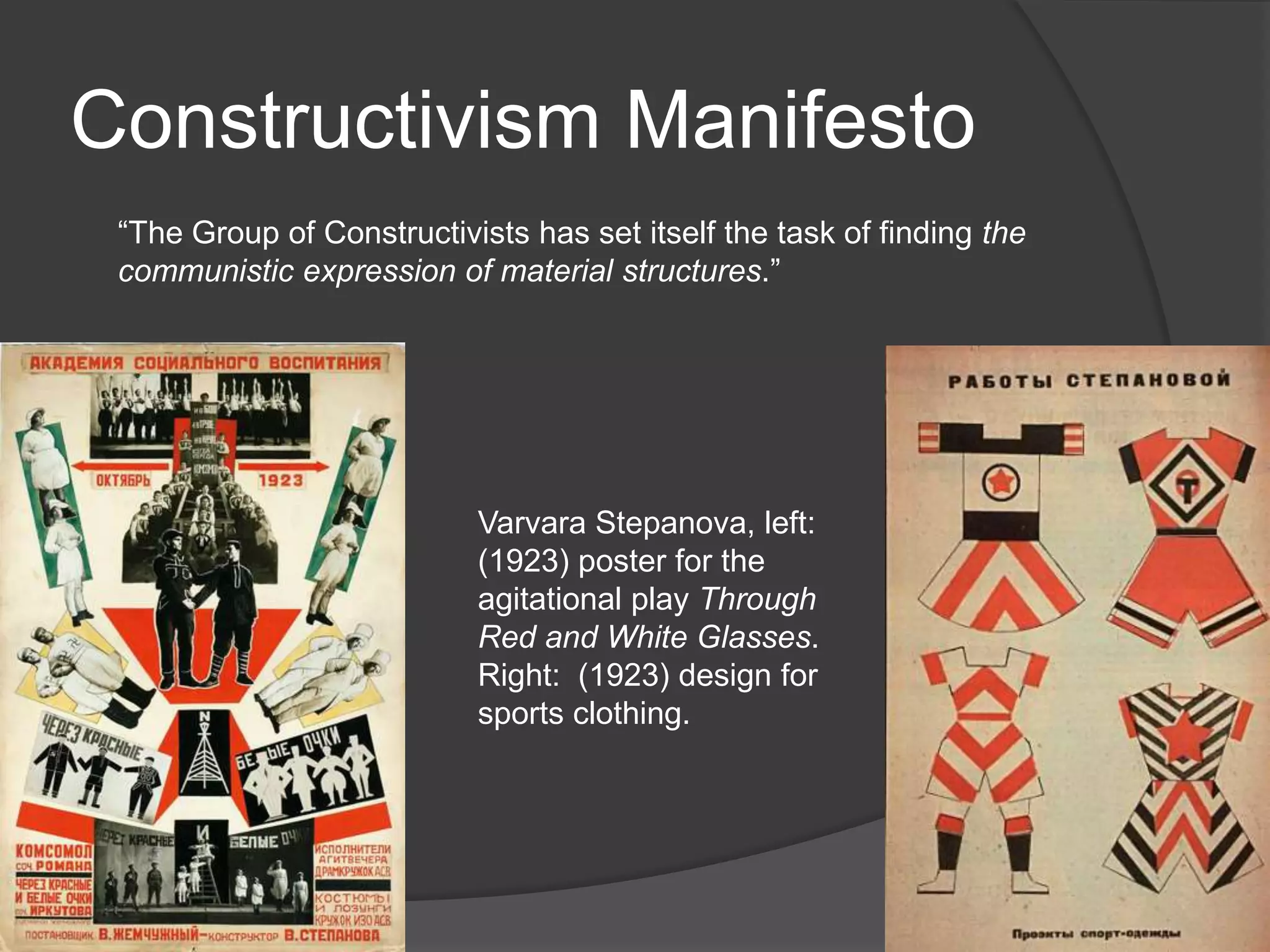
Constructivism Manifesto“The Group of Constructivists has set itself the task of finding the communistic expression of material structures.”Varvara Stepanova, left:  (1923) poster for the agitational play Through Red and White Glasses.  Right:  (1923) design for sports clothing.
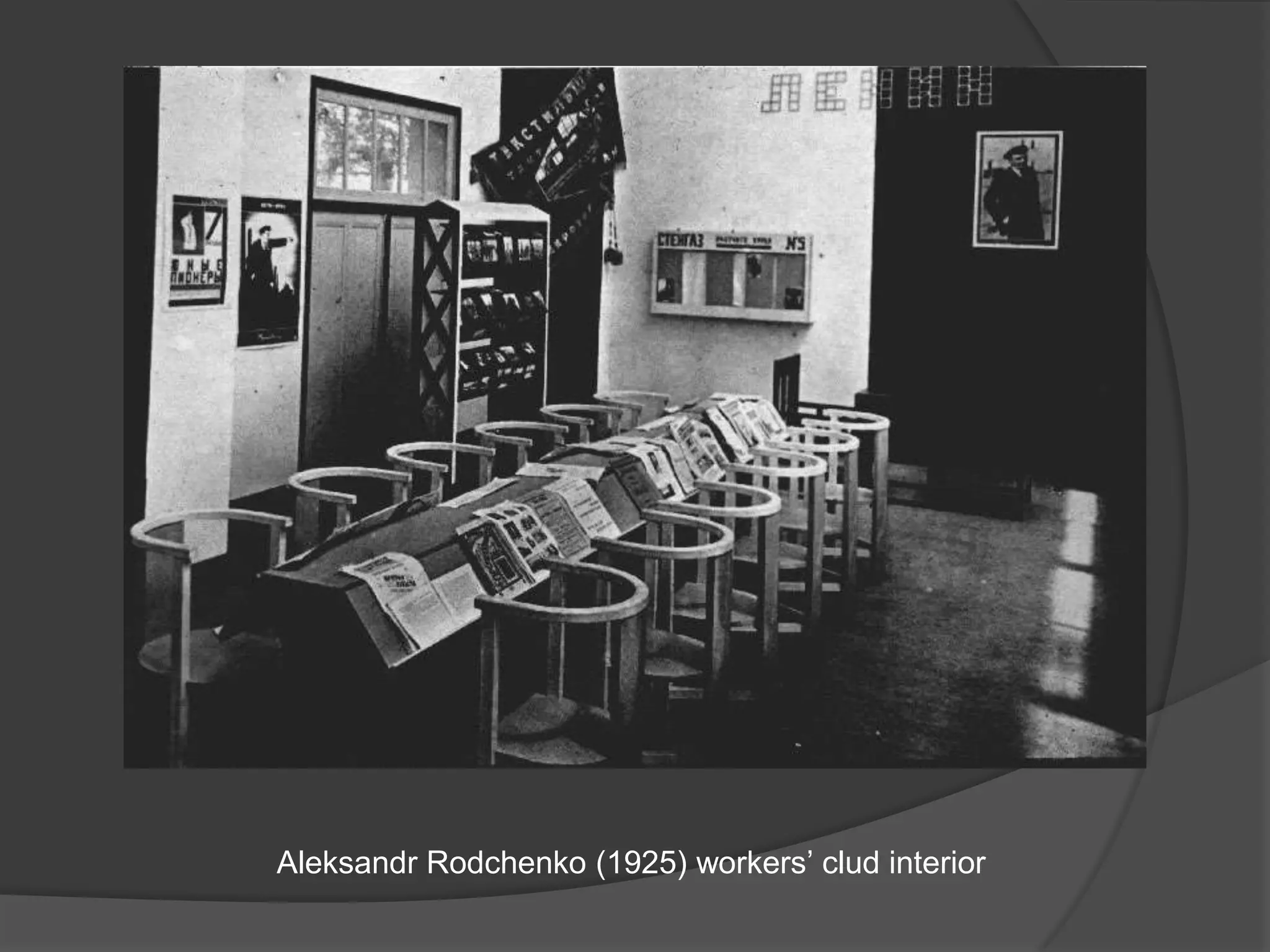
Aleksandr Rodchenko (1925) workers’ clud interior
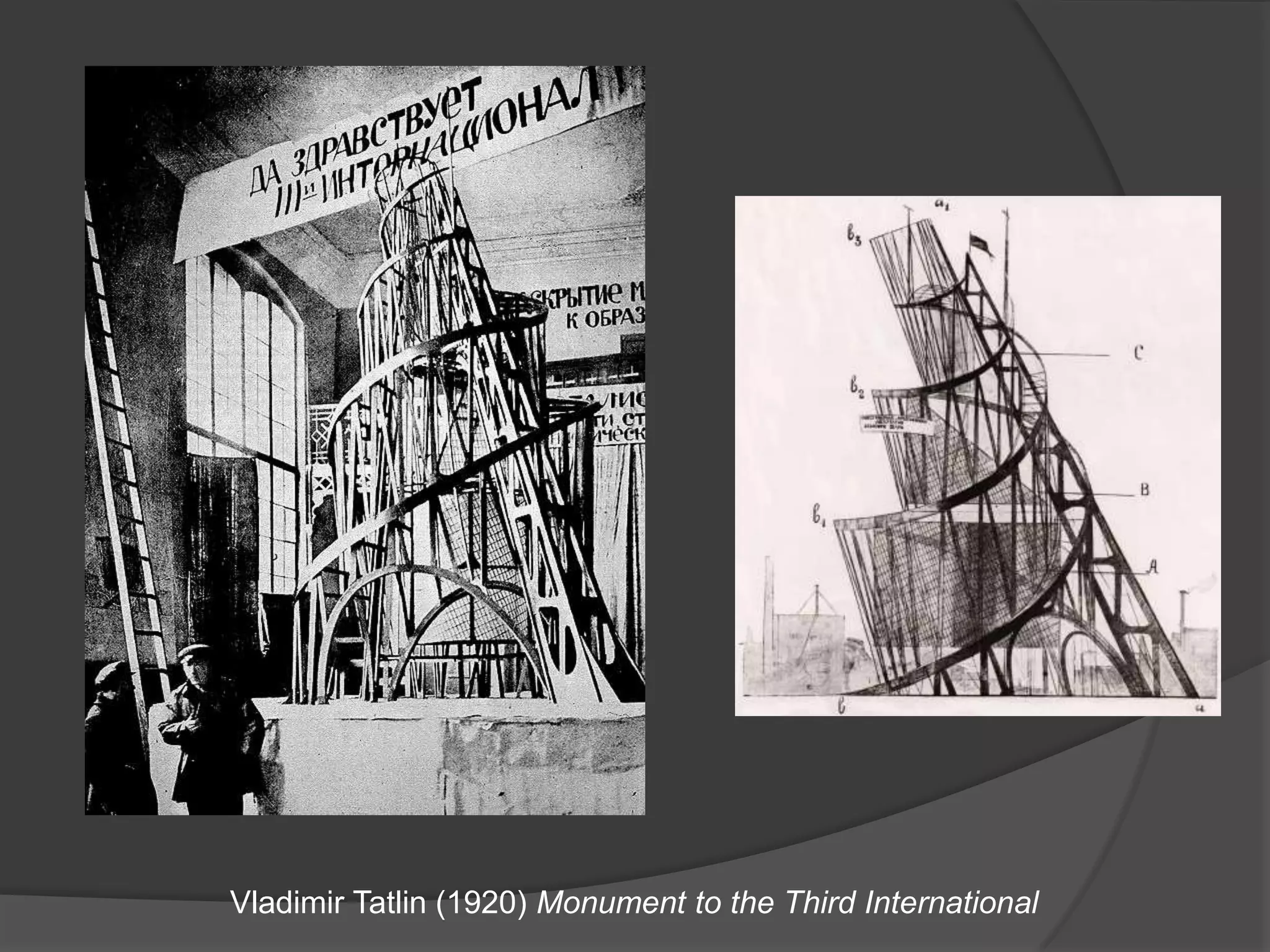
Vladimir Tatlin (1920) Monument to the Third International
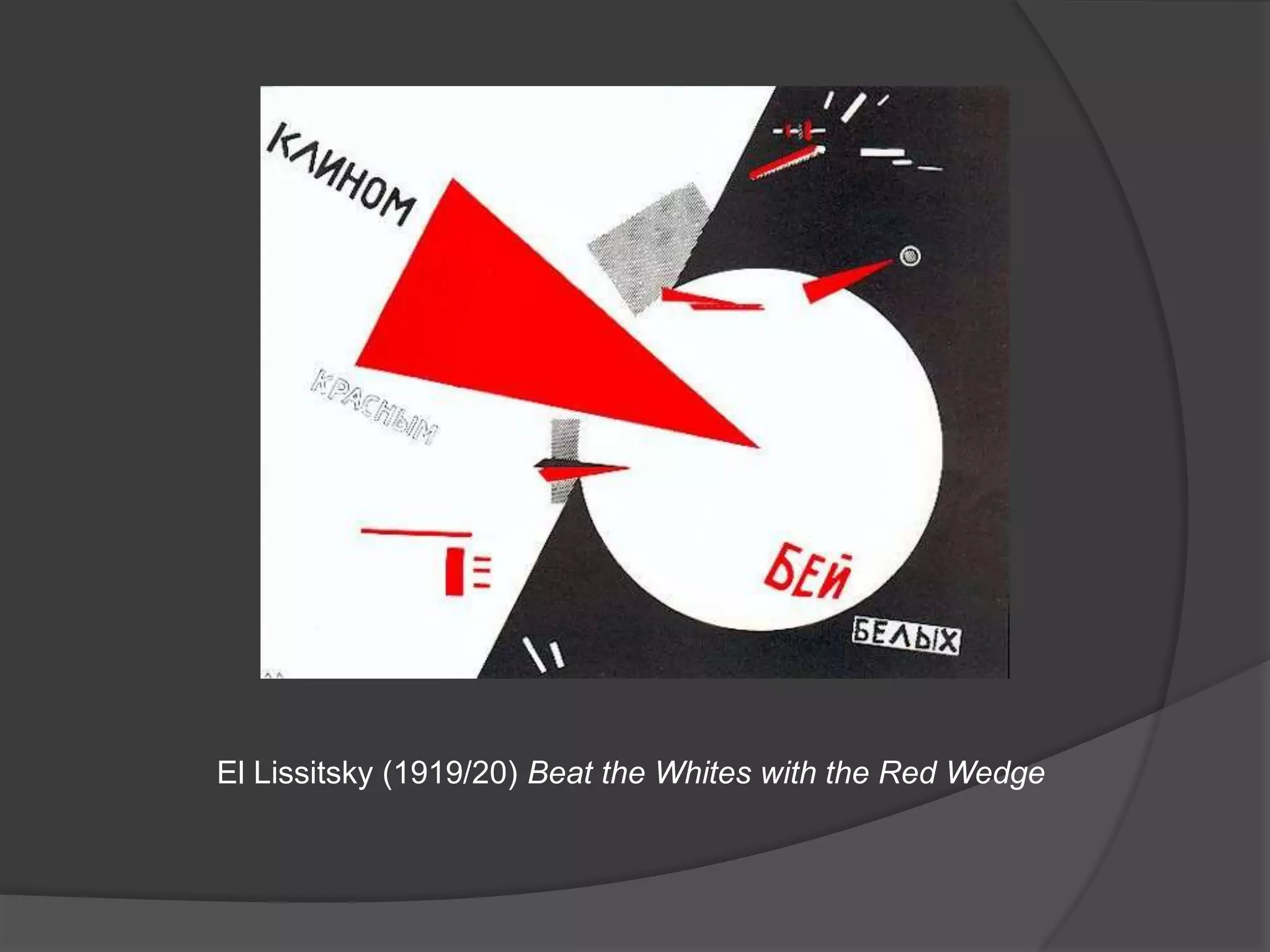
El Lissitsky (1919/20) Beat the Whites with the Red Wedge
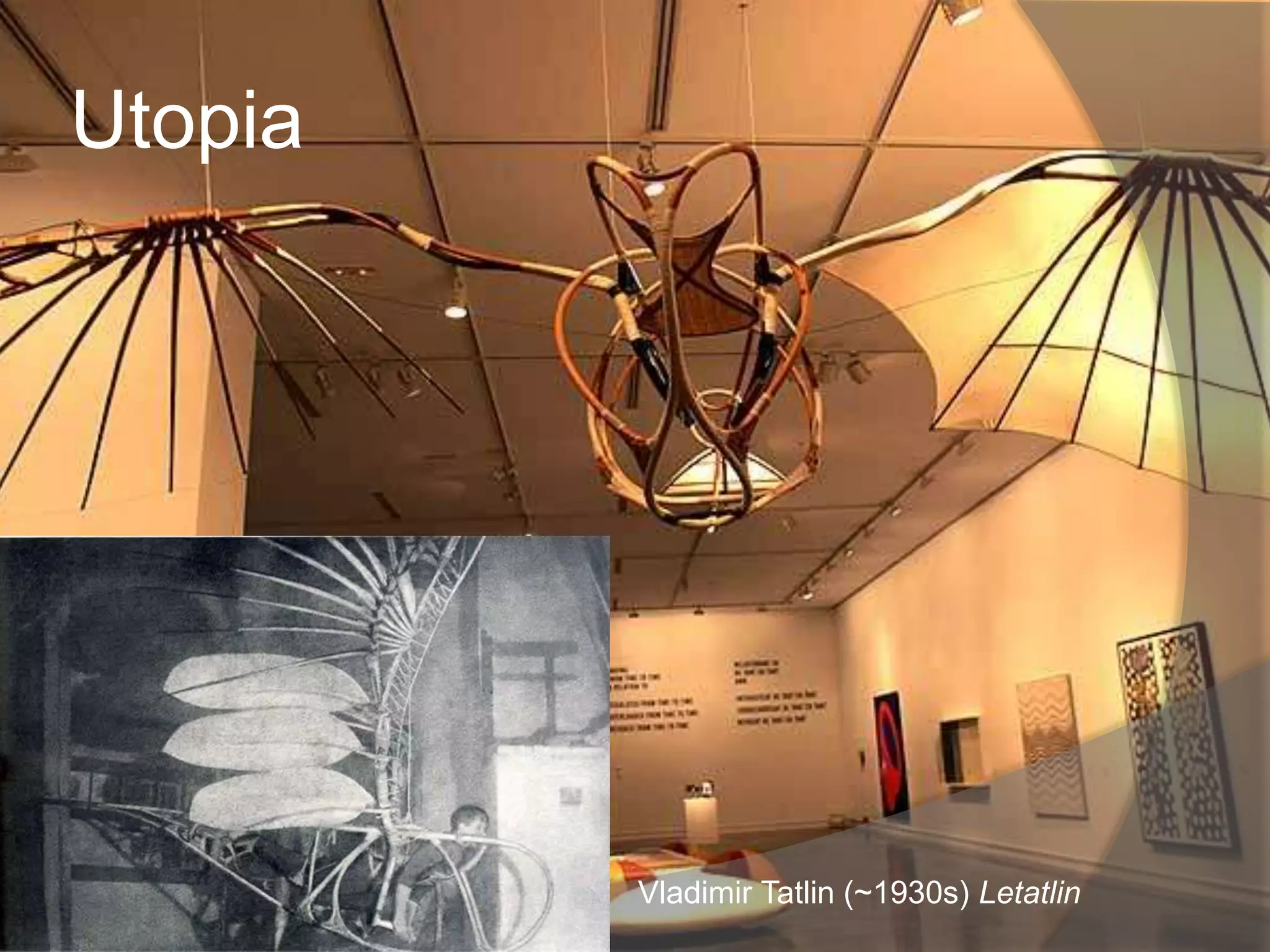
UtopiaVladimir Tatlin (~1930s) Letatlin
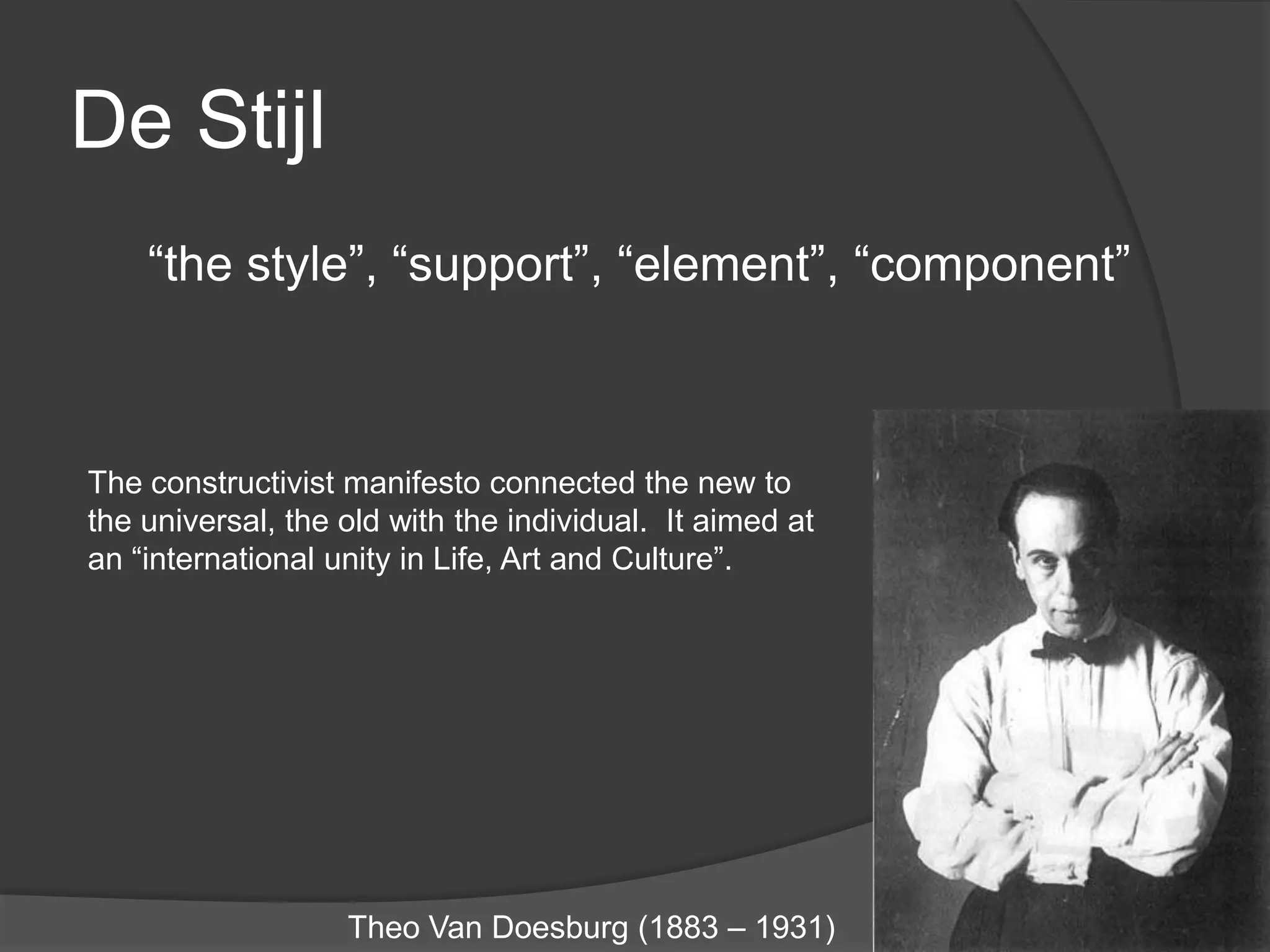
De Stijl“the style”, “support”, “element”, “component”The constructivist manifesto connected the new to the universal, the old with the individual.  It aimed at an “international unity in Life, Art and Culture”.Theo Van Doesburg (1883 – 1931)
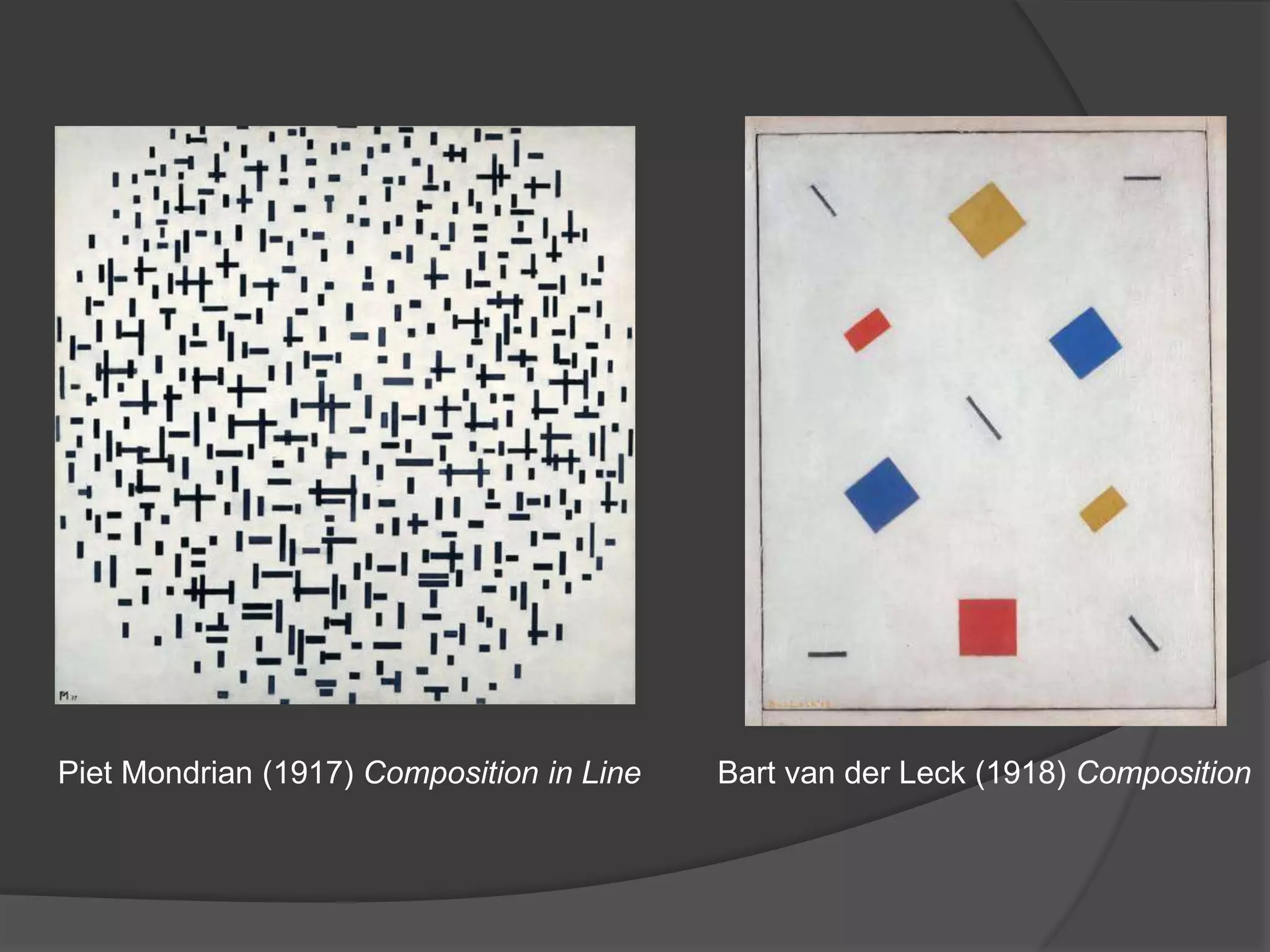
Piet Mondrian (1917) Composition in LineBart van der Leck (1918) Composition
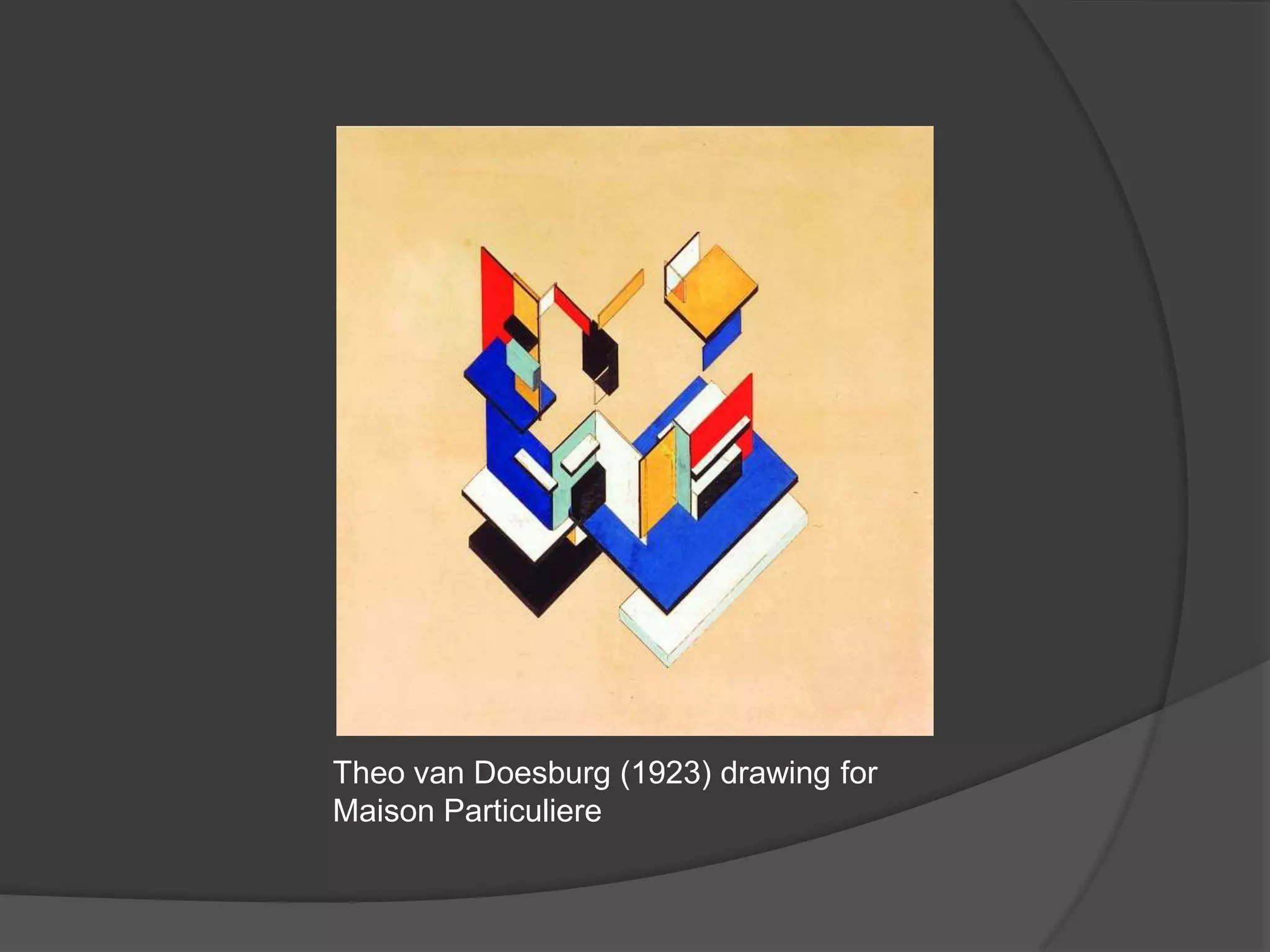
Theo van Doesburg (1923) drawing for Maison Particuliere
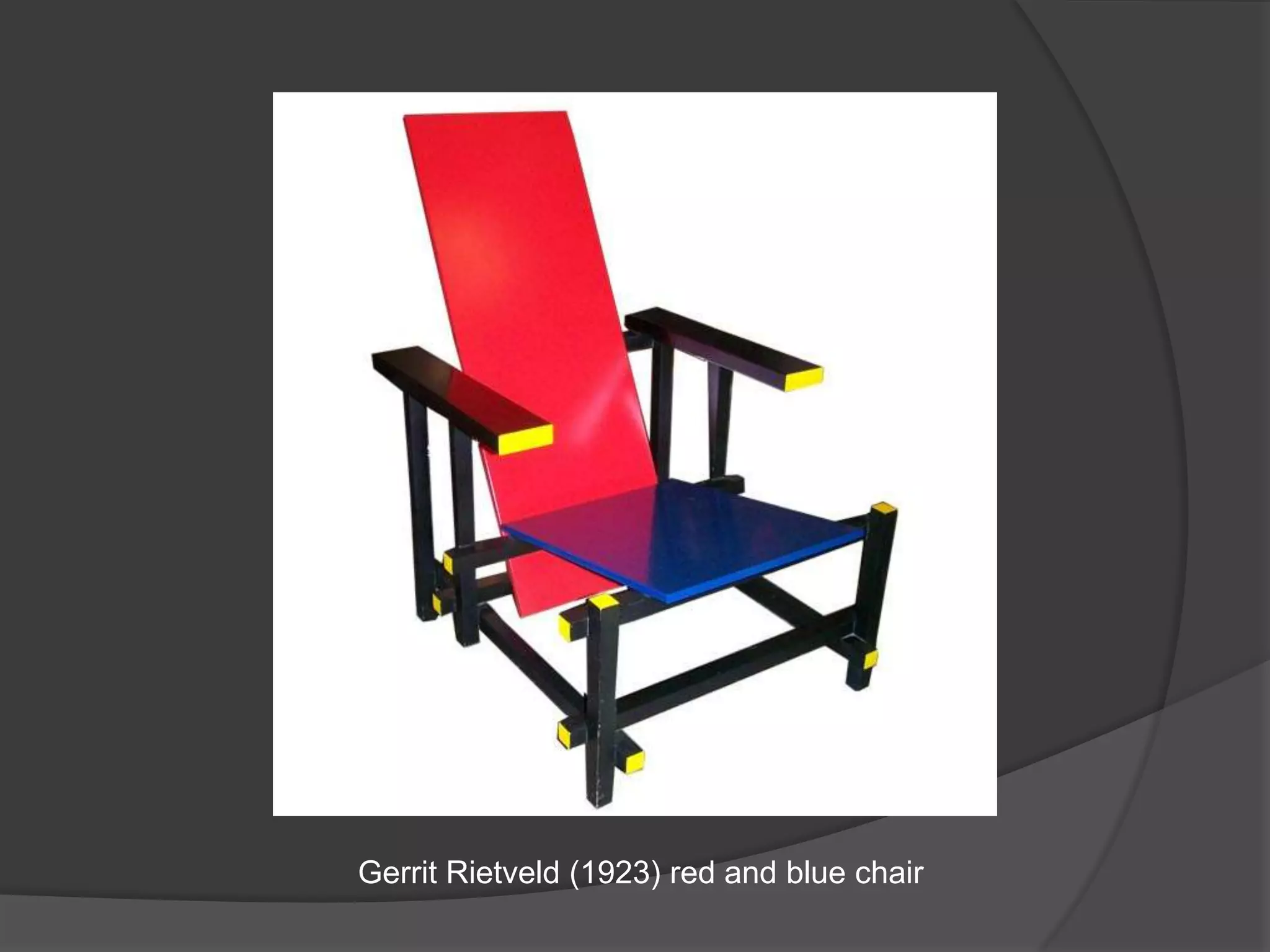
Gerrit Rietveld (1923) red and blue chair
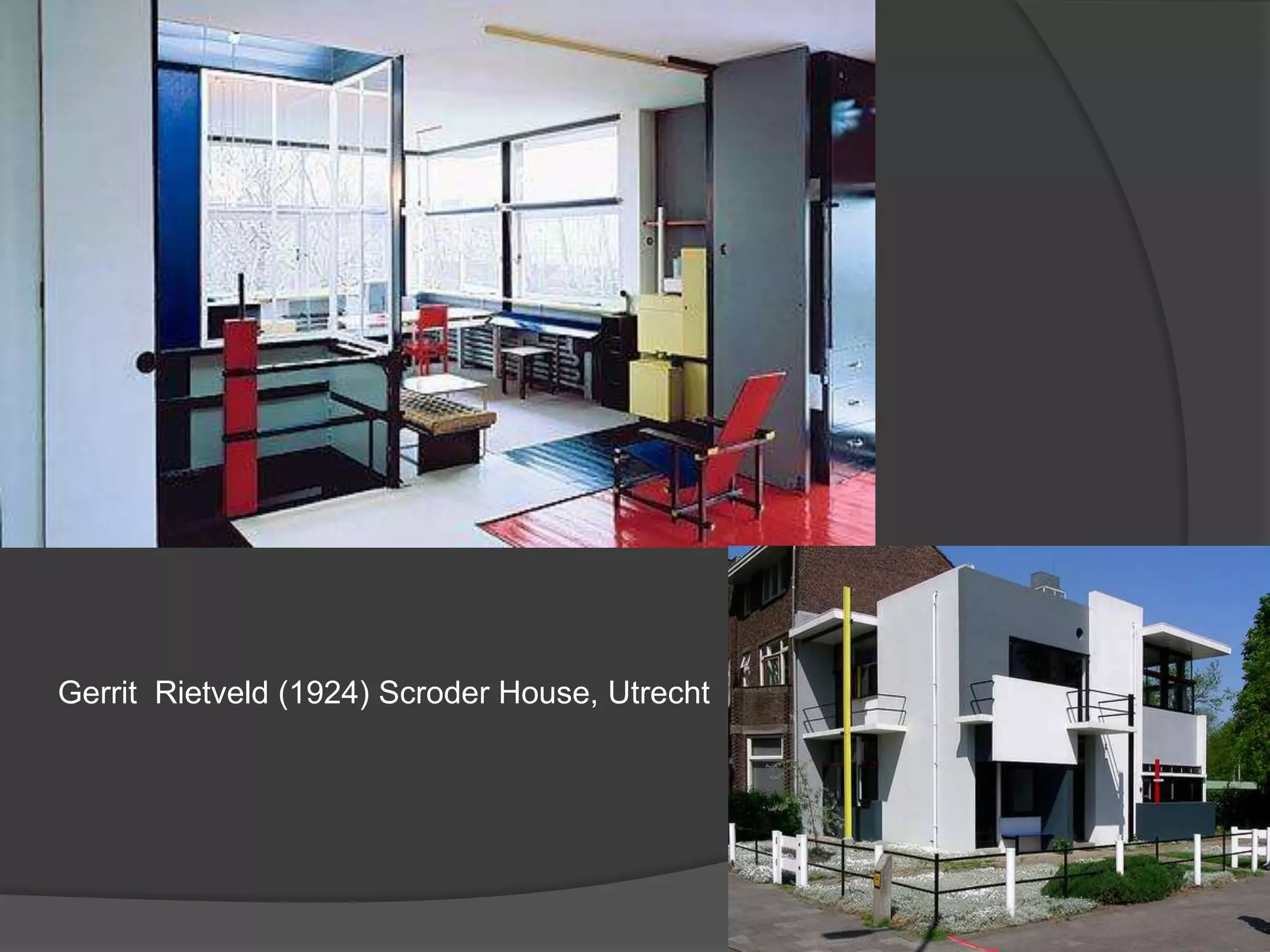
Gerrit  Rietveld (1924) Scroder House, Utrecht
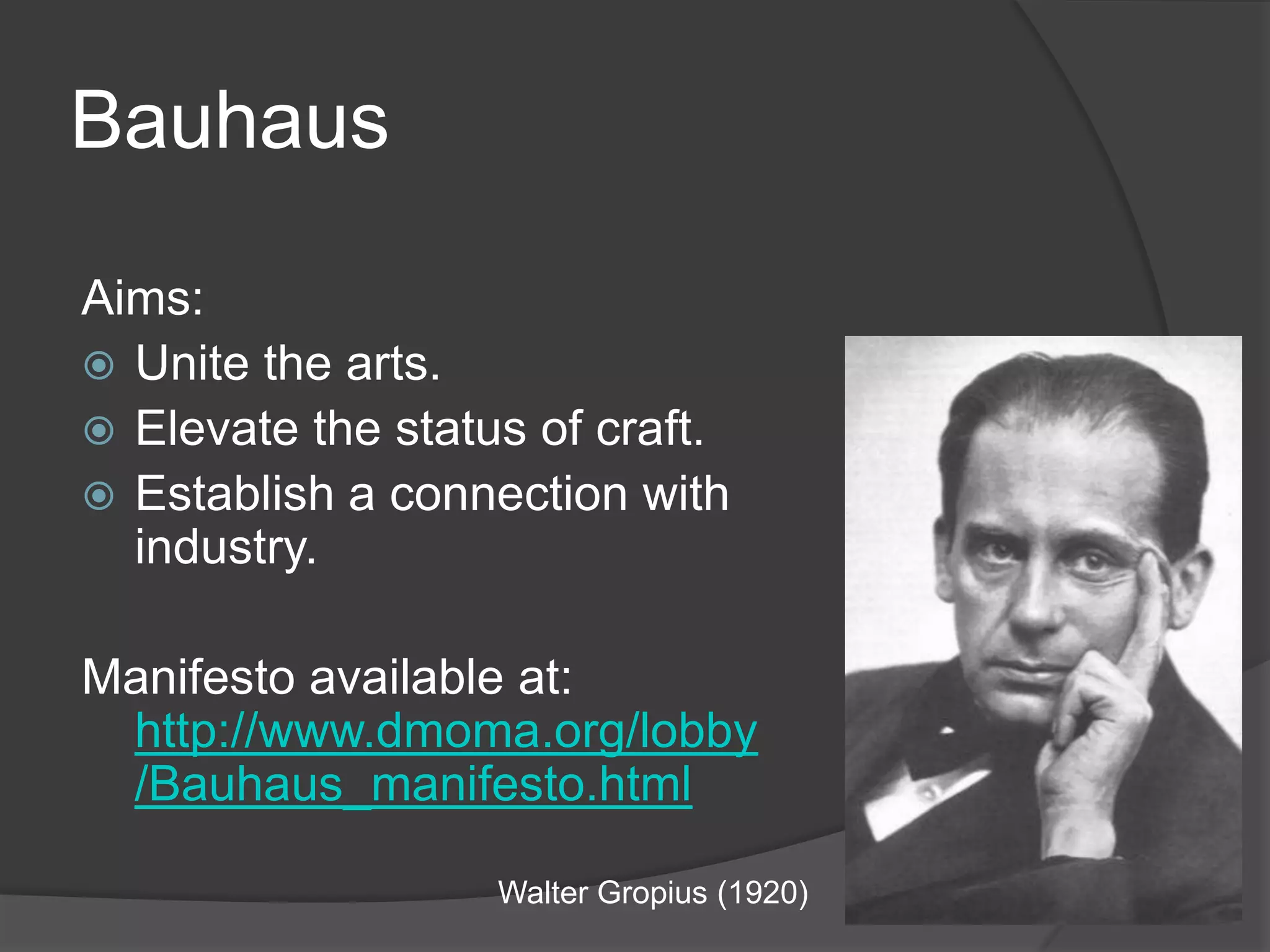
BauhausAims:Unite the arts.
Elevate the status of craft.
Establish a connection with industry.Manifesto available at:  http://www.dmoma.org/lobby/Bauhaus_manifesto.htmlWalter Gropius (1920)
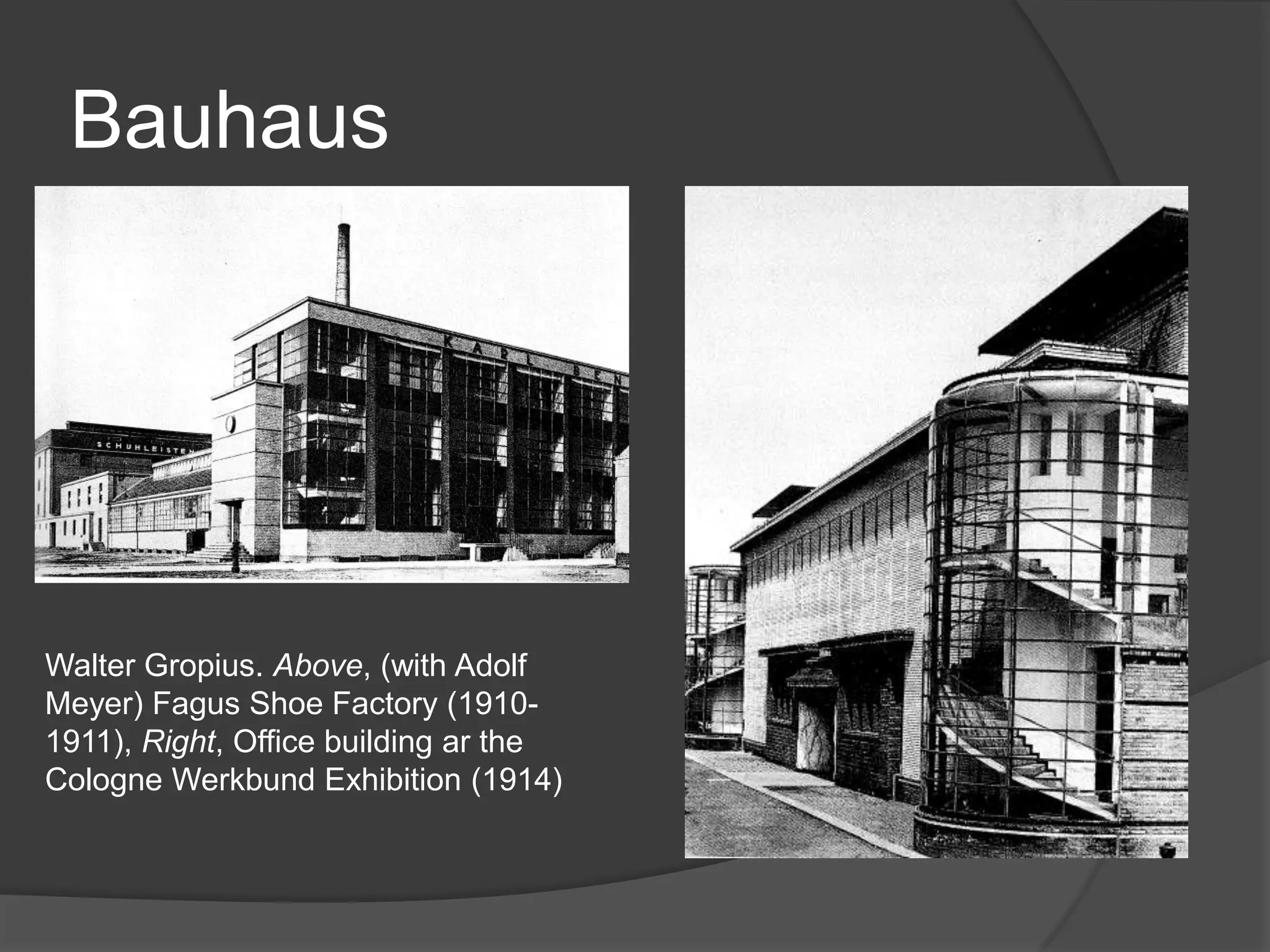
BauhausWalter Gropius. Above, (with Adolf Meyer) Fagus Shoe Factory (1910-1911), Right, Office building ar the Cologne Werkbund Exhibition (1914)
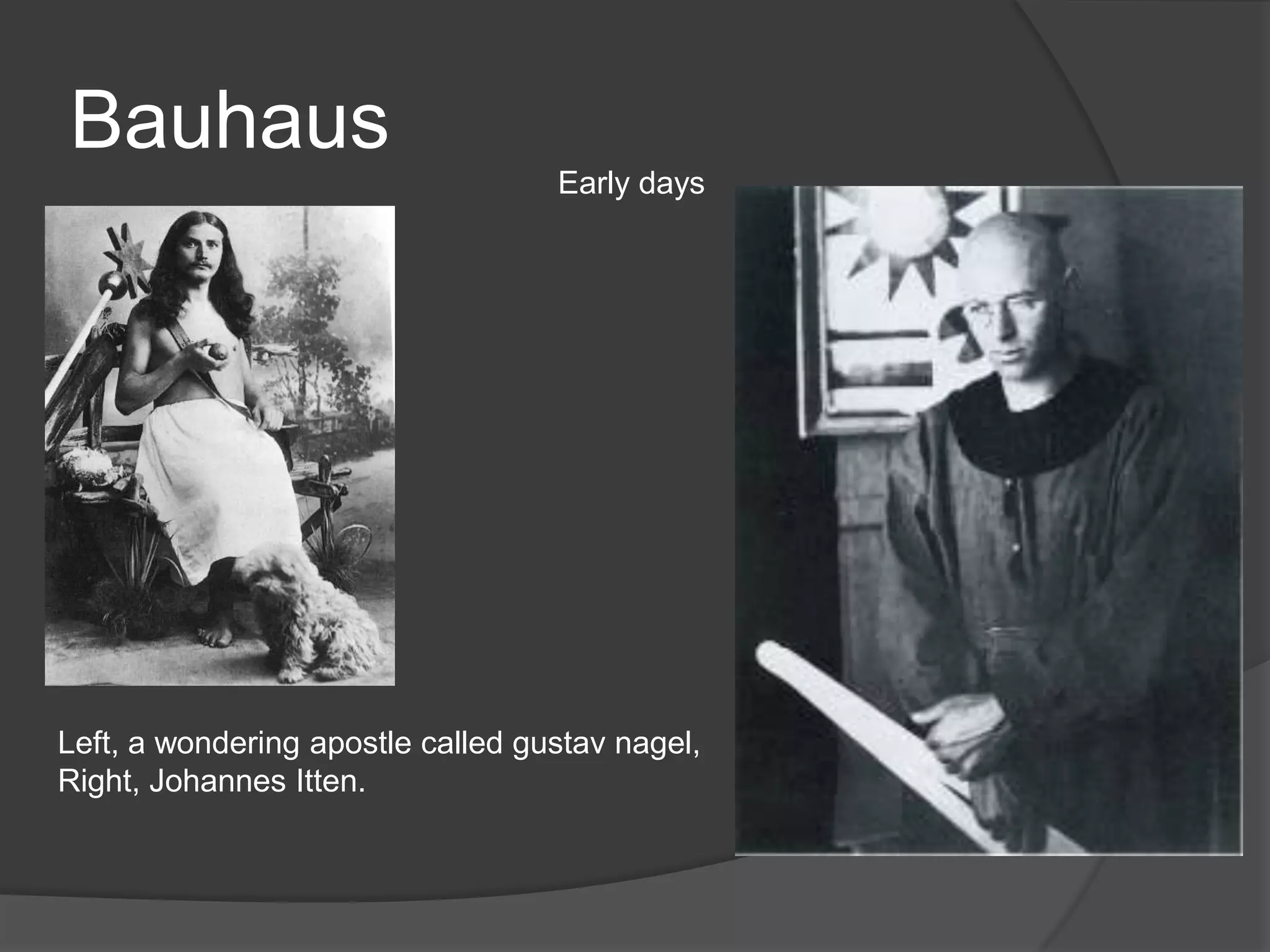
BauhausEarly daysLeft, a wondering apostle called gustav nagel,Right, Johannes Itten.
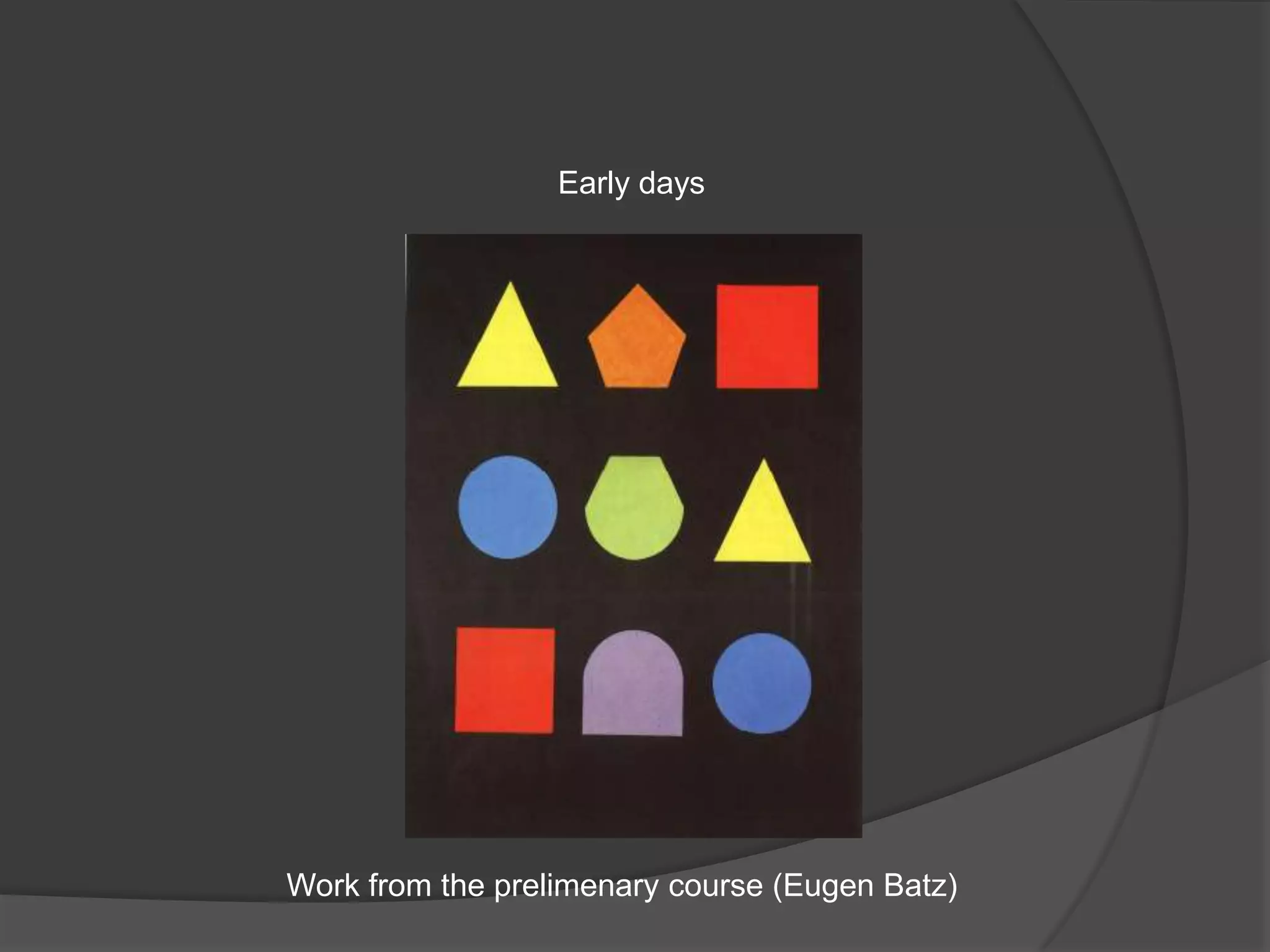
Early daysWork from the prelimenary course (Eugen Batz)
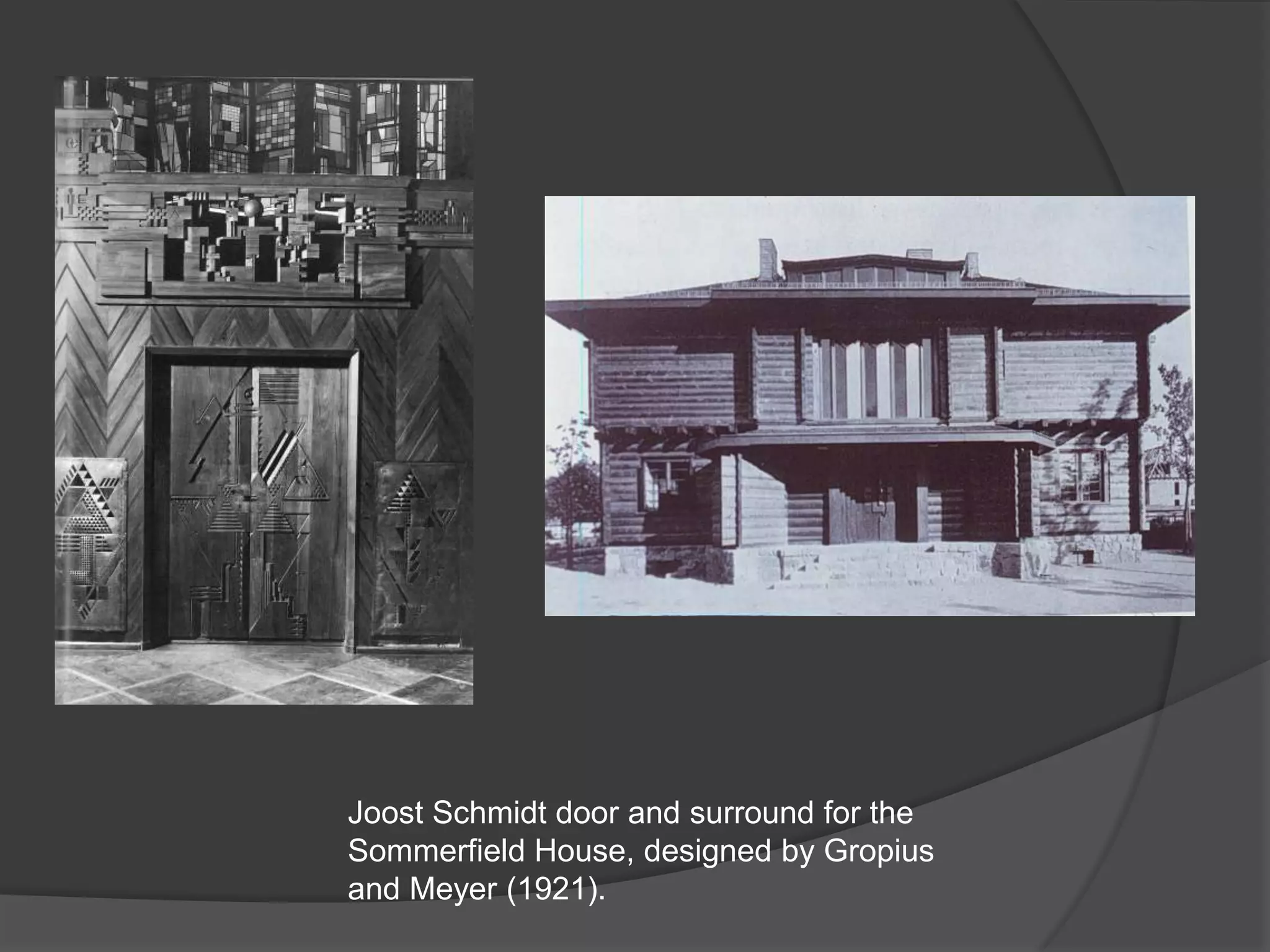
Joost Schmidt door and surround for the Sommerfield House, designed by Gropius and Meyer (1921).
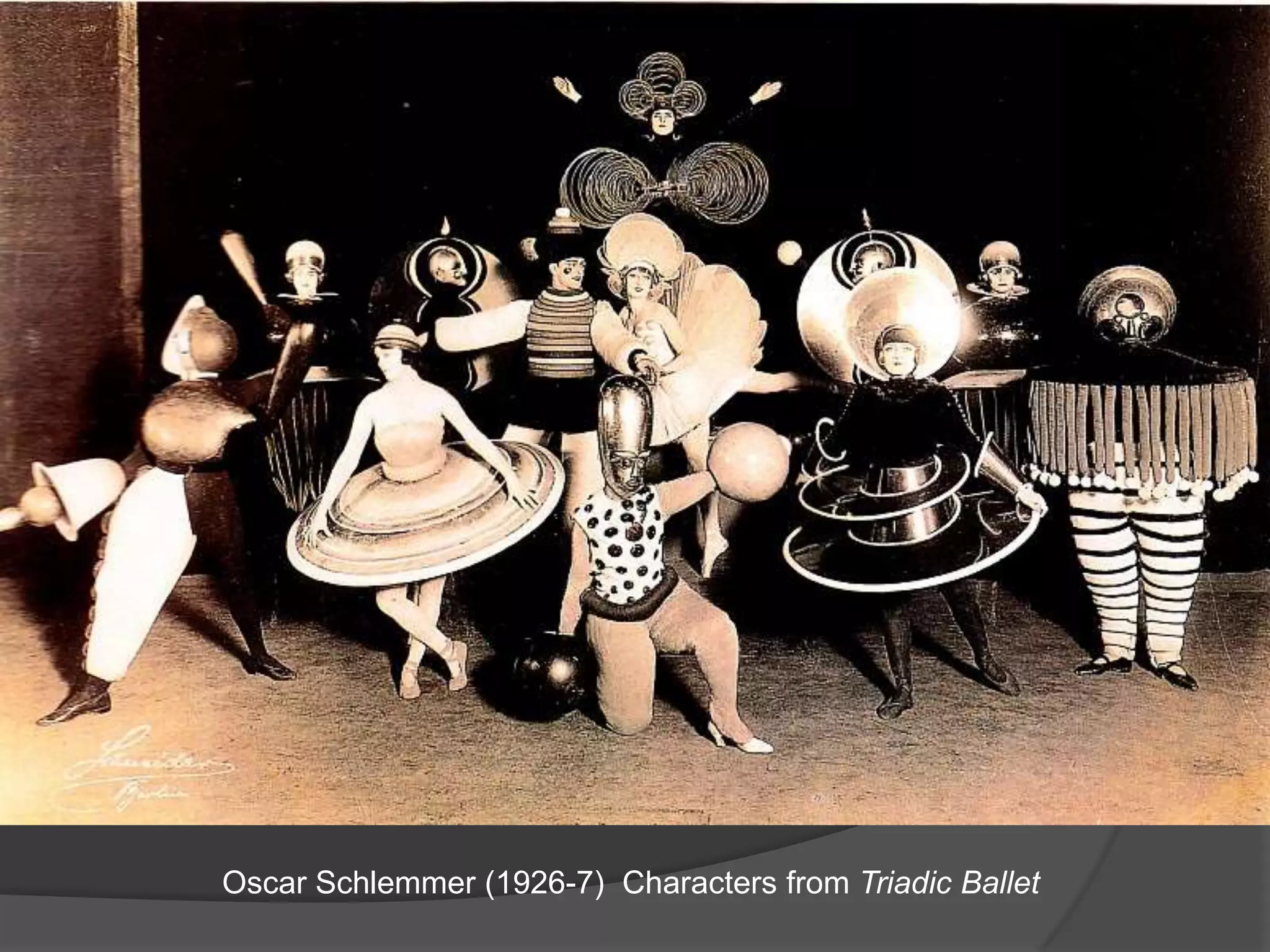
Oscar Schlemmer (1926-7)  Characters from Triadic Ballet
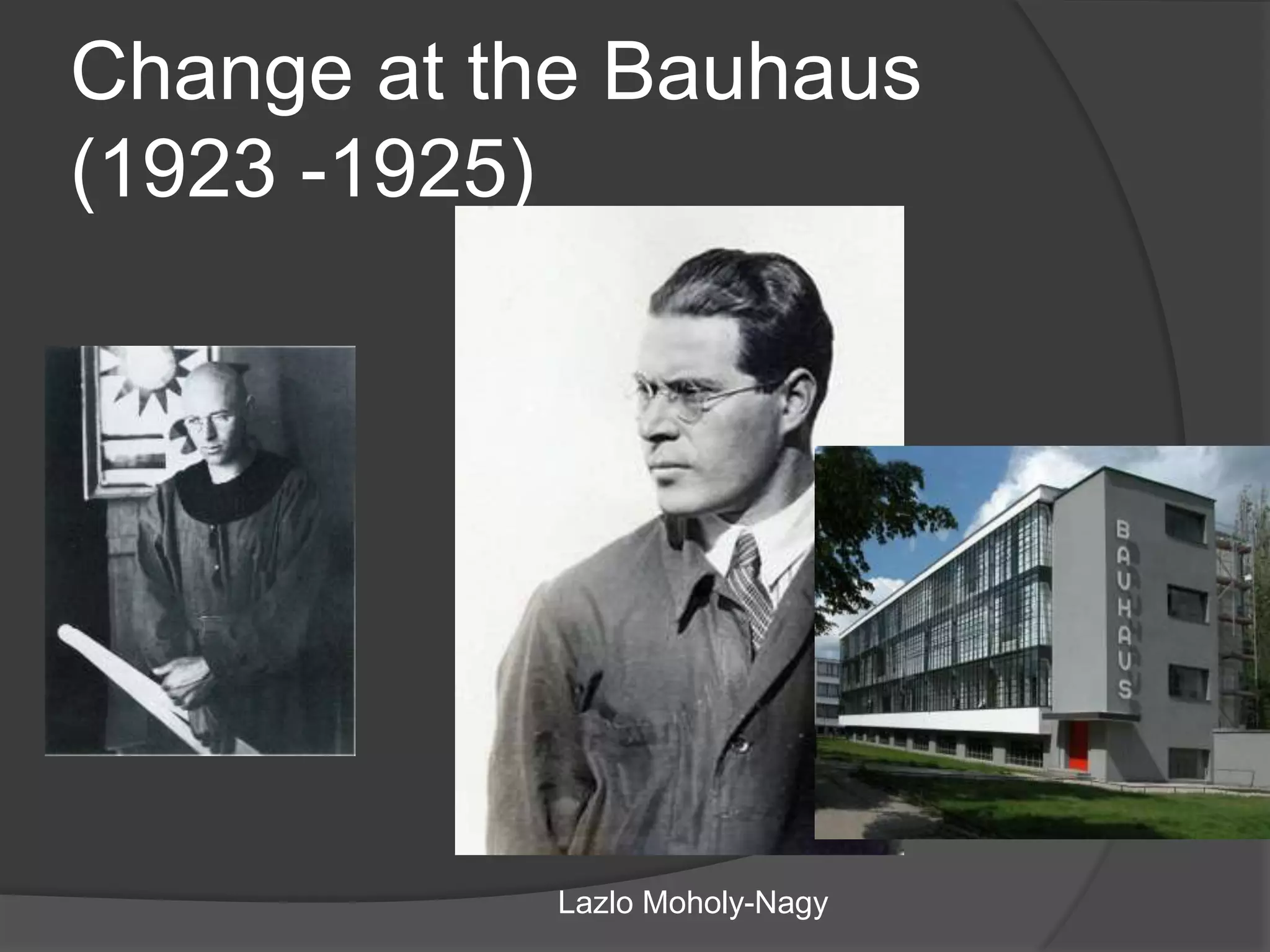
Change at the Bauhaus (1923 -1925)Lazlo Moholy-Nagy
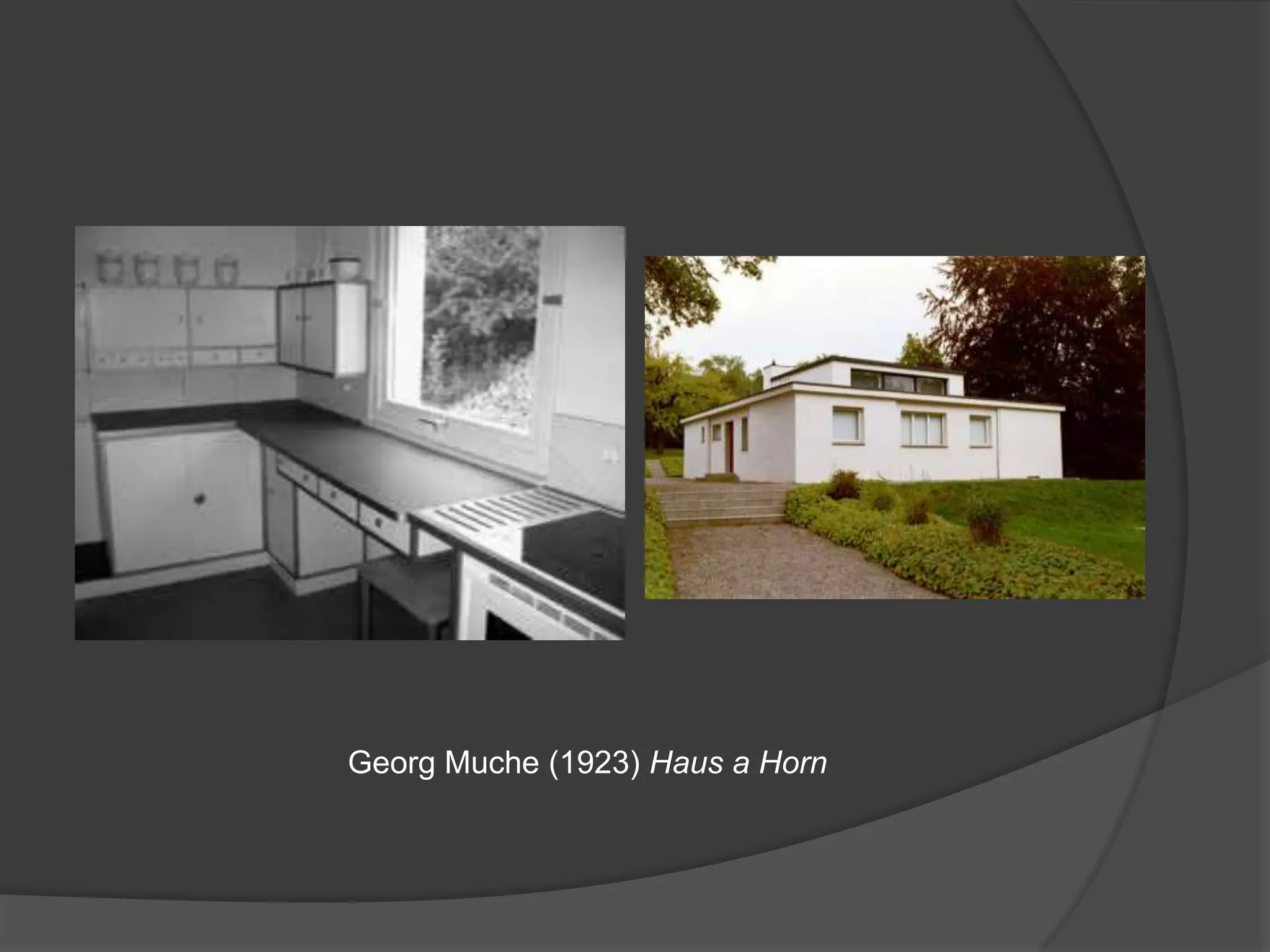
Georg Muche (1923) Haus a Horn
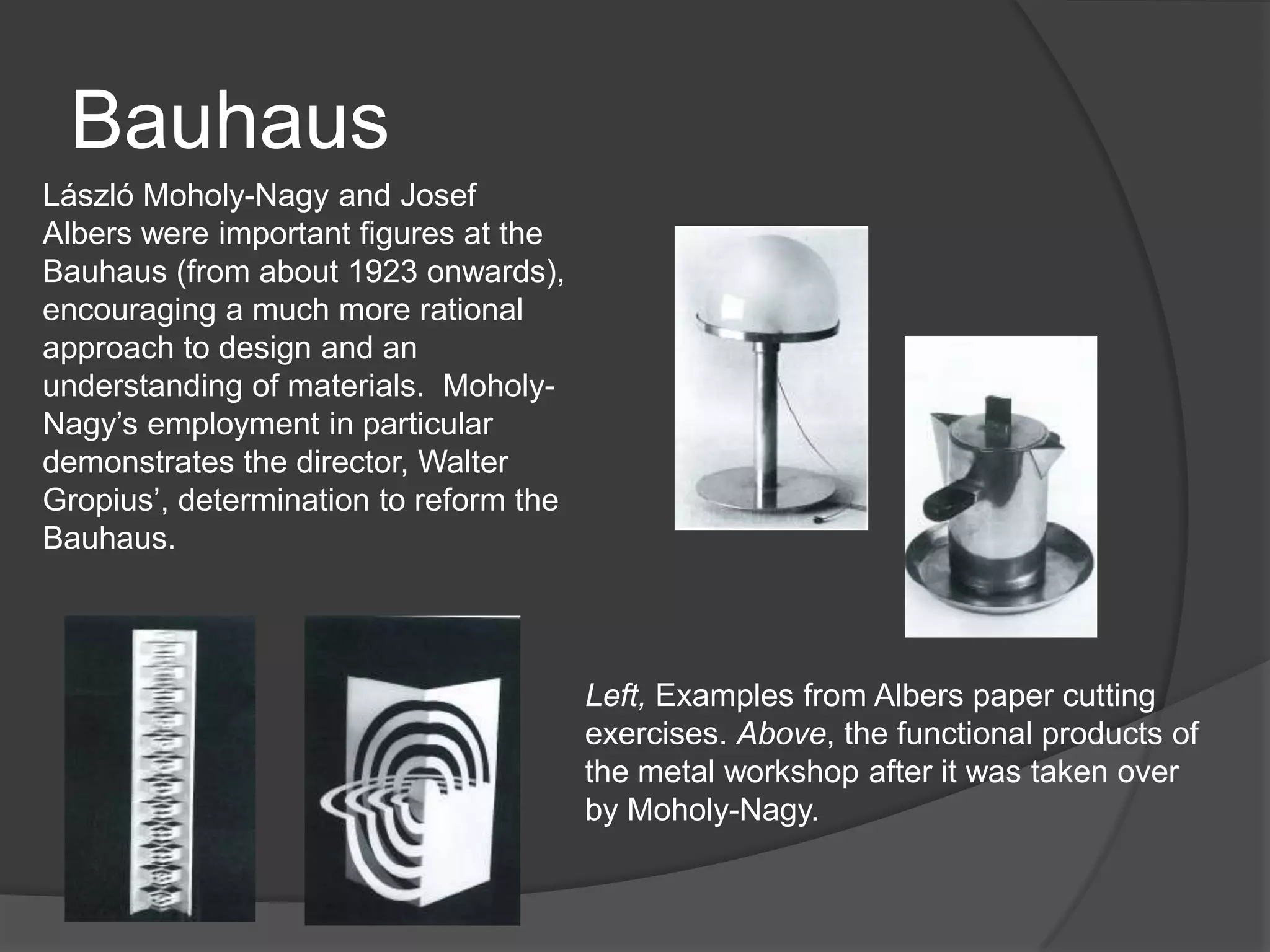
BauhausLászló Moholy-Nagy and Josef Albers were important figures at the Bauhaus (from about 1923 onwards), encouraging a much more rational approach to design and an understanding of materials.  Moholy-Nagy’s employment in particular demonstrates the director, Walter Gropius’, determination to reform the Bauhaus.Left, Examples from Albers paper cutting exercises. Above, the functional products of the metal workshop after it was taken over by Moholy-Nagy.
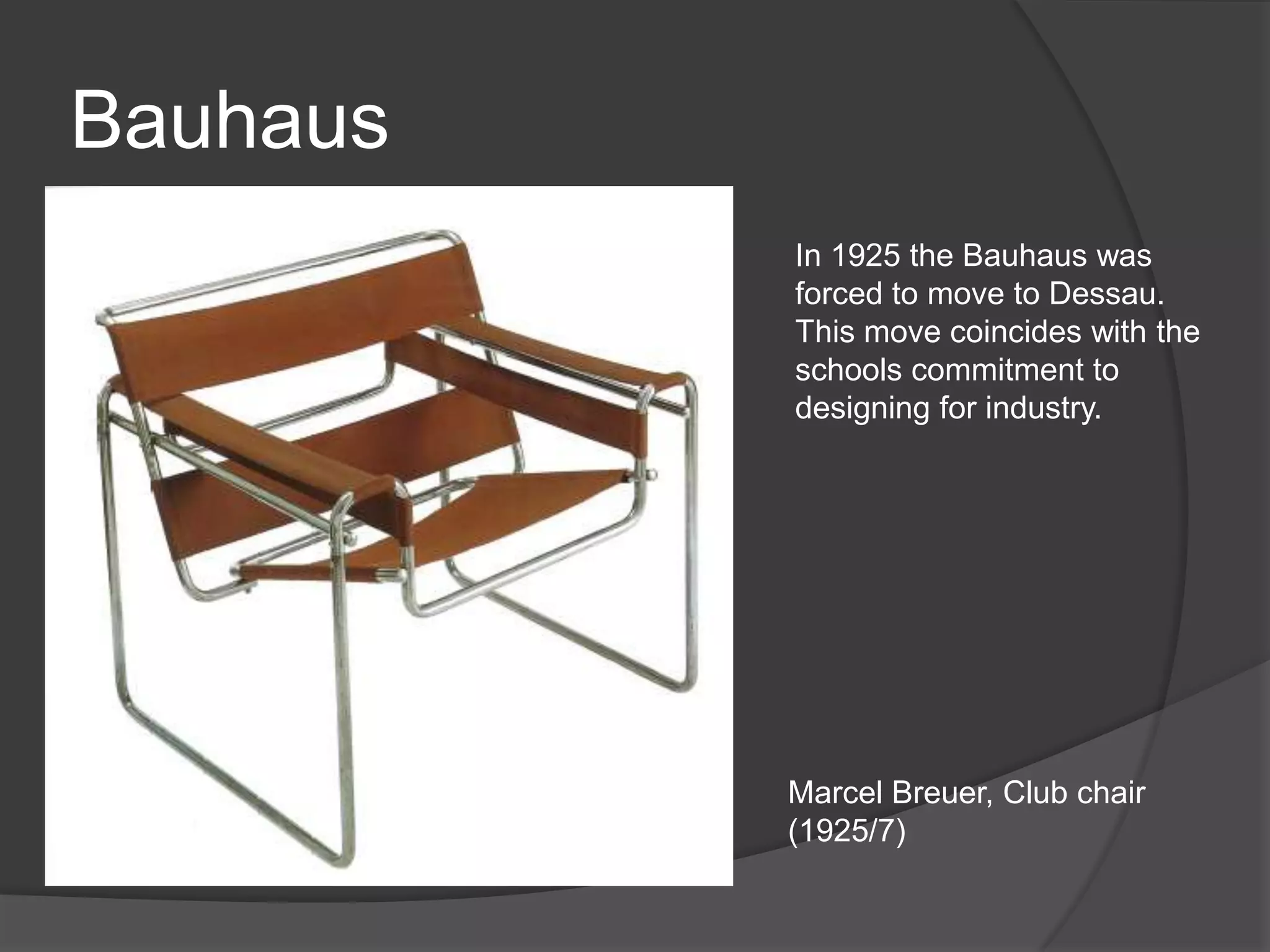
BauhausIn 1925 the Bauhaus was forced to move to Dessau.  This move coincides with the schools commitment to designing for industry.Marcel Breuer, Club chair (1925/7)
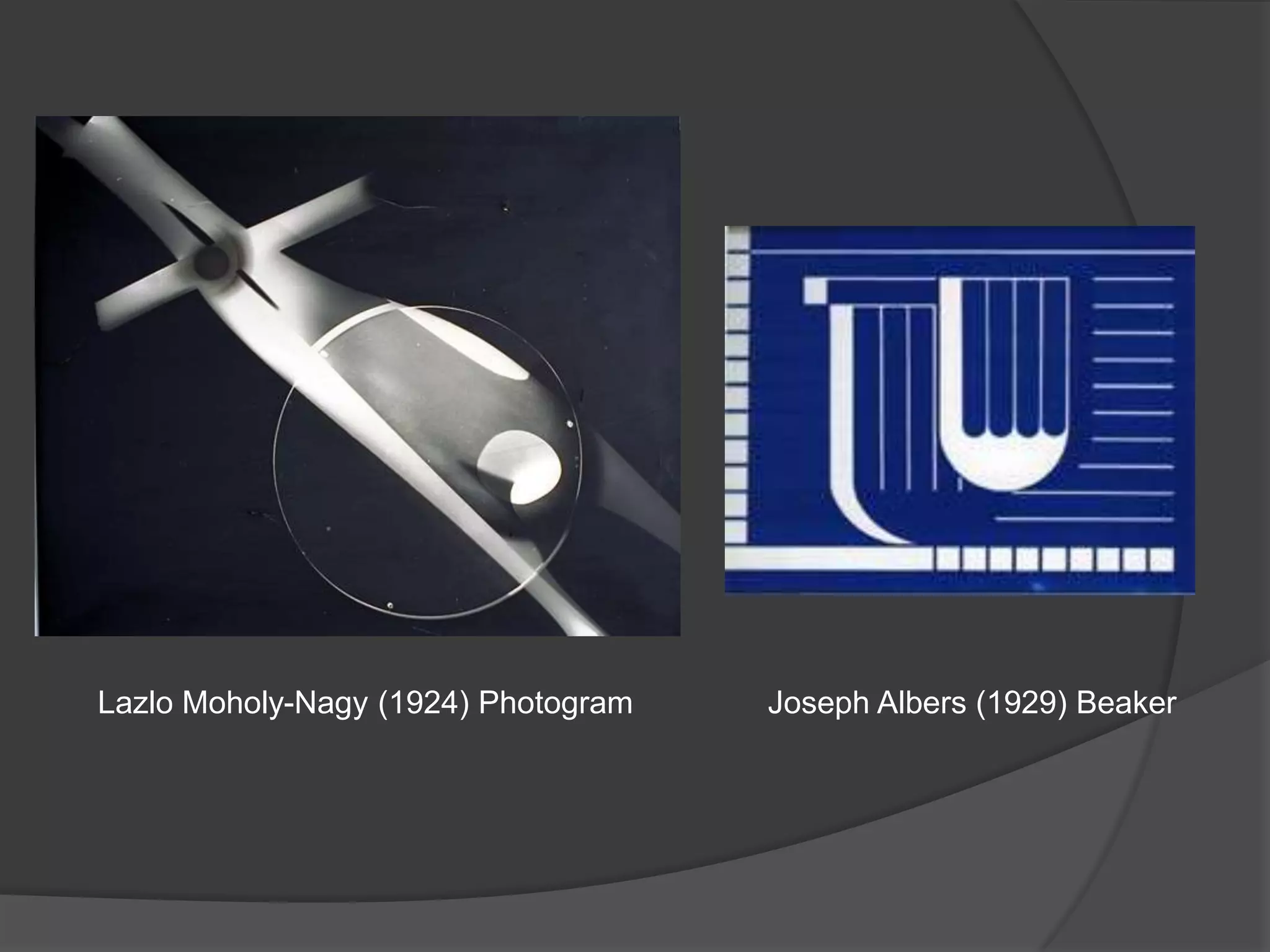
Lazlo Moholy-Nagy (1924) PhotogramJoseph Albers (1929) Beaker
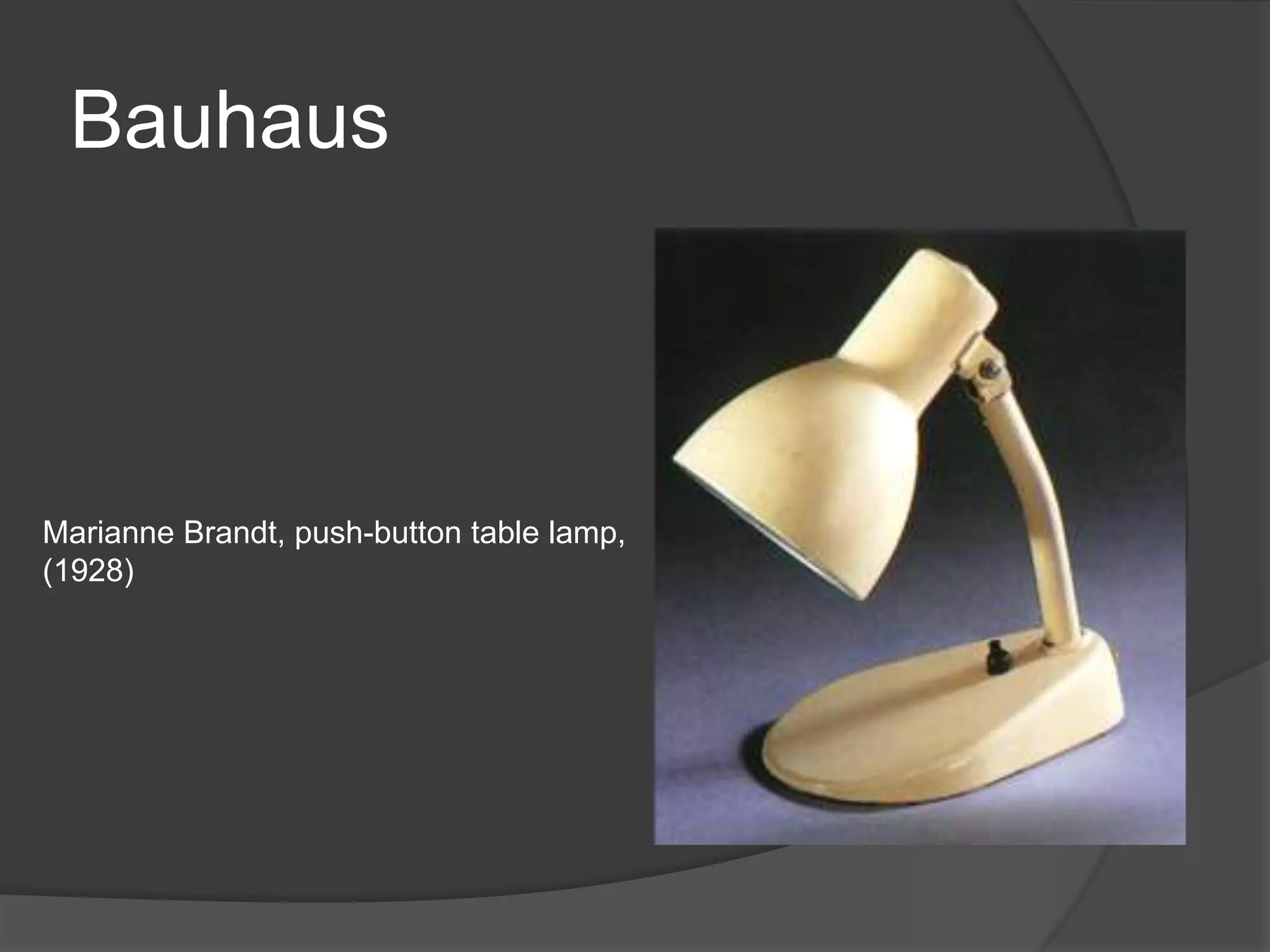
BauhausMarianne Brandt, push-button table lamp, (1928)
The end of social-avantgarde?
Modern ideas:IndividualityProgressTruthRational ThinkingNew Technologies
Activity – in pairsThink of ideas for your own Utopia.  What would it be like?  What role would artists have in designing this Utopia and what might it look like?Create an Ism to reflect some of your ideas.  What would your manifesto state?
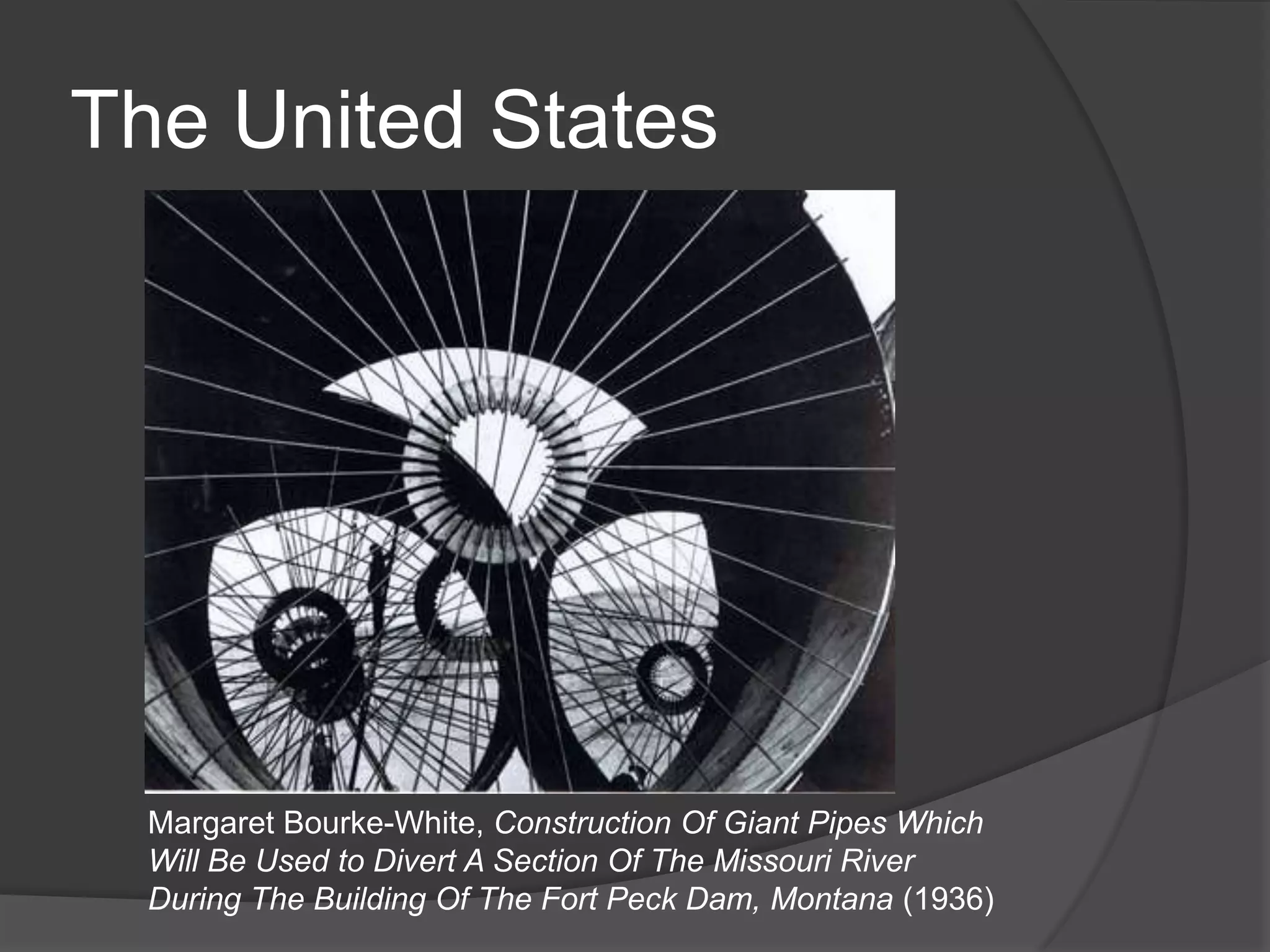
The United States	The United States was seen as a testament to the wonders of the machine and industrialisation.  Though it didn’t foster the same relationship between the artist and industry, producing very few ‘machine modernist’ works, its economy was a source of great inspiration for many European Designers.
The United StatesMargaret Bourke-White, Construction Of Giant Pipes Which Will Be Used to Divert A Section Of The Missouri River During The Building Of The Fort Peck Dam, Montana (1936)
“Scientific Management”	Factories towards the end of the 19th Century tended to reflect a disorganized range of old and new production methods.  Scientific Management refers to the re-structuring and Modernization of these methods for greater efficiency.
Taylorism	Frederick Winslow Taylor emphasized the importance of making the workers more efficient:	“We can see and feel the waste of material things.  Awkward, inefficient, or ill-directed movements of men, however, leave nothing visible or tangible behind them… And for this reason, even though our daily loss from this source is greater than our waste of material things, the one has stirred us deeply, while the other has moved us but little. ”Taylor, F W. (1911) Principles of Scientific Management.
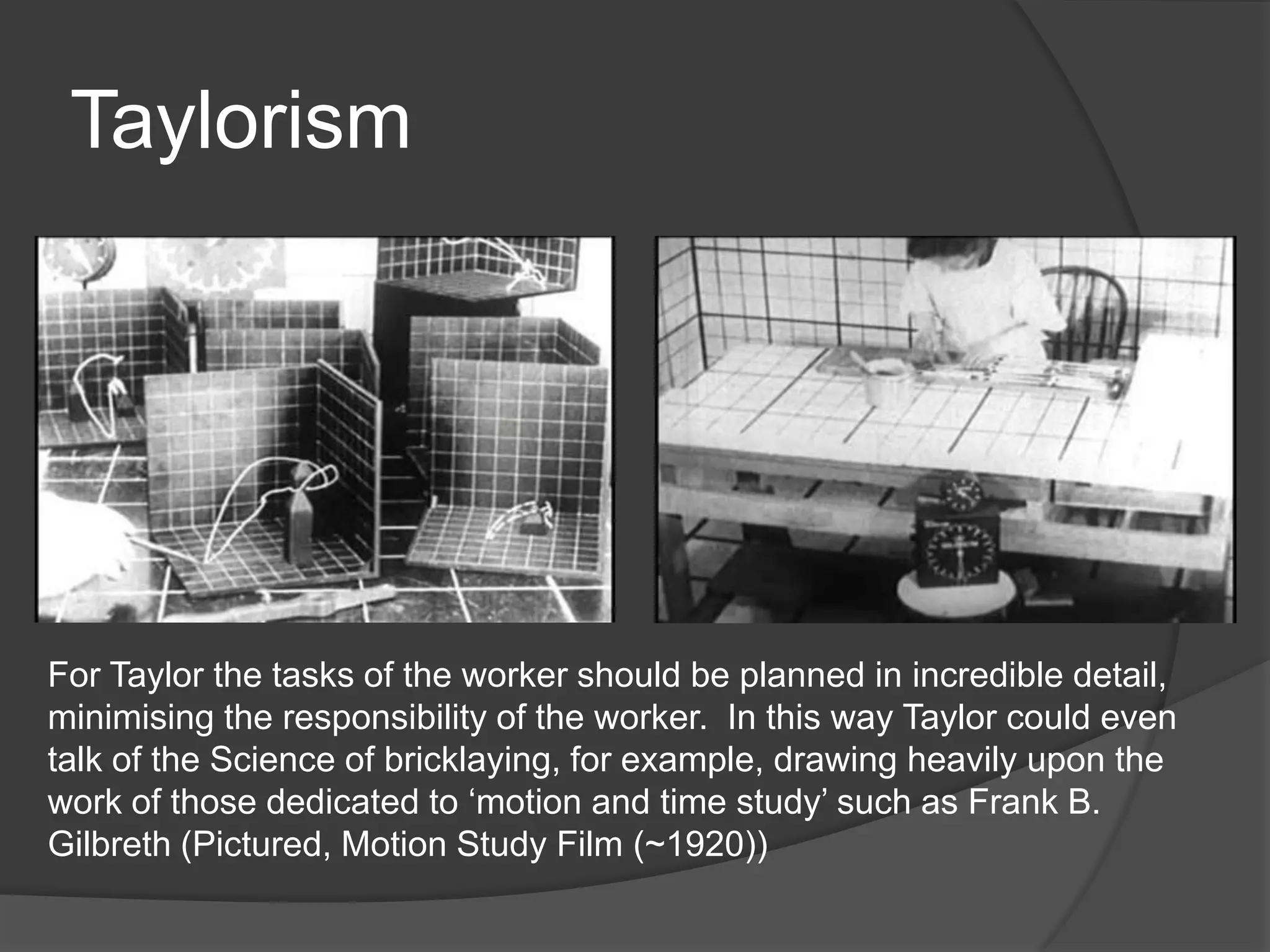
TaylorismFor Taylor the tasks of the worker should be planned in incredible detail, minimising the responsibility of the worker.  In this way Taylor could even talk of the Science of bricklaying, for example, drawing heavily upon the work of those dedicated to ‘motion and time study’ such as Frank B. Gilbreth (Pictured, Motion Study Film (~1920))
Taylorism	“[Handling pig iron] is so crude and elementary in its nature that the writer firmly believes that it would be possible to train an intelligent gorilla so as to become a more efficient pig-iron handler than any man can be… And the further illustrations to be given will make it clear that in almost all of the mechanical arts the science which underlies each workman’s act is so great… that the workman who is best suited to do the work is incapable … of understanding [it].”Taylor, F W. (1911) Principles of Scientific Management.
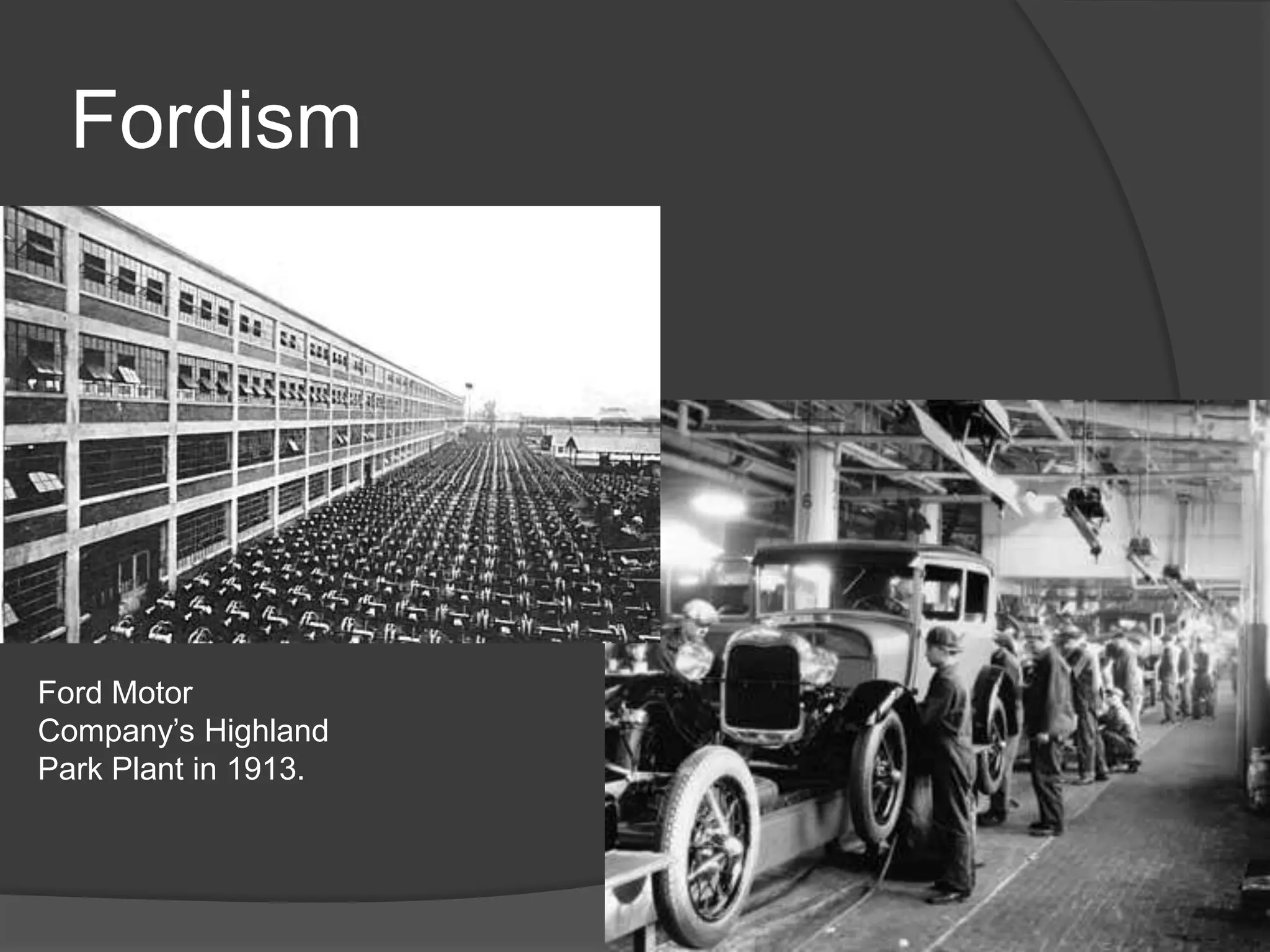
FordismFord Motor Company’s Highland Park Plant in 1913.
Increased ProductivityHigher WagesRevolutionary?Dehumanising?Mindless, Repetitive WorkThe Machine is Boss!
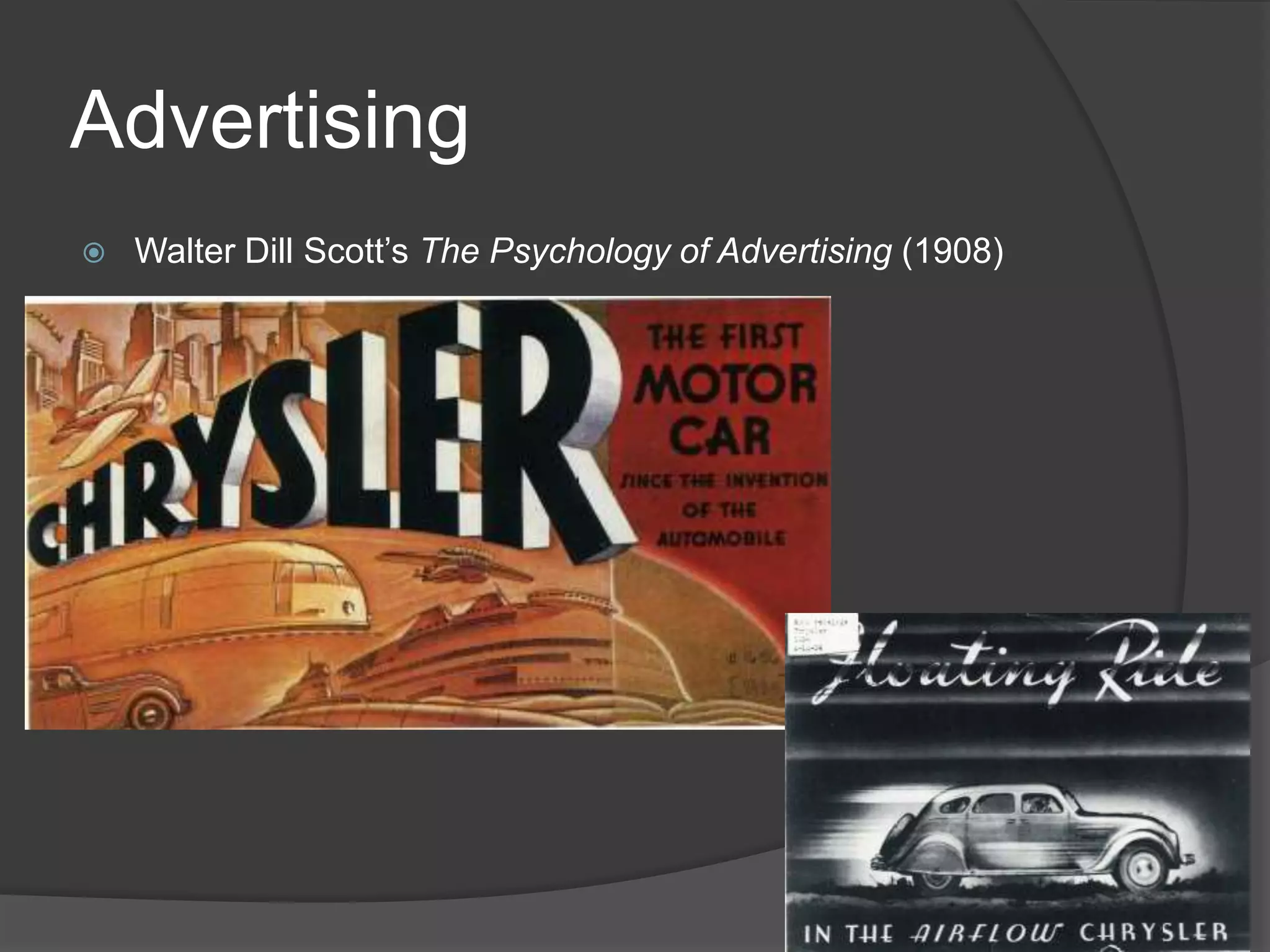
AdvertisingWalter Dill Scott’s The Psychology of Advertising (1908)
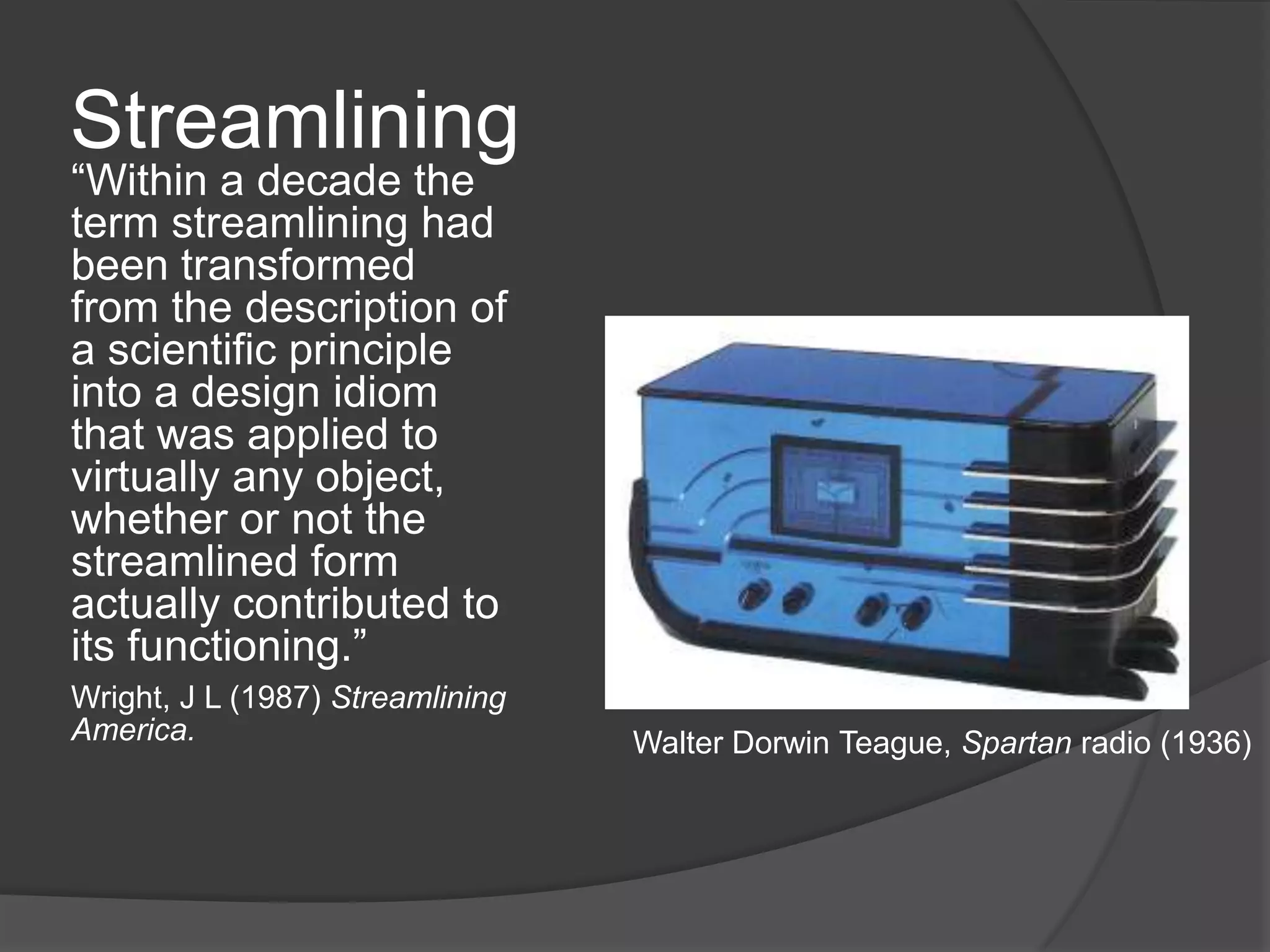
Streamlining	“Within a decade the term streamlining had been transformed from the description of a scientific principle into a design idiom that was applied to virtually any object, whether or not the streamlined form actually contributed to its functioning.”Wright, J L (1987) Streamlining America.Walter Dorwin Teague, Spartan radio (1936)
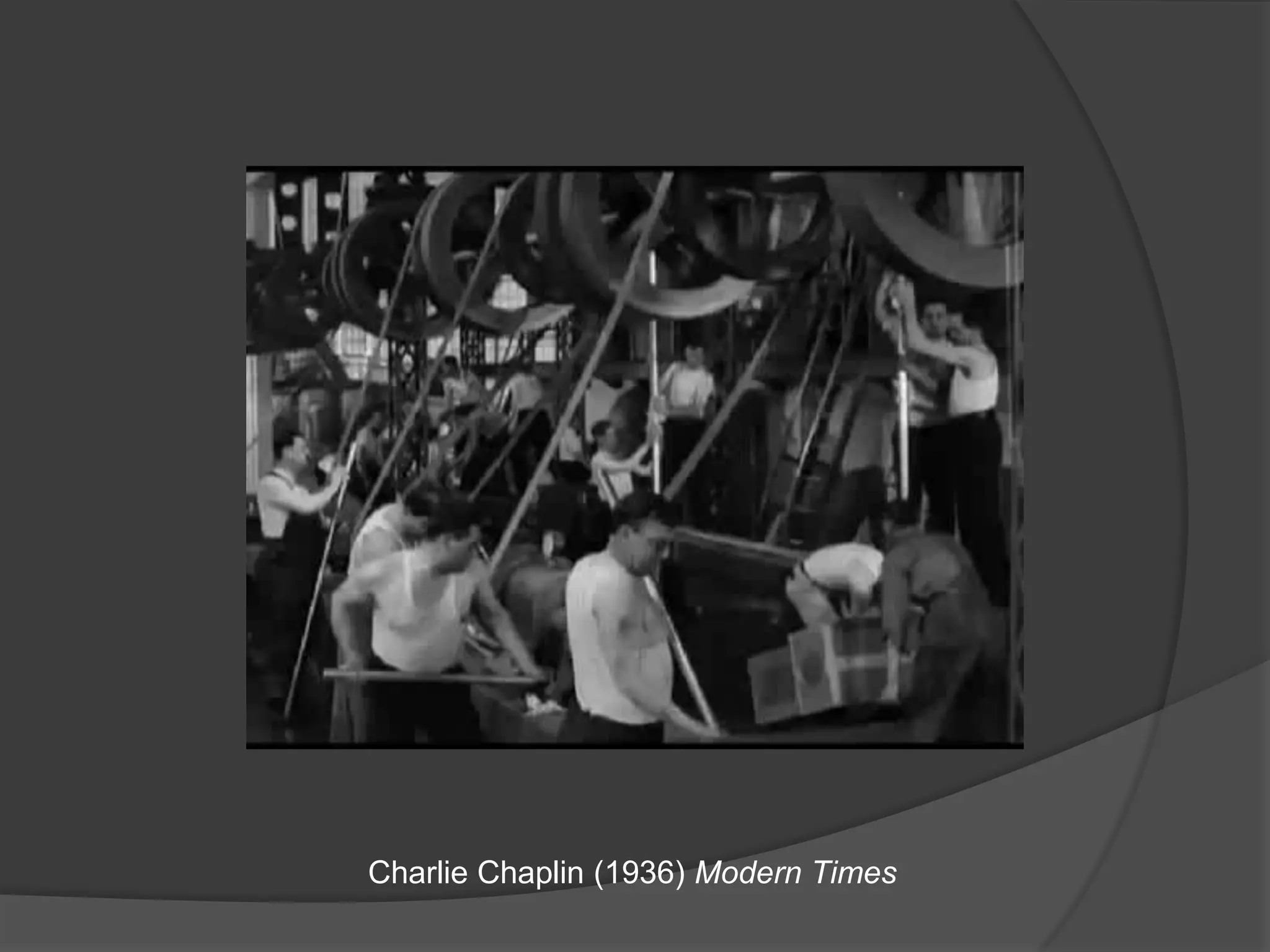
Charlie Chaplin (1936) Modern Times

Modernism in Art: An Introduction: Revolution and rebuilding, Constructivism, De Stijl and Bauhaus

  • 1.
    Revolution and Rebuilding: Constructivism, De Stijl and the BauhausModernism in Art: An Introduction
  • 2.
  • 3.
  • 4.
  • 5.
    Ornament and Crime– Adolf Loos“The child is amoral. To us the Papuan is also amoral [...] The Papuan tattoos his skin, his boat, his oar, in short, everything that is within his reach. He is no criminal. The modern man who tattoos himself is a criminal or a degenerate. There are prisons where eighty percent of the inmates bear tattoos.”“...the man of our time who daubs the walls with erotic symbols to satisfy an inner urge is a criminal or a degenerate. It is obvious that this urge overcomes man; such symptoms of degeneration most forcefully express themselves in public conveniences. One can measure the culture of a country by the degree to which its lavatory walls are daubed [...] what is natural to the Papuan and the child is a symptom of degeneration in the modern man.”“The evolution of culture is synonymous with the removal of ornament from objects of daily use.”(Loos 1908)
  • 6.
    Avant-GardeTriumvirateThe idea ofthe Avant-garde by Saint-Simon, 1820s
  • 7.
    “The ambition [ofthe artistic-social avant-garde] was to create a new social role for art, one that made the artist a significant participant in the organization and building of social life” (Margolin 1997, p.2)Giacomo Balla (1914)Design for Futurist Suit
  • 9.
    Concerning the Spiritualin Art (1914): http://www.mnstate.edu/gracyk/courses/phil%20of%20art/kandinskytext2.htm#1Wassily Kandinsky (1922) White Cross
  • 10.
    Revolution and Rebuilding: Constructivism, De Stijl and the BauhausThis lecture should:Examine the desire for art and design to be socially engaged within the context of:Russian ConstructivismDe Stijl, in Holland Bauhaus, GermanyWhat about America?
  • 11.
    Before ConstructivismNatalia Goncharova,left: (1911) Peasants Dancing, right, (1911-12) Cats, bottom (1912-13) The Cylist.
  • 12.
    Kasimir Malevich, left(1904-5) Flower Girl, right: Chiropodist in the Bathroom, bottom: (1911) The Woodcutter
  • 13.
  • 14.
    “Only with thedisappearance of a habit of mind which sees in pictures little corners of nature, madonnas and shameless Venuses, shall we witness a work of pure living art. I have transformed myself in the zero of form and dragged myself out of the rubbish-filled pool of Academic art”From Cubism and Futurism to Suprematism: The New Realism in Painting (1916)http://www.mariabuszek.com/kcai/ConstrBau/Readings/MlevchSupr.pdf
  • 15.
    “The artist canbe a creator only when the forms in his picture have nothing in common with nature [...] art is the ability to construct [...] on the basis of weight, speed and the directions of movement.”Kasimir Malevich (1916) Suprematist Construction
  • 16.
    Vladimir Tatlin (1914)Painting Relief, above: (1915) Complex Corner Relief.
  • 17.
  • 18.
  • 19.
    Constructivism Manifesto“The Groupof Constructivists has set itself the task of finding the communistic expression of material structures.”Varvara Stepanova, left: (1923) poster for the agitational play Through Red and White Glasses. Right: (1923) design for sports clothing.
  • 20.
    Aleksandr Rodchenko (1925)workers’ clud interior
  • 21.
    Vladimir Tatlin (1920)Monument to the Third International
  • 22.
    El Lissitsky (1919/20)Beat the Whites with the Red Wedge
  • 23.
  • 24.
    De Stijl“the style”,“support”, “element”, “component”The constructivist manifesto connected the new to the universal, the old with the individual. It aimed at an “international unity in Life, Art and Culture”.Theo Van Doesburg (1883 – 1931)
  • 25.
    Piet Mondrian (1917)Composition in LineBart van der Leck (1918) Composition
  • 26.
    Theo van Doesburg(1923) drawing for Maison Particuliere
  • 27.
    Gerrit Rietveld (1923)red and blue chair
  • 28.
    Gerrit Rietveld(1924) Scroder House, Utrecht
  • 29.
  • 30.
  • 31.
    Establish a connectionwith industry.Manifesto available at: http://www.dmoma.org/lobby/Bauhaus_manifesto.htmlWalter Gropius (1920)
  • 32.
    BauhausWalter Gropius. Above,(with Adolf Meyer) Fagus Shoe Factory (1910-1911), Right, Office building ar the Cologne Werkbund Exhibition (1914)
  • 33.
    BauhausEarly daysLeft, awondering apostle called gustav nagel,Right, Johannes Itten.
  • 34.
    Early daysWork fromthe prelimenary course (Eugen Batz)
  • 35.
    Joost Schmidt doorand surround for the Sommerfield House, designed by Gropius and Meyer (1921).
  • 36.
    Oscar Schlemmer (1926-7) Characters from Triadic Ballet
  • 37.
    Change at theBauhaus (1923 -1925)Lazlo Moholy-Nagy
  • 38.
  • 39.
    BauhausLászló Moholy-Nagy andJosef Albers were important figures at the Bauhaus (from about 1923 onwards), encouraging a much more rational approach to design and an understanding of materials. Moholy-Nagy’s employment in particular demonstrates the director, Walter Gropius’, determination to reform the Bauhaus.Left, Examples from Albers paper cutting exercises. Above, the functional products of the metal workshop after it was taken over by Moholy-Nagy.
  • 40.
    BauhausIn 1925 theBauhaus was forced to move to Dessau. This move coincides with the schools commitment to designing for industry.Marcel Breuer, Club chair (1925/7)
  • 41.
    Lazlo Moholy-Nagy (1924)PhotogramJoseph Albers (1929) Beaker
  • 42.
  • 44.
    The end ofsocial-avantgarde?
  • 45.
  • 47.
    Activity – inpairsThink of ideas for your own Utopia. What would it be like? What role would artists have in designing this Utopia and what might it look like?Create an Ism to reflect some of your ideas. What would your manifesto state?
  • 48.
    The United States TheUnited States was seen as a testament to the wonders of the machine and industrialisation. Though it didn’t foster the same relationship between the artist and industry, producing very few ‘machine modernist’ works, its economy was a source of great inspiration for many European Designers.
  • 49.
    The United StatesMargaretBourke-White, Construction Of Giant Pipes Which Will Be Used to Divert A Section Of The Missouri River During The Building Of The Fort Peck Dam, Montana (1936)
  • 50.
    “Scientific Management” Factories towardsthe end of the 19th Century tended to reflect a disorganized range of old and new production methods. Scientific Management refers to the re-structuring and Modernization of these methods for greater efficiency.
  • 51.
    Taylorism Frederick Winslow Tayloremphasized the importance of making the workers more efficient: “We can see and feel the waste of material things. Awkward, inefficient, or ill-directed movements of men, however, leave nothing visible or tangible behind them… And for this reason, even though our daily loss from this source is greater than our waste of material things, the one has stirred us deeply, while the other has moved us but little. ”Taylor, F W. (1911) Principles of Scientific Management.
  • 52.
    TaylorismFor Taylor thetasks of the worker should be planned in incredible detail, minimising the responsibility of the worker. In this way Taylor could even talk of the Science of bricklaying, for example, drawing heavily upon the work of those dedicated to ‘motion and time study’ such as Frank B. Gilbreth (Pictured, Motion Study Film (~1920))
  • 53.
    Taylorism “[Handling pig iron]is so crude and elementary in its nature that the writer firmly believes that it would be possible to train an intelligent gorilla so as to become a more efficient pig-iron handler than any man can be… And the further illustrations to be given will make it clear that in almost all of the mechanical arts the science which underlies each workman’s act is so great… that the workman who is best suited to do the work is incapable … of understanding [it].”Taylor, F W. (1911) Principles of Scientific Management.
  • 54.
    FordismFord Motor Company’sHighland Park Plant in 1913.
  • 55.
  • 56.
    AdvertisingWalter Dill Scott’sThe Psychology of Advertising (1908)
  • 57.
    Streamlining “Within a decadethe term streamlining had been transformed from the description of a scientific principle into a design idiom that was applied to virtually any object, whether or not the streamlined form actually contributed to its functioning.”Wright, J L (1987) Streamlining America.Walter Dorwin Teague, Spartan radio (1936)
  • 58.
  • 59.
  • 60.
    ReferencesAllison, Nicholas H.(1990) Art Into Life: Russian Constructivism. Rizzoli International Publications, New York.
  • 61.
    Becker, Lutz andRichard Hollis (2004) Avant-Garde Graphics: 1918-1934. Hayward Gallery Publishing, London.
  • 62.
    Borchardt-Hume, Achim (ed.)Albers and Moholy-Nagy: From the Bauhaus to the New World. Tate, London
  • 63.
    Brettell, Richard (1999)Modern Art: 1851 – 1929. Oxford University Press, Oxford.
  • 64.
    Champa, Kermit S.(1985) Mondrian Studies. The University of Chicago Press, London.
  • 65.
    Droste, Magdalena (2006)Bauhaus. Taschen, Berlin.
  • 66.
    Fabre, Gladys andDoris WintensHotte (eds.) (2009) Constructing a New World: Van Doesburg & the International Avant-Garde. Tate Modern, London.
  • 67.
    Gray, Camilla (1986)The Russian Experiment in Art: 1863- 1922. Thames & Hudson, London.
  • 68.
    Hollis, Richard (2001)Graphic Design: A Concise History. Thames & Hudson, London.
  • 69.
    Kandinsky, Wassily (2003[1912]) Concerning the Spiritual in Art. In Harrison, Charles and Paul Wood (eds.) (2003) Art in Theory: 1900 – 2000. Blackwell Publishing, Oxford.
  • 70.
    Kiaer, Christian (2005)Imagine no Possessions: The Socialist Objects of Russian Constructivism. The MIT Press, Cambridge USA.
  • 71.
    Loos, Adolf (1908)Ornament and Crime [excepts]. Available at: http://www.mariabuszek.com/kcai/Design%20History/Design_readings/LoosOrnamentCrime.pdf .
  • 72.
    Margolin, Victor (1997)The Struggle for Utopia. The University of Chicago Press, London.
  • 73.
    Overy, Paul (2000)De Stijl. Thames and Hudson, London.
  • 74.
    Whitford, Frank (2006)Bauhaus. Thames & Hudson, London.
  • 75.
    Wilks, Christopher (2003)Modernism: Designing a New World. V&A, London.Reading:Woodham, Jonathan M. (1997) Design and Modernism, in Twentieth-Century Design. Oxford University Press, Oxford.

Editor's Notes

  • #32 Summarise the manifesto.