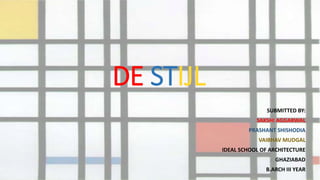
DE STIJL
SUBMITTED BY:
SAKSHI AGGARWAL
PRASHANT SHISHODIA
VAIBHAV MUDGAL
IDEAL SCHOOL OF ARCHITECTURE
GHAZIABAD
B.ARCH III YEAR
INTRODUCTION
• In Dutch, “DE STIJL” means “The Style”, also known
as neoplasticism.
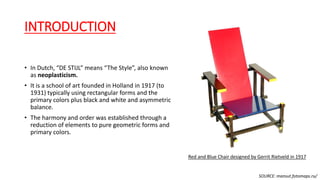
• It is a school of art founded in Holland in 1917 (to
1931) typically using rectangular forms and the
primary colors plus black and white and asymmetric
balance.
• The harmony and order was established through a
reduction of elements to pure geometric forms and
primary colors.
Red and Blue Chair designed by Gerrit Rietveld in 1917
SOURCE: mansut.fotomaps.ru/
HISTORY
• From the flurry of new art movements that followed the Impressionist revolutionary new
perception of painting, Cubism arose in the early 20th century as an important and influential
new direction. In the Netherlands, too, there was interest in this "new art".
• However, because the Netherlands remained neutral in World War I, Dutch artists were not able
to leave the country after 1914 and were thus effectively isolated from the international art
world—and in particular, from Paris, which was its centre then.
• During that period, painter Theo van Doesburg started looking for other artists to set up
a journal and start an art movement. Van Doesburg was also a writer, poet, and critic, who had
been more successful writing about art than working as an independent artist. Quite adept at
making new contacts due to his flamboyant personality and outgoing nature, he had many useful
connections in the art world.
SOURCE: designishistory.com
OBJECTIVES
• To rebuild society after WW1- essential ordering of structure.
• Construct an ideal ‘model’ for a new world.
• Achieving a utopian perception of spiritual harmony.
• Would function as a sign for n ethical view of society.
• To show that art and design have the power to change the future.
STARTING OF DE STIJL
In 1915 Van Doesburg started meeting the artists
Met Piet Mondrian at Stedelijk Museum Amsterdam
While his stay at Laren, Piet M. met Bart van der Leck
Van Doesburg also knew J. J. P. Oud & Vilmos Huszár
In 1917, cooperation of these artists, resulted in foundation of De Stijl
In 1918, Gerrit Rietveld joined the group but Van der Leck left due to artistic differences of opinion.
Nieuwe Beelding (neoplasticism) was a term first coined in 1917 by Mondrian
SOURCE: wikipedia.org
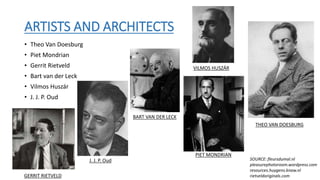
ARTISTS AND ARCHITECTS
• Theo Van Doesburg
• Piet Mondrian
• Gerrit Rietveld
• Bart van der Leck
• Vilmos Huszár
• J. J. P. Oud
THEO VAN DOESBURG
BART VAN DER LECK
SOURCE: fleursdumal.nl
pleasurephotoroom.wordpress.com
resources.huygens.knaw.nl
rietveldoriginals.comGERRIT RIETVELD
VILMOS HUSZÁR
J. J. P. Oud
PIET MONDRIAN
THEO VAN DOESBURG
• A Dutch artist, who practiced painting, writing, poetry and architecture.
• Founder and leader of De Stijl Movement.
• Complete abstraction of reality in his paintings.
• Promoted De Stijl across Europe.
1883-1931
COMPOSITION VII (THE THREE GRACES)
EN.WIKIPEDIA.ORG
SIMULTANEOUS COUNTER-COMPOSITION 1929
SLIDESHARE.NET
SOURCE: theartstory.org
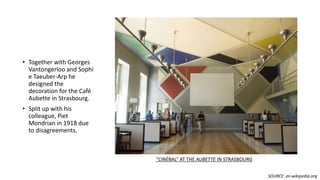
• Together with Georges
Vantongerloo and Sophi
e Taeuber-Arp he
designed the
decoration for the Café
Aubette in Strasbourg.
• Split up with his
colleague, Piet
Mondrian in 1918 due
to disagreements.
“CINÉBAL” AT THE AUBETTE IN STRASBOURG
SOURCE: en.wikipedia.org
PIET MONDRIAN
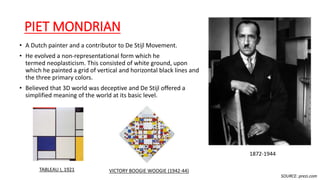
• A Dutch painter and a contributor to De Stijl Movement.
• He evolved a non-representational form which he
termed neoplasticism. This consisted of white ground, upon
which he painted a grid of vertical and horizontal black lines and
the three primary colors.
• Believed that 3D world was deceptive and De Stijl offered a
simplified meaning of the world at its basic level.
1872-1944
VICTORY BOOGIE WOOGIE (1942-44)TABLEAU I, 1921
SOURCE: prezi.com
GERRIT RIETVELD
• Dutch furniture designer and architect.
• One of the principal members of De Stijl.
• Famous for his Red and Blue chair design.
• The chair was designed for the Rietveld Schroder House
built in 1924 which is a UNESCO world heritage site.
1888-1964
SOURCE: architecturegroupie.wordpress.com
SCHRODER HOUSE BY GERRIT RIETVELD- EXTERIOR & INTERIOR VIEW
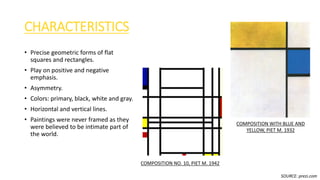
CHARACTERISTICS
• Precise geometric forms of flat
squares and rectangles.
• Play on positive and negative
emphasis.
• Asymmetry.
• Colors: primary, black, white and gray.
• Horizontal and vertical lines.
• Paintings were never framed as they
were believed to be intimate part of
the world.
COMPOSITION NO. 10, PIET M. 1942
COMPOSITION WITH BLUE AND
YELLOW, PIET M. 1932
SOURCE: prezi.com
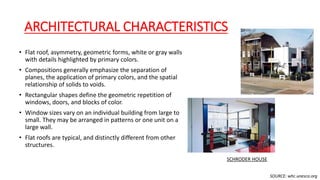
ARCHITECTURAL CHARACTERISTICS
• Flat roof, asymmetry, geometric forms, white or gray walls
with details highlighted by primary colors.
• Compositions generally emphasize the separation of
planes, the application of primary colors, and the spatial
relationship of solids to voids.
• Rectangular shapes define the geometric repetition of
windows, doors, and blocks of color.
• Window sizes vary on an individual building from large to
small. They may be arranged in patterns or one unit on a
large wall.
• Flat roofs are typical, and distinctly different from other
structures.
SOURCE: whc.unesco.org
SCHRODER HOUSE
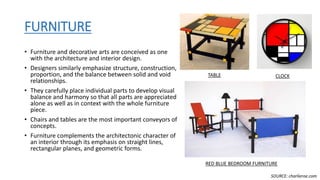
FURNITURE
• Furniture and decorative arts are conceived as one
with the architecture and interior design.
• Designers similarly emphasize structure, construction,
proportion, and the balance between solid and void
relationships.
• They carefully place individual parts to develop visual
balance and harmony so that all parts are appreciated
alone as well as in context with the whole furniture
piece.
• Chairs and tables are the most important conveyors of
concepts.
• Furniture complements the architectonic character of
an interior through its emphasis on straight lines,
rectangular planes, and geometric forms.
TABLE
RED BLUE BEDROOM FURNITURE
CLOCK
SOURCE: charlieroe.com
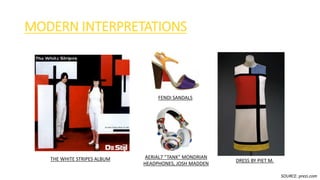
MODERN INTERPRETATIONS
DRESS BY PIET M.THE WHITE STRIPES ALBUM
FENDI SANDALS
AERIAL7 “TANK” MONDRIAN
HEADPHONES, JOSH MADDEN
SOURCE: prezi.com
THANKYOU

De stijl

  • 1.
    DE STIJL SUBMITTED BY: SAKSHIAGGARWAL PRASHANT SHISHODIA VAIBHAV MUDGAL IDEAL SCHOOL OF ARCHITECTURE GHAZIABAD B.ARCH III YEAR
  • 2.
    INTRODUCTION • In Dutch,“DE STIJL” means “The Style”, also known as neoplasticism. • It is a school of art founded in Holland in 1917 (to 1931) typically using rectangular forms and the primary colors plus black and white and asymmetric balance. • The harmony and order was established through a reduction of elements to pure geometric forms and primary colors. Red and Blue Chair designed by Gerrit Rietveld in 1917 SOURCE: mansut.fotomaps.ru/
  • 3.
    HISTORY • From theflurry of new art movements that followed the Impressionist revolutionary new perception of painting, Cubism arose in the early 20th century as an important and influential new direction. In the Netherlands, too, there was interest in this "new art". • However, because the Netherlands remained neutral in World War I, Dutch artists were not able to leave the country after 1914 and were thus effectively isolated from the international art world—and in particular, from Paris, which was its centre then. • During that period, painter Theo van Doesburg started looking for other artists to set up a journal and start an art movement. Van Doesburg was also a writer, poet, and critic, who had been more successful writing about art than working as an independent artist. Quite adept at making new contacts due to his flamboyant personality and outgoing nature, he had many useful connections in the art world. SOURCE: designishistory.com
  • 4.
    OBJECTIVES • To rebuildsociety after WW1- essential ordering of structure. • Construct an ideal ‘model’ for a new world. • Achieving a utopian perception of spiritual harmony. • Would function as a sign for n ethical view of society. • To show that art and design have the power to change the future.
  • 5.
    STARTING OF DESTIJL In 1915 Van Doesburg started meeting the artists Met Piet Mondrian at Stedelijk Museum Amsterdam While his stay at Laren, Piet M. met Bart van der Leck Van Doesburg also knew J. J. P. Oud & Vilmos Huszár In 1917, cooperation of these artists, resulted in foundation of De Stijl In 1918, Gerrit Rietveld joined the group but Van der Leck left due to artistic differences of opinion. Nieuwe Beelding (neoplasticism) was a term first coined in 1917 by Mondrian SOURCE: wikipedia.org
  • 6.
    ARTISTS AND ARCHITECTS •Theo Van Doesburg • Piet Mondrian • Gerrit Rietveld • Bart van der Leck • Vilmos Huszár • J. J. P. Oud THEO VAN DOESBURG BART VAN DER LECK SOURCE: fleursdumal.nl pleasurephotoroom.wordpress.com resources.huygens.knaw.nl rietveldoriginals.comGERRIT RIETVELD VILMOS HUSZÁR J. J. P. Oud PIET MONDRIAN
  • 7.
    THEO VAN DOESBURG •A Dutch artist, who practiced painting, writing, poetry and architecture. • Founder and leader of De Stijl Movement. • Complete abstraction of reality in his paintings. • Promoted De Stijl across Europe. 1883-1931 COMPOSITION VII (THE THREE GRACES) EN.WIKIPEDIA.ORG SIMULTANEOUS COUNTER-COMPOSITION 1929 SLIDESHARE.NET SOURCE: theartstory.org
  • 8.
    • Together withGeorges Vantongerloo and Sophi e Taeuber-Arp he designed the decoration for the Café Aubette in Strasbourg. • Split up with his colleague, Piet Mondrian in 1918 due to disagreements. “CINÉBAL” AT THE AUBETTE IN STRASBOURG SOURCE: en.wikipedia.org
  • 9.
    PIET MONDRIAN • ADutch painter and a contributor to De Stijl Movement. • He evolved a non-representational form which he termed neoplasticism. This consisted of white ground, upon which he painted a grid of vertical and horizontal black lines and the three primary colors. • Believed that 3D world was deceptive and De Stijl offered a simplified meaning of the world at its basic level. 1872-1944 VICTORY BOOGIE WOOGIE (1942-44)TABLEAU I, 1921 SOURCE: prezi.com
  • 10.
    GERRIT RIETVELD • Dutchfurniture designer and architect. • One of the principal members of De Stijl. • Famous for his Red and Blue chair design. • The chair was designed for the Rietveld Schroder House built in 1924 which is a UNESCO world heritage site. 1888-1964 SOURCE: architecturegroupie.wordpress.com SCHRODER HOUSE BY GERRIT RIETVELD- EXTERIOR & INTERIOR VIEW
  • 11.
    CHARACTERISTICS • Precise geometricforms of flat squares and rectangles. • Play on positive and negative emphasis. • Asymmetry. • Colors: primary, black, white and gray. • Horizontal and vertical lines. • Paintings were never framed as they were believed to be intimate part of the world. COMPOSITION NO. 10, PIET M. 1942 COMPOSITION WITH BLUE AND YELLOW, PIET M. 1932 SOURCE: prezi.com
  • 12.
    ARCHITECTURAL CHARACTERISTICS • Flatroof, asymmetry, geometric forms, white or gray walls with details highlighted by primary colors. • Compositions generally emphasize the separation of planes, the application of primary colors, and the spatial relationship of solids to voids. • Rectangular shapes define the geometric repetition of windows, doors, and blocks of color. • Window sizes vary on an individual building from large to small. They may be arranged in patterns or one unit on a large wall. • Flat roofs are typical, and distinctly different from other structures. SOURCE: whc.unesco.org SCHRODER HOUSE
  • 13.
    FURNITURE • Furniture anddecorative arts are conceived as one with the architecture and interior design. • Designers similarly emphasize structure, construction, proportion, and the balance between solid and void relationships. • They carefully place individual parts to develop visual balance and harmony so that all parts are appreciated alone as well as in context with the whole furniture piece. • Chairs and tables are the most important conveyors of concepts. • Furniture complements the architectonic character of an interior through its emphasis on straight lines, rectangular planes, and geometric forms. TABLE RED BLUE BEDROOM FURNITURE CLOCK SOURCE: charlieroe.com
  • 14.
    MODERN INTERPRETATIONS DRESS BYPIET M.THE WHITE STRIPES ALBUM FENDI SANDALS AERIAL7 “TANK” MONDRIAN HEADPHONES, JOSH MADDEN SOURCE: prezi.com
  • 15.