Cubism “ Everything in nature takes its form from the sphere, the cone, and the cylinder.”-Cezanne
Definition Cubism: a style of painting and sculpture developed in the early 20th century, characterized chiefly by an emphasis on formal structure, the reduction of natural forms to their geometrical equivalents, and the organization of the planes of a represented object independently of representational requirements.
Quick Facts First abstract art style Radical change of renaissance norms of painting Depicted subjects from multiple viewpoints or angles then reassembling it in abstract form. Two major phases: analytical and synthetic
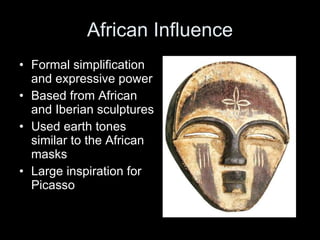
African Influence Formal simplification and expressive power Based from African and Iberian sculptures Used earth tones similar to the African masks Large inspiration for Picasso
Cezanne influence Taught to break away from technique and concentrate on color and power of single brush stroke Disengages with detail and simplified a painting
Key Artists Main Artists: Pablo Picasso George Braque Juan Gris
Pablo Picasso 1881-1973 Spanish painter and sculptor
George Braque 1882-1963 Influenced by Latisse and the Fauves, then Cezanne and Picasso Worked closely with Picasso Co-creator of Cubism
Juan Gris 1887-1927 Didn’t invent, but was a large contributor to cubism Was not as popular as Braque or Picasso More theoretical painter than others
Artists to also Note Ferdinand Leger Robert Delaunay Raymond Duchamp-Villon Marcel Duchamp Jacques Villon Jacques Lipchitz
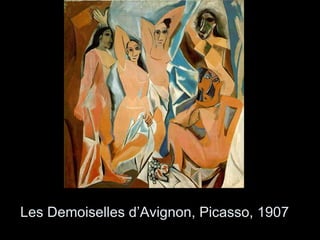
Protocubism 1906 Beginning experiments to the start of cubism Lacked spatial depth in order to make images look flatter Intentional distortion of subjects
Les Demoiselles d’Avignon, Picasso, 1907
House at L’Estaque, Braque, 1908
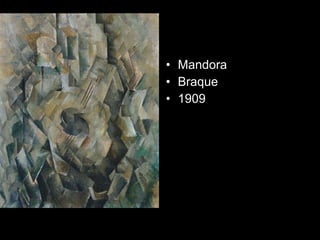
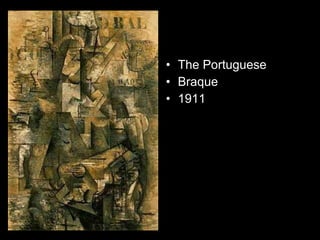
Analytical Cubism 1907-1911 Flatter, more consistent and more ambiguous Color Scheme; monochromatic (tan, brown, gray, cream, green, and blue) Emphasis on pictorial structure, not color
Portrait of Ambrose Vollard Picasso 1909
Girl with Mandolin Picasso 1910
Mandora Braque 1909
The Portuguese Braque 1911
Bread and Fruit Dish Picasso 1909
Three Women Picasso 1913
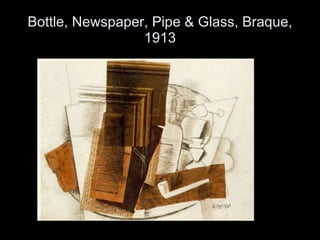
Synthetic Cubism 1912-1919 More colorful than analytical and incorporated various extraneous materials Collages and papier colles Included a number of daily household objects Instead of breaking down an object into fragments and then reassembling them, the image was being built up from new elements and shapes
Fruit Dish and Glass Braque 1912
Still Life with Chair Caning, Picasso, 1912
The Guitar Picasso 1913
Three Musicians, Picasso, 1921
Bottle, Newspaper, Pipe & Glass, Braque, 1913
Guitar and Glasses Juan Gris 1912
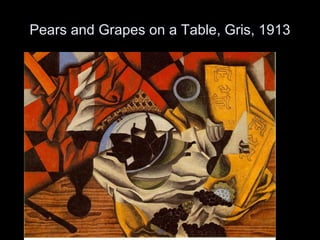
Pears and Grapes on a Table, Gris, 1913
Cubist Literature Cubism was adapted into literature especially poetry, by the likes of Guillaune Apollinaire, Max Jacob, Gertrude Stein, and Pierre Reverdy It was destructive of grammar, strange or absent punctuation, free verse, etc.
On the coast of Texas  Between Mobile and Galveston there is A great big garden overgrown with roses  It also contains a villa  Which is one great rose  Often a woman walks  In the garden all alone  And when I pass on the lime-tree-bordered road We look at each other  Since this woman belongs to the Mennonite sect  Her rose trees have no buds and her clothes no buttons  There are two missing from my jacket  This lady and I are almost of the same religion  Annie by Guillaune Apollinaire
Cubism’s Effect Expressionists Futurists Dada Constructivism Orphism

Cubism

  • 1.
    Cubism “ Everythingin nature takes its form from the sphere, the cone, and the cylinder.”-Cezanne
  • 2.
    Definition Cubism: astyle of painting and sculpture developed in the early 20th century, characterized chiefly by an emphasis on formal structure, the reduction of natural forms to their geometrical equivalents, and the organization of the planes of a represented object independently of representational requirements.
  • 3.
    Quick Facts Firstabstract art style Radical change of renaissance norms of painting Depicted subjects from multiple viewpoints or angles then reassembling it in abstract form. Two major phases: analytical and synthetic
  • 4.
    African Influence Formalsimplification and expressive power Based from African and Iberian sculptures Used earth tones similar to the African masks Large inspiration for Picasso
  • 5.
    Cezanne influence Taughtto break away from technique and concentrate on color and power of single brush stroke Disengages with detail and simplified a painting
  • 6.
    Key Artists MainArtists: Pablo Picasso George Braque Juan Gris
  • 7.
    Pablo Picasso 1881-1973Spanish painter and sculptor
  • 8.
    George Braque 1882-1963Influenced by Latisse and the Fauves, then Cezanne and Picasso Worked closely with Picasso Co-creator of Cubism
  • 9.
    Juan Gris 1887-1927Didn’t invent, but was a large contributor to cubism Was not as popular as Braque or Picasso More theoretical painter than others
  • 10.
    Artists to alsoNote Ferdinand Leger Robert Delaunay Raymond Duchamp-Villon Marcel Duchamp Jacques Villon Jacques Lipchitz
  • 11.
    Protocubism 1906 Beginningexperiments to the start of cubism Lacked spatial depth in order to make images look flatter Intentional distortion of subjects
  • 12.
  • 13.
  • 14.
    Analytical Cubism 1907-1911Flatter, more consistent and more ambiguous Color Scheme; monochromatic (tan, brown, gray, cream, green, and blue) Emphasis on pictorial structure, not color
  • 15.
    Portrait of AmbroseVollard Picasso 1909
  • 16.
    Girl with MandolinPicasso 1910
  • 17.
  • 18.
  • 19.
    Bread and FruitDish Picasso 1909
  • 20.
  • 21.
    Synthetic Cubism 1912-1919More colorful than analytical and incorporated various extraneous materials Collages and papier colles Included a number of daily household objects Instead of breaking down an object into fragments and then reassembling them, the image was being built up from new elements and shapes
  • 22.
    Fruit Dish andGlass Braque 1912
  • 23.
    Still Life withChair Caning, Picasso, 1912
  • 24.
  • 25.
  • 26.
    Bottle, Newspaper, Pipe& Glass, Braque, 1913
  • 27.
    Guitar and GlassesJuan Gris 1912
  • 28.
    Pears and Grapeson a Table, Gris, 1913
  • 29.
    Cubist Literature Cubismwas adapted into literature especially poetry, by the likes of Guillaune Apollinaire, Max Jacob, Gertrude Stein, and Pierre Reverdy It was destructive of grammar, strange or absent punctuation, free verse, etc.
  • 30.
    On the coastof Texas Between Mobile and Galveston there is A great big garden overgrown with roses It also contains a villa Which is one great rose Often a woman walks In the garden all alone And when I pass on the lime-tree-bordered road We look at each other Since this woman belongs to the Mennonite sect Her rose trees have no buds and her clothes no buttons There are two missing from my jacket This lady and I are almost of the same religion Annie by Guillaune Apollinaire
  • 31.
    Cubism’s Effect ExpressionistsFuturists Dada Constructivism Orphism