Rhythm in Architecture. 
-Architecture and Music.
Rhythm and Architecture 
• No doubt, that the branches of arts are unified in 
one connected chain. Each branch is affected by 
the others, thus the branches of music and 
Architecture 
• Rhythm can be defined as: 
-a strong, regular repeated pattern of 
movement or sound. 
-the measured flow of words and phrases in 
verse or prose as determined by the relation of long 
and short or stressed and unstressed syllables
Music and Architecture 
• Renaissance architect Leon Battista Alberti said that the same 
characteristics that please the eye also please the ear. 
• Musical terms such as rhythm, texture, harmony, proportion, 
dynamics, and articulation refer both to architecture and to music. 
-Musical texture refers to layers of sounds and rhythms 
produced by different instruments 
-Architectural texture appears in different materials. 
Harmony is balance of sound or composition and balance of parts 
together. 
Proportion is relationship between parts; in music it is distance 
between notes or intervals. 
Dynamics is the quality of action in music or in a building’s facade 
or mass. 
And often Architecture is referred to A frozen musical Composition.
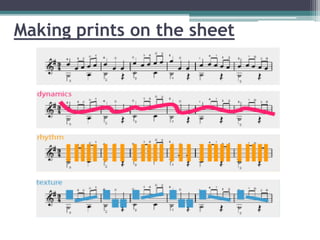
Obtaining Ideas from Musical sheets 
• Firstly, a music sheet can provide a great deal of 
inspiration to an aspiring artist. 
• One can take the Music sheet and listen at the 
same time to the composition playing. 
• As the composition plays, the artist lets his 
hands loose and makes random prints on the 
musical sheet. 
• Each piece or stanza contains different 
expressions from dynamics to rhythm and 
texture.
Making prints on the sheet
Obtaining the final result 
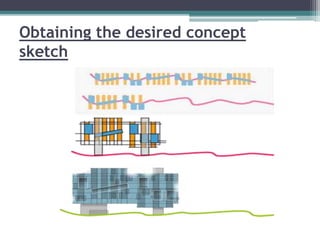
• Using the three steps of dynamics, rhythm and 
texture, this time combine the three diagrams 
into one diagram. Think of stanzas of a musical 
score 
• The obtained final product can be used as a 
concept for Elevations, Sections or even a Plan.
Obtaining the desired concept 
sketch
Examples of Such Concepts 
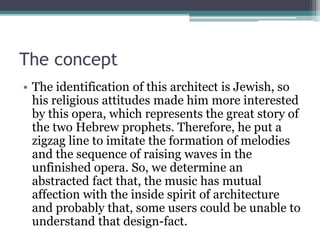
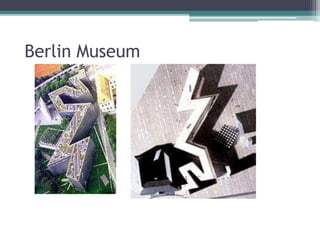
• Architect: Daniel Libeskind 
• Extension of the Berlin museum with the department 
Jewish ,Berlin, Germany.(1989-2002)
Thoughts of an Architect 
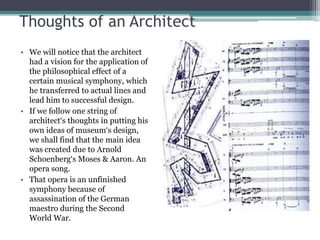
• We will notice that the architect 
had a vision for the application of 
the philosophical effect of a 
certain musical symphony, which 
he transferred to actual lines and 
lead him to successful design. 
• If we follow one string of 
architect‘s thoughts in putting his 
own ideas of museum‘s design, 
we shall find that the main idea 
was created due to Arnold 
Schoenberg‘s Moses & Aaron. An 
opera song. 
• That opera is an unfinished 
symphony because of 
assassination of the German 
maestro during the Second 
World War.
The concept 
• The identification of this architect is Jewish, so 
his religious attitudes made him more interested 
by this opera, which represents the great story of 
the two Hebrew prophets. Therefore, he put a 
zigzag line to imitate the formation of melodies 
and the sequence of raising waves in the 
unfinished opera. So, we determine an 
abstracted fact that, the music has mutual 
affection with the inside spirit of architecture 
and probably that, some users could be unable to 
understand that design-fact.
Berlin Museum
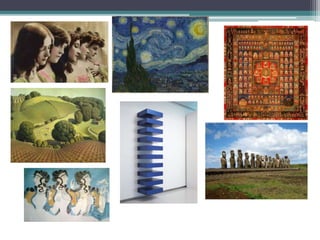
Art works inspired by Rhythm
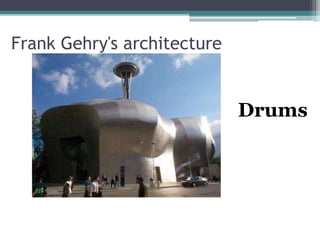
Frank Gehry's architecture 
Drums
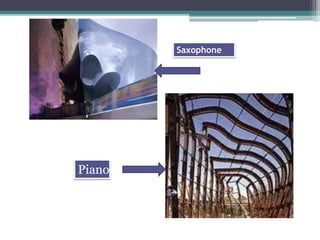
Saxophone 
Piano
REFEERNCES 
• The music of architecture, master of 
architecture Marilyn Sheppard2011 
• MUTUAL REALTION ROLE 
BETWEEN,MUSIC AND ARCHITECTURE IN 
DESIGN by Khaled Mohamed Dewidar, Amr 
Farouk El-Gohary, Maged Nabeel Aly, Hebatallah 
Aly Salama. 
• Experiencing Architecture by Steen Eiler 
Rasmussen. 
• http://www.next.cc/journey/discovery/music-and-architecture
Thank you

Rhythm in architecture

  • 1.
    Rhythm in Architecture. -Architecture and Music.
  • 2.
    Rhythm and Architecture • No doubt, that the branches of arts are unified in one connected chain. Each branch is affected by the others, thus the branches of music and Architecture • Rhythm can be defined as: -a strong, regular repeated pattern of movement or sound. -the measured flow of words and phrases in verse or prose as determined by the relation of long and short or stressed and unstressed syllables
  • 3.
    Music and Architecture • Renaissance architect Leon Battista Alberti said that the same characteristics that please the eye also please the ear. • Musical terms such as rhythm, texture, harmony, proportion, dynamics, and articulation refer both to architecture and to music. -Musical texture refers to layers of sounds and rhythms produced by different instruments -Architectural texture appears in different materials. Harmony is balance of sound or composition and balance of parts together. Proportion is relationship between parts; in music it is distance between notes or intervals. Dynamics is the quality of action in music or in a building’s facade or mass. And often Architecture is referred to A frozen musical Composition.
  • 4.
    Obtaining Ideas fromMusical sheets • Firstly, a music sheet can provide a great deal of inspiration to an aspiring artist. • One can take the Music sheet and listen at the same time to the composition playing. • As the composition plays, the artist lets his hands loose and makes random prints on the musical sheet. • Each piece or stanza contains different expressions from dynamics to rhythm and texture.
  • 5.
  • 7.
    Obtaining the finalresult • Using the three steps of dynamics, rhythm and texture, this time combine the three diagrams into one diagram. Think of stanzas of a musical score • The obtained final product can be used as a concept for Elevations, Sections or even a Plan.
  • 8.
    Obtaining the desiredconcept sketch
  • 9.
    Examples of SuchConcepts • Architect: Daniel Libeskind • Extension of the Berlin museum with the department Jewish ,Berlin, Germany.(1989-2002)
  • 10.
    Thoughts of anArchitect • We will notice that the architect had a vision for the application of the philosophical effect of a certain musical symphony, which he transferred to actual lines and lead him to successful design. • If we follow one string of architect‘s thoughts in putting his own ideas of museum‘s design, we shall find that the main idea was created due to Arnold Schoenberg‘s Moses & Aaron. An opera song. • That opera is an unfinished symphony because of assassination of the German maestro during the Second World War.
  • 11.
    The concept •The identification of this architect is Jewish, so his religious attitudes made him more interested by this opera, which represents the great story of the two Hebrew prophets. Therefore, he put a zigzag line to imitate the formation of melodies and the sequence of raising waves in the unfinished opera. So, we determine an abstracted fact that, the music has mutual affection with the inside spirit of architecture and probably that, some users could be unable to understand that design-fact.
  • 12.
  • 13.
  • 15.
  • 16.
  • 17.
    REFEERNCES • Themusic of architecture, master of architecture Marilyn Sheppard2011 • MUTUAL REALTION ROLE BETWEEN,MUSIC AND ARCHITECTURE IN DESIGN by Khaled Mohamed Dewidar, Amr Farouk El-Gohary, Maged Nabeel Aly, Hebatallah Aly Salama. • Experiencing Architecture by Steen Eiler Rasmussen. • http://www.next.cc/journey/discovery/music-and-architecture
  • 18.