What Is
Dada?
An Art?
Philosophy?
Or State
Religion?
Is DADA
Real
Energy?
Or It Is
Nothing At
All?
WHAT IS DADAISM?
 Dadaism or Dada(1916-1923) is a post-World
War I cultural movement in visual art as well as
literature (mainly poetry), theatre and graphic
design.
 A protest against the barbarism of the War
and what Dadaists believed was an
oppressive intellectual rigidity in both art and
everyday society; its works were
characterized by a deliberate irrationality and
the rejection of the prevailing standards of
art.
HOW WAS DADA CREATED ?
 The Dadaists first met at a café
Cabaret Voltaire in Zurich,Switzerland
in 1916.
 The artists who started it were against
World War 1. They wanted to rebel
against the horrors of war.
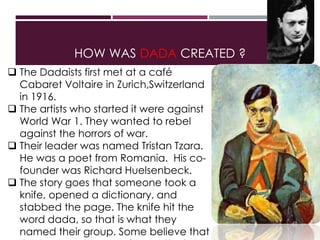
 Their leader was named Tristan Tzara.
He was a poet from Romania. His co-
founder was Richard Huelsenbeck.
 The story goes that someone took a
knife, opened a dictionary, and
stabbed the page. The knife hit the
word dada, so that is what they
named their group. Some believe that
 Their motto was
"Destruction is also
creation" because Dada
had no rules. Dada had no
values. Dada shocked
people.
 The Dada artists liked to do
absurd art. It may be one
of the strangest art styles
ever invented.
 Dadaists did not even
want to be called an art
movement!
DADAISM PHILOSOPHY
“The idea is more important than the
work itself”
“Art can be made of anything”
CHARACTERISTICS OF DADAISM
 In general, Dada sought to undermine all
art, viewing it as part of cultural norms and
sensibilities that established oppressive
aesthetic standards and emphasized the
"reason" and "order" that had led to the
self-annihilating destruction of World War I.
Therefore, anything that contradicted
these norms-chaos, irrationality,
impermanence, repugnance-was fair
game for Dada's proponents.
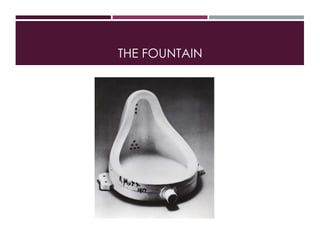
•The “Fountain”, a major
Dadaist work by Marcel
Duchamp, was rejected
at the exhibition of the
Society of Independent
Artists, causing an uproar
among the Dadaists.
•It influenced later
modern art movements
such as Surrealism and
Pop Arts, and led to
important innovations in
fine art like collage and
photo-montage.
The rejection of cultural standards and
values also implied the rejection of "art" as
well.
The Dadaists saw themselves an anti-art
movement. The simple act of creating "art"
that is "anti-art" is itself ironic, but some
Dada works were imbued with an
additionally dark humor.
The artists were shocked by the war, and
wanted to produce something
shocking.They wanted to be different and
produce things that were different.
FAMOUS DADAISTS AND
THEIR WORKS
MARCEL DUCHAMP (1887-1968): AVANT-GARDE
ARTIST
 He was considered as one of
the most famous artists of the
20th century. Marcel
Duchamp, as all the other
representatives of the Dada
current, managed to
completely change the vision
on art.
 He used to artistically present
different objects surrounding
him and called them “found
art”. Such a representation is
L.H.O.O.Q , an ironization of
the famous painting Mona
Lisa by Leonardo da Vinci.
Mona Lisa is rendered with a
beard and a mustache, in
'I have forced myself to contradict
myself in order to avoid
conforming to my own taste.’
--Marcel Duchamp
THE FOUNTAIN
'L.H.O.O.Q
 The title is a typical Duchamp
witticism. Pronouncing those
letters in French makes the
sentence “Elle a chaud au
cul”, for which the literal
translation is 'she is hot in the
ass'.
MAX ERNST (1891-1976): PAINTER, SCULPTOR,
GRAPHIC ARTIST, POET
 He founded a Dada group in
Cologne in 1919.
 One of his most important works is
Celebes, realized in 1921. This
work combines over realistic
elements with those of the
Dadaism specific collage.
 His paintings are characterized by
spontaneity and they are very
abstract.'Art has nothing to do with
taste. Art is not there to be
tasted.' --Max Ernst
THE ELEPHANT CELEBES
PIETÁ OU LA REVOLUTION LA NUIT REALIZED IN
1923.
It is a controversial painting
since the critics claimed
that it is a reproduction of
the Virgin Mary holding her
baby, but the Virgin is
replaced by the artist’s
father and Jesus by the
artist himself.
FRANCIS PICABIA (1879-1953): PAINTER,
AVANT-GARDE ARTIST
 A French painter,
Picabia is one of the
most famous painters of
Dadaism.
 He formed a group for
the supporters of
Dadaism in Barcelona
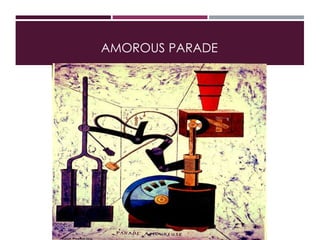
 His most important
painting is Amorous
Parade.'Dada talks with you, it is everything, it
includes everything, it belongs to all
religions, can be neither victory nor
defeat, it lives in space and not in time.' -
-Francis Picabia
AMOROUS PARADE
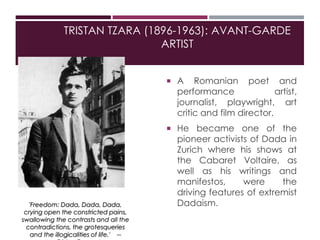
TRISTAN TZARA (1896-1963): AVANT-GARDE
ARTIST
 A Romanian poet and
performance artist,
journalist, playwright, art
critic and film director.
 He became one of the
pioneer activists of Dada in
Zurich where his shows at
the Cabaret Voltaire, as
well as his writings and
manifestos, were the
driving features of extremist
Dadaism.'Freedom: Dada, Dada, Dada,
crying open the constricted pains,
swallowing the contrasts and all the
contradictions, the grotesqueries
and the illogicalities of life.' --
PARLER SEUL
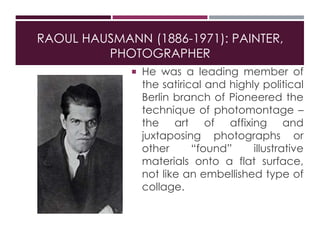
RAOUL HAUSMANN (1886-1971): PAINTER,
PHOTOGRAPHER
 He was a leading member of
the satirical and highly political
Berlin branch of Pioneered the
technique of photomontage –
the art of affixing and
juxtaposing photographs or
other “found” illustrative
materials onto a flat surface,
not like an embellished type of
collage.
RAOUL
HAUSMANN’
S
SELF-
PORTRAIT OF
THE
DADASOPHE
,
COLLAGE-
PHOTOMONT
AGE, 1920.
“RECTANGLES
ARRANGED
ACCORDING
TO THE LAWS OF
CHANCE”
BY
JEAN/HANS ARP
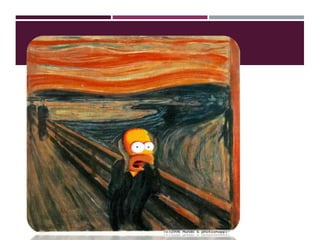
THE SIMPSONS’ “THE SCREAM”
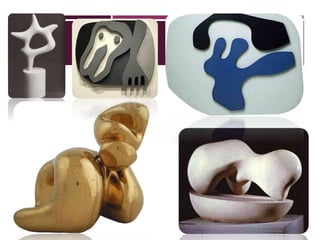
JEAN ARP
POET AND SCULPTOR
Jean Arp / Hans Arp (16
September 1886 – 7 June
1966) was a German/French
sculptor, painter, poet and a
founding member of
Dadaism.
MAX ERNST
PAINTER SCULPTOR GRAPHIC ARTIST POET
Ernst was one of the
primary pioneers of the
Dada movement and
Surrealism.
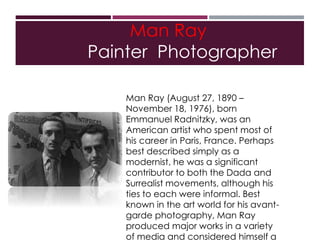
Man Ray
Painter Photographer
Man Ray (August 27, 1890 –
November 18, 1976), born
Emmanuel Radnitzky, was an
American artist who spent most of
his career in Paris, France. Perhaps
best described simply as a
modernist, he was a significant
contributor to both the Dada and
Surrealist movements, although his
ties to each were informal. Best
known in the art world for his avant-
garde photography, Man Ray
produced major works in a variety
of media and considered himself a
According to the
artists, dada was
not real art, it was
anti-art – meant
to be everything
opposite of what
art stood for.
Dada was a movement in visual art, but also literature
(mainly poetry), theatre, and graphic design.
The dada
movement
developed in
European
countries as
well as in
America –
mostly in New
York.
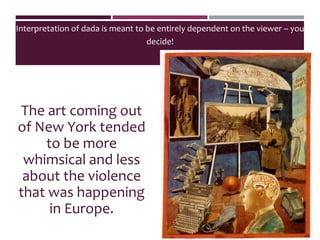
Interpretation of dada is meant to be entirely dependent on the viewer – you
decide!
The art coming out
of New York tended
to be more
whimsical and less
about the violence
that was happening
in Europe.
THE END.

Dada

  • 2.
    What Is Dada? An Art? Philosophy? OrState Religion? Is DADA Real Energy? Or It Is Nothing At All?
  • 3.
    WHAT IS DADAISM? Dadaism or Dada(1916-1923) is a post-World War I cultural movement in visual art as well as literature (mainly poetry), theatre and graphic design.  A protest against the barbarism of the War and what Dadaists believed was an oppressive intellectual rigidity in both art and everyday society; its works were characterized by a deliberate irrationality and the rejection of the prevailing standards of art.
  • 4.
    HOW WAS DADACREATED ?  The Dadaists first met at a café Cabaret Voltaire in Zurich,Switzerland in 1916.  The artists who started it were against World War 1. They wanted to rebel against the horrors of war.  Their leader was named Tristan Tzara. He was a poet from Romania. His co- founder was Richard Huelsenbeck.  The story goes that someone took a knife, opened a dictionary, and stabbed the page. The knife hit the word dada, so that is what they named their group. Some believe that
  • 5.
     Their mottowas "Destruction is also creation" because Dada had no rules. Dada had no values. Dada shocked people.  The Dada artists liked to do absurd art. It may be one of the strangest art styles ever invented.  Dadaists did not even want to be called an art movement!
  • 6.
    DADAISM PHILOSOPHY “The ideais more important than the work itself” “Art can be made of anything”
  • 7.
    CHARACTERISTICS OF DADAISM In general, Dada sought to undermine all art, viewing it as part of cultural norms and sensibilities that established oppressive aesthetic standards and emphasized the "reason" and "order" that had led to the self-annihilating destruction of World War I. Therefore, anything that contradicted these norms-chaos, irrationality, impermanence, repugnance-was fair game for Dada's proponents.
  • 8.
    •The “Fountain”, amajor Dadaist work by Marcel Duchamp, was rejected at the exhibition of the Society of Independent Artists, causing an uproar among the Dadaists. •It influenced later modern art movements such as Surrealism and Pop Arts, and led to important innovations in fine art like collage and photo-montage.
  • 9.
    The rejection ofcultural standards and values also implied the rejection of "art" as well. The Dadaists saw themselves an anti-art movement. The simple act of creating "art" that is "anti-art" is itself ironic, but some Dada works were imbued with an additionally dark humor. The artists were shocked by the war, and wanted to produce something shocking.They wanted to be different and produce things that were different.
  • 10.
  • 11.
    MARCEL DUCHAMP (1887-1968):AVANT-GARDE ARTIST  He was considered as one of the most famous artists of the 20th century. Marcel Duchamp, as all the other representatives of the Dada current, managed to completely change the vision on art.  He used to artistically present different objects surrounding him and called them “found art”. Such a representation is L.H.O.O.Q , an ironization of the famous painting Mona Lisa by Leonardo da Vinci. Mona Lisa is rendered with a beard and a mustache, in 'I have forced myself to contradict myself in order to avoid conforming to my own taste.’ --Marcel Duchamp
  • 12.
  • 13.
    'L.H.O.O.Q  The titleis a typical Duchamp witticism. Pronouncing those letters in French makes the sentence “Elle a chaud au cul”, for which the literal translation is 'she is hot in the ass'.
  • 14.
    MAX ERNST (1891-1976):PAINTER, SCULPTOR, GRAPHIC ARTIST, POET  He founded a Dada group in Cologne in 1919.  One of his most important works is Celebes, realized in 1921. This work combines over realistic elements with those of the Dadaism specific collage.  His paintings are characterized by spontaneity and they are very abstract.'Art has nothing to do with taste. Art is not there to be tasted.' --Max Ernst
  • 15.
  • 16.
    PIETÁ OU LAREVOLUTION LA NUIT REALIZED IN 1923. It is a controversial painting since the critics claimed that it is a reproduction of the Virgin Mary holding her baby, but the Virgin is replaced by the artist’s father and Jesus by the artist himself.
  • 17.
    FRANCIS PICABIA (1879-1953):PAINTER, AVANT-GARDE ARTIST  A French painter, Picabia is one of the most famous painters of Dadaism.  He formed a group for the supporters of Dadaism in Barcelona  His most important painting is Amorous Parade.'Dada talks with you, it is everything, it includes everything, it belongs to all religions, can be neither victory nor defeat, it lives in space and not in time.' - -Francis Picabia
  • 18.
  • 19.
    TRISTAN TZARA (1896-1963):AVANT-GARDE ARTIST  A Romanian poet and performance artist, journalist, playwright, art critic and film director.  He became one of the pioneer activists of Dada in Zurich where his shows at the Cabaret Voltaire, as well as his writings and manifestos, were the driving features of extremist Dadaism.'Freedom: Dada, Dada, Dada, crying open the constricted pains, swallowing the contrasts and all the contradictions, the grotesqueries and the illogicalities of life.' --
  • 20.
  • 21.
    RAOUL HAUSMANN (1886-1971):PAINTER, PHOTOGRAPHER  He was a leading member of the satirical and highly political Berlin branch of Pioneered the technique of photomontage – the art of affixing and juxtaposing photographs or other “found” illustrative materials onto a flat surface, not like an embellished type of collage.
  • 22.
  • 23.
    “RECTANGLES ARRANGED ACCORDING TO THE LAWSOF CHANCE” BY JEAN/HANS ARP
  • 24.
  • 25.
    JEAN ARP POET ANDSCULPTOR Jean Arp / Hans Arp (16 September 1886 – 7 June 1966) was a German/French sculptor, painter, poet and a founding member of Dadaism.
  • 27.
    MAX ERNST PAINTER SCULPTORGRAPHIC ARTIST POET Ernst was one of the primary pioneers of the Dada movement and Surrealism.
  • 29.
    Man Ray Painter Photographer ManRay (August 27, 1890 – November 18, 1976), born Emmanuel Radnitzky, was an American artist who spent most of his career in Paris, France. Perhaps best described simply as a modernist, he was a significant contributor to both the Dada and Surrealist movements, although his ties to each were informal. Best known in the art world for his avant- garde photography, Man Ray produced major works in a variety of media and considered himself a
  • 31.
    According to the artists,dada was not real art, it was anti-art – meant to be everything opposite of what art stood for.
  • 32.
    Dada was amovement in visual art, but also literature (mainly poetry), theatre, and graphic design.
  • 33.
    The dada movement developed in European countriesas well as in America – mostly in New York.
  • 34.
    Interpretation of dadais meant to be entirely dependent on the viewer – you decide! The art coming out of New York tended to be more whimsical and less about the violence that was happening in Europe.
  • 35.