Paper Mache : The art of using
paper to create objects/images
Newspaper Strips
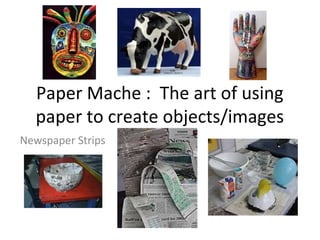
PAPER MACHE: The Art of Paper Made
Objects: Paper is ‘molded’ or “formed’.

Terms: Papier-Mache, Paper-mache,
Carton-pierre, Decoupage, Lacquer,
Armature. Please note that most of
these terms originated in the French
language.

Papier-mâché (French for
'chewed-up paper'
because of its
appearance), sometimes
called paper-mâché, is a
construction material that
consists of pieces of paper
, sometimes reinforced
with textiles, stuck
together using a wet paste
(e.g., glue, starch, or
wallpaper adhesive). The
crafted object becomes
solid when the paste dries.
[1]

Countries where we find paper-mache used as an artistic medium:
Persia, Kashmir, Japan, China, England, Russia, India, Korea,
America, Italy, France, Germany, Poland, and France.
Paper Mache Animals are popular as masks, piggy banks, and as piñatas.
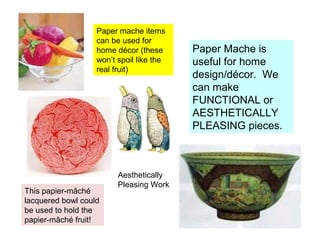
Paper mache items
can be used for
home décor (these
won’t spoil like the
real fruit)

This papier-mâché
lacquered bowl could
be used to hold the
papier-mâché fruit!

Aesthetically
Pleasing Work

Paper Mache is
useful for home
design/décor. We
can make
FUNCTIONAL or
AESTHETICALLY
PLEASING pieces.
Papier-mâché was used for
doll heads starting as far
back as 1540, and continued
to be used into the early 20th
century. The heads were
molded in two parts from a
mixture of paper pulp, clay,
and plaster, and then glued
together. The head would
then be smoothed, painted
and varnished.

Paper Mache
has been used
to create DOLL
HEADS in many
different
countries. This
has gone out of
use with the
development of
modern plastic
materials.
Papier-mâché is commonly used for large,
temporary sculpture such as Carnival
floats. A basic structure of wood, metal
and metal wire is covered in papiermâché. Once dried, details are added. The
papier-mâché is then sanded and painted.
Carnival floats can be very large and
comprise a number of characters, props
and scenic elements all organized around
a chosen theme. They can also
accommodate several dozens people,
including the operators of the
mechanisms. The floats can have movable
parts, like the facial features of a character
or its limbs. It is not unusual for local
professional architects, engineers,
painters, sculptors and ceramists to take
part in the design and construction of the
floats. Italian float makers are some of the
best in the world,
Papier-mâché MASKS
and theatrical head gear
are important to the
world of play-acting
Paper Mache has been
used to create FLOAT
DESIGNS for parades.
Papier-mâché has been used in Theatre for
creating Set Design objects and Costume
Parts
Puppetry involves the
creation of Papier-mâché
Puppets and other
associated set pieces.
AMAZINGLY: Paper
Mache has been used to
create ARCHITECTURAL
FEATURES such as
CELING DESIGNS.. …
WALL DESIGNS…..EVEN
FURNITURE!
RUSSIAN PAPER MACHE WORK: Decorated Boxes
The village of Fedoskino (Федоскино)[ located not far from Moscow
on the banks of the Ucha River, is the oldest of the four art centers of
Russian lacquer miniature painting on papier-mâché, which has been
practiced there since 1795. It stands apart both geographically, and
in that that oil paints are used rather than egg tempera.
The lacquer artists of Palekh, Kholui
and Mstera continue to use the
technique of painting in egg-based
tempera overlaid with intricate gold
leaf highlighting.

A Palekh jewelery box

No Russian lacquer artwork is
presently considered genuine piece
unless it bears the signature of one
of the recognised artists from one of
four villages, each village having its
own style.
Many
Countries have
used paper
Mache to
create
beautiful
objects. To
the LEFT are
Russian
Enameled
paper Mache
Boxes. Below
are items from
Asia.
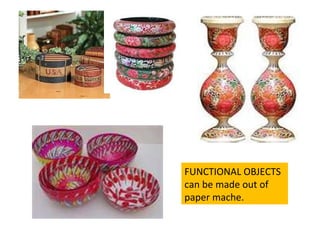
FUNCTIONAL OBJECTS
can be made out of
paper mache.
Carton-pierre
(French for 'stone
cardboard') is
papier-mâché that
has been
decorated to
resemble wood,
stone, or metal,
and is used as
decoration.[2]
Starting around 1725, gilded papier-mâché began to appear
in Europe as a low-cost alternative to similarly treated plaster
or carved wood in architecture. Henry Clay of Birmingham,
England, patented a process for treating laminated sheets of
paper with linseed oil to produce waterproof panels in 1772.
Japanned is most often a heavy black lacquer, almost like
enamel paint. The European technique uses varnishes
that have a resin base similar to shellac, applied in heatdried layers which are then polished, to give a smooth
glossy finish. It can also come in reds, greens and blues.
Originating in India, China, and Japan as a decorative
coating for pottery, it made its way into Europe by the
1600s.
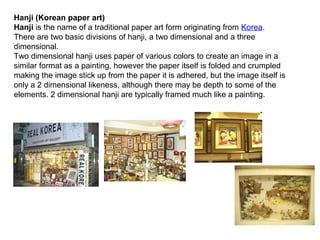
Hanji (Korean paper art)
Hanji is the name of a traditional paper art form originating from Korea.
There are two basic divisions of hanji, a two dimensional and a three
dimensional.
Two dimensional hanji uses paper of various colors to create an image in a
similar format as a painting, however the paper itself is folded and crumpled
making the image stick up from the paper it is adhered, but the image itself is
only a 2 dimensional likeness, although there may be depth to some of the
elements. 2 dimensional hanji are typically framed much like a painting.
Korean Hanji 3Dimensional Sculpture

Korean Hanji lacquer Boxes
Three dimensional Hanji is similar to papier-mâché, in
that it attempts to make sculpture type objects which may
stand unsupported.
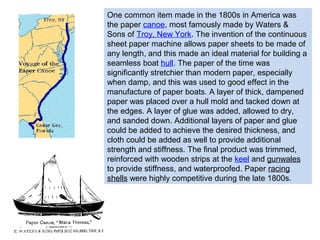
One common item made in the 1800s in America was
the paper canoe, most famously made by Waters &
Sons of Troy, New York. The invention of the continuous
sheet paper machine allows paper sheets to be made of
any length, and this made an ideal material for building a
seamless boat hull. The paper of the time was
significantly stretchier than modern paper, especially
when damp, and this was used to good effect in the
manufacture of paper boats. A layer of thick, dampened
paper was placed over a hull mold and tacked down at
the edges. A layer of glue was added, allowed to dry,
and sanded down. Additional layers of paper and glue
could be added to achieve the desired thickness, and
cloth could be added as well to provide additional
strength and stiffness. The final product was trimmed,
reinforced with wooden strips at the keel and gunwales
to provide stiffness, and waterproofed. Paper racing
shells were highly competitive during the late 1800s.
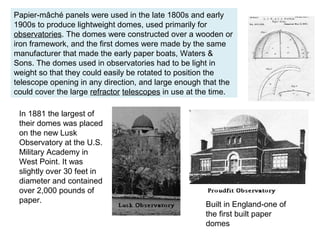
Papier-mâché panels were used in the late 1800s and early
1900s to produce lightweight domes, used primarily for
observatories. The domes were constructed over a wooden or
iron framework, and the first domes were made by the same
manufacturer that made the early paper boats, Waters &
Sons. The domes used in observatories had to be light in
weight so that they could easily be rotated to position the
telescope opening in any direction, and large enough that the
could cover the large refractor telescopes in use at the time.
In 1881 the largest of
their domes was placed
on the new Lusk
Observatory at the U.S.
Military Academy in
West Point. It was
slightly over 30 feet in
diameter and contained
over 2,000 pounds of
paper.

Built in England-one of
the first built paper
domes
More
SCULTPURES
: Note the
stylized
forms versus
completely
realistic
forms.
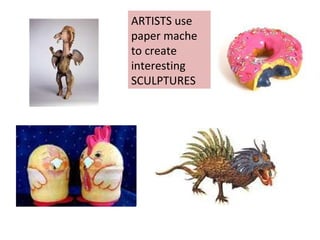
ARTISTS use
paper mache
to create
interesting
SCULPTURES
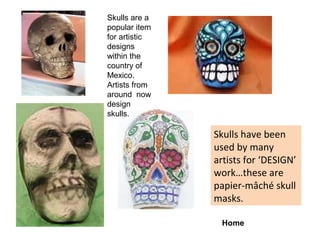
Skulls are a
popular item
for artistic
designs
within the
country of
Mexico.
Artists from
around now
design
skulls.

Skulls have been
used by many
artists for ‘DESIGN’
work…these are
papier-mâché skull
masks.
Home

Paper mache powerpoint

  • 1.
    Paper Mache :The art of using paper to create objects/images Newspaper Strips
  • 2.
    PAPER MACHE: TheArt of Paper Made Objects: Paper is ‘molded’ or “formed’. Terms: Papier-Mache, Paper-mache, Carton-pierre, Decoupage, Lacquer, Armature. Please note that most of these terms originated in the French language. Papier-mâché (French for 'chewed-up paper' because of its appearance), sometimes called paper-mâché, is a construction material that consists of pieces of paper , sometimes reinforced with textiles, stuck together using a wet paste (e.g., glue, starch, or wallpaper adhesive). The crafted object becomes solid when the paste dries. [1] Countries where we find paper-mache used as an artistic medium: Persia, Kashmir, Japan, China, England, Russia, India, Korea, America, Italy, France, Germany, Poland, and France.
  • 3.
    Paper Mache Animalsare popular as masks, piggy banks, and as piñatas.
  • 4.
    Paper mache items canbe used for home décor (these won’t spoil like the real fruit) This papier-mâché lacquered bowl could be used to hold the papier-mâché fruit! Aesthetically Pleasing Work Paper Mache is useful for home design/décor. We can make FUNCTIONAL or AESTHETICALLY PLEASING pieces.
  • 5.
    Papier-mâché was usedfor doll heads starting as far back as 1540, and continued to be used into the early 20th century. The heads were molded in two parts from a mixture of paper pulp, clay, and plaster, and then glued together. The head would then be smoothed, painted and varnished. Paper Mache has been used to create DOLL HEADS in many different countries. This has gone out of use with the development of modern plastic materials.
  • 6.
    Papier-mâché is commonlyused for large, temporary sculpture such as Carnival floats. A basic structure of wood, metal and metal wire is covered in papiermâché. Once dried, details are added. The papier-mâché is then sanded and painted. Carnival floats can be very large and comprise a number of characters, props and scenic elements all organized around a chosen theme. They can also accommodate several dozens people, including the operators of the mechanisms. The floats can have movable parts, like the facial features of a character or its limbs. It is not unusual for local professional architects, engineers, painters, sculptors and ceramists to take part in the design and construction of the floats. Italian float makers are some of the best in the world,
  • 7.
    Papier-mâché MASKS and theatricalhead gear are important to the world of play-acting
  • 8.
    Paper Mache hasbeen used to create FLOAT DESIGNS for parades.
  • 9.
    Papier-mâché has beenused in Theatre for creating Set Design objects and Costume Parts
  • 10.
    Puppetry involves the creationof Papier-mâché Puppets and other associated set pieces.
  • 11.
    AMAZINGLY: Paper Mache hasbeen used to create ARCHITECTURAL FEATURES such as CELING DESIGNS.. … WALL DESIGNS…..EVEN FURNITURE!
  • 12.
    RUSSIAN PAPER MACHEWORK: Decorated Boxes The village of Fedoskino (Федоскино)[ located not far from Moscow on the banks of the Ucha River, is the oldest of the four art centers of Russian lacquer miniature painting on papier-mâché, which has been practiced there since 1795. It stands apart both geographically, and in that that oil paints are used rather than egg tempera. The lacquer artists of Palekh, Kholui and Mstera continue to use the technique of painting in egg-based tempera overlaid with intricate gold leaf highlighting. A Palekh jewelery box No Russian lacquer artwork is presently considered genuine piece unless it bears the signature of one of the recognised artists from one of four villages, each village having its own style.
  • 13.
    Many Countries have used paper Macheto create beautiful objects. To the LEFT are Russian Enameled paper Mache Boxes. Below are items from Asia.
  • 14.
    FUNCTIONAL OBJECTS can bemade out of paper mache.
  • 15.
    Carton-pierre (French for 'stone cardboard')is papier-mâché that has been decorated to resemble wood, stone, or metal, and is used as decoration.[2] Starting around 1725, gilded papier-mâché began to appear in Europe as a low-cost alternative to similarly treated plaster or carved wood in architecture. Henry Clay of Birmingham, England, patented a process for treating laminated sheets of paper with linseed oil to produce waterproof panels in 1772.
  • 16.
    Japanned is mostoften a heavy black lacquer, almost like enamel paint. The European technique uses varnishes that have a resin base similar to shellac, applied in heatdried layers which are then polished, to give a smooth glossy finish. It can also come in reds, greens and blues. Originating in India, China, and Japan as a decorative coating for pottery, it made its way into Europe by the 1600s.
  • 17.
    Hanji (Korean paperart) Hanji is the name of a traditional paper art form originating from Korea. There are two basic divisions of hanji, a two dimensional and a three dimensional. Two dimensional hanji uses paper of various colors to create an image in a similar format as a painting, however the paper itself is folded and crumpled making the image stick up from the paper it is adhered, but the image itself is only a 2 dimensional likeness, although there may be depth to some of the elements. 2 dimensional hanji are typically framed much like a painting.
  • 18.
    Korean Hanji 3DimensionalSculpture Korean Hanji lacquer Boxes Three dimensional Hanji is similar to papier-mâché, in that it attempts to make sculpture type objects which may stand unsupported.
  • 19.
    One common itemmade in the 1800s in America was the paper canoe, most famously made by Waters & Sons of Troy, New York. The invention of the continuous sheet paper machine allows paper sheets to be made of any length, and this made an ideal material for building a seamless boat hull. The paper of the time was significantly stretchier than modern paper, especially when damp, and this was used to good effect in the manufacture of paper boats. A layer of thick, dampened paper was placed over a hull mold and tacked down at the edges. A layer of glue was added, allowed to dry, and sanded down. Additional layers of paper and glue could be added to achieve the desired thickness, and cloth could be added as well to provide additional strength and stiffness. The final product was trimmed, reinforced with wooden strips at the keel and gunwales to provide stiffness, and waterproofed. Paper racing shells were highly competitive during the late 1800s.
  • 20.
    Papier-mâché panels wereused in the late 1800s and early 1900s to produce lightweight domes, used primarily for observatories. The domes were constructed over a wooden or iron framework, and the first domes were made by the same manufacturer that made the early paper boats, Waters & Sons. The domes used in observatories had to be light in weight so that they could easily be rotated to position the telescope opening in any direction, and large enough that the could cover the large refractor telescopes in use at the time. In 1881 the largest of their domes was placed on the new Lusk Observatory at the U.S. Military Academy in West Point. It was slightly over 30 feet in diameter and contained over 2,000 pounds of paper. Built in England-one of the first built paper domes
  • 21.
    More SCULTPURES : Note the stylized formsversus completely realistic forms.
  • 22.
    ARTISTS use paper mache tocreate interesting SCULPTURES
  • 23.
    Skulls are a popularitem for artistic designs within the country of Mexico. Artists from around now design skulls. Skulls have been used by many artists for ‘DESIGN’ work…these are papier-mâché skull masks. Home