Framework for Marketing Management
18
Managing Marketing
in the
Global Economy
1
Copyright © 2011 Pearson Education, Inc. Publishing as Prentice Hall 18-2
Chapter Questions
 What factors should a company review before
deciding to market internationally?
 What are the major ways of entering foreign
markets?
 What are the keys to effective internal
marketing?
 How can companies be responsible social
marketers?
 What tools can companies use to monitor and
improve their marketing activities?
Copyright © 2011 Pearson Education, Inc. Publishing as Prentice Hall 18-3
Chapter Questions
 To what extent must the company adapt its
products and marketing program to each
foreign country?
 How do marketers influence country-of-origin
effects?
 How should the company manage and
organize its international activities?
Copyright © 2011 Pearson Education, Inc. Publishing as Prentice Hall 18-4
What is a Global Firm?
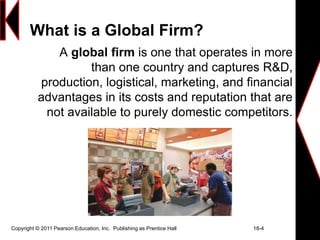
A global firm is one that operates in more
than one country and captures R&D,
production, logistical, marketing, and financial
advantages in its costs and reputation that are
not available to purely domestic competitors.
Copyright © 2011 Pearson Education, Inc. Publishing as Prentice Hall 18-5
Major Decisions in
International Marketing
 Deciding whether to go
 Deciding which markets to enter
 Deciding how to enter
 Deciding on the marketing program
 Deciding on the marketing organization
Reasons for Pursuing
Global Markets
 Better profit opportunities
 Larger customer base to achieve economies
of scale
 Less dependence on any one market
 Desire to counterattack global competitors in
their home markets
 Customers require international service
Copyright © 2011 Pearson Education, Inc. Publishing as Prentice Hall 18-6
Risks to Going Abroad
 Lack of knowledge of foreign culture
 Lack of understanding of foreign needs
 Lack of understanding of foreign regulations
 Lack of managers with international expertise
 Changes in the country environment
Copyright © 2011 Pearson Education, Inc. Publishing as Prentice Hall 18-7
Copyright © 2011 Pearson Education, Inc. Publishing as Prentice Hall 18-8
Four Stages of
Internationalization
 Stage 1: No regular export activities
 Stage 2: Export via independent agents
 Stage 3: Establish sales subsidiaries
 Stage 4: Establish production facilities abroad
Copyright © 2011 Pearson Education, Inc. Publishing as Prentice Hall 18-9
Five Modes of Entry
into Foreign Markets
 Indirect exporting
 Direct exporting
 Licensing
 Joint ventures
 Direct investment
Copyright © 2011 Pearson Education, Inc. Publishing as Prentice Hall 18-10
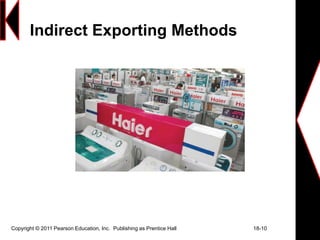
Indirect Exporting Methods
Copyright © 2011 Pearson Education, Inc. Publishing as Prentice Hall 18-11
Direct Exporting Methods
 Domestic-based export department
 Overseas sales branch or subsidiary
 Traveling export sales representatives
 Foreign-based distributors or agents
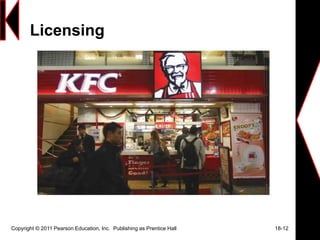
Licensing
Copyright © 2011 Pearson Education, Inc. Publishing as Prentice Hall 18-12
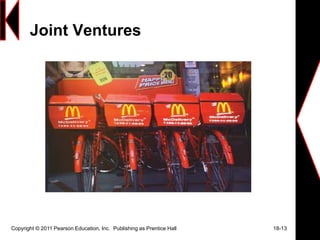
Joint Ventures
Copyright © 2011 Pearson Education, Inc. Publishing as Prentice Hall 18-13
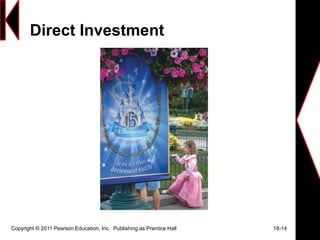
Direct Investment
Copyright © 2011 Pearson Education, Inc. Publishing as Prentice Hall 18-14
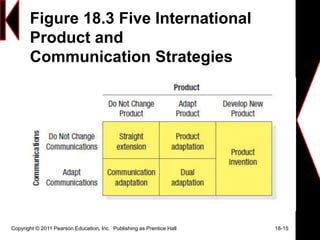
Figure 18.3 Five International
Product and
Communication Strategies
Copyright © 2011 Pearson Education, Inc. Publishing as Prentice Hall 18-15
Copyright © 2011 Pearson Education, Inc. Publishing as Prentice Hall 18-16
Levels of Product Adaptation
 Production of regional product versions
 Production of country versions
 Production of city versions
 Production of retailer versions
Copyright © 2011 Pearson Education, Inc. Publishing as Prentice Hall 18-17
Price Choices
 Set a uniform price everywhere
 Set a market-based price in each country
 Set a cost-based price in each country
Copyright © 2011 Pearson Education, Inc. Publishing as Prentice Hall 18-18
What is a Gray Market?
A gray market consists of branded
products diverted from normal or authorized
distributions channels in the country of
product origin or cross international
borders; dealers in lower priced countries
sell products in higher priced countries
Copyright © 2011 Pearson Education, Inc. Publishing as Prentice Hall 18-19
Whole-Channel Concept for
International Marketing
 Seller
 International headquarters
 Channels between nations
 Channels within nations
 Final buyers
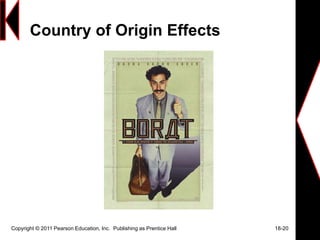
Country of Origin Effects
Copyright © 2011 Pearson Education, Inc. Publishing as Prentice Hall 18-20
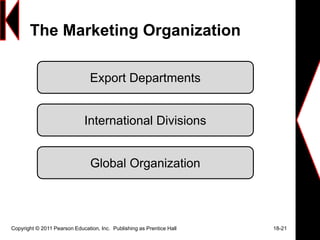
The Marketing Organization
Copyright © 2011 Pearson Education, Inc. Publishing as Prentice Hall 18-21
Export Departments
International Divisions
Global Organization
Copyright © 2011 Pearson Education, Inc. Publishing as Prentice Hall 18-22
For Review
 What factors should a company review before
deciding to market internationally?
 What are the major ways of entering foreign
markets?
 What are the keys to effective internal
marketing?
 How can companies be responsible social
marketers?
 What tools can companies use to monitor and
improve their marketing activities?

Kotler framework 5e_18_sppt

  • 1.
    Framework for MarketingManagement 18 Managing Marketing in the Global Economy 1
  • 2.
    Copyright © 2011Pearson Education, Inc. Publishing as Prentice Hall 18-2 Chapter Questions  What factors should a company review before deciding to market internationally?  What are the major ways of entering foreign markets?  What are the keys to effective internal marketing?  How can companies be responsible social marketers?  What tools can companies use to monitor and improve their marketing activities?
  • 3.
    Copyright © 2011Pearson Education, Inc. Publishing as Prentice Hall 18-3 Chapter Questions  To what extent must the company adapt its products and marketing program to each foreign country?  How do marketers influence country-of-origin effects?  How should the company manage and organize its international activities?
  • 4.
    Copyright © 2011Pearson Education, Inc. Publishing as Prentice Hall 18-4 What is a Global Firm? A global firm is one that operates in more than one country and captures R&D, production, logistical, marketing, and financial advantages in its costs and reputation that are not available to purely domestic competitors.
  • 5.
    Copyright © 2011Pearson Education, Inc. Publishing as Prentice Hall 18-5 Major Decisions in International Marketing  Deciding whether to go  Deciding which markets to enter  Deciding how to enter  Deciding on the marketing program  Deciding on the marketing organization
  • 6.
    Reasons for Pursuing GlobalMarkets  Better profit opportunities  Larger customer base to achieve economies of scale  Less dependence on any one market  Desire to counterattack global competitors in their home markets  Customers require international service Copyright © 2011 Pearson Education, Inc. Publishing as Prentice Hall 18-6
  • 7.
    Risks to GoingAbroad  Lack of knowledge of foreign culture  Lack of understanding of foreign needs  Lack of understanding of foreign regulations  Lack of managers with international expertise  Changes in the country environment Copyright © 2011 Pearson Education, Inc. Publishing as Prentice Hall 18-7
  • 8.
    Copyright © 2011Pearson Education, Inc. Publishing as Prentice Hall 18-8 Four Stages of Internationalization  Stage 1: No regular export activities  Stage 2: Export via independent agents  Stage 3: Establish sales subsidiaries  Stage 4: Establish production facilities abroad
  • 9.
    Copyright © 2011Pearson Education, Inc. Publishing as Prentice Hall 18-9 Five Modes of Entry into Foreign Markets  Indirect exporting  Direct exporting  Licensing  Joint ventures  Direct investment
  • 10.
    Copyright © 2011Pearson Education, Inc. Publishing as Prentice Hall 18-10 Indirect Exporting Methods
  • 11.
    Copyright © 2011Pearson Education, Inc. Publishing as Prentice Hall 18-11 Direct Exporting Methods  Domestic-based export department  Overseas sales branch or subsidiary  Traveling export sales representatives  Foreign-based distributors or agents
  • 12.
    Licensing Copyright © 2011Pearson Education, Inc. Publishing as Prentice Hall 18-12
  • 13.
    Joint Ventures Copyright ©2011 Pearson Education, Inc. Publishing as Prentice Hall 18-13
  • 14.
    Direct Investment Copyright ©2011 Pearson Education, Inc. Publishing as Prentice Hall 18-14
  • 15.
    Figure 18.3 FiveInternational Product and Communication Strategies Copyright © 2011 Pearson Education, Inc. Publishing as Prentice Hall 18-15
  • 16.
    Copyright © 2011Pearson Education, Inc. Publishing as Prentice Hall 18-16 Levels of Product Adaptation  Production of regional product versions  Production of country versions  Production of city versions  Production of retailer versions
  • 17.
    Copyright © 2011Pearson Education, Inc. Publishing as Prentice Hall 18-17 Price Choices  Set a uniform price everywhere  Set a market-based price in each country  Set a cost-based price in each country
  • 18.
    Copyright © 2011Pearson Education, Inc. Publishing as Prentice Hall 18-18 What is a Gray Market? A gray market consists of branded products diverted from normal or authorized distributions channels in the country of product origin or cross international borders; dealers in lower priced countries sell products in higher priced countries
  • 19.
    Copyright © 2011Pearson Education, Inc. Publishing as Prentice Hall 18-19 Whole-Channel Concept for International Marketing  Seller  International headquarters  Channels between nations  Channels within nations  Final buyers
  • 20.
    Country of OriginEffects Copyright © 2011 Pearson Education, Inc. Publishing as Prentice Hall 18-20
  • 21.
    The Marketing Organization Copyright© 2011 Pearson Education, Inc. Publishing as Prentice Hall 18-21 Export Departments International Divisions Global Organization
  • 22.
    Copyright © 2011Pearson Education, Inc. Publishing as Prentice Hall 18-22 For Review  What factors should a company review before deciding to market internationally?  What are the major ways of entering foreign markets?  What are the keys to effective internal marketing?  How can companies be responsible social marketers?  What tools can companies use to monitor and improve their marketing activities?