CUBISM
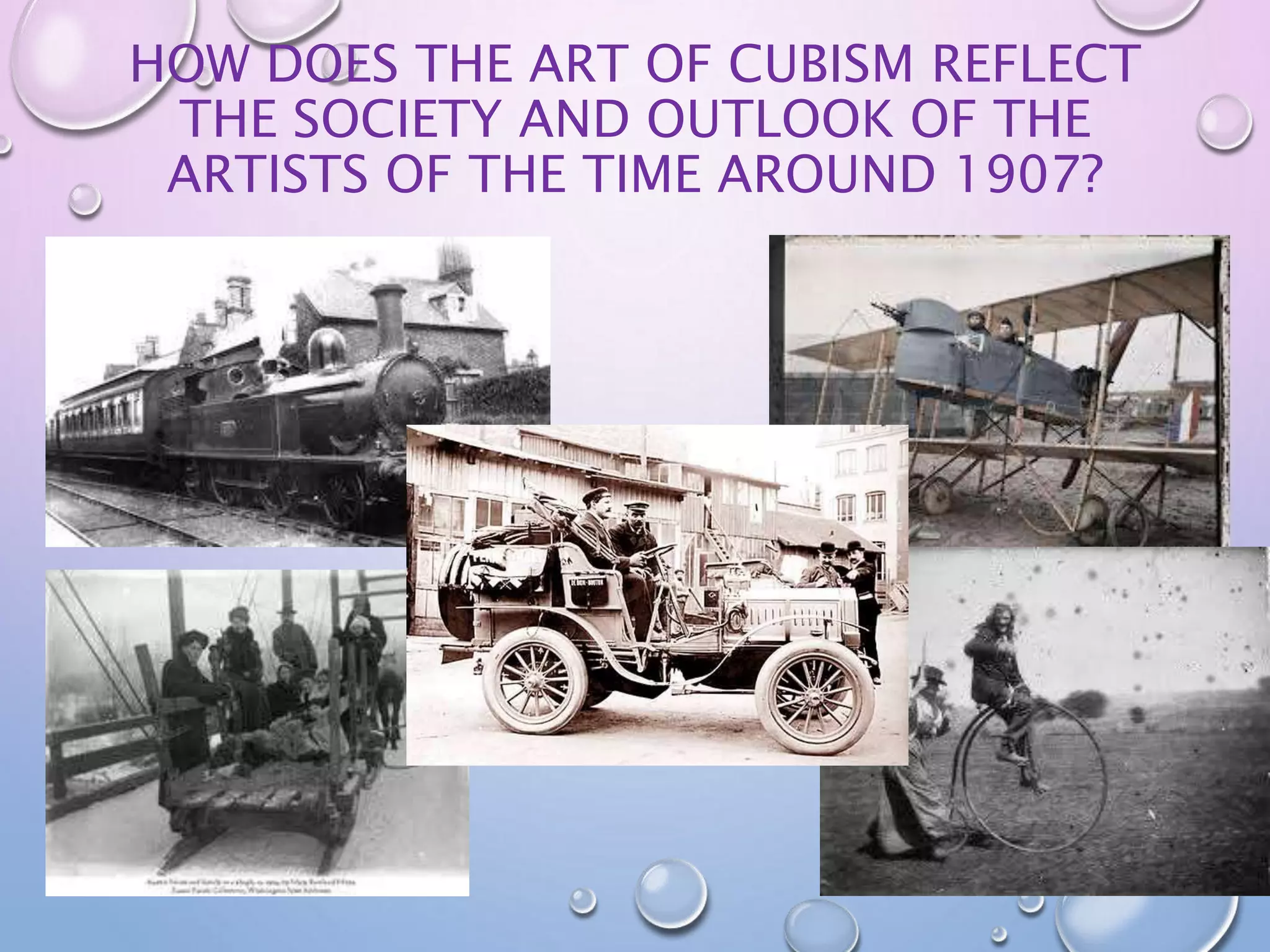
HOW DOES THE ART OF CUBISM REFLECT 
THE SOCIETY AND OUTLOOK OF THE 
ARTISTS OF THE TIME AROUND 1907?
INFLUENCE OF SOCIETY ON 
ARTISTS 
• There was a push towards being modern. 
A time of great change as people 
embraced new inventions and people’s 
lifestyles were changing. e.g., transport, 
electricity, communications, factories, 
people moving away from farms to the 
cities (industrialisation). 
• Invention of photography took over from 
the needs of traditional art forms to 
reproduce realistic scenes.
INFLUENCE OF SOCIETY ON 
ARTISTS 
• New philosophies and rise of 
psychology. Artists could now interpret 
the world communicating their 
emotions, thoughts and philosophies. 
• Artists no longer wanted to depict a 
single traditional view in their art but 
wanted to interpret their world 
showing movement, time and multiple 
views as if you were moving through 
space, thoughts and opinions, a more 
expressive response to the subject.
WHAT DID THE ARTISTS DO IN 
THEIR PAINTINGS TO REFLECT 
THESE IDEAS? 
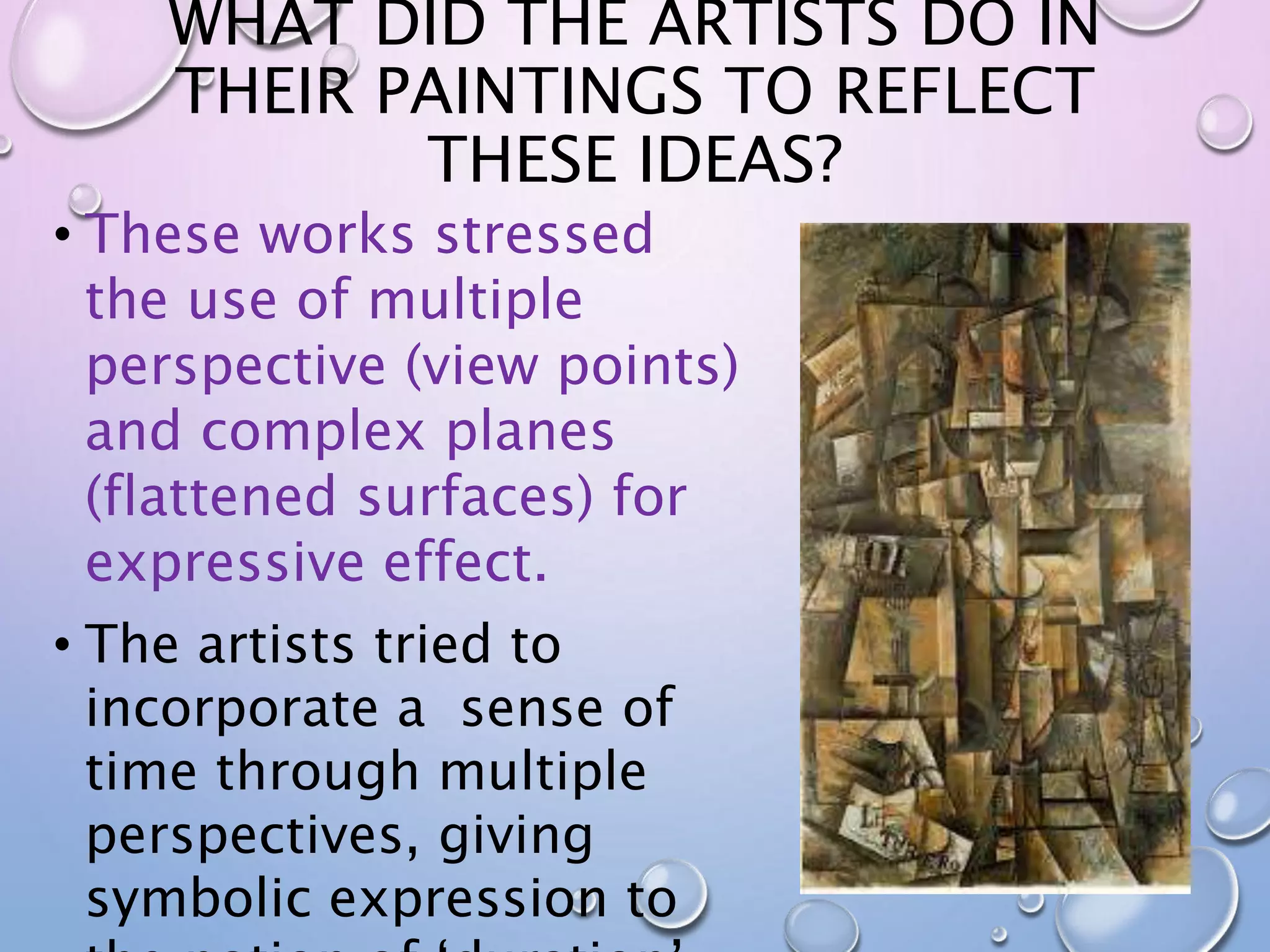
• These works stressed 
the use of multiple 
perspective (view points) 
and complex planes 
(flattened surfaces) for 
expressive effect. 
• The artists tried to 
incorporate a sense of 
time through multiple 
perspectives, giving 
symbolic expression to 
the notion of ‘duration’.
WHAT DID THE ARTISTS DO IN 
THEIR PAINTINGS TO REFLECT 
THESE IDEAS? 
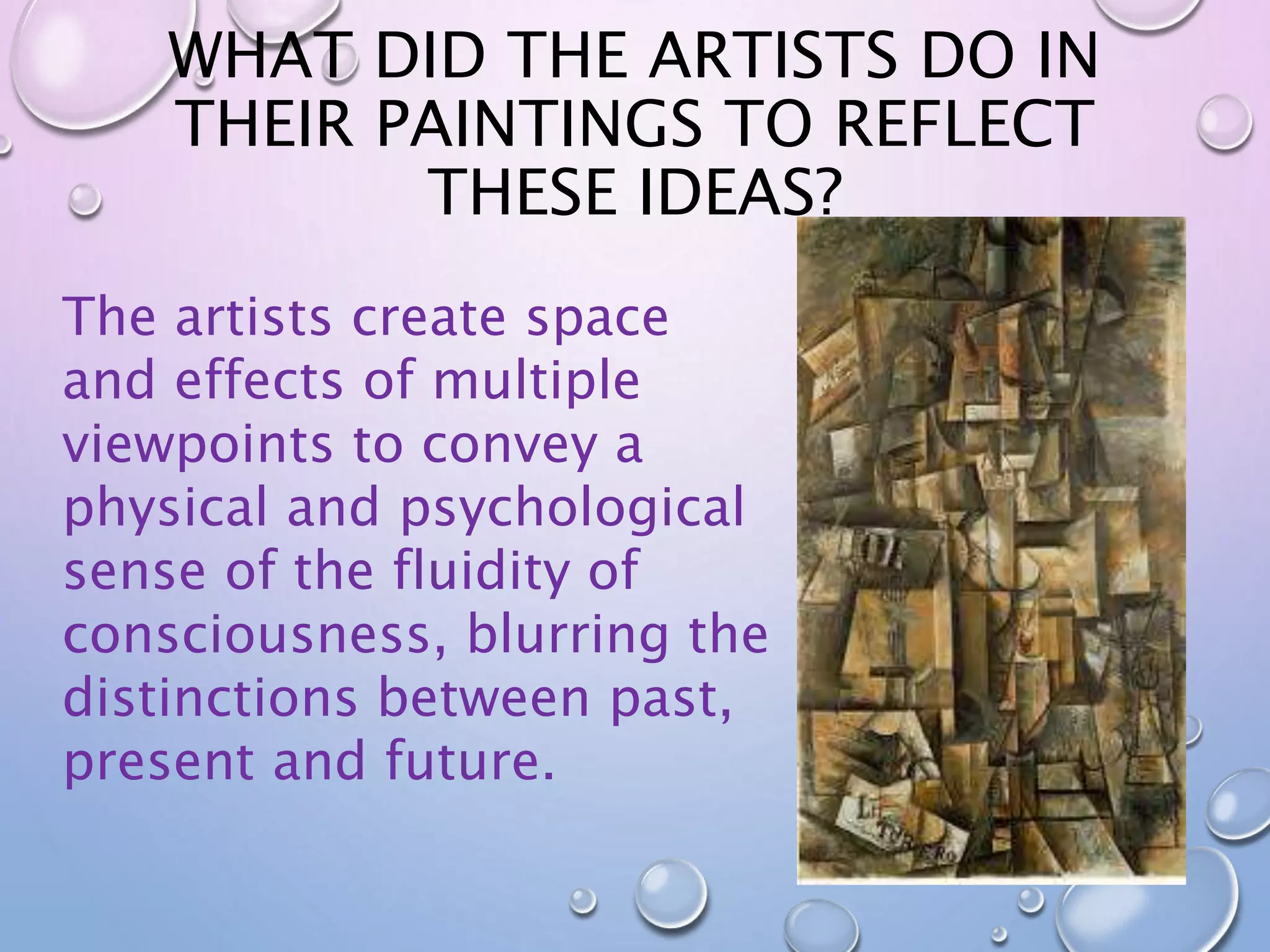
The artists create space 
and effects of multiple 
viewpoints to convey a 
physical and psychological 
sense of the fluidity of 
consciousness, blurring the 
distinctions between past, 
present and future.
WHAT DID THE ARTISTS DO IN 
THEIR PAINTINGS TO REFLECT 
THESE IDEAS? 
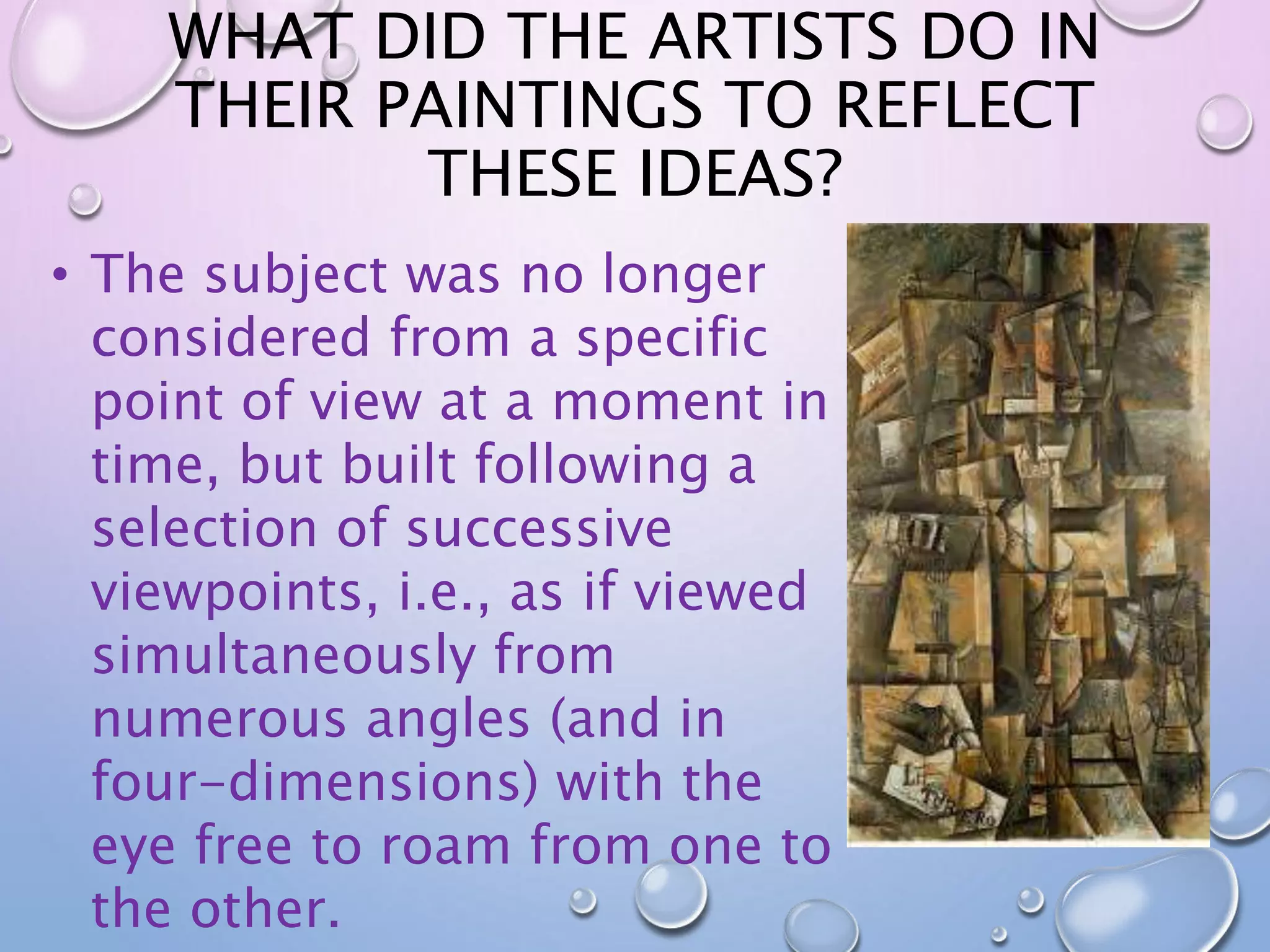
• The subject was no longer 
considered from a specific 
point of view at a moment in 
time, but built following a 
selection of successive 
viewpoints, i.e., as if viewed 
simultaneously from 
numerous angles (and in 
four-dimensions) with the 
eye free to roam from one to 
the other.
WHAT DID THE ARTISTS DO IN 
THEIR PAINTINGS TO REFLECT 
THESE IDEAS? 
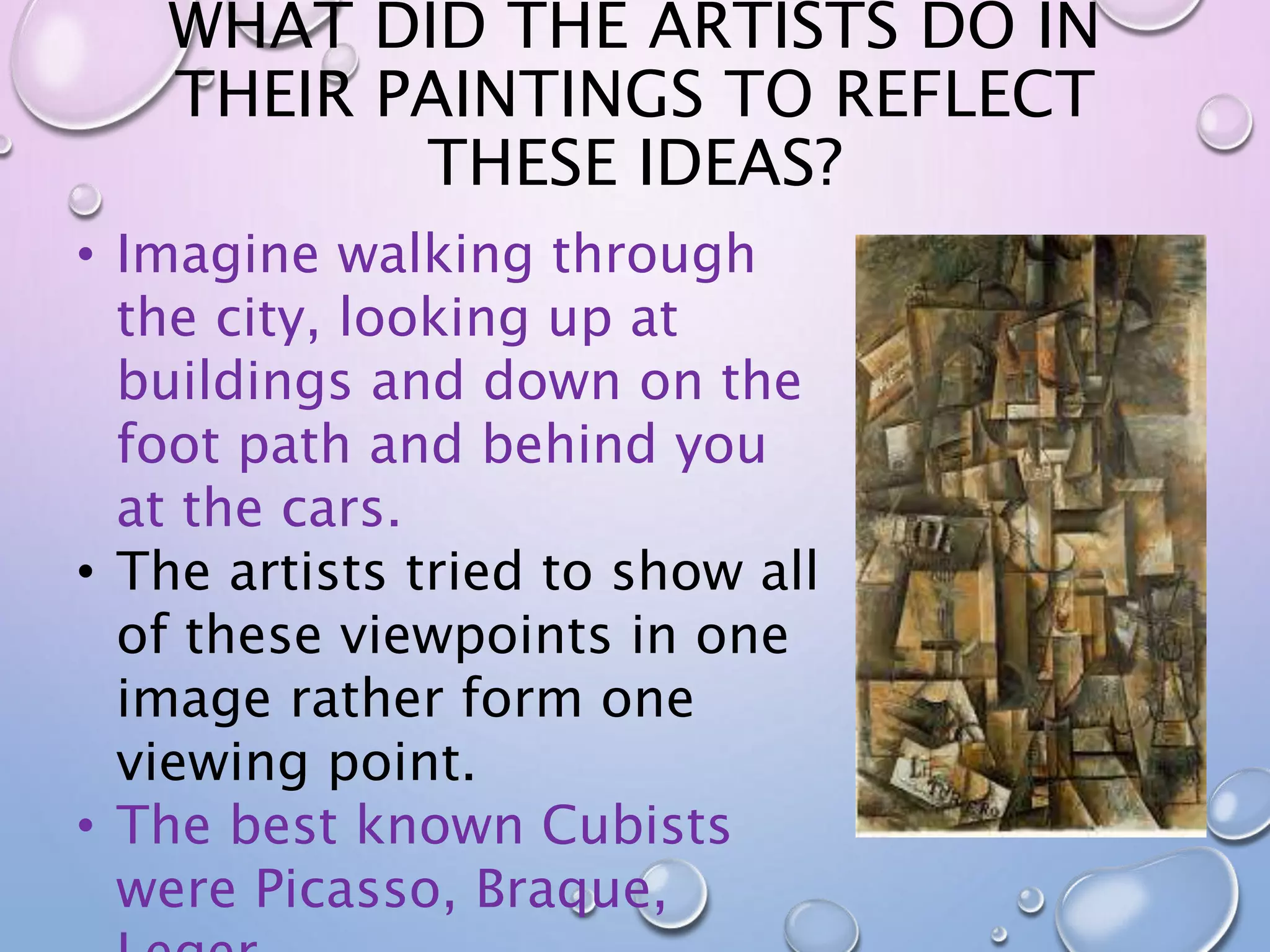
• Imagine walking through 
the city, looking up at 
buildings and down on the 
foot path and behind you 
at the cars. 
• The artists tried to show all 
of these viewpoints in one 
image rather form one 
viewing point. 
• The best known Cubists 
were Picasso, Braque, 
Leger.
ANALYTICAL CUBISM 
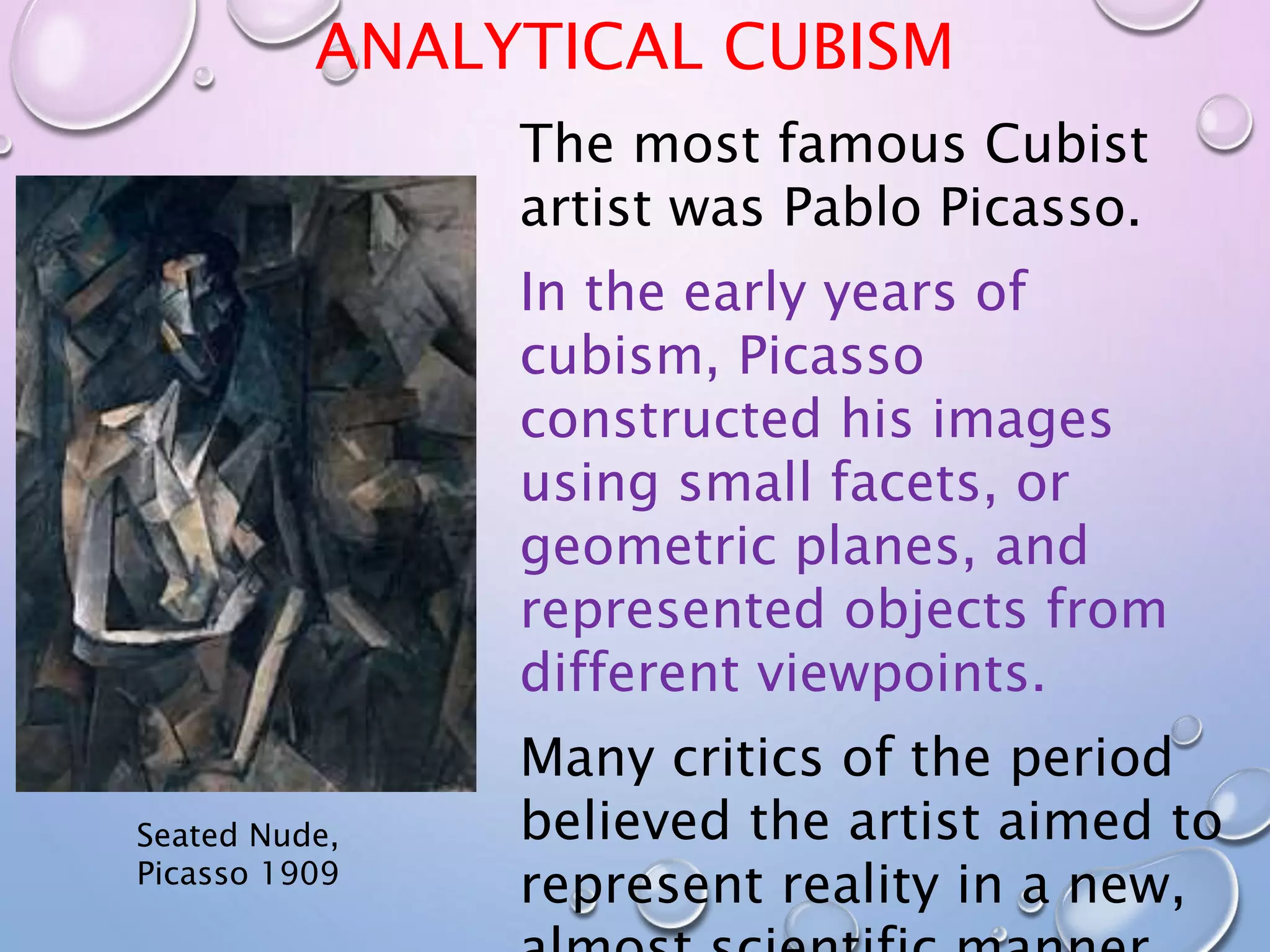
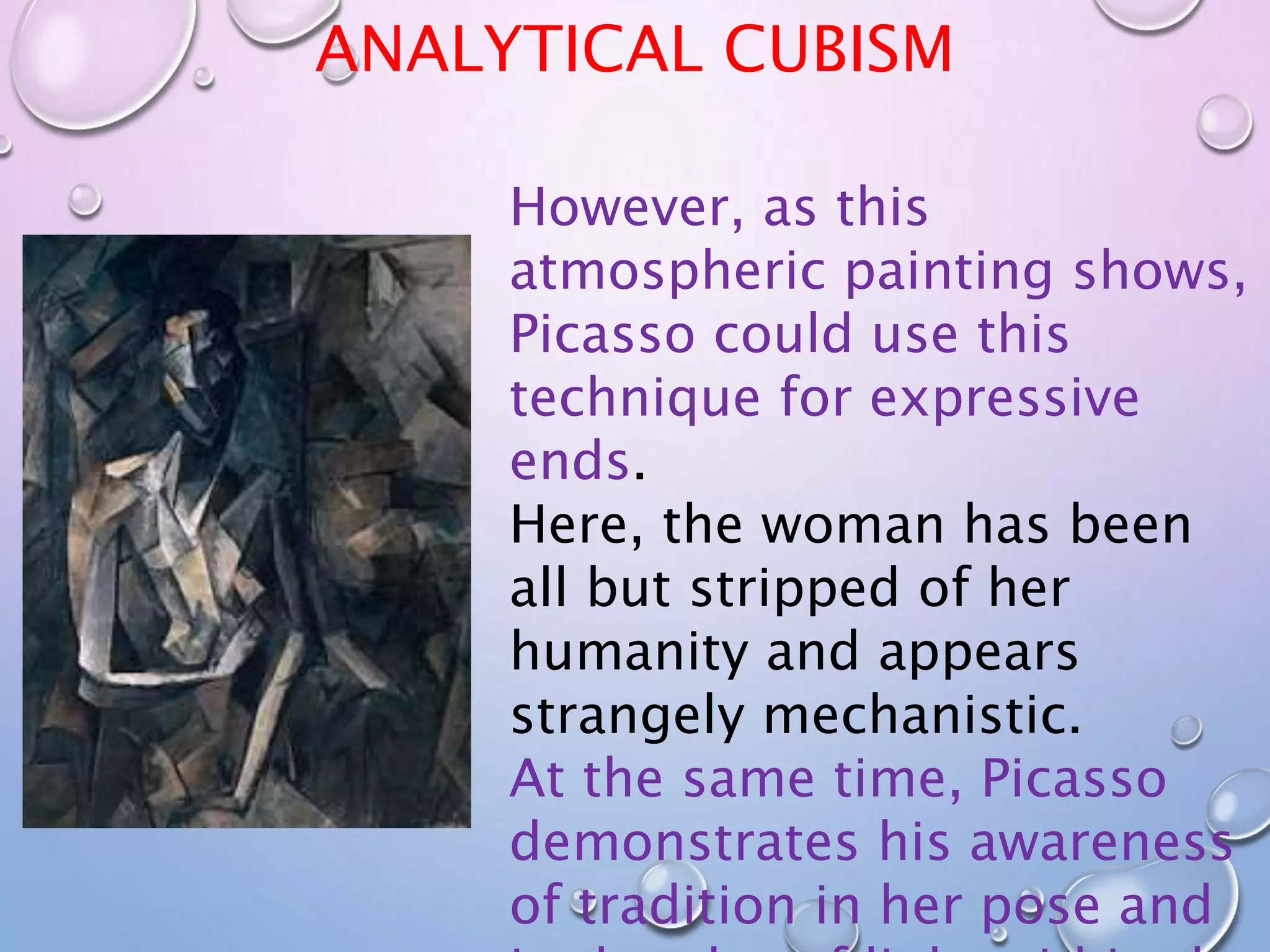
Seated Nude, 
Picasso 1909 
The most famous Cubist 
artist was Pablo Picasso. 
In the early years of 
cubism, Picasso 
constructed his images 
using small facets, or 
geometric planes, and 
represented objects from 
different viewpoints. 
Many critics of the period 
believed the artist aimed to 
represent reality in a new, 
almost scientific manner.
ANALYTICAL CUBISM 
However, as this 
atmospheric painting shows, 
Picasso could use this 
technique for expressive 
ends. 
Here, the woman has been 
all but stripped of her 
humanity and appears 
strangely mechanistic. 
At the same time, Picasso 
demonstrates his awareness 
of tradition in her pose and 
in the play of light within the
SYNTHETIC CUBISM 
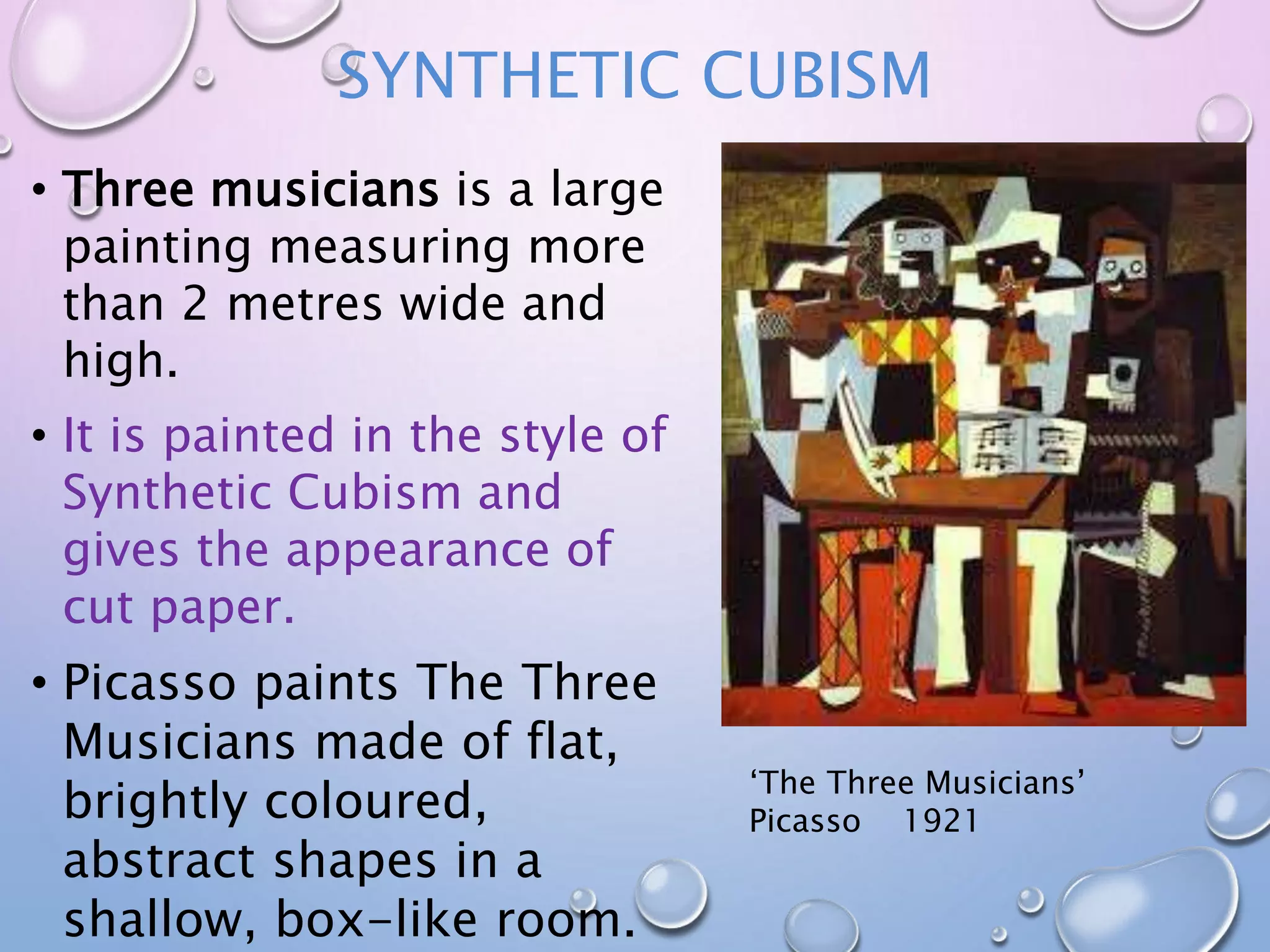
• Three musicians is a large 
painting measuring more 
than 2 metres wide and 
high. 
• It is painted in the style of 
Synthetic Cubism and 
gives the appearance of 
cut paper. 
• Picasso paints The Three 
Musicians made of flat, 
brightly coloured, 
abstract shapes in a 
shallow, box-like room. 
‘The Three Musicians’ 
Picasso 1921
SYNTHETIC CUBISM 
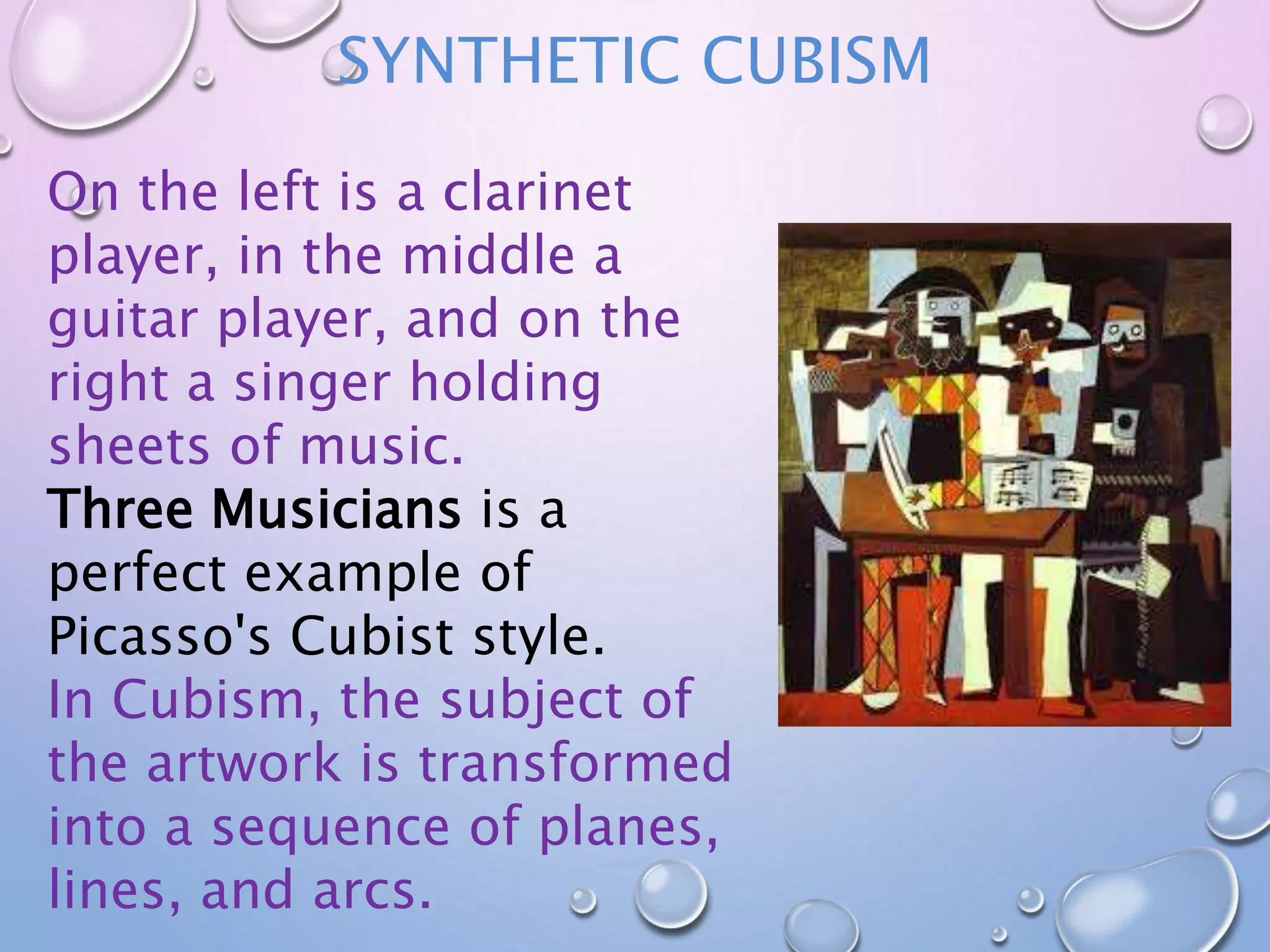
On the left is a clarinet 
player, in the middle a 
guitar player, and on the 
right a singer holding 
sheets of music. 
Three Musicians is a 
perfect example of 
Picasso's Cubist style. 
In Cubism, the subject of 
the artwork is transformed 
into a sequence of planes, 
lines, and arcs.
SYNTHETIC CUBISM 
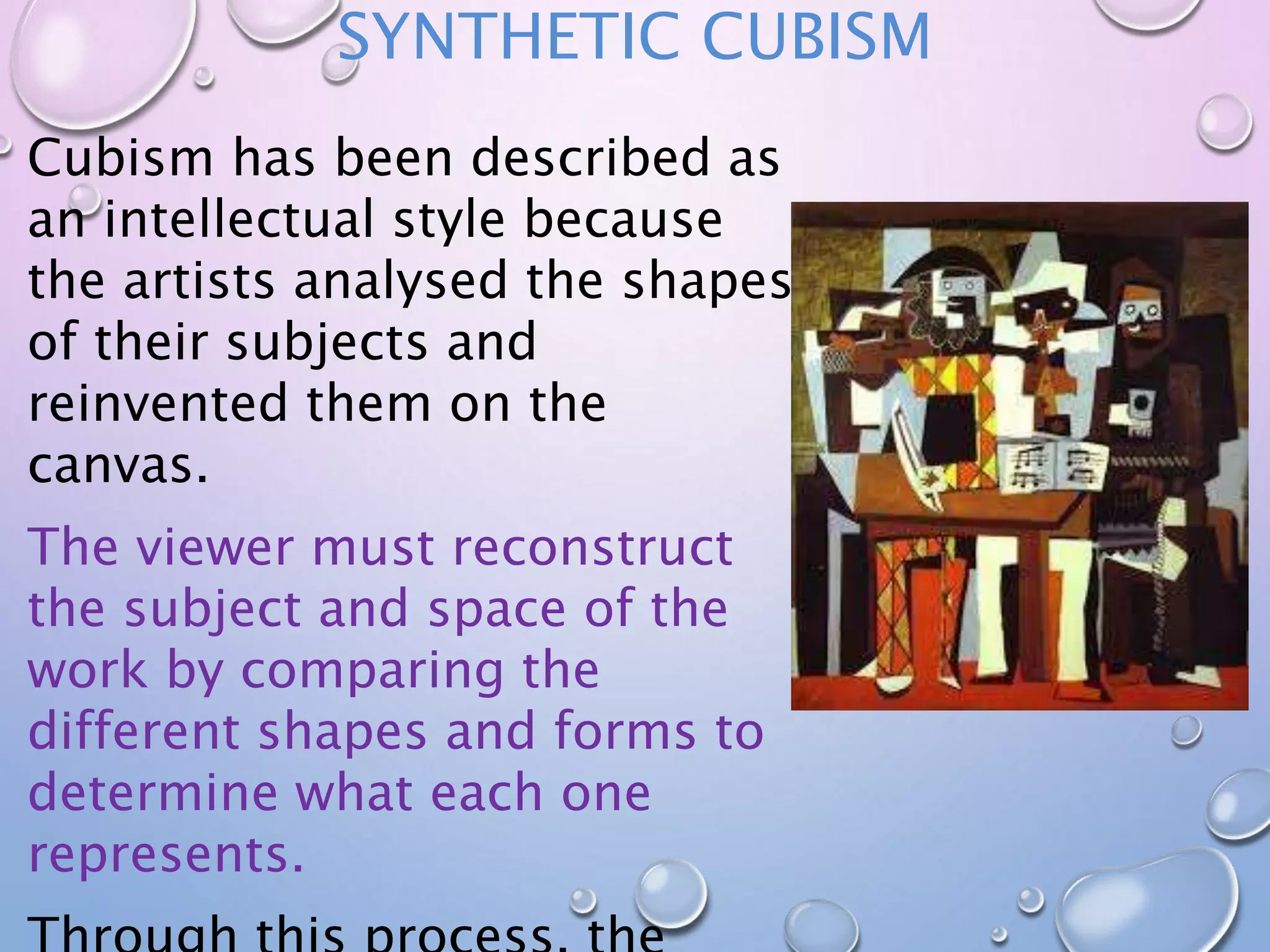
Cubism has been described as 
an intellectual style because 
the artists analysed the shapes 
of their subjects and 
reinvented them on the 
canvas. 
The viewer must reconstruct 
the subject and space of the 
work by comparing the 
different shapes and forms to 
determine what each one 
represents. 
Through this process, the
SYNTHETIC CUBISM 
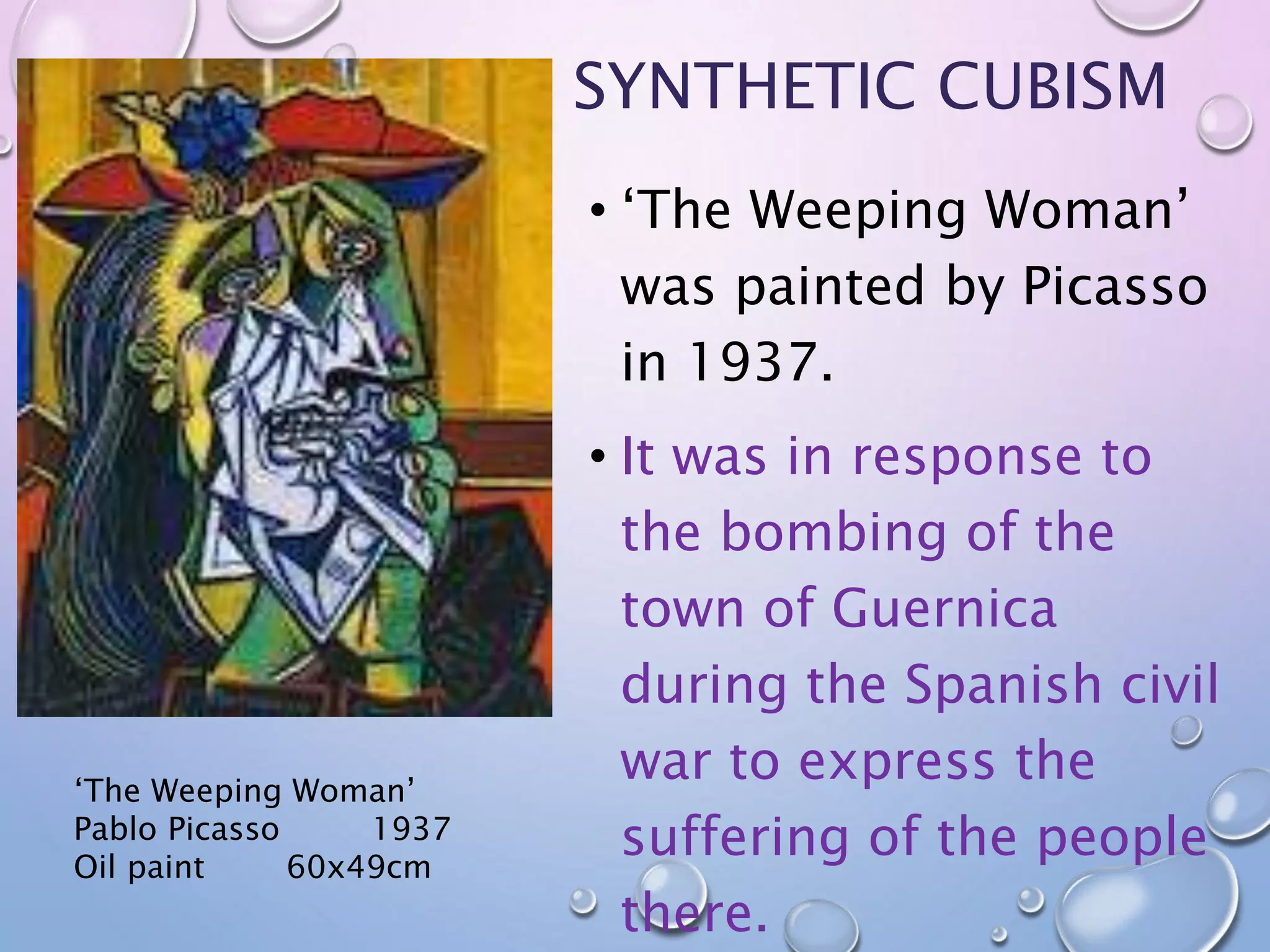
• ‘The Weeping Woman’ 
was painted by Picasso 
in 1937. 
• It was in response to 
the bombing of the 
town of Guernica 
during the Spanish civil 
war to express the 
suffering of the people 
there. 
‘The Weeping Woman’ 
Pablo Picasso 1937 
Oil paint 60x49cm
SYNTHETIC 
CUBISM 
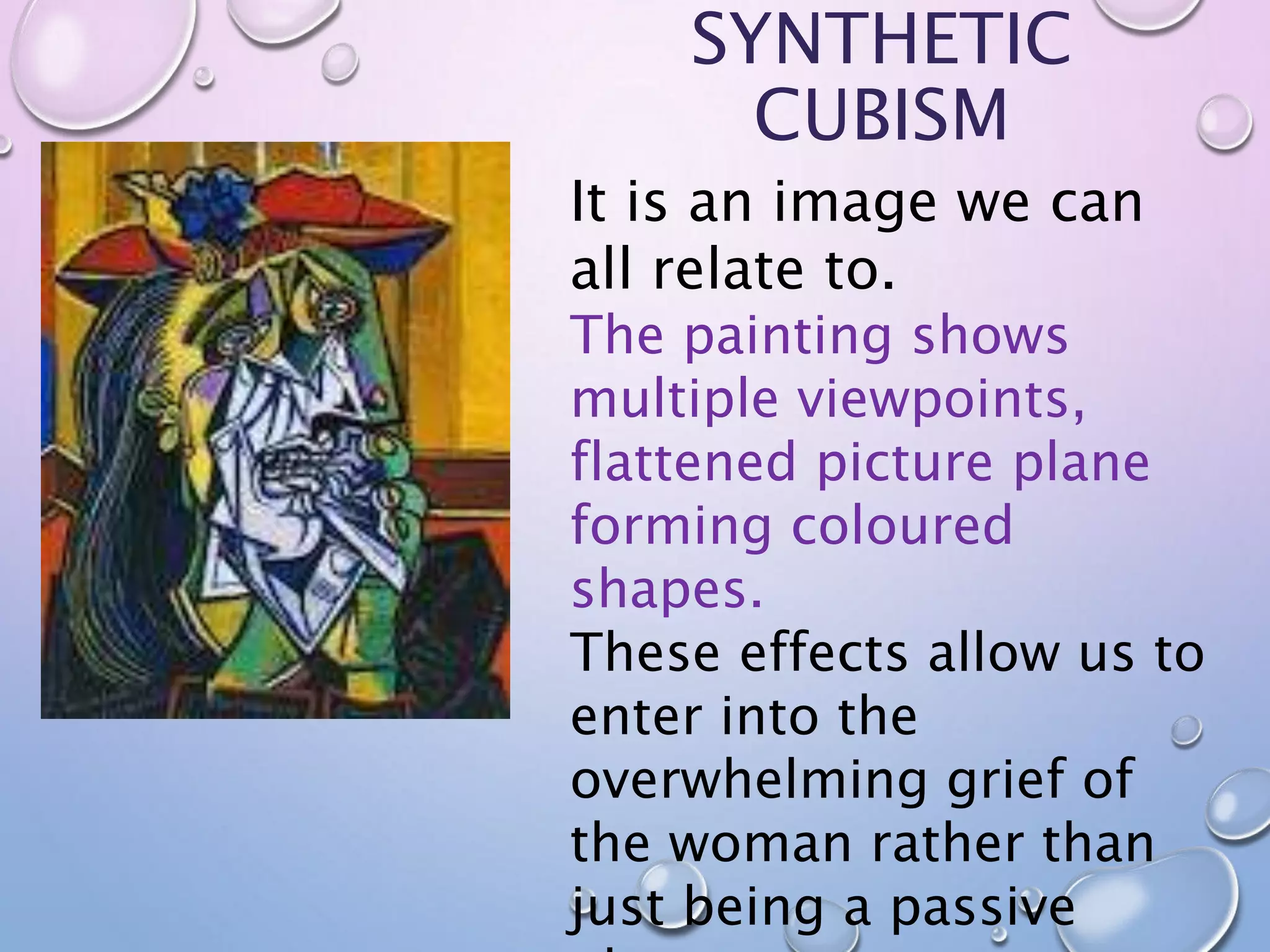
It is an image we can 
all relate to. 
The painting shows 
multiple viewpoints, 
flattened picture plane 
forming coloured 
shapes. 
These effects allow us to 
enter into the 
overwhelming grief of 
the woman rather than 
just being a passive 
observer.
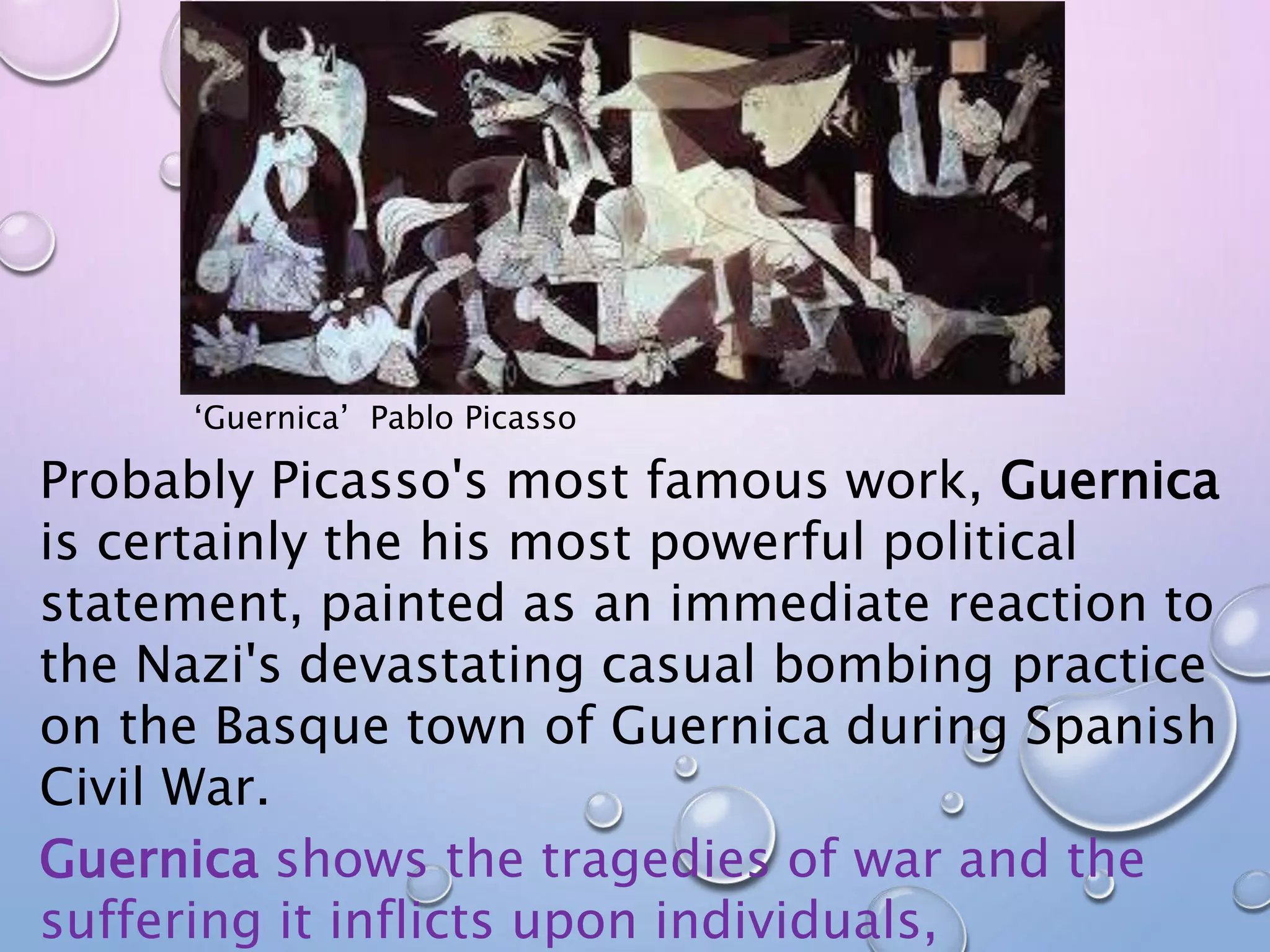
‘Guernica’ Pablo Picasso 
Probably Picasso's most famous work, Guernica 
is certainly the his most powerful political 
statement, painted as an immediate reaction to 
the Nazi's devastating casual bombing practice 
on the Basque town of Guernica during Spanish 
Civil War. 
Guernica shows the tragedies of war and the 
suffering it inflicts upon individuals,
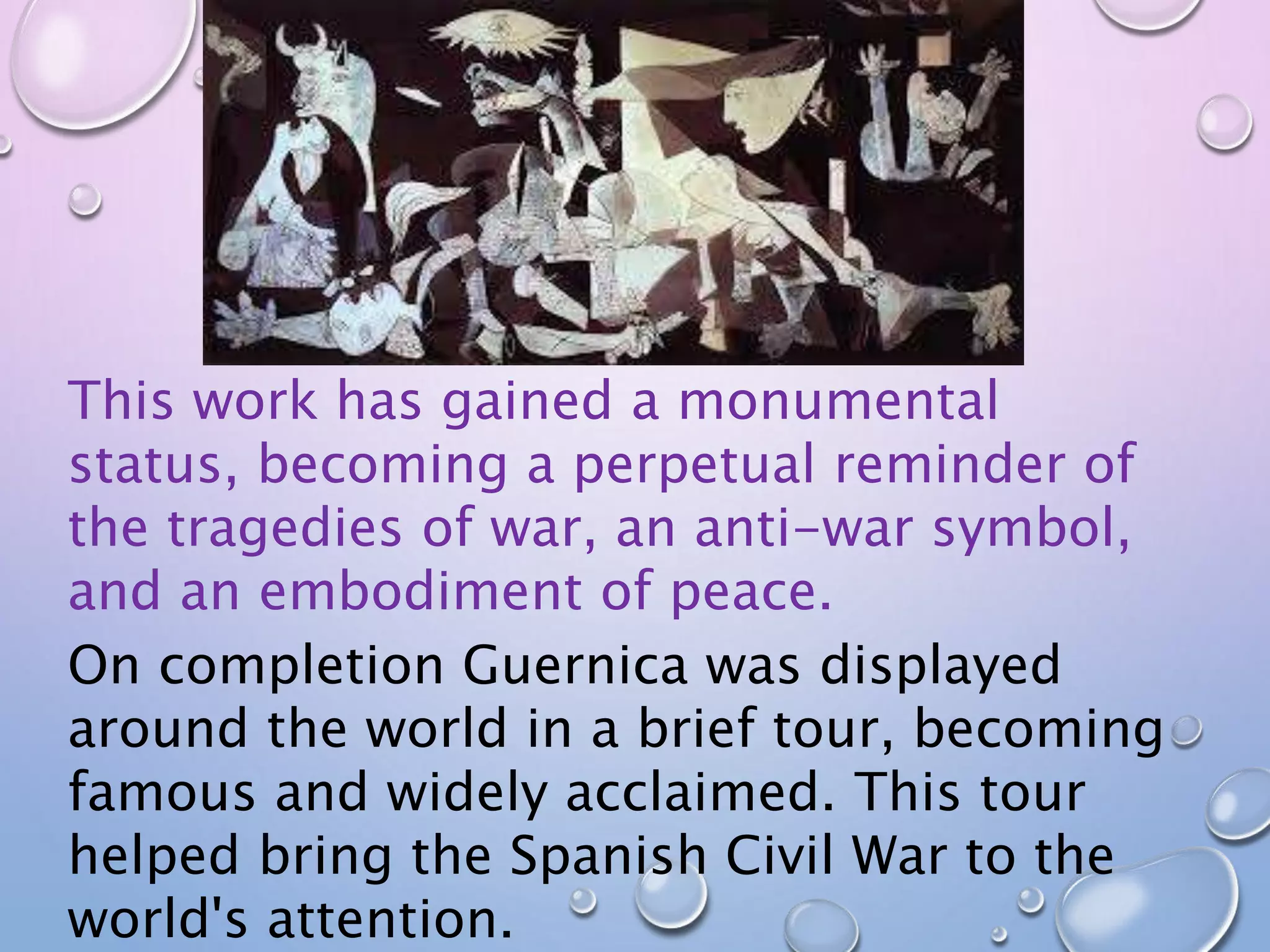
This work has gained a monumental 
status, becoming a perpetual reminder of 
the tragedies of war, an anti-war symbol, 
and an embodiment of peace. 
On completion Guernica was displayed 
around the world in a brief tour, becoming 
famous and widely acclaimed. This tour 
helped bring the Spanish Civil War to the 
world's attention.
DAVID HOCKNEY 
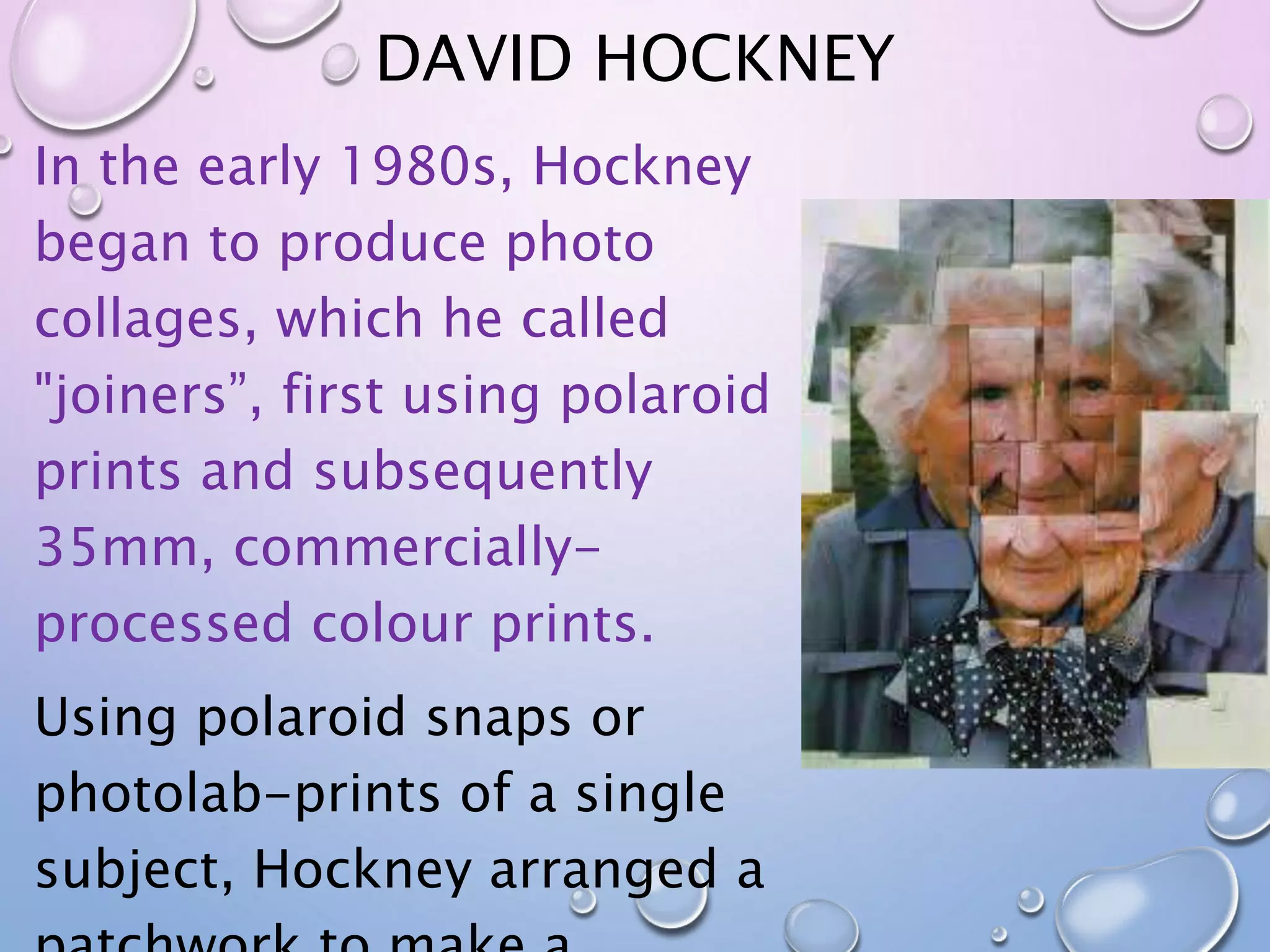
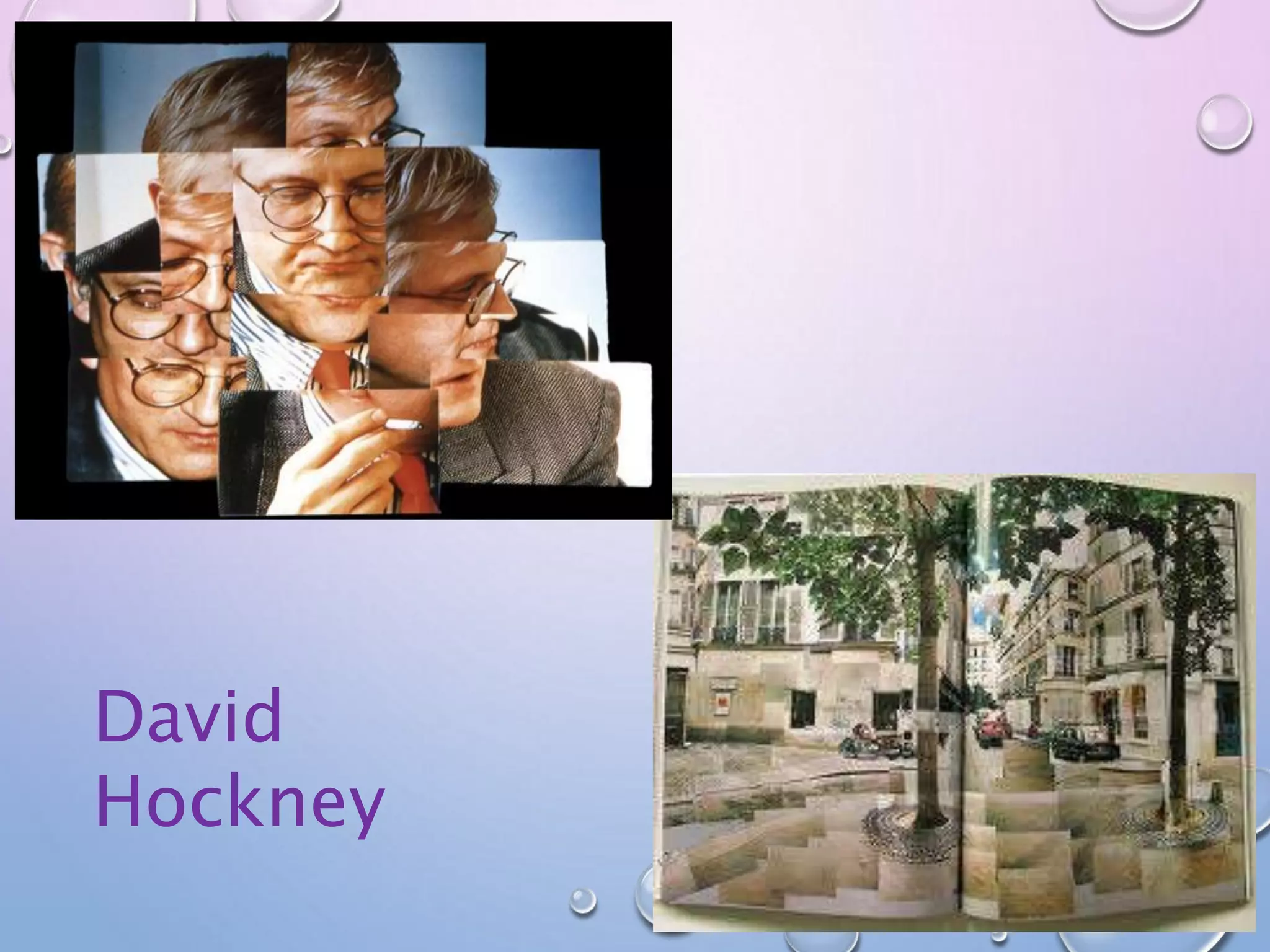
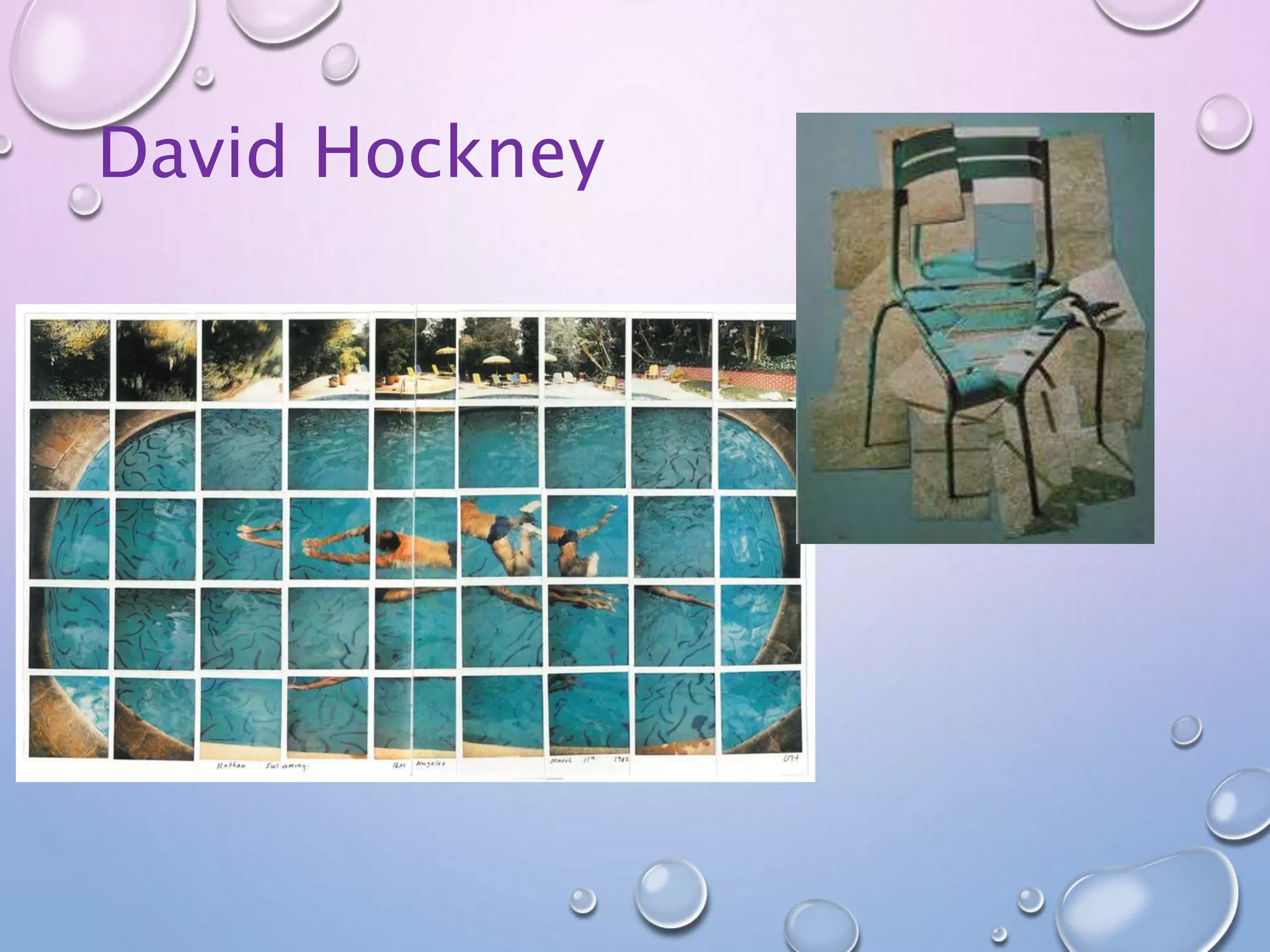
In the early 1980s, Hockney 
began to produce photo 
collages, which he called 
"joiners”, first using polaroid 
prints and subsequently 
35mm, commercially-processed 
colour prints. 
Using polaroid snaps or 
photolab-prints of a single 
subject, Hockney arranged a 
patchwork to make a
DAVID HOCKNEY 
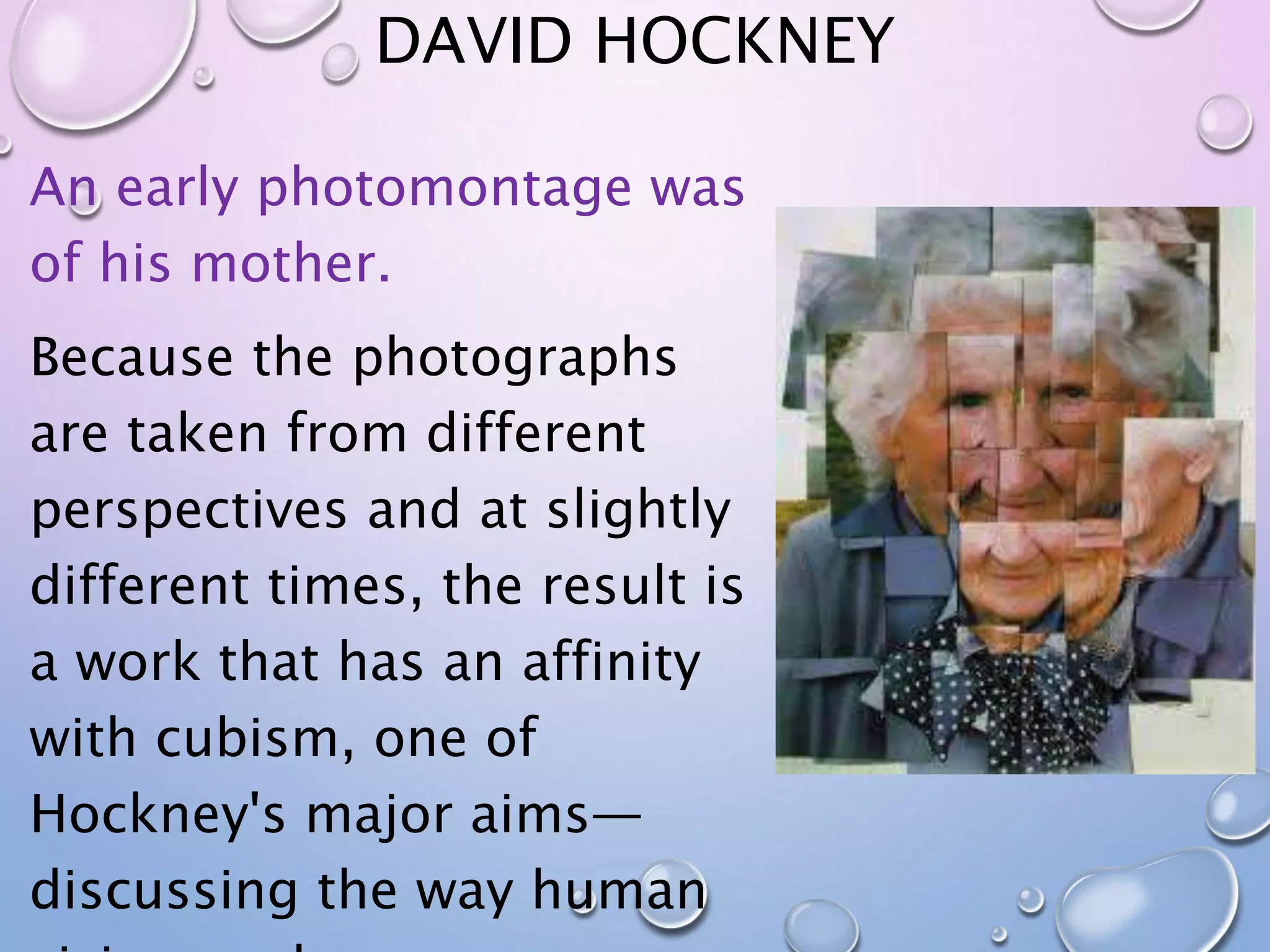
An early photomontage was 
of his mother. 
Because the photographs 
are taken from different 
perspectives and at slightly 
different times, the result is 
a work that has an affinity 
with cubism, one of 
Hockney's major aims— 
discussing the way human 
vision works.
DAVID HOCKNEY 
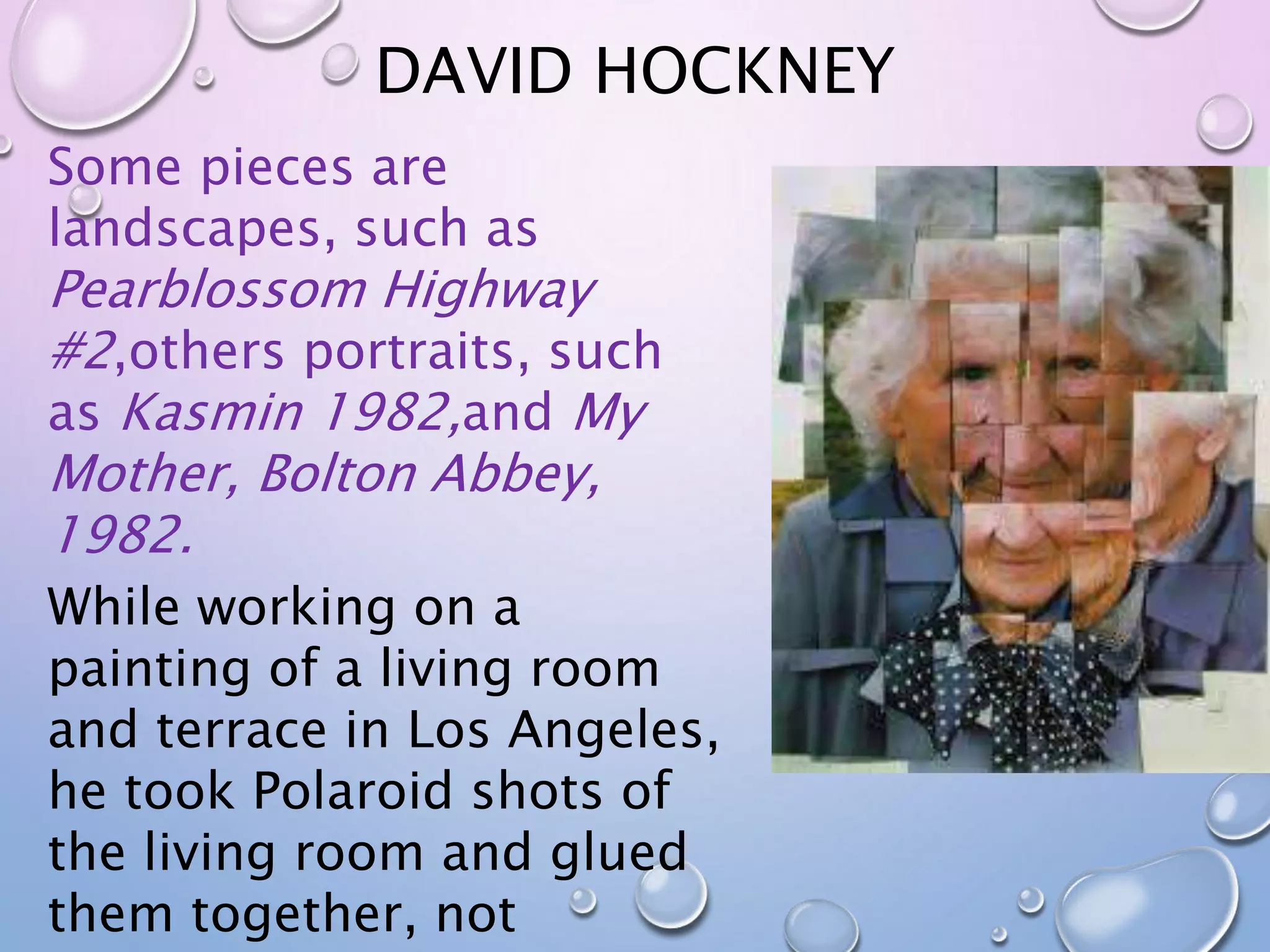
Some pieces are 
landscapes, such as 
Pearblossom Highway 
#2,others portraits, such 
as Kasmin 1982,and My 
Mother, Bolton Abbey, 
1982. 
While working on a 
painting of a living room 
and terrace in Los Angeles, 
he took Polaroid shots of 
the living room and glued 
them together, not
DAVID HOCKNEY 
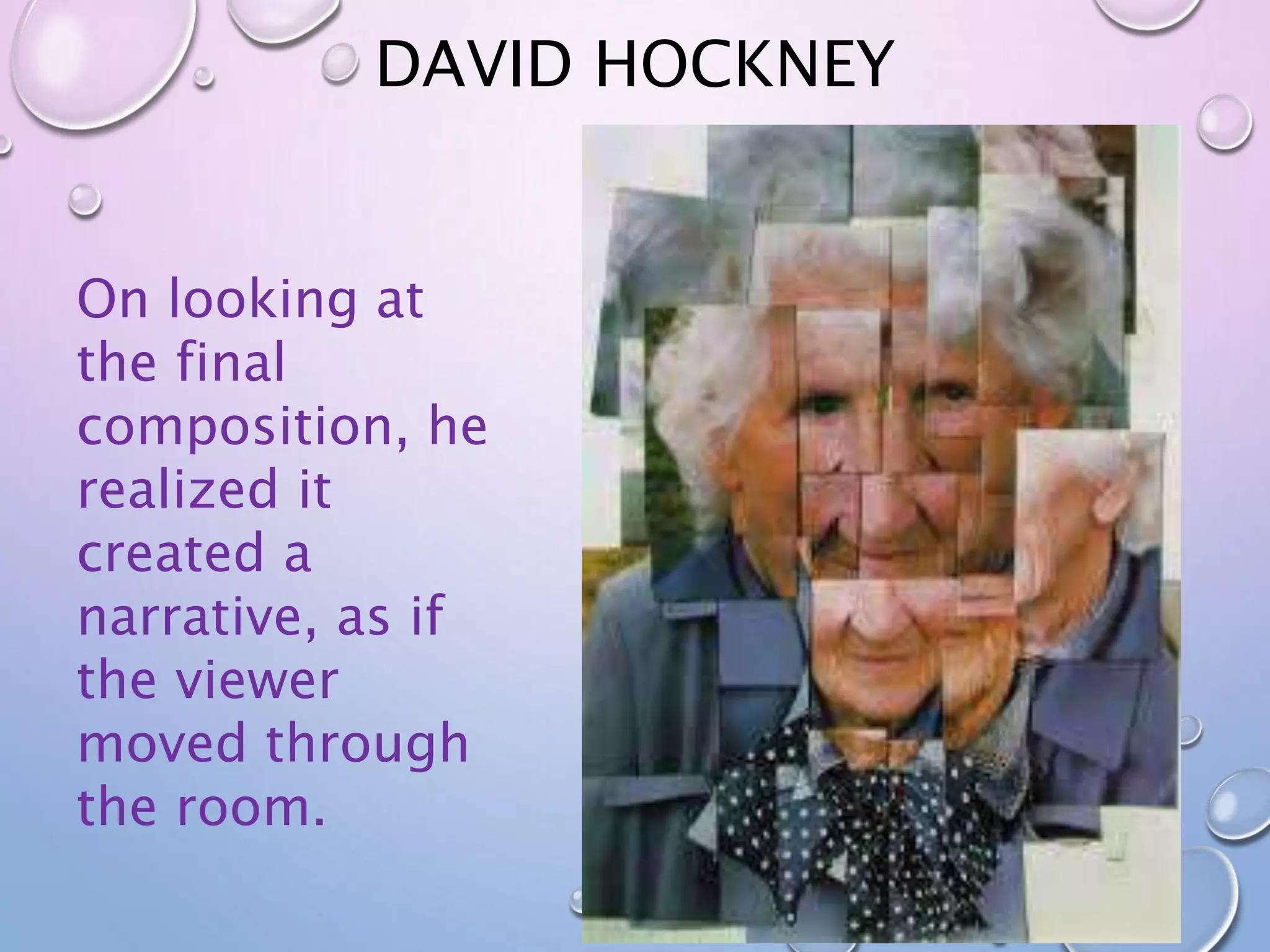
On looking at 
the final 
composition, he 
realized it 
created a 
narrative, as if 
the viewer 
moved through 
the room.
David 
Hockney
David Hockney
ASSESSMENT TASK IDEAS 
• Each group must research and communicate 
their ideas in the form of a poster on one of 
the following questions: 
1. How does the art of cubism reflect the 
society and outlook of the artists of the 
time around 1907? 
2. How did the cubist artists communicate 
their ideas through analytical cubism? 
Use at least 4 artworks of the most famous 
cubist artists to explain your research.
ASSESSMENT TASK IDEAS 
3. How did the cubist artists 
communicate their ideas through 
synthetic cubism? 
Use 3-4 of Picasso’s artworks to 
explain your research. 
4. How did the artist David Hockney’s 
‘joiners’, photo collage works, reflect 
a modern interpretation of cubism? 
Discuss 4 examples.

Cubism 101

  • 1.
  • 2.
    HOW DOES THEART OF CUBISM REFLECT THE SOCIETY AND OUTLOOK OF THE ARTISTS OF THE TIME AROUND 1907?
  • 3.
    INFLUENCE OF SOCIETYON ARTISTS • There was a push towards being modern. A time of great change as people embraced new inventions and people’s lifestyles were changing. e.g., transport, electricity, communications, factories, people moving away from farms to the cities (industrialisation). • Invention of photography took over from the needs of traditional art forms to reproduce realistic scenes.
  • 4.
    INFLUENCE OF SOCIETYON ARTISTS • New philosophies and rise of psychology. Artists could now interpret the world communicating their emotions, thoughts and philosophies. • Artists no longer wanted to depict a single traditional view in their art but wanted to interpret their world showing movement, time and multiple views as if you were moving through space, thoughts and opinions, a more expressive response to the subject.
  • 5.
    WHAT DID THEARTISTS DO IN THEIR PAINTINGS TO REFLECT THESE IDEAS? • These works stressed the use of multiple perspective (view points) and complex planes (flattened surfaces) for expressive effect. • The artists tried to incorporate a sense of time through multiple perspectives, giving symbolic expression to the notion of ‘duration’.
  • 6.
    WHAT DID THEARTISTS DO IN THEIR PAINTINGS TO REFLECT THESE IDEAS? The artists create space and effects of multiple viewpoints to convey a physical and psychological sense of the fluidity of consciousness, blurring the distinctions between past, present and future.
  • 7.
    WHAT DID THEARTISTS DO IN THEIR PAINTINGS TO REFLECT THESE IDEAS? • The subject was no longer considered from a specific point of view at a moment in time, but built following a selection of successive viewpoints, i.e., as if viewed simultaneously from numerous angles (and in four-dimensions) with the eye free to roam from one to the other.
  • 8.
    WHAT DID THEARTISTS DO IN THEIR PAINTINGS TO REFLECT THESE IDEAS? • Imagine walking through the city, looking up at buildings and down on the foot path and behind you at the cars. • The artists tried to show all of these viewpoints in one image rather form one viewing point. • The best known Cubists were Picasso, Braque, Leger.
  • 9.
    ANALYTICAL CUBISM SeatedNude, Picasso 1909 The most famous Cubist artist was Pablo Picasso. In the early years of cubism, Picasso constructed his images using small facets, or geometric planes, and represented objects from different viewpoints. Many critics of the period believed the artist aimed to represent reality in a new, almost scientific manner.
  • 10.
    ANALYTICAL CUBISM However,as this atmospheric painting shows, Picasso could use this technique for expressive ends. Here, the woman has been all but stripped of her humanity and appears strangely mechanistic. At the same time, Picasso demonstrates his awareness of tradition in her pose and in the play of light within the
  • 11.
    SYNTHETIC CUBISM •Three musicians is a large painting measuring more than 2 metres wide and high. • It is painted in the style of Synthetic Cubism and gives the appearance of cut paper. • Picasso paints The Three Musicians made of flat, brightly coloured, abstract shapes in a shallow, box-like room. ‘The Three Musicians’ Picasso 1921
  • 12.
    SYNTHETIC CUBISM Onthe left is a clarinet player, in the middle a guitar player, and on the right a singer holding sheets of music. Three Musicians is a perfect example of Picasso's Cubist style. In Cubism, the subject of the artwork is transformed into a sequence of planes, lines, and arcs.
  • 13.
    SYNTHETIC CUBISM Cubismhas been described as an intellectual style because the artists analysed the shapes of their subjects and reinvented them on the canvas. The viewer must reconstruct the subject and space of the work by comparing the different shapes and forms to determine what each one represents. Through this process, the
  • 14.
    SYNTHETIC CUBISM •‘The Weeping Woman’ was painted by Picasso in 1937. • It was in response to the bombing of the town of Guernica during the Spanish civil war to express the suffering of the people there. ‘The Weeping Woman’ Pablo Picasso 1937 Oil paint 60x49cm
  • 15.
    SYNTHETIC CUBISM Itis an image we can all relate to. The painting shows multiple viewpoints, flattened picture plane forming coloured shapes. These effects allow us to enter into the overwhelming grief of the woman rather than just being a passive observer.
  • 16.
    ‘Guernica’ Pablo Picasso Probably Picasso's most famous work, Guernica is certainly the his most powerful political statement, painted as an immediate reaction to the Nazi's devastating casual bombing practice on the Basque town of Guernica during Spanish Civil War. Guernica shows the tragedies of war and the suffering it inflicts upon individuals,
  • 17.
    This work hasgained a monumental status, becoming a perpetual reminder of the tragedies of war, an anti-war symbol, and an embodiment of peace. On completion Guernica was displayed around the world in a brief tour, becoming famous and widely acclaimed. This tour helped bring the Spanish Civil War to the world's attention.
  • 18.
    DAVID HOCKNEY Inthe early 1980s, Hockney began to produce photo collages, which he called "joiners”, first using polaroid prints and subsequently 35mm, commercially-processed colour prints. Using polaroid snaps or photolab-prints of a single subject, Hockney arranged a patchwork to make a
  • 19.
    DAVID HOCKNEY Anearly photomontage was of his mother. Because the photographs are taken from different perspectives and at slightly different times, the result is a work that has an affinity with cubism, one of Hockney's major aims— discussing the way human vision works.
  • 20.
    DAVID HOCKNEY Somepieces are landscapes, such as Pearblossom Highway #2,others portraits, such as Kasmin 1982,and My Mother, Bolton Abbey, 1982. While working on a painting of a living room and terrace in Los Angeles, he took Polaroid shots of the living room and glued them together, not
  • 21.
    DAVID HOCKNEY Onlooking at the final composition, he realized it created a narrative, as if the viewer moved through the room.
  • 22.
  • 23.
  • 24.
    ASSESSMENT TASK IDEAS • Each group must research and communicate their ideas in the form of a poster on one of the following questions: 1. How does the art of cubism reflect the society and outlook of the artists of the time around 1907? 2. How did the cubist artists communicate their ideas through analytical cubism? Use at least 4 artworks of the most famous cubist artists to explain your research.
  • 25.
    ASSESSMENT TASK IDEAS 3. How did the cubist artists communicate their ideas through synthetic cubism? Use 3-4 of Picasso’s artworks to explain your research. 4. How did the artist David Hockney’s ‘joiners’, photo collage works, reflect a modern interpretation of cubism? Discuss 4 examples.