CHAPTER 3
Crystal and Amorphous
Structure in Materials
Solids: Crystal or amorphous
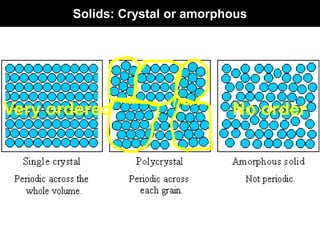
• All solids are either crystalline or
amorphous.
• Yes, this means all solid “stuff” on Earth
and even in the universe.
• What’s the difference?
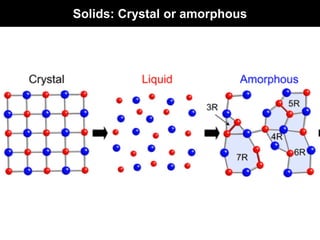
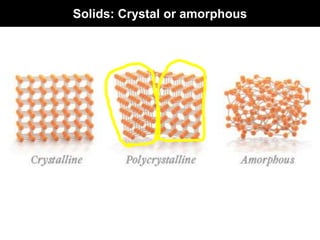
– Crystals have long range order.
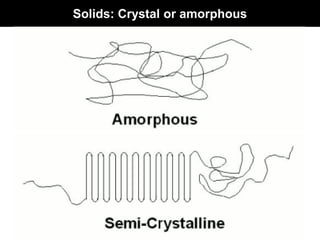
– Amorphous solids lack long range order.
Solids: Crystal or amorphous
Very ordered No order
Solids: Crystal or amorphous
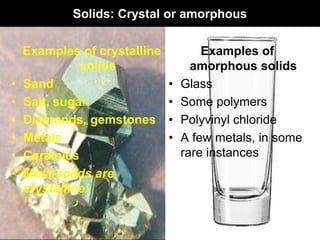
Examples of crystalline
solids
• Sand
• Salt, sugar
• Diamonds, gemstones
• Metals
• Ceramics
• Most solids are
crystalline!
Examples of
amorphous solids
• Glass
• Some polymers
• Polyvinyl chloride
• A few metals, in some
rare instances
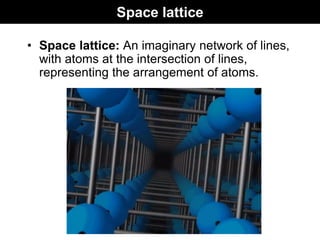
Space lattice
• Space lattice: An imaginary network of lines,
with atoms at the intersection of lines,
representing the arrangement of atoms.
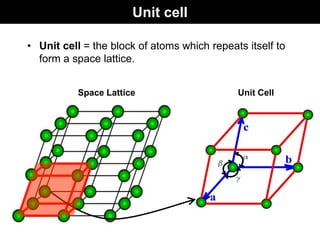
Unit cell
• Unit cell = the block of atoms which repeats itself to
form a space lattice.
Unit Cell
Space Lattice
Crystal Systems and Bravais Lattice
• According to Bravais,
fourteen standard unit cells
can describe all possible
lattice networks.
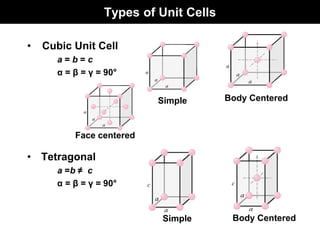
Types of Unit Cells
• Cubic Unit Cell
a = b = c
α = β = γ = 90°
• Tetragonal
a =b ≠ c
α = β = γ = 90°
Simple Body Centered
Face centered
Simple Body Centered
Types of Unit Cells (Cont.)
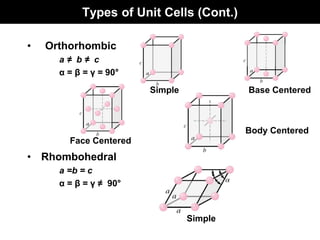
• Orthorhombic
a ≠ b ≠ c
α = β = γ = 90°
• Rhombohedral
a =b = c
α = β = γ ≠ 90°
Base Centered
Body Centered
Simple
Simple
Face Centered
Types of Unit Cells (Cont.)
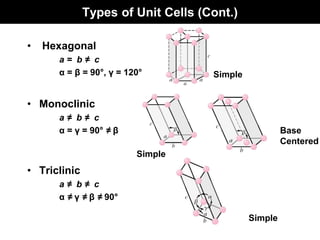
• Hexagonal
a = b ≠ c
α = β = 90°, γ = 120°
• Monoclinic
a ≠ b ≠ c
α = γ = 90° ≠ β
• Triclinic
a ≠ b ≠ c
α ≠ γ ≠ β ≠ 90°
Simple
Simple
Simple
Base
Centered
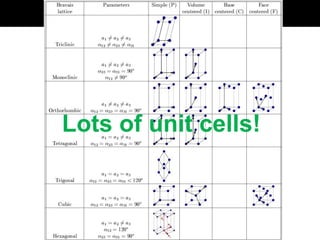
Lots of unit cells!
Principal Metallic Crystal Structures
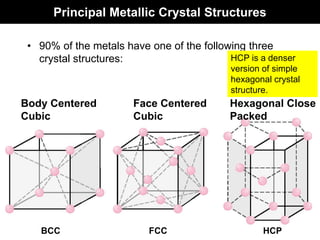
BCC FCC HCP
• 90% of the metals have one of the following three
crystal structures:
Body Centered
Cubic
Face Centered
Cubic
Hexagonal Close
Packed
HCP is a denser
version of simple
hexagonal crystal
structure.
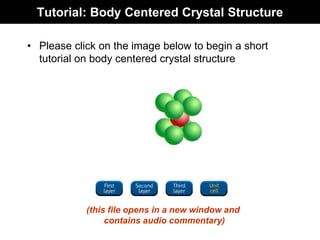
Tutorial: Body Centered Crystal Structure
• Please click on the image below to begin a short
tutorial on body centered crystal structure
(this file opens in a new window and
contains audio commentary)
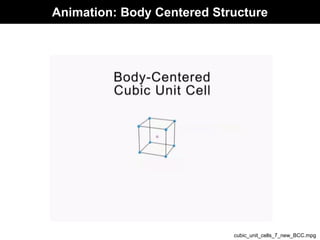
Animation: Body Centered Structure
cubic_unit_cells_7_new_BCC.mpg
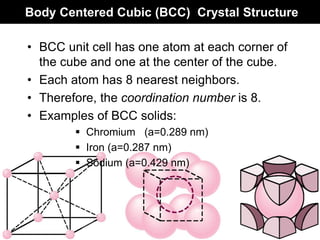
Body Centered Cubic (BCC) Crystal Structure
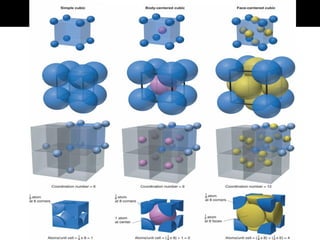
• BCC unit cell has one atom at each corner of
the cube and one at the center of the cube.
• Each atom has 8 nearest neighbors.
• Therefore, the coordination number is 8.
• Examples of BCC solids:
 Chromium (a=0.289 nm)
 Iron (a=0.287 nm)
 Sodium (a=0.429 nm)
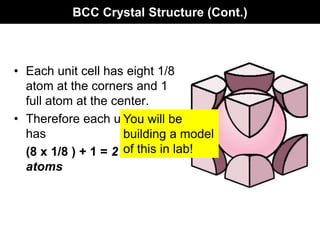
BCC Crystal Structure (Cont.)
• Each unit cell has eight 1/8
atom at the corners and 1
full atom at the center.
• Therefore each unit cell
has
(8 x 1/8 ) + 1 = 2 full
atoms
You will be
building a model
of this in lab!
BCC Crystal Structure (Cont.)
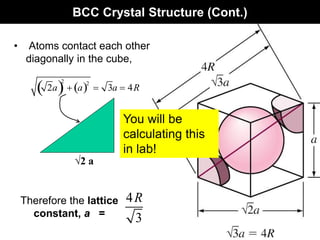
• Atoms contact each other
diagonally in the cube,
a
√2 a
2a
 
2
 a
 2
 3a  4R
4R
3
Therefore the lattice
constant, a =
You will be
calculating this
in lab!
Atomic Packing Factor
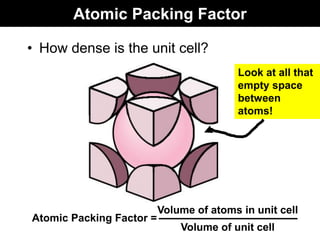
• How dense is the unit cell?
Atomic Packing Factor =
Volume of atoms in unit cell
Volume of unit cell
Look at all that
empty space
between
atoms!
Atomic Packing Factor of BCC Structure
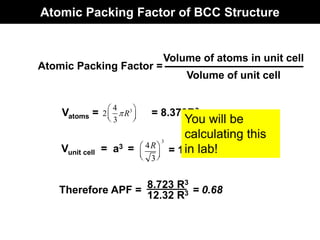
Atomic Packing Factor =
Volume of atoms in unit cell
Volume of unit cell
Vatoms = = 8.373R3
4R
3






3
= 12.32 R3
Therefore APF =
8.723 R3
12.32 R3 = 0.68
Vunit cell = a3 =
2
4
3
R3






You will be
calculating this
in lab!
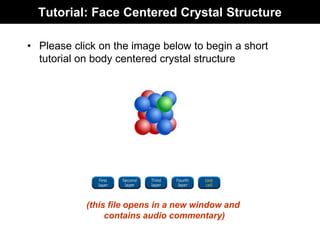
Tutorial: Face Centered Crystal Structure
• Please click on the image below to begin a short
tutorial on body centered crystal structure
(this file opens in a new window and
contains audio commentary)
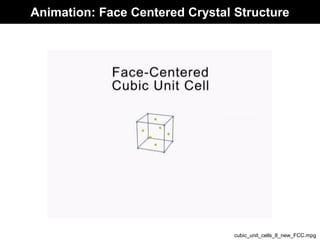
Animation: Face Centered Crystal Structure
cubic_unit_cells_8_new_FCC.mpg
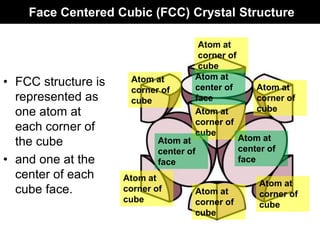
Face Centered Cubic (FCC) Crystal Structure
• FCC structure is
represented as
one atom at
each corner of
the cube
• and one at the
center of each
cube face.
Atom at
corner of
cube
Atom at
corner of
cube
Atom at
corner of
cube
Atom at
corner of
cube
Atom at
corner of
cube
Atom at
corner of
cube
Atom at
corner of
cube
Atom at
center of
face
Atom at
center of
face
Atom at
center of
face
Face Centered Cubic (FCC) Crystal Structure
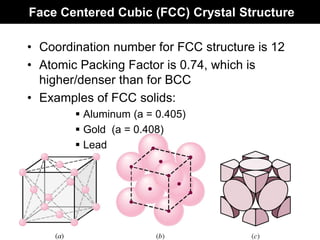
• Coordination number for FCC structure is 12
• Atomic Packing Factor is 0.74, which is
higher/denser than for BCC
• Examples of FCC solids:
 Aluminum (a = 0.405)
 Gold (a = 0.408)
 Lead
FCC Crystal Structure (Cont.)
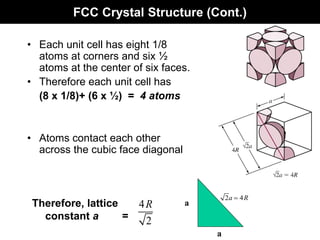
• Each unit cell has eight 1/8
atoms at corners and six ½
atoms at the center of six faces.
• Therefore each unit cell has
(8 x 1/8)+ (6 x ½) = 4 atoms
• Atoms contact each other
across the cubic face diagonal
4R
2
Therefore, lattice
constant a =
a
a
2a  4R
Summary: Cubic Crystal Structures
cubic_unit_cells_9_new.mpg
Example: Unit Cells
cubic_unit_cells_10_new_NaCl.mpg
Example: Unit Cells
cubic_unit_cells_11_new_Zn_blend.mpg
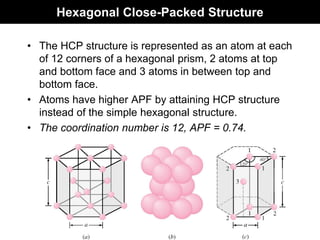
Hexagonal Close-Packed Structure
• The HCP structure is represented as an atom at each
of 12 corners of a hexagonal prism, 2 atoms at top
and bottom face and 3 atoms in between top and
bottom face.
• Atoms have higher APF by attaining HCP structure
instead of the simple hexagonal structure.
• The coordination number is 12, APF = 0.74.
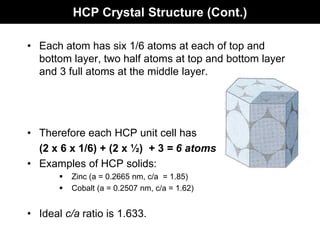
HCP Crystal Structure (Cont.)
• Each atom has six 1/6 atoms at each of top and
bottom layer, two half atoms at top and bottom layer
and 3 full atoms at the middle layer.
• Therefore each HCP unit cell has
(2 x 6 x 1/6) + (2 x ½) + 3 = 6 atoms
• Examples of HCP solids:
 Zinc (a = 0.2665 nm, c/a = 1.85)
 Cobalt (a = 0.2507 nm, c/a = 1.62)
• Ideal c/a ratio is 1.633.
Summary: Crystal Structure Tutorial
• Please click on the image below to begin a short
tutorial on the structure of crystalline solids.
(this file opens in a new window and
contains audio commentary)
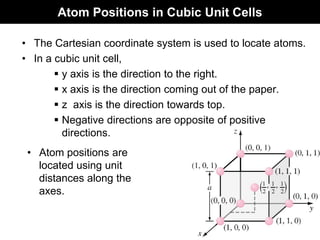
Atom Positions in Cubic Unit Cells
• Atom positions are
located using unit
distances along the
axes.
• The Cartesian coordinate system is used to locate atoms.
• In a cubic unit cell,
 y axis is the direction to the right.
 x axis is the direction coming out of the paper.
 z axis is the direction towards top.
 Negative directions are opposite of positive
directions.
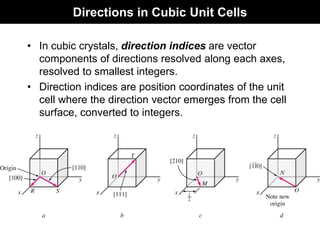
Directions in Cubic Unit Cells
• In cubic crystals, direction indices are vector
components of directions resolved along each axes,
resolved to smallest integers.
• Direction indices are position coordinates of the unit
cell where the direction vector emerges from the cell
surface, converted to integers.
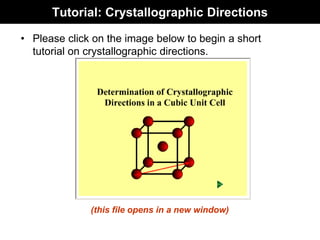
Tutorial: Crystallographic Directions
• Please click on the image below to begin a short
tutorial on crystallographic directions.
(this file opens in a new window)
Procedure: Find Direction Indices
(0,0,0)
(1,1/2,1)
z
Extend the direction vector until it
emerges from the surface of cubic cell
Determine the coordinates of the
points of emergence and origin
Subtract coordinates of point of
emergence by that of origin
(1,1/2,1) - (0,0,0)
= (1,1/2,1)
Are all are
integers?
Convert them to
smallest possible
integer by multiplying
by an integer.
2 x (1,1/2,1)
= (2,1,2)
Are any of the direction
vectors negative?
Represent the indices in a square
bracket without comas with a
over negative index (Eg: [121])
Represent the indices in a square
bracket without comas (Eg: [212] )
The direction indices are [212]
x
y
YES
NO
YES
NO
Example: Direction Indices
• Determine direction indices of the given vector.
Origin coordinates are (3/4 , 0 , 1/4).
Emergence coordinates are (1/4, 1/2, 1/2).
Subtract origin coordinates
from emergence coordinates,
(1/4, 1/2, 1/2) - (3/4 , 0 , 1/4)
= (-1/2, 1/2, 1/4)
Multiply by 4 to convert all
fractions to integers
4 x (-1/2, 1/2, 1/4) = (-2, 2, 1)
Therefore, the direction indices are [ 2 2 1 ]
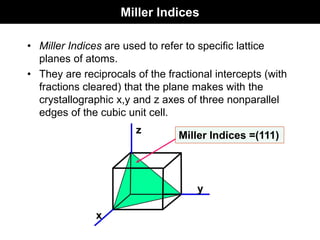
Miller Indices
• Miller Indices are used to refer to specific lattice
planes of atoms.
• They are reciprocals of the fractional intercepts (with
fractions cleared) that the plane makes with the
crystallographic x,y and z axes of three nonparallel
edges of the cubic unit cell.
z
x
y
Miller Indices =(111)
Tutorial: Cubic Crystal Planes
• Please click on the image below to begin a short
tutorial on cubic crystal planes.
(this file opens in a new window and
contains audio commentary)
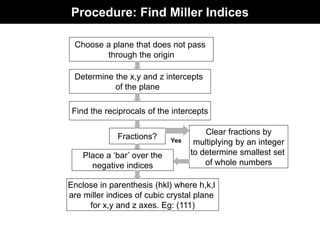
Procedure: Find Miller Indices
Choose a plane that does not pass
through the origin
Determine the x,y and z intercepts
of the plane
Find the reciprocals of the intercepts
Fractions?
Clear fractions by
multiplying by an integer
to determine smallest set
of whole numbers
Enclose in parenthesis (hkl) where h,k,l
are miller indices of cubic crystal plane
for x,y and z axes. Eg: (111)
Place a ‘bar’ over the
negative indices
Yes
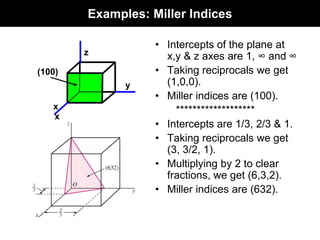
Examples: Miller Indices
• Intercepts of the plane at
x,y & z axes are 1, ∞ and ∞
• Taking reciprocals we get
(1,0,0).
• Miller indices are (100).
*******************
• Intercepts are 1/3, 2/3 & 1.
• Taking reciprocals we get
(3, 3/2, 1).
• Multiplying by 2 to clear
fractions, we get (6,3,2).
• Miller indices are (632).
x
x
y
z
(100)
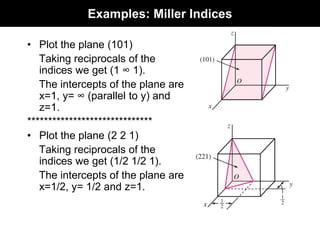
Examples: Miller Indices
• Plot the plane (101)
Taking reciprocals of the
indices we get (1 ∞ 1).
The intercepts of the plane are
x=1, y= ∞ (parallel to y) and
z=1.
******************************
• Plot the plane (2 2 1)
Taking reciprocals of the
indices we get (1/2 1/2 1).
The intercepts of the plane are
x=1/2, y= 1/2 and z=1.
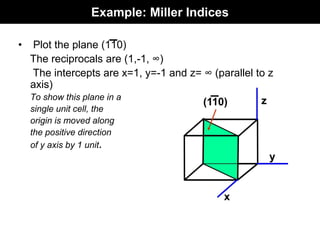
Example: Miller Indices
• Plot the plane (110)
The reciprocals are (1,-1, ∞)
The intercepts are x=1, y=-1 and z= ∞ (parallel to z
axis)
To show this plane in a
single unit cell, the
origin is moved along
the positive direction
of y axis by 1 unit.
x
y
z
(110)
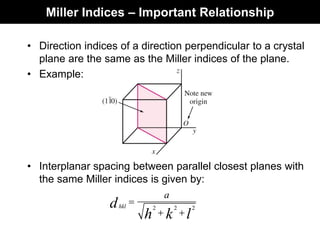
Miller Indices – Important Relationship
• Direction indices of a direction perpendicular to a crystal
plane are the same as the Miller indices of the plane.
• Example:
• Interplanar spacing between parallel closest planes with
the same Miller indices is given by:
hkl
d 
a
2
h 
2
k 
2
l
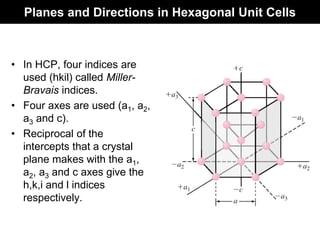
Planes and Directions in Hexagonal Unit Cells
• In HCP, four indices are
used (hkil) called Miller-
Bravais indices.
• Four axes are used (a1, a2,
a3 and c).
• Reciprocal of the
intercepts that a crystal
plane makes with the a1,
a2, a3 and c axes give the
h,k,i and l indices
respectively.
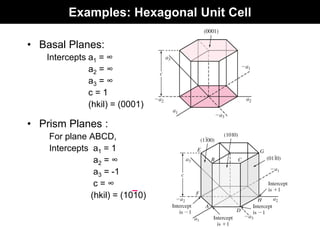
Examples: Hexagonal Unit Cell
• Basal Planes:
Intercepts a1 = ∞
a2 = ∞
a3 = ∞
c = 1
(hkil) = (0001)
• Prism Planes :
For plane ABCD,
Intercepts a1 = 1
a2 = ∞
a3 = -1
c = ∞
(hkil) = (1010)
Directions in HCP Unit Cells
• Indicated by 4 indices [uvtw].
• u,v,t and w are lattice vectors in a1, a2, a3 and c directions
respectively.
• Example:
For a1, a2, a3 directions, the direction indices are
[ 2 1 1 0], [1 2 1 0] and [ 1 1 2 0] respectively.
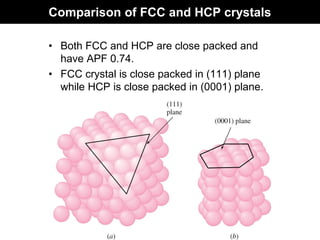
Comparison of FCC and HCP crystals
• Both FCC and HCP are close packed and
have APF 0.74.
• FCC crystal is close packed in (111) plane
while HCP is close packed in (0001) plane.
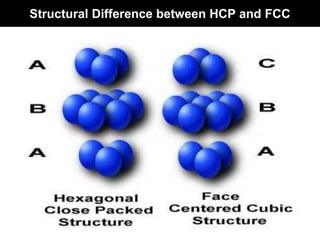
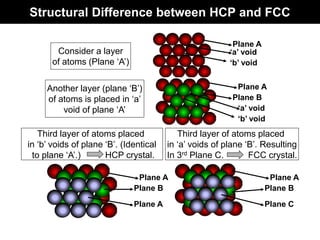
Structural Difference between HCP and FCC
Consider a layer
of atoms (Plane ‘A’)
Another layer (plane ‘B’)
of atoms is placed in ‘a’
void of plane ‘A’
Third layer of atoms placed
in ‘b’ voids of plane ‘B’. (Identical
to plane ‘A’.) HCP crystal.
Third layer of atoms placed
in ‘a’ voids of plane ‘B’. Resulting
In 3rd Plane C. FCC crystal.
Plane A
‘a’ void
‘b’ void
Plane A
Plane B
‘a’ void
‘b’ void
Plane A
Plane B
Plane A
Plane A
Plane B
Plane C
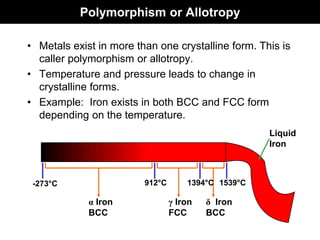
Polymorphism or Allotropy
• Metals exist in more than one crystalline form. This is
caller polymorphism or allotropy.
• Temperature and pressure leads to change in
crystalline forms.
• Example: Iron exists in both BCC and FCC form
depending on the temperature.
-273°C 912°C 1394°C 1539°C
α Iron
BCC
γ Iron
FCC
δ Iron
BCC
Liquid
Iron
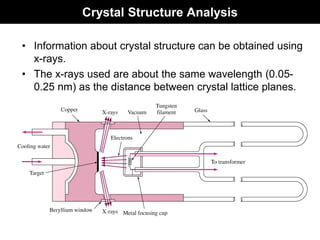
Crystal Structure Analysis
• Information about crystal structure can be obtained using
x-rays.
• The x-rays used are about the same wavelength (0.05-
0.25 nm) as the distance between crystal lattice planes.
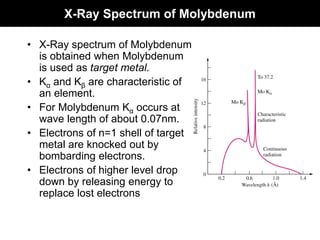
X-Ray Spectrum of Molybdenum
• X-Ray spectrum of Molybdenum
is obtained when Molybdenum
is used as target metal.
• Kα and Kβ are characteristic of
an element.
• For Molybdenum Kα occurs at
wave length of about 0.07nm.
• Electrons of n=1 shell of target
metal are knocked out by
bombarding electrons.
• Electrons of higher level drop
down by releasing energy to
replace lost electrons
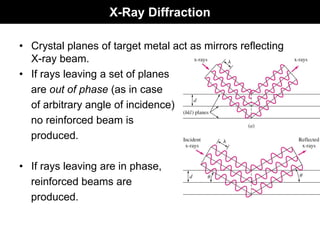
X-Ray Diffraction
• Crystal planes of target metal act as mirrors reflecting
X-ray beam.
• If rays leaving a set of planes
are out of phase (as in case
of arbitrary angle of incidence)
no reinforced beam is
produced.
• If rays leaving are in phase,
reinforced beams are
produced.
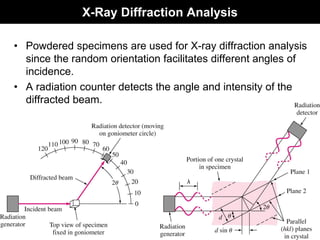
X-Ray Diffraction Analysis
• Powdered specimens are used for X-ray diffraction analysis
since the random orientation facilitates different angles of
incidence.
• A radiation counter detects the angle and intensity of the
diffracted beam.
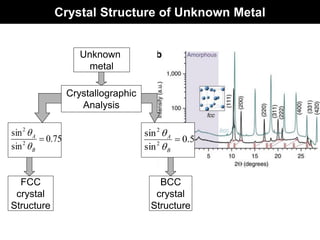
Crystal Structure of Unknown Metal
Unknown
metal
Crystallographic
Analysis
FCC
crystal
Structure
BCC
crystal
Structure
75
.
0
sin
sin
2
2

B
A


5
.
0
sin
sin
2
2

B
A


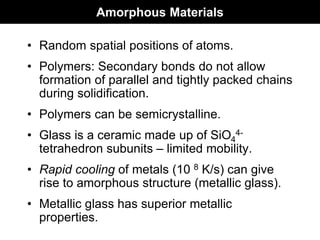
Amorphous Materials
• Random spatial positions of atoms.
• Polymers: Secondary bonds do not allow
formation of parallel and tightly packed chains
during solidification.
• Polymers can be semicrystalline.
• Glass is a ceramic made up of SiO4
4-
tetrahedron subunits – limited mobility.
• Rapid cooling of metals (10 8 K/s) can give
rise to amorphous structure (metallic glass).
• Metallic glass has superior metallic
properties.

Materials_Ch3.pdf

  • 1.
    CHAPTER 3 Crystal andAmorphous Structure in Materials
  • 2.
    Solids: Crystal oramorphous • All solids are either crystalline or amorphous. • Yes, this means all solid “stuff” on Earth and even in the universe. • What’s the difference? – Crystals have long range order. – Amorphous solids lack long range order.
  • 3.
  • 4.
    Solids: Crystal oramorphous Very ordered No order
  • 5.
  • 6.
  • 7.
    Solids: Crystal oramorphous Examples of crystalline solids • Sand • Salt, sugar • Diamonds, gemstones • Metals • Ceramics • Most solids are crystalline! Examples of amorphous solids • Glass • Some polymers • Polyvinyl chloride • A few metals, in some rare instances
  • 8.
    Space lattice • Spacelattice: An imaginary network of lines, with atoms at the intersection of lines, representing the arrangement of atoms.
  • 9.
    Unit cell • Unitcell = the block of atoms which repeats itself to form a space lattice. Unit Cell Space Lattice
  • 10.
    Crystal Systems andBravais Lattice • According to Bravais, fourteen standard unit cells can describe all possible lattice networks.
  • 11.
    Types of UnitCells • Cubic Unit Cell a = b = c α = β = γ = 90° • Tetragonal a =b ≠ c α = β = γ = 90° Simple Body Centered Face centered Simple Body Centered
  • 12.
    Types of UnitCells (Cont.) • Orthorhombic a ≠ b ≠ c α = β = γ = 90° • Rhombohedral a =b = c α = β = γ ≠ 90° Base Centered Body Centered Simple Simple Face Centered
  • 13.
    Types of UnitCells (Cont.) • Hexagonal a = b ≠ c α = β = 90°, γ = 120° • Monoclinic a ≠ b ≠ c α = γ = 90° ≠ β • Triclinic a ≠ b ≠ c α ≠ γ ≠ β ≠ 90° Simple Simple Simple Base Centered
  • 14.
  • 15.
    Principal Metallic CrystalStructures BCC FCC HCP • 90% of the metals have one of the following three crystal structures: Body Centered Cubic Face Centered Cubic Hexagonal Close Packed HCP is a denser version of simple hexagonal crystal structure.
  • 16.
    Tutorial: Body CenteredCrystal Structure • Please click on the image below to begin a short tutorial on body centered crystal structure (this file opens in a new window and contains audio commentary)
  • 17.
    Animation: Body CenteredStructure cubic_unit_cells_7_new_BCC.mpg
  • 18.
    Body Centered Cubic(BCC) Crystal Structure • BCC unit cell has one atom at each corner of the cube and one at the center of the cube. • Each atom has 8 nearest neighbors. • Therefore, the coordination number is 8. • Examples of BCC solids:  Chromium (a=0.289 nm)  Iron (a=0.287 nm)  Sodium (a=0.429 nm)
  • 19.
    BCC Crystal Structure(Cont.) • Each unit cell has eight 1/8 atom at the corners and 1 full atom at the center. • Therefore each unit cell has (8 x 1/8 ) + 1 = 2 full atoms You will be building a model of this in lab!
  • 20.
    BCC Crystal Structure(Cont.) • Atoms contact each other diagonally in the cube, a √2 a 2a   2  a  2  3a  4R 4R 3 Therefore the lattice constant, a = You will be calculating this in lab!
  • 21.
    Atomic Packing Factor •How dense is the unit cell? Atomic Packing Factor = Volume of atoms in unit cell Volume of unit cell Look at all that empty space between atoms!
  • 22.
    Atomic Packing Factorof BCC Structure Atomic Packing Factor = Volume of atoms in unit cell Volume of unit cell Vatoms = = 8.373R3 4R 3       3 = 12.32 R3 Therefore APF = 8.723 R3 12.32 R3 = 0.68 Vunit cell = a3 = 2 4 3 R3       You will be calculating this in lab!
  • 23.
    Tutorial: Face CenteredCrystal Structure • Please click on the image below to begin a short tutorial on body centered crystal structure (this file opens in a new window and contains audio commentary)
  • 24.
    Animation: Face CenteredCrystal Structure cubic_unit_cells_8_new_FCC.mpg
  • 25.
    Face Centered Cubic(FCC) Crystal Structure • FCC structure is represented as one atom at each corner of the cube • and one at the center of each cube face. Atom at corner of cube Atom at corner of cube Atom at corner of cube Atom at corner of cube Atom at corner of cube Atom at corner of cube Atom at corner of cube Atom at center of face Atom at center of face Atom at center of face
  • 26.
    Face Centered Cubic(FCC) Crystal Structure • Coordination number for FCC structure is 12 • Atomic Packing Factor is 0.74, which is higher/denser than for BCC • Examples of FCC solids:  Aluminum (a = 0.405)  Gold (a = 0.408)  Lead
  • 27.
    FCC Crystal Structure(Cont.) • Each unit cell has eight 1/8 atoms at corners and six ½ atoms at the center of six faces. • Therefore each unit cell has (8 x 1/8)+ (6 x ½) = 4 atoms • Atoms contact each other across the cubic face diagonal 4R 2 Therefore, lattice constant a = a a 2a  4R
  • 28.
    Summary: Cubic CrystalStructures cubic_unit_cells_9_new.mpg
  • 30.
  • 31.
  • 32.
    Hexagonal Close-Packed Structure •The HCP structure is represented as an atom at each of 12 corners of a hexagonal prism, 2 atoms at top and bottom face and 3 atoms in between top and bottom face. • Atoms have higher APF by attaining HCP structure instead of the simple hexagonal structure. • The coordination number is 12, APF = 0.74.
  • 33.
    HCP Crystal Structure(Cont.) • Each atom has six 1/6 atoms at each of top and bottom layer, two half atoms at top and bottom layer and 3 full atoms at the middle layer. • Therefore each HCP unit cell has (2 x 6 x 1/6) + (2 x ½) + 3 = 6 atoms • Examples of HCP solids:  Zinc (a = 0.2665 nm, c/a = 1.85)  Cobalt (a = 0.2507 nm, c/a = 1.62) • Ideal c/a ratio is 1.633.
  • 34.
    Summary: Crystal StructureTutorial • Please click on the image below to begin a short tutorial on the structure of crystalline solids. (this file opens in a new window and contains audio commentary)
  • 35.
    Atom Positions inCubic Unit Cells • Atom positions are located using unit distances along the axes. • The Cartesian coordinate system is used to locate atoms. • In a cubic unit cell,  y axis is the direction to the right.  x axis is the direction coming out of the paper.  z axis is the direction towards top.  Negative directions are opposite of positive directions.
  • 36.
    Directions in CubicUnit Cells • In cubic crystals, direction indices are vector components of directions resolved along each axes, resolved to smallest integers. • Direction indices are position coordinates of the unit cell where the direction vector emerges from the cell surface, converted to integers.
  • 37.
    Tutorial: Crystallographic Directions •Please click on the image below to begin a short tutorial on crystallographic directions. (this file opens in a new window)
  • 38.
    Procedure: Find DirectionIndices (0,0,0) (1,1/2,1) z Extend the direction vector until it emerges from the surface of cubic cell Determine the coordinates of the points of emergence and origin Subtract coordinates of point of emergence by that of origin (1,1/2,1) - (0,0,0) = (1,1/2,1) Are all are integers? Convert them to smallest possible integer by multiplying by an integer. 2 x (1,1/2,1) = (2,1,2) Are any of the direction vectors negative? Represent the indices in a square bracket without comas with a over negative index (Eg: [121]) Represent the indices in a square bracket without comas (Eg: [212] ) The direction indices are [212] x y YES NO YES NO
  • 39.
    Example: Direction Indices •Determine direction indices of the given vector. Origin coordinates are (3/4 , 0 , 1/4). Emergence coordinates are (1/4, 1/2, 1/2). Subtract origin coordinates from emergence coordinates, (1/4, 1/2, 1/2) - (3/4 , 0 , 1/4) = (-1/2, 1/2, 1/4) Multiply by 4 to convert all fractions to integers 4 x (-1/2, 1/2, 1/4) = (-2, 2, 1) Therefore, the direction indices are [ 2 2 1 ]
  • 40.
    Miller Indices • MillerIndices are used to refer to specific lattice planes of atoms. • They are reciprocals of the fractional intercepts (with fractions cleared) that the plane makes with the crystallographic x,y and z axes of three nonparallel edges of the cubic unit cell. z x y Miller Indices =(111)
  • 41.
    Tutorial: Cubic CrystalPlanes • Please click on the image below to begin a short tutorial on cubic crystal planes. (this file opens in a new window and contains audio commentary)
  • 42.
    Procedure: Find MillerIndices Choose a plane that does not pass through the origin Determine the x,y and z intercepts of the plane Find the reciprocals of the intercepts Fractions? Clear fractions by multiplying by an integer to determine smallest set of whole numbers Enclose in parenthesis (hkl) where h,k,l are miller indices of cubic crystal plane for x,y and z axes. Eg: (111) Place a ‘bar’ over the negative indices Yes
  • 43.
    Examples: Miller Indices •Intercepts of the plane at x,y & z axes are 1, ∞ and ∞ • Taking reciprocals we get (1,0,0). • Miller indices are (100). ******************* • Intercepts are 1/3, 2/3 & 1. • Taking reciprocals we get (3, 3/2, 1). • Multiplying by 2 to clear fractions, we get (6,3,2). • Miller indices are (632). x x y z (100)
  • 44.
    Examples: Miller Indices •Plot the plane (101) Taking reciprocals of the indices we get (1 ∞ 1). The intercepts of the plane are x=1, y= ∞ (parallel to y) and z=1. ****************************** • Plot the plane (2 2 1) Taking reciprocals of the indices we get (1/2 1/2 1). The intercepts of the plane are x=1/2, y= 1/2 and z=1.
  • 45.
    Example: Miller Indices •Plot the plane (110) The reciprocals are (1,-1, ∞) The intercepts are x=1, y=-1 and z= ∞ (parallel to z axis) To show this plane in a single unit cell, the origin is moved along the positive direction of y axis by 1 unit. x y z (110)
  • 46.
    Miller Indices –Important Relationship • Direction indices of a direction perpendicular to a crystal plane are the same as the Miller indices of the plane. • Example: • Interplanar spacing between parallel closest planes with the same Miller indices is given by: hkl d  a 2 h  2 k  2 l
  • 47.
    Planes and Directionsin Hexagonal Unit Cells • In HCP, four indices are used (hkil) called Miller- Bravais indices. • Four axes are used (a1, a2, a3 and c). • Reciprocal of the intercepts that a crystal plane makes with the a1, a2, a3 and c axes give the h,k,i and l indices respectively.
  • 48.
    Examples: Hexagonal UnitCell • Basal Planes: Intercepts a1 = ∞ a2 = ∞ a3 = ∞ c = 1 (hkil) = (0001) • Prism Planes : For plane ABCD, Intercepts a1 = 1 a2 = ∞ a3 = -1 c = ∞ (hkil) = (1010)
  • 49.
    Directions in HCPUnit Cells • Indicated by 4 indices [uvtw]. • u,v,t and w are lattice vectors in a1, a2, a3 and c directions respectively. • Example: For a1, a2, a3 directions, the direction indices are [ 2 1 1 0], [1 2 1 0] and [ 1 1 2 0] respectively.
  • 50.
    Comparison of FCCand HCP crystals • Both FCC and HCP are close packed and have APF 0.74. • FCC crystal is close packed in (111) plane while HCP is close packed in (0001) plane.
  • 51.
  • 52.
    Structural Difference betweenHCP and FCC Consider a layer of atoms (Plane ‘A’) Another layer (plane ‘B’) of atoms is placed in ‘a’ void of plane ‘A’ Third layer of atoms placed in ‘b’ voids of plane ‘B’. (Identical to plane ‘A’.) HCP crystal. Third layer of atoms placed in ‘a’ voids of plane ‘B’. Resulting In 3rd Plane C. FCC crystal. Plane A ‘a’ void ‘b’ void Plane A Plane B ‘a’ void ‘b’ void Plane A Plane B Plane A Plane A Plane B Plane C
  • 53.
    Polymorphism or Allotropy •Metals exist in more than one crystalline form. This is caller polymorphism or allotropy. • Temperature and pressure leads to change in crystalline forms. • Example: Iron exists in both BCC and FCC form depending on the temperature. -273°C 912°C 1394°C 1539°C α Iron BCC γ Iron FCC δ Iron BCC Liquid Iron
  • 54.
    Crystal Structure Analysis •Information about crystal structure can be obtained using x-rays. • The x-rays used are about the same wavelength (0.05- 0.25 nm) as the distance between crystal lattice planes.
  • 55.
    X-Ray Spectrum ofMolybdenum • X-Ray spectrum of Molybdenum is obtained when Molybdenum is used as target metal. • Kα and Kβ are characteristic of an element. • For Molybdenum Kα occurs at wave length of about 0.07nm. • Electrons of n=1 shell of target metal are knocked out by bombarding electrons. • Electrons of higher level drop down by releasing energy to replace lost electrons
  • 56.
    X-Ray Diffraction • Crystalplanes of target metal act as mirrors reflecting X-ray beam. • If rays leaving a set of planes are out of phase (as in case of arbitrary angle of incidence) no reinforced beam is produced. • If rays leaving are in phase, reinforced beams are produced.
  • 57.
    X-Ray Diffraction Analysis •Powdered specimens are used for X-ray diffraction analysis since the random orientation facilitates different angles of incidence. • A radiation counter detects the angle and intensity of the diffracted beam.
  • 58.
    Crystal Structure ofUnknown Metal Unknown metal Crystallographic Analysis FCC crystal Structure BCC crystal Structure 75 . 0 sin sin 2 2  B A   5 . 0 sin sin 2 2  B A  
  • 59.
    Amorphous Materials • Randomspatial positions of atoms. • Polymers: Secondary bonds do not allow formation of parallel and tightly packed chains during solidification. • Polymers can be semicrystalline. • Glass is a ceramic made up of SiO4 4- tetrahedron subunits – limited mobility. • Rapid cooling of metals (10 8 K/s) can give rise to amorphous structure (metallic glass). • Metallic glass has superior metallic properties.