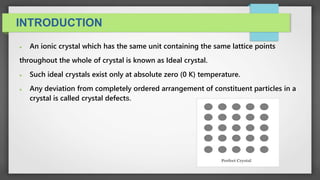
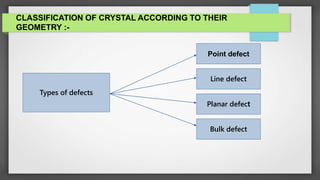
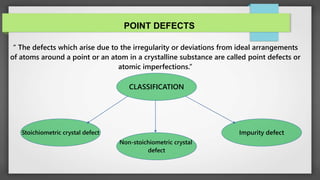
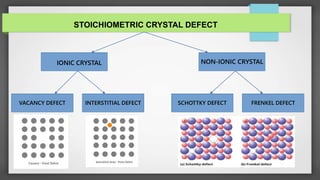
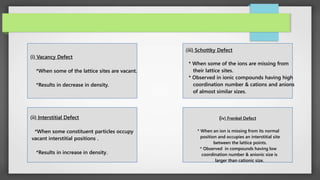
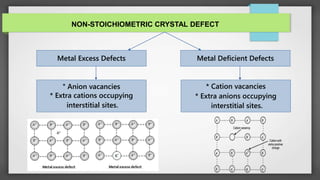
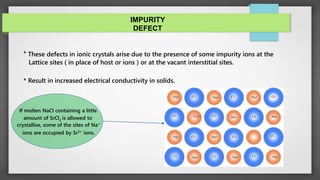
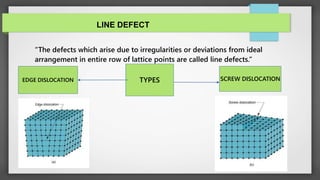
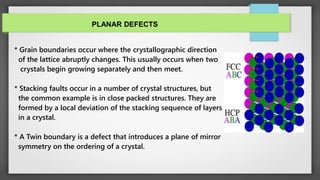
This document discusses different types of crystal defects. It begins by defining an ideal crystal and explaining that real crystals contain defects due to deviations from a completely ordered atomic arrangement. Crystal defects are classified as point defects, line defects, planar defects, or bulk defects depending on their geometry. Point defects, which occur around a single atom, are further divided into vacancy defects, interstitial defects, Schottky defects, and Frenkel defects. Line defects include edge dislocations and screw dislocations. Planar defects involve grain boundaries and stacking faults, while bulk defects are voids, cracks, or impurity inclusions. The document provides examples and descriptions of each type of defect.