LECTURE NOTES ON
MM-15-022 : MATERIALS CHARACTERIZATION
6th Semester, MME
1
MATERIALS CHARACTERIZATION
Suneeti Purohit
Department of Metallurgical & Materials Engineering (MME)
Veer Surendra Sai University of Technology (VSSUT), Burla-768018
E-mail : suneeti.purohit@gmail.com Phone: (+91) (8339037187)
Course Coordinator
Avala Lava Kumar
Department of MME, VSSUT, Burla – 768018
E-mail : lavakumar.vssut@gmail.com
Phone : (+91) 7077110110
Gautam Behera
Department of MME, VSSUT, Burla – 768018
E-mail : gautamiitkgpian@gmail.com
Phone : (+91) 7855856611
MM-15-022
2
MM-15-022 : MATERIALS CHARACTERIZATION
CONTENTS
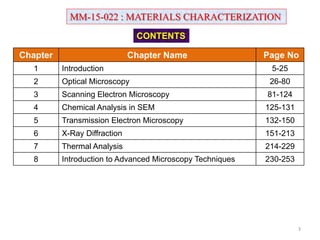
Chapter Chapter Name Page No
1 Introduction 5-25
2 Optical Microscopy 26-80
3 Scanning Electron Microscopy 81-124
4 Chemical Analysis in SEM 125-131
5 Transmission Electron Microscopy 132-150
6 X-Ray Diffraction 151-213
7 Thermal Analysis 214-229
8 Introduction to Advanced Microscopy Techniques 230-253
3
MATERIALS CHARACTERIZATION
REFERENCES
 Fundamentals of light microscopy and electronic imaging
Douglas B. Murphy
Wiley-Liss, Inc. USA
 Electron Microscopy and Microanalysis
Goodhew, Humphreys and Beanland
Taylor and Francis, New York
 Elements of X-Ray Diffraction
B.D. Cullity
Prentice Hall
 Transmission Electron Microscopy
Williams, David B., Carter, C. Barry
Springer
 Introduction to Thermal Analysis Techniques and Applications
Michael E. Brown
Kluwer Academic Publishers
 Materials Characterization
ASM Metals Handbook, Volume 10
4
Suneeti Purohit *: Avala Lava Kumar : Gautam Behera
Department of Metallurgical & Materials Engineering (MME)
Veer Surendra Sai University of Technology (VSSUT), Burla -768018
*E-mail : suneeti.purohit@gmail.com
5
 Committee on Characterization of Materials, Materials Advisory Board, National
Research Council developed the definition of Material Characterization: “ Characterization
describes those features of composition and structure (including defects) of a material that
are significant for a particular preparation, study of properties, or use, and suffice for
reproduction of the material ”.
 Materials Characterization has 2 main aspects:
- Accurately measuring the physical and chemical properties of materials
- Accurately measuring (determining) the structure of a material
(Atomic level structure & Microscopic level structures)
 Mechanical, electrical and magnetic properties of a material are strongly dependent on
its structural characteristics. Therefore, material characterization is very important part of
any structure-property correlation exercise.
6
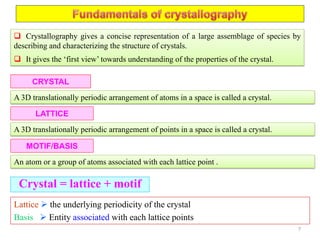
 Crystallography gives a concise representation of a large assemblage of species by
describing and characterizing the structure of crystals.
 It gives the ‘first view’ towards understanding of the properties of the crystal.
CRYSTAL
A 3D translationally periodic arrangement of atoms in a space is called a crystal.
LATTICE
A 3D translationally periodic arrangement of points in a space is called a crystal.
Crystal = lattice + motif
MOTIF/BASIS
An atom or a group of atoms associated with each lattice point .
Lattice  the underlying periodicity of the crystal
Basis  Entity associated with each lattice points
7
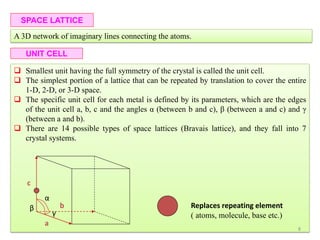
UNIT CELL
SPACE LATTICE
A 3D network of imaginary lines connecting the atoms.
 Smallest unit having the full symmetry of the crystal is called the unit cell.
 The simplest portion of a lattice that can be repeated by translation to cover the entire
1-D, 2-D, or 3-D space.
 The specific unit cell for each metal is defined by its parameters, which are the edges
of the unit cell a, b, c and the angles α (between b and c), β (between a and c) and γ
(between a and b).
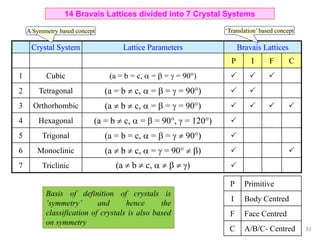
 There are 14 possible types of space lattices (Bravais lattice), and they fall into 7
crystal systems.
a
c
b
α
β
γ
Replaces repeating element
( atoms, molecule, base etc.)
8
Crystal System Lattice Parameters Bravais Lattices
P I F C
1 Cubic (a = b = c,  =  =  = 90)   
2 Tetragonal (a = b  c,  =  =  = 90)  
3 Orthorhombic (a  b  c,  =  =  = 90)    
4 Hexagonal (a = b  c,  =  = 90,  = 120) 
5 Trigonal (a = b = c,  =  =   90) 
6 Monoclinic (a  b  c,  =  = 90  )  
7 Triclinic (a  b  c,     ) 
14 Bravais Lattices divided into 7 Crystal Systems
P Primitive
I Body Centred
F Face Centred
C A/B/C- Centred
A Symmetry based concept ‘Translation’ based concept
82
Basis of definition of crystals is
‘symmetry’ and hence the
classification of crystals is also based
on symmetry
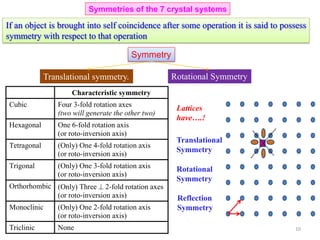
Characteristic symmetry
Cubic Four 3-fold rotation axes
(two will generate the other two)
Hexagonal One 6-fold rotation axis
(or roto-inversion axis)
Tetragonal (Only) One 4-fold rotation axis
(or roto-inversion axis)
Trigonal (Only) One 3-fold rotation axis
(or roto-inversion axis)
Orthorhombic (Only) Three  2-fold rotation axes
(or roto-inversion axis)
Monoclinic (Only) One 2-fold rotation axis
(or roto-inversion axis)
Triclinic None
Symmetries of the 7 crystal systems
If an object is brought into self coincidence after some operation it is said to possess
symmetry with respect to that operation
Symmetry
Translational symmetry. Rotational Symmetry
Lattices
have….!
Translational
Symmetry
Rotational
Symmetry
Reflection
Symmetry
10
Crystallographic Directions
 A crystallographic direction is defined as a line between 2 points, or a vector.
 The following steps are utilized in the determination of the 3 directional indices:
 A vector of convenient length is positioned such that it passes through the origin of
the coordinate system.
 Any vector may be translated throughout the crystal lattice without alteration, if
parallelism in maintained.
 The length of the vector projection on each of the 3 axes is determined; these are
measured in terms of the unit cell dimensions a, b, and c.
 These 3 numbers are multiplied or divided by a common factor to reduce them to the
smallest integer values.
 The 3 indices (not separated by commas) are enclosed in square brackets: [uvw]
where u, v, and w integers correspond to the reduced projection along the x, y, and z
axes, respectively.
 A vector r passing from the origin to a lattice
point can be written as:
r = r1 a + r2 b + r3 c Where, a, b, c → basic
vectors
 Note their length is not 1 unit! (like for the basis
vectors of a coordinate axis).
11
[010]
[100]
[001]
[110]
[101]
[011]
[110] [111]
Important directions in 3D represented by Miller Indices (cubic lattice)
Face diagonal
Body diagonal
X
Y
Z
Memorize these
116
[+ + -] [+ - -]
[+ - +]
[- - +][- + +]
[+ + +]
[- - -][- + -]
If you have confusion while selecting origin in negative indices refer this figure
Possible coordinates in 3D
X
Y
Z
117
Family of directions
Index Members in family for cubic lattice Number
<100> 3 x 2 = 6
<110>
6 x 2 =
12
<111> 4 x 2 = 8
Symbol
Alternate
symbol
[ ] → Particular direction
< > [[ ]] → Family of directions
[100],[100],[010],[010],[001],[001]
[110],[110],[110],[110],[101],[101],[101],[101],[011],[011],[011],[011]
[111],[111],[111],[111],[111],[111],[111],[111]
the ‘negatives’
(opposite direction)
 A set of directions related by symmetry operations of the lattice or the crystal is called a
family of directions
 A family of directions is represented (Miller Index notation) as: <u v w>
118
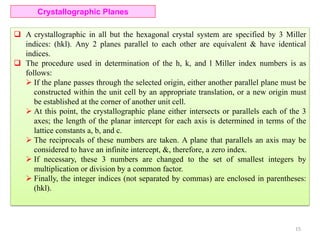
Crystallographic Planes
 A crystallographic in all but the hexagonal crystal system are specified by 3 Miller
indices: (hkl). Any 2 planes parallel to each other are equivalent & have identical
indices.
 The procedure used in determination of the h, k, and l Miller index numbers is as
follows:
 If the plane passes through the selected origin, either another parallel plane must be
constructed within the unit cell by an appropriate translation, or a new origin must
be established at the corner of another unit cell.
 At this point, the crystallographic plane either intersects or parallels each of the 3
axes; the length of the planar intercept for each axis is determined in terms of the
lattice constants a, b, and c.
 The reciprocals of these numbers are taken. A plane that parallels an axis may be
considered to have an infinite intercept, &, therefore, a zero index.
 If necessary, these 3 numbers are changed to the set of smallest integers by
multiplication or division by a common factor.
 Finally, the integer indices (not separated by commas) are enclosed in parentheses:
(hkl).
15
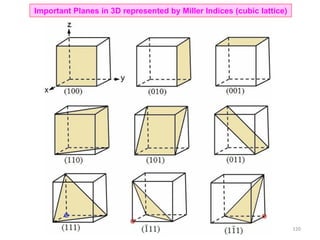
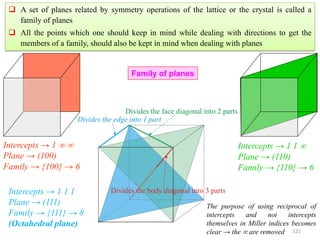
Important Planes in 3D represented by Miller Indices (cubic lattice)
120
Intercepts → 1  
Plane → (100)
Family → {100} → 6
Intercepts → 1 1 
Plane → (110)
Family → {110} → 6
Intercepts → 1 1 1
Plane → (111)
Family → {111} → 8
(Octahedral plane)
The purpose of using reciprocal of
intercepts and not intercepts
themselves in Miller indices becomes
clear → the  are removed
 A set of planes related by symmetry operations of the lattice or the crystal is called a
family of planes
 All the points which one should keep in mind while dealing with directions to get the
members of a family, should also be kept in mind when dealing with planes
Family of planes
121
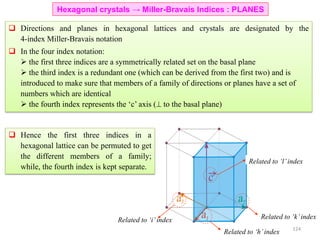
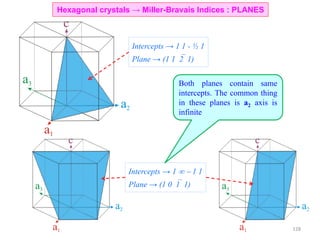
Hexagonal crystals → Miller-Bravais Indices : PLANES
 Directions and planes in hexagonal lattices and crystals are designated by the
4-index Miller-Bravais notation
 In the four index notation:
 the first three indices are a symmetrically related set on the basal plane
 the third index is a redundant one (which can be derived from the first two) and is
introduced to make sure that members of a family of directions or planes have a set of
numbers which are identical
 the fourth index represents the ‘c’ axis ( to the basal plane)
Related to ‘k’index
Related to ‘h’index
Related to ‘i’index
Related to ‘l’index
 Hence the first three indices in a
hexagonal lattice can be permuted to get
the different members of a family;
while, the fourth index is kept separate.
124
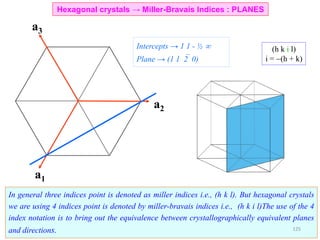
(h k i l)
i = (h + k)
a1
a2
a3
Intercepts → 1 1 - ½ 
Plane → (1 12 0)
In general three indices point is denoted as miller indices i.e., (h k l). But hexagonal crystals
we are using 4 indices point is denoted by miller-bravais indices i.e., (h k i l)The use of the 4
index notation is to bring out the equivalence between crystallographically equivalent planes
and directions.
Hexagonal crystals → Miller-Bravais Indices : PLANES
125
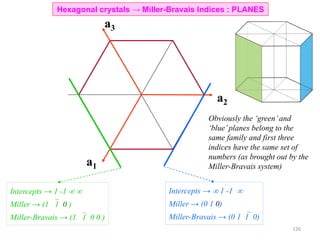
a1
a2
a3
Intercepts →  1 -1 
Miller → (0 1 0)
Miller-Bravais → (0 11 0)
Intercepts → 1 -1  
Miller → (1 1 0 )
Miller-Bravais → (1 1 0 0 )
Obviously the ‘green’and
‘blue’planes belong to the
same family and first three
indices have the same set of
numbers (as brought out by the
Miller-Bravais system)
Hexagonal crystals → Miller-Bravais Indices : PLANES
126
Intercepts → 1 1 - ½ 1
Plane → (1 12 1)
Intercepts → 1   1 1
Plane → (1 01 1)
Both planes contain same
intercepts. The common thing
in these planes is a2 axis is
infinite
Hexagonal crystals → Miller-Bravais Indices : PLANES
128
• Trace a path along the basis vectors as required by the direction. In the current example move
1unit along a1, 1unit along a2 and 2 units along a3.
• Directions are projected onto the basis vectors to determine the components and hence the Miller-
Bravais indices can be determined as in the table.
[1120]Drawing the direction
Hexagonal crystals → Miller-Bravais Indices : DIRECTIONS
Drawing the [10 0] direction1
129
 Unknown direction → [uvw]
 Unknown plane → (hkl)
 Double digit indices should be separated by commas → (12,22,3)
 In cubic lattices/crystals [hkl]  (hkl)
2 2 2
cubic lattice
hkl
a
d
h k l

 
Points about planes and directions
Interplanar spacing (dhkl) in cubic
lattice (& crystals)
Symbol
Alternate
symbols
Direction
[ ] [uvw] → Particular direction
< > <uvw> [[ ]] → Family of directions
Plane
( ) (hkl) → Particular plane
{ } {hkl} (( )) → Family of planes
122
Crystalline and Noncrystalline Materials
 Isotropic Materials: If the properties of the material are independent of the
direction in which they are measured, the material is categorized as isotropic.
 Anisotropy Materials: If the properties of the material are dependent of the
direction in which they are measured, the material is categorized as
anisotropic. Examples of these properties include: Periodicity of atoms in a
crystal structure, Density of a material of crystalline solids, Carrier velocity,
Phonon velocity etc.
 Allotropy: Elements that can exhibit more than one crystal structure are
allotropic.
 Polymorphism: Compounds that behave in the same manner as allotropic
materials are referred to as polymorphism.
 Single Crystal: A continuous periodic crystal structure only interrupted by the
boundaries of the solid
 Amorphous: Although short range periodicity may be present, long range
periodicity is absent. Hence, amorphous material is not crystalline.
 Polycrystalline: A material composed of from two to many single crystal
grains.
24
25
Suneeti Purohit *: Avala Lava Kumar : Gautam Behera
Department of Metallurgical & Materials Engineering (MME)
Veer Surendra Sai University of Technology (VSSUT), Burla -768018
*E-mail : suneeti.purohit@gmail.com
26
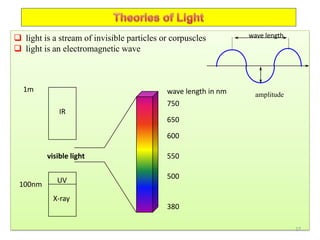
 light is a stream of invisible particles or corpuscles
 light is an electromagnetic wave
wave length
amplitude
380
500
550
600
750
wave length in nm
visible light
IR
UV
X-ray
1m
100nm
650
27
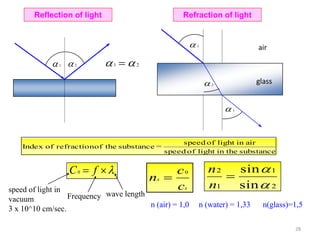
Reflection of light Refraction of light
1 2  1 2
 1
 2
 1
air
glass
substancein thelightofspeed
airinlightofspeed
=substancetheofrefractionofIndex
s
s
c
c
n
0

n (air) = 1,0 n (water) = 1,33 n(glass)=1,5
2
1
1
2
sin
sin



n
n fC0
wave lengthFrequency
speed of light in
vacuum
3 x 10^10 cm/sec.
28
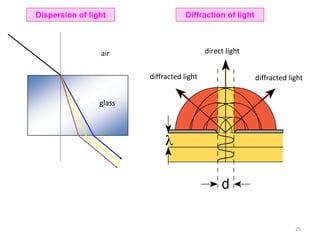
air
glass
Dispersion of light Diffraction of light
direct light
diffracted light diffracted light
29
30
31
32
33
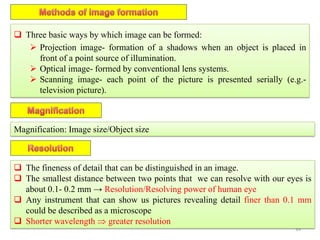
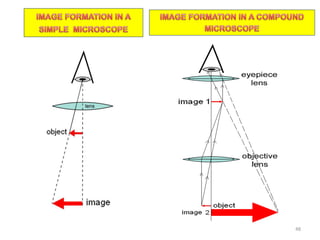
 Three basic ways by which image can be formed:
 Projection image- formation of a shadows when an object is placed in
front of a point source of illumination.
 Optical image- formed by conventional lens systems.
 Scanning image- each point of the picture is presented serially (e.g.-
television picture).
Magnification: Image size/Object size
 The fineness of detail that can be distinguished in an image.
 The smallest distance between two points that we can resolve with our eyes is
about 0.1- 0.2 mm → Resolution/Resolving power of human eye
 Any instrument that can show us pictures revealing detail finer than 0.1 mm
could be described as a microscope
 Shorter wavelength  greater resolution
34
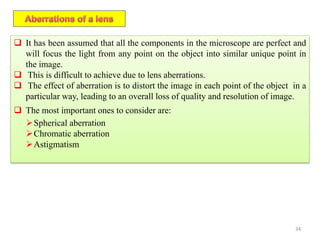
 It has been assumed that all the components in the microscope are perfect and
will focus the light from any point on the object into similar unique point in
the image.
 This is difficult to achieve due to lens aberrations.
 The effect of aberration is to distort the image in each point of the object in a
particular way, leading to an overall loss of quality and resolution of image.
 The most important ones to consider are:
Spherical aberration
Chromatic aberration
Astigmatism
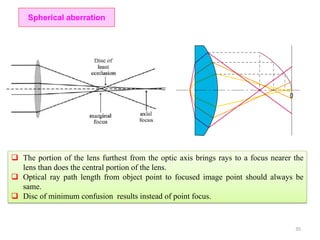
Spherical aberration
35
 The portion of the lens furthest from the optic axis brings rays to a focus nearer the
lens than does the central portion of the lens.
 Optical ray path length from object point to focused image point should always be
same.
 Disc of minimum confusion results instead of point focus.
36
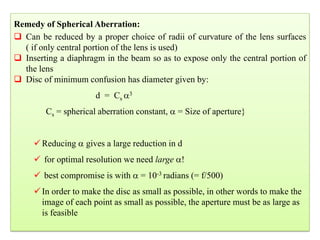
Remedy of Spherical Aberration:
 Can be reduced by a proper choice of radii of curvature of the lens surfaces
( if only central portion of the lens is used)
 Inserting a diaphragm in the beam so as to expose only the central portion of
the lens
 Disc of minimum confusion has diameter given by:
d = Cs 3
Cs = spherical aberration constant,  = Size of aperture}
Reducing  gives a large reduction in d
 for optimal resolution we need large !
 best compromise is with  = 10-3 radians (= f/500)
In order to make the disc as small as possible, in other words to make the
image of each point as small as possible, the aperture must be as large as
is feasible
37
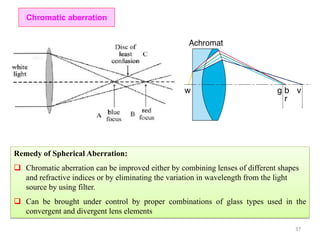
Chromatic aberration
Remedy of Spherical Aberration:
 Chromatic aberration can be improved either by combining lenses of different shapes
and refractive indices or by eliminating the variation in wavelength from the light
source by using filter.
 Can be brought under control by proper combinations of glass types used in the
convergent and divergent lens elements
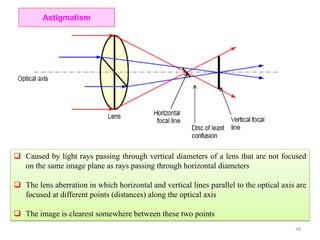
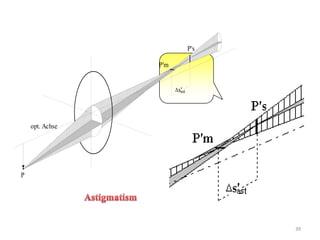
Astigmatism
 Caused by light rays passing through vertical diameters of a lens that are not focused
on the same image plane as rays passing through horizontal diameters
 The lens aberration in which horizontal and vertical lines parallel to the optical axis are
focused at different points (distances) along the optical axis
 The image is clearest somewhere between these two points
38
P
P'm
P's
opt. Achse
s'ast
39
40
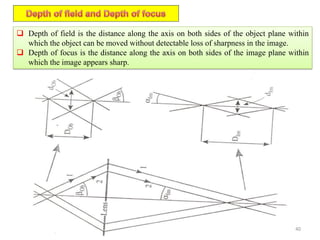
 Depth of field is the distance along the axis on both sides of the object plane within
which the object can be moved without detectable loss of sharpness in the image.
 Depth of focus is the distance along the axis on both sides of the image plane within
which the image appears sharp.
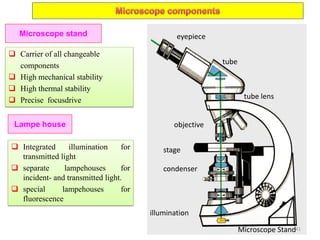
Microscope stand
 Carrier of all changeable
components
 High mechanical stability
 High thermal stability
 Precise focusdrive
illumination
condenser
stage
objective
tube lens
tube
eyepiece
Microscope Stand
Lampe house
 Integrated illumination for
transmitted light
 separate lampehouses for
incident- and transmitted light.
 special lampehouses for
fluorescence
41
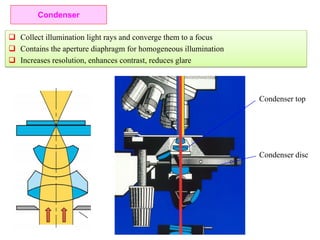
Condenser top
Condenser disc
Condenser
 Collect illumination light rays and converge them to a focus
 Contains the aperture diaphragm for homogeneous illumination
 Increases resolution, enhances contrast, reduces glare
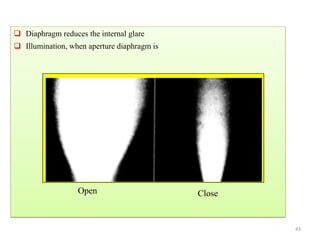
 Diaphragm reduces the internal glare
 Illumination, when aperture diaphragm is
Open Close
43
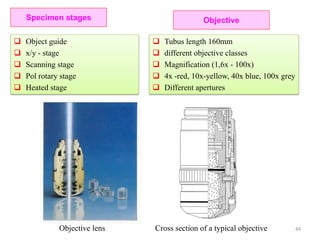
Specimen stages
 Object guide
 x/y - stage
 Scanning stage
 Pol rotary stage
 Heated stage
 Tubus length 160mm
 different objective classes
 Magnification (1,6x - 100x)
 4x -red, 10x-yellow, 40x blue, 100x grey
 Different apertures
Objective
Cross section of a typical objectiveObjective lens 44
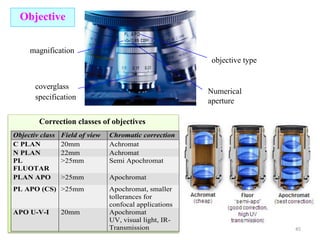
objective type
magnification
coverglass
specification
Numerical
aperture
Correction classes of objectives
Objective
Objectiv class Field of view Chromatic correction
C PLAN 20mm Achromat
N PLAN 22mm Achromat
PL
FLUOTAR
>25mm Semi Apochromat
PLAN APO >25mm Apochromat
PL APO (CS) >25mm Apochromat, smaller
tollerances for
confocal applications
APO U-V-I 20mm Apochromat
UV, visual light, IR-
Transmission 45
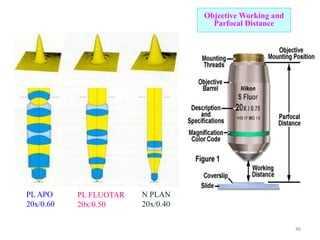
N PLAN
20x/0.40
PL FLUOTAR
20x/0.50
PL APO
20x/0.60
Objective Working and
Parfocal Distance
46
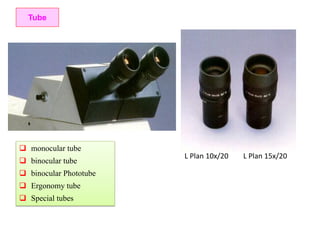
 monocular tube
 binocular tube
 binocular Phototube
 Ergonomy tube
 Special tubes
L Plan 10x/20 L Plan 15x/20
Tube
48
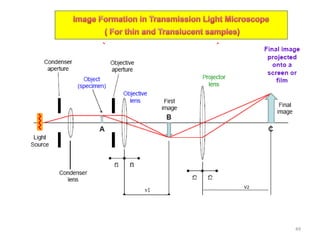
V2
49
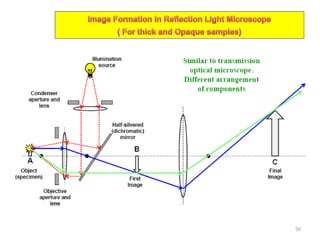
50
51
eyepiecetubelensobjectivetotal MMMM 
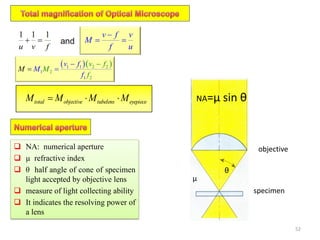
 NA: numerical aperture
 µ refractive index
 θ half angle of cone of specimen
light accepted by objective lens
 measure of light collecting ability
 It indicates the resolving power of
a lens
µ
θ
objective
specimen
NA=µ sin θ
52
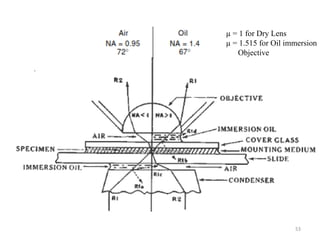
µ = 1 for Dry Lens
µ = 1.515 for Oil immersion
Objective
53
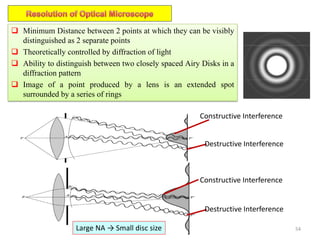
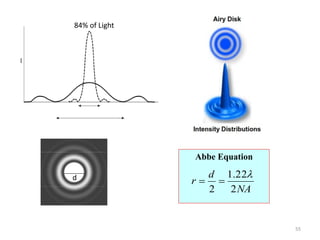
 Minimum Distance between 2 points at which they can be visibly
distinguished as 2 separate points
 Theoretically controlled by diffraction of light
 Ability to distinguish between two closely spaced Airy Disks in a
diffraction pattern
 Image of a point produced by a lens is an extended spot
surrounded by a series of rings
Constructive Interference
Destructive Interference
Constructive Interference
Destructive Interference
Large NA → Small disc size 54
84% of Light
d
Abbe Equation
NA
d
r
2
22.1
2


55
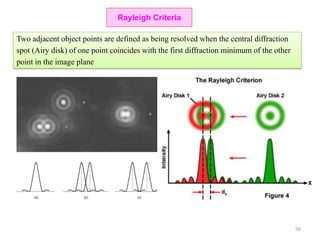
Two adjacent object points are defined as being resolved when the central diffraction
spot (Airy disk) of one point coincides with the first diffraction minimum of the other
point in the image plane
Rayleigh Criteria
56
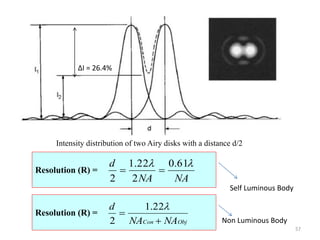
ΔI = 26.4%
Resolution (R) =
Intensity distribution of two Airy disks with a distance d/2
NANA
d  61.0
2
22.1
2

Self Luminous Body
Resolution (R) =
ObjCon NANA
d


22.1
2 Non Luminous Body
57
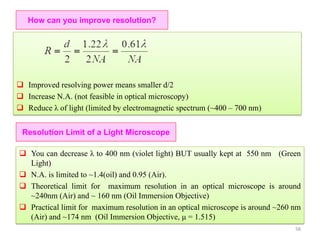
How can you improve resolution?
 Improved resolving power means smaller d/2
 Increase N.A. (not feasible in optical microscopy)
 Reduce λ of light (limited by electromagnetic spectrum (~400 – 700 nm)
Resolution Limit of a Light Microscope
 You can decrease λ to 400 nm (violet light) BUT usually kept at 550 nm (Green
Light)
 N.A. is limited to ~1.4(oil) and 0.95 (Air).
 Theoretical limit for maximum resolution in an optical microscope is around
~240nm (Air) and ~ 160 nm (Oil Immersion Objective)
 Practical limit for maximum resolution in an optical microscope is around ~260 nm
(Air) and ~174 nm (Oil Immersion Objective, μ = 1.515)
58
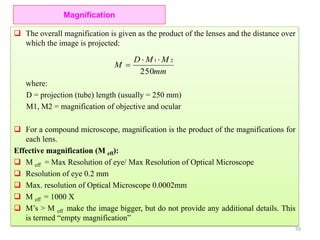
 The overall magnification is given as the product of the lenses and the distance over
which the image is projected:
where:
D = projection (tube) length (usually = 250 mm)
M1, M2 = magnification of objective and ocular
 For a compound microscope, magnification is the product of the magnifications for
each lens.
Effective magnification (M eff):
 M eff = Max Resolution of eye/ Max Resolution of Optical Microscope
 Resolution of eye 0.2 mm
 Max. resolution of Optical Microscope 0.0002mm
 M eff = 1000 X
 M’s > M eff make the image bigger, but do not provide any additional details. This
is termed “empty magnification”
Magnification
mm
MMD
M
250
21 

59
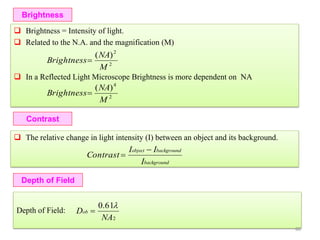
Depth of Field
Depth of Field:
Brightness
 Brightness = Intensity of light.
 Related to the N.A. and the magnification (M)
 In a Reflected Light Microscope Brightness is more dependent on NA
2
2
)(
M
NA
Brightness
2
4
)(
M
NA
Brightness
Contrast
 The relative change in light intensity (I) between an object and its background.
background
backgroundobject
I
II
Contrast


2
61.0
NA
Dob


60
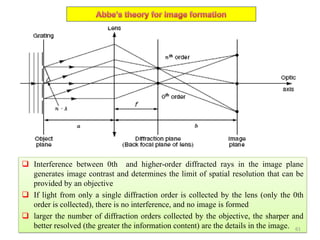
 Interference between 0th and higher-order diffracted rays in the image plane
generates image contrast and determines the limit of spatial resolution that can be
provided by an objective
 If light from only a single diffraction order is collected by the lens (only the 0th
order is collected), there is no interference, and no image is formed
 larger the number of diffraction orders collected by the objective, the sharper and
better resolved (the greater the information content) are the details in the image. 61
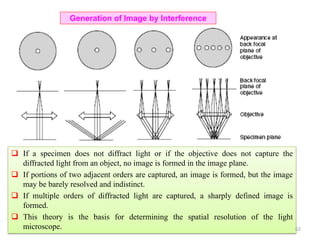
 If a specimen does not diffract light or if the objective does not capture the
diffracted light from an object, no image is formed in the image plane.
 If portions of two adjacent orders are captured, an image is formed, but the image
may be barely resolved and indistinct.
 If multiple orders of diffracted light are captured, a sharply defined image is
formed.
 This theory is the basis for determining the spatial resolution of the light
microscope.
Generation of Image by Interference
62
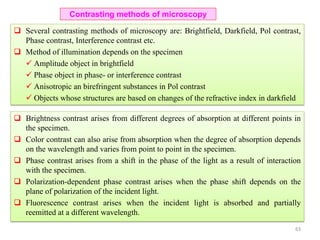
Contrasting methods of microscopy
 Several contrasting methods of microscopy are: Brightfield, Darkfield, Pol contrast,
Phase contrast, Interference contrast etc.
 Method of illumination depends on the specimen
 Amplitude object in brightfield
 Phase object in phase- or interference contrast
 Anisotropic an birefringent substances in Pol contrast
 Objects whose structures are based on changes of the refractive index in darkfield
 Brightness contrast arises from different degrees of absorption at different points in
the specimen.
 Color contrast can also arise from absorption when the degree of absorption depends
on the wavelength and varies from point to point in the specimen.
 Phase contrast arises from a shift in the phase of the light as a result of interaction
with the specimen.
 Polarization-dependent phase contrast arises when the phase shift depends on the
plane of polarization of the incident light.
 Fluorescence contrast arises when the incident light is absorbed and partially
reemitted at a different wavelength.
63
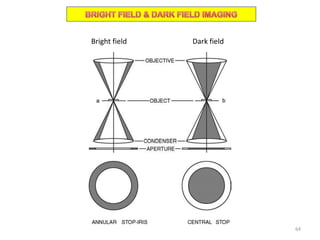
Bright field Dark field
64
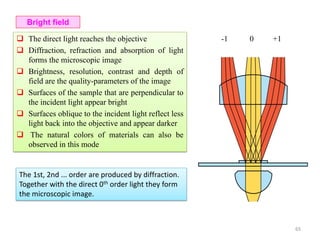
 The direct light reaches the objective
 Diffraction, refraction and absorption of light
forms the microscopic image
 Brightness, resolution, contrast and depth of
field are the quality-parameters of the image
 Surfaces of the sample that are perpendicular to
the incident light appear bright
 Surfaces oblique to the incident light reflect less
light back into the objective and appear darker
 The natural colors of materials can also be
observed in this mode
Bright field
-1 0 +1
The 1st, 2nd ... order are produced by diffraction.
Together with the direct 0th order light they form
the microscopic image.
65
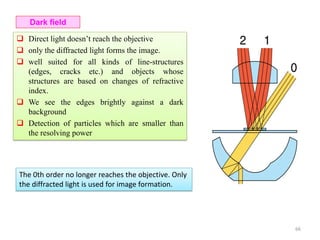
 Direct light doesn’t reach the objective
 only the diffracted light forms the image.
 well suited for all kinds of line-structures
(edges, cracks etc.) and objects whose
structures are based on changes of refractive
index.
 We see the edges brightly against a dark
background
 Detection of particles which are smaller than
the resolving power
Dark field
The 0th order no longer reaches the objective. Only
the diffracted light is used for image formation.
66
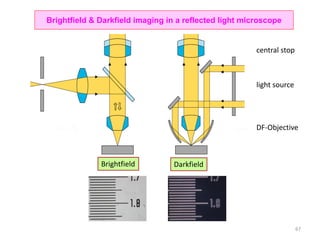
Brightfield & Darkfield imaging in a reflected light microscope
light source
central stop
DF-Objective
Brightfield Darkfield
67
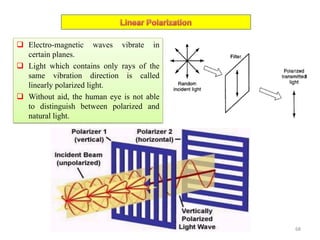
 Electro-magnetic waves vibrate in
certain planes.
 Light which contains only rays of the
same vibration direction is called
linearly polarized light.
 Without aid, the human eye is not able
to distinguish between polarized and
natural light.
68
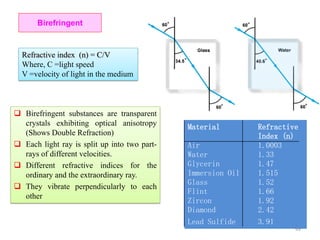
Birefringent
Refractive index (n) = C/V
Where, C =light speed
V =velocity of light in the medium
Material Refractive
Index (n)
Air 1.0003
Water 1.33
Glycerin 1.47
Immersion Oil 1.515
Glass 1.52
Flint 1.66
Zircon 1.92
Diamond 2.42
Lead Sulfide 3.91
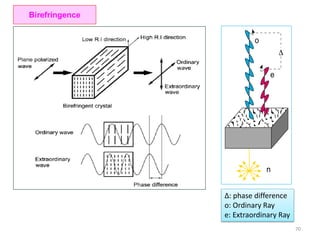
 Birefringent substances are transparent
crystals exhibiting optical anisotropy
(Shows Double Refraction)
 Each light ray is split up into two part-
rays of different velocities.
 Different refractive indices for the
ordinary and the extraordinary ray.
 They vibrate perpendicularly to each
other
69
Δ: phase difference
o: Ordinary Ray
e: Extraordinary Ray
Birefringence
70
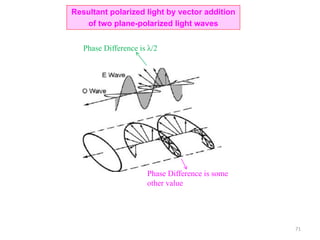
Phase Difference is λ/2
Phase Difference is some
other value
Resultant polarized light by vector addition
of two plane-polarized light waves
71
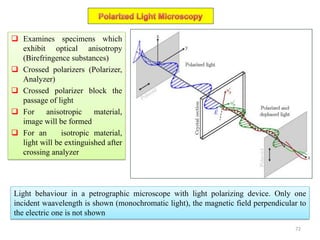
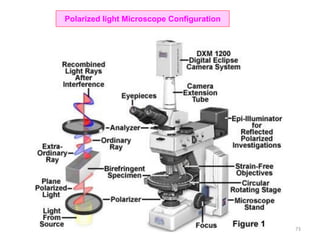
 Examines specimens which
exhibit optical anisotropy
(Birefringence substances)
 Crossed polarizers (Polarizer,
Analyzer)
 Crossed polarizer block the
passage of light
 For anisotropic material,
image will be formed
 For an isotropic material,
light will be extinguished after
crossing analyzer
Light behaviour in a petrographic microscope with light polarizing device. Only one
incident waavelength is shown (monochromatic light), the magnetic field perpendicular to
the electric one is not shown
72
Polarized light Microscope Configuration
73
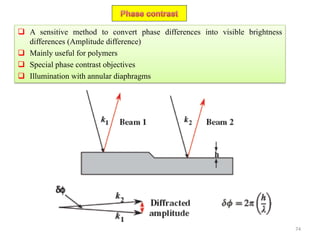
 A sensitive method to convert phase differences into visible brightness
differences (Amplitude difference)
 Mainly useful for polymers
 Special phase contrast objectives
 Illumination with annular diaphragms
74
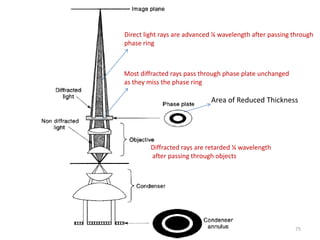
Area of Reduced Thickness
Diffracted rays are retarded ¼ wavelength
after passing through objects
Most diffracted rays pass through phase plate unchanged
as they miss the phase ring
Direct light rays are advanced ¼ wavelength after passing through
phase ring
75
Why sectioning?
1. Size limitation of specimen to be examined under optical microscope.
2. Locate area needs to be selected from a large sample.
Metallography:
 A systematic method to examine microstructure of materials (mainly metallic materials).
 Can also be used to examine ceramics, polymers and semiconductors.
Abrasive Cutting: It is the most common sectioning method.
(1) Sectioning
Electric Discharge Machining (EDM):
 Electrically conductive materials can be produced via EDM.
 Cutting is accomplished by an electric discharge between an electrode and the sample
submerged in a dielectric fluid.
Microtomy:
 Useful for preparing soft materials such as polymer samples.
 Steel, glass or diamond knives in a microtome can cut samples into very thin sections.
76
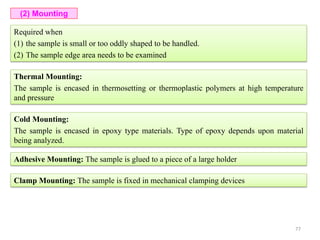
(2) Mounting
Required when
(1) the sample is small or too oddly shaped to be handled.
(2) The sample edge area needs to be examined
Thermal Mounting:
The sample is encased in thermosetting or thermoplastic polymers at high temperature
and pressure
Cold Mounting:
The sample is encased in epoxy type materials. Type of epoxy depends upon material
being analyzed.
Adhesive Mounting: The sample is glued to a piece of a large holder
Clamp Mounting: The sample is fixed in mechanical clamping devices
77
 Removes the damage from the surface produced by sectioning.
 Grinding also produces damage which must be minimized by subsequent grinding
with finer abrasives.
 At the end of grinding phase, the only grinding damage present must be from the last
grinding step.
 Such damage will be removed by polishing.
(2) Grinding
Grinding Materials: Abrasive paper (covered with silicon carbide grit).
Commonly a series of abrasive papers are used from coarse to fine.
Typical Grit Sequence: 120-, 240-, 320-, 400-, 600-, 1200-, 2400-, etc.
 The initial grit size depends on the surface roughness and depth of damage from
sectioning.
 Surfaces cut with abrasive cutoff saws generally start with 120- to 240- grit surface
finishes.
 Surfaces cut by EDM or diamond saws generally start with 320- to 400- grit surface
finishes.
78
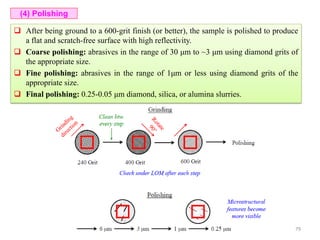
 After being ground to a 600-grit finish (or better), the sample is polished to produce
a flat and scratch-free surface with high reflectivity.
 Coarse polishing: abrasives in the range of 30 μm to ~3 μm using diamond grits of
the appropriate size.
 Fine polishing: abrasives in the range of 1μm or less using diamond grits of the
appropriate size.
 Final polishing: 0.25-0.05 μm diamond, silica, or alumina slurries.
(4) Polishing
79
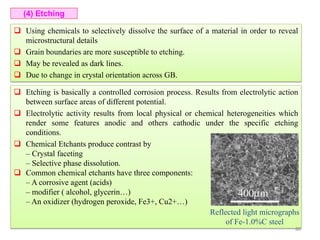
 Using chemicals to selectively dissolve the surface of a material in order to reveal
microstructural details
 Grain boundaries are more susceptible to etching.
 May be revealed as dark lines.
 Due to change in crystal orientation across GB.
(4) Etching
 Etching is basically a controlled corrosion process. Results from electrolytic action
between surface areas of different potential.
 Electrolytic activity results from local physical or chemical heterogeneities which
render some features anodic and others cathodic under the specific etching
conditions.
 Chemical Etchants produce contrast by
– Crystal faceting
– Selective phase dissolution.
 Common chemical etchants have three components:
– A corrosive agent (acids)
– modifier ( alcohol, glycerin…)
– An oxidizer (hydrogen peroxide, Fe3+, Cu2+…)
Reflected light micrographs
of Fe-1.0%C steel
80
Suneeti Purohit *: Avala Lava Kumar : Gautam Behera
Department of Metallurgical & Materials Engineering (MME)
Veer Surendra Sai University of Technology (VSSUT), Burla -768018
*E-mail : suneeti.purohit@gmail.com
81
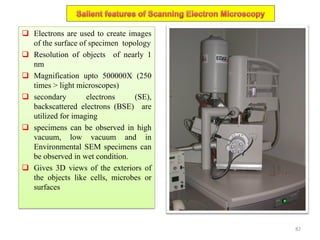
 Electrons are used to create images
of the surface of specimen topology
 Resolution of objects of nearly 1
nm
 Magnification upto 500000X (250
times > light microscopes)
 secondary electrons (SE),
backscattered electrons (BSE) are
utilized for imaging
 specimens can be observed in high
vacuum, low vacuum and in
Environmental SEM specimens can
be observed in wet condition.
 Gives 3D views of the exteriors of
the objects like cells, microbes or
surfaces
82
83
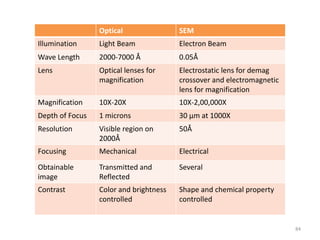
Optical SEM
Illumination Light Beam Electron Beam
Wave Length 2000-7000 Å 0.05Å
Lens Optical lenses for
magnification
Electrostatic lens for demag
crossover and electromagnetic
lens for magnification
Magnification 10X-20X 10X-2,00,000X
Depth of Focus 1 microns 30 μm at 1000X
Resolution Visible region on
2000Å
50Å
Focusing Mechanical Electrical
Obtainable
image
Transmitted and
Reflected
Several
Contrast Color and brightness
controlled
Shape and chemical property
controlled
84
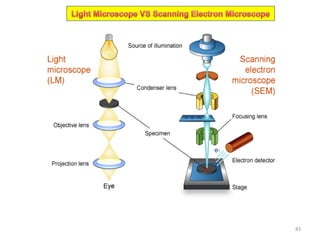
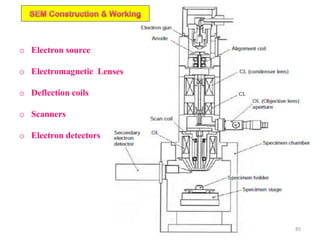
o Electron source
o Electromagnetic Lenses
o Deflection coils
o Scanners
o Electron detectors
85
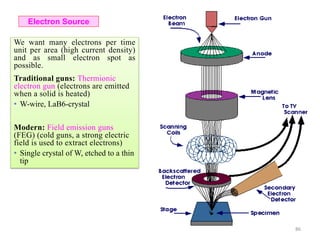
We want many electrons per time
unit per area (high current density)
and as small electron spot as
possible.
Traditional guns: Thermionic
electron gun (electrons are emitted
when a solid is heated)
• W-wire, LaB6-crystal
Modern: Field emission guns
(FEG) (cold guns, a strong electric
field is used to extract electrons)
• Single crystal of W, etched to a thin
tip
Electron Source
86
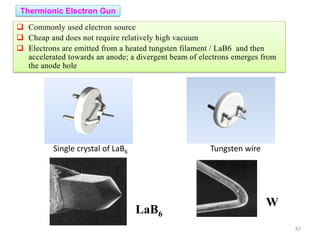
 Commonly used electron source
 Cheap and does not require relatively high vacuum
 Electrons are emitted from a heated tungsten filament / LaB6 and then
accelerated towards an anode; a divergent beam of electrons emerges from
the anode hole
Single crystal of LaB6 Tungsten wire
Thermionic Electron Gun
W
LaB6
87
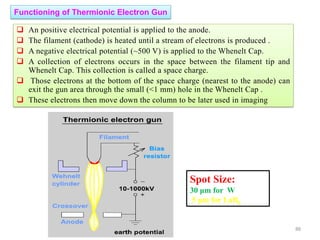
Functioning of Thermionic Electron Gun
 An positive electrical potential is applied to the anode.
 The filament (cathode) is heated until a stream of electrons is produced .
 A negative electrical potential (~500 V) is applied to the Whenelt Cap.
 A collection of electrons occurs in the space between the filament tip and
Whenelt Cap. This collection is called a space charge.
 Those electrons at the bottom of the space charge (nearest to the anode) can
exit the gun area through the small (<1 mm) hole in the Whenelt Cap .
 These electrons then move down the column to be later used in imaging
Spot Size:
30 μm for W
5 μm for LaB6
88
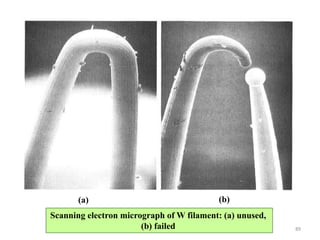
Scanning electron micrograph of W filament: (a) unused,
(b) failed
(a) (b)
89
Field Emission Gun (FEG)
 In recent years cold field-emission and thermally-assisted field emission guns have
become increasingly common.
 FEG requires a different gun design as well as much better vacuum in the gun area
(~10e-8 Pa instead of the ~10e-5 Pa)
 With field emission guns we get a smaller spot and higher current densities
compared to thermionic guns
 In these a very fine point on the pointed filament is formed.
 Electrons are emitted by tunnelling through the potential barrier at the tip surface
when a very high potential field gradient is formed at the surface.
Field Emission Tip
A simple tungsten tip can be very sensitive
to surface contamination. More than any
other cathode design, the field emission tip
is extremely sensitive to the size, shape and
surface condition
90
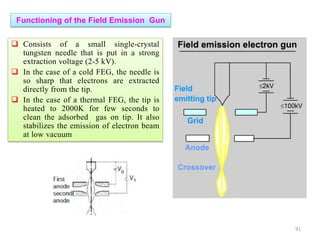
Functioning of the Field Emission Gun
 Consists of a small single-crystal
tungsten needle that is put in a strong
extraction voltage (2-5 kV).
 In the case of a cold FEG, the needle is
so sharp that electrons are extracted
directly from the tip.
 In the case of a thermal FEG, the tip is
heated to 2000K for few seconds to
clean the adsorbed gas on tip. It also
stabilizes the emission of electron beam
at low vacuum
91
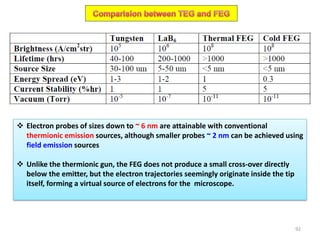
 Electron probes of sizes down to ~ 6 nm are attainable with conventional
thermionic emission sources, although smaller probes ~ 2 nm can be achieved using
field emission sources
 Unlike the thermionic gun, the FEG does not produce a small cross-over directly
below the emitter, but the electron trajectories seemingly originate inside the tip
itself, forming a virtual source of electrons for the microscope.
92
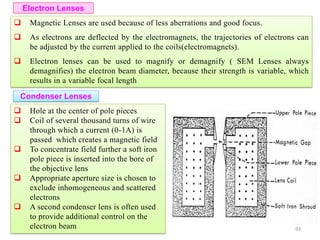
 Magnetic Lenses are used because of less aberrations and good focus.
 As electrons are deflected by the electromagnets, the trajectories of electrons can
be adjusted by the current applied to the coils(electromagnets).
 Electron lenses can be used to magnify or demagnify ( SEM Lenses always
demagnifies) the electron beam diameter, because their strength is variable, which
results in a variable focal length
Electron Lenses
Condenser Lenses
 Hole at the center of pole pieces
 Coil of several thousand turns of wire
through which a current (0-1A) is
passed which creates a magnetic field
 To concentrate field further a soft iron
pole piece is inserted into the bore of
the objective lens
 Appropriate aperture size is chosen to
exclude inhomogeneous and scattered
electrons
 A second condenser lens is often used
to provide additional control on the
electron beam 93
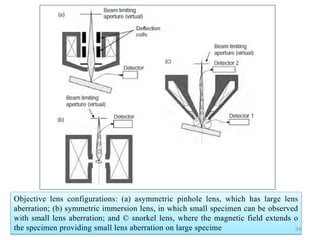
Objective Lens
Objective lens configurations: (a) asymmetric pinhole lens, which has large lens
aberration; (b) symmetric immersion lens, in which small specimen can be observed
with small lens aberration; and © snorkel lens, where the magnetic field extends o
the specimen providing small lens aberration on large specime 94
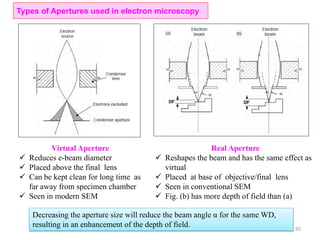
Virtual Aperture
 Reduces e-beam diameter
 Placed above the final lens
 Can be kept clean for long time as
far away from specimen chamber
 Seen in modern SEM
Real Aperture
 Reshapes the beam and has the same effect as
virtual
 Placed at base of objective/final lens
 Seen in conventional SEM
 Fig. (b) has more depth of field than (a)
Types of Apertures used in electron microscopy
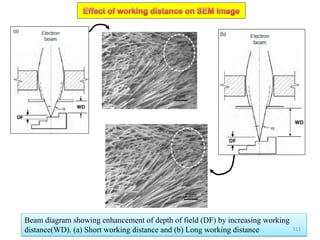
Decreasing the aperture size will reduce the beam angle α for the same WD,
resulting in an enhancement of the depth of field. 95
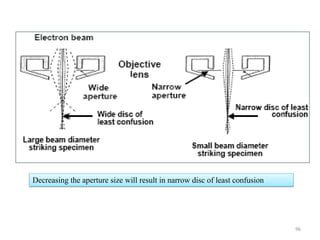
Decreasing the aperture size will result in narrow disc of least confusion
96
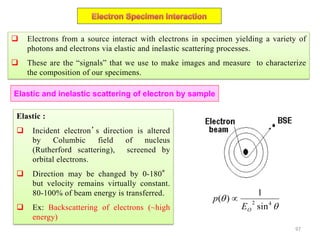
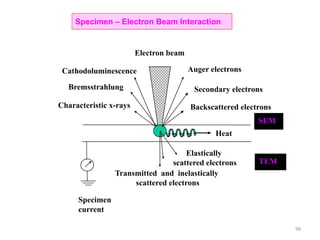
 Electrons from a source interact with electrons in specimen yielding a variety of
photons and electrons via elastic and inelastic scattering processes.
 These are the “signals” that we use to make images and measure to characterize
the composition of our specimens.
Elastic and inelastic scattering of electron by sample
Elastic :
 Incident electron’s direction is altered
by Columbic field of nucleus
(Rutherford scattering), screened by
orbital electrons.
 Direction may be changed by 0-180°
but velocity remains virtually constant.
80-100% of beam energy is transferred.
 Ex: Backscattering of electrons (~high
energy)

 42
sin
1
)(
OE
p 
97
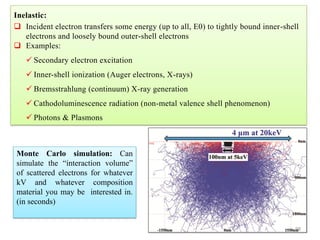
Inelastic:
 Incident electron transfers some energy (up to all, E0) to tightly bound inner-shell
electrons and loosely bound outer-shell electrons
 Examples:
 Secondary electron excitation
 Inner-shell ionization (Auger electrons, X-rays)
 Bremsstrahlung (continuum) X-ray generation
 Cathodoluminescence radiation (non-metal valence shell phenomenon)
 Photons & Plasmons
Monte Carlo simulation: Can
simulate the “interaction volume”
of scattered electrons for whatever
kV and whatever composition
material you may be interested in.
(in seconds)
98
Auger electrons
Secondary electrons
Backscattered electrons
Cathodoluminescence
Bremsstrahlung
Characteristic x-rays
Electron beam
Transmitted and inelastically
scattered electrons
Elastically
scattered electrons
Heat
Specimen
current
TEM
SEM
Specimen – Electron Beam Interaction
99
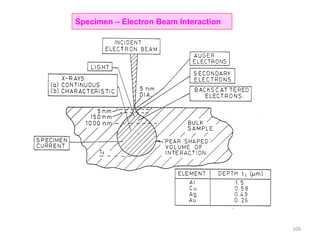
Specimen – Electron Beam Interaction
100
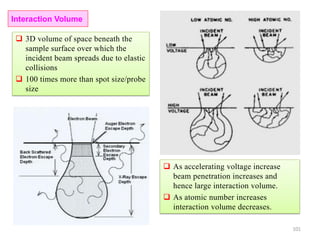
 3D volume of space beneath the
sample surface over which the
incident beam spreads due to elastic
collisions
 100 times more than spot size/probe
size
Interaction Volume
 As accelerating voltage increase
beam penetration increases and
hence large interaction volume.
 As atomic number increases
interaction volume decreases.
101
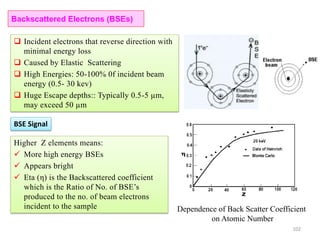
 Incident electrons that reverse direction with
minimal energy loss
 Caused by Elastic Scattering
 High Energies: 50-100% 0f incident beam
energy (0.5- 30 kev)
 Huge Escape depths:: Typically 0.5-5 µm,
may exceed 50 µm
Backscattered Electrons (BSEs)
BSE Signal
Dependence of Back Scatter Coefficient
on Atomic Number
Higher Z elements means:
 More high energy BSEs
 Appears bright
 Eta (η) is the Backscattered coefficient
which is the Ratio of No. of BSE’s
produced to the no. of beam electrons
incident to the sample
102
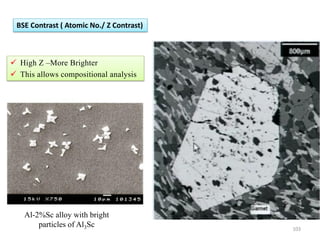
 High Z –More Brighter
 This allows compositional analysis
BSE Contrast ( Atomic No./ Z Contrast)
Al-2%Sc alloy with bright
particles of Al3Sc 103
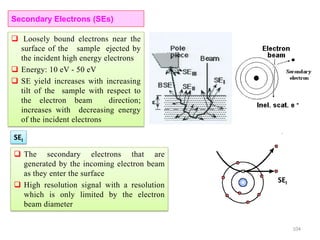
 Loosely bound electrons near the
surface of the sample ejected by
the incident high energy electrons
 Energy: 10 eV - 50 eV
 SE yield increases with increasing
tilt of the sample with respect to
the electron beam direction;
increases with decreasing energy
of the incident electrons
Secondary Electrons (SEs)
 The secondary electrons that are
generated by the incoming electron beam
as they enter the surface
 High resolution signal with a resolution
which is only limited by the electron
beam diameter
SEI
SEI
104
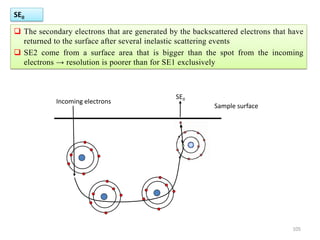
Sample surface
Incoming electrons
SEII
 The secondary electrons that are generated by the backscattered electrons that have
returned to the surface after several inelastic scattering events
 SE2 come from a surface area that is bigger than the spot from the incoming
electrons → resolution is poorer than for SE1 exclusively
SEII
105
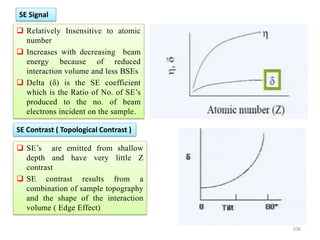
 Relatively Insensitive to atomic
number
 Increases with decreasing beam
energy because of reduced
interaction volume and less BSEs
 Delta (δ) is the SE coefficient
which is the Ratio of No. of SE’s
produced to the no. of beam
electrons incident on the sample.
SE Signal
SE Contrast ( Topological Contrast )
 SE’s are emitted from shallow
depth and have very little Z
contrast
 SE contrast results from a
combination of sample topography
and the shape of the interaction
volume ( Edge Effect)
106
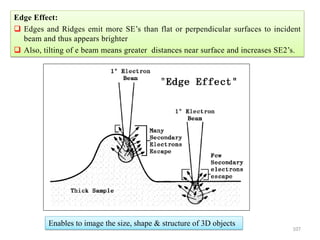
Edge Effect:
 Edges and Ridges emit more SE’s than flat or perpendicular surfaces to incident
beam and thus appears brighter
 Also, tilting of e beam means greater distances near surface and increases SE2’s.
Enables to image the size, shape & structure of 3D objects
107
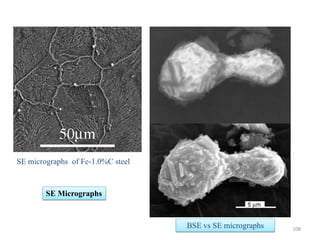
SE Micrographs
SE micrographs of Fe-1.0%C steel
108BSE vs SE micrographs
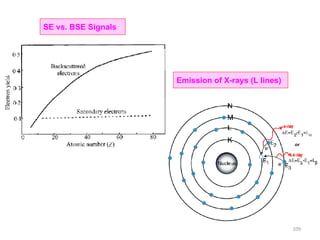
SE vs. BSE Signals
Emission of X-rays (L lines)
109
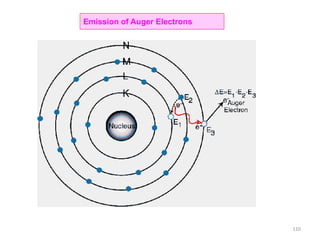
Emission of Auger Electrons
110
Beam diagram showing enhancement of depth of field (DF) by increasing working
distance(WD). (a) Short working distance and (b) Long working distance 111
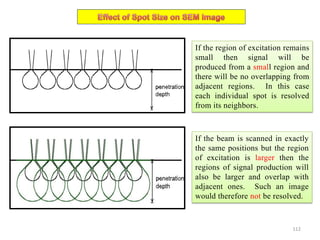
If the region of excitation remains
small then signal will be
produced from a small region and
there will be no overlapping from
adjacent regions. In this case
each individual spot is resolved
from its neighbors.
If the beam is scanned in exactly
the same positions but the region
of excitation is larger then the
regions of signal production will
also be larger and overlap with
adjacent ones. Such an image
would therefore not be resolved.
112
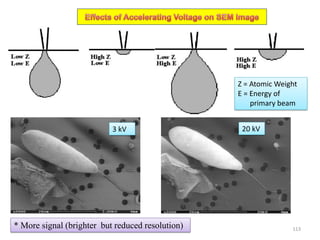
Z = Atomic Weight
E = Energy of
primary beam
20 kV3 kV
* More signal (brighter but reduced resolution) 113
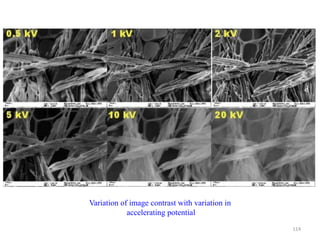
Variation of image contrast with variation in
accelerating potential
114
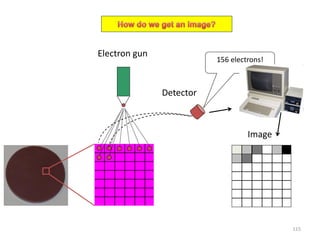
156 electrons!
Image
Detector
Electron gun
115
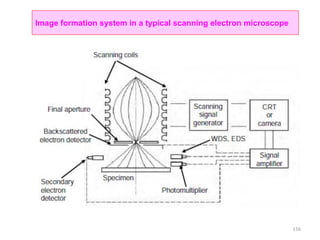
Image formation system in a typical scanning electron microscope
116
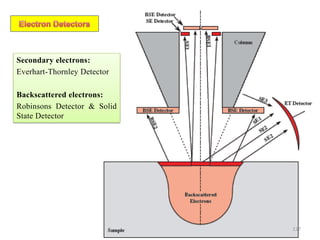
Secondary electrons:
Everhart-Thornley Detector
Backscattered electrons:
Robinsons Detector & Solid
State Detector
117
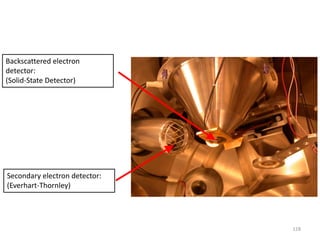
Secondary electron detector:
(Everhart-Thornley)
Backscattered electron
detector:
(Solid-State Detector)
118
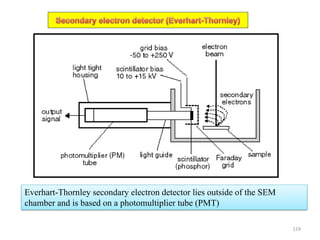
Everhart-Thornley secondary electron detector lies outside of the SEM
chamber and is based on a photomultiplier tube (PMT)
119
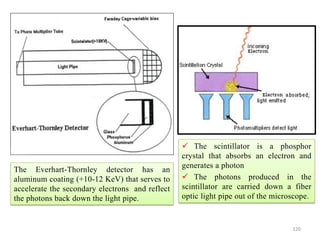
The Everhart-Thornley detector has an
aluminum coating (+10-12 KeV) that serves to
accelerate the secondary electrons and reflect
the photons back down the light pipe.
 The scintillator is a phosphor
crystal that absorbs an electron and
generates a photon
 The photons produced in the
scintillator are carried down a fiber
optic light pipe out of the microscope.
120
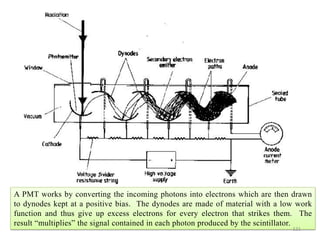
A PMT works by converting the incoming photons into electrons which are then drawn
to dynodes kept at a positive bias. The dynodes are made of material with a low work
function and thus give up excess electrons for every electron that strikes them. The
result “multiplies” the signal contained in each photon produced by the scintillator.
121
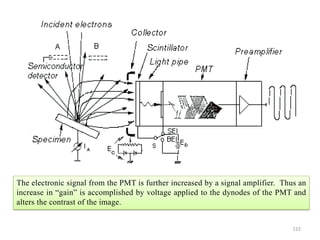
The electronic signal from the PMT is further increased by a signal amplifier. Thus an
increase in “gain” is accomplished by voltage applied to the dynodes of the PMT and
alters the contrast of the image.
122
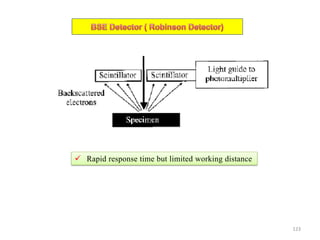
 Rapid response time but limited working distance
123
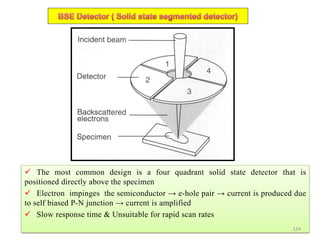
 The most common design is a four quadrant solid state detector that is
positioned directly above the specimen
 Electron impinges the semiconductor → e-hole pair → current is produced due
to self biased P-N junction → current is amplified
 Slow response time & Unsuitable for rapid scan rates
124
Suneeti Purohit *: Avala Lava Kumar : Gautam Behera
Department of Metallurgical & Materials Engineering (MME)
Veer Surendra Sai University of Technology (VSSUT), Burla -768018
*E-mail : suneeti.purohit@gmail.com
125
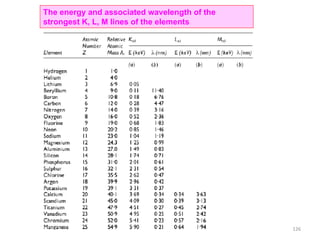
The energy and associated wavelength of the
strongest K, L, M lines of the elements
126
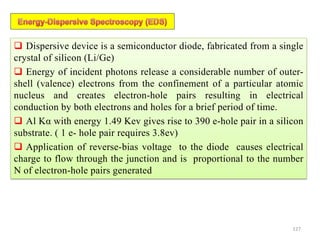
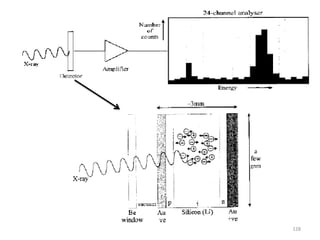
 Dispersive device is a semiconductor diode, fabricated from a single
crystal of silicon (Li/Ge)
 Energy of incident photons release a considerable number of outer-
shell (valence) electrons from the confinement of a particular atomic
nucleus and creates electron-hole pairs resulting in electrical
conduction by both electrons and holes for a brief period of time.
 Al Kα with energy 1.49 Kev gives rise to 390 e-hole pair in a silicon
substrate. ( 1 e- hole pair requires 3.8ev)
 Application of reverse-bias voltage to the diode causes electrical
charge to flow through the junction and is proportional to the number
N of electron-hole pairs generated
127
128
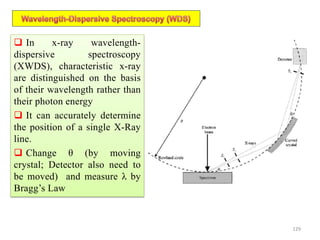
 In x-ray wavelength-
dispersive spectroscopy
(XWDS), characteristic x-ray
are distinguished on the basis
of their wavelength rather than
their photon energy
 It can accurately determine
the position of a single X-Ray
line.
 Change θ (by moving
crystal; Detector also need to
be moved) and measure λ by
Bragg’s Law
129
 A big advantage of the EDS technique is the speed of data
acquisition, due largely to the fact that x-rays within a wide energy
range are detected and analyzed simultaneously. In contrast, the
WDS system examines only one wavelength at any one time and
may take several minutes to scan the required wavelength range.
 EDS detector can be brought very close (within a few mm) of the
specimen, allowing about 1% of the emitted x-rays to be analyzed,
whereas the WDS analyzing crystal needs room to move and
subtends a smaller (solid) angle, so that much less than 1% of the
x-ray photons are collected
 EDS is less costly than WDS
 WDS can clearly analyze low Z elements and elements present at
low concentration which EDS can’t do
130
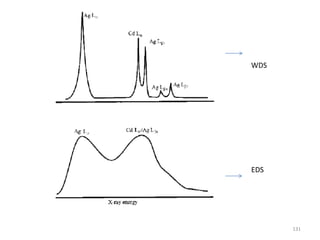
WDS
EDS
131
Suneeti Purohit *: Avala Lava Kumar : Gautam Behera
Department of Metallurgical & Materials Engineering (MME)
Veer Surendra Sai University of Technology (VSSUT), Burla -768018
*E-mail : suneeti.purohit@gmail.com
132
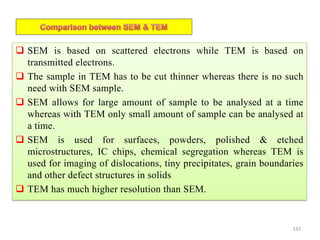
 SEM is based on scattered electrons while TEM is based on
transmitted electrons.
 The sample in TEM has to be cut thinner whereas there is no such
need with SEM sample.
 SEM allows for large amount of sample to be analysed at a time
whereas with TEM only small amount of sample can be analysed at
a time.
 SEM is used for surfaces, powders, polished & etched
microstructures, IC chips, chemical segregation whereas TEM is
used for imaging of dislocations, tiny precipitates, grain boundaries
and other defect structures in solids
 TEM has much higher resolution than SEM.
133
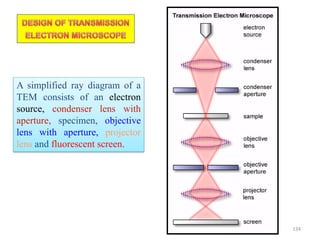
A simplified ray diagram of a
TEM consists of an electron
source, condenser lens with
aperture, specimen, objective
lens with aperture, projector
lens and fluorescent screen.
134
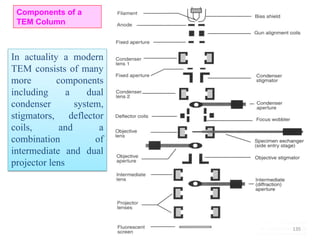
In actuality a modern
TEM consists of many
more components
including a dual
condenser system,
stigmators, deflector
coils, and a
combination of
intermediate and dual
projector lens
Components of a
TEM Column
135
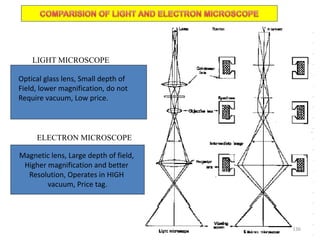
Optical glass lens, Small depth of
Field, lower magnification, do not
Require vacuum, Low price.
Magnetic lens, Large depth of field,
Higher magnification and better
Resolution, Operates in HIGH
vacuum, Price tag.
LIGHT MICROSCOPE
ELECTRON MICROSCOPE
136
Sample Holder of TEM
137
Fluorescent Screen
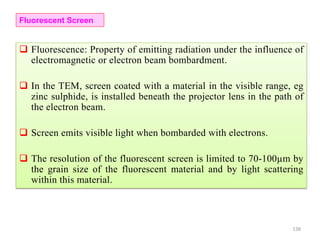
 Fluorescence: Property of emitting radiation under the influence of
electromagnetic or electron beam bombardment.
 In the TEM, screen coated with a material in the visible range, eg
zinc sulphide, is installed beneath the projector lens in the path of
the electron beam.
 Screen emits visible light when bombarded with electrons.
 The resolution of the fluorescent screen is limited to 70-100µm by
the grain size of the fluorescent material and by light scattering
within this material.
138
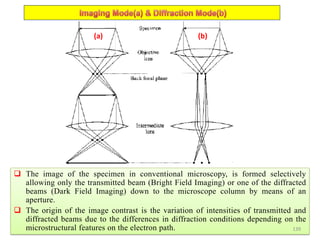
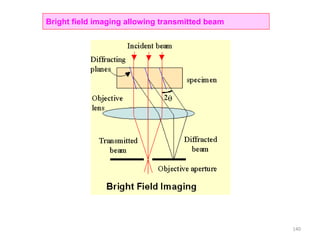
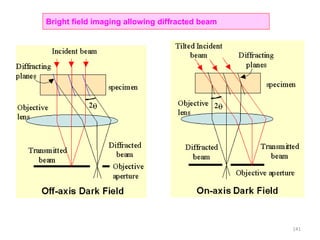
 The image of the specimen in conventional microscopy, is formed selectively
allowing only the transmitted beam (Bright Field Imaging) or one of the diffracted
beams (Dark Field Imaging) down to the microscope column by means of an
aperture.
 The origin of the image contrast is the variation of intensities of transmitted and
diffracted beams due to the differences in diffraction conditions depending on the
microstructural features on the electron path.
(a) (b)
139
Bright field imaging allowing transmitted beam
140
Bright field imaging allowing diffracted beam
141
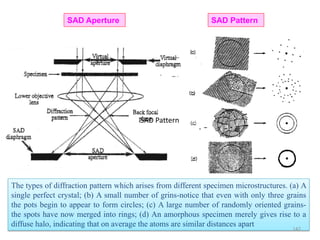
SAD Pattern
SAD Aperture SAD Pattern
The types of diffraction pattern which arises from different specimen microstructures. (a) A
single perfect crystal; (b) A small number of grins-notice that even with only three grains
the pots begin to appear to form circles; (c) A large number of randomly oriented grains-
the spots have now merged into rings; (d) An amorphous specimen merely gives rise to a
diffuse halo, indicating that on average the atoms are similar distances apart
142
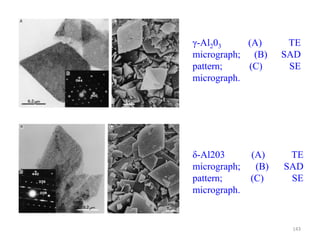
γ-Al203 (A) TE
micrograph; (B) SAD
pattern; (C) SE
micrograph.
δ-Al203 (A) TE
micrograph; (B) SAD
pattern; (C) SE
micrograph.
143
144
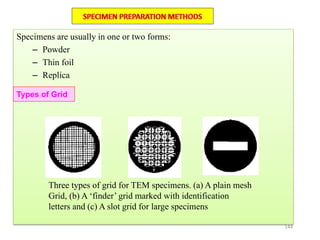
Specimens are usually in one or two forms:
– Powder
– Thin foil
– Replica
Three types of grid for TEM specimens. (a) A plain mesh
Grid, (b) A ‘finder’ grid marked with identification
letters and (c) A slot grid for large specimens
Types of Grid
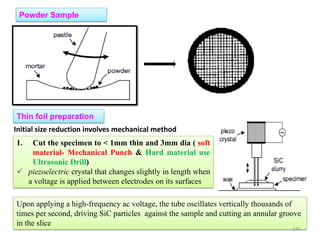
Powder Sample
Thin foil preparation
1. Cut the specimen to < 1mm thin and 3mm dia ( soft
material- Mechanical Punch & Hard material use
Ultrasonic Drill)
 piezoelectric crystal that changes slightly in length when
a voltage is applied between electrodes on its surfaces
Initial size reduction involves mechanical method
Upon applying a high-frequency ac voltage, the tube oscillates vertically thousands of
times per second, driving SiC particles against the sample and cutting an annular groove
in the slice
145
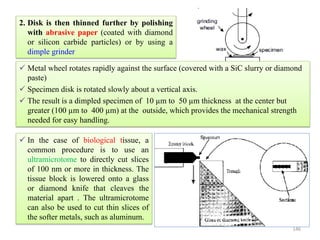
2. Disk is then thinned further by polishing
with abrasive paper (coated with diamond
or silicon carbide particles) or by using a
dimple grinder
 Metal wheel rotates rapidly against the surface (covered with a SiC slurry or diamond
paste)
 Specimen disk is rotated slowly about a vertical axis.
 The result is a dimpled specimen of 10 µm to 50 µm thickness at the center but
greater (100 µm to 400 µm) at the outside, which provides the mechanical strength
needed for easy handling.
 In the case of biological tissue, a
common procedure is to use an
ultramicrotome to directly cut slices
of 100 nm or more in thickness. The
tissue block is lowered onto a glass
or diamond knife that cleaves the
material apart . The ultramicrotome
can also be used to cut thin slices of
the softer metals, such as aluminum.
146
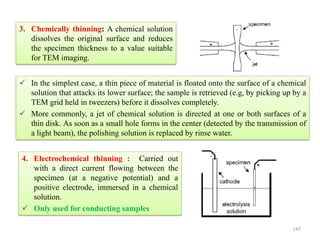
3. Chemically thinning: A chemical solution
dissolves the original surface and reduces
the specimen thickness to a value suitable
for TEM imaging.
 In the simplest case, a thin piece of material is floated onto the surface of a chemical
solution that attacks its lower surface; the sample is retrieved (e.g, by picking up by a
TEM grid held in tweezers) before it dissolves completely.
 More commonly, a jet of chemical solution is directed at one or both surfaces of a
thin disk. As soon as a small hole forms in the center (detected by the transmission of
a light beam), the polishing solution is replaced by rinse water.
4. Electrochemical thinning : Carried out
with a direct current flowing between the
specimen (at a negative potential) and a
positive electrode, immersed in a chemical
solution.
 Only used for conducting samples
147
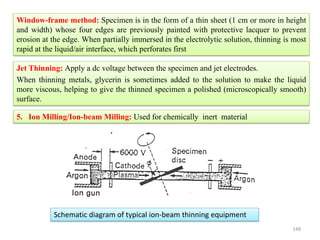
Window-frame method: Specimen is in the form of a thin sheet (1 cm or more in height
and width) whose four edges are previously painted with protective lacquer to prevent
erosion at the edge. When partially immersed in the electrolytic solution, thinning is most
rapid at the liquid/air interface, which perforates first
Jet Thinning: Apply a dc voltage between the specimen and jet electrodes.
When thinning metals, glycerin is sometimes added to the solution to make the liquid
more viscous, helping to give the thinned specimen a polished (microscopically smooth)
surface.
5. Ion Milling/Ion-beam Milling: Used for chemically inert material
Schematic diagram of typical ion-beam thinning equipment
148
149
6. Replication: These are prepared by different techniques
 Surface or Carbon replica
 “Extraction” replica
Surface Or Carbon Replica:
This is produced from a specimen.
 The specimen surface is coated with a cellulose acetate film (e.g., collodion) to
produce a negative impression of the surface features.
 The plastic film is stripped from the specimen surface and coated with a layer of
carbon (about 10 to 20 nm thick). The carbon-coating process takes place in a
vacuum evaporator unit.
 The plastic is then removed (dissolved) from the carbon replica by solvent.
 Before the replica is observed in the microscope, it is usually shadowed (sputtered)
with carbon or a heavy element to enhance the topographical features of the
surface.
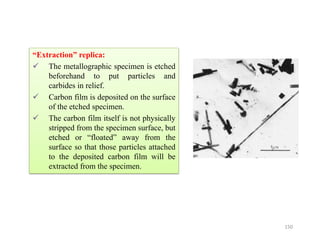
“Extraction” replica:
 The metallographic specimen is etched
beforehand to put particles and
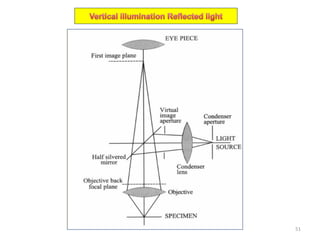
carbides in relief.
 Carbon film is deposited on the surface
of the etched specimen.
 The carbon film itself is not physically
stripped from the specimen surface, but
etched or “floated” away from the
surface so that those particles attached
to the deposited carbon film will be
extracted from the specimen.
150
Suneeti Purohit *: Avala Lava Kumar : Gautam Behera
Department of Metallurgical & Materials Engineering (MME)
Veer Surendra Sai University of Technology (VSSUT), Burla -768018
*E-mail : suneeti.purohit@gmail.com
151
152
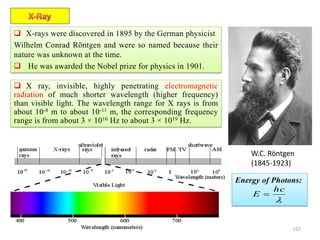
 X-rays were discovered in 1895 by the German physicist
Wilhelm Conrad Röntgen and were so named because their
nature was unknown at the time.
 He was awarded the Nobel prize for physics in 1901.
W.C. Röntgen
(1845-1923)
 X ray, invisible, highly penetrating electromagnetic
radiation of much shorter wavelength (higher frequency)
than visible light. The wavelength range for X rays is from
about 10-8 m to about 10-11 m, the corresponding frequency
range is from about 3 × 10¹⁶ Hz to about 3 × 10¹⁹ Hz.
Energy of Photons:

hc
E 
153
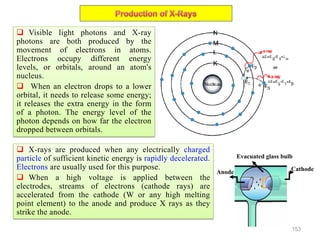
 Visible light photons and X-ray
photons are both produced by the
movement of electrons in atoms.
Electrons occupy different energy
levels, or orbitals, around an atom's
nucleus.
 When an electron drops to a lower
orbital, it needs to release some energy;
it releases the extra energy in the form
of a photon. The energy level of the
photon depends on how far the electron
dropped between orbitals.
 X-rays are produced when any electrically charged
particle of sufficient kinetic energy is rapidly decelerated.
Electrons are usually used for this purpose.
 When a high voltage is applied between the
electrodes, streams of electrons (cathode rays) are
accelerated from the cathode (W or any high melting
point element) to the anode and produce X rays as they
strike the anode.
Evacuated glass bulb
Anode Cathode
154
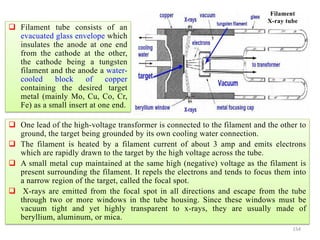
 One lead of the high-voltage transformer is connected to the filament and the other to
ground, the target being grounded by its own cooling water connection.
 The filament is heated by a filament current of about 3 amp and emits electrons
which are rapidly drawn to the target by the high voltage across the tube.
 A small metal cup maintained at the same high (negative) voltage as the filament is
present surrounding the filament. It repels the electrons and tends to focus them into
a narrow region of the target, called the focal spot.
 X-rays are emitted from the focal spot in all directions and escape from the tube
through two or more windows in the tube housing. Since these windows must be
vacuum tight and yet highly transparent to x-rays, they are usually made of
beryllium, aluminum, or mica.
Filament
X-ray tube
 Filament tube consists of an
evacuated glass envelope which
insulates the anode at one end
from the cathode at the other,
the cathode being a tungsten
filament and the anode a water-
cooled block of copper
containing the desired target
metal (mainly Mo, Cu, Co, Cr,
Fe) as a small insert at one end.
155
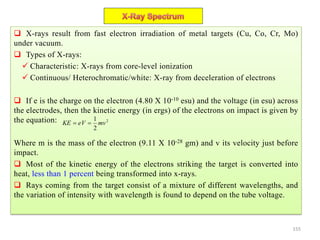
 X-rays result from fast electron irradiation of metal targets (Cu, Co, Cr, Mo)
under vacuum.
 Types of X-rays:
 Characteristic: X-rays from core-level ionization
 Continuous/ Heterochromatic/white: X-ray from deceleration of electrons
 If e is the charge on the electron (4.80 X 10⁻¹⁰ esu) and the voltage (in esu) across
the electrodes, then the kinetic energy (in ergs) of the electrons on impact is given by
the equation:
Where m is the mass of the electron (9.11 X 10⁻²⁸ gm) and v its velocity just before
impact.
 Most of the kinetic energy of the electrons striking the target is converted into
heat, less than 1 percent being transformed into x-rays.
 Rays coming from the target consist of a mixture of different wavelengths, and
the variation of intensity with wavelength is found to depend on the tube voltage.
2
2
1
mveVKE 
156
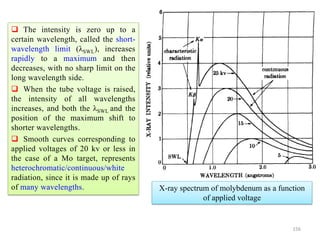
X-ray spectrum of molybdenum as a function
of applied voltage
 The intensity is zero up to a
certain wavelength, called the short-
wavelength limit (λSWL), increases
rapidly to a maximum and then
decreases, with no sharp limit on the
long wavelength side.
 When the tube voltage is raised,
the intensity of all wavelengths
increases, and both the λSWL and the
position of the maximum shift to
shorter wavelengths.
 Smooth curves corresponding to
applied voltages of 20 kv or less in
the case of a Mo target, represents
heterochromatic/continuous/white
radiation, since it is made up of rays
of many wavelengths.
157
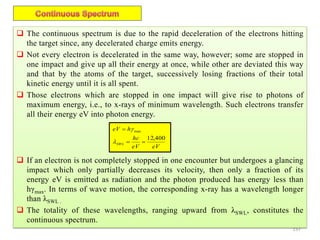
 The continuous spectrum is due to the rapid deceleration of the electrons hitting
the target since, any decelerated charge emits energy.
 Not every electron is decelerated in the same way, however; some are stopped in
one impact and give up all their energy at once, while other are deviated this way
and that by the atoms of the target, successively losing fractions of their total
kinetic energy until it is all spent.
 Those electrons which are stopped in one impact will give rise to photons of
maximum energy, i.e., to x-rays of minimum wavelength. Such electrons transfer
all their energy eV into photon energy.
 If an electron is not completely stopped in one encounter but undergoes a glancing
impact which only partially decreases its velocity, then only a fraction of its
energy eV is emitted as radiation and the photon produced has energy less than
hγmax. In terms of wave motion, the corresponding x-ray has a wavelength longer
than λSWL .
 The totality of these wavelengths, ranging upward from λSWL, constitutes the
continuous spectrum.
eVeV
hc
heV
SWL
400,12
max




158
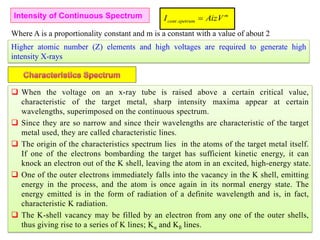
Intensity of Continuous Spectrum
Where A is a proportionality constant and m is a constant with a value of about 2
m
spetrumcont AizVI .
Higher atomic number (Z) elements and high voltages are required to generate high
intensity X-rays
 When the voltage on an x-ray tube is raised above a certain critical value,
characteristic of the target metal, sharp intensity maxima appear at certain
wavelengths, superimposed on the continuous spectrum.
 Since they are so narrow and since their wavelengths are characteristic of the target
metal used, they are called characteristic lines.
 The origin of the characteristics spectrum lies in the atoms of the target metal itself.
If one of the electrons bombarding the target has sufficient kinetic energy, it can
knock an electron out of the K shell, leaving the atom in an excited, high-energy state.
 One of the outer electrons immediately falls into the vacancy in the K shell, emitting
energy in the process, and the atom is once again in its normal energy state. The
energy emitted is in the form of radiation of a definite wavelength and is, in fact,
characteristic K radiation.
 The K-shell vacancy may be filled by an electron from any one of the outer shells,
thus giving rise to a series of K lines; Kα and Kß lines.
159
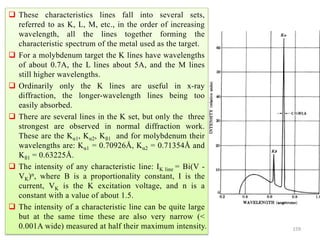
 These characteristics lines fall into several sets,
referred to as K, L, M, etc., in the order of increasing
wavelength, all the lines together forming the
characteristic spectrum of the metal used as the target.
 For a molybdenum target the K lines have wavelengths
of about 0.7A, the L lines about 5A, and the M lines
still higher wavelengths.
 Ordinarily only the K lines are useful in x-ray
diffraction, the longer-wavelength lines being too
easily absorbed.
 There are several lines in the K set, but only the three
strongest are observed in normal diffraction work.
These are the Kα1, Kα2, Kß1 and for molybdenum their
wavelengths are: Kα1 = 0.70926Å, Kα2 = 0.71354Å and
Kß1 = 0.63225Å.
 The intensity of any characteristic line: IK line = Bi(V -
VK)n, where B is a proportionality constant, I is the
current, VK is the K excitation voltage, and n is a
constant with a value of about 1.5.
 The intensity of a characteristic line can be quite large
but at the same time these are also very narrow (<
0.001A wide) measured at half their maximum intensity.
160
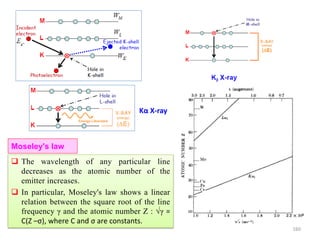
 The wavelength of any particular line
decreases as the atomic number of the
emitter increases.
 In particular, Moseley's law shows a linear
relation between the square root of the line
frequency γ and the atomic number Z : √γ =
C(Z –σ), where C and σ are constants.
Moseley's law
Kα X-ray
161
 X-rays can be created by bombarding a metal target with high energy (> )
electrons.
 Some of these electrons excite electrons from core states in the metal, which
then recombine, producing highly monochromatic X-rays. These are referred to as
characteristic X-ray lines.
 Other electrons, which are decelerated by the periodic potential of the metal,
produce a broad spectrum of X-ray frequencies.
 Depending on the diffraction experiment, either or both of these X-ray spectra
can be used.
4
10
Monochromatic and Broad Spectrum of X-rays
Absorptıon of X-rays
 When x-rays encounter any form of matter, they are partly transmitted and
partly absorbed.
 Fractional decrease in the intensity I of an x-ray beam as it passes through any
homogeneous substance is proportional to the distance traversed, x.
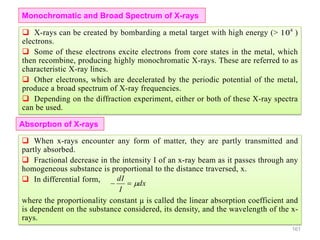
 In differential form,
where the proportionality constant μ is called the linear absorption coefficient and
is dependent on the substance considered, its density, and the wavelength of the x-
rays.
dx
I
dI

162
On integration,
where Io = intensity of incident x-ray beam and Ix
= intensity of transmitted beam after passing
through a thickness x.
The linear absorption coefficient μ is proportional
to the density ρ, which means that the quantity μ / ρ
is a constant of the material and independent of its
physical state (solid, liquid, or gas).
This latter quantity, called the mass absorption
coefficient.
Mass absorption coefficient is the weighted average
of the mass absorption coefficients of its constituent
elements.
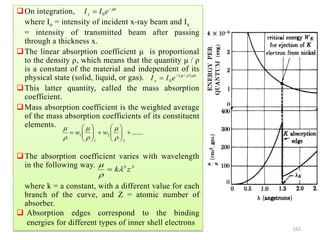
The absorption coefficient varies with wavelength
in the following way.
where k = a constant, with a different value for each
branch of the curve, and Z = atomic number of
absorber.
 Absorption edges correspond to the binding
energies for different types of inner shell electrons
x
x eII 
 0
x
x eII  )/(
0


.......
2
2
1
1 


















ww
33
zk



163
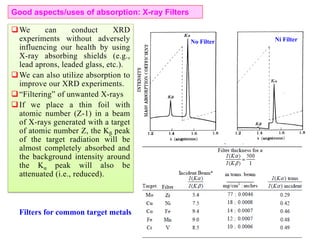
No Filter Ni Filter
Good aspects/uses of absorption: X-ray Filters
We can conduct XRD
experiments without adversely
influencing our health by using
X-ray absorbing shields (e.g.,
lead aprons, leaded glass, etc.).
We can also utilize absorption to
improve our XRD experiments.
“Filtering” of unwanted X-rays
If we place a thin foil with
atomic number (Z-1) in a beam
of X-rays generated with a target
of atomic number Z, the Kβ peak
of the target radiation will be
almost completely absorbed and
the background intensity around
the Kα peak will also be
attenuated (i.e., reduced).
Filters for common target metals
164
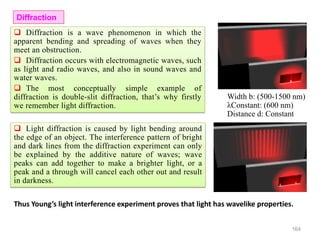
 Diffraction is a wave phenomenon in which the
apparent bending and spreading of waves when they
meet an obstruction.
 Diffraction occurs with electromagnetic waves, such
as light and radio waves, and also in sound waves and
water waves.
 The most conceptually simple example of
diffraction is double-slit diffraction, that’s why firstly
we remember light diffraction.
Width b: (500-1500 nm)
λConstant: (600 nm)
Distance d: Constant
Diffraction
 Light diffraction is caused by light bending around
the edge of an object. The interference pattern of bright
and dark lines from the diffraction experiment can only
be explained by the additive nature of waves; wave
peaks can add together to make a brighter light, or a
peak and a through will cancel each other out and result
in darkness.
Thus Young’s light interference experiment proves that light has wavelike properties.
165
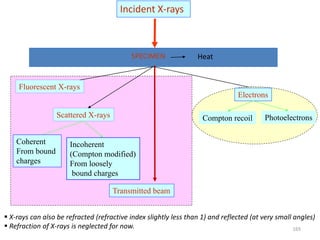
Incident X-rays
 X-rays can also be refracted (refractive index slightly less than 1) and reflected (at very small angles)
 Refraction of X-rays is neglected for now.
HeatSPECIMEN
Transmitted beam
Fluorescent X-rays
Electrons
Compton recoil PhotoelectronsScattered X-rays
Incoherent
(Compton modified)
From loosely
bound charges
Coherent
From bound
charges
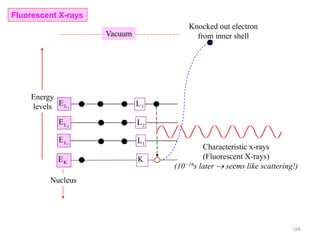
Vacuum
Energy
levels
KE
1LE
2LE
3LE
Nucleus
K
1L
2L
3L
Characteristic x-rays
(Fluorescent X-rays)
(10−16s later  seems like scattering!)
Fluorescent X-rays
Knocked out electron
from inner shell
166
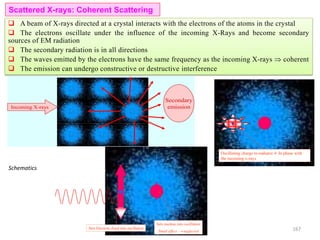
Sets Electron cloud into oscillation
Sets nucleus into oscillation
Small effect  neglected
Schematics
Incoming X-rays
Secondary
emission
Oscillating charge re-radiates  In phase with
the incoming x-rays
Scattered X-rays: Coherent Scattering
 A beam of X-rays directed at a crystal interacts with the electrons of the atoms in the crystal
 The electrons oscillate under the influence of the incoming X-Rays and become secondary
sources of EM radiation
 The secondary radiation is in all directions
 The waves emitted by the electrons have the same frequency as the incoming X-rays  coherent
 The emission can undergo constructive or destructive interference
167
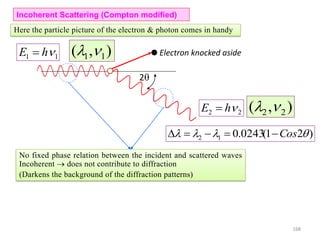
Here the particle picture of the electron & photon comes in handy
),( 11  Electron knocked aside
),( 22 
11 hE 
22 hE 
)21(0243.012  Cos
2
No fixed phase relation between the incident and scattered waves
Incoherent  does not contribute to diffraction
(Darkens the background of the diffraction patterns)
Incoherent Scattering (Compton modified)
168
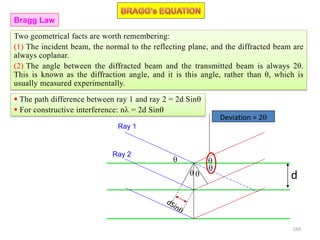
 The path difference between ray 1 and ray 2 = 2d Sin
 For constructive interference: n = 2d Sin
d




Ray 1
Ray 2

Deviation = 2
Two geometrical facts are worth remembering:
(1) The incident beam, the normal to the reflecting plane, and the diffracted beam are
always coplanar.
(2) The angle between the diffracted beam and the transmitted beam is always 2θ.
This is known as the diffraction angle, and it is this angle, rather than θ, which is
usually measured experimentally.
Bragg Law
169
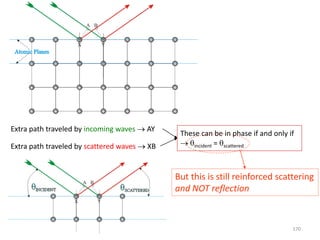
Extra path traveled by incoming waves  AY
Extra path traveled by scattered waves  XB
These can be in phase if and only if
 incident = scattered
But this is still reinforced scattering
and NOT reflection
170
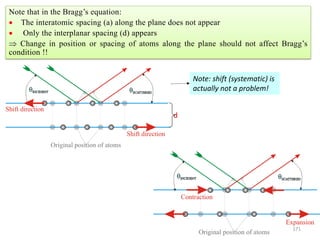
Note that in the Bragg’s equation:
 The interatomic spacing (a) along the plane does not appear
 Only the interplanar spacing (d) appears
 Change in position or spacing of atoms along the plane should not affect Bragg’s
condition !!
d
Note: shift (systematic) is
actually not a problem!
171
Note: shift is actually not a problem!  Why is ‘systematic’ shift not a problem?
n AY YB   [180 ( )] ( )AY XY Cos XY Cos        
( )YB XY Cos   
[ ( ) ( )] [2 ]n AY YB XY Cos Cos XY Sin Sin            
( )
d
Sin
XY
[2 ] 2
d
n Sin Sin d Sin
Sin
   

  2n d Sin 
172
Reflection versus Scattering
Reflection Diffraction
Occurs from surface Occurs throughout the bulk
Takes place at any angle Takes place only at Bragg angles
~100 % of the intensity may be
reflected
Small fraction of intensity is diffracted
X-rays can be reflected at very small angles of incidence
 Bragg’s equation is a negative law  If Bragg’s eq. is NOT satisfied  NO
reflection can occur
 If Bragg’s eq. is satisfied  reflection MAY occur
 Diffraction = Reinforced Coherent Scattering
 In XRD nth order reflection from (h k l) is considered as 1st order reflection
from (nh nk nl)
 sin2 hkldn   sin2
n
dhkl
  sin2 nnn lkhd
173
174
Monochromatic X-rays
Panchromatic X-rays
Monochromatic X-rays
Many s (orientations)
Powder specimen
POWDER
METHOD
Single 
LAUE
TECHNIQUE
 Varied by rotation
ROTATING
CRYSTAL
METHOD
λ fixed
θ variable


λ fixed
θ rotated


λ variable
θ fixed


 As diffraction occurs only at specific Bragg angles, the chance that a reflection is
observed when a crystal is irradiated with monochromatic X-rays at a particular angle is
small (added to this the diffracted intensity is a small fraction of the beam used for
irradiation).
 The probability to get a diffracted beam (with sufficient intensity) is increased by
either varying the wavelength () or having many orientations (rotating the crystal or
having multiple crystallites in many orientations).
 The three methods used to achieve high probability of diffraction are shown below.
175
 The Laue method is mainly used to determine the orientation of large single
crystals while radiation is reflected from, or transmitted through a fixed crystal.
 The diffracted beams form arrays of spots, that lie
on curves on the film.
 The Bragg angle is fixed for every set of planes in
the crystal. Each set of planes picks out and diffracts
the particular wavelength from the white radiation
that satisfies the Bragg law for the values of d and θ
involved.
Back-reflection Laue Method
 In the back-reflection method, the film is
placed between the x-ray source and the crystal.
 The beams which are diffracted in a backward
direction are recorded.
 One side of the cone of Laue reflections
is defined by the transmitted beam. The
film intersects the cone, with the diffraction
spots generally lying on an hyperbola.
X-Ray
Film
Single
Crystal
Transmission Laue Method
FilmSingle
Crystal
Laue Pattern
 The symmetry of the spot pattern reflects the
symmetry of the crystal when viewed along the
direction of the incident beam. Laue method is
often used to determine the orientation of single
crystals by means of illuminating the crystal with
a continuos spectrum of X-rays.
 Although the Laue method can also be used to
determine the crystal structure, several
wavelengths can reflect in different orders from
the same set of planes, with the different order
reflections superimposed on the same spot in the
film. This makes crystal structure determination
by spot intensity diffucult.
X-Ray
 In the transmission Laue method, the film is
placed behind the crystal to record beams which
are transmitted through the crystal.
 One side of the cone of Laue reflections is
defined by the transmitted beam. The film
intersects the cone, with the diffraction spots
generally lying on an ellipse.
176
177
 In the rotating crystal method, a single
crystal is mounted with an axis normal to a
monochromatic x-ray beam. A cylindrical
film is placed around it and the crystal is
rotated about the chosen axis.
 As the crystal rotates, sets of lattice planes
will at some point make the correct Bragg
angle for the monochromatic incident beam,
and at that point a diffracted beam will be
formed.
 The reflected beams are located on the
surface of imaginary cones. By recording the
diffraction patterns (both angles and intensities)
for various crystal orientations, one can
determine the shape and size of unit cell as well
as arrangement of atoms inside the cell.
 Lattice constant of the crystal can be determined by means of this method; for a
given wavelength if the angle θ at which a reflection occurs is known, dhkl can be
determined.
2 2 2
a
d
h k l

 
Film
178
 If a powdered specimen is used, instead of a single crystal, then there is no need to
rotate the specimen, because there will always be some crystals at an orientation for
which diffraction is permitted. Here a monochromatic X-ray beam is incident on a
powdered or polycrystalline sample.
 This method is useful for samples that are difficult to obtain in single crystal form.
 In the powder method the specimen has crystallites (or grains) in many orientations
(usually random).
 Monochromatic X-rays are irradiated on the specimen and the intensity of the
diffracted beams is measured as a function of the diffracted angle.
 The powder method is used to determine the value of the lattice parameters
accurately. Lattice parameters are the magnitudes of the unit vectors a, b and c which
define the unit cell for the crystal.
 For every set of crystal planes, by chance, one or more crystals will be in the correct
orientation to give the correct Bragg angle to satisfy Bragg's equation. Every crystal
plane is thus capable of diffraction. Each diffraction line is made up of a large number
of small spots, each from a separate crystal. Each spot is so small as to give the
appearance of a continuous line.
 If the sample consists of some tens of randomly orientated single crystals, the
diffracted beams are seen to lie on the surface of several cones. The cones may emerge
in all directions, forwards and backwards.
179
 If a monochromatic x-ray beam is directed at a single crystal, then only one or
two diffracted beams may result.
 A sample of some hundreds of crystals (i.e. a powdered sample) show that the
diffracted beams form continuous cones. A circle of film is used to record the
diffraction pattern as shown. Each cone intersects the film giving diffraction lines.
The lines are seen as arcs on the film.
 A very small amount of powdered
material is sealed into a fine capillary
tube made from glass that does not
diffract x-rays.
 The specimen is placed in the Debye
Scherrer camera and is accurately
aligned to be in the centre of the
camera. X-rays enter the camera
through a collimator.
 The powder diffracts the x-rays in
accordance with Braggs law to produce
cones of diffracted beams. These cones
intersect a strip of photographic film
located in the cylindrical camera to
produce a characteristic set of arcs on
the film.
180
Debye Scherrer Camera
When the film is removed from the camera, flattened and processed, it shows the
diffraction lines and the holes for the incident and transmitted beams.
Electron
Atom
Unit cell (uc)
Scattering by a crystal can be understood in three steps
A
B
C
Polarization factor
Atomic scattering factor (f)
Structure factor (F)
To understand the scattering from a crystal leading to the
‘intensity of reflections’ (and why some reflections go
missing), three levels of scattering have to be considered:
1) scattering from electrons
2) scattering from an atom
3) scattering from a unit cell
Click here to know the details
Structure factor calculations
&
Intensity in powder patterns
 Structure Factor (F): The resultant wave
scattered by all atoms of the unit cell
 The Structure Factor is independent of the
shape and size of the unit cell; but is
dependent on the position of the atoms/ions
etc. within the cell
Click here to know more about
Bragg’s equation tells us about the position of the intensity peaks (in terms of )  but
tells us nothing about the intensities. The intensities of the peaks depend on many factors
as considered here.
181
),( 00 
Sets electron into oscillation
Scattered beams),( 00 
Coherent
(definite phase relationship)
A
 The electric field (E) is the main cause for the acceleration of the electron
 The moving particle radiates most strongly in a direction perpendicular to its motion
 The radiation will be polarized along the direction of its motion
Scattering by an Electron
182
x
Intensity of the scattered beam due to an
electron (I) at a point P such that r >> 






 2
2
42
4
0
r
Sin
cm
e
II

z
r
P
For a wave oscillating in z direction
For an polarized wave
The reason we are able to neglect
scattering from the protons in the
nucleus
The scattered rays are also plane polarized
183
For an unpolarized wave E is the measure of the amplitude of the wave
E2 = Intensity
222
zy EEE  zy II
I
00
0
2

 24
0 2 4 2
y
Py y
Sine
I I
m c r
 
 
 
 
IPy = Intensity at point P due to Ey
IPz = Intensity at point P due to Ez
 24
0 2 4 2
z
Pz z
Sine
I I
m c r
 
   
 
Total Intensity at point P due to Ey & Ez
   2 24
0 2 4 2
y z
P
Sin Sine
I I
m c r
  
 
 
 
184
   2 24
0 2 4 2
y z
P
Sin Sine
I I
m c r
  
 
 
 
           2 2 2 2 2 2
1 1 2y z y z y zSin Sin Cos Cos Cos Cos                      
     2 2 2
1x y zCos Cos Cos       Sum of the squares of the direction cosines =1
       2 2 2 2
2 2 1 ( ) 1 ( )y z x xCos Cos Cos Cos                  Hence

 24
0 2 4 2
1 ( )x
P
Cose
I I
m c r
 
 
 
 
 24
0 2 4 2
1 (2 )
P
Cose
I I
m c r
 
 
 
 
In terms of 2
185
0
0.2
0.4
0.6
0.8
1
0 30 60 90 120 150 180
2t
[Cos(2t)]^2
 In general P could lie anywhere in 3D
space.
 For the specific case of Bragg scattering:
The incident direction  IO
The diffracted beam direction  OP
The trace of the scattering plane  BB’
Are all coplanar  OP is constrained to be
on the xz plane
x
z
r
P

2






 2
2
42
4
0
2
r
Cos
cm
e
II

186
For an unpolarized wave E is the measure of the amplitude of the wave
E2 = Intensity
222
zy EEE 
zy II
I
00
0
2

 















 242
4
02
2
42
4
0
12
rcm
e
I
r
Sin
cm
e
II yyPy

IPy = Intensity at point P due to Ey
IPz = Intensity at point P due to Ez
   














 
 2
2
42
4
02
2
42
4
0
22
2
r
Cos
cm
e
I
r
Sin
cm
e
II zzPz

The zx plane is  to the y direction: hence,  = 90
187
-1
-0.8
-0.6
-0.4
-0.2
0
0.2
0.4
0.6
0.8
1
0 30 60 90 120 150 180 210 240 270 300 330 360
t
Cos(t)
 







 
 2
2
00
42
4
2
r
CosII
cm
e
III
zy
PzPyP

 





 
 2
2
42
4
0 21
2 r
Cos
cm
eI
IP

 Scattered beam is not unpolarized
 Forward and backward scattered intensity higher than at 90
 Scattered intensity minute fraction of the incident intensity
Very small number
Polarization factor
Comes into being as we used
unpolarized beam
 





 

2
21 2
42
4
2
0 Cos
cm
e
r
I
IP
0
0.2
0.4
0.6
0.8
1
1.2
0 30 60 90 120 150 180 210 240 270 300 330 360
2t
(1+Cos(2t)^2)/2
188
B Scattering by an Atom
Scattering by an atom  [Atomic number, (path difference suffered by scattering from
each e−, )]
Scattering by an atom  [Z, (, )]  Angle of scattering leads to path differences
 In the forward direction all scattered waves are in phase
electronanbyscatteredwaveofAmplitude
atomanbyscatteredwaveofAmplitude
FactorScatteringAtomicf


f→

)(Sin
(Å−1) →
0.2 0.4 0.6 0.8 1.0
10
20
30
Schematic

)(Sin
Coherent
scattering
Incoherent
(Compton)
scattering
Z   
Sin() /    
189
C Scattering by the Unit cell (uc)
 Coherent Scattering
 Unit Cell (UC) is representative of the crystal structure
 Scattered waves from various atoms in the UC interfere to create the diffraction pattern
The wave scattered from the middle plane is out of phase with the ones scattered from top
and bottom planes 190
d(h00)
B 
Ray 1 = R1
Ray 2 = R2
Ray 3 = R3
Unit Cell
x
M
C
N
R
B
S
A
'
1R
'
2R
'
3R
(h00) plane
a
191
h
a
dAC h  00
:::: ACMCN
xABRBS ::::
h
a
xx
AC
AB


  )(2 0021
SindMCN hRR

h
a
x
AC
AB
RBSRR 31




2

a
x
h
h
a
x
RR 


 2
2
31
 xcoordinatefractional
a
x
 xhRR
  231
Extending to 3D 2 ( )h x k y l z       Independent of the shape of UC
Note: R1 is from corner atoms and R3 is from atoms in additional positions in UC



 
2
192
 If atom B is different from atom A  the amplitudes must be weighed by the respective
atomic scattering factors (f)
 The resultant amplitude of all the waves scattered by all the atoms in the UC gives the
scattering factor for the unit cell
 The unit cell scattering factor is called the Structure Factor (F)
Scattering by an unit cell = f(position of the atoms, atomic scattering factors)
electronanbyscatteredwaveofAmplitude
ucinatomsallbyscatteredwaveofAmplitude
FactorStructureF 
[2 ( )]i i h x k y l z
E Ae fe     
 2 ( )h x k y l z      
In complex notation
2
FI 
[2 ( )]
1 1
j j j j
n n
i i h x k y l zhkl
n j j
j j
F f e f e
     
 
  
Structure factor is independent of the shape and size of the unit cell
For n atoms in the UC
If the UC distorts so do the planes in it!!
193
nni
e )1(
)(
2


Cos
ee ii

 
Structure factor calculations
A Atom at (0,0,0) and equivalent positions
[2 ( )]j j j ji i h x k y l z
j jF f e f e
     
 
[2 ( 0 0 0)] 0i h k l
F f e f e f     
  
22
fF   F is independent of the scattering plane (h k l)
 nini
ee 

Simple Cubic
1)(
inodd
e
1)(
ineven
e
194
B Atom at (0,0,0) & (½, ½, 0) and equivalent positions
[2 ( )]j j j ji i h x k y l z
j jF f e f e
     
 
1 1
[2 ( 0)]
[2 ( 0 0 0)] 2 2
[ 2 ( )]
0 ( )2
[1 ]
i h k l
i h k l
h k
i
i h k
F f e f e
f e f e f e




    
    


 
   
 F is independent of the ‘l’index
C- centred Orthorhombic
Real
]1[ )( khi
efF 
 
fF 2
0F
22
4 fF 
02
F
e.g. (001), (110), (112); (021), (022), (023)
e.g. (100), (101), (102); (031), (032), (033)
195
C Atom at (0,0,0) & (½, ½, ½) and equivalent positions
[2 ( )]j j j ji i h x k y l z
j jF f e f e
     
 
1 1 1
[2 ( )]
[2 ( 0 0 0)] 2 2 2
[ 2 ( )]
0 ( )2
[1 ]
i h k l
i h k l
h k l
i
i h k l
F f e f e
f e f e f e




    
    
 
 
 
   
Body centred
Orthorhombic
Real
]1[ )( lkhi
efF 
 
fF 2
0F
22
4 fF 
02
F
e.g. (110), (200), (211); (220), (022), (310)
e.g. (100), (001), (111); (210), (032), (133)
196
D Atom at (0,0,0) & (½, ½, 0) and equivalent positions
[2 ( )]j j j ji i h x k y l z
j jF f e f e
     
 
]1[ )()()(
)]
2
(2[)]
2
(2[)]
2
(2[
)]0(2[
hlilkikhi
hl
i
lk
i
kh
i
i
eeef
eeeefF













Face Centred Cubic
Real
fF 4
0F
22
16 fF 
02
F
(h, k, l) unmixed
(h, k, l) mixed
e.g. (111), (200), (220), (333), (420)
e.g. (100), (211); (210), (032), (033)
(½, ½, 0), (½, 0, ½), (0, ½, ½)
]1[ )()()( hlilkikhi
eeefF 
 
Two odd and one even (e.g. 112); two even and one odd (e.g. 122) 197
Mixed indices CASE h k l
A o o e
B o e e
( ) ( ) ( )
CASE A : [1 ] [1 1 1 1] 0i e i o i o
e e e  
       
( ) ( ) ( )
CASE B: [1 ] [1 1 1 1] 0i o i e i o
e e e  
       
0F 02
F(h, k, l) mixed e.g. (100), (211); (210), (032), (033)
Mixed indices Two odd and one even (e.g. 112); two even and one odd (e.g. 122)
Unmixed indices CASE h k l
A o o o
B e e e
Unmixed indices
fF 4 22
16 fF (h, k, l) unmixed
e.g. (111), (200), (220), (333), (420)
All odd (e.g. 111); all even (e.g. 222)
( ) ( ) ( )
CASE A : [1 ] [1 1 1 1] 4i e i e i e
e e e  
       
( ) ( ) ( )
CASE B: [1 ] [1 1 1 1] 4i e i e i e
e e e  
       
198
E
Na+ at (0,0,0) + Face Centering Translations  (½, ½, 0), (½, 0, ½), (0, ½, ½)
Cl− at (½, 0, 0) + FCT  (0, ½, 0), (0, 0, ½), (½, ½, ½)


















)]
2
(2[)]
2
(2[)]
2
(2[)]
2
(2[
)]
2
(2[)]
2
(2[)]
2
(2[
)]0(2[
lkh
i
l
i
k
i
h
i
Cl
hl
i
lk
i
kh
i
i
Na
eeeef
eeeefF



][
]1[
)()()()(
)()()(
lkhilikihi
Cl
hlilkikhi
Na
eeeef
eeefF








]1[
]1[
)()()()(
)()()(






khihlilkilkhi
Cl
hlilkikhi
Na
eeeef
eeefF


]1][[ )()()()( hlilkikhilkhi
ClNa
eeeeffF 
 

NaCl:
Face Centred Cubic
199
]1][[ )()()()( hlilkikhilkhi
ClNa
eeeeffF 
 

Zero for mixed indices
Mixed indices CASE h k l
A o o e
B o e e
]2][1[  TermTermF
0]1111[]1[2:ACASE )()()(
 oioiei
eeeTerm 
0]1111[]1[2:BCASE )()()(
 oieioi
eeeTerm 
0F 02
F(h, k, l) mixed e.g. (100), (211); (210), (032), (033)
Mixed indices
200
(h, k, l) unmixed ][4 )( lkhi
ClNa
effF 
  
][4   ClNa
ffF If (h + k + l) is even
22
][16   ClNa
ffF
][4   ClNa
ffF If (h + k + l) is odd
22
][16   ClNa
ffF
e.g. (111), (222); (133), (244)
e.g. (222),(244)
e.g. (111), (133)
Unmixed indices CASE h k l
A o o o
B e e e
4]1111[]1[2:ACASE )()()(
 eieiei
eeeTerm 
4]1111[]1[2:BCASE )()()(
 eieiei
eeeTerm 
Unmixed indices
201
 Presence of additional atoms/ions/molecules in the UC can alter the intensities of some of
the reflections
Selection / Extinction Rules
Bravais Lattice
Reflections which
may be present
Reflections necessarily
absent
Simple all None
Body centred (h + k + l) even (h + k + l) odd
Face centred h, k and l unmixed h, k and l mixed
End centred
h and k unmixed
C centred
h and k mixed
C centred
Bravais Lattice Allowed Reflections
SC All
BCC (h + k + l) even
FCC h, k and l unmixed
DC
h, k and l are all odd Or all are even
& (h + k + l) divisible by 4 202
h2 + k2 + l2 SC FCC BCC DC
1 100
2 110 110
3 111 111 111
4 200 200 200
5 210
6 211 211
7
8 220 220 220 220
9 300, 221
10 310 310
11 311 311 311
12 222 222 222
13 320
14 321 321
15
16 400 400 400 400
17 410, 322
18 411, 330 411, 330
19 331 331 331
203
Bravais lattice determination
Lattice parameter determination
Determination of solvus line in phase diagrams
Long range order
Crystallite size and Strain
More
204
Diffraction angle (2) →
Intensity→
90 1800
Crystal
90 1800
Diffraction angle (2) →
Intensity→
Liquid / Amorphous solid
90 1800
Diffraction angle (2) →
Intensity→
Monoatomic gas
Schematic of difference between
the diffraction patterns of various phases
205
 Bragg’s equation assumes:
 Crystal is perfect and infinite
 Incident beam is perfectly parallel and monochromatic
 Actual experimental conditions are different from these leading various kinds of deviations
from Bragg’s condition
 Peaks are not ‘’ curves  Peaks are broadened
 There are also deviations from the assumptions involved in the generating powder patterns
 Crystals may not be randomly oriented (textured sample)  Peak intensities are altered
 In a powder sample if the crystallite size < 0.5 m
 there are insufficient number of planes to build up a sharp diffraction pattern
 peaks are broadened
206
207
SC 1 2 3 4 5 6 8 …
BCC 1 2 3 4 5 6 7 …
FCC 3 4 8 11 12 …
DC 3 8 11 16 …
The ratio of (h2 + K2 + l2) derived from extinction rules
 In cubic systems, the first XRD peak in the XRD pattern will be due to diffraction
from planes with the lowest Miller indices
 For the close packed planes i.e.:
 simple cubic, (100), h2 + k2 + l2 =1
 body-centered cubic, (110), h2 + k2 + l2 =2, and
 face-centered, (111), h2 + k2 + l2 =3
Powder diffraction pattern from Al
420
111
200
220
311
222
400
331
422
1 & 2 peaks resolved
Radiation: Cu K,  = 1.54 Å
Note:
 Peaks or not idealized  peaks  broadend
 Increasing splitting of peaks with g 
 Peaks are all not of same intensity
208
n 2  Sin Sin2  ratio Index
1 38.52 19.26 0.33 0.11 3 111
2 44.76 22.38 0.38 0.14 4 200
3 65.14 32.57 0.54 0.29 8 220
4 78.26 39.13 0.63 0.40 11 311
5 82.47 41.235 0.66 0.43 12 222
6 99.11 49.555 0.76 0.58 16 400
7 112.03 56.015 0.83 0.69 19 331
8 116.60 58.3 0.85 0.72 20 420
9 137.47 68.735 0.93 0.87 24 422
Determination of Crystal Structure from 2 versus Intensity Data
FCC
209
2→  Intensity Sin Sin2  ratio
1 21.5 0.366 0.134 3
2 25 0.422 0.178 4
3 37 0.60 0.362 8
4 45 0.707 0.500 11
5 47 0.731 0.535 12
6 58 0.848 0.719 16
7 68 0.927 0.859 19
FCC
210
211
 For cubic materials, interplanar spacing is given as:
 Recall Bragg’s law:
 Combining above 2 equations:
 , a are constants, hence is constant
 sin 2 θ is proportional to h2 + k2 +l2 i.e. planes with higher Miller indices will diffract at
higher values of θ.
For Cubic Materials:
212
 Allowed reflection for cubic lattices
 Primitive h2 + k2 + l2 = 1,2,3,4,5,6,8,9,10,11,12,13,14,16…
 Body-centered h2 + k2 + l2 = 2,4,6,8,10,12,14,16…
 Face-centered h2 + k2 + l2 = 3,4,8,11,12,16,19,20,24,27,32…
 Diamond cubic h2 + k2 + l2 = 3,8,11,16,19,24,27,32…
 After determining the hkl values for each reflection, put it in the equation given
below:
 Here the values of sin 2 θ and λ is known.
 So for each n, one value of ‘a’ can be calculated. Then the average of that will give
the lattice parameter.
213
 Many materials have crystal structures that are not cubic. In other words, they are based
on noncubic Bravais lattices (e.g., hexagonal, tetragonal, orthorhombic, etc…).
 In fact, many intermetallic, semiconductors, ceramics, and minerals of interest have
very complicated structures.
 Consider the plane spacing equations for the crystal structures of interest.
 Combining the above equations with bragg’s law:
For Non-Cubic Materials:
Suneeti Purohit *: Avala Lava Kumar : Gautam Behera
Department of Metallurgical & Materials Engineering (MME)
Veer Surendra Sai University of Technology (VSSUT), Burla -768018
*E-mail : suneeti.purohit@gmail.com
214
 Thermal analysis (TA) is a group of techniques in which changes of physical or chemical
properties of the sample are monitored against time or temperature, while the
temperature of the sample is programmed.
 The temperature program may involve heating or cooling at a fixed rate, holding the
temperature constant (isothermal), or any sequence of these.
 The sample is subjected to a predefined heating or cooling program.
 The sample is usually in the solid state and the changes that occur on heating include
melting, phase transition, sublimation, and decomposition.
Application of thermal analysis in characterization of solids
215
 Differential Thermal Analysis (DTA): The temperature difference between a sample
and an inert reference material, ΔT = TS - TR, is measured as both are subjected to
identical heat treatments.
 Differential Scanning Calorimetry (DSC): The sample and reference are maintained
at the same temperature, even during a thermal event (in the sample). The energy
required to maintain zero temperature differential between the sample and the
reference, d Δq/dt, is measured.
 Thermogravimetric Analysis (TGA): The change in mass of a sample on heating is
measured
 Dynamic Mechanical Analysis: Viscoelastic Properties
 Thermo mechanical Analysis: Thermal Expansion Coefficient
 Dielectric Thermal Analysis
 Evolved Gas Analysis
 Thermo-Optical Analysis
 Dilatometry
216
 PRINCIPLE: A Technique in which the
temperature difference between a substance
and reference material is measured as a
function of temperature, while the substance
and reference are subjected to a controlled
temperature programme.
 The record is the differential thermal or DTA
curve; the temperature difference (ΔT) should
be plotted on the ordinate (with endothermic
reactions downwards and exothermic reactions
upwards) and temperature or time on the
abscissa increasing from left to right.
 Endothermic reaction (absorption of energy)
includes vaporization, sublimation, and
absorption & gives downward peak.
 Exothermic reaction (liberation of energy)
includes oxidation, polymerization, and
catalytic reaction & gives upward peak.
217
Specimens
 Sample
 Reference (Known substance, thermally inert
over the temp range of interest)
Sample holder
 Container for sample and reference
Sensors
 Pt/Rh or chromel/alumel thermocouples one for
the sample and one for the reference joined to
differential temperature controller
Furnace
 alumina block containing sample and reference
cells
Temperature controller/ Programmer
 controls for temperature program and furnace
atmosphere
 Uniform heating rate: 10-20o/min
Recorder
218
 If S and R are heated at the same rate, by placing them in the same furnace, their
temperatures will rise
 TR rises steadily, as the reference material is chosen to have no physical or chemical
transitions
 TS also rises steadily in the absence of any transitions, but if for instance the sample
melts, its temperature will lag behind TR as it absorbs the heat energy necessary for
melting
 If an exothermic (heat-producing) event had occurred, the curve would show a peak in the
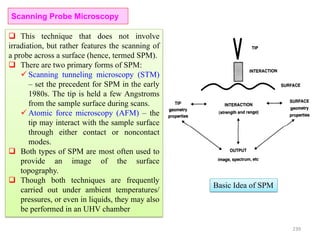
opposite direction
 The area A on the curve is proportional to the heat of the reaction: ΔH = K.A=K ʃ ΔT.dt
 K: Proportionality constant and includes thermal properties of the substance
Differential Thermal Analysis Plot
219
Applications of Differential thermal analysis
 Qualitative and Quantitative Identification of Minerals: detection of any minerals in a
sample
 Measures:
 Tg (Glass transition temperature), Tm (Melting temperature), Td (decomposition)
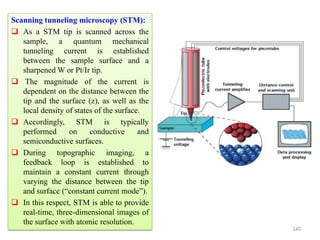
 Heat of fusion, vaporization, crystallization,
 Heat of reaction, decomposition, solution, adsorption
Advantages:
 Instruments can be used at very high temperatures
 Instruments are highly sensitive
 Flexibility in crucible volume/form
 Characteristic transition or reaction temperatures can be accurately determined
 Determination of transition temperatures are accurate in a DTA.
Disadvantages:
Estimates of enthalpies of transition are generally not accurate i.e. Uncertainty of heats
of fusion, transition, or reaction ; estimations is 20-50%.
Advantage & Disadvantage
220
Power compensation DSC Heat flux DSC
 PRINCIPLE: DSC differs fundamentally from DTA in that the sample and reference
are both maintained at the temperature predetermined by the program (i.e. ΔT of
reference/sample is maintained @ 0)
 During a thermal event in the sample, the system will transfer heat to or from the
sample pan to maintain the same temperature in reference and sample pans.
 Current required to maintain isothermal conditions is recorded
 Endothermic processes will lower the sample temperature relative to that of
reference, so the sample must be heated more in order to maintain equal T in both
pans
 Two basic types of DSC instruments: power compensation and heat-flux
221
 Temperatures of the sample and reference are controlled independently using
separate, identical furnaces.
 The temperatures of the sample and reference are made identical by varying the
power input to the two furnaces; the energy required to do this is a measure of the
enthalpy or heat capacity changes in the sample relative to the reference.
Power Compensation DSC
Sample holder: Al or Pt pans
Sensors
 Pt resistance thermocouples
 separate sensors and heaters for the
sample and reference
Furnace
 separate blocks for sample and
reference cells
Temperature controller
 differential thermal power is
supplied to the heaters to maintain
the temperature of the sample and
reference at the program value
222
223
Heat flux DSC
 Sample and reference are connected by a low resistance heat flow path (a metal disc).
The assembly is enclosed in a single furnace.
 Enthalpy or heat capacity changes in the sample cause a difference in its temperature
relative to the reference; the resulting heat flow is small compared with that in
differential thermal analysis (DTA) because the sample and reference are in good
thermal contact.
 The temperature difference is recorded and related to enthalpy change in the sample
using calibration experiments
Sample holder
 sample and reference are connected by a low-
resistance heat flow path
 Al or Pt pans placed on constantan disc
Sensors: Chromel®-alumel thermocouples
Furnace
 One block for both sample and reference cells
 Heating block dissipates heat to the sample
and reference via the constantan disc
Temperature controller
 The temperature difference between the sample and reference is converted to
differential thermal power, dΔq/dt, which is supplied to the heaters to maintain the
temperature of the sample and reference at the program value
Temperature, K
Thermogram
dH/dt,mJ/s
Glass transition
crystallization
melting
exo
endo
Output of DSC
224
225
Application of DSC
 To observe fusion and crystallization events as well glass transition temperature
 To study oxidation, as well as other chemical reactions
 Glass transition may occur as the temperature of an amorphous solid is increased.
These transition appear as a step in the baseline of the recorded DSC signal. This is
due to the sample undergoing a change in heat capacity.
 As the temperature increases, an amorphous solid will become less viscous. At some
point the molecules may obtain enough freedom of motion to spontaneously arrange
themselves into a crystalline form. This is known as the crystallization temperature.
This transition from amorphous to crystalline is an exothermic process, and results in
a peak in the DSC signal.
 As the temperature increases the sample eventfully reaches its melting point. The
melting process results in an endothermic peak in the DSC curve.
 The ability to determine transition temperature and enthalpies makes DSC an
invaluable toll in producing phase diagram for various chemical systems.
Calibration for DTA & DSC
Parameters to be calibrated are as follows:
 Energy calibration may be carried out by using either known heats of fusion for
metals, commonly indium, or known heat capacities
 Temperature calibration is carried out by running standard materials, usually very
pure metals with accurately known melting points
PRINCIPLE
 Changes in the mass/weight of a sample are studied while the sample is subjected to a
programme.
 The temperature programme is most often a linear increase in temperature, but, also
be carried out, when the changes in sample mass with time are followed.
 TGA is inherently quantitative, and therefore an extremely powerful thermal
technique, but gives no direct chemical information.
Thermo balance/microbalance:
 Balance sensitivity is usually around one microgram, with a total capacity of a few
hundred milligrams
Furnace
 A typical operating range for the furnace is ambient to 1500°C, with heating rates up
to 200°C/min
Temperature sensor: Thermocouple placed close to the sample
Sample holder/pan
 An enclosure for establishing the required atmosphere: Reactive or inert
Microcomputer/microprocessor: Instrument control, Data acquisition and display
226
GAS-TIGHT
ENCLOSURE
SAMPLE
HEATER
TEMPERATURE PROGRAMMER
BALANCE
CONTROLLER
POWER FURNACE TEMP.
SAMPLE TEMP.
WEIGH
T
GAS IN
TGA Instrument Process Weight
gain
Weight
loss
Ad- or absorption Yes
Desorption,
drying
Yes
Dehydration,
desolvation
Yes
Sublimation Yes
Vaporisation Yes
Decomposition Yes
Solid-solid
reactions(some)
Yes
Solid-gas
reactions
Yes Yes
Magnetic
transitions
Yes Yes
227
 Thermogram is graph of mass versus temperature. Sometimes given as % of original
mass.
 Draw tangents of the curve to find the onset and the offset points
TGA Plot
228
 Thermal Stability: related materials can be compared at elevated temperatures under
the required atmosphere. The TG curve can help to elucidate decomposition
mechanisms.
 Material characterization: TG and DTG curves can be used to "fingerprint"
materials for identification or quality control.
 Compositional analysis: by careful choice of temperature programming and gaseous
environment, many complex materials or mixtures may be analyzed by selectively
decomposing or removing their components. This approach is regularly used to
analyze e.g. filler content in polymers; carbon black in oils; ash and carbon in coals,
and the moisture content of many substances.
 Simulation of industrial processes: the thermo balance furnace may be thought of as
a mini-reactor, with the ability to mimic the conditions in some types of industrial
reactor.
 Kinetic Studies: a variety of methods exist for analyzing the kinetic features of all
types of weight loss or gain, either with a view to predictive studies, or to
understanding the controlling chemistry.
 Corrosion studies: TG provides an excellent means of studying oxidation, or reaction
with other reactive gases or vapors.
Application
229
Suneeti Purohit *: Avala Lava Kumar : Gautam Behera
Department of Metallurgical & Materials Engineering (MME)
Veer Surendra Sai University of Technology (VSSUT), Burla -768018
*E-mail : suneeti.purohit@gmail.com
230
231
Scanning transmission electron microscopy (STEM)
 An imaging mode that merges both SEM and TEM is also possible on most modern
TEM instruments.
 Uses a LaB6 source that produces a focused electron beam with a high current density
and extremely small diameter.
 Instead of monitoring the transmitted electrons from a static beam as performed in
standard TEM imaging, the beam within a STEM is scanned across the sample –
analogous to SEM.
 Due to a higher beam intensity, thicker samples may be analyzed in a STEM;
furthermore, staining is generally not necessary for low-Z elements due to a higher
sensitivity to sample density/composition.
 In particular, it is possible to overlay the image with the EDS data – a technique known
as elemental dot-mapping, widely used for SEM/EDS analysis.
232
Electron energy-loss spectroscopy
 In order to increase the sensitivity toward the detection of light elements, this
technique (EELS) may be utilized.
 This method may be carried out within a (S)TEM, and consists of monitoring the loss
in energy (due to inelastic scattering) of the beam electrons as they pass through the
sample.
 Since it is more difficult to focus X-rays relative to electrons with appropriate lenses,
oscillation of many outer-shell (valence or conduction) electrons.
 The most useful application for this peak is the accurate determination of the sample
thickness, of upto several thousand nanometers with a precision of a few percent.
 At higher energy losses, an EELS spectrum will exhibit a variety of sharp features
known as “edges,” which are diagnostic for the presence of specific elements.
 The positions of the edges correspond to the binding energies of the core electrons in
the sample.
 Once the background is subtracted, the area under each edge peak(s) is integrated in
order to determine the elemental concentrations
233
Auger Spectroscopy
 Auger spectroscopy can be considered as involving three basic steps :
(1) Atomic ionization (by removal of a core electron): Typically carried out by exposing
the sample to a beam of high energy electrons (typically having a primary energy in the
range 2 - 10 keV). Such electrons have sufficient energy to ionise all levels of the lighter
elements, and higher core levels of the heavier elements.
(2) Electron emission (the Auger process): The ionized atom that remains after the
removal of the core hole electron is, of course, in a highly excited state and will rapidly
relax back to a lower energy state by Auger emission
(3) Analysis of the emitted Auger electrons: Each element in a sample being studied
will give rise to a characteristic spectrum of peaks at various kinetic energies.
 Auger Electron Spectroscopy (AES) is a surface-sensitive spectroscopic technique
used for elemental analysis of surfaces; it offers high sensitivity (typically ca. 1%
monolayer) for all elements except H and He.
 A means of monitoring surface cleanliness of samples
 Quantitative compositional analysis of the surface region of specimens, by comparison
with standard samples of known composition.
234
 The photoelectric effect, first outlined by
Einstein in the early 1900s, refers to the
ejection of electrons from a surface due to
photon impingement.
 However, it was not until the 1960s that
this phenomenon was exploited for surface
analysis – a technique referred to as X-ray
photoelectron spectroscopy (XPS), or electron
spectroscopy for chemical analysis (ESCA).
This technique consists of the irradiation of a
sample with monochromatic X-rays (e.g., Al
Kα (1.487 keV), Mg Kα (1.254 keV), Ti Kα
(2.040 keV)), which releases photoelectrons
from the sample surface.
 Due to the short free mean path (FMP) of
the photoelectrons in the solid, this technique
provides compositional information from
only the top 1–5 nm of a sample.
Photoelectron Spectroscopy
235
These techniques employs the “collide and collect” principle, by using a number of ions.
Metastable impact electron spectroscopy (MIES):
 Metastable He atoms (in an excited 2s1 state, with an energy of 19.8 eV and a lifetime
of ca. 4,000 s) are directed toward a sample.
 As the atom collides with the sample, the 2s electron tunnels into an empty valence
orbital in a sample atom, releasing an Auger electron.
Ion neutralization spectroscopy (INS):
 Carried out by incident He ions.
 Since the incident atoms/ions are not sufficiently energetic, the beam does not penetrate
through the sample surface.
 Hence, the spectra resulting from these techniques provide information regarding the
density of states for the topmost surface monolayer of the sample.
Particle-induced X-ray emission (PIXE):
 Uses high-energy H+ or He+ ions (at >2 MeV) as the incident beam which dislodge
inner-shell electrons, releasing characteristic X-rays.
 This technique offers a nondestructive quantitative analysis of a sample (for elements
with Z ≥ 13).
Surface Characterization Techniques Based on Ion Bombardment
236
Experimental setup and X-ray spectrum resulting from PIXE analysis of
single-walled carbon nanotubes.
237
Rutherford backscattering (RBS):
 If a high-energy beam (2–4 MeV) of He (α-particles) or H ions collides with a
surface, information may be gained regarding the composition and thickness of a
surface coating.
 As the energetic ion penetrates the material, it loses energy through collisions with
electrons, and (less frequently) with nuclei.
 When the positively charged He+ ion approaches the nucleus of a sample atom, it
will be electrostatically repelled.
 As you would expect, the energy of the backscattered ions will depend on their
incident energy, as well as the mass of the surface atom that causes the scattering.
 For instance, contact with high-Z atoms such as gold, will result in the energy of
the backscattered ions being almost equivalent as the incident beam.
 By measuring the energy spectrum of the backscattered ions, information on the
composition of the elements, and their origination depth from the sample may be
obtained.
 Hence, RBS provides facile compositional information regarding a sample,
without the need for a reference sample.
 This technique is most often applied to determine the chemical composition versus
depth for heavy elements in a low-Z matrix, amenable for thicknesses of up to 0.5
μm (for He ions) and 10 μm (for H ions).
238
Elastic recoil detection analysis (ERDA):
 This technique uses a high-energy ion beam (e.g., He, Au, Cl, C, or O ions), which
causes light elements to be elastically ejected from the surface (i.e., “recoiled”) due to
interactions between the incident beam and their atomic nuclei.
 By choice of the correct angle between the sample surface and detector, the incident
beam is blocked by “stopper foil” to increase the signal/noise ratio for the measurement.
 Nondestructively quantifies light elements such as hydrogen or deuterium.
Secondary-ion mass spectrometry (SIMS):
 A high-energy (1–30 keV) ion source is directed onto a sample surface. The absorption
of this energy by the top 50 ˚A of the sample results in the sputtering of neutral and
charged (+/−) species from the surface.
 SIMS analyzes these secondary ions based on their relative mass/charge (m/z) ratios.
 It is the most sensitive surface characterization technique developed to date, with
detection limits of 1010–1015 atoms cm−3 (i.e., 0.1 ppb − 0.1 ppm) and ability to
detect/quantify any element in the Periodic Table.
 SIMS analyzes samples in their native state without the need for a suitable matrix
solution. As a result, SIMS is the best choice to characterize organic-based thin films
and polymer surfaces.
239
Scanning Probe Microscopy
 This technique that does not involve
irradiation, but rather features the scanning of
a probe across a surface (hence, termed SPM).
 There are two primary forms of SPM:
 Scanning tunneling microscopy (STM)
– set the precedent for SPM in the early
1980s. The tip is held a few Angstroms
from the sample surface during scans.
 Atomic force microscopy (AFM) – the
tip may interact with the sample surface
through either contact or noncontact
modes.
 Both types of SPM are most often used to
provide an image of the surface
topography.
 Though both techniques are frequently
carried out under ambient temperatures/
pressures, or even in liquids, they may also
be performed in an UHV chamber
Basic Idea of SPM
240
Scanning tunneling microscopy (STM):
 As a STM tip is scanned across the
sample, a quantum mechanical
tunneling current is established
between the sample surface and a
sharpened W or Pt/Ir tip.
 The magnitude of the current is
dependent on the distance between the
tip and the surface (z), as well as the
local density of states of the surface.
 Accordingly, STM is typically
performed on conductive and
semiconductive surfaces.
 During topographic imaging, a
feedback loop is established to
maintain a constant current through
varying the distance between the tip
and surface (“constant current mode”).
 In this respect, STM is able to provide
real-time, three-dimensional images of
the surface with atomic resolution.
 In constant-height mode, the tip travels in a horizontal plane above the sample and the
tunneling current varies depending on topography and the local surface electronic
properties of the sample. The tunneling current measured at each location on the sample
surface constitute the data set, the topographic image.
constant-height mode constant-current mode
 In constant-current mode, STMs use feedback to keep the tunneling current constant by
adjusting the height of the scanner at each measurement point. For example, when the
system detects an increase in tunneling current, it adjusts the voltage applied to the
piezoelectric scanner to increase the distance between the tip and the sample. In
constant-current mode, the motion of the scanner constitutes the data set. If the system
keeps the tunneling current constant to within a few percent, the tip-to-sample distance
will be constant to within a few hundredths of an angstrom.
242
Atomic Force Microscopy (AFM):
 Rather than monitoring electronic
tunneling phenomena, AFM measures the
forces between the tip and surface, which
depends on the nature of the sample, the
probe tip, and the distance between them.
 The deflection of the tip in response to
surface–tip interfacial forces is recorded
by using a laser focused on top of the Si
or SiN cantilever, and reflected onto
photodetectors.
 The signal emanating from the
photodetector is used to generate a surface
topographic map, or the direct
measurement of surface intermolecular
forces.
 A feedback loop is present in the system,
which controls the distance between the
tip and sample via an electrical current
sent to piezoelectric transducers.
243
 Such “constant force” scanning is used most frequently, since “constant-height”
scanning could result in collisional damage between the tip and surface.
 The most common operating modes of AFM are contact, noncontact, and tapping.
 In contact-mode AFM, there is a repulsive force between the sample and tip; the
piezoelectric response of the cantilever either raises or lowers the tip to maintain a
constant force. Similarly as STM, the best resolution will be obtained under UHV
conditions.
 Noncontact AFM overcomes the frictional and adhesive forces between the tip and
sample by hovering the tip a few Angstroms above the surface. In this mode, the
attractive Vander Waal forces between the tip and surface are monitored.
 During tapping AFM, the cantilever oscillation amplitude remains constant when not
in contact with the surface. The tip is then carefully moved downward until it gently
taps the surface. As the tip passes over an elevated surface feature, the cantilever has
less room to oscillate, and the amplitude of oscillation decreases (vice versa for a
surface depression).
Tapping Mode
245
AFM exhibits a much greater versatility for surface analysis than STM. In particular, the
following variations are possible, through altering the nature of the tip:
 Chemical force microscopy (CFM) – uses a chemically modified tip to examine
interfacial behavior between the sample and functional groups on the tip surface.
 Magnetic force microscopy (MFM) – uses a noncontact magnetic-susceptible tip to
map the magnetic properties of a surface, with spatial resolutions of <20 nm.
 Scanning thermal microscopy (SThM) – uses a resistive Wollaston wire instead of a
conventional AFM probe, which acts as a localized heating source and
microthermocouple, used to map the thermal conductivity of a surface.
 Scanning electrochemical microscopy (SECM) – based on the electrochemical
interaction between a redox-active species produced at the tip, and the substrate
Lateral Force Microscopy
 Lateral force microscopy (LFM) measures
lateral deflections (twisting) of the cantilever
that arise from forces on the cantilever parallel
to the plane of the sample surface.
 LFM studies are useful for imaging
variations in surface friction that can arise
from inhomogeneity in surface material, and
also for obtaining edge-enhanced images of
any surface.
 Lateral deflections of the cantilever
usually arise from two sources: changes in
surface friction and changes in slope. In the
first case, the tip may experience greater
friction as it traverses some areas, causing the
cantilever to twist more strongly. In the second
case, the cantilever may twist when it
encounters a steep slope.
 To separate one effect from the other, LFM
andAFM images should be collected
simultaneously.
 LFM uses a position-sensitive photodetector to detect the deflection of the cantilever,
just as for AFM. The difference is that for LFM, the PSPD also senses the cantilever's
twist, or lateral deflection.
 AFM uses a "bi-cell" PSPD, divided into two halves, A and B.
 LFM requires a "quad-cell" PSPD, divided into four quadrants, A through D. By
adding the signals from the A and C quadrants, and comparing the result to the sum
fromthe B and D quadrants, the quad-cell can also sense the lateral component of the
cantilever's deflection. A properly engineered system can generate both AFM and LFM
data simultaneously.
 In FMM mode, the AFM tip is scanned in contact with the sample, and the z feedback
loop maintains a constant cantilever deflection (as for constant-force mode AFM).
 In addition, a periodic signal is applied to either the tip or the sample. The amplitude
of cantilever modulation that results from this applied signal varies according to the
elastic properties of the sample
Force Modularion Microscopy
 The system generates a force
modulation image, which is a map of the
sample's elastic properties, from the
changes in the amplitude of cantilever
modulation.
 The frequency of the applied signal is
on the order of hundreds of kilohertz,
which is faster than the z feedback loop is
set up to track.
 Thus, topographic information can be
separated from local variations in the
sample's elastic properties, and the two
types of images can be collected
simultaneously.
AFM image (left) and an FMM image (right) of
a carbon fiber/polymer composite
 Phase detection refers to the monitoring of the phase lag between the signal that drives
the cantilever to oscillate and the cantilever oscillation output signal.
 Changes in the phase lag reflect changes in the mechanical properties of the sample
surface.
Phase Detection Microscopy
Non-contact AFM image (left) and PDM
image (right) of an adhesive label, collected
simultaneously. Field of view 3µm.
 EFM maps locally charged
domains on the sample surface, similar
to how MFM plots the magnetic
domains of the sample surface.
 The magnitude of the deflection,
proportional to the charge density, can
be measured with the standard beam-
bounce system. EFM is used to study
the spatial variation of surface charge
carrier density. For instance, EFM can
map the electrostatic fields of a
electronic circuit as the device is
turned on and off.
 This technique is known as
"voltage probing" and is a valuable
tool for testing live microprocessor
chips at the sub-micron scale.
 Electrostatic force microscopy (EFM) applies a voltage between the tip and the
sample while the cantilever hovers above the surface, not touching it.
 The cantilever deflects when it scans over static charges.
Electrostatic Force Microscopy
 The phenomenon behind this technique was first reported by
Sir Chandrasekhara Venkata Raman (1888-1970) in 1928 – in
1930 he was awarded the Nobel Prize in physics for his
findings.
 A small percentage of light scattered at a molecule is
inelastically scattered (1 in 107 photons).
 At room temperature majority of molecules in initial (ground)
state → anti-Stokes signal will be less pronounced: Ratio of
anti-Stokes to Stokes can be used for temperature
measurement. Sir C.V. Raman
Raman spectroscopy
252
 The energy of a vibrational mode depends on molecular structure and environment.
Atomic mass, bond order, molecular substituents, molecular geometry and hydrogen
bonding all effect the vibrational force constant which, in turn dictates the vibrational
energy.
 Vibrational Raman spectroscopy is not limited to intramolecular vibrations. Crystal
lattice vibrations and other motions of extended solids are Raman-active
 Raman scattering occurs when it features a change in polarizability during the vibration
 This rule is analogous to the rule for an infrared-active vibration (that there must be a
net change in permanent dipole moment during the vibration) - from group theory it is
possible to show that if a molecule has a center of symmetry, vibrations which are
Raman-active will be silent in the infrared, and vice versa
Extended Equilibrium Compressed
Raman = Polarizability of Molecules
 The frequency of the RBS
mode is inversely
proportional to the diameter
of the nanotube.
 RBS mode and double
peaked high energy modes
are prove of the existence of
single-wall nanotubes in a
sample.
 In metallic carbon nanotubes
the lower high-energy mode
is strongly broadened and
shifted to smaller energies
(1540 cm-1).

Materials Characterization Technique Lecture Notes

  • 1.
    LECTURE NOTES ON MM-15-022: MATERIALS CHARACTERIZATION 6th Semester, MME 1
  • 2.
    MATERIALS CHARACTERIZATION Suneeti Purohit Departmentof Metallurgical & Materials Engineering (MME) Veer Surendra Sai University of Technology (VSSUT), Burla-768018 E-mail : suneeti.purohit@gmail.com Phone: (+91) (8339037187) Course Coordinator Avala Lava Kumar Department of MME, VSSUT, Burla – 768018 E-mail : lavakumar.vssut@gmail.com Phone : (+91) 7077110110 Gautam Behera Department of MME, VSSUT, Burla – 768018 E-mail : gautamiitkgpian@gmail.com Phone : (+91) 7855856611 MM-15-022 2
  • 3.
    MM-15-022 : MATERIALSCHARACTERIZATION CONTENTS Chapter Chapter Name Page No 1 Introduction 5-25 2 Optical Microscopy 26-80 3 Scanning Electron Microscopy 81-124 4 Chemical Analysis in SEM 125-131 5 Transmission Electron Microscopy 132-150 6 X-Ray Diffraction 151-213 7 Thermal Analysis 214-229 8 Introduction to Advanced Microscopy Techniques 230-253 3
  • 4.
    MATERIALS CHARACTERIZATION REFERENCES  Fundamentalsof light microscopy and electronic imaging Douglas B. Murphy Wiley-Liss, Inc. USA  Electron Microscopy and Microanalysis Goodhew, Humphreys and Beanland Taylor and Francis, New York  Elements of X-Ray Diffraction B.D. Cullity Prentice Hall  Transmission Electron Microscopy Williams, David B., Carter, C. Barry Springer  Introduction to Thermal Analysis Techniques and Applications Michael E. Brown Kluwer Academic Publishers  Materials Characterization ASM Metals Handbook, Volume 10 4
  • 5.
    Suneeti Purohit *:Avala Lava Kumar : Gautam Behera Department of Metallurgical & Materials Engineering (MME) Veer Surendra Sai University of Technology (VSSUT), Burla -768018 *E-mail : suneeti.purohit@gmail.com 5
  • 6.
     Committee onCharacterization of Materials, Materials Advisory Board, National Research Council developed the definition of Material Characterization: “ Characterization describes those features of composition and structure (including defects) of a material that are significant for a particular preparation, study of properties, or use, and suffice for reproduction of the material ”.  Materials Characterization has 2 main aspects: - Accurately measuring the physical and chemical properties of materials - Accurately measuring (determining) the structure of a material (Atomic level structure & Microscopic level structures)  Mechanical, electrical and magnetic properties of a material are strongly dependent on its structural characteristics. Therefore, material characterization is very important part of any structure-property correlation exercise. 6
  • 7.
     Crystallography givesa concise representation of a large assemblage of species by describing and characterizing the structure of crystals.  It gives the ‘first view’ towards understanding of the properties of the crystal. CRYSTAL A 3D translationally periodic arrangement of atoms in a space is called a crystal. LATTICE A 3D translationally periodic arrangement of points in a space is called a crystal. Crystal = lattice + motif MOTIF/BASIS An atom or a group of atoms associated with each lattice point . Lattice  the underlying periodicity of the crystal Basis  Entity associated with each lattice points 7
  • 8.
    UNIT CELL SPACE LATTICE A3D network of imaginary lines connecting the atoms.  Smallest unit having the full symmetry of the crystal is called the unit cell.  The simplest portion of a lattice that can be repeated by translation to cover the entire 1-D, 2-D, or 3-D space.  The specific unit cell for each metal is defined by its parameters, which are the edges of the unit cell a, b, c and the angles α (between b and c), β (between a and c) and γ (between a and b).  There are 14 possible types of space lattices (Bravais lattice), and they fall into 7 crystal systems. a c b α β γ Replaces repeating element ( atoms, molecule, base etc.) 8
  • 9.
    Crystal System LatticeParameters Bravais Lattices P I F C 1 Cubic (a = b = c,  =  =  = 90)    2 Tetragonal (a = b  c,  =  =  = 90)   3 Orthorhombic (a  b  c,  =  =  = 90)     4 Hexagonal (a = b  c,  =  = 90,  = 120)  5 Trigonal (a = b = c,  =  =   90)  6 Monoclinic (a  b  c,  =  = 90  )   7 Triclinic (a  b  c,     )  14 Bravais Lattices divided into 7 Crystal Systems P Primitive I Body Centred F Face Centred C A/B/C- Centred A Symmetry based concept ‘Translation’ based concept 82 Basis of definition of crystals is ‘symmetry’ and hence the classification of crystals is also based on symmetry
  • 10.
    Characteristic symmetry Cubic Four3-fold rotation axes (two will generate the other two) Hexagonal One 6-fold rotation axis (or roto-inversion axis) Tetragonal (Only) One 4-fold rotation axis (or roto-inversion axis) Trigonal (Only) One 3-fold rotation axis (or roto-inversion axis) Orthorhombic (Only) Three  2-fold rotation axes (or roto-inversion axis) Monoclinic (Only) One 2-fold rotation axis (or roto-inversion axis) Triclinic None Symmetries of the 7 crystal systems If an object is brought into self coincidence after some operation it is said to possess symmetry with respect to that operation Symmetry Translational symmetry. Rotational Symmetry Lattices have….! Translational Symmetry Rotational Symmetry Reflection Symmetry 10
  • 11.
    Crystallographic Directions  Acrystallographic direction is defined as a line between 2 points, or a vector.  The following steps are utilized in the determination of the 3 directional indices:  A vector of convenient length is positioned such that it passes through the origin of the coordinate system.  Any vector may be translated throughout the crystal lattice without alteration, if parallelism in maintained.  The length of the vector projection on each of the 3 axes is determined; these are measured in terms of the unit cell dimensions a, b, and c.  These 3 numbers are multiplied or divided by a common factor to reduce them to the smallest integer values.  The 3 indices (not separated by commas) are enclosed in square brackets: [uvw] where u, v, and w integers correspond to the reduced projection along the x, y, and z axes, respectively.  A vector r passing from the origin to a lattice point can be written as: r = r1 a + r2 b + r3 c Where, a, b, c → basic vectors  Note their length is not 1 unit! (like for the basis vectors of a coordinate axis). 11
  • 12.
    [010] [100] [001] [110] [101] [011] [110] [111] Important directionsin 3D represented by Miller Indices (cubic lattice) Face diagonal Body diagonal X Y Z Memorize these 116
  • 13.
    [+ + -][+ - -] [+ - +] [- - +][- + +] [+ + +] [- - -][- + -] If you have confusion while selecting origin in negative indices refer this figure Possible coordinates in 3D X Y Z 117
  • 14.
    Family of directions IndexMembers in family for cubic lattice Number <100> 3 x 2 = 6 <110> 6 x 2 = 12 <111> 4 x 2 = 8 Symbol Alternate symbol [ ] → Particular direction < > [[ ]] → Family of directions [100],[100],[010],[010],[001],[001] [110],[110],[110],[110],[101],[101],[101],[101],[011],[011],[011],[011] [111],[111],[111],[111],[111],[111],[111],[111] the ‘negatives’ (opposite direction)  A set of directions related by symmetry operations of the lattice or the crystal is called a family of directions  A family of directions is represented (Miller Index notation) as: <u v w> 118
  • 15.
    Crystallographic Planes  Acrystallographic in all but the hexagonal crystal system are specified by 3 Miller indices: (hkl). Any 2 planes parallel to each other are equivalent & have identical indices.  The procedure used in determination of the h, k, and l Miller index numbers is as follows:  If the plane passes through the selected origin, either another parallel plane must be constructed within the unit cell by an appropriate translation, or a new origin must be established at the corner of another unit cell.  At this point, the crystallographic plane either intersects or parallels each of the 3 axes; the length of the planar intercept for each axis is determined in terms of the lattice constants a, b, and c.  The reciprocals of these numbers are taken. A plane that parallels an axis may be considered to have an infinite intercept, &, therefore, a zero index.  If necessary, these 3 numbers are changed to the set of smallest integers by multiplication or division by a common factor.  Finally, the integer indices (not separated by commas) are enclosed in parentheses: (hkl). 15
  • 16.
    Important Planes in3D represented by Miller Indices (cubic lattice) 120
  • 17.
    Intercepts → 1  Plane → (100) Family → {100} → 6 Intercepts → 1 1  Plane → (110) Family → {110} → 6 Intercepts → 1 1 1 Plane → (111) Family → {111} → 8 (Octahedral plane) The purpose of using reciprocal of intercepts and not intercepts themselves in Miller indices becomes clear → the  are removed  A set of planes related by symmetry operations of the lattice or the crystal is called a family of planes  All the points which one should keep in mind while dealing with directions to get the members of a family, should also be kept in mind when dealing with planes Family of planes 121
  • 18.
    Hexagonal crystals →Miller-Bravais Indices : PLANES  Directions and planes in hexagonal lattices and crystals are designated by the 4-index Miller-Bravais notation  In the four index notation:  the first three indices are a symmetrically related set on the basal plane  the third index is a redundant one (which can be derived from the first two) and is introduced to make sure that members of a family of directions or planes have a set of numbers which are identical  the fourth index represents the ‘c’ axis ( to the basal plane) Related to ‘k’index Related to ‘h’index Related to ‘i’index Related to ‘l’index  Hence the first three indices in a hexagonal lattice can be permuted to get the different members of a family; while, the fourth index is kept separate. 124
  • 19.
    (h k il) i = (h + k) a1 a2 a3 Intercepts → 1 1 - ½  Plane → (1 12 0) In general three indices point is denoted as miller indices i.e., (h k l). But hexagonal crystals we are using 4 indices point is denoted by miller-bravais indices i.e., (h k i l)The use of the 4 index notation is to bring out the equivalence between crystallographically equivalent planes and directions. Hexagonal crystals → Miller-Bravais Indices : PLANES 125
  • 20.
    a1 a2 a3 Intercepts → 1 -1  Miller → (0 1 0) Miller-Bravais → (0 11 0) Intercepts → 1 -1   Miller → (1 1 0 ) Miller-Bravais → (1 1 0 0 ) Obviously the ‘green’and ‘blue’planes belong to the same family and first three indices have the same set of numbers (as brought out by the Miller-Bravais system) Hexagonal crystals → Miller-Bravais Indices : PLANES 126
  • 21.
    Intercepts → 11 - ½ 1 Plane → (1 12 1) Intercepts → 1   1 1 Plane → (1 01 1) Both planes contain same intercepts. The common thing in these planes is a2 axis is infinite Hexagonal crystals → Miller-Bravais Indices : PLANES 128
  • 22.
    • Trace apath along the basis vectors as required by the direction. In the current example move 1unit along a1, 1unit along a2 and 2 units along a3. • Directions are projected onto the basis vectors to determine the components and hence the Miller- Bravais indices can be determined as in the table. [1120]Drawing the direction Hexagonal crystals → Miller-Bravais Indices : DIRECTIONS Drawing the [10 0] direction1 129
  • 23.
     Unknown direction→ [uvw]  Unknown plane → (hkl)  Double digit indices should be separated by commas → (12,22,3)  In cubic lattices/crystals [hkl]  (hkl) 2 2 2 cubic lattice hkl a d h k l    Points about planes and directions Interplanar spacing (dhkl) in cubic lattice (& crystals) Symbol Alternate symbols Direction [ ] [uvw] → Particular direction < > <uvw> [[ ]] → Family of directions Plane ( ) (hkl) → Particular plane { } {hkl} (( )) → Family of planes 122
  • 24.
    Crystalline and NoncrystallineMaterials  Isotropic Materials: If the properties of the material are independent of the direction in which they are measured, the material is categorized as isotropic.  Anisotropy Materials: If the properties of the material are dependent of the direction in which they are measured, the material is categorized as anisotropic. Examples of these properties include: Periodicity of atoms in a crystal structure, Density of a material of crystalline solids, Carrier velocity, Phonon velocity etc.  Allotropy: Elements that can exhibit more than one crystal structure are allotropic.  Polymorphism: Compounds that behave in the same manner as allotropic materials are referred to as polymorphism.  Single Crystal: A continuous periodic crystal structure only interrupted by the boundaries of the solid  Amorphous: Although short range periodicity may be present, long range periodicity is absent. Hence, amorphous material is not crystalline.  Polycrystalline: A material composed of from two to many single crystal grains. 24
  • 25.
  • 26.
    Suneeti Purohit *:Avala Lava Kumar : Gautam Behera Department of Metallurgical & Materials Engineering (MME) Veer Surendra Sai University of Technology (VSSUT), Burla -768018 *E-mail : suneeti.purohit@gmail.com 26
  • 27.
     light isa stream of invisible particles or corpuscles  light is an electromagnetic wave wave length amplitude 380 500 550 600 750 wave length in nm visible light IR UV X-ray 1m 100nm 650 27
  • 28.
    Reflection of lightRefraction of light 1 2  1 2  1  2  1 air glass substancein thelightofspeed airinlightofspeed =substancetheofrefractionofIndex s s c c n 0  n (air) = 1,0 n (water) = 1,33 n(glass)=1,5 2 1 1 2 sin sin    n n fC0 wave lengthFrequency speed of light in vacuum 3 x 10^10 cm/sec. 28
  • 29.
    air glass Dispersion of lightDiffraction of light direct light diffracted light diffracted light 29
  • 30.
  • 31.
  • 32.
  • 33.
    33  Three basicways by which image can be formed:  Projection image- formation of a shadows when an object is placed in front of a point source of illumination.  Optical image- formed by conventional lens systems.  Scanning image- each point of the picture is presented serially (e.g.- television picture). Magnification: Image size/Object size  The fineness of detail that can be distinguished in an image.  The smallest distance between two points that we can resolve with our eyes is about 0.1- 0.2 mm → Resolution/Resolving power of human eye  Any instrument that can show us pictures revealing detail finer than 0.1 mm could be described as a microscope  Shorter wavelength  greater resolution
  • 34.
    34  It hasbeen assumed that all the components in the microscope are perfect and will focus the light from any point on the object into similar unique point in the image.  This is difficult to achieve due to lens aberrations.  The effect of aberration is to distort the image in each point of the object in a particular way, leading to an overall loss of quality and resolution of image.  The most important ones to consider are: Spherical aberration Chromatic aberration Astigmatism
  • 35.
    Spherical aberration 35  Theportion of the lens furthest from the optic axis brings rays to a focus nearer the lens than does the central portion of the lens.  Optical ray path length from object point to focused image point should always be same.  Disc of minimum confusion results instead of point focus.
  • 36.
    36 Remedy of SphericalAberration:  Can be reduced by a proper choice of radii of curvature of the lens surfaces ( if only central portion of the lens is used)  Inserting a diaphragm in the beam so as to expose only the central portion of the lens  Disc of minimum confusion has diameter given by: d = Cs 3 Cs = spherical aberration constant,  = Size of aperture} Reducing  gives a large reduction in d  for optimal resolution we need large !  best compromise is with  = 10-3 radians (= f/500) In order to make the disc as small as possible, in other words to make the image of each point as small as possible, the aperture must be as large as is feasible
  • 37.
    37 Chromatic aberration Remedy ofSpherical Aberration:  Chromatic aberration can be improved either by combining lenses of different shapes and refractive indices or by eliminating the variation in wavelength from the light source by using filter.  Can be brought under control by proper combinations of glass types used in the convergent and divergent lens elements
  • 38.
    Astigmatism  Caused bylight rays passing through vertical diameters of a lens that are not focused on the same image plane as rays passing through horizontal diameters  The lens aberration in which horizontal and vertical lines parallel to the optical axis are focused at different points (distances) along the optical axis  The image is clearest somewhere between these two points 38
  • 39.
  • 40.
    40  Depth offield is the distance along the axis on both sides of the object plane within which the object can be moved without detectable loss of sharpness in the image.  Depth of focus is the distance along the axis on both sides of the image plane within which the image appears sharp.
  • 41.
    Microscope stand  Carrierof all changeable components  High mechanical stability  High thermal stability  Precise focusdrive illumination condenser stage objective tube lens tube eyepiece Microscope Stand Lampe house  Integrated illumination for transmitted light  separate lampehouses for incident- and transmitted light.  special lampehouses for fluorescence 41
  • 42.
    Condenser top Condenser disc Condenser Collect illumination light rays and converge them to a focus  Contains the aperture diaphragm for homogeneous illumination  Increases resolution, enhances contrast, reduces glare
  • 43.
     Diaphragm reducesthe internal glare  Illumination, when aperture diaphragm is Open Close 43
  • 44.
    Specimen stages  Objectguide  x/y - stage  Scanning stage  Pol rotary stage  Heated stage  Tubus length 160mm  different objective classes  Magnification (1,6x - 100x)  4x -red, 10x-yellow, 40x blue, 100x grey  Different apertures Objective Cross section of a typical objectiveObjective lens 44
  • 45.
    objective type magnification coverglass specification Numerical aperture Correction classesof objectives Objective Objectiv class Field of view Chromatic correction C PLAN 20mm Achromat N PLAN 22mm Achromat PL FLUOTAR >25mm Semi Apochromat PLAN APO >25mm Apochromat PL APO (CS) >25mm Apochromat, smaller tollerances for confocal applications APO U-V-I 20mm Apochromat UV, visual light, IR- Transmission 45
  • 46.
    N PLAN 20x/0.40 PL FLUOTAR 20x/0.50 PLAPO 20x/0.60 Objective Working and Parfocal Distance 46
  • 47.
     monocular tube binocular tube  binocular Phototube  Ergonomy tube  Special tubes L Plan 10x/20 L Plan 15x/20 Tube
  • 48.
  • 49.
  • 50.
  • 51.
  • 52.
    eyepiecetubelensobjectivetotal MMMM  NA: numerical aperture  µ refractive index  θ half angle of cone of specimen light accepted by objective lens  measure of light collecting ability  It indicates the resolving power of a lens µ θ objective specimen NA=µ sin θ 52
  • 53.
    µ = 1for Dry Lens µ = 1.515 for Oil immersion Objective 53
  • 54.
     Minimum Distancebetween 2 points at which they can be visibly distinguished as 2 separate points  Theoretically controlled by diffraction of light  Ability to distinguish between two closely spaced Airy Disks in a diffraction pattern  Image of a point produced by a lens is an extended spot surrounded by a series of rings Constructive Interference Destructive Interference Constructive Interference Destructive Interference Large NA → Small disc size 54
  • 55.
    84% of Light d AbbeEquation NA d r 2 22.1 2   55
  • 56.
    Two adjacent objectpoints are defined as being resolved when the central diffraction spot (Airy disk) of one point coincides with the first diffraction minimum of the other point in the image plane Rayleigh Criteria 56
  • 57.
    ΔI = 26.4% Resolution(R) = Intensity distribution of two Airy disks with a distance d/2 NANA d  61.0 2 22.1 2  Self Luminous Body Resolution (R) = ObjCon NANA d   22.1 2 Non Luminous Body 57
  • 58.
    How can youimprove resolution?  Improved resolving power means smaller d/2  Increase N.A. (not feasible in optical microscopy)  Reduce λ of light (limited by electromagnetic spectrum (~400 – 700 nm) Resolution Limit of a Light Microscope  You can decrease λ to 400 nm (violet light) BUT usually kept at 550 nm (Green Light)  N.A. is limited to ~1.4(oil) and 0.95 (Air).  Theoretical limit for maximum resolution in an optical microscope is around ~240nm (Air) and ~ 160 nm (Oil Immersion Objective)  Practical limit for maximum resolution in an optical microscope is around ~260 nm (Air) and ~174 nm (Oil Immersion Objective, μ = 1.515) 58
  • 59.
     The overallmagnification is given as the product of the lenses and the distance over which the image is projected: where: D = projection (tube) length (usually = 250 mm) M1, M2 = magnification of objective and ocular  For a compound microscope, magnification is the product of the magnifications for each lens. Effective magnification (M eff):  M eff = Max Resolution of eye/ Max Resolution of Optical Microscope  Resolution of eye 0.2 mm  Max. resolution of Optical Microscope 0.0002mm  M eff = 1000 X  M’s > M eff make the image bigger, but do not provide any additional details. This is termed “empty magnification” Magnification mm MMD M 250 21   59
  • 60.
    Depth of Field Depthof Field: Brightness  Brightness = Intensity of light.  Related to the N.A. and the magnification (M)  In a Reflected Light Microscope Brightness is more dependent on NA 2 2 )( M NA Brightness 2 4 )( M NA Brightness Contrast  The relative change in light intensity (I) between an object and its background. background backgroundobject I II Contrast   2 61.0 NA Dob   60
  • 61.
     Interference between0th and higher-order diffracted rays in the image plane generates image contrast and determines the limit of spatial resolution that can be provided by an objective  If light from only a single diffraction order is collected by the lens (only the 0th order is collected), there is no interference, and no image is formed  larger the number of diffraction orders collected by the objective, the sharper and better resolved (the greater the information content) are the details in the image. 61
  • 62.
     If aspecimen does not diffract light or if the objective does not capture the diffracted light from an object, no image is formed in the image plane.  If portions of two adjacent orders are captured, an image is formed, but the image may be barely resolved and indistinct.  If multiple orders of diffracted light are captured, a sharply defined image is formed.  This theory is the basis for determining the spatial resolution of the light microscope. Generation of Image by Interference 62
  • 63.
    Contrasting methods ofmicroscopy  Several contrasting methods of microscopy are: Brightfield, Darkfield, Pol contrast, Phase contrast, Interference contrast etc.  Method of illumination depends on the specimen  Amplitude object in brightfield  Phase object in phase- or interference contrast  Anisotropic an birefringent substances in Pol contrast  Objects whose structures are based on changes of the refractive index in darkfield  Brightness contrast arises from different degrees of absorption at different points in the specimen.  Color contrast can also arise from absorption when the degree of absorption depends on the wavelength and varies from point to point in the specimen.  Phase contrast arises from a shift in the phase of the light as a result of interaction with the specimen.  Polarization-dependent phase contrast arises when the phase shift depends on the plane of polarization of the incident light.  Fluorescence contrast arises when the incident light is absorbed and partially reemitted at a different wavelength. 63
  • 64.
  • 65.
     The directlight reaches the objective  Diffraction, refraction and absorption of light forms the microscopic image  Brightness, resolution, contrast and depth of field are the quality-parameters of the image  Surfaces of the sample that are perpendicular to the incident light appear bright  Surfaces oblique to the incident light reflect less light back into the objective and appear darker  The natural colors of materials can also be observed in this mode Bright field -1 0 +1 The 1st, 2nd ... order are produced by diffraction. Together with the direct 0th order light they form the microscopic image. 65
  • 66.
     Direct lightdoesn’t reach the objective  only the diffracted light forms the image.  well suited for all kinds of line-structures (edges, cracks etc.) and objects whose structures are based on changes of refractive index.  We see the edges brightly against a dark background  Detection of particles which are smaller than the resolving power Dark field The 0th order no longer reaches the objective. Only the diffracted light is used for image formation. 66
  • 67.
    Brightfield & Darkfieldimaging in a reflected light microscope light source central stop DF-Objective Brightfield Darkfield 67
  • 68.
     Electro-magnetic wavesvibrate in certain planes.  Light which contains only rays of the same vibration direction is called linearly polarized light.  Without aid, the human eye is not able to distinguish between polarized and natural light. 68
  • 69.
    Birefringent Refractive index (n)= C/V Where, C =light speed V =velocity of light in the medium Material Refractive Index (n) Air 1.0003 Water 1.33 Glycerin 1.47 Immersion Oil 1.515 Glass 1.52 Flint 1.66 Zircon 1.92 Diamond 2.42 Lead Sulfide 3.91  Birefringent substances are transparent crystals exhibiting optical anisotropy (Shows Double Refraction)  Each light ray is split up into two part- rays of different velocities.  Different refractive indices for the ordinary and the extraordinary ray.  They vibrate perpendicularly to each other 69
  • 70.
    Δ: phase difference o:Ordinary Ray e: Extraordinary Ray Birefringence 70
  • 71.
    Phase Difference isλ/2 Phase Difference is some other value Resultant polarized light by vector addition of two plane-polarized light waves 71
  • 72.
     Examines specimenswhich exhibit optical anisotropy (Birefringence substances)  Crossed polarizers (Polarizer, Analyzer)  Crossed polarizer block the passage of light  For anisotropic material, image will be formed  For an isotropic material, light will be extinguished after crossing analyzer Light behaviour in a petrographic microscope with light polarizing device. Only one incident waavelength is shown (monochromatic light), the magnetic field perpendicular to the electric one is not shown 72
  • 73.
  • 74.
     A sensitivemethod to convert phase differences into visible brightness differences (Amplitude difference)  Mainly useful for polymers  Special phase contrast objectives  Illumination with annular diaphragms 74
  • 75.
    Area of ReducedThickness Diffracted rays are retarded ¼ wavelength after passing through objects Most diffracted rays pass through phase plate unchanged as they miss the phase ring Direct light rays are advanced ¼ wavelength after passing through phase ring 75
  • 76.
    Why sectioning? 1. Sizelimitation of specimen to be examined under optical microscope. 2. Locate area needs to be selected from a large sample. Metallography:  A systematic method to examine microstructure of materials (mainly metallic materials).  Can also be used to examine ceramics, polymers and semiconductors. Abrasive Cutting: It is the most common sectioning method. (1) Sectioning Electric Discharge Machining (EDM):  Electrically conductive materials can be produced via EDM.  Cutting is accomplished by an electric discharge between an electrode and the sample submerged in a dielectric fluid. Microtomy:  Useful for preparing soft materials such as polymer samples.  Steel, glass or diamond knives in a microtome can cut samples into very thin sections. 76
  • 77.
    (2) Mounting Required when (1)the sample is small or too oddly shaped to be handled. (2) The sample edge area needs to be examined Thermal Mounting: The sample is encased in thermosetting or thermoplastic polymers at high temperature and pressure Cold Mounting: The sample is encased in epoxy type materials. Type of epoxy depends upon material being analyzed. Adhesive Mounting: The sample is glued to a piece of a large holder Clamp Mounting: The sample is fixed in mechanical clamping devices 77
  • 78.
     Removes thedamage from the surface produced by sectioning.  Grinding also produces damage which must be minimized by subsequent grinding with finer abrasives.  At the end of grinding phase, the only grinding damage present must be from the last grinding step.  Such damage will be removed by polishing. (2) Grinding Grinding Materials: Abrasive paper (covered with silicon carbide grit). Commonly a series of abrasive papers are used from coarse to fine. Typical Grit Sequence: 120-, 240-, 320-, 400-, 600-, 1200-, 2400-, etc.  The initial grit size depends on the surface roughness and depth of damage from sectioning.  Surfaces cut with abrasive cutoff saws generally start with 120- to 240- grit surface finishes.  Surfaces cut by EDM or diamond saws generally start with 320- to 400- grit surface finishes. 78
  • 79.
     After beingground to a 600-grit finish (or better), the sample is polished to produce a flat and scratch-free surface with high reflectivity.  Coarse polishing: abrasives in the range of 30 μm to ~3 μm using diamond grits of the appropriate size.  Fine polishing: abrasives in the range of 1μm or less using diamond grits of the appropriate size.  Final polishing: 0.25-0.05 μm diamond, silica, or alumina slurries. (4) Polishing 79
  • 80.
     Using chemicalsto selectively dissolve the surface of a material in order to reveal microstructural details  Grain boundaries are more susceptible to etching.  May be revealed as dark lines.  Due to change in crystal orientation across GB. (4) Etching  Etching is basically a controlled corrosion process. Results from electrolytic action between surface areas of different potential.  Electrolytic activity results from local physical or chemical heterogeneities which render some features anodic and others cathodic under the specific etching conditions.  Chemical Etchants produce contrast by – Crystal faceting – Selective phase dissolution.  Common chemical etchants have three components: – A corrosive agent (acids) – modifier ( alcohol, glycerin…) – An oxidizer (hydrogen peroxide, Fe3+, Cu2+…) Reflected light micrographs of Fe-1.0%C steel 80
  • 81.
    Suneeti Purohit *:Avala Lava Kumar : Gautam Behera Department of Metallurgical & Materials Engineering (MME) Veer Surendra Sai University of Technology (VSSUT), Burla -768018 *E-mail : suneeti.purohit@gmail.com 81
  • 82.
     Electrons areused to create images of the surface of specimen topology  Resolution of objects of nearly 1 nm  Magnification upto 500000X (250 times > light microscopes)  secondary electrons (SE), backscattered electrons (BSE) are utilized for imaging  specimens can be observed in high vacuum, low vacuum and in Environmental SEM specimens can be observed in wet condition.  Gives 3D views of the exteriors of the objects like cells, microbes or surfaces 82
  • 83.
  • 84.
    Optical SEM Illumination LightBeam Electron Beam Wave Length 2000-7000 Å 0.05Å Lens Optical lenses for magnification Electrostatic lens for demag crossover and electromagnetic lens for magnification Magnification 10X-20X 10X-2,00,000X Depth of Focus 1 microns 30 μm at 1000X Resolution Visible region on 2000Å 50Å Focusing Mechanical Electrical Obtainable image Transmitted and Reflected Several Contrast Color and brightness controlled Shape and chemical property controlled 84
  • 85.
    o Electron source oElectromagnetic Lenses o Deflection coils o Scanners o Electron detectors 85
  • 86.
    We want manyelectrons per time unit per area (high current density) and as small electron spot as possible. Traditional guns: Thermionic electron gun (electrons are emitted when a solid is heated) • W-wire, LaB6-crystal Modern: Field emission guns (FEG) (cold guns, a strong electric field is used to extract electrons) • Single crystal of W, etched to a thin tip Electron Source 86
  • 87.
     Commonly usedelectron source  Cheap and does not require relatively high vacuum  Electrons are emitted from a heated tungsten filament / LaB6 and then accelerated towards an anode; a divergent beam of electrons emerges from the anode hole Single crystal of LaB6 Tungsten wire Thermionic Electron Gun W LaB6 87
  • 88.
    Functioning of ThermionicElectron Gun  An positive electrical potential is applied to the anode.  The filament (cathode) is heated until a stream of electrons is produced .  A negative electrical potential (~500 V) is applied to the Whenelt Cap.  A collection of electrons occurs in the space between the filament tip and Whenelt Cap. This collection is called a space charge.  Those electrons at the bottom of the space charge (nearest to the anode) can exit the gun area through the small (<1 mm) hole in the Whenelt Cap .  These electrons then move down the column to be later used in imaging Spot Size: 30 μm for W 5 μm for LaB6 88
  • 89.
    Scanning electron micrographof W filament: (a) unused, (b) failed (a) (b) 89
  • 90.
    Field Emission Gun(FEG)  In recent years cold field-emission and thermally-assisted field emission guns have become increasingly common.  FEG requires a different gun design as well as much better vacuum in the gun area (~10e-8 Pa instead of the ~10e-5 Pa)  With field emission guns we get a smaller spot and higher current densities compared to thermionic guns  In these a very fine point on the pointed filament is formed.  Electrons are emitted by tunnelling through the potential barrier at the tip surface when a very high potential field gradient is formed at the surface. Field Emission Tip A simple tungsten tip can be very sensitive to surface contamination. More than any other cathode design, the field emission tip is extremely sensitive to the size, shape and surface condition 90
  • 91.
    Functioning of theField Emission Gun  Consists of a small single-crystal tungsten needle that is put in a strong extraction voltage (2-5 kV).  In the case of a cold FEG, the needle is so sharp that electrons are extracted directly from the tip.  In the case of a thermal FEG, the tip is heated to 2000K for few seconds to clean the adsorbed gas on tip. It also stabilizes the emission of electron beam at low vacuum 91
  • 92.
     Electron probesof sizes down to ~ 6 nm are attainable with conventional thermionic emission sources, although smaller probes ~ 2 nm can be achieved using field emission sources  Unlike the thermionic gun, the FEG does not produce a small cross-over directly below the emitter, but the electron trajectories seemingly originate inside the tip itself, forming a virtual source of electrons for the microscope. 92
  • 93.
     Magnetic Lensesare used because of less aberrations and good focus.  As electrons are deflected by the electromagnets, the trajectories of electrons can be adjusted by the current applied to the coils(electromagnets).  Electron lenses can be used to magnify or demagnify ( SEM Lenses always demagnifies) the electron beam diameter, because their strength is variable, which results in a variable focal length Electron Lenses Condenser Lenses  Hole at the center of pole pieces  Coil of several thousand turns of wire through which a current (0-1A) is passed which creates a magnetic field  To concentrate field further a soft iron pole piece is inserted into the bore of the objective lens  Appropriate aperture size is chosen to exclude inhomogeneous and scattered electrons  A second condenser lens is often used to provide additional control on the electron beam 93
  • 94.
    Objective Lens Objective lensconfigurations: (a) asymmetric pinhole lens, which has large lens aberration; (b) symmetric immersion lens, in which small specimen can be observed with small lens aberration; and © snorkel lens, where the magnetic field extends o the specimen providing small lens aberration on large specime 94
  • 95.
    Virtual Aperture  Reducese-beam diameter  Placed above the final lens  Can be kept clean for long time as far away from specimen chamber  Seen in modern SEM Real Aperture  Reshapes the beam and has the same effect as virtual  Placed at base of objective/final lens  Seen in conventional SEM  Fig. (b) has more depth of field than (a) Types of Apertures used in electron microscopy Decreasing the aperture size will reduce the beam angle α for the same WD, resulting in an enhancement of the depth of field. 95
  • 96.
    Decreasing the aperturesize will result in narrow disc of least confusion 96
  • 97.
     Electrons froma source interact with electrons in specimen yielding a variety of photons and electrons via elastic and inelastic scattering processes.  These are the “signals” that we use to make images and measure to characterize the composition of our specimens. Elastic and inelastic scattering of electron by sample Elastic :  Incident electron’s direction is altered by Columbic field of nucleus (Rutherford scattering), screened by orbital electrons.  Direction may be changed by 0-180° but velocity remains virtually constant. 80-100% of beam energy is transferred.  Ex: Backscattering of electrons (~high energy)   42 sin 1 )( OE p  97
  • 98.
    Inelastic:  Incident electrontransfers some energy (up to all, E0) to tightly bound inner-shell electrons and loosely bound outer-shell electrons  Examples:  Secondary electron excitation  Inner-shell ionization (Auger electrons, X-rays)  Bremsstrahlung (continuum) X-ray generation  Cathodoluminescence radiation (non-metal valence shell phenomenon)  Photons & Plasmons Monte Carlo simulation: Can simulate the “interaction volume” of scattered electrons for whatever kV and whatever composition material you may be interested in. (in seconds) 98
  • 99.
    Auger electrons Secondary electrons Backscatteredelectrons Cathodoluminescence Bremsstrahlung Characteristic x-rays Electron beam Transmitted and inelastically scattered electrons Elastically scattered electrons Heat Specimen current TEM SEM Specimen – Electron Beam Interaction 99
  • 100.
    Specimen – ElectronBeam Interaction 100
  • 101.
     3D volumeof space beneath the sample surface over which the incident beam spreads due to elastic collisions  100 times more than spot size/probe size Interaction Volume  As accelerating voltage increase beam penetration increases and hence large interaction volume.  As atomic number increases interaction volume decreases. 101
  • 102.
     Incident electronsthat reverse direction with minimal energy loss  Caused by Elastic Scattering  High Energies: 50-100% 0f incident beam energy (0.5- 30 kev)  Huge Escape depths:: Typically 0.5-5 µm, may exceed 50 µm Backscattered Electrons (BSEs) BSE Signal Dependence of Back Scatter Coefficient on Atomic Number Higher Z elements means:  More high energy BSEs  Appears bright  Eta (η) is the Backscattered coefficient which is the Ratio of No. of BSE’s produced to the no. of beam electrons incident to the sample 102
  • 103.
     High Z–More Brighter  This allows compositional analysis BSE Contrast ( Atomic No./ Z Contrast) Al-2%Sc alloy with bright particles of Al3Sc 103
  • 104.
     Loosely boundelectrons near the surface of the sample ejected by the incident high energy electrons  Energy: 10 eV - 50 eV  SE yield increases with increasing tilt of the sample with respect to the electron beam direction; increases with decreasing energy of the incident electrons Secondary Electrons (SEs)  The secondary electrons that are generated by the incoming electron beam as they enter the surface  High resolution signal with a resolution which is only limited by the electron beam diameter SEI SEI 104
  • 105.
    Sample surface Incoming electrons SEII The secondary electrons that are generated by the backscattered electrons that have returned to the surface after several inelastic scattering events  SE2 come from a surface area that is bigger than the spot from the incoming electrons → resolution is poorer than for SE1 exclusively SEII 105
  • 106.
     Relatively Insensitiveto atomic number  Increases with decreasing beam energy because of reduced interaction volume and less BSEs  Delta (δ) is the SE coefficient which is the Ratio of No. of SE’s produced to the no. of beam electrons incident on the sample. SE Signal SE Contrast ( Topological Contrast )  SE’s are emitted from shallow depth and have very little Z contrast  SE contrast results from a combination of sample topography and the shape of the interaction volume ( Edge Effect) 106
  • 107.
    Edge Effect:  Edgesand Ridges emit more SE’s than flat or perpendicular surfaces to incident beam and thus appears brighter  Also, tilting of e beam means greater distances near surface and increases SE2’s. Enables to image the size, shape & structure of 3D objects 107
  • 108.
    SE Micrographs SE micrographsof Fe-1.0%C steel 108BSE vs SE micrographs
  • 109.
    SE vs. BSESignals Emission of X-rays (L lines) 109
  • 110.
    Emission of AugerElectrons 110
  • 111.
    Beam diagram showingenhancement of depth of field (DF) by increasing working distance(WD). (a) Short working distance and (b) Long working distance 111
  • 112.
    If the regionof excitation remains small then signal will be produced from a small region and there will be no overlapping from adjacent regions. In this case each individual spot is resolved from its neighbors. If the beam is scanned in exactly the same positions but the region of excitation is larger then the regions of signal production will also be larger and overlap with adjacent ones. Such an image would therefore not be resolved. 112
  • 113.
    Z = AtomicWeight E = Energy of primary beam 20 kV3 kV * More signal (brighter but reduced resolution) 113
  • 114.
    Variation of imagecontrast with variation in accelerating potential 114
  • 115.
  • 116.
    Image formation systemin a typical scanning electron microscope 116
  • 117.
    Secondary electrons: Everhart-Thornley Detector Backscatteredelectrons: Robinsons Detector & Solid State Detector 117
  • 118.
    Secondary electron detector: (Everhart-Thornley) Backscatteredelectron detector: (Solid-State Detector) 118
  • 119.
    Everhart-Thornley secondary electrondetector lies outside of the SEM chamber and is based on a photomultiplier tube (PMT) 119
  • 120.
    The Everhart-Thornley detectorhas an aluminum coating (+10-12 KeV) that serves to accelerate the secondary electrons and reflect the photons back down the light pipe.  The scintillator is a phosphor crystal that absorbs an electron and generates a photon  The photons produced in the scintillator are carried down a fiber optic light pipe out of the microscope. 120
  • 121.
    A PMT worksby converting the incoming photons into electrons which are then drawn to dynodes kept at a positive bias. The dynodes are made of material with a low work function and thus give up excess electrons for every electron that strikes them. The result “multiplies” the signal contained in each photon produced by the scintillator. 121
  • 122.
    The electronic signalfrom the PMT is further increased by a signal amplifier. Thus an increase in “gain” is accomplished by voltage applied to the dynodes of the PMT and alters the contrast of the image. 122
  • 123.
     Rapid responsetime but limited working distance 123
  • 124.
     The mostcommon design is a four quadrant solid state detector that is positioned directly above the specimen  Electron impinges the semiconductor → e-hole pair → current is produced due to self biased P-N junction → current is amplified  Slow response time & Unsuitable for rapid scan rates 124
  • 125.
    Suneeti Purohit *:Avala Lava Kumar : Gautam Behera Department of Metallurgical & Materials Engineering (MME) Veer Surendra Sai University of Technology (VSSUT), Burla -768018 *E-mail : suneeti.purohit@gmail.com 125
  • 126.
    The energy andassociated wavelength of the strongest K, L, M lines of the elements 126
  • 127.
     Dispersive deviceis a semiconductor diode, fabricated from a single crystal of silicon (Li/Ge)  Energy of incident photons release a considerable number of outer- shell (valence) electrons from the confinement of a particular atomic nucleus and creates electron-hole pairs resulting in electrical conduction by both electrons and holes for a brief period of time.  Al Kα with energy 1.49 Kev gives rise to 390 e-hole pair in a silicon substrate. ( 1 e- hole pair requires 3.8ev)  Application of reverse-bias voltage to the diode causes electrical charge to flow through the junction and is proportional to the number N of electron-hole pairs generated 127
  • 128.
  • 129.
     In x-raywavelength- dispersive spectroscopy (XWDS), characteristic x-ray are distinguished on the basis of their wavelength rather than their photon energy  It can accurately determine the position of a single X-Ray line.  Change θ (by moving crystal; Detector also need to be moved) and measure λ by Bragg’s Law 129
  • 130.
     A bigadvantage of the EDS technique is the speed of data acquisition, due largely to the fact that x-rays within a wide energy range are detected and analyzed simultaneously. In contrast, the WDS system examines only one wavelength at any one time and may take several minutes to scan the required wavelength range.  EDS detector can be brought very close (within a few mm) of the specimen, allowing about 1% of the emitted x-rays to be analyzed, whereas the WDS analyzing crystal needs room to move and subtends a smaller (solid) angle, so that much less than 1% of the x-ray photons are collected  EDS is less costly than WDS  WDS can clearly analyze low Z elements and elements present at low concentration which EDS can’t do 130
  • 131.
  • 132.
    Suneeti Purohit *:Avala Lava Kumar : Gautam Behera Department of Metallurgical & Materials Engineering (MME) Veer Surendra Sai University of Technology (VSSUT), Burla -768018 *E-mail : suneeti.purohit@gmail.com 132
  • 133.
     SEM isbased on scattered electrons while TEM is based on transmitted electrons.  The sample in TEM has to be cut thinner whereas there is no such need with SEM sample.  SEM allows for large amount of sample to be analysed at a time whereas with TEM only small amount of sample can be analysed at a time.  SEM is used for surfaces, powders, polished & etched microstructures, IC chips, chemical segregation whereas TEM is used for imaging of dislocations, tiny precipitates, grain boundaries and other defect structures in solids  TEM has much higher resolution than SEM. 133
  • 134.
    A simplified raydiagram of a TEM consists of an electron source, condenser lens with aperture, specimen, objective lens with aperture, projector lens and fluorescent screen. 134
  • 135.
    In actuality amodern TEM consists of many more components including a dual condenser system, stigmators, deflector coils, and a combination of intermediate and dual projector lens Components of a TEM Column 135
  • 136.
    Optical glass lens,Small depth of Field, lower magnification, do not Require vacuum, Low price. Magnetic lens, Large depth of field, Higher magnification and better Resolution, Operates in HIGH vacuum, Price tag. LIGHT MICROSCOPE ELECTRON MICROSCOPE 136
  • 137.
  • 138.
    Fluorescent Screen  Fluorescence:Property of emitting radiation under the influence of electromagnetic or electron beam bombardment.  In the TEM, screen coated with a material in the visible range, eg zinc sulphide, is installed beneath the projector lens in the path of the electron beam.  Screen emits visible light when bombarded with electrons.  The resolution of the fluorescent screen is limited to 70-100µm by the grain size of the fluorescent material and by light scattering within this material. 138
  • 139.
     The imageof the specimen in conventional microscopy, is formed selectively allowing only the transmitted beam (Bright Field Imaging) or one of the diffracted beams (Dark Field Imaging) down to the microscope column by means of an aperture.  The origin of the image contrast is the variation of intensities of transmitted and diffracted beams due to the differences in diffraction conditions depending on the microstructural features on the electron path. (a) (b) 139
  • 140.
    Bright field imagingallowing transmitted beam 140
  • 141.
    Bright field imagingallowing diffracted beam 141
  • 142.
    SAD Pattern SAD ApertureSAD Pattern The types of diffraction pattern which arises from different specimen microstructures. (a) A single perfect crystal; (b) A small number of grins-notice that even with only three grains the pots begin to appear to form circles; (c) A large number of randomly oriented grains- the spots have now merged into rings; (d) An amorphous specimen merely gives rise to a diffuse halo, indicating that on average the atoms are similar distances apart 142
  • 143.
    γ-Al203 (A) TE micrograph;(B) SAD pattern; (C) SE micrograph. δ-Al203 (A) TE micrograph; (B) SAD pattern; (C) SE micrograph. 143
  • 144.
    144 Specimens are usuallyin one or two forms: – Powder – Thin foil – Replica Three types of grid for TEM specimens. (a) A plain mesh Grid, (b) A ‘finder’ grid marked with identification letters and (c) A slot grid for large specimens Types of Grid
  • 145.
    Powder Sample Thin foilpreparation 1. Cut the specimen to < 1mm thin and 3mm dia ( soft material- Mechanical Punch & Hard material use Ultrasonic Drill)  piezoelectric crystal that changes slightly in length when a voltage is applied between electrodes on its surfaces Initial size reduction involves mechanical method Upon applying a high-frequency ac voltage, the tube oscillates vertically thousands of times per second, driving SiC particles against the sample and cutting an annular groove in the slice 145
  • 146.
    2. Disk isthen thinned further by polishing with abrasive paper (coated with diamond or silicon carbide particles) or by using a dimple grinder  Metal wheel rotates rapidly against the surface (covered with a SiC slurry or diamond paste)  Specimen disk is rotated slowly about a vertical axis.  The result is a dimpled specimen of 10 µm to 50 µm thickness at the center but greater (100 µm to 400 µm) at the outside, which provides the mechanical strength needed for easy handling.  In the case of biological tissue, a common procedure is to use an ultramicrotome to directly cut slices of 100 nm or more in thickness. The tissue block is lowered onto a glass or diamond knife that cleaves the material apart . The ultramicrotome can also be used to cut thin slices of the softer metals, such as aluminum. 146
  • 147.
    3. Chemically thinning:A chemical solution dissolves the original surface and reduces the specimen thickness to a value suitable for TEM imaging.  In the simplest case, a thin piece of material is floated onto the surface of a chemical solution that attacks its lower surface; the sample is retrieved (e.g, by picking up by a TEM grid held in tweezers) before it dissolves completely.  More commonly, a jet of chemical solution is directed at one or both surfaces of a thin disk. As soon as a small hole forms in the center (detected by the transmission of a light beam), the polishing solution is replaced by rinse water. 4. Electrochemical thinning : Carried out with a direct current flowing between the specimen (at a negative potential) and a positive electrode, immersed in a chemical solution.  Only used for conducting samples 147
  • 148.
    Window-frame method: Specimenis in the form of a thin sheet (1 cm or more in height and width) whose four edges are previously painted with protective lacquer to prevent erosion at the edge. When partially immersed in the electrolytic solution, thinning is most rapid at the liquid/air interface, which perforates first Jet Thinning: Apply a dc voltage between the specimen and jet electrodes. When thinning metals, glycerin is sometimes added to the solution to make the liquid more viscous, helping to give the thinned specimen a polished (microscopically smooth) surface. 5. Ion Milling/Ion-beam Milling: Used for chemically inert material Schematic diagram of typical ion-beam thinning equipment 148
  • 149.
    149 6. Replication: Theseare prepared by different techniques  Surface or Carbon replica  “Extraction” replica Surface Or Carbon Replica: This is produced from a specimen.  The specimen surface is coated with a cellulose acetate film (e.g., collodion) to produce a negative impression of the surface features.  The plastic film is stripped from the specimen surface and coated with a layer of carbon (about 10 to 20 nm thick). The carbon-coating process takes place in a vacuum evaporator unit.  The plastic is then removed (dissolved) from the carbon replica by solvent.  Before the replica is observed in the microscope, it is usually shadowed (sputtered) with carbon or a heavy element to enhance the topographical features of the surface.
  • 150.
    “Extraction” replica:  Themetallographic specimen is etched beforehand to put particles and carbides in relief.  Carbon film is deposited on the surface of the etched specimen.  The carbon film itself is not physically stripped from the specimen surface, but etched or “floated” away from the surface so that those particles attached to the deposited carbon film will be extracted from the specimen. 150
  • 151.
    Suneeti Purohit *:Avala Lava Kumar : Gautam Behera Department of Metallurgical & Materials Engineering (MME) Veer Surendra Sai University of Technology (VSSUT), Burla -768018 *E-mail : suneeti.purohit@gmail.com 151
  • 152.
    152  X-rays werediscovered in 1895 by the German physicist Wilhelm Conrad Röntgen and were so named because their nature was unknown at the time.  He was awarded the Nobel prize for physics in 1901. W.C. Röntgen (1845-1923)  X ray, invisible, highly penetrating electromagnetic radiation of much shorter wavelength (higher frequency) than visible light. The wavelength range for X rays is from about 10-8 m to about 10-11 m, the corresponding frequency range is from about 3 × 10¹⁶ Hz to about 3 × 10¹⁹ Hz. Energy of Photons:  hc E 
  • 153.
    153  Visible lightphotons and X-ray photons are both produced by the movement of electrons in atoms. Electrons occupy different energy levels, or orbitals, around an atom's nucleus.  When an electron drops to a lower orbital, it needs to release some energy; it releases the extra energy in the form of a photon. The energy level of the photon depends on how far the electron dropped between orbitals.  X-rays are produced when any electrically charged particle of sufficient kinetic energy is rapidly decelerated. Electrons are usually used for this purpose.  When a high voltage is applied between the electrodes, streams of electrons (cathode rays) are accelerated from the cathode (W or any high melting point element) to the anode and produce X rays as they strike the anode. Evacuated glass bulb Anode Cathode
  • 154.
    154  One leadof the high-voltage transformer is connected to the filament and the other to ground, the target being grounded by its own cooling water connection.  The filament is heated by a filament current of about 3 amp and emits electrons which are rapidly drawn to the target by the high voltage across the tube.  A small metal cup maintained at the same high (negative) voltage as the filament is present surrounding the filament. It repels the electrons and tends to focus them into a narrow region of the target, called the focal spot.  X-rays are emitted from the focal spot in all directions and escape from the tube through two or more windows in the tube housing. Since these windows must be vacuum tight and yet highly transparent to x-rays, they are usually made of beryllium, aluminum, or mica. Filament X-ray tube  Filament tube consists of an evacuated glass envelope which insulates the anode at one end from the cathode at the other, the cathode being a tungsten filament and the anode a water- cooled block of copper containing the desired target metal (mainly Mo, Cu, Co, Cr, Fe) as a small insert at one end.
  • 155.
    155  X-rays resultfrom fast electron irradiation of metal targets (Cu, Co, Cr, Mo) under vacuum.  Types of X-rays:  Characteristic: X-rays from core-level ionization  Continuous/ Heterochromatic/white: X-ray from deceleration of electrons  If e is the charge on the electron (4.80 X 10⁻¹⁰ esu) and the voltage (in esu) across the electrodes, then the kinetic energy (in ergs) of the electrons on impact is given by the equation: Where m is the mass of the electron (9.11 X 10⁻²⁸ gm) and v its velocity just before impact.  Most of the kinetic energy of the electrons striking the target is converted into heat, less than 1 percent being transformed into x-rays.  Rays coming from the target consist of a mixture of different wavelengths, and the variation of intensity with wavelength is found to depend on the tube voltage. 2 2 1 mveVKE 
  • 156.
    156 X-ray spectrum ofmolybdenum as a function of applied voltage  The intensity is zero up to a certain wavelength, called the short- wavelength limit (λSWL), increases rapidly to a maximum and then decreases, with no sharp limit on the long wavelength side.  When the tube voltage is raised, the intensity of all wavelengths increases, and both the λSWL and the position of the maximum shift to shorter wavelengths.  Smooth curves corresponding to applied voltages of 20 kv or less in the case of a Mo target, represents heterochromatic/continuous/white radiation, since it is made up of rays of many wavelengths.
  • 157.
    157  The continuousspectrum is due to the rapid deceleration of the electrons hitting the target since, any decelerated charge emits energy.  Not every electron is decelerated in the same way, however; some are stopped in one impact and give up all their energy at once, while other are deviated this way and that by the atoms of the target, successively losing fractions of their total kinetic energy until it is all spent.  Those electrons which are stopped in one impact will give rise to photons of maximum energy, i.e., to x-rays of minimum wavelength. Such electrons transfer all their energy eV into photon energy.  If an electron is not completely stopped in one encounter but undergoes a glancing impact which only partially decreases its velocity, then only a fraction of its energy eV is emitted as radiation and the photon produced has energy less than hγmax. In terms of wave motion, the corresponding x-ray has a wavelength longer than λSWL .  The totality of these wavelengths, ranging upward from λSWL, constitutes the continuous spectrum. eVeV hc heV SWL 400,12 max    
  • 158.
    158 Intensity of ContinuousSpectrum Where A is a proportionality constant and m is a constant with a value of about 2 m spetrumcont AizVI . Higher atomic number (Z) elements and high voltages are required to generate high intensity X-rays  When the voltage on an x-ray tube is raised above a certain critical value, characteristic of the target metal, sharp intensity maxima appear at certain wavelengths, superimposed on the continuous spectrum.  Since they are so narrow and since their wavelengths are characteristic of the target metal used, they are called characteristic lines.  The origin of the characteristics spectrum lies in the atoms of the target metal itself. If one of the electrons bombarding the target has sufficient kinetic energy, it can knock an electron out of the K shell, leaving the atom in an excited, high-energy state.  One of the outer electrons immediately falls into the vacancy in the K shell, emitting energy in the process, and the atom is once again in its normal energy state. The energy emitted is in the form of radiation of a definite wavelength and is, in fact, characteristic K radiation.  The K-shell vacancy may be filled by an electron from any one of the outer shells, thus giving rise to a series of K lines; Kα and Kß lines.
  • 159.
    159  These characteristicslines fall into several sets, referred to as K, L, M, etc., in the order of increasing wavelength, all the lines together forming the characteristic spectrum of the metal used as the target.  For a molybdenum target the K lines have wavelengths of about 0.7A, the L lines about 5A, and the M lines still higher wavelengths.  Ordinarily only the K lines are useful in x-ray diffraction, the longer-wavelength lines being too easily absorbed.  There are several lines in the K set, but only the three strongest are observed in normal diffraction work. These are the Kα1, Kα2, Kß1 and for molybdenum their wavelengths are: Kα1 = 0.70926Å, Kα2 = 0.71354Å and Kß1 = 0.63225Å.  The intensity of any characteristic line: IK line = Bi(V - VK)n, where B is a proportionality constant, I is the current, VK is the K excitation voltage, and n is a constant with a value of about 1.5.  The intensity of a characteristic line can be quite large but at the same time these are also very narrow (< 0.001A wide) measured at half their maximum intensity.
  • 160.
    160  The wavelengthof any particular line decreases as the atomic number of the emitter increases.  In particular, Moseley's law shows a linear relation between the square root of the line frequency γ and the atomic number Z : √γ = C(Z –σ), where C and σ are constants. Moseley's law Kα X-ray
  • 161.
    161  X-rays canbe created by bombarding a metal target with high energy (> ) electrons.  Some of these electrons excite electrons from core states in the metal, which then recombine, producing highly monochromatic X-rays. These are referred to as characteristic X-ray lines.  Other electrons, which are decelerated by the periodic potential of the metal, produce a broad spectrum of X-ray frequencies.  Depending on the diffraction experiment, either or both of these X-ray spectra can be used. 4 10 Monochromatic and Broad Spectrum of X-rays Absorptıon of X-rays  When x-rays encounter any form of matter, they are partly transmitted and partly absorbed.  Fractional decrease in the intensity I of an x-ray beam as it passes through any homogeneous substance is proportional to the distance traversed, x.  In differential form, where the proportionality constant μ is called the linear absorption coefficient and is dependent on the substance considered, its density, and the wavelength of the x- rays. dx I dI 
  • 162.
    162 On integration, where Io= intensity of incident x-ray beam and Ix = intensity of transmitted beam after passing through a thickness x. The linear absorption coefficient μ is proportional to the density ρ, which means that the quantity μ / ρ is a constant of the material and independent of its physical state (solid, liquid, or gas). This latter quantity, called the mass absorption coefficient. Mass absorption coefficient is the weighted average of the mass absorption coefficients of its constituent elements. The absorption coefficient varies with wavelength in the following way. where k = a constant, with a different value for each branch of the curve, and Z = atomic number of absorber.  Absorption edges correspond to the binding energies for different types of inner shell electrons x x eII   0 x x eII  )/( 0   ....... 2 2 1 1                    ww 33 zk   
  • 163.
    163 No Filter NiFilter Good aspects/uses of absorption: X-ray Filters We can conduct XRD experiments without adversely influencing our health by using X-ray absorbing shields (e.g., lead aprons, leaded glass, etc.). We can also utilize absorption to improve our XRD experiments. “Filtering” of unwanted X-rays If we place a thin foil with atomic number (Z-1) in a beam of X-rays generated with a target of atomic number Z, the Kβ peak of the target radiation will be almost completely absorbed and the background intensity around the Kα peak will also be attenuated (i.e., reduced). Filters for common target metals
  • 164.
    164  Diffraction isa wave phenomenon in which the apparent bending and spreading of waves when they meet an obstruction.  Diffraction occurs with electromagnetic waves, such as light and radio waves, and also in sound waves and water waves.  The most conceptually simple example of diffraction is double-slit diffraction, that’s why firstly we remember light diffraction. Width b: (500-1500 nm) λConstant: (600 nm) Distance d: Constant Diffraction  Light diffraction is caused by light bending around the edge of an object. The interference pattern of bright and dark lines from the diffraction experiment can only be explained by the additive nature of waves; wave peaks can add together to make a brighter light, or a peak and a through will cancel each other out and result in darkness. Thus Young’s light interference experiment proves that light has wavelike properties.
  • 165.
    165 Incident X-rays  X-rayscan also be refracted (refractive index slightly less than 1) and reflected (at very small angles)  Refraction of X-rays is neglected for now. HeatSPECIMEN Transmitted beam Fluorescent X-rays Electrons Compton recoil PhotoelectronsScattered X-rays Incoherent (Compton modified) From loosely bound charges Coherent From bound charges
  • 166.
    Vacuum Energy levels KE 1LE 2LE 3LE Nucleus K 1L 2L 3L Characteristic x-rays (Fluorescent X-rays) (10−16slater  seems like scattering!) Fluorescent X-rays Knocked out electron from inner shell 166
  • 167.
    Sets Electron cloudinto oscillation Sets nucleus into oscillation Small effect  neglected Schematics Incoming X-rays Secondary emission Oscillating charge re-radiates  In phase with the incoming x-rays Scattered X-rays: Coherent Scattering  A beam of X-rays directed at a crystal interacts with the electrons of the atoms in the crystal  The electrons oscillate under the influence of the incoming X-Rays and become secondary sources of EM radiation  The secondary radiation is in all directions  The waves emitted by the electrons have the same frequency as the incoming X-rays  coherent  The emission can undergo constructive or destructive interference 167
  • 168.
    Here the particlepicture of the electron & photon comes in handy ),( 11  Electron knocked aside ),( 22  11 hE  22 hE  )21(0243.012  Cos 2 No fixed phase relation between the incident and scattered waves Incoherent  does not contribute to diffraction (Darkens the background of the diffraction patterns) Incoherent Scattering (Compton modified) 168
  • 169.
     The pathdifference between ray 1 and ray 2 = 2d Sin  For constructive interference: n = 2d Sin d     Ray 1 Ray 2  Deviation = 2 Two geometrical facts are worth remembering: (1) The incident beam, the normal to the reflecting plane, and the diffracted beam are always coplanar. (2) The angle between the diffracted beam and the transmitted beam is always 2θ. This is known as the diffraction angle, and it is this angle, rather than θ, which is usually measured experimentally. Bragg Law 169
  • 170.
    Extra path traveledby incoming waves  AY Extra path traveled by scattered waves  XB These can be in phase if and only if  incident = scattered But this is still reinforced scattering and NOT reflection 170
  • 171.
    Note that inthe Bragg’s equation:  The interatomic spacing (a) along the plane does not appear  Only the interplanar spacing (d) appears  Change in position or spacing of atoms along the plane should not affect Bragg’s condition !! d Note: shift (systematic) is actually not a problem! 171
  • 172.
    Note: shift isactually not a problem!  Why is ‘systematic’ shift not a problem? n AY YB   [180 ( )] ( )AY XY Cos XY Cos         ( )YB XY Cos    [ ( ) ( )] [2 ]n AY YB XY Cos Cos XY Sin Sin             ( ) d Sin XY [2 ] 2 d n Sin Sin d Sin Sin        2n d Sin  172
  • 173.
    Reflection versus Scattering ReflectionDiffraction Occurs from surface Occurs throughout the bulk Takes place at any angle Takes place only at Bragg angles ~100 % of the intensity may be reflected Small fraction of intensity is diffracted X-rays can be reflected at very small angles of incidence  Bragg’s equation is a negative law  If Bragg’s eq. is NOT satisfied  NO reflection can occur  If Bragg’s eq. is satisfied  reflection MAY occur  Diffraction = Reinforced Coherent Scattering  In XRD nth order reflection from (h k l) is considered as 1st order reflection from (nh nk nl)  sin2 hkldn   sin2 n dhkl   sin2 nnn lkhd 173
  • 174.
    174 Monochromatic X-rays Panchromatic X-rays MonochromaticX-rays Many s (orientations) Powder specimen POWDER METHOD Single  LAUE TECHNIQUE  Varied by rotation ROTATING CRYSTAL METHOD λ fixed θ variable   λ fixed θ rotated   λ variable θ fixed    As diffraction occurs only at specific Bragg angles, the chance that a reflection is observed when a crystal is irradiated with monochromatic X-rays at a particular angle is small (added to this the diffracted intensity is a small fraction of the beam used for irradiation).  The probability to get a diffracted beam (with sufficient intensity) is increased by either varying the wavelength () or having many orientations (rotating the crystal or having multiple crystallites in many orientations).  The three methods used to achieve high probability of diffraction are shown below.
  • 175.
    175  The Lauemethod is mainly used to determine the orientation of large single crystals while radiation is reflected from, or transmitted through a fixed crystal.  The diffracted beams form arrays of spots, that lie on curves on the film.  The Bragg angle is fixed for every set of planes in the crystal. Each set of planes picks out and diffracts the particular wavelength from the white radiation that satisfies the Bragg law for the values of d and θ involved. Back-reflection Laue Method  In the back-reflection method, the film is placed between the x-ray source and the crystal.  The beams which are diffracted in a backward direction are recorded.  One side of the cone of Laue reflections is defined by the transmitted beam. The film intersects the cone, with the diffraction spots generally lying on an hyperbola. X-Ray Film Single Crystal
  • 176.
    Transmission Laue Method FilmSingle Crystal LauePattern  The symmetry of the spot pattern reflects the symmetry of the crystal when viewed along the direction of the incident beam. Laue method is often used to determine the orientation of single crystals by means of illuminating the crystal with a continuos spectrum of X-rays.  Although the Laue method can also be used to determine the crystal structure, several wavelengths can reflect in different orders from the same set of planes, with the different order reflections superimposed on the same spot in the film. This makes crystal structure determination by spot intensity diffucult. X-Ray  In the transmission Laue method, the film is placed behind the crystal to record beams which are transmitted through the crystal.  One side of the cone of Laue reflections is defined by the transmitted beam. The film intersects the cone, with the diffraction spots generally lying on an ellipse. 176
  • 177.
    177  In therotating crystal method, a single crystal is mounted with an axis normal to a monochromatic x-ray beam. A cylindrical film is placed around it and the crystal is rotated about the chosen axis.  As the crystal rotates, sets of lattice planes will at some point make the correct Bragg angle for the monochromatic incident beam, and at that point a diffracted beam will be formed.  The reflected beams are located on the surface of imaginary cones. By recording the diffraction patterns (both angles and intensities) for various crystal orientations, one can determine the shape and size of unit cell as well as arrangement of atoms inside the cell.  Lattice constant of the crystal can be determined by means of this method; for a given wavelength if the angle θ at which a reflection occurs is known, dhkl can be determined. 2 2 2 a d h k l    Film
  • 178.
    178  If apowdered specimen is used, instead of a single crystal, then there is no need to rotate the specimen, because there will always be some crystals at an orientation for which diffraction is permitted. Here a monochromatic X-ray beam is incident on a powdered or polycrystalline sample.  This method is useful for samples that are difficult to obtain in single crystal form.  In the powder method the specimen has crystallites (or grains) in many orientations (usually random).  Monochromatic X-rays are irradiated on the specimen and the intensity of the diffracted beams is measured as a function of the diffracted angle.  The powder method is used to determine the value of the lattice parameters accurately. Lattice parameters are the magnitudes of the unit vectors a, b and c which define the unit cell for the crystal.  For every set of crystal planes, by chance, one or more crystals will be in the correct orientation to give the correct Bragg angle to satisfy Bragg's equation. Every crystal plane is thus capable of diffraction. Each diffraction line is made up of a large number of small spots, each from a separate crystal. Each spot is so small as to give the appearance of a continuous line.  If the sample consists of some tens of randomly orientated single crystals, the diffracted beams are seen to lie on the surface of several cones. The cones may emerge in all directions, forwards and backwards.
  • 179.
    179  If amonochromatic x-ray beam is directed at a single crystal, then only one or two diffracted beams may result.  A sample of some hundreds of crystals (i.e. a powdered sample) show that the diffracted beams form continuous cones. A circle of film is used to record the diffraction pattern as shown. Each cone intersects the film giving diffraction lines. The lines are seen as arcs on the film.
  • 180.
     A verysmall amount of powdered material is sealed into a fine capillary tube made from glass that does not diffract x-rays.  The specimen is placed in the Debye Scherrer camera and is accurately aligned to be in the centre of the camera. X-rays enter the camera through a collimator.  The powder diffracts the x-rays in accordance with Braggs law to produce cones of diffracted beams. These cones intersect a strip of photographic film located in the cylindrical camera to produce a characteristic set of arcs on the film. 180 Debye Scherrer Camera When the film is removed from the camera, flattened and processed, it shows the diffraction lines and the holes for the incident and transmitted beams.
  • 181.
    Electron Atom Unit cell (uc) Scatteringby a crystal can be understood in three steps A B C Polarization factor Atomic scattering factor (f) Structure factor (F) To understand the scattering from a crystal leading to the ‘intensity of reflections’ (and why some reflections go missing), three levels of scattering have to be considered: 1) scattering from electrons 2) scattering from an atom 3) scattering from a unit cell Click here to know the details Structure factor calculations & Intensity in powder patterns  Structure Factor (F): The resultant wave scattered by all atoms of the unit cell  The Structure Factor is independent of the shape and size of the unit cell; but is dependent on the position of the atoms/ions etc. within the cell Click here to know more about Bragg’s equation tells us about the position of the intensity peaks (in terms of )  but tells us nothing about the intensities. The intensities of the peaks depend on many factors as considered here. 181
  • 182.
    ),( 00  Setselectron into oscillation Scattered beams),( 00  Coherent (definite phase relationship) A  The electric field (E) is the main cause for the acceleration of the electron  The moving particle radiates most strongly in a direction perpendicular to its motion  The radiation will be polarized along the direction of its motion Scattering by an Electron 182
  • 183.
    x Intensity of thescattered beam due to an electron (I) at a point P such that r >>         2 2 42 4 0 r Sin cm e II  z r P For a wave oscillating in z direction For an polarized wave The reason we are able to neglect scattering from the protons in the nucleus The scattered rays are also plane polarized 183
  • 184.
    For an unpolarizedwave E is the measure of the amplitude of the wave E2 = Intensity 222 zy EEE  zy II I 00 0 2   24 0 2 4 2 y Py y Sine I I m c r         IPy = Intensity at point P due to Ey IPz = Intensity at point P due to Ez  24 0 2 4 2 z Pz z Sine I I m c r         Total Intensity at point P due to Ey & Ez    2 24 0 2 4 2 y z P Sin Sine I I m c r          184
  • 185.
      2 24 0 2 4 2 y z P Sin Sine I I m c r                     2 2 2 2 2 2 1 1 2y z y z y zSin Sin Cos Cos Cos Cos                            2 2 2 1x y zCos Cos Cos       Sum of the squares of the direction cosines =1        2 2 2 2 2 2 1 ( ) 1 ( )y z x xCos Cos Cos Cos                  Hence   24 0 2 4 2 1 ( )x P Cose I I m c r          24 0 2 4 2 1 (2 ) P Cose I I m c r         In terms of 2 185
  • 186.
    0 0.2 0.4 0.6 0.8 1 0 30 6090 120 150 180 2t [Cos(2t)]^2  In general P could lie anywhere in 3D space.  For the specific case of Bragg scattering: The incident direction  IO The diffracted beam direction  OP The trace of the scattering plane  BB’ Are all coplanar  OP is constrained to be on the xz plane x z r P  2        2 2 42 4 0 2 r Cos cm e II  186
  • 187.
    For an unpolarizedwave E is the measure of the amplitude of the wave E2 = Intensity 222 zy EEE  zy II I 00 0 2                    242 4 02 2 42 4 0 12 rcm e I r Sin cm e II yyPy  IPy = Intensity at point P due to Ey IPz = Intensity at point P due to Ez                      2 2 42 4 02 2 42 4 0 22 2 r Cos cm e I r Sin cm e II zzPz  The zx plane is  to the y direction: hence,  = 90 187
  • 188.
    -1 -0.8 -0.6 -0.4 -0.2 0 0.2 0.4 0.6 0.8 1 0 30 6090 120 150 180 210 240 270 300 330 360 t Cos(t)             2 2 00 42 4 2 r CosII cm e III zy PzPyP            2 2 42 4 0 21 2 r Cos cm eI IP   Scattered beam is not unpolarized  Forward and backward scattered intensity higher than at 90  Scattered intensity minute fraction of the incident intensity Very small number Polarization factor Comes into being as we used unpolarized beam           2 21 2 42 4 2 0 Cos cm e r I IP 0 0.2 0.4 0.6 0.8 1 1.2 0 30 60 90 120 150 180 210 240 270 300 330 360 2t (1+Cos(2t)^2)/2 188
  • 189.
    B Scattering byan Atom Scattering by an atom  [Atomic number, (path difference suffered by scattering from each e−, )] Scattering by an atom  [Z, (, )]  Angle of scattering leads to path differences  In the forward direction all scattered waves are in phase electronanbyscatteredwaveofAmplitude atomanbyscatteredwaveofAmplitude FactorScatteringAtomicf   f→  )(Sin (Å−1) → 0.2 0.4 0.6 0.8 1.0 10 20 30 Schematic  )(Sin Coherent scattering Incoherent (Compton) scattering Z    Sin() /     189
  • 190.
    C Scattering bythe Unit cell (uc)  Coherent Scattering  Unit Cell (UC) is representative of the crystal structure  Scattered waves from various atoms in the UC interfere to create the diffraction pattern The wave scattered from the middle plane is out of phase with the ones scattered from top and bottom planes 190
  • 191.
    d(h00) B  Ray 1= R1 Ray 2 = R2 Ray 3 = R3 Unit Cell x M C N R B S A ' 1R ' 2R ' 3R (h00) plane a 191
  • 192.
    h a dAC h 00 :::: ACMCN xABRBS :::: h a xx AC AB     )(2 0021 SindMCN hRR  h a x AC AB RBSRR 31     2  a x h h a x RR     2 2 31  xcoordinatefractional a x  xhRR   231 Extending to 3D 2 ( )h x k y l z       Independent of the shape of UC Note: R1 is from corner atoms and R3 is from atoms in additional positions in UC      2 192
  • 193.
     If atomB is different from atom A  the amplitudes must be weighed by the respective atomic scattering factors (f)  The resultant amplitude of all the waves scattered by all the atoms in the UC gives the scattering factor for the unit cell  The unit cell scattering factor is called the Structure Factor (F) Scattering by an unit cell = f(position of the atoms, atomic scattering factors) electronanbyscatteredwaveofAmplitude ucinatomsallbyscatteredwaveofAmplitude FactorStructureF  [2 ( )]i i h x k y l z E Ae fe       2 ( )h x k y l z       In complex notation 2 FI  [2 ( )] 1 1 j j j j n n i i h x k y l zhkl n j j j j F f e f e            Structure factor is independent of the shape and size of the unit cell For n atoms in the UC If the UC distorts so do the planes in it!! 193
  • 194.
    nni e )1( )( 2   Cos ee ii   Structure factor calculations A Atom at (0,0,0) and equivalent positions [2 ( )]j j j ji i h x k y l z j jF f e f e         [2 ( 0 0 0)] 0i h k l F f e f e f         22 fF   F is independent of the scattering plane (h k l)  nini ee   Simple Cubic 1)( inodd e 1)( ineven e 194
  • 195.
    B Atom at(0,0,0) & (½, ½, 0) and equivalent positions [2 ( )]j j j ji i h x k y l z j jF f e f e         1 1 [2 ( 0)] [2 ( 0 0 0)] 2 2 [ 2 ( )] 0 ( )2 [1 ] i h k l i h k l h k i i h k F f e f e f e f e f e                        F is independent of the ‘l’index C- centred Orthorhombic Real ]1[ )( khi efF    fF 2 0F 22 4 fF  02 F e.g. (001), (110), (112); (021), (022), (023) e.g. (100), (101), (102); (031), (032), (033) 195
  • 196.
    C Atom at(0,0,0) & (½, ½, ½) and equivalent positions [2 ( )]j j j ji i h x k y l z j jF f e f e         1 1 1 [2 ( )] [2 ( 0 0 0)] 2 2 2 [ 2 ( )] 0 ( )2 [1 ] i h k l i h k l h k l i i h k l F f e f e f e f e f e                         Body centred Orthorhombic Real ]1[ )( lkhi efF    fF 2 0F 22 4 fF  02 F e.g. (110), (200), (211); (220), (022), (310) e.g. (100), (001), (111); (210), (032), (133) 196
  • 197.
    D Atom at(0,0,0) & (½, ½, 0) and equivalent positions [2 ( )]j j j ji i h x k y l z j jF f e f e         ]1[ )()()( )] 2 (2[)] 2 (2[)] 2 (2[ )]0(2[ hlilkikhi hl i lk i kh i i eeef eeeefF              Face Centred Cubic Real fF 4 0F 22 16 fF  02 F (h, k, l) unmixed (h, k, l) mixed e.g. (111), (200), (220), (333), (420) e.g. (100), (211); (210), (032), (033) (½, ½, 0), (½, 0, ½), (0, ½, ½) ]1[ )()()( hlilkikhi eeefF    Two odd and one even (e.g. 112); two even and one odd (e.g. 122) 197
  • 198.
    Mixed indices CASEh k l A o o e B o e e ( ) ( ) ( ) CASE A : [1 ] [1 1 1 1] 0i e i o i o e e e           ( ) ( ) ( ) CASE B: [1 ] [1 1 1 1] 0i o i e i o e e e           0F 02 F(h, k, l) mixed e.g. (100), (211); (210), (032), (033) Mixed indices Two odd and one even (e.g. 112); two even and one odd (e.g. 122) Unmixed indices CASE h k l A o o o B e e e Unmixed indices fF 4 22 16 fF (h, k, l) unmixed e.g. (111), (200), (220), (333), (420) All odd (e.g. 111); all even (e.g. 222) ( ) ( ) ( ) CASE A : [1 ] [1 1 1 1] 4i e i e i e e e e           ( ) ( ) ( ) CASE B: [1 ] [1 1 1 1] 4i e i e i e e e e           198
  • 199.
    E Na+ at (0,0,0)+ Face Centering Translations  (½, ½, 0), (½, 0, ½), (0, ½, ½) Cl− at (½, 0, 0) + FCT  (0, ½, 0), (0, 0, ½), (½, ½, ½)                   )] 2 (2[)] 2 (2[)] 2 (2[)] 2 (2[ )] 2 (2[)] 2 (2[)] 2 (2[ )]0(2[ lkh i l i k i h i Cl hl i lk i kh i i Na eeeef eeeefF    ][ ]1[ )()()()( )()()( lkhilikihi Cl hlilkikhi Na eeeef eeefF         ]1[ ]1[ )()()()( )()()(       khihlilkilkhi Cl hlilkikhi Na eeeef eeefF   ]1][[ )()()()( hlilkikhilkhi ClNa eeeeffF     NaCl: Face Centred Cubic 199
  • 200.
    ]1][[ )()()()( hlilkikhilkhi ClNa eeeeffF    Zero for mixed indices Mixed indices CASE h k l A o o e B o e e ]2][1[  TermTermF 0]1111[]1[2:ACASE )()()(  oioiei eeeTerm  0]1111[]1[2:BCASE )()()(  oieioi eeeTerm  0F 02 F(h, k, l) mixed e.g. (100), (211); (210), (032), (033) Mixed indices 200
  • 201.
    (h, k, l)unmixed ][4 )( lkhi ClNa effF     ][4   ClNa ffF If (h + k + l) is even 22 ][16   ClNa ffF ][4   ClNa ffF If (h + k + l) is odd 22 ][16   ClNa ffF e.g. (111), (222); (133), (244) e.g. (222),(244) e.g. (111), (133) Unmixed indices CASE h k l A o o o B e e e 4]1111[]1[2:ACASE )()()(  eieiei eeeTerm  4]1111[]1[2:BCASE )()()(  eieiei eeeTerm  Unmixed indices 201
  • 202.
     Presence ofadditional atoms/ions/molecules in the UC can alter the intensities of some of the reflections Selection / Extinction Rules Bravais Lattice Reflections which may be present Reflections necessarily absent Simple all None Body centred (h + k + l) even (h + k + l) odd Face centred h, k and l unmixed h, k and l mixed End centred h and k unmixed C centred h and k mixed C centred Bravais Lattice Allowed Reflections SC All BCC (h + k + l) even FCC h, k and l unmixed DC h, k and l are all odd Or all are even & (h + k + l) divisible by 4 202
  • 203.
    h2 + k2+ l2 SC FCC BCC DC 1 100 2 110 110 3 111 111 111 4 200 200 200 5 210 6 211 211 7 8 220 220 220 220 9 300, 221 10 310 310 11 311 311 311 12 222 222 222 13 320 14 321 321 15 16 400 400 400 400 17 410, 322 18 411, 330 411, 330 19 331 331 331 203
  • 204.
    Bravais lattice determination Latticeparameter determination Determination of solvus line in phase diagrams Long range order Crystallite size and Strain More 204
  • 205.
    Diffraction angle (2)→ Intensity→ 90 1800 Crystal 90 1800 Diffraction angle (2) → Intensity→ Liquid / Amorphous solid 90 1800 Diffraction angle (2) → Intensity→ Monoatomic gas Schematic of difference between the diffraction patterns of various phases 205
  • 206.
     Bragg’s equationassumes:  Crystal is perfect and infinite  Incident beam is perfectly parallel and monochromatic  Actual experimental conditions are different from these leading various kinds of deviations from Bragg’s condition  Peaks are not ‘’ curves  Peaks are broadened  There are also deviations from the assumptions involved in the generating powder patterns  Crystals may not be randomly oriented (textured sample)  Peak intensities are altered  In a powder sample if the crystallite size < 0.5 m  there are insufficient number of planes to build up a sharp diffraction pattern  peaks are broadened 206
  • 207.
    207 SC 1 23 4 5 6 8 … BCC 1 2 3 4 5 6 7 … FCC 3 4 8 11 12 … DC 3 8 11 16 … The ratio of (h2 + K2 + l2) derived from extinction rules  In cubic systems, the first XRD peak in the XRD pattern will be due to diffraction from planes with the lowest Miller indices  For the close packed planes i.e.:  simple cubic, (100), h2 + k2 + l2 =1  body-centered cubic, (110), h2 + k2 + l2 =2, and  face-centered, (111), h2 + k2 + l2 =3
  • 208.
    Powder diffraction patternfrom Al 420 111 200 220 311 222 400 331 422 1 & 2 peaks resolved Radiation: Cu K,  = 1.54 Å Note:  Peaks or not idealized  peaks  broadend  Increasing splitting of peaks with g   Peaks are all not of same intensity 208
  • 209.
    n 2 Sin Sin2  ratio Index 1 38.52 19.26 0.33 0.11 3 111 2 44.76 22.38 0.38 0.14 4 200 3 65.14 32.57 0.54 0.29 8 220 4 78.26 39.13 0.63 0.40 11 311 5 82.47 41.235 0.66 0.43 12 222 6 99.11 49.555 0.76 0.58 16 400 7 112.03 56.015 0.83 0.69 19 331 8 116.60 58.3 0.85 0.72 20 420 9 137.47 68.735 0.93 0.87 24 422 Determination of Crystal Structure from 2 versus Intensity Data FCC 209
  • 210.
    2→  IntensitySin Sin2  ratio 1 21.5 0.366 0.134 3 2 25 0.422 0.178 4 3 37 0.60 0.362 8 4 45 0.707 0.500 11 5 47 0.731 0.535 12 6 58 0.848 0.719 16 7 68 0.927 0.859 19 FCC 210
  • 211.
    211  For cubicmaterials, interplanar spacing is given as:  Recall Bragg’s law:  Combining above 2 equations:  , a are constants, hence is constant  sin 2 θ is proportional to h2 + k2 +l2 i.e. planes with higher Miller indices will diffract at higher values of θ. For Cubic Materials:
  • 212.
    212  Allowed reflectionfor cubic lattices  Primitive h2 + k2 + l2 = 1,2,3,4,5,6,8,9,10,11,12,13,14,16…  Body-centered h2 + k2 + l2 = 2,4,6,8,10,12,14,16…  Face-centered h2 + k2 + l2 = 3,4,8,11,12,16,19,20,24,27,32…  Diamond cubic h2 + k2 + l2 = 3,8,11,16,19,24,27,32…  After determining the hkl values for each reflection, put it in the equation given below:  Here the values of sin 2 θ and λ is known.  So for each n, one value of ‘a’ can be calculated. Then the average of that will give the lattice parameter.
  • 213.
    213  Many materialshave crystal structures that are not cubic. In other words, they are based on noncubic Bravais lattices (e.g., hexagonal, tetragonal, orthorhombic, etc…).  In fact, many intermetallic, semiconductors, ceramics, and minerals of interest have very complicated structures.  Consider the plane spacing equations for the crystal structures of interest.  Combining the above equations with bragg’s law: For Non-Cubic Materials:
  • 214.
    Suneeti Purohit *:Avala Lava Kumar : Gautam Behera Department of Metallurgical & Materials Engineering (MME) Veer Surendra Sai University of Technology (VSSUT), Burla -768018 *E-mail : suneeti.purohit@gmail.com 214
  • 215.
     Thermal analysis(TA) is a group of techniques in which changes of physical or chemical properties of the sample are monitored against time or temperature, while the temperature of the sample is programmed.  The temperature program may involve heating or cooling at a fixed rate, holding the temperature constant (isothermal), or any sequence of these.  The sample is subjected to a predefined heating or cooling program.  The sample is usually in the solid state and the changes that occur on heating include melting, phase transition, sublimation, and decomposition. Application of thermal analysis in characterization of solids 215
  • 216.
     Differential ThermalAnalysis (DTA): The temperature difference between a sample and an inert reference material, ΔT = TS - TR, is measured as both are subjected to identical heat treatments.  Differential Scanning Calorimetry (DSC): The sample and reference are maintained at the same temperature, even during a thermal event (in the sample). The energy required to maintain zero temperature differential between the sample and the reference, d Δq/dt, is measured.  Thermogravimetric Analysis (TGA): The change in mass of a sample on heating is measured  Dynamic Mechanical Analysis: Viscoelastic Properties  Thermo mechanical Analysis: Thermal Expansion Coefficient  Dielectric Thermal Analysis  Evolved Gas Analysis  Thermo-Optical Analysis  Dilatometry 216
  • 217.
     PRINCIPLE: ATechnique in which the temperature difference between a substance and reference material is measured as a function of temperature, while the substance and reference are subjected to a controlled temperature programme.  The record is the differential thermal or DTA curve; the temperature difference (ΔT) should be plotted on the ordinate (with endothermic reactions downwards and exothermic reactions upwards) and temperature or time on the abscissa increasing from left to right.  Endothermic reaction (absorption of energy) includes vaporization, sublimation, and absorption & gives downward peak.  Exothermic reaction (liberation of energy) includes oxidation, polymerization, and catalytic reaction & gives upward peak. 217
  • 218.
    Specimens  Sample  Reference(Known substance, thermally inert over the temp range of interest) Sample holder  Container for sample and reference Sensors  Pt/Rh or chromel/alumel thermocouples one for the sample and one for the reference joined to differential temperature controller Furnace  alumina block containing sample and reference cells Temperature controller/ Programmer  controls for temperature program and furnace atmosphere  Uniform heating rate: 10-20o/min Recorder 218
  • 219.
     If Sand R are heated at the same rate, by placing them in the same furnace, their temperatures will rise  TR rises steadily, as the reference material is chosen to have no physical or chemical transitions  TS also rises steadily in the absence of any transitions, but if for instance the sample melts, its temperature will lag behind TR as it absorbs the heat energy necessary for melting  If an exothermic (heat-producing) event had occurred, the curve would show a peak in the opposite direction  The area A on the curve is proportional to the heat of the reaction: ΔH = K.A=K ʃ ΔT.dt  K: Proportionality constant and includes thermal properties of the substance Differential Thermal Analysis Plot 219
  • 220.
    Applications of Differentialthermal analysis  Qualitative and Quantitative Identification of Minerals: detection of any minerals in a sample  Measures:  Tg (Glass transition temperature), Tm (Melting temperature), Td (decomposition)  Heat of fusion, vaporization, crystallization,  Heat of reaction, decomposition, solution, adsorption Advantages:  Instruments can be used at very high temperatures  Instruments are highly sensitive  Flexibility in crucible volume/form  Characteristic transition or reaction temperatures can be accurately determined  Determination of transition temperatures are accurate in a DTA. Disadvantages: Estimates of enthalpies of transition are generally not accurate i.e. Uncertainty of heats of fusion, transition, or reaction ; estimations is 20-50%. Advantage & Disadvantage 220
  • 221.
    Power compensation DSCHeat flux DSC  PRINCIPLE: DSC differs fundamentally from DTA in that the sample and reference are both maintained at the temperature predetermined by the program (i.e. ΔT of reference/sample is maintained @ 0)  During a thermal event in the sample, the system will transfer heat to or from the sample pan to maintain the same temperature in reference and sample pans.  Current required to maintain isothermal conditions is recorded  Endothermic processes will lower the sample temperature relative to that of reference, so the sample must be heated more in order to maintain equal T in both pans  Two basic types of DSC instruments: power compensation and heat-flux 221
  • 222.
     Temperatures ofthe sample and reference are controlled independently using separate, identical furnaces.  The temperatures of the sample and reference are made identical by varying the power input to the two furnaces; the energy required to do this is a measure of the enthalpy or heat capacity changes in the sample relative to the reference. Power Compensation DSC Sample holder: Al or Pt pans Sensors  Pt resistance thermocouples  separate sensors and heaters for the sample and reference Furnace  separate blocks for sample and reference cells Temperature controller  differential thermal power is supplied to the heaters to maintain the temperature of the sample and reference at the program value 222
  • 223.
    223 Heat flux DSC Sample and reference are connected by a low resistance heat flow path (a metal disc). The assembly is enclosed in a single furnace.  Enthalpy or heat capacity changes in the sample cause a difference in its temperature relative to the reference; the resulting heat flow is small compared with that in differential thermal analysis (DTA) because the sample and reference are in good thermal contact.  The temperature difference is recorded and related to enthalpy change in the sample using calibration experiments Sample holder  sample and reference are connected by a low- resistance heat flow path  Al or Pt pans placed on constantan disc Sensors: Chromel®-alumel thermocouples Furnace  One block for both sample and reference cells  Heating block dissipates heat to the sample and reference via the constantan disc
  • 224.
    Temperature controller  Thetemperature difference between the sample and reference is converted to differential thermal power, dΔq/dt, which is supplied to the heaters to maintain the temperature of the sample and reference at the program value Temperature, K Thermogram dH/dt,mJ/s Glass transition crystallization melting exo endo Output of DSC 224
  • 225.
    225 Application of DSC To observe fusion and crystallization events as well glass transition temperature  To study oxidation, as well as other chemical reactions  Glass transition may occur as the temperature of an amorphous solid is increased. These transition appear as a step in the baseline of the recorded DSC signal. This is due to the sample undergoing a change in heat capacity.  As the temperature increases, an amorphous solid will become less viscous. At some point the molecules may obtain enough freedom of motion to spontaneously arrange themselves into a crystalline form. This is known as the crystallization temperature. This transition from amorphous to crystalline is an exothermic process, and results in a peak in the DSC signal.  As the temperature increases the sample eventfully reaches its melting point. The melting process results in an endothermic peak in the DSC curve.  The ability to determine transition temperature and enthalpies makes DSC an invaluable toll in producing phase diagram for various chemical systems. Calibration for DTA & DSC Parameters to be calibrated are as follows:  Energy calibration may be carried out by using either known heats of fusion for metals, commonly indium, or known heat capacities  Temperature calibration is carried out by running standard materials, usually very pure metals with accurately known melting points
  • 226.
    PRINCIPLE  Changes inthe mass/weight of a sample are studied while the sample is subjected to a programme.  The temperature programme is most often a linear increase in temperature, but, also be carried out, when the changes in sample mass with time are followed.  TGA is inherently quantitative, and therefore an extremely powerful thermal technique, but gives no direct chemical information. Thermo balance/microbalance:  Balance sensitivity is usually around one microgram, with a total capacity of a few hundred milligrams Furnace  A typical operating range for the furnace is ambient to 1500°C, with heating rates up to 200°C/min Temperature sensor: Thermocouple placed close to the sample Sample holder/pan  An enclosure for establishing the required atmosphere: Reactive or inert Microcomputer/microprocessor: Instrument control, Data acquisition and display 226
  • 227.
    GAS-TIGHT ENCLOSURE SAMPLE HEATER TEMPERATURE PROGRAMMER BALANCE CONTROLLER POWER FURNACETEMP. SAMPLE TEMP. WEIGH T GAS IN TGA Instrument Process Weight gain Weight loss Ad- or absorption Yes Desorption, drying Yes Dehydration, desolvation Yes Sublimation Yes Vaporisation Yes Decomposition Yes Solid-solid reactions(some) Yes Solid-gas reactions Yes Yes Magnetic transitions Yes Yes 227
  • 228.
     Thermogram isgraph of mass versus temperature. Sometimes given as % of original mass.  Draw tangents of the curve to find the onset and the offset points TGA Plot 228
  • 229.
     Thermal Stability:related materials can be compared at elevated temperatures under the required atmosphere. The TG curve can help to elucidate decomposition mechanisms.  Material characterization: TG and DTG curves can be used to "fingerprint" materials for identification or quality control.  Compositional analysis: by careful choice of temperature programming and gaseous environment, many complex materials or mixtures may be analyzed by selectively decomposing or removing their components. This approach is regularly used to analyze e.g. filler content in polymers; carbon black in oils; ash and carbon in coals, and the moisture content of many substances.  Simulation of industrial processes: the thermo balance furnace may be thought of as a mini-reactor, with the ability to mimic the conditions in some types of industrial reactor.  Kinetic Studies: a variety of methods exist for analyzing the kinetic features of all types of weight loss or gain, either with a view to predictive studies, or to understanding the controlling chemistry.  Corrosion studies: TG provides an excellent means of studying oxidation, or reaction with other reactive gases or vapors. Application 229
  • 230.
    Suneeti Purohit *:Avala Lava Kumar : Gautam Behera Department of Metallurgical & Materials Engineering (MME) Veer Surendra Sai University of Technology (VSSUT), Burla -768018 *E-mail : suneeti.purohit@gmail.com 230
  • 231.
    231 Scanning transmission electronmicroscopy (STEM)  An imaging mode that merges both SEM and TEM is also possible on most modern TEM instruments.  Uses a LaB6 source that produces a focused electron beam with a high current density and extremely small diameter.  Instead of monitoring the transmitted electrons from a static beam as performed in standard TEM imaging, the beam within a STEM is scanned across the sample – analogous to SEM.  Due to a higher beam intensity, thicker samples may be analyzed in a STEM; furthermore, staining is generally not necessary for low-Z elements due to a higher sensitivity to sample density/composition.  In particular, it is possible to overlay the image with the EDS data – a technique known as elemental dot-mapping, widely used for SEM/EDS analysis.
  • 232.
    232 Electron energy-loss spectroscopy In order to increase the sensitivity toward the detection of light elements, this technique (EELS) may be utilized.  This method may be carried out within a (S)TEM, and consists of monitoring the loss in energy (due to inelastic scattering) of the beam electrons as they pass through the sample.  Since it is more difficult to focus X-rays relative to electrons with appropriate lenses, oscillation of many outer-shell (valence or conduction) electrons.  The most useful application for this peak is the accurate determination of the sample thickness, of upto several thousand nanometers with a precision of a few percent.  At higher energy losses, an EELS spectrum will exhibit a variety of sharp features known as “edges,” which are diagnostic for the presence of specific elements.  The positions of the edges correspond to the binding energies of the core electrons in the sample.  Once the background is subtracted, the area under each edge peak(s) is integrated in order to determine the elemental concentrations
  • 233.
    233 Auger Spectroscopy  Augerspectroscopy can be considered as involving three basic steps : (1) Atomic ionization (by removal of a core electron): Typically carried out by exposing the sample to a beam of high energy electrons (typically having a primary energy in the range 2 - 10 keV). Such electrons have sufficient energy to ionise all levels of the lighter elements, and higher core levels of the heavier elements. (2) Electron emission (the Auger process): The ionized atom that remains after the removal of the core hole electron is, of course, in a highly excited state and will rapidly relax back to a lower energy state by Auger emission (3) Analysis of the emitted Auger electrons: Each element in a sample being studied will give rise to a characteristic spectrum of peaks at various kinetic energies.  Auger Electron Spectroscopy (AES) is a surface-sensitive spectroscopic technique used for elemental analysis of surfaces; it offers high sensitivity (typically ca. 1% monolayer) for all elements except H and He.  A means of monitoring surface cleanliness of samples  Quantitative compositional analysis of the surface region of specimens, by comparison with standard samples of known composition.
  • 234.
    234  The photoelectriceffect, first outlined by Einstein in the early 1900s, refers to the ejection of electrons from a surface due to photon impingement.  However, it was not until the 1960s that this phenomenon was exploited for surface analysis – a technique referred to as X-ray photoelectron spectroscopy (XPS), or electron spectroscopy for chemical analysis (ESCA). This technique consists of the irradiation of a sample with monochromatic X-rays (e.g., Al Kα (1.487 keV), Mg Kα (1.254 keV), Ti Kα (2.040 keV)), which releases photoelectrons from the sample surface.  Due to the short free mean path (FMP) of the photoelectrons in the solid, this technique provides compositional information from only the top 1–5 nm of a sample. Photoelectron Spectroscopy
  • 235.
    235 These techniques employsthe “collide and collect” principle, by using a number of ions. Metastable impact electron spectroscopy (MIES):  Metastable He atoms (in an excited 2s1 state, with an energy of 19.8 eV and a lifetime of ca. 4,000 s) are directed toward a sample.  As the atom collides with the sample, the 2s electron tunnels into an empty valence orbital in a sample atom, releasing an Auger electron. Ion neutralization spectroscopy (INS):  Carried out by incident He ions.  Since the incident atoms/ions are not sufficiently energetic, the beam does not penetrate through the sample surface.  Hence, the spectra resulting from these techniques provide information regarding the density of states for the topmost surface monolayer of the sample. Particle-induced X-ray emission (PIXE):  Uses high-energy H+ or He+ ions (at >2 MeV) as the incident beam which dislodge inner-shell electrons, releasing characteristic X-rays.  This technique offers a nondestructive quantitative analysis of a sample (for elements with Z ≥ 13). Surface Characterization Techniques Based on Ion Bombardment
  • 236.
    236 Experimental setup andX-ray spectrum resulting from PIXE analysis of single-walled carbon nanotubes.
  • 237.
    237 Rutherford backscattering (RBS): If a high-energy beam (2–4 MeV) of He (α-particles) or H ions collides with a surface, information may be gained regarding the composition and thickness of a surface coating.  As the energetic ion penetrates the material, it loses energy through collisions with electrons, and (less frequently) with nuclei.  When the positively charged He+ ion approaches the nucleus of a sample atom, it will be electrostatically repelled.  As you would expect, the energy of the backscattered ions will depend on their incident energy, as well as the mass of the surface atom that causes the scattering.  For instance, contact with high-Z atoms such as gold, will result in the energy of the backscattered ions being almost equivalent as the incident beam.  By measuring the energy spectrum of the backscattered ions, information on the composition of the elements, and their origination depth from the sample may be obtained.  Hence, RBS provides facile compositional information regarding a sample, without the need for a reference sample.  This technique is most often applied to determine the chemical composition versus depth for heavy elements in a low-Z matrix, amenable for thicknesses of up to 0.5 μm (for He ions) and 10 μm (for H ions).
  • 238.
    238 Elastic recoil detectionanalysis (ERDA):  This technique uses a high-energy ion beam (e.g., He, Au, Cl, C, or O ions), which causes light elements to be elastically ejected from the surface (i.e., “recoiled”) due to interactions between the incident beam and their atomic nuclei.  By choice of the correct angle between the sample surface and detector, the incident beam is blocked by “stopper foil” to increase the signal/noise ratio for the measurement.  Nondestructively quantifies light elements such as hydrogen or deuterium. Secondary-ion mass spectrometry (SIMS):  A high-energy (1–30 keV) ion source is directed onto a sample surface. The absorption of this energy by the top 50 ˚A of the sample results in the sputtering of neutral and charged (+/−) species from the surface.  SIMS analyzes these secondary ions based on their relative mass/charge (m/z) ratios.  It is the most sensitive surface characterization technique developed to date, with detection limits of 1010–1015 atoms cm−3 (i.e., 0.1 ppb − 0.1 ppm) and ability to detect/quantify any element in the Periodic Table.  SIMS analyzes samples in their native state without the need for a suitable matrix solution. As a result, SIMS is the best choice to characterize organic-based thin films and polymer surfaces.
  • 239.
    239 Scanning Probe Microscopy This technique that does not involve irradiation, but rather features the scanning of a probe across a surface (hence, termed SPM).  There are two primary forms of SPM:  Scanning tunneling microscopy (STM) – set the precedent for SPM in the early 1980s. The tip is held a few Angstroms from the sample surface during scans.  Atomic force microscopy (AFM) – the tip may interact with the sample surface through either contact or noncontact modes.  Both types of SPM are most often used to provide an image of the surface topography.  Though both techniques are frequently carried out under ambient temperatures/ pressures, or even in liquids, they may also be performed in an UHV chamber Basic Idea of SPM
  • 240.
    240 Scanning tunneling microscopy(STM):  As a STM tip is scanned across the sample, a quantum mechanical tunneling current is established between the sample surface and a sharpened W or Pt/Ir tip.  The magnitude of the current is dependent on the distance between the tip and the surface (z), as well as the local density of states of the surface.  Accordingly, STM is typically performed on conductive and semiconductive surfaces.  During topographic imaging, a feedback loop is established to maintain a constant current through varying the distance between the tip and surface (“constant current mode”).  In this respect, STM is able to provide real-time, three-dimensional images of the surface with atomic resolution.
  • 241.
     In constant-heightmode, the tip travels in a horizontal plane above the sample and the tunneling current varies depending on topography and the local surface electronic properties of the sample. The tunneling current measured at each location on the sample surface constitute the data set, the topographic image. constant-height mode constant-current mode  In constant-current mode, STMs use feedback to keep the tunneling current constant by adjusting the height of the scanner at each measurement point. For example, when the system detects an increase in tunneling current, it adjusts the voltage applied to the piezoelectric scanner to increase the distance between the tip and the sample. In constant-current mode, the motion of the scanner constitutes the data set. If the system keeps the tunneling current constant to within a few percent, the tip-to-sample distance will be constant to within a few hundredths of an angstrom.
  • 242.
    242 Atomic Force Microscopy(AFM):  Rather than monitoring electronic tunneling phenomena, AFM measures the forces between the tip and surface, which depends on the nature of the sample, the probe tip, and the distance between them.  The deflection of the tip in response to surface–tip interfacial forces is recorded by using a laser focused on top of the Si or SiN cantilever, and reflected onto photodetectors.  The signal emanating from the photodetector is used to generate a surface topographic map, or the direct measurement of surface intermolecular forces.  A feedback loop is present in the system, which controls the distance between the tip and sample via an electrical current sent to piezoelectric transducers.
  • 243.
    243  Such “constantforce” scanning is used most frequently, since “constant-height” scanning could result in collisional damage between the tip and surface.  The most common operating modes of AFM are contact, noncontact, and tapping.  In contact-mode AFM, there is a repulsive force between the sample and tip; the piezoelectric response of the cantilever either raises or lowers the tip to maintain a constant force. Similarly as STM, the best resolution will be obtained under UHV conditions.  Noncontact AFM overcomes the frictional and adhesive forces between the tip and sample by hovering the tip a few Angstroms above the surface. In this mode, the attractive Vander Waal forces between the tip and surface are monitored.  During tapping AFM, the cantilever oscillation amplitude remains constant when not in contact with the surface. The tip is then carefully moved downward until it gently taps the surface. As the tip passes over an elevated surface feature, the cantilever has less room to oscillate, and the amplitude of oscillation decreases (vice versa for a surface depression).
  • 244.
  • 245.
    245 AFM exhibits amuch greater versatility for surface analysis than STM. In particular, the following variations are possible, through altering the nature of the tip:  Chemical force microscopy (CFM) – uses a chemically modified tip to examine interfacial behavior between the sample and functional groups on the tip surface.  Magnetic force microscopy (MFM) – uses a noncontact magnetic-susceptible tip to map the magnetic properties of a surface, with spatial resolutions of <20 nm.  Scanning thermal microscopy (SThM) – uses a resistive Wollaston wire instead of a conventional AFM probe, which acts as a localized heating source and microthermocouple, used to map the thermal conductivity of a surface.  Scanning electrochemical microscopy (SECM) – based on the electrochemical interaction between a redox-active species produced at the tip, and the substrate
  • 246.
    Lateral Force Microscopy Lateral force microscopy (LFM) measures lateral deflections (twisting) of the cantilever that arise from forces on the cantilever parallel to the plane of the sample surface.  LFM studies are useful for imaging variations in surface friction that can arise from inhomogeneity in surface material, and also for obtaining edge-enhanced images of any surface.  Lateral deflections of the cantilever usually arise from two sources: changes in surface friction and changes in slope. In the first case, the tip may experience greater friction as it traverses some areas, causing the cantilever to twist more strongly. In the second case, the cantilever may twist when it encounters a steep slope.  To separate one effect from the other, LFM andAFM images should be collected simultaneously.
  • 247.
     LFM usesa position-sensitive photodetector to detect the deflection of the cantilever, just as for AFM. The difference is that for LFM, the PSPD also senses the cantilever's twist, or lateral deflection.  AFM uses a "bi-cell" PSPD, divided into two halves, A and B.  LFM requires a "quad-cell" PSPD, divided into four quadrants, A through D. By adding the signals from the A and C quadrants, and comparing the result to the sum fromthe B and D quadrants, the quad-cell can also sense the lateral component of the cantilever's deflection. A properly engineered system can generate both AFM and LFM data simultaneously.
  • 248.
     In FMMmode, the AFM tip is scanned in contact with the sample, and the z feedback loop maintains a constant cantilever deflection (as for constant-force mode AFM).  In addition, a periodic signal is applied to either the tip or the sample. The amplitude of cantilever modulation that results from this applied signal varies according to the elastic properties of the sample Force Modularion Microscopy  The system generates a force modulation image, which is a map of the sample's elastic properties, from the changes in the amplitude of cantilever modulation.  The frequency of the applied signal is on the order of hundreds of kilohertz, which is faster than the z feedback loop is set up to track.  Thus, topographic information can be separated from local variations in the sample's elastic properties, and the two types of images can be collected simultaneously. AFM image (left) and an FMM image (right) of a carbon fiber/polymer composite
  • 249.
     Phase detectionrefers to the monitoring of the phase lag between the signal that drives the cantilever to oscillate and the cantilever oscillation output signal.  Changes in the phase lag reflect changes in the mechanical properties of the sample surface. Phase Detection Microscopy Non-contact AFM image (left) and PDM image (right) of an adhesive label, collected simultaneously. Field of view 3µm.
  • 250.
     EFM mapslocally charged domains on the sample surface, similar to how MFM plots the magnetic domains of the sample surface.  The magnitude of the deflection, proportional to the charge density, can be measured with the standard beam- bounce system. EFM is used to study the spatial variation of surface charge carrier density. For instance, EFM can map the electrostatic fields of a electronic circuit as the device is turned on and off.  This technique is known as "voltage probing" and is a valuable tool for testing live microprocessor chips at the sub-micron scale.  Electrostatic force microscopy (EFM) applies a voltage between the tip and the sample while the cantilever hovers above the surface, not touching it.  The cantilever deflects when it scans over static charges. Electrostatic Force Microscopy
  • 251.
     The phenomenonbehind this technique was first reported by Sir Chandrasekhara Venkata Raman (1888-1970) in 1928 – in 1930 he was awarded the Nobel Prize in physics for his findings.  A small percentage of light scattered at a molecule is inelastically scattered (1 in 107 photons).  At room temperature majority of molecules in initial (ground) state → anti-Stokes signal will be less pronounced: Ratio of anti-Stokes to Stokes can be used for temperature measurement. Sir C.V. Raman Raman spectroscopy
  • 252.
    252  The energyof a vibrational mode depends on molecular structure and environment. Atomic mass, bond order, molecular substituents, molecular geometry and hydrogen bonding all effect the vibrational force constant which, in turn dictates the vibrational energy.  Vibrational Raman spectroscopy is not limited to intramolecular vibrations. Crystal lattice vibrations and other motions of extended solids are Raman-active  Raman scattering occurs when it features a change in polarizability during the vibration  This rule is analogous to the rule for an infrared-active vibration (that there must be a net change in permanent dipole moment during the vibration) - from group theory it is possible to show that if a molecule has a center of symmetry, vibrations which are Raman-active will be silent in the infrared, and vice versa Extended Equilibrium Compressed Raman = Polarizability of Molecules
  • 253.
     The frequencyof the RBS mode is inversely proportional to the diameter of the nanotube.  RBS mode and double peaked high energy modes are prove of the existence of single-wall nanotubes in a sample.  In metallic carbon nanotubes the lower high-energy mode is strongly broadened and shifted to smaller energies (1540 cm-1).