AAR 553
     STRUCTURAL THEORIES AND APPLICATIONS

     STEEL (MATERIAL)
                              BY :

                       NAME             STUDENT ID
1.   INTAN INDAHATI BINTI RAHMAN        2010598037
2.   MAISARA BINTI MOHD RAZALI          2010166887
3.   NUR AQILAH BINTI MASKURI           2010372209
4.   NURUL NAJMI BINTI SALLEH           2010762715
5.   WATI ANAK NYAGON                   2010167993

            LECTURER : MR. SOHAIMI BIN MAN
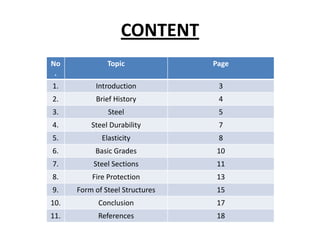
CONTENT
No             Topic             Page
 .
1.         Introduction           3
2.         Brief History          4
3.             Steel              5
4.        Steel Durability        7
5.           Elasticity           8
6.         Basic Grades          10
7.         Steel Sections        11
8.        Fire Protection        13
9.    Form of Steel Structures   15
10.         Conclusion           17
11.         References           18
INTRODUCTION
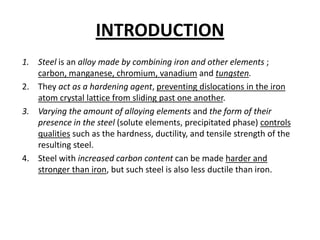
1. Steel is an alloy made by combining iron and other elements ;
   carbon, manganese, chromium, vanadium and tungsten.
2. They act as a hardening agent, preventing dislocations in the iron
   atom crystal lattice from sliding past one another.
3. Varying the amount of alloying elements and the form of their
   presence in the steel (solute elements, precipitated phase) controls
   qualities such as the hardness, ductility, and tensile strength of the
   resulting steel.
4. Steel with increased carbon content can be made harder and
   stronger than iron, but such steel is also less ductile than iron.
BRIEF HISTORY
• Though steel had been produced by various inefficient methods
  long before the Renaissance, its use became more common after
  more efficient production methods were devised in the 17th
  century.
• With the invention of the Bessemer process in the mid-19th
  century, steel became an inexpensive mass-produced material.
• Further refinements in the process, such as basic oxygen
  steelmaking (BOS), lowered the cost of production while increasing
  the quality of the metal.
• Today, steel is one of the most common materials in the
  world, with more than 1.3 billion tons produced annually.
• It is a major component in
  buildings, infrastructure, tools, ships, automobiles, machines, appli
  ances, and weapons.
• Modern steel is generally identified by various grades defined by
  assorted standards organizations.
Produced from iron ore
                                   by removing the ore’s
                                    naturally occurring
density ρ = 7.7 ÷ 8.1 [kg/dm3]          impurities
 elastic modulus E=190÷210
            [GPa]
Poisson’s ratio ν = 0.27 ÷ 0.30
                                                             High strength in
Thermal conductivity κ = 11.2                                  tension and
      ÷ 48.3 [W/mK]                                           compression
Thermal expansion α = 9 ÷27
         [10-6 / K]


                                  STEEL
         Physical properties of
                                                           Able to undergo large
          steel are related to
                                                           deformation without
           the physics of the
                                                                  fracture
                material


                                     Ductile material
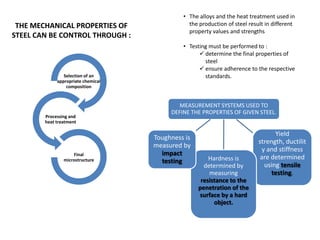
• The alloys and the heat treatment used in
 THE MECHANICAL PROPERTIES OF                  the production of steel result in different
                                               property values and strengths
STEEL CAN BE CONTROL THROUGH :
                                             • Testing must be performed to :
                                                    determine the final properties of
                                                     steel
                                                    ensure adherence to the respective
                Selection of an                      standards.
             appropriate chemical
                 composition


                                            MEASUREMENT SYSTEMS USED TO
                                         DEFINE THE PROPERTIES OF GIVEN STEEL.
        Processing and
        heat treatment

                                                                                  Yield
                                    Toughness is
                                                                           strength, ductilit
                                    measured by
                                                                             y and stiffness
                    Final             impact
                                                       Hardness is          are determined
                microstructure        testing
                                                     determined by            using tensile
                                                       measuring                testing.
                                                    resistance to the
                                                   penetration of the
                                                   surface by a hard
                                                         object.
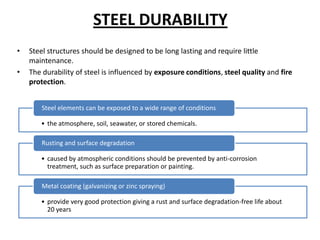
STEEL DURABILITY
•   Steel structures should be designed to be long lasting and require little
    maintenance.
•   The durability of steel is influenced by exposure conditions, steel quality and fire
    protection.


        Steel elements can be exposed to a wide range of conditions

       • the atmosphere, soil, seawater, or stored chemicals.

        Rusting and surface degradation

       • caused by atmospheric conditions should be prevented by anti-corrosion
         treatment, such as surface preparation or painting.

        Metal coating (galvanizing or zinc spraying)

       • provide very good protection giving a rust and surface degradation-free life about
         20 years
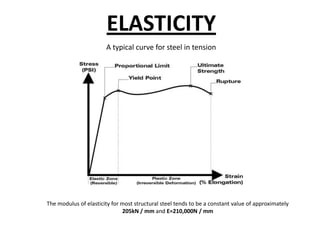
ELASTICITY
                       A typical curve for steel in tension


The modulus of elasticity for most structural steel tends to be a constant value of approximately
                              205kN / mm and E=210,000N / mm
BASIC GRADES
The four basic grades of steel are :
   1.   S450
   2.   S355
   3.   S275
   4.   S235

    The numbers represent the minimum tensile strength
    of each grade in N/mm.
   Grade S275 is the most commonly used in steel
    structures at the start of the twenty-first century.
STEEL SECTIONS
FIRE PROTECTION
• The rate of loss of strength is very high at
  temperatures more than 300 degree Celsius.
• Commonly used :
   Concrete
   Brick work
   Light encasement
FORM OF STEEL STRUCTURE
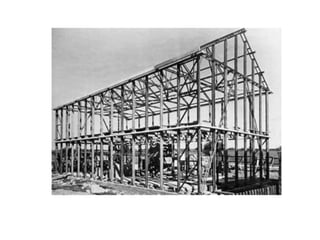
• Can be constructed or fabricated out of hot rolled
  structural steel shapes or cold formed steel sections.
• It provides adaptability, speed, lower monitoring/ or
  control; costs and lower preliminaries.
• The effects of environmental and other conditions on the
  final shape of a steel building should be discussed by the
  design or construction team in the initial stages of
  planning the layout and preparing the construction plan.
• The architect should consider aspect such as :
  1.   The integration of facilities
  2.   Environmental aspects
  3.   Internal non-commercial values and spaces
  4.   Creation of a building that would add some excitement, colour, light
       and size to provide the visual interest
  5.   Provision for the easy expansion of the area of the building.


• All steel buildings must comply with the current
  building regulations.

• These are statutory instruments approved by
  parliament covering all aspects of building
  construction.
CONCLUSION
ADVANTAGES
• Does not deteriorate with age like timber and concrete
• Steel is very strong and flexible.
• Steel framed houses are ideal in cyclone/hurricane prone regions.
• The best material for bridges and skyscrapers
• Can be recycled.
• Many section types are made (square, tube, H-section, etc).
• Steel is such a versatile material which allows radical architecture.
• Steel has a high expansion rate in changing temperatures, and this must be allowed
   for in the engineering.

DISADVANTAGES
• Heavy
• Maintains its strength indefinitely
• Expensive to transport.
• Susceptible to corrosion which steel bridges must be painted continuously,
   particularly in a salty environment.
• In conditions of repeated stress and changing temperatures, steel can suffer fatigue
   and cracks, and more corrosion and energy intensive needed to produce steel.
REFERENCES
• Al-Nageim, H., Durka, F., Morgan, W., and
  Williams D., Structural Mechanics:
  Loads, Analysis, Materials and Design of
  Structural Elements, Great Britain, 2010
• Key To
  Metals, http://www.keytometals.com/page.aspx?
  ID=SteelProperties&LN=EN
• Parker, B., Prefabricated
  House, http://www.localhistory.scit.wlv.ac.uk/arti
  cles/DarlastonHouses/Prefabs.htm

Steel material

  • 1.
    AAR 553 STRUCTURAL THEORIES AND APPLICATIONS STEEL (MATERIAL) BY : NAME STUDENT ID 1. INTAN INDAHATI BINTI RAHMAN 2010598037 2. MAISARA BINTI MOHD RAZALI 2010166887 3. NUR AQILAH BINTI MASKURI 2010372209 4. NURUL NAJMI BINTI SALLEH 2010762715 5. WATI ANAK NYAGON 2010167993 LECTURER : MR. SOHAIMI BIN MAN
  • 2.
    CONTENT No Topic Page . 1. Introduction 3 2. Brief History 4 3. Steel 5 4. Steel Durability 7 5. Elasticity 8 6. Basic Grades 10 7. Steel Sections 11 8. Fire Protection 13 9. Form of Steel Structures 15 10. Conclusion 17 11. References 18
  • 3.
    INTRODUCTION 1. Steel isan alloy made by combining iron and other elements ; carbon, manganese, chromium, vanadium and tungsten. 2. They act as a hardening agent, preventing dislocations in the iron atom crystal lattice from sliding past one another. 3. Varying the amount of alloying elements and the form of their presence in the steel (solute elements, precipitated phase) controls qualities such as the hardness, ductility, and tensile strength of the resulting steel. 4. Steel with increased carbon content can be made harder and stronger than iron, but such steel is also less ductile than iron.
  • 4.
    BRIEF HISTORY • Thoughsteel had been produced by various inefficient methods long before the Renaissance, its use became more common after more efficient production methods were devised in the 17th century. • With the invention of the Bessemer process in the mid-19th century, steel became an inexpensive mass-produced material. • Further refinements in the process, such as basic oxygen steelmaking (BOS), lowered the cost of production while increasing the quality of the metal. • Today, steel is one of the most common materials in the world, with more than 1.3 billion tons produced annually. • It is a major component in buildings, infrastructure, tools, ships, automobiles, machines, appli ances, and weapons. • Modern steel is generally identified by various grades defined by assorted standards organizations.
  • 5.
    Produced from ironore by removing the ore’s naturally occurring density ρ = 7.7 ÷ 8.1 [kg/dm3] impurities elastic modulus E=190÷210 [GPa] Poisson’s ratio ν = 0.27 ÷ 0.30 High strength in Thermal conductivity κ = 11.2 tension and ÷ 48.3 [W/mK] compression Thermal expansion α = 9 ÷27 [10-6 / K] STEEL Physical properties of Able to undergo large steel are related to deformation without the physics of the fracture material Ductile material
  • 6.
    • The alloysand the heat treatment used in THE MECHANICAL PROPERTIES OF the production of steel result in different property values and strengths STEEL CAN BE CONTROL THROUGH : • Testing must be performed to :  determine the final properties of steel  ensure adherence to the respective Selection of an standards. appropriate chemical composition MEASUREMENT SYSTEMS USED TO DEFINE THE PROPERTIES OF GIVEN STEEL. Processing and heat treatment Yield Toughness is strength, ductilit measured by y and stiffness Final impact Hardness is are determined microstructure testing determined by using tensile measuring testing. resistance to the penetration of the surface by a hard object.
  • 7.
    STEEL DURABILITY • Steel structures should be designed to be long lasting and require little maintenance. • The durability of steel is influenced by exposure conditions, steel quality and fire protection. Steel elements can be exposed to a wide range of conditions • the atmosphere, soil, seawater, or stored chemicals. Rusting and surface degradation • caused by atmospheric conditions should be prevented by anti-corrosion treatment, such as surface preparation or painting. Metal coating (galvanizing or zinc spraying) • provide very good protection giving a rust and surface degradation-free life about 20 years
  • 8.
    ELASTICITY A typical curve for steel in tension The modulus of elasticity for most structural steel tends to be a constant value of approximately 205kN / mm and E=210,000N / mm
  • 10.
    BASIC GRADES The fourbasic grades of steel are : 1. S450 2. S355 3. S275 4. S235  The numbers represent the minimum tensile strength of each grade in N/mm. Grade S275 is the most commonly used in steel structures at the start of the twenty-first century.
  • 11.
  • 13.
  • 14.
    • The rateof loss of strength is very high at temperatures more than 300 degree Celsius. • Commonly used :  Concrete  Brick work  Light encasement
  • 15.
    FORM OF STEELSTRUCTURE • Can be constructed or fabricated out of hot rolled structural steel shapes or cold formed steel sections. • It provides adaptability, speed, lower monitoring/ or control; costs and lower preliminaries. • The effects of environmental and other conditions on the final shape of a steel building should be discussed by the design or construction team in the initial stages of planning the layout and preparing the construction plan.
  • 16.
    • The architectshould consider aspect such as : 1. The integration of facilities 2. Environmental aspects 3. Internal non-commercial values and spaces 4. Creation of a building that would add some excitement, colour, light and size to provide the visual interest 5. Provision for the easy expansion of the area of the building. • All steel buildings must comply with the current building regulations. • These are statutory instruments approved by parliament covering all aspects of building construction.
  • 20.
    CONCLUSION ADVANTAGES • Does notdeteriorate with age like timber and concrete • Steel is very strong and flexible. • Steel framed houses are ideal in cyclone/hurricane prone regions. • The best material for bridges and skyscrapers • Can be recycled. • Many section types are made (square, tube, H-section, etc). • Steel is such a versatile material which allows radical architecture. • Steel has a high expansion rate in changing temperatures, and this must be allowed for in the engineering. DISADVANTAGES • Heavy • Maintains its strength indefinitely • Expensive to transport. • Susceptible to corrosion which steel bridges must be painted continuously, particularly in a salty environment. • In conditions of repeated stress and changing temperatures, steel can suffer fatigue and cracks, and more corrosion and energy intensive needed to produce steel.
  • 21.
    REFERENCES • Al-Nageim, H.,Durka, F., Morgan, W., and Williams D., Structural Mechanics: Loads, Analysis, Materials and Design of Structural Elements, Great Britain, 2010 • Key To Metals, http://www.keytometals.com/page.aspx? ID=SteelProperties&LN=EN • Parker, B., Prefabricated House, http://www.localhistory.scit.wlv.ac.uk/arti cles/DarlastonHouses/Prefabs.htm