Structural geography and stratigraphy
Shruthi V
Dept. of Civil Engg.
SJCEM, Palghar.
Structural geography and Stratigraphy
3.1 Structural geography
● Dip and Strike.
● Outcrop and width of outcrop.
● Inliers and Outliers.
● Type of discontinuities in the rock
● Fold
● Fault
● Joints & Unconformity:
Structural geology
● The interaction of forces are responsible for development of different
characteristics on rock bodies ( size, shape and inclination).
● Sometimes the layers of sedimentary rocks may be horizontal or
inclined at various angles.
● Bedding, wrapping and fracturing of rocks due to these forces are
termed together as structural features of rocks.
● The branch of geology that deals with study of morphology,
classification, mechanism and causes of development of these rock
structure is called as Structural Geology.
Stratigraphy
Stratigraphy is a branch of geology which studies rock layers (strata) and
layering (stratification).
Stratigraphy concerned with the order and relative position of strata and
their relationship to the geological timescale. Stratigraphy includes two
related sub fields:
1. Lithologic stratigraphy or lithostratigraphy,
2. Biologic stratigraphy or bio-stratigraphy
Stratigraphy
1. Lithostratigraphy
Lithostratigraphy is the geological science associated with the study
of strata or rock layers ( associated with lithology).
Major focuses include geochronology, comparative geology, and
petrology. In general a stratum will be primarily igneous or sedimentary
relating to how the rock was formed.
Lithology:
The lithology of a rock unit is a description of its physical
characteristics visible at outcrop, in hand or core samples or with low
magnification microscopy, such as color, texture, grain size, or
composition.
Stratigraphy
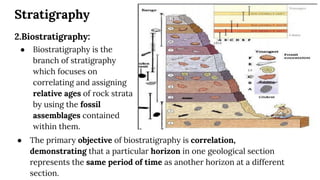
2.Biostratigraphy:
● The primary objective of biostratigraphy is correlation,
demonstrating that a particular horizon in one geological section
represents the same period of time as another horizon at a different
section.
● Biostratigraphy is the
branch of stratigraphy
which focuses on
correlating and assigning
relative ages of rock strata
by using the fossil
assemblages contained
within them.
Primary and secondary structures
1. Primary structure
● Structural features of Rock developed on its surface during the
formation stage.
a. Stratification and lamination (sedimentary rock)
b. Crystalline structure (igneous rock)
c. Foliated structure (metamorphic rock)
2. Secondary structure
● Modification of original rocks and development of new shapes and
rearrangement of composite materials after their formation.
● Forces induced by tectonic plates are most responsible for formation
of secondary structures.
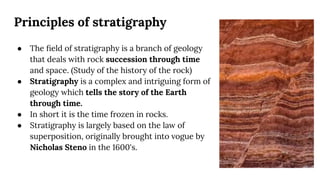
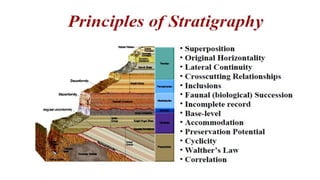
Principles of stratigraphy
● The field of stratigraphy is a branch of geology
that deals with rock succession through time
and space. (Study of the history of the rock)
● Stratigraphy is a complex and intriguing form of
geology which tells the story of the Earth
through time.
● In short it is the time frozen in rocks.
● Stratigraphy is largely based on the law of
superposition, originally brought into vogue by
Nicholas Steno in the 1600's.
“Present is the key to past”
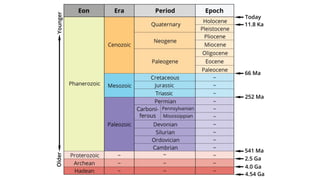
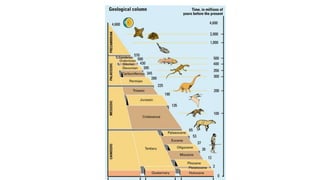
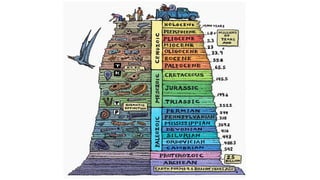
Elements of correlation
1. Era :
● It comprises several Periods.
● Each era is measured in terms of many hundred million years.
● Geological history is divided into 4 Eras.
Time units Rock units
ERA
PERIOD
EPOCH
AGE
Group
System
Series
Stage
2. Period
● It is referred As standard and fundamental unit of geological time scale which is clearly
understood and can be ascertained with the help of features developed in the rock
formations.
3. Epochs :
● It is divided to show smaller time frames indicated by local variations in the conditions of
formations of rocks.
4. Age :
● The smallest unit on time scale frame, encompassing a few to many thousands of years
which corresponds to the smallest rock unit formed during that time.
Principles of stratigraphy
● The principle of original horizontality
● The principle of superposition
● Principle of Lateral Continuity
● Principle of crosscutting relationships
● Principle of Inclusions
● Principle of Faunal Succession
● Principle of Uniformitarianism
Cont.., Principles of stratigraphy
1. The principle of original
horizontality
● All sedimentary rocks are originally
deposited horizontally.
● It is based on the fact that sediment
usually accumulates in horizontal
layers.
● If sedimentary rocks lie at an angle,
we can infer that tectonic forces
tilted them after they formed.
Cont.., Principles of stratigraphy
2. The principle of superposition
● It states that sedimentary rocks
become younger from top to bottom
(as long as tectonic forces have not
turned them upside down).
● This is because younger layers of
sediment always accumulate on top of
older layers.
In the figure above shown stratification
layers become progressively younger in
the order E, D, C, B, and A
Cont.., Principles of stratigraphy
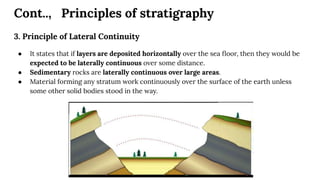
3. Principle of Lateral Continuity
● It states that if layers are deposited horizontally over the sea floor, then they would be
expected to be laterally continuous over some distance.
● Sedimentary rocks are laterally continuous over large areas.
● Material forming any stratum work continuously over the surface of the earth unless
some other solid bodies stood in the way.
Cont.., Principles of stratigraphy
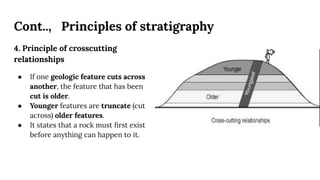
4. Principle of crosscutting
relationships
● If one geologic feature cuts across
another, the feature that has been
cut is older.
● Younger features are truncate (cut
across) older features.
● It states that a rock must first exist
before anything can happen to it.
Cont.., Principles of stratigraphy
5. Principle of Inclusions
● The Law of Inclusions states that if a
rock body (Rock B) contained fragments
of another rock body (Rock A), it(Rock B)
must be younger than the fragments of
rock it contained.
Cont.., Principles of stratigraphy
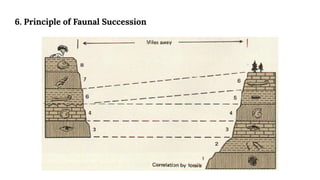
6. Principle of Faunal Succession
● Law of Faunal Succession states that fossils occur in a definite, invariable
sequence in the geologic record.
● Fossils represent living creatures that have evolved through time, so
when we found a fossil of the same type in two different areas (sections)
that are not laterally continuous, we are pretty sure that the rocks are
about the same age.
● Faunal succession deals with the study of both flora and fauna in the
definite sedimentary laminated structure of rocks.
● By observing the set of fossils found under rock,a geologist can easily
identify the life span of the organism.
6. Principle of Faunal Succession
Cont.., Principles of stratigraphy
7. Principle of Uniformitarianism
● Was postulated by James Hutton (1726-1797).
● The features like mud cracks, ripple marks, graded bedding and so on,
where the same features that could be seen forming in modern
environments, and that past geologic events can be explained by
phenomena and forces observable today.
● Hutton concluded that processes are currently operating on the Earth
must be the same processes that operated in the past. Later on stated as
"the present is the key to the past".
“Present is the key to past”
Types of Stratigraphy
1. Lithostratigraphy
● Physical properties and stratigraphic position relative to other
lithostratigraphic units.
● Organization of strata on the basis of their lithologic characteristics.
2. Chronostratigraphy
● Integrated approach to establishing the time relationships among geologic
units.
● It is the organisation of strata on the basis of Time relationships.
3. Biostratigraphy
● Study of the fossil record with emphasis on faunal succession to establish
relative time relationships.
● Organization of strata on the basis of the fossils they contain.
Cont.., Types of Stratigraphy
4. Magnetostratigraphy
● Study of the magnetic properties of rock units for the purpose of correlation
using magnetic polarity reversals.
● Organization of strata on the basis of their magnetic characteristics.
5. Allostratigraphy - Study of rock units defined by unconformities and other features
generated by base level change
6. Geochronology
● Various techniques, especially isotope geochemistry, to establish the absolute
age of rock units.
● Depositional sequences, packages of strata bounded by unconformities.
7. Seismic Stratigraphy- Organization of strata on the basis of their seismic
characteristics
Thank You

Stratigraphy

  • 1.
    Structural geography andstratigraphy Shruthi V Dept. of Civil Engg. SJCEM, Palghar.
  • 2.
    Structural geography andStratigraphy 3.1 Structural geography ● Dip and Strike. ● Outcrop and width of outcrop. ● Inliers and Outliers. ● Type of discontinuities in the rock ● Fold ● Fault ● Joints & Unconformity:
  • 3.
    Structural geology ● Theinteraction of forces are responsible for development of different characteristics on rock bodies ( size, shape and inclination). ● Sometimes the layers of sedimentary rocks may be horizontal or inclined at various angles. ● Bedding, wrapping and fracturing of rocks due to these forces are termed together as structural features of rocks. ● The branch of geology that deals with study of morphology, classification, mechanism and causes of development of these rock structure is called as Structural Geology.
  • 4.
    Stratigraphy Stratigraphy is abranch of geology which studies rock layers (strata) and layering (stratification). Stratigraphy concerned with the order and relative position of strata and their relationship to the geological timescale. Stratigraphy includes two related sub fields: 1. Lithologic stratigraphy or lithostratigraphy, 2. Biologic stratigraphy or bio-stratigraphy
  • 5.
    Stratigraphy 1. Lithostratigraphy Lithostratigraphy isthe geological science associated with the study of strata or rock layers ( associated with lithology). Major focuses include geochronology, comparative geology, and petrology. In general a stratum will be primarily igneous or sedimentary relating to how the rock was formed. Lithology: The lithology of a rock unit is a description of its physical characteristics visible at outcrop, in hand or core samples or with low magnification microscopy, such as color, texture, grain size, or composition.
  • 6.
    Stratigraphy 2.Biostratigraphy: ● The primaryobjective of biostratigraphy is correlation, demonstrating that a particular horizon in one geological section represents the same period of time as another horizon at a different section. ● Biostratigraphy is the branch of stratigraphy which focuses on correlating and assigning relative ages of rock strata by using the fossil assemblages contained within them.
  • 7.
    Primary and secondarystructures 1. Primary structure ● Structural features of Rock developed on its surface during the formation stage. a. Stratification and lamination (sedimentary rock) b. Crystalline structure (igneous rock) c. Foliated structure (metamorphic rock) 2. Secondary structure ● Modification of original rocks and development of new shapes and rearrangement of composite materials after their formation. ● Forces induced by tectonic plates are most responsible for formation of secondary structures.
  • 8.
    Principles of stratigraphy ●The field of stratigraphy is a branch of geology that deals with rock succession through time and space. (Study of the history of the rock) ● Stratigraphy is a complex and intriguing form of geology which tells the story of the Earth through time. ● In short it is the time frozen in rocks. ● Stratigraphy is largely based on the law of superposition, originally brought into vogue by Nicholas Steno in the 1600's.
  • 9.
    “Present is thekey to past”
  • 10.
    Elements of correlation 1.Era : ● It comprises several Periods. ● Each era is measured in terms of many hundred million years. ● Geological history is divided into 4 Eras. Time units Rock units ERA PERIOD EPOCH AGE Group System Series Stage 2. Period ● It is referred As standard and fundamental unit of geological time scale which is clearly understood and can be ascertained with the help of features developed in the rock formations. 3. Epochs : ● It is divided to show smaller time frames indicated by local variations in the conditions of formations of rocks. 4. Age : ● The smallest unit on time scale frame, encompassing a few to many thousands of years which corresponds to the smallest rock unit formed during that time.
  • 15.
    Principles of stratigraphy ●The principle of original horizontality ● The principle of superposition ● Principle of Lateral Continuity ● Principle of crosscutting relationships ● Principle of Inclusions ● Principle of Faunal Succession ● Principle of Uniformitarianism
  • 16.
    Cont.., Principles ofstratigraphy 1. The principle of original horizontality ● All sedimentary rocks are originally deposited horizontally. ● It is based on the fact that sediment usually accumulates in horizontal layers. ● If sedimentary rocks lie at an angle, we can infer that tectonic forces tilted them after they formed.
  • 17.
    Cont.., Principles ofstratigraphy 2. The principle of superposition ● It states that sedimentary rocks become younger from top to bottom (as long as tectonic forces have not turned them upside down). ● This is because younger layers of sediment always accumulate on top of older layers. In the figure above shown stratification layers become progressively younger in the order E, D, C, B, and A
  • 18.
    Cont.., Principles ofstratigraphy 3. Principle of Lateral Continuity ● It states that if layers are deposited horizontally over the sea floor, then they would be expected to be laterally continuous over some distance. ● Sedimentary rocks are laterally continuous over large areas. ● Material forming any stratum work continuously over the surface of the earth unless some other solid bodies stood in the way.
  • 19.
    Cont.., Principles ofstratigraphy 4. Principle of crosscutting relationships ● If one geologic feature cuts across another, the feature that has been cut is older. ● Younger features are truncate (cut across) older features. ● It states that a rock must first exist before anything can happen to it.
  • 20.
    Cont.., Principles ofstratigraphy 5. Principle of Inclusions ● The Law of Inclusions states that if a rock body (Rock B) contained fragments of another rock body (Rock A), it(Rock B) must be younger than the fragments of rock it contained.
  • 21.
    Cont.., Principles ofstratigraphy 6. Principle of Faunal Succession ● Law of Faunal Succession states that fossils occur in a definite, invariable sequence in the geologic record. ● Fossils represent living creatures that have evolved through time, so when we found a fossil of the same type in two different areas (sections) that are not laterally continuous, we are pretty sure that the rocks are about the same age. ● Faunal succession deals with the study of both flora and fauna in the definite sedimentary laminated structure of rocks. ● By observing the set of fossils found under rock,a geologist can easily identify the life span of the organism.
  • 22.
    6. Principle ofFaunal Succession
  • 23.
    Cont.., Principles ofstratigraphy 7. Principle of Uniformitarianism ● Was postulated by James Hutton (1726-1797). ● The features like mud cracks, ripple marks, graded bedding and so on, where the same features that could be seen forming in modern environments, and that past geologic events can be explained by phenomena and forces observable today. ● Hutton concluded that processes are currently operating on the Earth must be the same processes that operated in the past. Later on stated as "the present is the key to the past".
  • 24.
    “Present is thekey to past”
  • 25.
    Types of Stratigraphy 1.Lithostratigraphy ● Physical properties and stratigraphic position relative to other lithostratigraphic units. ● Organization of strata on the basis of their lithologic characteristics. 2. Chronostratigraphy ● Integrated approach to establishing the time relationships among geologic units. ● It is the organisation of strata on the basis of Time relationships. 3. Biostratigraphy ● Study of the fossil record with emphasis on faunal succession to establish relative time relationships. ● Organization of strata on the basis of the fossils they contain.
  • 26.
    Cont.., Types ofStratigraphy 4. Magnetostratigraphy ● Study of the magnetic properties of rock units for the purpose of correlation using magnetic polarity reversals. ● Organization of strata on the basis of their magnetic characteristics. 5. Allostratigraphy - Study of rock units defined by unconformities and other features generated by base level change 6. Geochronology ● Various techniques, especially isotope geochemistry, to establish the absolute age of rock units. ● Depositional sequences, packages of strata bounded by unconformities. 7. Seismic Stratigraphy- Organization of strata on the basis of their seismic characteristics
  • 27.