Elements, Compounds and Mixtures ELEMENTS
I:  Elements Element:  a pure substance that cannot be  separated into simpler substances by physical or chemical means.  They contain only one type of particle Pure substance:  contains only one type of particle  Meet the Giants
Every Element has a Unique Set of Properties Each element can be identified by it’s characteristic properties
Review Turn to your partner and tell them what a characteristic property is and give one example of a characteristic property
Characteristic Properties are: Properties that do not change regardless of the sample size Some examples are boiling point, melting point and density (physical properties) and reactivity with an acid (chemical property).
Elements Are Classified by Their Properties Elements are grouped into categories according to their shared properties Examples: iron, nickel and cobalt All three are shiny, all conduct thermal energy and electric current so all three are grouped together in a single group called metals
If You Know the Category, You Know the Properties! If the category is metals, what are the properties? Hint:  we just talked about them
If You Know the Category, You Know the Properties! Elements are classified into three categories:  metals, nonmetals, and metalloids
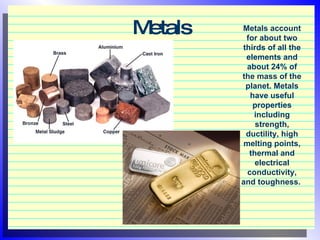
Metals Metals account for about two thirds of all the elements and about 24% of the mass of the planet. Metals have useful properties including strength, ductility, high melting points, thermal and electrical conductivity, and toughness.
Non-metals Oxygen atom Sulfur Non-metals tend to be brittle and non-conductive of heat or electricity
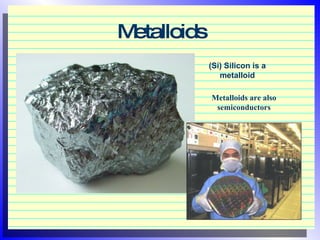
Metalloids (Si) Silicon is a metalloid Metalloids are also semiconductors
Summarize:  which have the following properties? Which are good conductors of electric current? Brittle and nonmalleable? Shiny? Poor conductors of thermal energy?
Which are good conductors of electric current? Metals and some metalloids Brittle and nonmalleable? nonmetals Shiny? metals and some metalloids Poor conductors of thermal energy? nonmetals and some metalloids
II:  Compounds Few elements found in nature are found alone; most elements are found combined with other elements as compounds A compound is a pure substance composed of two or more elements that are chemically combined
In an compound, a particle is formed when atoms from two or more elements join In order for atoms to join, they must react or undergo a chemical change with one another The compound is a new pure substance that is different from the elements that reacted to form it
Some common compounds: Insert table p 86
Elements Combine in a Definite Ratio to Form a Compound Compounds form in a specific ratio according to their mass For example,  in water, the mass ratio of hydrogen to oxygen is always 1:8 Every sample of water has this mass ratio so if the sample has a different mass ratio it cannot possibly be water.
Every Compound Has a Unique Set of Properties Each compound has its own unique set of properties such as boiling point, melting point, density and color. Compounds can also be identified by chemical properties
Every Compound Has a Unique Set of Properties A compound has different properties from the elements that form it. NaCl
Every Compound Has a Unique Set of Properties Physical properties of sodium Standard state : solid at 298 K  Color: silvery white
Every Compound Has a Unique Set of Properties Chlorine is a greenish yellow gas which combines directly with nearly all elements. Chlorine is a respiratory irritant. The gas irritates the mucous membranes and the liquid burns the skin. As little as 3.5 ppm can be detected as an odor, and 1000 ppm is likely to be fatal after a few deep breaths. It was used as a war gas in 1915. It is not found in a free state in nature, but is found commonly as NaCl (solid or seawater).
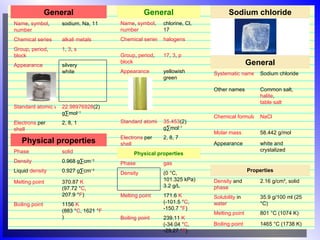
Sodium chloride                        General Systematic name Sodium chloride Other names Common salt, halite , table salt Chemical formula Na Cl Molar mass 58.442 g/mol Appearance white and crystalized Properties Density  and  phase 2.16 g/cm³, solid Solubility  in  water 35.9 g/100 ml (25 °C) Melting point 801 °C (1074 K) Boiling point 1465 °C (1738 K) General Name ,  symbol ,  number sodium, Na, 11 Chemical series alkali metals Group ,  period ,  block 1 ,  3 ,  s Appearance silvery white            Standard atomic weight 22.98976928 (2)  g·mol −1 Electrons  per  shell 2, 8, 1 Physical properties Phase solid Density   0.968 g·cm −3 Liquid  density   0.927 g·cm −3 Melting point 370.87  K (97.72 ° C , 207.9 ° F ) Boiling point 1156  K (883 ° C , 1621 ° F ) General Name ,  symbol ,  number chlorine, Cl, 17 Chemical series halogens Group ,  period ,  block 17 ,  3 ,  p Appearance yellowish green              Standard atomic weight 35.453 (2)  g·mol −1 Electrons  per  shell 2, 8, 7 Physical properties Phase gas Density (0 °C, 101.325 kPa) 3.2 g/L Melting point 171.6  K (-101.5 ° C , -150.7 ° F ) Boiling point 239.11  K (-34.04 ° C , -29.27 ° F )
Compounds Can Be Broken Down Into Simpler Substances Some compounds can be broken down into elements through chemical changes NaCl can be broken back down into their original pure substances by adding an electric current to the compound.  Adding electric current to break compounds and elements is called electrolysis.
Compounds Can Be Broken Down Into Simpler Substances Carbonic acid (or the “stuff” that gives soda its fizz, can be broken down into Carbon Dioxide and Water These can be further broken down into carbon, oxygen, and hydrogen through additional chemical change
Compounds Can Be Broken Down Into Simpler Substances Compounds cannot be broken down by physical change
Compounds in Your World In nature:  remember the bacteria that live as nodules in the roots of plants that help  (last year, nitrogen cycle) the plant absorb the usable nitrogen compounds from the soil (nitrogen fixation) to transfer the nitrogen from the ground to the plant?
Compounds in Your World The element nitrogen is also combined in industry with hydrogen to make ammonia.  Plants can also use this as a source of nitrogen when used in combination with fertilizers
Let’s Check Understanding How are compounds and elements alike? Different? Both are pure substances , but elements cannot be broken down into simpler substances; compounds can be broken down into simpler substances
Let’s Check Understanding What are two ways to break down a compound? Heating and electrolysis
Let’s Check Understanding How do the properties of sodium chloride compare with the properties of sodium and of chloride? Sodium Chloride is a white solid that dissolves in water and is safe to eat.  Sodium is a soft, silvery white metal that reacts violently with water, and chlorine is a poisonous greenish, yellow gas.
Let’s Check Understanding What is a compound? A compound is a pure substance composed of two or more elements that are chemically combined
Let’s Check Understanding A jar contains samples of the elements carbon and oxygen.  Does the jar contain a compound?  Support your response.  A jar containing samples of carbon and oxygen does not contain a compound because the two elements are not chemically combined.
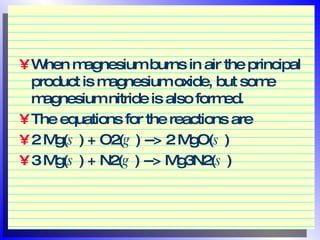
When magnesium burns in air the principal product is magnesium oxide, but some magnesium nitride is also formed.  The equations for the reactions are  2 Mg( s  ) + O2( g  ) --> 2 MgO( s  )  3 Mg( s  ) + N2( g  ) --> Mg3N2( s  )

Ch 4 elements_compounds_and_mixtures

  • 1.
    Elements, Compounds andMixtures ELEMENTS
  • 2.
    I: ElementsElement: a pure substance that cannot be separated into simpler substances by physical or chemical means. They contain only one type of particle Pure substance: contains only one type of particle Meet the Giants
  • 3.
    Every Element hasa Unique Set of Properties Each element can be identified by it’s characteristic properties
  • 4.
    Review Turn toyour partner and tell them what a characteristic property is and give one example of a characteristic property
  • 5.
    Characteristic Properties are:Properties that do not change regardless of the sample size Some examples are boiling point, melting point and density (physical properties) and reactivity with an acid (chemical property).
  • 6.
    Elements Are Classifiedby Their Properties Elements are grouped into categories according to their shared properties Examples: iron, nickel and cobalt All three are shiny, all conduct thermal energy and electric current so all three are grouped together in a single group called metals
  • 7.
    If You Knowthe Category, You Know the Properties! If the category is metals, what are the properties? Hint: we just talked about them
  • 8.
    If You Knowthe Category, You Know the Properties! Elements are classified into three categories: metals, nonmetals, and metalloids
  • 9.
    Metals Metals accountfor about two thirds of all the elements and about 24% of the mass of the planet. Metals have useful properties including strength, ductility, high melting points, thermal and electrical conductivity, and toughness.
  • 10.
    Non-metals Oxygen atomSulfur Non-metals tend to be brittle and non-conductive of heat or electricity
  • 11.
    Metalloids (Si) Siliconis a metalloid Metalloids are also semiconductors
  • 12.
    Summarize: whichhave the following properties? Which are good conductors of electric current? Brittle and nonmalleable? Shiny? Poor conductors of thermal energy?
  • 13.
    Which are goodconductors of electric current? Metals and some metalloids Brittle and nonmalleable? nonmetals Shiny? metals and some metalloids Poor conductors of thermal energy? nonmetals and some metalloids
  • 14.
    II: CompoundsFew elements found in nature are found alone; most elements are found combined with other elements as compounds A compound is a pure substance composed of two or more elements that are chemically combined
  • 15.
    In an compound,a particle is formed when atoms from two or more elements join In order for atoms to join, they must react or undergo a chemical change with one another The compound is a new pure substance that is different from the elements that reacted to form it
  • 16.
    Some common compounds:Insert table p 86
  • 17.
    Elements Combine ina Definite Ratio to Form a Compound Compounds form in a specific ratio according to their mass For example, in water, the mass ratio of hydrogen to oxygen is always 1:8 Every sample of water has this mass ratio so if the sample has a different mass ratio it cannot possibly be water.
  • 18.
    Every Compound Hasa Unique Set of Properties Each compound has its own unique set of properties such as boiling point, melting point, density and color. Compounds can also be identified by chemical properties
  • 19.
    Every Compound Hasa Unique Set of Properties A compound has different properties from the elements that form it. NaCl
  • 20.
    Every Compound Hasa Unique Set of Properties Physical properties of sodium Standard state : solid at 298 K Color: silvery white
  • 21.
    Every Compound Hasa Unique Set of Properties Chlorine is a greenish yellow gas which combines directly with nearly all elements. Chlorine is a respiratory irritant. The gas irritates the mucous membranes and the liquid burns the skin. As little as 3.5 ppm can be detected as an odor, and 1000 ppm is likely to be fatal after a few deep breaths. It was used as a war gas in 1915. It is not found in a free state in nature, but is found commonly as NaCl (solid or seawater).
  • 22.
    Sodium chloride                     General Systematic name Sodium chloride Other names Common salt, halite , table salt Chemical formula Na Cl Molar mass 58.442 g/mol Appearance white and crystalized Properties Density and phase 2.16 g/cm³, solid Solubility in water 35.9 g/100 ml (25 °C) Melting point 801 °C (1074 K) Boiling point 1465 °C (1738 K) General Name , symbol , number sodium, Na, 11 Chemical series alkali metals Group , period , block 1 ,  3 , s Appearance silvery white            Standard atomic weight 22.98976928 (2)  g·mol −1 Electrons per shell 2, 8, 1 Physical properties Phase solid Density 0.968 g·cm −3 Liquid density 0.927 g·cm −3 Melting point 370.87  K (97.72 ° C , 207.9 ° F ) Boiling point 1156 K (883 ° C , 1621 ° F ) General Name , symbol , number chlorine, Cl, 17 Chemical series halogens Group , period , block 17 ,  3 , p Appearance yellowish green              Standard atomic weight 35.453 (2)  g·mol −1 Electrons per shell 2, 8, 7 Physical properties Phase gas Density (0 °C, 101.325 kPa) 3.2 g/L Melting point 171.6  K (-101.5 ° C , -150.7 ° F ) Boiling point 239.11 K (-34.04 ° C , -29.27 ° F )
  • 23.
    Compounds Can BeBroken Down Into Simpler Substances Some compounds can be broken down into elements through chemical changes NaCl can be broken back down into their original pure substances by adding an electric current to the compound. Adding electric current to break compounds and elements is called electrolysis.
  • 24.
    Compounds Can BeBroken Down Into Simpler Substances Carbonic acid (or the “stuff” that gives soda its fizz, can be broken down into Carbon Dioxide and Water These can be further broken down into carbon, oxygen, and hydrogen through additional chemical change
  • 25.
    Compounds Can BeBroken Down Into Simpler Substances Compounds cannot be broken down by physical change
  • 26.
    Compounds in YourWorld In nature: remember the bacteria that live as nodules in the roots of plants that help (last year, nitrogen cycle) the plant absorb the usable nitrogen compounds from the soil (nitrogen fixation) to transfer the nitrogen from the ground to the plant?
  • 27.
    Compounds in YourWorld The element nitrogen is also combined in industry with hydrogen to make ammonia. Plants can also use this as a source of nitrogen when used in combination with fertilizers
  • 28.
    Let’s Check UnderstandingHow are compounds and elements alike? Different? Both are pure substances , but elements cannot be broken down into simpler substances; compounds can be broken down into simpler substances
  • 29.
    Let’s Check UnderstandingWhat are two ways to break down a compound? Heating and electrolysis
  • 30.
    Let’s Check UnderstandingHow do the properties of sodium chloride compare with the properties of sodium and of chloride? Sodium Chloride is a white solid that dissolves in water and is safe to eat. Sodium is a soft, silvery white metal that reacts violently with water, and chlorine is a poisonous greenish, yellow gas.
  • 31.
    Let’s Check UnderstandingWhat is a compound? A compound is a pure substance composed of two or more elements that are chemically combined
  • 32.
    Let’s Check UnderstandingA jar contains samples of the elements carbon and oxygen. Does the jar contain a compound? Support your response. A jar containing samples of carbon and oxygen does not contain a compound because the two elements are not chemically combined.
  • 33.
    When magnesium burnsin air the principal product is magnesium oxide, but some magnesium nitride is also formed. The equations for the reactions are 2 Mg( s ) + O2( g ) --> 2 MgO( s ) 3 Mg( s ) + N2( g ) --> Mg3N2( s )